Abstract
Single-machine due-window assignment scheduling with delivery times and variable processing times is investigated, where the variable processing time of a job means that the processing time is a function of its position in a sequence and its resource allocation. Currently, there are multiple optimization objectives for the due-window assignment problem, and there is a small amount of research on optimization problems where the window starting time, the rejected cost and the optimal scheduling are jointly required. The goal of this paper is to minimize the weighed sum of scheduling cost, resource consumption cost and outsourcing measure under the optional job outsourcing (rejection). Under two resource allocation models (i.e., linear and convex resource allocation models), the scheduling cost is the weighted sum of the number of early–tardy jobs, earliness–tardiness penalties and due-window starting time and size, where the weights are positional-dependent. The main contributions of this paper include the study and data simulation of single-machine scheduling with learning effects, delivery times and outsourcing cost. For the weighed sum of scheduling cost, resource consumption cost and outsourcing measure, we prove the polynomial solvability of the problem. Under the common and slack due-window assignments, through the theoretical analysis of the optimal solution, we reveal that four problems can be solved in time, where n is the number of jobs.
MSC:
90B35
1. Introduction
In many real-world producing and scheduling problems, the due-window assignment is a growing concern, especially for the earliness and tardiness penalty problems (Tian [1]). Under the common/slack due-window (CONDW/SLKDW), if a job is earlier (later) than the due-window, it will incur an early (delayed) penalty (Xu et al. [2], Shabtay et al. [3] and Zhang et al. [4]). For any enterprise in production, it is necessary to specify the delivery time period of the product, which is the due window. Qian and Zhan [5] and Mao et al. [6] thought over the single-machine scheduling problems with a due-window and delivery time, where the delivery time is the past-sequence-dependent delivery time (denoted by ). Mao et al. [7] considered the single-machine scheduling with deteriorating jobs and . They proved that the makespan minimization can be solved in polynomial time. Ren et al. [8] explored the single-machine scheduling with learning effects and exponential . Moreover, minimizing the total cost is an important optimization objective in the problem of due-window assignment in single-machine scheduling. The total cost is a weighted sum function of the earliness and tardiness, the start of due window and the size of due window, where the weights depend only on their positions in the sequence (i.e., position-dependent weights, Lin [9]). Wang et al. [10] considered single-machine position-dependent weights scheduling problem with and truncated sum-of-processing-times-based learning effect. Recently, under common and slack due-window assignments, Wang et al. [11] examined single-machine problems with due-window assignment and positional-dependent weights. They demonstrated that some versions of common and slack due-window assignments are polynomially solvable. Nevertheless, in real-world production processes, job processing times need to be controlled by allocating additional resources, which is the scheduling with resource allocation (see Lu et al. [12] and Wang et al. [13]). Zhao et al. [14] and Sun et al. [15] considered the resource allocation scheduling with slack due-window assignment.
In addition to the due-window assignments, there are more factors to consider in actual scheduling problems, namely the cost of job rejection and/or learning effect. In the classical scheduling models, all jobs must be processed; nevertheless, in actual production, due to the requirements of processing capacity and profitability, vendors need to reject some jobs that take longer to process or are less profitable, thus incurring rejection costs. The learning effect is due to the accumulation of experience, which shortens the processing times of jobs (Lv and Wang [16] and Zhang et al. [17]). Li and Chen [18] conducted single-machine scheduling problems with job rejection and a deteriorating maintenance activity. Mor [19] considered single-machine scheduling problems with job rejection and deteriorating effects. Geng et al. [20] studied proportionate flow shop scheduling with job rejection. Under common due-date assignment, they proved that some problems are polynomially solvable. Toksari and Atalay [21] and Liu et al. [22] considered single-machine scheduling problems with job rejection and learning effects. Atsmony and Mosheiov [23] studied single-machine scheduling with job rejection. For the maximum earliness/tardiness cost minimization under an upper bound on the total permitted rejection cost, they proposed a pseudo-polynomial dynamic programming algorithm and a heuristic algorithm. The learning effect is specifically seen in the fact that workers repeat their work many times and their skills become more proficient (Sun et al. [24], Zhao [25] and Chen et al. [26]). Li et al. [27] considered the flow shop scheduling with truncated learning effects. For the makespan objective, they proposed the branch-and-bound and heuristic algorithms.
Currently, in the practical application of due-window assignment scheduling problems, there are multiple optimization objectives and, therefore, some limitations. Recently, Wang et al. [28] considered the single-machine resource allocation scheduling with the CONDW assignment. Under the linear and convex resource allocations, they showed that four versions of general earliness–tardiness cost and resource consumption cost are polynomially solvable. The goal of this paper is to further extend the results of Wang et al. [28] by combining delivery times and optional outsourcing (job rejection), i.e., under CONDW/SLKDW assignment; the method of outsourcing enables the operations manager to improve the overall performance; obviously, the outsourced jobs have outsourcing costs (see Fang et al. [29] and Freud and Mosheiov [30]). The main contributions of this paper are as follows: (i) single-machine scheduling with learning effects, delivery times and outsourcing costs is studied and simulated with data; (ii) for a given schedule, the optimal solution properties are given; (iii) for the weighed sum of scheduling cost, resource consumption cost and outsourcing measure, we prove that the problem can be solved in polynomial time. The paper is organized as follows: Section 2 provide a description of the problem. In Section 3, we prove that four problems are polynomially solvable. Section 4 conducts the experiment. In Section 5, we summarize the conclusions.
2. Problem Statement
In this paper, the mathematical notations used are listed in Table 1. There are n independent and non-preemptive jobs are processed on a single machine, all jobs are available at time zero and the machine processes at most one job at the same time. First, we determine whether the job is processed or not, and classify the jobs into an acceptable set and unacceptable (rejected) set .
Table 1.
Mathematical notations.
Under linear resource allocation, the actual processing time of job in position r can be expressed as
where is the position-dependent learning index, and is the upper bound of . Under convex resource allocation, can be expressed as
where is a constant. Let be the due-window of job , where (resp. ) is the starting (resp. finishing) time, and is the due-window size of job . Under the common due-window (CONDW) assignment, it is assumed that and is the size of the common due-window. Under slack due-window (SLKDW) assignment, it is assumed that and is the size of the slack due-window. Let be some job placed in the jth position, as in Qian and Zhan [5], the past-sequence-dependent delivery time (denoted by ) of job is
where the delivery rate is ; then, the completion time of job is
Let the number of early job and tardy job be
and
Let the earliness and tardiness of job be and , the goal of this paper is to determine the optimal schedule , (), () (such D can be obtained) and resource allocation for the jobs in the acceptable set. This paper is to minimize the weighed sum of scheduling cost (), resource consumption cost () and outsourcing measure (), i.e., , where , , , and are positional-dependent weights (Wang et al. [31] and Qian et al. [32]); and are the unit time weight for the due-window starting time and size D; is the weight of resource consumption cost; is the weight of unacceptable set of jobs (where is the rejected cost of job ). If the above parameters are given (i.e., , , , , , , , , , , , , , X are the assumptions made), the problems can be denoted by
and
Table 2 lists the relevant models studied.
Table 2.
Model studied.
3. Method
For the P1–P4, there exists an optimal schedule such that all jobs are not idle during processing and processing starts at moment 0 from Wang et al. [11].
Lemma 1.
In the case that is given for the P1 and P3 of the CONDW assignment, there exists an optimal schedule π such that the optimal (resp. ) is equal to (resp. ), i.e., , where
, where
Proof.
It is similar to the proof of Wang et al. [11] and Wang et al. [28]:
(1) Let and , we have
When and , we have
When and , we have
and
If , then ; if ; thus, . Hence, is equal to the completion time of some job, i.e., . Let and , similarly, is equal to the completion time of some job, i.e., .
(2) Let and , we have
When reduces x (i.e., ) and , we have
When induces x (i.e., ) and , we have
By using the classical small perturbation technique, we have
and
Accordingly, . Since it is impossible to determine the value of , and is given, it can only determine that
Similarly, following the above steps, we can get . Since it is impossible to determine the value of , and is given, it can only determine that . □
Lemma 2.
Proof.
It is similar to the proof of Lemma 1 (see Wang et al. [11] and Wang et al. [28]). □
3.1. Problem P1
For a given schedule of the acceptable job set, from Lemma 1, , and D can be computed as follows: , and . Thus
where
When , we have
Lemma 3.
For problem P1, the optimal resource allocation of the jth () position is
Proof.
We take the partial derivation of Equation (23); it follows that . When , the optimal resource allocation is ; when , the optimal resource allocation is ; when , the optimal resource allocation is . □
From the distribution of resources requested and substituted into Equation (23), if k and w are given, let
then, the optimal job schedule of the P1 can be transformed into the following assignment problem (denoted by ):
included among these is
where is given from Equation (22) and
From the above analysis, the algorithm for solving P1 can be given as follows (Algorithm 1):
| Algorithm 1 P1 |
|
Theorem 1.
The P1 can be solved in time by Algorithm 1.
Proof.
For each given value of , Algorithm 1 needs to recursively k and w from 1 to , which takes a total of time. At the same time, it takes time to calculate . It takes time to solve . Thus, the P1 can be solved by Algorithm 1 in time. □
3.2. Problem P2
For any given schedule, from Lemma 2, , and D can be computed as follows: , and , we have
where
When , we have
Lemma 4.
For the P2, the optimal resource allocation of the jth () position is
Proof.
It is similar to the proof of the Lemma 3. □
From the distribution of resources requested and substituted into Equation (32), if k and w are given, the optimal job schedule of the P2 can be transformed into the following :
included among these is
where is given from Equation (31) and is given from Equation (29).
From the above analysis, the algorithm for solving P2 can be given as follows (Algorithm 2):
| Algorithm 2 P2 |
|
Theorem 2.
The P2 can be solved in time by Algorithm 2.
Proof.
It is similar to the proof of the Theorem 1. □
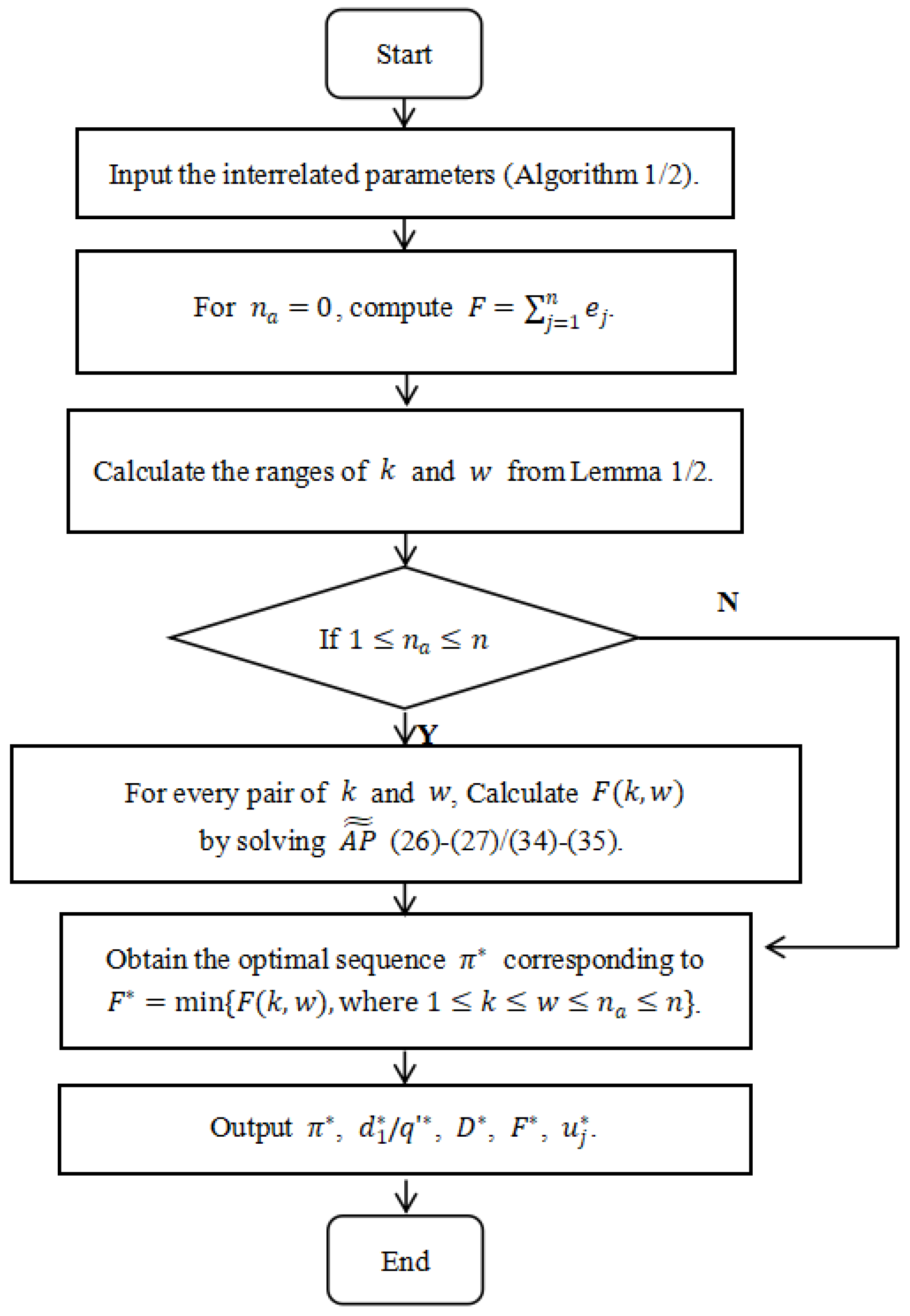
The corresponding explanation for Algorithms 1 and 2 can be seen in the following flowchart (see Figure 1).
Figure 1.
The flowchart of Algorithms 1 and 2.
3.3. Problem P3
According to Section 3.1, for the P3, when , we have
Lemma 5.
The optimal resource allocation of the P3 is
Proof.
We take the partial derivation of Equation (37) and, making it equal to 0, it follows that
and the result of Equation (38) can be obtained. □
Substituting Equation (38) into Equation (37) yields
In the same way, if k and w are given, from Equation (40), the optimal schedule of the P3 can be transformed into the following :
where
and is given from Equation (22). From the above analysis, the algorithm for solving P3 can be given as follows (Algorithm 3):
| Algorithm 3 P3 |
|
Theorem 3.
The P3 can be solved in time by Algorithm 3.
Proof.
It is similar to the proof of Theorem 1. □
3.4. Problem P4
According to Section 3.2, for the P4, where , we have
Lemma 6.
The optimal resource allocation of the P4 is
Proof.
It is similar to the proof of the Lemma 5. □
Substituting Equation (45) into Equation (44) yields
In the same way, if k and w are given, from Equation (46), the optimal schedule of the P4 can be transformed into the following :
where
and is given from Equation (31). From the above analysis, the algorithm for solving P4 can be given as follows (Algorithm 4):
| Algorithm 4 P4 |
|
Theorem 4.
The P4 can be solved in time by Algorithm 4.
Proof.
It is similar to the proof of Theorem 1. □
4. Experiment
4.1. An Example
We only consider the CONDW assignment, where , , . , , and ; the parameters of jobs setting are shown in Table 3 below and the parameters of position-dependent weights setting are shown in Table 4 below.
Table 3.
Values of job-dependent parameters.
Table 4.
Values of position-dependent weights.
In relation to problem P1, and Table 5 shows all the results.
Table 5.
Results of P1.
From Table 5, the optimal solution is , , and ; the optimal schedule is ; the optimal resources are , and ; and . In addition, for the optimal solution, the values (from Equation (12)) are , and and the values for are presented in Table 6 (see Equation (17)).
Table 6.
Values for , and (bold numbers are the optimal solution).
Meanwhile, for the problem P3, by Algorithm 3, the results are given by Table 7.
Table 7.
Results of P3.
From Table 7, the optimal solution is , , and ; the optimal schedule is ; the optimal resources are , , and ; and .
4.2. Numerical Study
We only consider the CONDW assignment, for Algorithms 1 and 3; the program was coded and run on Pycharm and the testing computer was a desktop machine (HUAWEI, Shenzhen, China) with CPU 12th Gen Intel(R) Core(TM) i5-12400 2.50 GHz, 16.00 GB RAM and a Windows 11 operating system. The coefficients of instances are listed below:
- (1)
- and 150;
- (2)
- and ;
- (3)
- () were generated using the uniform distribution over [1, 100];
- (4)
- () were generated using the uniform distribution over [1, 10] (such that );
- (5)
- was generated using the uniform distribution over [−0.9, −0.1];
- (6)
- was generated using the uniform distribution over [1, 1000];
- (7)
- () were generated using the uniform distribution over [1, 30].
For each experimental condition, 20 replications were generated randomly, and the minimum (min), mean and maximum (max) CPU times (milliseconds, denoted by ms) are given in Table 8. From Table 8, it is found that Algorithms 1 and 3 are effective as n increases from 30 to 150, and the maximum CPU time of Algorithm 3 is 1,087,899.14 ms.
Table 8.
CPU times of algorithms.
5. Conclusions
This paper studied resource allocation single-machine scheduling problems with delivery times and due-window assignments under the premise that jobs have learning effects and a rejection cost. Under common and slack due-window assignments, we proved that the problems presented in this paper can be solved in time, i.e., these problems are polynomially solvable. The managerial implications of our approach are as follows: the single-machine scheduling with delivery times, variable processing times, outsourcing cost and due-window allocation combine to affect the order in which jobs are processed and, thus, production decisions. We conducted computational experiments on randomly generated data. As can be seen in Table 8, our approach is effective and helps to improve resource utilization, reduce resource consumption costs, reduce inventory backlogs and, thus, reduce overheads such as warehousing costs in practical applications.
However, the current algorithms have some limitations because there are many dynamic factors in scheduling in real production, and the existing algorithms may perform well under specific conditions, but may need to be adjusted differently under different production environments and scheduling goals. In future research, the scheduling problem presented in this paper can be further generalized to existing algorithms by taking the deterioration effects (i.e., deteriorating jobs) into account (see Sun et al. [33], Lv et al. [34], Miao et al. [35] and Lu et al. [36]), or applied to flow shops (see Rossit et al. [37] and Panwalkar and Koulamas [38]).
Author Contributions
Methodology, B.B.; writing—original draft preparation, B.B.; writing—review and editing, B.B., C.-M.W., H.-Y.H. and J.-B.W. All authors have read and agreed to the published version of the manuscript.
Funding
This research was funded by the Fundamental Research Funds for the Universities of Liaoning Province and Liaoning Social Science Fund (Project No. L23BGL013).
Data Availability Statement
The data used to support the findings of this paper are available from the corresponding authors upon request.
Conflicts of Interest
The authors declare no conflicts of interest.
References
- Tian, Y. Single-machine due-window assignment scheduling with resource allocation and generalized earliness/tardiness penalties. Asia-Pac. J. Oper. Res. 2022, 39, 2150041. [Google Scholar] [CrossRef]
- Xu, C.; Xu, Y.; Zheng, F.; Liu, M. Multitasking scheduling problems with a common due-window. RAIRO-Oper. Res. 2021, 55, 1787–1798. [Google Scholar] [CrossRef]
- Shabtay, D.; Mosheiov, G.; Oron, D. Single machine scheduling with common assignable due date/due window to minimize total weighted early and late work. Eur. J. Oper. Res. 2022, 303, 66–77. [Google Scholar] [CrossRef]
- Zhang, L.-H.; Geng, X.-N.; Xue, J.; Wang, J.-B. Single machine slack due window assignment and deteriorating jobs. J. Ind. Manag. Optim. 2024, 20, 1593–1614. [Google Scholar] [CrossRef]
- Qian, J.; Zhan, Y. The due window assignment problems with deteriorating job and delivery time. Mathematics 2022, 10, 1672. [Google Scholar] [CrossRef]
- Mao, R.-R.; Wang, Y.-C.; Lv, D.-Y.; Wang, J.-B.; Lu, Y.-Y. Delivery times scheduling with deterioration effects in due window assignment environments. Mathematics 2023, 11, 3983. [Google Scholar] [CrossRef]
- Mao, R.-R.; Lv, D.-Y.; Ren, N.; Wang, J.-B. Supply chain scheduling with deteriorating jobs and delivery times. J. Appl. Math. Comput. 2024, 70, 2285–2312. [Google Scholar] [CrossRef]
- Ren, N.; Lv, D.-Y.; Wang, J.-B.; Wang, X.-Y. Solution algorithms for single-machine scheduling with learning effects and exponential past-sequence-dependent delivery times. J. Ind. Manag. Optim. 2023, 19, 8429–8450. [Google Scholar] [CrossRef]
- Lin, S.-S. Due-window assignment scheduling with learning and deterioration effects. J. Ind. Manag. Optim. 2022, 18, 2567–2578. [Google Scholar] [CrossRef]
- Wang, S.-H.; Lv, D.-Y.; Wang, J.-B. Research on position-dependent weights scheduling with delivery times and truncated sum-of-processing-times-based learning effect. J. Ind. Manag. Optim. 2023, 19, 2824–2837. [Google Scholar] [CrossRef]
- Wang, J.-B.; Wang, S.-H.; Gao, K.; Liu, M.; Jia, X. Due-window assignment methods and scheduling with generalized positional-dependent weights. Asia-Pac. J. Oper. Res. 2022, 39, 2250028. [Google Scholar] [CrossRef]
- Lu, Y.-Y.; Wang, T.-T.; Wang, R.-Q.; Li, Y. A note on due-date assignment scheduling with job-dependent learning effects and convex resource allocation. Eng. Optim. 2021, 53, 1273–1281. [Google Scholar] [CrossRef]
- Wang, J.-B.; Wang, Y.-C.; Wan, C.; Lv, D.-Y.; Zhang, L. Controllable processing time scheduling with total weighted completion time objective and deteriorating jobs. Asia-Pac. J. Oper. Res. 2024, 41, 2350026. [Google Scholar] [CrossRef]
- Zhao, S. Resource allocation flowshop scheduling with learning effect and slack due window assignment. J. Ind. Manag. Optim. 2021, 17, 2817–2835. [Google Scholar] [CrossRef]
- Sun, X.; Geng, X.-N.; Wang, J.; Pan, L. Slack due window assignment scheduling in the single-machine with controllable processing times. J. Ind. Manag. Optim. 2024, 20, 15–35. [Google Scholar] [CrossRef]
- Lv, D.-Y.; Wang, J.-B. Research on two-machine flow shop scheduling problem with release dates and truncated learning effects. Eng. Optim. 2024. [Google Scholar] [CrossRef]
- Zhang, Y.; Sun, X.-Y.; Liu, T.; Wang, J.; Geng, X.-N. Single-machine scheduling simultaneous consideration of resource allocations and exponential time-dependent learning effects. J. Oper. Res. Soc. 2024. [Google Scholar] [CrossRef]
- Li, S.-S.; Chen, R.-X. Competitive two-agent scheduling with release dates and preemption on a single machine. J. Sched. 2023, 26, 227–249. [Google Scholar] [CrossRef]
- Mor, B. Single machine scheduling problems involving job-dependent step-deterioration dates and job rejection. Oper. Res. 2023, 23, 10. [Google Scholar] [CrossRef]
- Geng, X.-N.; Sun, X.; Wang, J.Y.; Pan, L. Scheduling on proportionate flow shop with job rejection and common due date assignment. Comput. Ind. Eng. 2023, 181, 109317. [Google Scholar] [CrossRef]
- Toksari, M.D.; Atalay, B. Some scheduling problems with job rejection and a learning effect. Comput. J. 2023, 66, 866–872. [Google Scholar] [CrossRef]
- Liu, W.; Wang, X.; Li, L.; Dai, W. Due-window assignment scheduling with job-rejection, truncated learning effects and setup times. J. Ind. Manag. Optim. 2024, 20, 313–324. [Google Scholar] [CrossRef]
- Atsmony, M.; Mosheiov, G. Single machine scheduling to?minimize maximum earliness/tardiness cost with job rejection. Optim. Lett. 2024, 18, 751–766. [Google Scholar] [CrossRef]
- Sun, X.; Geng, X.-N.; Liu, F. Flow shop scheduling with general position weighted learning effects to minimise total weighted completion time. J. Oper. Res. Soc. 2021, 72, 2674–2689. [Google Scholar] [CrossRef]
- Zhao, S. Scheduling jobs with general truncated learning effects including proportional setup times. Comput. Appl. Math. 2022, 41, 146. [Google Scholar] [CrossRef]
- Chen, K.; Cheng, T.-C.-E.; Huang, H.; Ji, M.; Yao, D. Single-machine scheduling with autonomous and induced learning to minimize the total weighted number of tardy jobs. Eur. J. Oper. Res. 2023, 309, 24–34. [Google Scholar] [CrossRef]
- Li, M.-H.; Lv, D.-Y.; Zhang, L.-H.; Wang, J.-B. Permutation flow shop scheduling with makespan objective and truncated learning effects. J. Appl. Math. Comput. 2024, 70, 2907–2939. [Google Scholar] [CrossRef]
- Wang, Y.-C.; Wang, S.-H.; Wang, J.-B. Resource allocation scheduling with position-dependent weights and generalized earliness-tardiness cost. Mathematics 2023, 11, 222. [Google Scholar] [CrossRef]
- Fang, K.; Luo, W.; Pinedo, M.L.; Lu, L. Rescheduling for new orders on a single machine with rejection. J. Oper. Res. Soc. 2024, 75, 346–360. [Google Scholar] [CrossRef]
- Freud, D.; Mosheiov, G. Scheduling with competing agents, total late work and job rejection. Comput. Oper. Res. 2021, 133, 105329. [Google Scholar] [CrossRef]
- Wang, J.-B.; Lv, D.-Y.; Wan, C. Proportionate flow shop scheduling with job-dependent due windows and position-dependent weights. Asia-Pac. J. Oper. Res. 2024. [Google Scholar] [CrossRef]
- Qian, J.; Chang, G.; Zhang, X. Single-machine common due-window assignment and scheduling with position-dependent weights, delivery time, learning effect and resource allocations. J. Appl. Math. Comput. 2024, 70, 1965–1994. [Google Scholar] [CrossRef]
- Sun, X.; Liu, T.; Geng, X.-N.; Hu, Y.; Xu, J.-X. Optimization of scheduling problems with deterioration effects and an optional maintenance activity. J. Sched. 2024, 26, 251–266. [Google Scholar] [CrossRef]
- Lv, Z.-G.; Zhang, L.-H.; Wang, X.-Y.; Wang, J.-B. Single machine scheduling proportionally deteriorating jobs with ready times subject to the total weighted completion time minimization. Mathematics 2024, 12, 610. [Google Scholar] [CrossRef]
- Miao, C.X.; Zhang, Y.Z. Scheduling with step-deteriorating jobs to minimize the makespan. J. Ind. Manag. Optim. 2019, 15, 1955–1964. [Google Scholar] [CrossRef]
- Lu, Y.-Y.; Zhang, S.; Tao, J.-Y. Earliness-tardiness scheduling with delivery times and deteriorating jobs. Asia-Pac. J. Oper. Res. 2024. [Google Scholar] [CrossRef]
- Rossit, D.A.; Tohme, F.; Frutos, M. The non-permutation flow-shop scheduling problem: A literature review. Omega 2018, 77, 143–153. [Google Scholar] [CrossRef]
- Panwalkar, S.S.; Koulamas, C. Analysis of flow shop scheduling anomalies. Eur. J. Oper. Res. 2020, 280, 25–33. [Google Scholar] [CrossRef]
Disclaimer/Publisher’s Note: The statements, opinions and data contained in all publications are solely those of the individual author(s) and contributor(s) and not of MDPI and/or the editor(s). MDPI and/or the editor(s) disclaim responsibility for any injury to people or property resulting from any ideas, methods, instructions or products referred to in the content. |
© 2024 by the authors. Licensee MDPI, Basel, Switzerland. This article is an open access article distributed under the terms and conditions of the Creative Commons Attribution (CC BY) license (https://creativecommons.org/licenses/by/4.0/).