Abstract
The motion of viscous incompressible magnetohydrodynamics (MHD) is considered in a domain that is bounded by a free surface. The motion interacts through the free surface with an electromagnetic field located in a domain exterior to the free surface and bounded by a given fixed surface. Some electromagnetic fields are prescribed on this fixed boundary. On the free surface, jumps in the magnetic and electric fields are assumed. The global existence of solutions to this problem assuming appropriate smallness conditions on the initial and boundary data is proved.
Keywords:
free boundary; incompressible; magnetohydrodynamics; transmission conditions; global existence MSC:
35D35; 35Q30; 76W05; 76D05; 76N10; 76B03; 35R35; 76D07
1. Introduction
We prove the global existence of solutions to equations of magnetohydrodynamics (MHD) in domain with a free boundary . The motion interacts with the electromagnetic field in domain , which is exterior to with a fixed boundary B. The magnetic fields in and are coupled by transmission conditions on . We prove the existence of solutions such that the velocity and magnetic fields are continuous with their time and space derivatives.
On boundary B, there is a magnetic field prescribed.
The motion in is described by velocity v and magnetic field . The electromagnetic field in is described by magnetic field .
Now, we describe the technical and physical background of the considered problem:
- 1.
- We model plasma as an MHD fluid and drop heat sources so that our problem models controlled thermonuclear fusion. The most important requirement is to keep the plasma in a region located at a positive distance from B by magnetic forces.This property is shown in (238).
- 2.
- The magnetic field on B is a restriction to B of a magnetic field generated by some electromagnets located at some distance from B. This kind of technical construction, although in a different geometrical framework, can be seen in CERN, where the motion of protons and antiprotons is confined to some torus thanks to a special magnetic field generated by strong electromagnets.
- 3.
- The considered problem is also realized in galaxies, where the motion of ionised gas is concentrated in some region and maintained by a magnetic field. This phenomenon is close to the model considered in this paper up to the point where gravitation must be taken into account.
- 4.
- The electromagnetic field from the Sun meets the magnitosphere, where similar transmission conditions appear. In this case, charged particles pass through the boundary of the magnetosphere.
Formulas (2)–(9) in Section 2 describe the considered problem. Next, the problem is transformed into problems (10) and (12), for which the solvability is proved in [1].
It is difficult to show the existence of solutions and derive appropriate estimates of problem (12) because we have jumps in the magnetic field and a current on . This can be carried out by applying the technique of the regularizer.
In Section 5, we derive necessary estimates by the energy method. The linearized problem (10) is the Stokes system with the Neumann boundary conditions. To find energy type estimates for solutions to (10), we need the Korn inequality, which is shown in Section 3.3.
Coupling estimates from Section 4 and Section 5, we prove a differential inequality in Section 6. The differential inequality yields a global estimate by applying a step-by-step approach in time for all and using sufficiently small data. The estimate guarantees a global existence. A non-small-data approach is not possible because the regularity problem of the Navier–Stokes equations is still open.
The first results on the existence of solutions to dissipative incompressible MHD in a complex domain were given by Ladyzhenskaya and Solonnikov [2]. The motions were considered in domains composed of two different materials separated by a fixed surface. On the surface, they assumed the continuity of the tangent components of the magnetic field, the continuity of the normal component of magnetic induction and the continuity of the tangent components of the electric field.
Moreover, the boundary of the domain was treated as an ideal conductor, so the normal component of the magnetic field and tangent components of the electric field vanish. They proved the existence of weak solutions. A necessary technique to solve the problem can be found in [3].
Padula and Solonnikov [4] proved the existence of local solutions to problems (2)–(9), where is a solution to the system
and the continuity of the tangent components of the magnetic field and the normal component of induction were assumed on .
Free boundary problems for MHD equations were also considered in [5,6], where the external magnetic field satisfies the elliptic system (1). In [7], using the Weis theory of Fourier multipliers and the semigroup technique, two different MHD fluids interacting through a free surface are considered.
Since the paper is very technical and long, we write a short review of its methods and results. In Section 2, the considered problem is formulated. Moreover, the main result is presented in Theorem 1. The considered problem is expressed in the form of two problems: problem (10) (for velocity and pressure for a given magnetic field ) and problem (12) (for magnetic fields in terms of a given velocity ). Estimates for solutions to (10) and (12) are derived in Section 4 and Section 5, respectively. The estimates are made by the energy method, so only the -Sobolev spaces are used. To prove the estimates in Section 4, we need Korn inequalities. Different variants of Korn inequalities can be found in Section 3.3. In Lemmas 14–16, energy-type estimates for and are found (in terms of some nonlinear expressions). To derive them, integration by parts is necessary, so some boundary terms on appear. They can be cancelled by applying the transmission conditions (see Lemma 15).
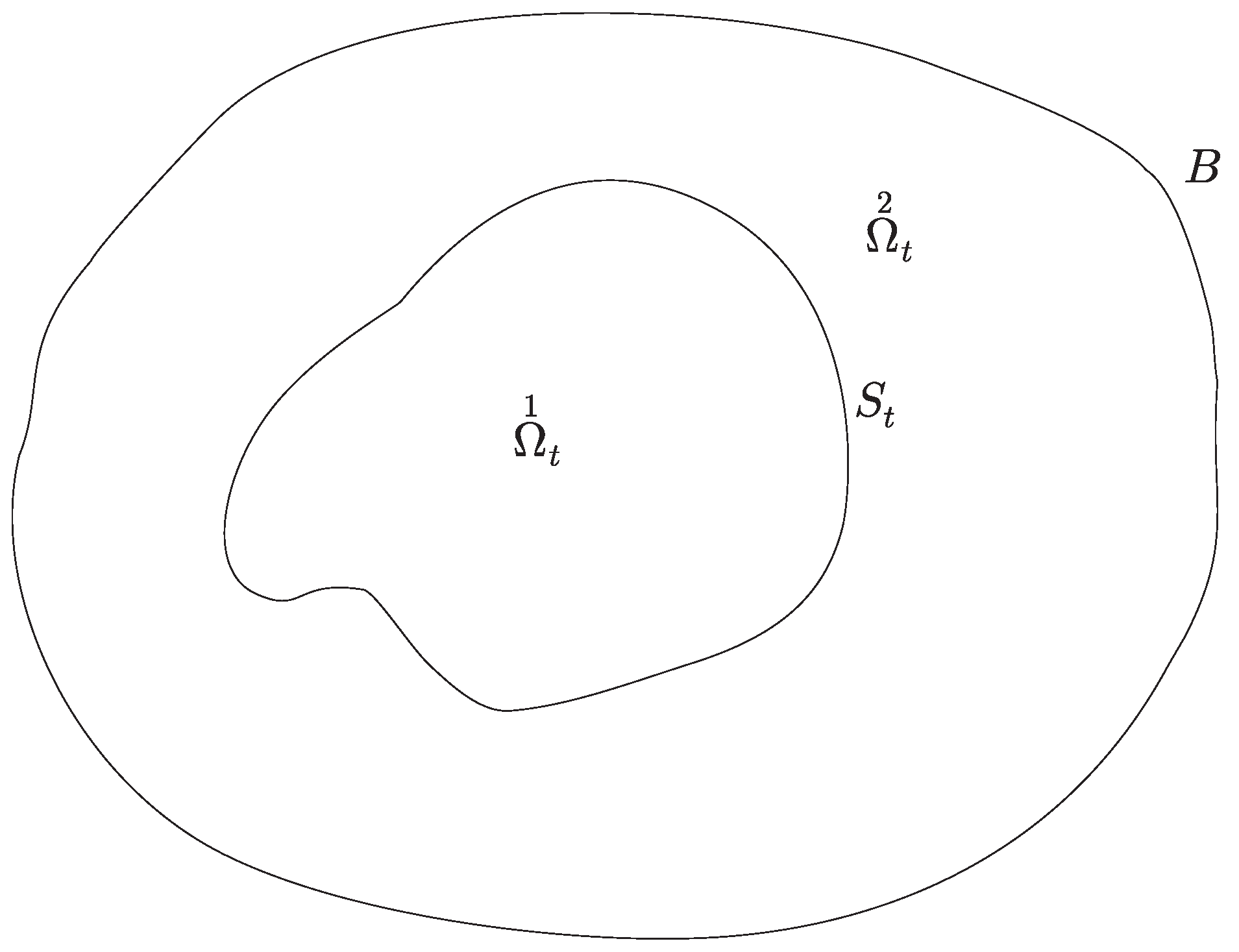
To describe the geometry of the considered problem we present its two-dimensional version in Figure 1.
Figure 1.
Description of the two-dimensional intersection of the space shape of the considered problem.
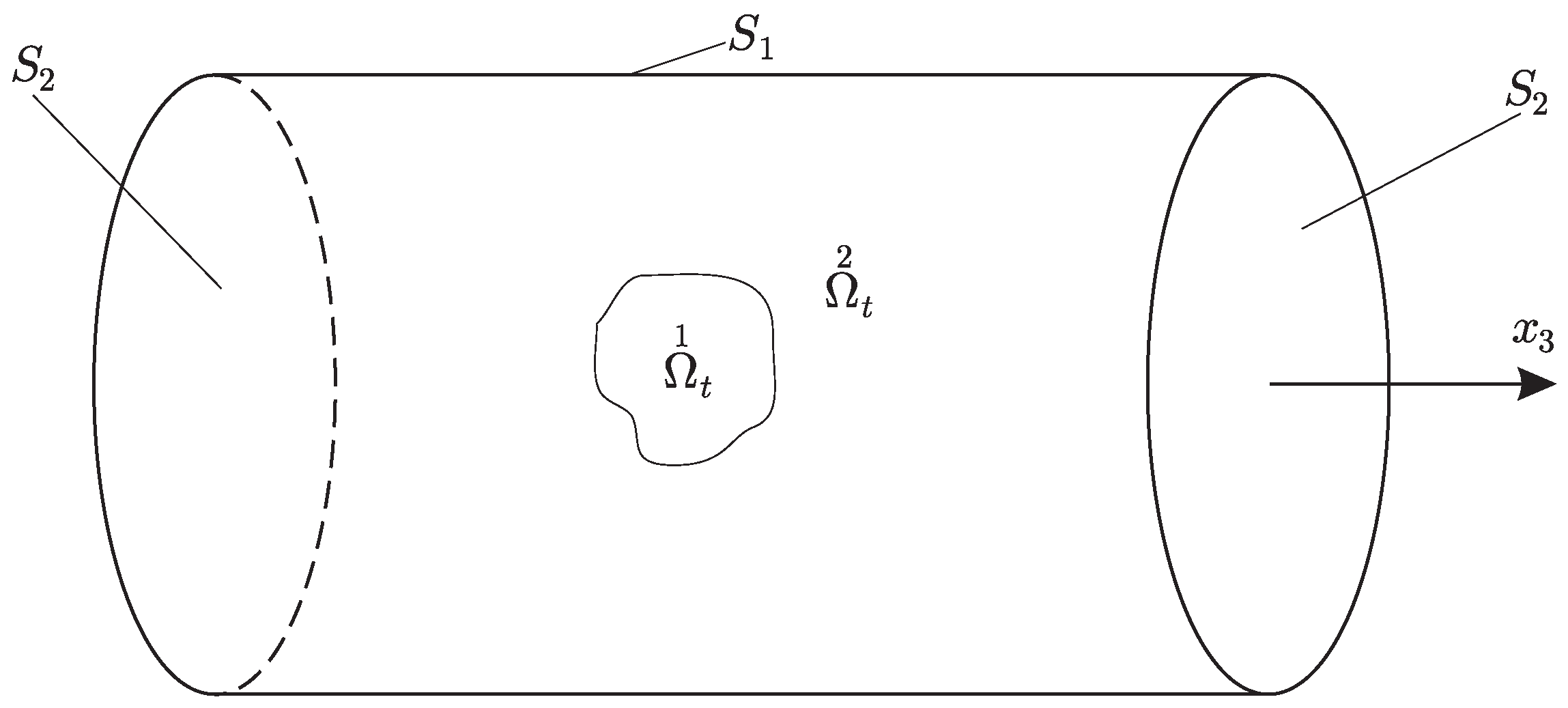
To estimate -norms of and by applying the Poincaré inequality it is convenient to use the geometry of the considered problem presented in Figure 2. It is clear that the boundary B, in the form of a cylinder makes an application of the Poincaré inequality simple.
Figure 2.
Special space geometry of the considered problem convenient for the proof of estimates for the magnetic fields.
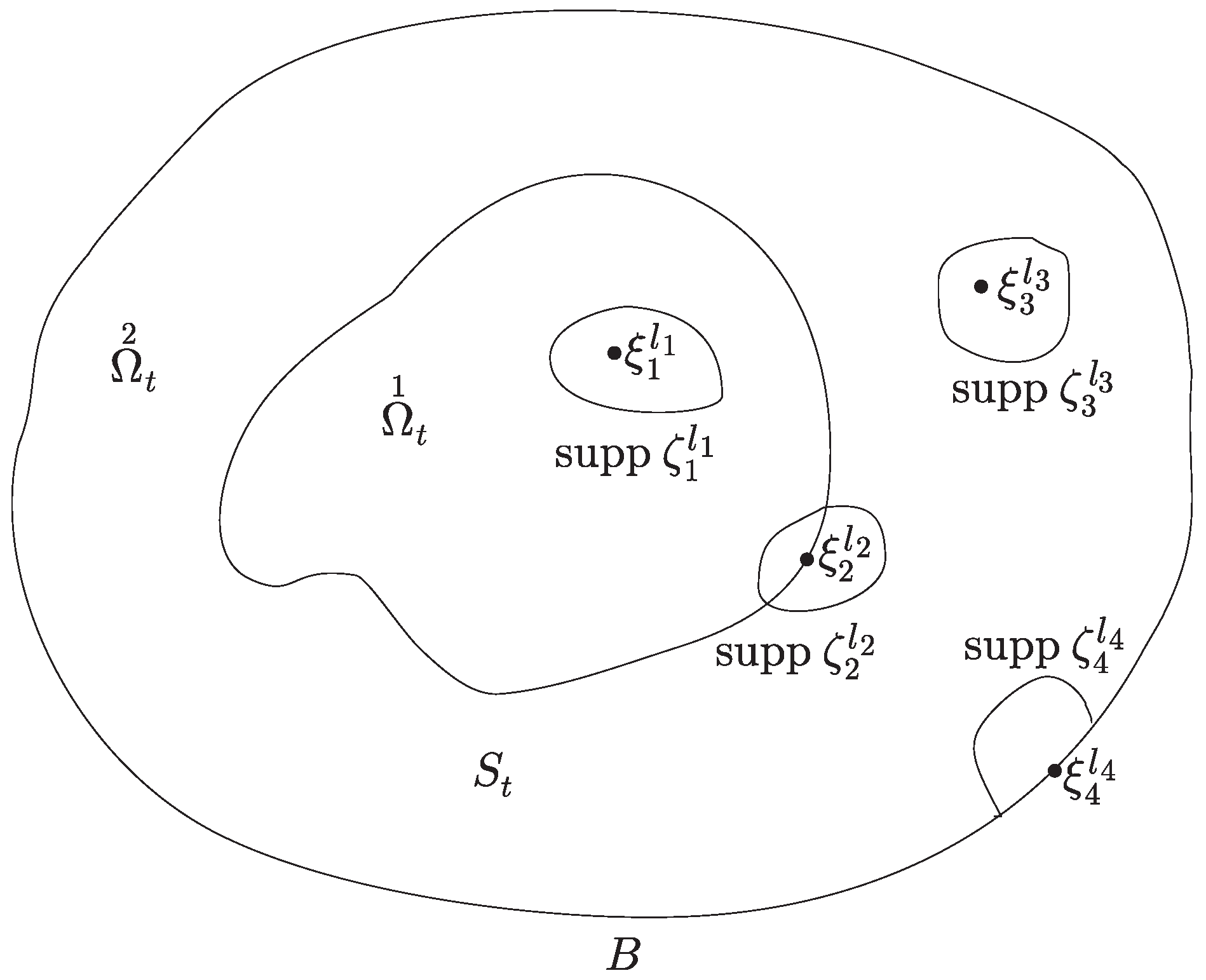
To estimate the second- and the third-space derivatives of and , we need the partition of unity described in Figure 3.
Figure 3.
Partition of unity necessary for application of the regularizer technique.
Consequently, local estimates for , are found in the proof of Lemma 17. By the collection of the estimates by the technique of the regularizer, we prove Lemma 17.
2. Statement of the Problem
We are concerned with MHD motions in and the electromagnetic field in coupled through the free surface by transmission conditions.
The MHD equations in read
where denotes the velocity of the fluid, denotes the pressure, denotes the magnetic field, denotes the electric field, denotes the external force field, and are Cartesian coordinates.
Furthermore, is the constant magnetic permeability, is the constant electrical conductivity, and is the stress tensor and has the form
where is the positive viscosity coefficient, is the unit matrix, and is the dilatation tensor:
We assume the following initial and boundary conditions
where is the unit vector outward to and normal to , and
From (5)1, the compatibility condition follows
where , , and is a tangent vector to .
In , which is occupied by a dielectric gas, we have a motionless electromagnetic field described by
with the following initial and boundary conditions:
where , , are tangent vectors to B.
Electromagnetic fields in and are coupled at by the following transmission conditions:
where , , is an orthonormal system of vector fields in a neighbourhood of such that is normal and are tangent to .
In addition, we assume that , , , , , are constants. Non-vanishing of the differences , means that there are jumps in the tangent components of the electric field and components of the magnetic field on the free surface . The transmission conditions (9) are very general, but they are admissible because the energy inequality holds for the solutions to problem (2)–(9) (see [1], Lemma 1.1). The first condition in (9) describes a current jump.
It is crucial to acknowledge that in magnetohydrodynamics, the displacement current is omitted.
The first problem is to identify v, p for a given :
where we assumed that is already absorbed by p.
The second problem is to identify , for a given v, p:
In this problem, it is possible to formulate very general anisotropic transmission conditions.
In Section 5, the conditions are reduced to a more simplified form.
The elimination of electric fields , from (11) takes the form
In this paper, we prove the global existence of solutions to problems (10) and (12) assuming sufficient smallness of the initial data, the external force and the magnetic field prescribed on B. Since local existence is proved in [1], our goal is to find a global estimate of the local solutions.
The proof is divided into the following steps:
- 1.
- 2.
- In Section 5, we derive a differential inequality for solutions to problem (12). Since we are interested in considering problem (12) with transmission conditions on the free surface , we need to use much more sophisticated methods than the energy method. To examine solutions to (12) in a neighbourhood of a flattened part of , we use the -Sobolev spaces in the language of Fourier–Laplace transforms. It helps us to consider a transmission condition with jumps in the magnetic field on .
- 3.
- Finally, in Section 6, we derive a differential inequality that combines the differential inequalities from Section 4 and Section 5. The differential inequality by the step-by-step-in-time argument implies a global estimate. The local existence and the global estimate yield a global existence for sufficiently small initial data, an external force and the magnetic field prescribed on B.
Theorem 1.
Assume that
- (1)
- , , and ;
- (2)
- , , , , and ;
- (3)
- ;
- (4)
- , and ;
- (5)
- The transmission conditionswhere , are arbitrary positive numbers, , and is any tangent vector to the boundary ;
- (6)
- B is a box.Let
- (7)
- .Let , , with γ being sufficiently small.
Remark 1.
The aim of this note is to describe the following initial conditions:
To describe the condition , we consider (10)1. Projecting it on , we have
It is necessary to estimate . In order to achieve this, we apply the div operator to (10) and project the result on . Then we have
Furthermore, (10) implies the boundary condition for :
For the solutions to problems (14) and (15), the following estimate is valid:
Using (16) in (13) yields
In the next step, we examine the condition . Differentiating (10)1 with respect to t and projecting the result on , we have
Because we calculate , , step by step, the above projection is possible.
From (12)1, we have
and (10)1 yields
From problems (14) and (15), we have
On the right-hand side of (18), we have the norm . Therefore, we have to consider the problem
To derive a weak-type estimate of solutions to (22), we construct the function η such that
Subsequently, we define the function
where is an extension of η such that , and is a solution to the problem
Multiplying (23)1 by and integrating over and by parts, we have
By continuing and using the Poincaré inequality, we obtain
Hence,
Using (19)–(21) and (26) in (18) implies
Finally, using (21) in (20) yields
This concludes the note.
The equations of magnetohydrodynamics can be found in [8]. We use Sobolev spaces, theorems of imbedding and traces introduced in [9].
3. Notation and Auxiliary Results
3.1. Spaces and a Partition of Unity
To simplify the presentation, we introduce the following notation:
Notation 1.
Let Ω be a domain in . We use the Lebesque and Sobolev spaces.
where . Next, we introduce -Sobolev spaces:
where , , , , is the multi-index, and .
We frequently use the embedding , which holds for
By , we denote the standard Sobolev space with the norm
where , .
We also need the embedding
We also have direct and inverse theorems of traces (see [10,11]).
Let , , . Let . Then and
Let . Then there exists such that and
Furthermore, by ϕ we denote an increasing positive function.
We apply the energy method to prove the existence of solutions to (10) and (12). Therefore, we use the -Sobolev spaces.
In order to examine problem (12) in a neighbourhood of the free surface , we need Sobolev spaces expressed by the Fourier transforms. Let
be the Fourier transform of u, , , and .
Then, by the Parseval identity, we have the equivalence
Consider functions defined in . Then
where .
Let , where
We introduce the notation
Now, we introduce a partition of unity in (see [12] Ch. 4, Sect. 4). We consider two collections of open subsets and , , such that , . For , and , for , and , for , and for .
We assume that at most of the have nonempty intersections, , and for some . Let be a smooth function such that , for , for and , where , . Then . Introducing the function
we have that for , , and .
We denote by an interior point of and for , an interior point of and of for , and an interior point of and of for . For , , .
Let be a Cartesian coordinate system with its origin located at the interior point of . Then, using translations and rotations, we introduce a local coordinate system with the origin at , , such that the part of the boundary is described by . We call the transformation . Then we introduce new coordinates defined by
We denote this transformation by , where .
We assume that the sets , are described in local coordinates at by the inequalities
respectively. Furthermore, if and for .
Let . Then and , .
For , we have
For , we introduce new local coordinates with the origin at such that describes locally . We also introduce the transformation , , and assume that belongs to for .
Finally, , are described by the inequalities
respectively.
In this paper, by , we denote an increasing positive function such that , and it can change its form from formula to formula.
3.2. Eulerian and Lagrangian Coordinates
Let be Eulerian coordinates. By Lagrangian coordinates, we mean the initial data of the problem
Solving (30) yields
where .
Domain and its boundary are described as follows:
By , we denote the Jacobi matrix of the transformation (31). Let be the Jacobian of this transformation. Then
For a divergence-free vector, we have . Let replace either or . Then we have
Using (34), we calculate
Hence,
Lemma 1.
Assume that v is a solution to (10). Assume that , are finite, where
where , , , , and is the Kronecker delta. Moreover, .
Then
Proof.
We calculate
First, we consider . Using (10)1 yields
Integrating by parts in and using the boundary condition (10)3 yields
where the first integral vanishes because is a symmetric tensor and is an antisymmetric tensor.
Hence,
To consider , we see that
The second term in equals
because is an antisymmetric tensor.
Remark 2.
We derive an energy-type inequality for solutions to problem (10) assuming that the tensor of the magnetic field is given.
3.3. The Korn Inequalities
Using ideas from [13,14], we derive Korn-type inequalities necessary for the existence of solutions.
Lemma 2.
Let be a given bounded domain. Let
where , , , , and is the Kronecker delta.
Let w be a given vector function such that
and the following quantities are finite:
Then
where c does not depend on w.
Proof.
Theorem 1 from [13] implies
where , and is the antisymmetric Ricci tensor.
Hence, (49) and Lemma 2.4 from [3] yield
Using the identity
and (53), we have
Given (47) and (54), we obtain
From (47), we derive the algebraic system
Since det , where and , we calculate
By the Poincaré inequality, (50) and (54), we obtain
Using (58) in (57) yields
Then (55) gives
Next,
Inequalities (60) and (61) imply (46). This concludes the proof. □
Lemma 3.
For sufficiently regular solutions to (2) such that , , , , , , and , the following inequality holds:
Proof.
From (2)1, we have
Integrating by parts in the second term on the right-hand side of (69) yields
where the first term vanishes because (10)3 holds.
To examine the second integral in (70), we use the kinematic condition
where describes the boundary .
The condition means that the free boundary is a material surface. Hence, consists of moving particles. Therefore,
Since describes , we have
where we used
The normal vector to has the following form:
Therefore,
Since
we obtain
Consequently, the second term on the right-hand side of (70) is bounded by
Finally, we obtain
From (2)1, we have
where function , , is introduced in (43).
Integrating by parts in the second term on the right-hand side of (78) gives
Since is symmetric and is antisymmetric, the integral equals
Using boundary condition (10)3, the integral takes the form
Therefore,
Using (77) and (80) in Lemma 2 with , we obtain
This inequality implies (68) and concludes the proof. □
3.4. Estimates for and
Next, we calculate
Using
and
we obtain
3.5. Poincaré Inequality for the Pressure
From boundary condition (5)1 and , we have
Knowing that p is defined on , we can derive the following Poincaré inequality:
Lemma 4.
Let be defined as in Notation 1. Let , , , and . Then
and
4. Differential Inequalities for Solutions to (10)
Lemma 5.
Assume that , , and
Then
Proof.
Multiply (10)1 by v and integrate over . Integrating by parts and using boundary conditions (10)3, we obtain
Using the Korn inequality (64) and the form of the tensor , we obtain
where the Hölder and Young inequalities are applied to the last term on the right-hand side of (87). This ends the proof. □
Lemma 6.
Assume that v, p, are sufficiently regular. Let .Let
Then
Proof.
By differentiating (10)1 with respect to t, multiplying by , integrating over , and using (34), we obtain
Integrating by parts in the second term on the left-hand side of (90) yields
The use of boundary condition (10)3 implies
Given of the Korn inequality (67) and (75), we obtain
The first term on the right-hand side of (93) is bounded by
the second by
the third by
and the fourth by
Using the above estimates in (93) and assuming that are sufficiently small, we have
Using Notation 1 we obtain (89). This concludes the proof. □
Lemma 7.
Assume that v, p, are sufficiently regular. Let
Then
Proof.
Differentiating (10)1 twice with respect to t, multiplying by , integrating over and using (34), we obtain
Integrate by parts in the second term on the left-hand side of (96). Then it takes the form
Applying boundary conditions (10)3, we write in the form
where . Using (75) and (82), we have
Next, we examine . Using (75), we have
Next, we have
where the second term is bounded by
The first term on the right-hand side of (96) is bounded by
Finally, we estimate the last term on the right-hand side of (96) by
Using (29), we have
The first term on the right-hand side of (96) is bounded by
Finally, using Notation 1 in the Korn inequality (81) yields
Using the above estimates in (96) yields
The above inequality implies (95) and concludes the proof. □
Corollary 3.
From Lemmas 5–7, we have
Lemma 8.
Proof.
Consider the stationary Stokes system:
where t is fixed.
Lemma 9.
To prove the existence of solutions to (102) and to derive appropriate estimates, we need the following compatibility condition:
Proof.
Lemma 10.
For solutions to (102), the following inequality holds:
Proof.
Lemma 11.
For solutions to (102), we have
Proof.
Differentiating (102) with respect to time yields
First, we find compatibility conditions for solutions to problem (109).
Remark 3.
Integrating (109)1 over yields
In the case of Eulerian coordinates, space and time variables are independent.
By the Green theorem, we have
Using boundary conditions (109)3 in (111) implies the following compatibility condition for problem (109).
Estimate (75) used in (112) implies
In view of Notation 1, we have
Applying again Notation 1 and theorems on traces, we finally derive the inequality
Lemma 12.
Proof.
To prove the lemma, we write (109) in the form
Using the compatibility condition (112), the Korn inequality from Lemma 5 and the Poincaré inequality from Lemma 4, we obtain the following inequality for solutions to (115):
The nonlinear terms from the right-hand side of (116) are bounded by
Finally, we estimate the boundary terms in the right-hand side of (116).
where we used
Continuing, we have
Next, we examine
Finally, we calculate
Using the above estimates in (116) yields
The above inequality implies (114) and ends the proof. □
Lemma 13.
For sufficiently regular solutions to (10), we have
5. Differential Inequality for Solutions to Problem (12)
First, we derive some inequalities using the energy method. For this, we need the Dirichlet data on B to be homogeneous. To solve this, we need local curvilinear coordinates. We introduce them near and B independently.
Remark 4.
We introduce systems of curvilinear coordinates , , n and , , in neighbourhoods of and B, respectively. Let be a Cartesian coordinate system. Then, in these neighbourhoods wehave diffeomorphisms and such that describes locally and describes locally B.
These curvilinear coordinates correspond to systems of orthonormal vectors , , and , , , respectively. Furthermore, the following relations hold:
where , , and , , are the Lamé coefficients.
We describe operators rot and div in the curvilinear coordinates. We only need the formulations in a neighbourhood of . Let u be any vector. We can decompose in the form
where , , are curvilinear coordinates of .
They can be expressed as follows:
Similarly, operator is expressed in the form
where we used that the parameter n increases in the direction exterior to the considered domain.
Now, we recall the boundary conditions on B.
Expressing (126)2 in the curvilinear coordinates, we have
To simplify, we assume that B is the boundary of a box. Then, . Hence, (127) takes the form
To allow any integration by parts in problem (12) to be possible, we introduce the following extension :
Then the function
is such that
A construction of such is given in the following remark:
Remark 5.
First, we define a vector-valued function δ such that
where
where are such that
Let be a smooth function equal to 1 near B and vanishing at a positive distance from . Then we define
Then we look for a function Φ in the form
which is a solution to the problem
where surface and is located at some positive distance from . The function σ is artificial, but it helps to make Φ divergence-free.
Since and are known, problem (136) yields the following problem for and :
Since (137) is the well-known Stokes system, the existence of its solutions is also well-known.
Problem (12) for , takes the form
where , , are parameters, , are tangent vectors to , and , are tangent to B.
Now, we derive an energy-type inequality for solutions to problem (138).
Lemma 14.
Let B be a box. Let , be a solution to (138). Assume that , , , , , , , , , , , . Then there exists a constant , assumed to be small, such that
Proof.
Multiply (138)1 by and integrate over . Multiply (138)2 by and integrate over . Adding the results and using (34) gives
Integrating by parts in the last two terms on the left-hand side of (140) yields
where is a unit normal vector to .
The boundary term in (141) equals
To apply transmission conditions (138)6,7 in I, we use the orthonormal system of vectors , , in a neighbourhood of such that , , is tangent to and is normal. Furthermore, the vectors satisfy the relations
Therefore, any vector can be decomposed as follows:
Using the properties of the orthonormal system, we can write I in the form
Considering transmission conditions (138)6,7, we have
Hence,
Applying the Hölder and Young inequalities to the first two terms on the right-hand side of (140), we bound the result with
and the third term on the right-hand side of (140) is estimated by
Integrating by parts in the last term on the right-hand side of (140) yields
where we have used that the tangent components of ′ vanish on B.
Consider the problem
where , , is a tangent vector to B, is a tangent vector to , and .
The transmission conditions in (9) are very general. To simplify the considerations in this paper, we restrict the parameters from (9) to parameters from (143)4,5. This makes the proof of Lemma 15 much easier.
Lemma 15.
Solutions to (143) satisfy the following inequality:
where ε can be assumed to be arbitrarily small, and we assume the following compatibility conditions:
where denotes the tangent component of H to , is the normal component, and means the tangent derivative.
Proof.
Consider the identities. (The idea of this proof is taken from [10])
Multiply (145)1 by and integrate over . Next, multiply (145)2 by and integrate over . By adding the results, we obtain
Integrating by parts yields
The boundary term on on the left-hand side of (147) equals I (see the proof of Lemma 14).
Then, it is estimated by
To examine the other boundary terms in (147), we introduce systems of curvilinear coordinates , , n and , , in neighbourhoods of and B, respectively, as described in Remark 4.
These curvilinear coordinates correspond to systems of orthonormal vectors , , and , , , respectively. Furthermore, the following relations , , and , , hold, where , , and , , are the Lamé coefficients.
We assume that systems of vectors , , and , , are orthonormal.
The last term on the left-hand side of (147) vanishes because and .
Using the curvilinear coordinates, the last term on right-hand side of (147) equals
Since , , we have
In view of (131), we have that .
Using the curvilinear coordinates, the third term on the right-hand side of (147) takes the form
Next, we write it in the more explicit form
Using the transmission conditions
we obtain
To examine and , we recall the form of the rotation operator in curvilinear coordinates (see Remark 4):
We have the following transmission condition:
Using (151) in (152) yields
and
We write (153) in the form
Multiplying the above equality by yields
Next, we write (154) in the form
Multiplying the above equality by yields
We write in the explicit form
Using the transmission
we can write in the form
From (156), we have
and
In consideration of the transmission
we obtain
From (149) and (158), we have that , .
Since , , we obtain
Using (159) in yields
Hence,
Next, we consider
To examine , we use , , in the curvilinear coordinates (see Remark 4):
where , and parameter n increases in the direction that is normal exterior to , .
Multiplying (163) by , we have
Using (149) in yields
In view of transmission conditions (160), we obtain
Finally, we prove that (147) implies (144). The third term on the left-hand side of (147), denoted by I, is estimated in (148).
In consideration of (131), the last terms on the left-hand side and right-hand side of (147) vanish.
The third term on the right-hand side of (147) is denoted by N, where .
Lemma 16.
Assume that B is a boundary of a cylinder and
where is a given quantity.
Then
Proof.
To prove (168), we need to show that
To simplify the proof of (169), we assume that boundary is such that is parallel and is perpendicular to the -axis.
In Note 4, we assumed that B is the boundary of a box.
Since , , on , we have that and , .
Hence, the Poincaré inequality yields
Therefore,
Hence, and
where we used that .
Consider problem (12). We write it in the form of the elliptic problem
where t is fixed and is treated as a parameter.
Lemma 17.
Assume that t is a fixed parameter.
Proof.
To prove the lemma, we use the technique of the regularizer. In the proof, we replace with . We use only in the formulation of this lemma. To make calculations easier, we write (174) in the simpler form
To examine problem (177), we introduce the following partition of unity
as described in Figure 3.
Now, we examine problem (177) in subdomains , , . We introduce the notation
In subdomain , problem (177) takes the form
Since and , we can treat problem (178) as a problem in such that all terms in (178) have compact supports equal to .
We can drop equation , , in any subdomain of the partition of unity because if initially, then in follows automatically for any as long as solutions exist.
Therefore, we can write problem (178) in the form
In subdomain , problem (148) reads
Problem (177) in subdomain takes the form
Finally, we write problem (177) in :
Using the forms of and , we obtain the following inequalities for solutions to (179), (180) and (182):
Now, we examine problem (181). First we introduce such coordinates that becomes flat. Introducing coordinates with origin at such that , the form has
Define global Cartesian coordinates in . Then the transformation is a composition of a rotation and a translation.
Next, we introduce new coordinates as defined by the relations
In these coordinates, interface , which is locally expressed by (189), is described by the equation
Transformation (190) is defined by
Let , .
We assume that for , and for we have that .
Let . Then and , where is any function from the partition of unity introduced in Section 3.1.
Let h be a quantity such that for , . Let . Then a jump of h across the interface is defined as follows:
We introduce the transformed operator
where .
To introduce the transformed tangent and normal vectors, we recall that
where and describes locally, and the index t is omitted for simplicity. Then the transformed normal vector has the form
where and
where , .
The transformed locally boundary has the form
Hence, , .
To describe problem (181) using variable z, for simplicity, we drop the index . Next, we pass to variable z and use the notation , where replaces any function in (181).
Then (181) takes the form
where the condition (194)4 is only important in local space considerations, since in the exit problem (174), and are divergence free and the summation over is assumed.
Extending functions , , on , we look for solutions to the problem
where is an extension of , , on .
We introduce the functions
Then functions , , are solutions to the problem
where we assume for simplicity that , , , and , .
Let us define the Fourier transform
and its inverse
Applying the Fourier transform to (197) yields
where
Solving (198)1,2, we obtain
where , and we used the Shapiro–Lopatinskii conditions.
To calculate coefficients and , we insert (199) to transmission conditions (198)3,4,5,6,7, where we dropped index ∼ in the right-hand side terms. Then we obtain
Using that
we write (200)1,2,3 in the form
Simplifying (202) yields
We write some comments on deriving problem (202). Applying the Fourier transform to problem (197) along directions perpendicular to , we derive (198). The solutions to the first two equations (198) have the form (199). Using them, we derive (200). Using solutions of the last two equations of (200), described by (201), implies (202).
We prove Lemma 17 in the simpler case because in the general case , the assertions of Lemma 17 also hold.
Setting in (203) yields
Now, we prove (175). Let
From (195), it follows that
Next, we examine
To estimate , we examine the Fourier transforms of , , described by (198) because norms and are equivalent. To estimate , , we use expressions of , calculated in (204) and (201).
We prove Lemma 17 in the simpler case . It is clear that in the general case , the assertions of Lemma 17 also hold.
By the Parseval identity, the norm is equivalent to the following one:
where is the Fourier transform of , , and .
Since , we restrict our considerations to estimating only the term
because the other terms can be treated in a similar way. From (201) and (204), we have
Since is described by (209) and (210), we shall examine the following part of :
Applying norm (208) to yields
Continuing the estimates for solutions to problem (198), we derive the estimate
By the Parseval identity estimate, (211) takes the form
From (194), we have
and (183)3 implies
We also have
Using the above estimates in (212), using (206) and (207), and passing to variables x, we obtain
Finally, using (183)–(188) and the above inequality, exploiting properties of the partition of unity and with sufficiently small (see Section 3.1), we derive (175). Similar considerations imply (176). This concludes the proof. □
Finally, we derive a differential inequality for magnetic fields.
Lemma 18.
Assume that the following quantities are finite:
where must be replaced by . Then the following differential inequality holds:
where
Proof.
In the proof, we replace by . Inequality (139) implies
Inequality (144) yields
Inequalities (214) and (215) imply
where
From (168), we have
Inequalities (216) and (217) imply
We differentiate (138)1,3 with respect to t. Then (218) is replaced by
where
We estimate the first term on the right-hand side of (219) by
and the second by
Considering the above estimates and with sufficiently small, inequality (219) takes the form
It is necessary to differentiate (138) twice with respect to time.
Then (190) is replaced by
where
We bound the first term on the right-hand side of (221) by
and the second by
Applying the above estimates in (221) and choosing a that is sufficiently small yields
We differentiate (174)1,3 with respect to time. Then (175) is replaced by
Finally, we also have inequality (176) for , .
We introduce the notation
where should be replaced by .
6. Global Estimate
Recall that
Eliminating p, (118) implies
where
Introducing the notation
where , are introduced in (224); we obtain from (227) and (225) the inequality
where
We can write (229) in the form
Lemma 19.
Let be a given positive number. Let satisfy
Let and , for any .
Then
Proof.
Let
We can write (230) in the form
For , we have
Hence, we have a contradiction with the definition of . Hence,
This concludes the proof. □
To control the free boundary , we recall its definition:
Since the free boundary changes with time, we have to show that it does not meet the boundary B at any time.
Otherwise, we would not have a global existence.
For this purpose, we need to show that
Lemma 20.
Assume that , where , .
Then
where and
where .
Proof.
From (235), it follows that , where c is the constant from the embedding .
Hence, we need
7. Conclusions
We prove the existence of global regular solutions to problems (2)–(9) (see Theorem 1). In reality, we only find the estimate, because existence follows by standard arguments. To prove the existence, we replace problem (2)–(9) with two problems: problem (10) for v, p for a given and problem (12) for , with a given v. Problem (10) is the Neumann problem for the Stokes system with nonlinear terms that depend on v and .
To derive the necessary energy method estimates for solutions to (10), we need Korn inequalities (see Lemma 2 and (64), (67) and (68)).
The estimate is described in (118).
Problem (12) is composed of two problems: the problems of and with nonlinear right-hand sides, which are coupled by the transmission conditions. To prove the existence of solutions to linearized problem (12), we need to apply the technique of the regularizer (see [1,15,16]). We use the energy method to find estimates for solutions to (12). Since in this method integration by parts is used, we derive some boundary terms on . We have to cancel them because otherwise there is no estimate. Applying the transmission conditions, we cancel the boundary terms on (see Lemmas 14 and 15). Furthermore, we use the energy method to eliminate the Lagrangian coordinates and to derive such a global estimate that the motion of can be controlled for all . This is important because we need to know that remains far from the fixed boundary B for all .
Author Contributions
Writing—original draft, P.K. and W.M.Z. All authors have read and agreed to the published version of the manuscript.
Funding
This research received no external funding.
Data Availability Statement
The original contributions presented in the study are included in the article, further inquiries can be directed to the corresponding author.
Conflicts of Interest
The authors declare no conflicts of interest.
References
- Kacprzyk, P.; Zaja̧czkowski, W.M. Local existence of solutions to a free boundary problem for a viscous incompressible magnetohydrodynamics. J. Math. Fluid Mech. 2024, 26, 50. [Google Scholar] [CrossRef]
- Ladyzhenskaya, O.A.; Solonnikov, V.A. Solvability of some nonstationary problems of magnetohydrodynamics for viscous incompressible fluids. Trudy Mat. Inst. Steklova 1960, 59, 115–173. (In Russian) [Google Scholar]
- Ladyzhenskaya, O.A.; Solonnikov, V.A. On some problems of vector analysis and generalized formulations of boundary problems for Navier-Stokes equations. Zap. Nauchn. Sem. LOMI 1976, 59, 81–116. (In Russian) [Google Scholar] [CrossRef]
- Padula, M.; Solonnikov, V.A. On free boundary problem of MHD. Zap. Nauchn. Sem. POMI 2010, 385, 135–186. English Transl.: J. Math. Sci. 2011, 178, 313–344. (In Russian) [Google Scholar]
- Frolova, E. Free boundary problem of magnetohydrodynamics. Zap. Nauchn. Sem. POMI 2014, 425, 149–178. (In Russian) [Google Scholar] [CrossRef]
- Frolova, E.; Solonnikov, V.A. Solvability of a free boundary problem of magnetohydrodynamics in an infinite time interval. Zap. Nauchn. Sem. POMI 2013, 410, 131–167. English Transl.: J. Math. Sci. 2013, 195, 76–97. (In Russian) [Google Scholar]
- Frolova, E.; Shibata, Y. On the maximal Lp-Lq regularity theorem for the linearized electromagnetic field equations with interface condition. Zap. Nauchn. Sem. POMI 2020, 489, 130–172. [Google Scholar]
- Landau, L.D.; Lifshitz, E.M.; Pitaevskiǐ, L.P. Electrodynamics of Continuous Media, 2nd ed.; Landau and Lifshitz Course of Theoretical Physics; Elsevier: Amsterdam, The Netherlands, 2013; Volume 8. [Google Scholar]
- Adams, R.A. Sobolev Spaces; Academic Press: New York, NY, USA, 1975. [Google Scholar]
- Bykhovsky, E.B. Solvability of mixed problem for the Maxwell equations for ideal conductive boundary. Vestn. Leningr. Univ. Ser. Mat. Mekh. Astr. 1957, 13, 55–66. (In Russian) [Google Scholar]
- Besov, O.V.; Il’in, V.P.; Nikolskii, S.M. Integral Representations of Functions and Imbedding Theorems; Nauka: Moscow, Russia, 1975; English Transl.: Scripta Series in Mathematics; Winston and Halsted Press: Washington, DC, USA, 1975. (In Russian) [Google Scholar]
- Ladyzhenskaya, O.A.; Solonnikov, V.A.; Ural’tseva, N.N. Linear and Quasilinear Equations of Parabolic Type; Nauka: Moscow, Russia, 1967. (In Russian) [Google Scholar]
- Solonnikov, V.A. On an unsteady motion of an isolated volume of a viscous incompressible fluid. Izv. Akad Nauk SSSR Ser. Mat. 1987, 51, 1065–1087. (In Russian) [Google Scholar]
- Zaja̧czkowski, W.M. On nonstationary motion of a compressible barotropic viscous fluid bounded by a free surface. Diss. Math. 1993, 324, 101. [Google Scholar] [CrossRef]
- Rencławowicz, J.; Zaja̧czkowski, W.M. On the Stokes system in cylindrical domains. J. Math. Fluid Mech. 2022, 24, 56. [Google Scholar] [CrossRef]
- Shibata, Y.; Zaja̧czkowski, W.M. On local solutions to a free boundary problem for incompressible viscous magnetohydrodynamics in the Lp-approach. Diss. Math. 2021, 566, 1–102. [Google Scholar]
Disclaimer/Publisher’s Note: The statements, opinions and data contained in all publications are solely those of the individual author(s) and contributor(s) and not of MDPI and/or the editor(s). MDPI and/or the editor(s) disclaim responsibility for any injury to people or property resulting from any ideas, methods, instructions or products referred to in the content. |
© 2024 by the authors. Licensee MDPI, Basel, Switzerland. This article is an open access article distributed under the terms and conditions of the Creative Commons Attribution (CC BY) license (https://creativecommons.org/licenses/by/4.0/).