Abstract
This paper investigates the spectral properties of block circulant matrices with high-order symmetric (or Hermitian) blocks. We analyze cases with dependent or sparse independent entries within these blocks. Additionally, we analyze the distribution of singular values for the product of independent circulant matrices with non-Hermitian blocks.
MSC:
60B20
1. Circulant Block Matrices with Dependence
The study of the spectrum of circulant matrices is inspired by their diverse applications in time series analysis [1], graph theory [2,3,4], wireless communication [5,6,7], etc. The asymptotic behavior of the spectrum of circulant matrices has been studied in numerous works, such as [8,9,10,11,12,13]. In 2007, Oraby [8] (Theorem 1) investigated the limiting distribution for the empirical spectral distribution function of a circulant matrix and established the limit distribution for symmetric block circulant matrices with Wigner blocks (see [8] (Proposition 1)). In [9], the limiting spectral distribution of block symmetric circulant matrices with rectangular blocks was considered.
This paper investigates the spectral properties of block circulant matrices of three classes. First, we analyze block circulant matrices with large, symmetric (or Hermitian) blocks. We consider two cases: when the block entries exhibit dependencies and when they are independent and sparse. In the third class, we examine the distribution of singular values for the product of independent circulant matrices with non-Hermitian blocks. The proofs rely on the method of Stieltjes transform.
Let
For symmetric n × n matrices
is symmetric and its eigenvalues are real. Let
Note that since the matrix W is symmetric, the matrices X(1), …, X(h) determine all matrices X(h+1), …, X(k) with the equality X(h+l) = X(k−h−l+2) for l = 1, …, k − h. Denote the eigenvalues of the matrix W in the following increasing order: λ1 ≤ λ2 ≤ ⋯ ≤ λnk. We define the empirical spectral distribution function of the matrix W as
where denotes the indicator function.
We shall assume that the matrices satisfy the following conditions for . Let and . Let . We assume that the matrices for are independent. Furthermore, for any and any , introduce -algebras
We shall assume that the following conditions are satisfied:
- Condition : for any and any ,
- Condition : for any ,
- Condition : for any and for any ,
- Condition :
We denote the density of the semicircle law with the parameter by , as follows:
Consider the distribution function with the density
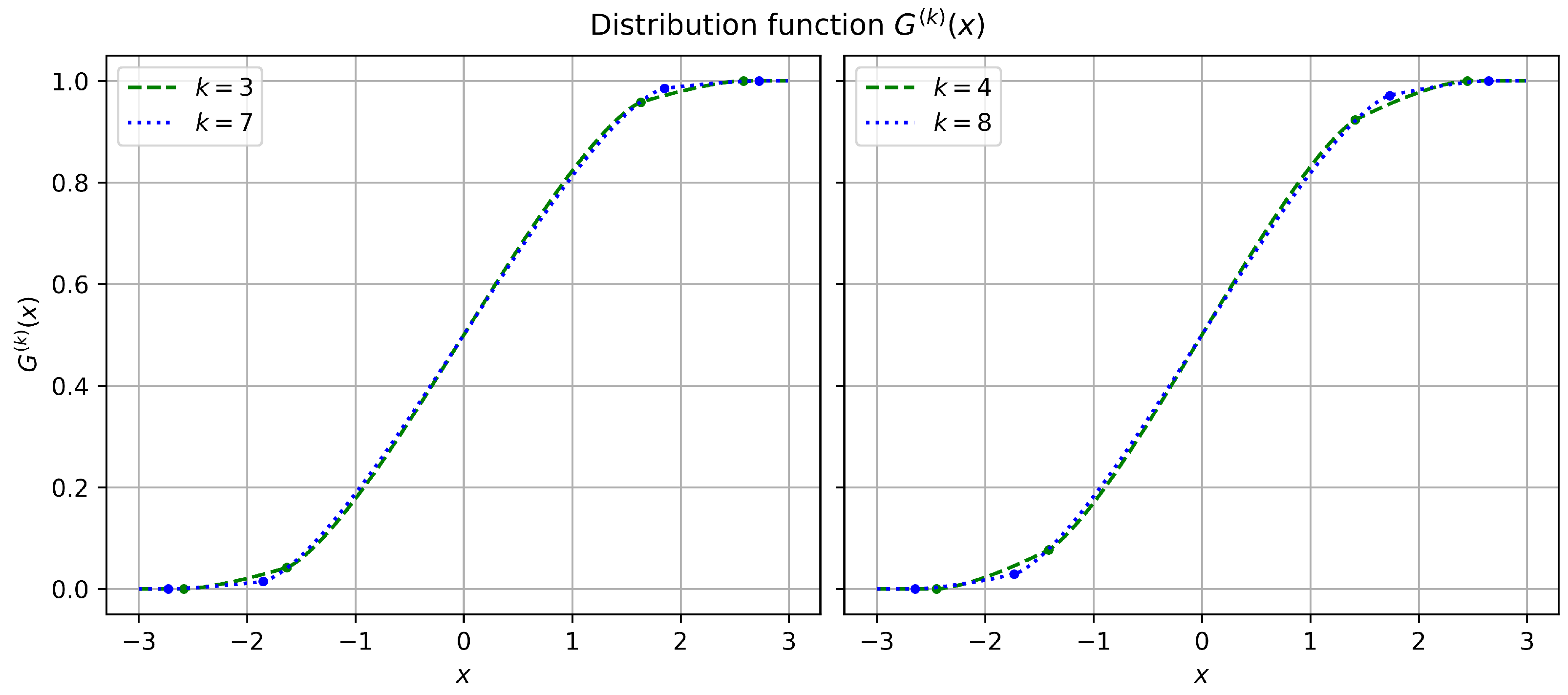
That is, it is a mixture of semicircle laws with parameters depending on the parity of k. For example, in the case of an odd k, we have a mixture of two semicircle laws and with supports and , respectively. Obviously, it is at the endpoints of these supports that the character of the function changes. Figure 1 shows the graphs of for . The dots on the distribution function curves mark the endpoints of the supports of the original distributions.
Figure 1.
Distribution function for (left plot) and (right plot).
We prove the following theorem.
Theorem 1.
Under conditions –, the empirical distribution function converges in probability to the distribution function .
The proof of Theorem 1.
We start from the well-known fact that the spectrum of the matrix is the union of the spectra of matrices , , where
Using the orthogonal transformation, we can reduce the matrix to the block-diagonal form with the blocks , , herewith the equality , where , holds. Let
Let and
It is easy to see that
We consider the case of even an k because the another case is similar. Note that
For or , we have
Using
we get, for ,
In fact,
To prove Theorem 1, we only need to prove that the spectral distribution of each matrix , converges to a semicircle law with the corresponding parameter. To this end, we apply Theorem 1 from paper [14]. We need to check the conditions (1)–(5) from ref. [14] for random variables and any fixed . For any fixed and any , we introduce -algebras
It is straightforward to check that, for any
Since are mutually independent for , we get the following using condition :
Thus, condition from [14] is fulfilled. Now, consider the quantity
Assume, for instance, . Note that for ,
Using this and the independence of and , , we get, for an even k,
Applying condition , we get
Thus, condition from [14] is proved. Furthermore, we check condition from ref. [14]. We need to prove that the Lindeberg fraction for the matrix tends to zero as n tends to ∞:
We prove the following auxiliary lemma:
Lemma 1.
For any random variables , and any , the following inequality holds:
Proof.
Combining inequality with inequality , we may write
There exists , such that and
Applying this equality, we get
Applying inequality , we get
Thus, Lemma 1 is proved. □
Now, we continue with the proof of relation (1). It is straightforward to check that
This implies that
Now, by applying Lemma 1, we get
Hence,
This inequality and condition proved condition from ref. [14].
Let . We need to prove that
where
It is straightforward to see that
Relation (2) and condition (5) from [14] now follow from condition . Thus, conditions (1)–(5) from ref. [14] are fulfilled, and the result of Theorem 1 now follows from ref. [14] (Theorem 1.1). □
2. Circulant Block Matrices with Sparsity
In this section, we consider circulant block matrices with independent blocks , . We shall assume as well that the entries of matrices are independent and sparse with independent Bernoulli random variables , . We construct the blocks
where “∘” denotes the Hadamard product of matrices and . Recall that all random variables , , , are jointly independent. For simplicity, we shall assume that and for any . We introduce the normalizing factor
and, for the blocks,
we define the block matrix
where . For instance, . We introduce some conditions on the probabilities and on the distributions of for and . Recall that
We shall assume that the following conditions are satisfied:
- Condition :
- Condition :
- Condition :
- Condition :and there exists a constant such that for any
We prove the following theorem.
Theorem 2.
Let conditions – be fulfilled. Then,
where was defined in Theorem 1.
The proof of Theorem 2.
We recall that the matrix can be reduced by a unitary (orthogonal) transformation to the block-diagonal form with the blocks , , such that and, for ,
if k is odd, and
if k is even. To prove the theorem, it is enough to prove that the spectral distribution functions of the matrices converges to the semicircle law with the corresponding parameter. Introduce the resolvent matrix of matrix ,
Denote the Stieltjes transform of the spectral distribution of the matrix by . We have
Applying Schur’s complement formula, we get
where denotes the matrix obtained from by deleting the j-th row and column, and
Introduce the following notations:
It is straightforward to check that, for and , when k is odd,
Let
Now, we can rewrite equality (3) in the form
Now, we approximate using condition . Introduce
Using and
we may write
Summing the last equality in , we get
where
To prove the convergence
it is enough to prove that
Here, denotes the Stieltjes transform of the semicircle law with the parameter . The inequality for implies that
The last inequality implies that it is enough to prove
We start with .
Lemma 2.
Under the conditions of Theorem 1, we have
Proof.
Since the cases of an odd and of even k are similar, we only consider an odd k. By the definition of and , for odd k we have
Applying Cauchy’s inequality, we get
Furthermore,
Summing up this inequality by indices , we get
Continuing with this inequality, we get
The last inequality and condition imply the result. Thus, Lemma 2 is proved. □
Lemma 3.
Under the conditions of Theorem 2, we have
Proof.
We start with the definition of . Thus, we have
Note that according to (4),
We may rewrite as follows:
where
To estimate , we represent it in the following form:
where
For , we have the estimation
Note that
Using this inequality, we get
Here, we use inequalities , , and . Combining inequalities (7) and (8), we obtain
Similarly, get the bound
Furthermore,
Using the independence of summands on the right hand side in reference with and that , we get
Applying this inequality, we get
The inequality
implies that
For the first term in the r.h.s. of this inequality, we have
Using inequality (9) again, we get
Using the definition of , we have
The claim follows from condition . □
Lemma 4.
Under the conditions of Theorem 2, we have
Proof.
Applying Cauchy’s inequality, we get
Furthermore, the independence of random variables , , and for implies that
Applying equality (6), we obtain
□
Lemma 5.
Under the conditions of Theorem 2, we have
Proof.
Using the definition of and the inequality , we have
Condition completes the proof. □
Lemma 6.
Under the conditions of Theorem 2, we have
Proof.
Using the definition of , we have
It is well known (see, for instance, ref. [15]) (Lemma 5.2) that
This inequality implies the result of Lemma 6. Thus, the lemma is proved. □
Combining the results of Lemmas 2–6, we get
Thus, Theorem 2 is proved. □
3. Product of Circulant Matrices
In this section, we consider the circulant matrices without symmetry. Let
Consider the array of random matrices . We shall assume that all random variables are independent in aggregate. With regard to random variables , we shall assume that the following conditions are satisfied:
- Condition : For any and , , ,
- Condition : For any , and for any , we have
Let us introduce the matrices
We shall investigate the distribution of singular values of the matrix
Denote the singular values of the matrix by and the spectral distribution function of the matrix by , as follows:
We prove the following result.
Theorem 3.
Under conditions –, we have
where is the distribution function described via its Stieltjes transform that satisfies the equation
Proof.
First of all, we note that the matrices can be transformed into a block diagonal form by applying the block matrix defined as
where and denotes the unit matrix of order n. Consequently, becomes a block-circulant matrix that can also be reduced to a block-diagonal form with :
where denotes a diagonal-block matrix with blocks of order . These blocks are the product of matrices :
with
Introduce matrix
The spectrum of matrix coincides with the spectrum of . Furthermore, it is the union of the spectra of matrices for .
Let denote the eigenvalues of for , . We define the empirical spectral distribution function as
It is simple to see that
We define and as the Stieltjes transforms of the distribution functions and , respectively. Using equality (10), we have
Consider the entries of for . It is straightforward to check that
Since for each fixed value of , the random matrices are jointly independent and the entries of each individual matrix are also independent, we may apply (Theorem 1.1) [16] the case of square matrices, where . We need to check the Lindeberg condition for random variables , for and . To verify this condition, we can apply Lemma 1 in a similar manner to the symmetric case. Note that
The last inequality and condition together imply that
From (Theorem 1) [16], it follows that
Equality (11) now implies the result of the theorem. Thus, Theorem 3 is proved. □
Author Contributions
Writing—original draft, A.T., S.G. and D.T. All authors have read and agreed to the published version of the manuscript.
Funding
The work was prepared in frames of the State task of the Institute of Physics and Mathematics FRC Komi SC UB RAS on the research topic № 122040600066-5.
Data Availability Statement
Data are contained within the article.
Conflicts of Interest
The authors declare no conflicts of interest.
References
- Bolla, M.; Szabados, T.; Baranyi, M.; Abdelkhalek, F. Block circulant matrices and the spectra of multivariate stationary sequences. Spec. Matrices 2021, 9, 36–51. [Google Scholar] [CrossRef]
- Elspas, B.; Turner, J. Graphs with circulant adjacency matrices. J. Combin. Theory 1970, 9, 297–307. [Google Scholar] [CrossRef]
- Gan, H.S.; Mokhtar, H.; Zhou, S. Forwarding and optical indices of 4-regular circulant networks. J. Discret. Algorithms 2015, 35, 27–39. [Google Scholar] [CrossRef]
- Liu, X.; Zhou, S. Eigenvalues of Cayley Graphs. Electron. J. Comb 2022, 29, 1–164. [Google Scholar] [CrossRef] [PubMed]
- Bianchi, T.; Magli, E. Analysis of the Security of Compressed Sensing with Circulant Matrices. In Proceedings of the 2014 IEEE International Workshop on Information Forensics and Security, Atlanta, GA, USA, 3–5 December 2014; pp. 173–178. [Google Scholar]
- Yu, N.Y. Indistinguishability of Compressed Encryption with Circulant Matrices for Wireless Security. IEEE Signal Process. Lett. 2017, 24, 181–185. [Google Scholar] [CrossRef]
- Gupta, T.V.S.; Gandhi, A.S. Compressive oversampling using circulant matrices for lossy wireless channels. In Proceedings of the 2016 11th International Conference on Industrial and Information Systems (ICIIS), Roorkee, India, 3–4 December 2016; pp. 507–511. [Google Scholar]
- Oraby, T. The spectral laws of Hermitian block-matrices with large random blocks. Elect. Comm. Probab. 2007, 12, 465–476. [Google Scholar] [CrossRef]
- Ding, X. Spectral analysis of large block random matrices with rectangular blocks. Lith. Math. J. 2014, 54, 115–126. [Google Scholar] [CrossRef]
- Kologlu, M.; Kopp, G.S.; Miller, S.J. The limiting spectral measure for ensembles of symmetric block circulant matrices. J. Theor. Probab. 2013, 26, 1020–1060. [Google Scholar] [CrossRef][Green Version]
- Oraby, T. The Limiting Spectra of Girko’s Block-Matrix. J. Theor. Probab. 2007, 20, 959–970. [Google Scholar] [CrossRef][Green Version]
- Far, R.; Oraby, T.; Bryc, W.; Speicher, R. Spectra of large block matrices. arXiv 2006, arXiv:cs/0610045. [Google Scholar]
- Tee, G.V. Eigenvectors of block circulant and alternating circulant matrices. Res. Lett. Inf. Math. Sci. 2005, 8, 123–142. [Google Scholar]
- Götze, F.; Naumov, A.; Tikhomirov, A. Limit Theorems for Two Classes of Random Matrices with Dependent Entries. Theory Probab. Its Appl. 2015, 59, 23–39. [Google Scholar] [CrossRef]
- Götze, F.; Tikhomirov, A. Limit theorems for spectra of random matrices with martingale structure. Theory Probab. Its Appl. 2007, 51, 42–64. [Google Scholar] [CrossRef]
- Alexeev, N.V.; Götze, F.; Tikhomirov, A.N. On the singular spectrum of powers and products of random matrices. Dokl. Math. 2010, 82, 505–507. [Google Scholar] [CrossRef]
Disclaimer/Publisher’s Note: The statements, opinions and data contained in all publications are solely those of the individual author(s) and contributor(s) and not of MDPI and/or the editor(s). MDPI and/or the editor(s) disclaim responsibility for any injury to people or property resulting from any ideas, methods, instructions or products referred to in the content. |
© 2024 by the authors. Licensee MDPI, Basel, Switzerland. This article is an open access article distributed under the terms and conditions of the Creative Commons Attribution (CC BY) license (https://creativecommons.org/licenses/by/4.0/).