


Abstract
Taipei mass rapid transit (MRT), operational since 1996, serves up to two million passengers daily. Equipment malfunctions pose a safety risk, making the dual goals of cost reduction and safety a significant challenge. Recently, outsourcing non-core technical tasks has emerged as an effective cost-control strategy, allowing resource allocation to employee salaries and operational efficiency. This study uses the analytic hierarchy process (AHP) and fuzzy analytic hierarchy process (FAHP) to prioritize outsourcing for electromechanical equipment. It incorporates analysis from the outsourcing literature, historical data, and ISO documents from Taipei MRT. The research included interviews and surveys with seven senior managers, using software to analyze the outsourcing priorities of four key systems: electrical and fire safety, environmental air conditioning, escalators and elevators, and power supply. It suggests prioritizing environmental air conditioning, followed by power supply systems, escalators and elevators, and electrical and fire safety systems. Additionally, this study employed the FAHP and the technique for order of preference by similarity to ideal solution (TOPSIS) for the rigorous evaluation and monitoring of vendor selection to ensure quality service and effective contract execution. By comparing technical expertise, problem-solving capabilities, certifications, response times, and contractual performance, this study identified the most suitable vendors. It concludes with recommendations for Taipei MRT to enhance maintenance quality and reduce costs.
Keywords:
Taipei mass rapid transit; analytic hierarchy process; outsourcing electromechanical maintenance; selecting contractors MSC:
90-08; 90B50; 90-XX
1. Introduction
Taipei mass rapid transit (MRT) has been operational since 1996 and currently averages two million passengers daily. After 27 years of operation, the aging of many facilities within the metro system has become a critical issue that needs attention to ensure passenger safety. Despite being a public transportation enterprise with the Taipei city government as its major shareholder, and not having raised fares for 27 years, Taipei MRT must seek alternative revenue sources such as leasing advertising space and selling merchandise. According to corporate law, profitability is the primary objective of the company. Therefore, effectively reducing operational costs while maintaining passenger safety is a crucial issue today.
In the past five years, Taipei MRT has experienced frequent equipment failures, including escalator malfunctions and power outages, highlighting the urgent need for equipment upgrades. With over one hundred stations in the Taipei area, such upgrades require significant financial and human resources. Meanwhile, staff salaries continue to rise annually. With the rise in outsourcing, delegating non-core technical tasks to other companies not only saves on salaries for permanent staff but also reduces personnel and equipment costs, thus more effectively controlling operating expenses.
However, in the realm of corporate management, there is extensive literature that delves into how to enhance work efficiency and reduce costs, as detailed below. Jorzik and colleagues conducted an in-depth study on how top management can drive and facilitate business model innovation supported by artificial intelligence. Using an inductive research approach, they conducted semi-structured interviews with 47 industry practitioners to develop a framework based on grounded theory. Overall, this research makes a significant contribution to the field of business model innovation theory [1]. Verhagen and colleagues’ research suggests that business models help companies translate abstract strategic decisions into daily operations. A key new finding in the study is that the impact of decisions is partly moderated through the implementation of business models, specifically by transforming new business models into operational models and enterprise architectures. This demonstrates that business model innovation involves not only strategic thinking and experimentation with business model components and architectures but also includes aligning business models with the operations and architectures of the enterprise [2]. “Business research for business leaders” explores the evolving role of middle managers in modern companies, highlighting a shift towards more coaching and less commanding. The article underscores the pivotal role skilled middle managers play in fostering collaboration and driving innovation within organizations. It posits that today’s middle managers are instrumental in providing companies with a competitive, innovative edge by nurturing talent and encouraging a more collaborative work environment [3]. Additionally, the article “COVID-19 pandemic tests global supply chains: How they adapt” discusses the reorganization of global supply chains under the impact of the COVID-19 pandemic. The focus of the article is on how companies are adjusting their distribution networks to enhance resilience and maintain operational efficiency in the face of crisis [3]. “Elon Musk’s Twitter takeover: lessons in strategic change” delves into Musk’s tactical approach during his acquisition of Twitter, emphasizing the strategic choices and management tactics he used to address both internal and external obstacles. This study illuminates how Musk’s distinctive leadership style influenced Twitter’s strategic direction, highlighting his methods for overcoming resistance and initiating transformative changes at the company [4]. Furthermore, the study “corporate purpose and financial performance” investigates how a strong sense of corporate purpose among middle managers and salaried professionals can impact a company’s financial performance. It highlights the importance of aligning employee beliefs with organizational goals [4]. Muhammad and colleagues explored the impact of agile management on project performance. Their research primarily examines how agile management practices can reduce project complexity and improve performance, particularly within the information technology (IT) sector in Pakistan. The study emphasizes the critical role of leadership competencies in effectively implementing these practices [5]. Ho and colleagues have observed that digitalization has rapidly transformed the operational landscape, necessitating quick decision making throughout the supply chain. They have proposed a management framework that identifies three main types of digital strategy development for manufacturing supply chains: (1) top-down; (2) bottom-up; and (3) mixed. These strategies provide a reference point for companies to plan their current and future digital supply chain strategies [6].
Additionally, numerous management research papers have proposed effective management strategies for subway systems [7,8,9,10]. Wang and colleagues investigated fires, one of the most common accidents in subway operations, with the goal of scientifically assessing the fire risk levels associated with subway operations and providing effective fire safety management measures for operating companies. The study systematically constructed a four-tier assessment system addressing human factors, management factors, environmental factors, and equipment factors. The subway operation fire risk evaluation index system includes 3 primary indicators and 32 secondary indicators, with each indicator’s weight calculated using the analytic hierarchy process (AHP). The research also incorporated the fuzzy comprehensive evaluation method to validate the assessment method, proving its applicability and effectiveness [7]. Researcher Li has explored the daily safety management system for rail transit. Due to the significant costs incurred by safety incidents, he has proposed managing the stability of electrical equipment (such as camera systems), which will help enhance the safety management system of subway companies [8]. Lin and others have explored how electrical equipment in railway lighting systems (such as lighting) can adopt smart management strategies. They integrated crowd monitoring with lighting adjustment technology, which not only enhances energy efficiency but also reduces the operating costs of subway companies. Additionally, their research provides a practical demonstration case for subway companies in various regions in the future [9]. Duan and others developed a management strategy based on ant colony algorithms, specifically for evacuation path planning in subway stations during fires. This strategy recommends the best escape routes based on location to ensure personnel safety. Simulation experiments have proven that, in the early stages of a fire and as it spreads, this strategy effectively guides passengers away from the fire area, thereby reducing casualties and operating costs for subway companies [10].
There are numerous approaches to business management, and this study focuses on an in-depth exploration of the management practices at the Taipei mass rapid transit (MRT) corporation. The following will detail their management strategies and implementation specifics. The Taipei MRT corporation has a diverse range of electromechanical equipment, which this study first categorizes into four main types: electrical and fire safety systems, environmental air control, escalators and elevators, and power supply systems. Subsequently, this study aims to identify which electromechanical equipment should be prioritized for improvement and further compares various vendors’ data against relevant criteria to select the most suitable partners.
Methodologically, the research employs the analytic hierarchy process (AHP) [11,12] and the fuzzy analytic hierarchy process (FAHP) [13,14]. Initially, the AHP method is used to collect data on the four categories of electromechanical equipment, determining their priority weights to identify which equipment should be outsourced first. Additionally, by integrating the FAHP and the technique for order of preference by similarity to ideal solution (TOPSIS) [15,16], a method based on the similarity to an ideal goal, this study ultimately determines the optimal sequence for selecting outsourcing vendors for the metro system [17,18].
The primary objectives of this study cover three crucial aspects: (i) From the electromechanical equipment of the metro system—including electrical and fire safety systems, environmental air control, escalators and elevators, and power supply systems—assess which should be prioritized for outsourcing. (ii) For the electromechanical equipment identified as a priority for outsourcing, further screen and evaluate suitable outsourcing vendors. (iii) Investigate the impact of changes in the weights of various evaluation criteria on the prioritization order for outsourcing.
Through these three objectives, we will be able to manage and optimize the maintenance outsourcing of metro electromechanical equipment more effectively, ensure the selection of the most appropriate vendors, and understand the specific effects of different criteria changes on the decision-making process.
This study analyzes the outsourcing of electromechanical equipment maintenance within the Taipei metro system, focusing on four key projects: environmental air conditioning, electrical and fire safety systems, escalators and elevators, and power supply systems. Initially, based on preliminary analysis, projects that should be prioritized for outsourcing were identified. This was combined with criteria considered important for this study and data from four vendors to determine the optimal sequence of outsourcing partners. This study primarily relies on publicly available data to estimate the current outsourcing costs. However, some metro data are confidential, which may result in incomplete information. Additionally, the selection of criteria items involves discussions with experts, which could be influenced by subjective assessments. These factors may impact the results of this study.
Table 1 displays a comparison of five management strategies applied in metro companies. There is extensive research in the field of metro system operational management, mainly focused on electrical and fire safety systems, as referenced in [7,8,9,10]. This study encompasses management planning for four critical systems: electrical and fire safety system, environmental air conditioning, escalators and elevators, and power supply systems. This planning will help improve the stability, operational service quality, and reduce the maintenance costs of the Taipei MRT system.

Table 1.
Comparison of five management strategies applied in metro companies.
2. Introduction to AHP, FAHP, and TOPSIS
2.1. Analytic Hierarchy Process
The analytic hierarchy process (AHP), developed by T. L. Saaty in the 1970s [19,20], is a structured technique for organizing and analyzing complex decisions based on mathematics and psychology. It assists in setting priorities and making the best decision when both qualitative and quantitative aspects need to be considered. By breaking down a decision into a hierarchy of more easily comprehended sub-problems, each of which can be analyzed independently, the AHP captures both subjective and objective aspects of a decision.
The AHP is widely used to determine the relative importance of a set of elements. This method also allows for deriving ratio scales through pairwise comparisons. The AHP facilitates the management of decision-making processes and helps decision-makers structure complex problems hierarchically. The AHP includes five main components: (i) hierarchical structuring of complex issues, (ii) pairwise comparisons, (iii) making judgments, (iv) using the eigenvector method to derive priority scales, and (v) considering consistency issues [11]. The AHP is widely used in areas such as government, business, industry, healthcare, and education to make decisions that require significant judgment and deliberation.
2.2. Fuzzy Analytic Hierarchy Process
The fuzzy analytic hierarchy process (FAHP) was established by Laarhoven and Pedtycz in 1983 [21], incorporating the concept of fuzzy theory to address the imprecision inherent in the traditional AHP. Building on this research, Buckley introduced an improved version of the FAHP in 1985, which involved fuzzifying the pairwise comparison values from T. L. Saaty’s AHP method.
The FAHP is a method used in the selection of usability requirements, which involves a multi-criteria decision-making problem that includes both qualitative and quantitative factors, some of which are in conflict with each other. Studies have shown that the FAHP is an effective and practical solution for multi-criteria decision making. Moreover, it assists decision-makers in converting the linguistic values of each criterion into numerical values to eliminate ambiguity and can handle incomplete and inaccurate data [13]. It replaces numerical ratios with ordinal scales to express the relative importance between elements, effectively addressing the issues of subjectivity and inaccuracy found in the traditional method. The specific process of the FAHP can be referenced in the method flowchart shown in Figure 1.
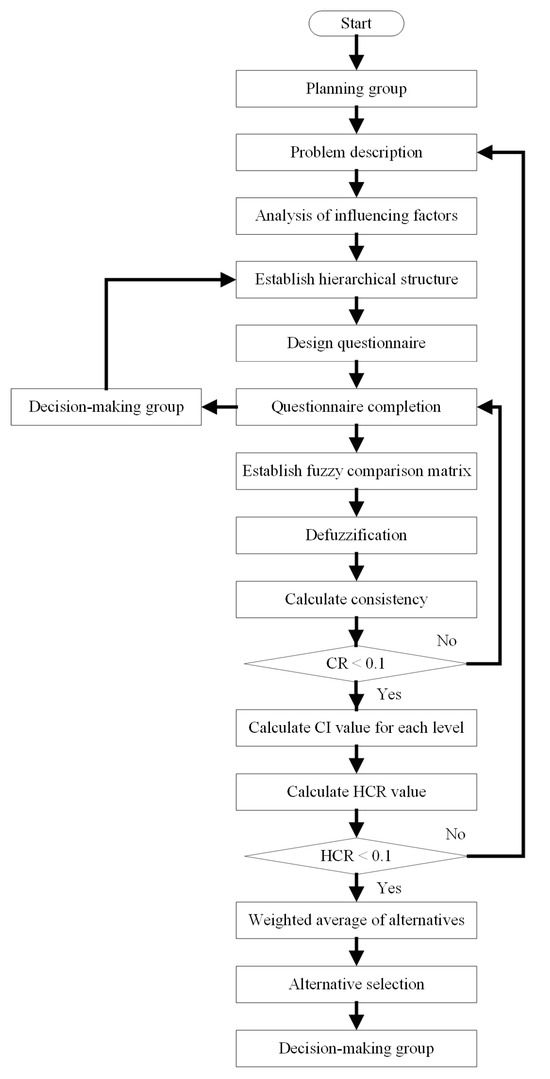
Figure 1.
Flowchart of the FAHP.
- A. Fuzzy Set
If the membership function of a fuzzy number in R corresponds to Formula (1), then it is a triangular fuzzy number (TFN) [22].
wherein l and u are the lower and upper bounds of the fuzzy number, respectively, and m is the modal value of the fuzzy number , as shown in Figure 2.
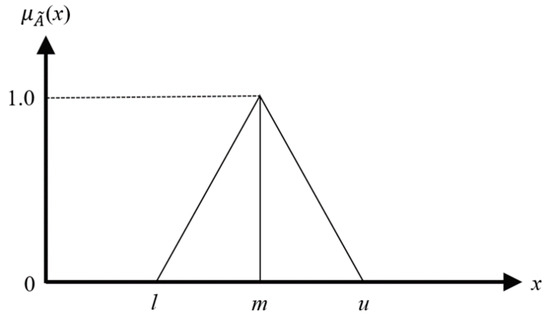
Figure 2.
Graph of the membership function of a TFN.
- B. FAHP Operational Steps
Step 1: In the fuzzy system, construct a pairwise comparison matrix for all elements or dimensions. By asking respondents to judge the relative importance between any two dimensions, assign these linguistically described preference values to the pairwise comparison matrix. Matrix , as shown in Formula (2), demonstrates this process:
Step 2: Use the geometric mean method to determine the fuzzy geometric means and the fuzzy weights for each criterion. The relevant calculation formulas are shown below, with Formula (3) used to determine the fuzzy geometric means, and Formula (4) to calculate the fuzzy weights for each criterion:
wherein the fuzzy comparison value between dimension i and criterion j is denoted as . Consequently, is the geometric mean of the fuzzy comparison values between criterion i and the other criteria. is the fuzzy weight for the ith criterion, which can be represented using a TFN, where , , and , respectively, represent the lower, middle, and upper limits of the fuzzy weight for dimension i.
- C. Technique for Order of Preference by Similarity to Ideal Solution
The core concept of the technique for order of preference by similarity to ideal solution (TOPSIS) is to first define the positive and negative ideal solutions [15,16]. The objective is to find a solution that is closest to the positive ideal solution and farthest from the negative ideal solution. In this method, the positive ideal solution represents the criterion value with the maximum benefit or minimum cost among all candidate solutions; conversely, the negative ideal solution refers to the criterion value with the minimum benefit or maximum cost.
Step 1: Normalize the original data to ensure consistency and comparability among the data. The decision matrix R, after normalization, is shown in Formula (5):
Step 2: Construct the weighted normalized decision matrix V, as detailed in the following Formula (6):
Herein vector represents the weight values calculated using the FAHP method.
Step 3: Calculate the positive ideal solution and the negative ideal solution, as detailed in the formulas below (7) and (8):
Step 4: Calculate the distance from each alternative to the positive ideal solution and the distance to the negative ideal solution, as specified in the formulas below (9) and (10):
Step 5: Calculate the closeness of each alternative to the ideal solution, as detailed in the formula below (11):
where 0 < <1, i = 1, 2, 3, …, m.
Last step: Perform a ranking of the alternatives based on their advantages to select the best maintenance outsourcing provider.
3. Model Establishment and Results of the Proposed Management Strategy
3.1. Preliminary Evaluation Model Established
Figure 3 presents the proposed evaluation model established flowchart by this study. Initially, the model involves collecting outsourcing data and implementing the analytic hierarchy process (AHP). Subsequently, industry data are gathered, and analyses are conducted using the fuzzy analytic hierarchy process (FAHP) and the technique for order of preference by similarity to ideal solution (TOPSIS), culminating in the final research results.
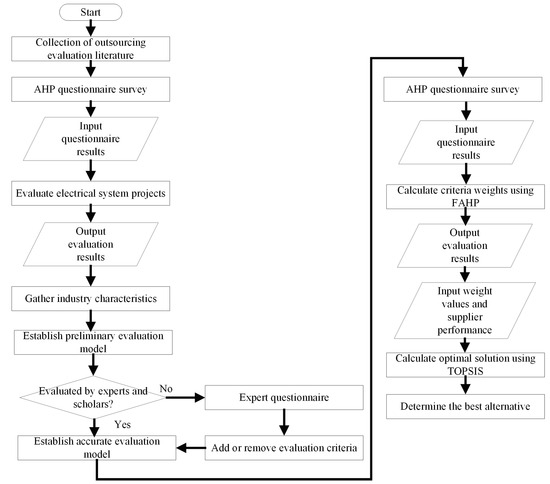
Figure 3.
The proposed evaluation model established flowchart.
The ideal maintenance outsourcing involves selecting external contractors or service providers who meet the following standards and characteristics: (i) Professional capability: External contractors should possess deep professional knowledge and skills to provide high-quality maintenance services. They must hold relevant professional certifications or qualifications and have extensive practical experience. (ii) Experience and reputation: These contractors should have a good reputation and experience and be able to provide customer reviews or case studies as references. They should demonstrate their capability and reliability in successfully handling similar projects. (iii) Efficiency and timeliness: Ideal outsourced maintenance services should ensure efficiency and timeliness. Contractors need to have good communication and coordination skills to ensure that maintenance work is completed on time and achieves the expected results. (iv) Cost-effectiveness: Maintenance outsourcing should offer reasonable and budget-aligned service costs. Contractors should be able to provide high-quality maintenance work that justifies the cost. In summary, the most ideal maintenance outsourcing is a collaboration model based on professional capability, experience, and reputation, capable of providing high-quality, efficient, and cost-effective maintenance services, fostering long-term partnerships.
3.2. Establish AHP Maintenance Outsourcing
After discussing the aforementioned characteristics and consulting with experts, this study has decided to use cost factors, staff factors, and the impact on operational quality as the first layer of evaluation criteria. The second layer of evaluation criteria includes labor cost, outsourcing cost, differential cost, core technology, staff mobility, scheduling capability, service quality, and emergency response capability. Each sub-criterion also lists multiple reference factors (see Table 2). Additionally, to clearly demonstrate the evaluation framework, this study has also established an analytic hierarchy process (AHP) framework diagram (see Figure 4 below).
Table 2.
AHP maintenance outsourcing evaluation criteria.
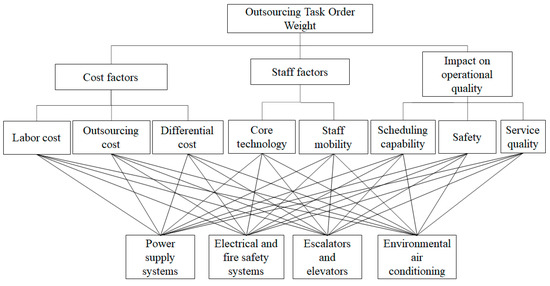
Figure 4.
AHP maintenance outsourcing criteria establishment diagram.
After establishing the criteria framework for the AHP, explanations and evaluations were provided for eight sub-criteria based on the literature, expert opinions, and ISO documents. The explanations for each evaluation criterion are shown in Table 3, while the estimation explanations for the criteria are provided in Table 4.
Table 3.
Explanation of evaluation criteria factors.
Table 4.
Explanation of evaluation criteria estimation.
Seven experts in metro and outsourcing utilized estimated data (as shown in Table 5) to conduct an analysis using the AHP method. Initially, pairwise comparisons were made to obtain geometric mean values. Subsequently, based on the FAHP, data analysis was carried out using computer software (Power Choice 4.0) to determine the weights of each criterion and to establish the priority order for outsourcing (as shown in Table 6).
Table 5.
Establishment of maintenance contractor evaluation criteria.
Table 6.
Priority order of mechanical and electrical equipment outsourcing.
3.3. Establishment of Maintenance Contractor Research Model
- A. Establishment of the AHP Model for Maintenance Contractors
Based on the final results, the system equipment most suitable for outsourcing is environmental air conditioning. Subsequently, this study assumes that the evaluation criteria for suppliers include technical capabilities, service quality, and cost control, as shown in Table 7. In terms of technical expertise, the rarity of the technology in the market serves as the estimation basis. Regarding problem-solving abilities, the maintenance completion rate is the benchmark. For professional certifications, points are awarded based on the number of announcements in the tender documents. Response speed is evaluated based on the proportion of time taken to arrive at the repair site after an incident occurs, according to metro regulations. Performance capability is assessed by whether the company can fulfill all contract obligations and is rated based on the percentage of compliance. Service levels are scored according to the standards of maintenance quality checks. Budget planning involves setting an approximate value based on the current market prices and estimated budget requirements for contract fulfillment. Bid amounts are estimated by referencing the bid amounts of specific contract cases. Sustainability is evaluated using ESG ratings.
Table 7.
Explanation of evaluation criteria.
Currently, there are four outsourcing companies, labeled as Company A, Company B, Company C, and Company D, as shown in Figure 5. The criteria for the data of the four companies are shown in Table 8.
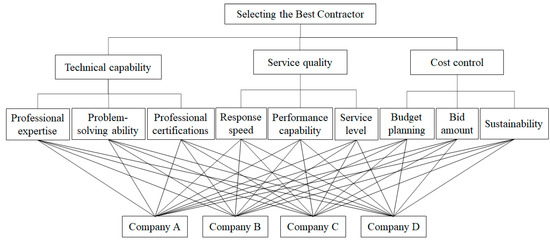
Figure 5.
Maintenance contractor criteria establishment diagram.
Table 8.
Maintenance contractor evaluation criteria establishment.
After collecting data from the four companies, we converted it into various forms required by the TOPSIS, as shown in Table 9, Table 10, Table 11, Table 12 and Table 13:
Table 9.
Maintenance contractor evaluation criteria.
Table 10.
Normalized performance evaluation matrix.
Table 11.
Weighted normalized performance evaluation matrix.
Table 12.
Distance from positive ideal solution.
Table 13.
Distance from negative ideal solution.
- B. Establishment of the AHP Model for Maintenance Contractors
Based on the criteria set by the experts for outsourcing companies, the weights of each criterion were determined using the FAHP method. The TOPSIS method was then used to define the positive ideal solution and the negative ideal solution, followed by finding the solution closest to the positive ideal solution and farthest from the negative ideal solution. Each solution was ranked by advantage to select the best maintenance outsourcing company. The ranking results for the weights of the first-level evaluation criteria are shown in Table 14.
Table 14.
Maintenance contractor evaluation criteria weights.
Through the evaluation results, it can be seen that the key factor in selecting a company is service quality, with the highest weight (0.7382), followed by cost control (0.1691) and technical capability (0.0927). Therefore, it is evident that service quality has the greatest influence on outsourcing, as shown in Figure 6. Figure 6 displays the maintenance contractor evaluation criteria weights chart. For the four companies, the evaluation values are ranked as follows: Company C (0.7273) is the highest, followed by Company A (0.6443), Company B (0.4280), and Company D (0.1669).
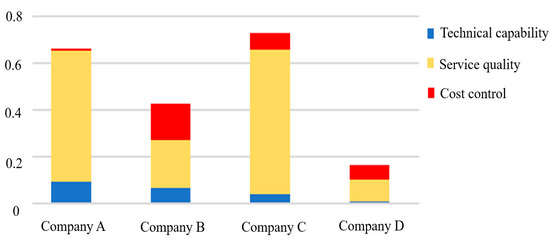
Figure 6.
Maintenance contractor evaluation criteria weights chart.
Firstly, using technical capability (first-level evaluation criteria) as an example, among the second-level evaluation criteria, professional certifications have the highest weight (0.7499), followed by problem-solving ability (0.1637), and professional expertise has the lowest weight (0.0862). Next, regarding service quality (first-level evaluation criteria), among the second-level evaluation criteria, service level has the highest weight (0.7256), followed by performance capability (0.1848), and response speed has the lowest weight (0.0895). Finally, concerning cost control (first-level evaluation criteria), among the second-level evaluation criteria, sustainability has the highest weight (0.6975), followed by bid amount (0.2362), and budget planning has the lowest weight (0.0662).
After linking the weights of the evaluation factors and criteria, the ranking of each evaluation criterion based on weight is as follows: service level (0.5356) > performance capability (0.1364) > sustainability (0.1179) > professional certifications (0.0695) > response speed (0.0661) > bid amount (0.0399) > problem-solving ability (0.0151) > budget planning (0.0111) > professional expertise (0.0079), as shown in Table 15.
Table 15.
Outsourcing evaluation criteria weight ranking.
For the four companies, the evaluation values are ranked as follows: Company C (0.7273) is the highest, followed by Company A (0.6443), Company B (0.4280), and Company D (0.1669), as shown in Table 16.
Table 16.
Evaluation values for four maintenance contractor criteria.
Figure 7 displays the weight chart of the evaluation factors and criteria for four maintenance contractors. This chart, derived from Table 16, provides a more intuitive understanding of the priority order and evaluation results for the four companies. The scores are as follows: Company C (0.7273), Company A (0.6443), Company B (0.4280), and Company D (0.1669).
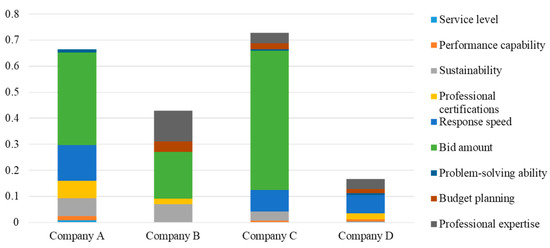
Figure 7.
Weight chart of evaluation factors and criteria for four maintenance contractors.
The analysis above reveals that service level is the most influential factor in this study. Having good service quality is crucial as it not only extends the equipment’s lifespan but also enables rapid on-site repairs during equipment failures. Both experts and the general public view service quality as more important than the other two factors. However, in reality, the metro still needs to operate profitably, so cost control is currently emphasized. Nevertheless, since passenger transportation quality needs to be ensured, this study suggests that the metro should consider service quality more. When equipment is less prone to damage, it not only protects passenger rights but also reduces unnecessary maintenance losses, achieving a win–win situation.
Furthermore, regarding the current outsourcing of metro environmental air-conditioning maintenance, this study proposes the following improvement directions: (i) Monitoring and communication: establish a more effective monitoring mechanism to ensure that outsourced contractors’ maintenance work meets contractual requirements and standards. (ii) Technical updates and training: regularly assess the technical capabilities of outsourced contractors to ensure they are up to date with the latest technologies and remain compliant. (iii) Increased flexibility and service level: ensure that outsourced contractors have the flexibility to adjust personnel and resources based on the needs of the metro system. (iv) Cost–benefit analysis: continuously evaluate the cost-effectiveness of outsourcing to ensure its economic viability.
These improvements will help enhance the efficiency and quality of outsourced services, ensuring the smooth operation of metro environmental air-conditioning maintenance. Maintaining close cooperation and communication with outsourced contractors will also contribute to long-term improvement and a sustainable contractual relationship.
4. Conclusions
Metro outsourced maintenance can provide professional, efficient, and reliable maintenance services, reducing system failures and downtime while improving system performance and passenger comfort. This study explored the outsourcing literature, metro data, and existing ISO documents of the metro company. Finally, expert interviews were conducted, and questionnaires were completed with the assistance of seven managers above the plant manager level in Taipei MRT. A pairwise comparison was carried out, and computer software was used to obtain the weight of each factor. However, when selecting outsourcing contractors, strict evaluation and monitoring should be conducted to ensure the effective implementation of outsourcing contracts and service quality.
This study examined four metro electromechanical systems: electrical and fire safety systems, environmental air conditioning, escalators and elevators, and power supply systems. By combining the AHP and FAHP, it was determined that environmental air conditioning should be prioritized for outsourcing technology to reduce costs, followed by power supply systems, plumbing and fire protection, and escalators and elevators.
Next, the FAHP and TOPSIS were combined to explore factors such as professional expertise, problem-solving ability, professional certifications, response speed, performance capability, service level, budget planning, bid amount, and sustainability of outsourcing contractors. The impact of these factors on the selection of outsourcing contractors was analyzed. The priority order of maintenance contractors for outsourcing is Company C, Company A, Company B, and Company D. The following are the more significant results of this study:
Evaluation Factors: Among the three evaluation factors of “technical capability”, “service quality”, and “cost control”, service quality has the highest weight (0.7832), followed by cost control (0.1691), and technical capability has the lowest weight (0.0927). From these results, it is clear that service quality is the primary factor influencing contractor ranking.
Evaluation Criteria: The overall weight ranking is as follows: service level (0.5356), performance capability (0.1364), sustainability (0.1179), professional certifications (0.0695), response speed (0.0661), bid amount (0.0399), problem-solving ability (0.0151), budget planning (0.0111), and professional expertise (0.0079).
Further research for Taipei MRT, Kaohsiung MRT, Taoyuan MRT, Taichung MRT, and New Taipei MRT involves analyzing and comparing the outsourcing strategies of these five companies. This analysis will aid in formulating the most effective outsourcing plans that simultaneously reduce costs and enhance operational quality. Moreover, by exchanging outsourcing strategies with contract management, a forward-looking plan for outsourced maintenance in the domestic rail industry can be developed. This initiative will create a platform to lower operating costs and improve the quality of passenger transport safety.
Author Contributions
Conceptualization, S.-N.P. and C.-Y.H.; formal analysis, S.-N.P. and C.-Y.H.; investigation, S.-N.P. and C.-Y.H.; software, S.-N.P. and C.-Y.H.; methodology, S.-N.P. and C.-Y.H.; data curation, S.-N.P. and C.-Y.H.; visualization: S.-N.P. and C.-Y.H.; funding acquisition, H.-D.L.; supervision, H.-D.L.; writing—original draft, S.-N.P., C.-Y.H. and H.-D.L.; writing—review and editing, S.-N.P., C.-Y.H. and H.-D.L. All authors have read and agreed to the published version of the manuscript.
Funding
This research is funded by the National Science and Technology Council, Taiwan, R.O.C., grant number NSTC 112-2221-E-003-003.
Data Availability Statement
The data presented in this study are available on request from the corresponding author.
Conflicts of Interest
The authors declare no conflicts of interest.
References
- Jorzik, P.; Yigit, A.; Kanbach, D.K.; Kraus, S.; Dabić, M. Artificial Intelligence-Enabled Business Model Innovation: Competencies and Roles of Top Management. IEEE Trans. Eng. Manag. 2024, 71, 7044–7056. [Google Scholar] [CrossRef]
- Verhagen, M.; de Reuver, M.; Bouwman, H. Implementing Business Models Into Operations: Impact of Business Model Implementation on Performance. IEEE Trans. Eng. Manag. 2023, 70, 173–183. [Google Scholar] [CrossRef]
- Business Research for Business Leaders Data. Available online: https://hbswk.hbs.edu/Pages/browse.aspx?HBSTopic=Management (accessed on 1 June 2024).
- Elon Musk’s Twitter Takeover: Lessons in Strategic Change Data. Available online: https://hbswk.hbs.edu/Pages/browse.aspx?HBSTopic=Business%20or%20Company%20Management (accessed on 1 June 2024).
- Muhammad, U.; Nazir, T.; Muhammad, N.; Maqsoom, A.; Nawab, S.; Fatima, S.T.; Shafi, K.; Butt, F.S. Impact of agile management on project performance: Evidence from I.T sector of Pakistan. PLoS ONE 2021, 16, e0249311. [Google Scholar] [CrossRef] [PubMed]
- Ho, W.R.; Tsolakis, N.; Dawes, T.; Dora, M.; Kumar, M. A Digital Strategy Development Framework for Supply Chains. IEEE Trans. Eng. Manag. 2023, 70, 2493–2506. [Google Scholar] [CrossRef]
- Wang, W.; Yao, X.; Liu, J. Research on fire risk assessment of subway operation based on fuzzy analytic hierarchy process. In Proceedings of the 2021 International Conference on Public Management and Intelligent Society (PMIS), Shanghai, China, 26–28 February 2021; pp. 199–202. [Google Scholar] [CrossRef]
- Li, Y. Design of Daily Safety Management System for Metro Traffic Engineering. In Proceedings of the 2022 4th International Conference on Smart Systems and Inventive Technology (ICSSIT), Tirunelveli, India, 20–22 January 2022; pp. 1316–1319. [Google Scholar] [CrossRef]
- Lin, S.; Liu, L.; He, Z.; Zhao, M.; Zheng, L.; Xu, W. Research on Subway Lighting Management System Based on Artificial Intelligence. In Proceedings of the 2021 4th International Conference on Energy, Electrical and Power Engineering (CEEPE), Chongqing, China, 23–25 April 2021; pp. 903–906. [Google Scholar] [CrossRef]
- Duan, G.; Liu, M.; Kong, W.; Cui, B. Research on Subway Fire Evacuation Path Planning Based on Improved Ant Colony Algorithm. In Proceedings of the 2023 35th Chinese Control and Decision Conference (CCDC), Yichang, China, 20–22 May 2023; pp. 2896–2902. [Google Scholar] [CrossRef]
- Dhurkari, R.K. Improving the Prescriptive Power of Analytic Hierarchy Process. IEEE Trans. Eng. Manag. 2024, 71, 7456–7466. [Google Scholar] [CrossRef]
- Dhumras, H.; Shukla, P.K.; Bajaj, R.K.; Boulila, W.; Shukla, V.; Shukla, P.K.; Chauhdary, S.H. Industry 5.0 Enablers in Consumer Electronics Market Assessment Under T-Spherical Fuzzy Integrated Decision-Making Approach. IEEE Trans. Consum. Electron. 2024, 70, 1443–1451. [Google Scholar] [CrossRef]
- Gulzar, K.; Tariq, O.; Mustafa, S.; Mohsin, S.M.; Kazmi, S.N.; Akber, S.M.A.; Abazeed, M.; Ali, M. A Fuzzy Analytic Hierarchy Process for Usability Requirements of Online Education Systems. IEEE Access 2023, 11, 146076–146089. [Google Scholar] [CrossRef]
- Zhang, H.; Feng, X.; Wei, Y.; Li, Z. A Vagueness Adaptive Efficiency Evaluation Method of Science and Technology Resources Opening and Sharing Platforms Based on FAHP and BP Neural Network. IEEE Trans. Eng. Manag. 2024, 71, 2049–2062. [Google Scholar] [CrossRef]
- Mathew, M.; Chakrabortty, R.K.; Ryan, M.J. Selection of an Optimal Maintenance Strategy Under Uncertain Conditions: An Interval Type-2 Fuzzy AHP-TOPSIS Method. IEEE Trans. Eng. Manag. 2022, 69, 1121–1134. [Google Scholar] [CrossRef]
- Shaw, K.; Lahri, V.; Shankar, R.; Ishizaka, A. Joint Multi-item Multi-supplier Sustainable Lot-Sizing Model Applying Combined BWM, TOPSIS, Possibilistic Programming, and ϵ-constraint Method. IEEE Trans. Eng. Manag. 2024, 71, 4530–4547. [Google Scholar] [CrossRef]
- Chang, H.-J.; Jen, J.-T. Comparing the Prediction Accuracy with Passenger Time Series of Taipei MRT under Different Deep RNNs. In Proceedings of the 2022 IET International Conference on Engineering Technologies and Applications (IET-ICETA), Changhua, Taiwan, 14–16 October 2022; pp. 1–2. [Google Scholar] [CrossRef]
- Huang, T.; Guo, J.; Hsieh, M.; Chen, L. Information System Architecture and APP for Passenger Notification of Specific Events in MRT Cabins Based on Artificial Intelligence Assistance. In Proceedings of the 2022 IEEE International Conference on Consumer Electronics-Taiwan, Taipei, Taiwan, 6–8 July 2022; pp. 371–372. [Google Scholar] [CrossRef]
- Saaty, T.L. Priority setting in complex problems. IEEE Trans. Eng. Manag. 1983, EM-30, 140–155. [Google Scholar] [CrossRef]
- Arbel, A.; Saaty, T.L.; Vargas, L.G. Nuclear balance and the parity index: The role of intangibles in decisions. IEEE Trans. Syst. Man Cybern. 1987, 17, 821–828. [Google Scholar] [CrossRef]
- Zhü, K. Fuzzy analytic hierarchy process: Fallacy of the popular methods. Eur. J. Oper. Res. 2014, 236, 209–217. [Google Scholar] [CrossRef]
- Zakeri, S.; Konstantas, D.; Bratvold, R.B.; Pamucar, D. A Supplier Selection Model Using the Triangular Fuzzy-Grey Numbers. IEEE Access 2023, 11, 107511–107532. [Google Scholar] [CrossRef]
Disclaimer/Publisher’s Note: The statements, opinions and data contained in all publications are solely those of the individual author(s) and contributor(s) and not of MDPI and/or the editor(s). MDPI and/or the editor(s) disclaim responsibility for any injury to people or property resulting from any ideas, methods, instructions or products referred to in the content. |
© 2024 by the authors. Licensee MDPI, Basel, Switzerland. This article is an open access article distributed under the terms and conditions of the Creative Commons Attribution (CC BY) license (https://creativecommons.org/licenses/by/4.0/).