1. Introduction
The interaction between species in ecosystems is one of the core contents of ecological research. In population ecology, species relationships include parasitic, reciprocal, competitive, and predator–prey interactions. Notably, the interaction between predators and prey plays a significant role in maintaining ecosystem stability and diversity. The Lotka–Volterra model
is a classic predator–prey model widely used to describe the interactions between predators and prey. In this model,
and
represent the population density of prey and predators, respectively. The parameter
indicates the birth rate of the prey population,
indicates the success rate of predators’ predation of prey,
represents the nutritional conversion coefficient of the predators, and
represents the mortality rate of predators. In the original Lotka–Volterra predator–prey model (1), it is assumed that the growth of prey populations is affected by the intrinsic growth rate and predation pressure from predators and that the growth of predator populations is affected by their feeding rates and their natural mortality rates. In order to describe the interaction between populations more realistically, the following model is proposed considering the density constraint effect within populations:
where
indicates the constraint coefficient of the prey population density,
represents the constraint coefficient of the predators’ population density, and
have the same biological significance as model (1).
In model (2), it is usually assumed that all individuals have the same degree of survival and predation ability and that the interaction between organisms is instantaneous, so there was no time delay, which is often not true in actual ecosystems. Considering that biological individuals usually have a growth and development process, it becomes necessary to consider the time delay effect between predators and prey. Time delay effect refers to the delay caused by physiological processes such as the growth, reproduction, and migration of biological individuals. Therefore, studying Lotka–Volterra predator–prey models with time delays helps to better understand the interactions between predators and prey in actual ecosystems, providing a theoretical basis for ecological protection and management. In order to more accurately describe and predict the changing trends of species populations with obvious seasonal or life cycle characteristics, researchers have incorporated time delay effects into the Lotka–Volterra predation model [
1,
2,
3,
4]. Most scholars have considered the single time delay effect [
5,
6]; for instance, May proposes the following model [
7]:
where
indicates the pregnancy time of the prey population.
Due to the different predatory abilities of predators at different stages, it takes time for juvenile predators to grow into adult predators. Therefore, incorporating these stage structures into predator models can provide a more accurate description of the relationship between predators and prey in ecosystems. Populations are typically divided into several stages according to certain physiological characteristics, such as juvenile, adult and old age. Corresponding stage-structured models are established for research purposes, which may result in new dynamic behaviors [
8,
9,
10]. Assuming that the growth of the prey population follows Lotka–Volterra and that the young predators are unable to prey on the prey and are unable to reproduce, Xu proposes the following model [
11]:
where
represents the population density of prey,
represents the population density of juvenile predators,
represents the population density of adult predators,
have the same biological significance as model (2),
represents the mortality rate of the adult predator population,
indicates the mortality rate of juvenile predators,
indicates the time when juvenile predators mature, and
indicates at the moment of
, the population density of juvenile predators reproduced by adult predators that survive after the time of
. Based on previous studies, this article considers the Lotka–Volterra predator–prey model with a stage structure including pregnancy delay, as follows:
In model (5), the first and third equations do not contain variables
, meaning that they are not coupled with the second equation; therefore, we only need to consider the following models:
where
represents the population density of prey,
represents the population density of adult predators,
are all positive numbers with the same biological significance as model (4),
indicates the pregnancy time of the prey population,
indicates the time when juvenile predators mature, and
indicates at the moment of
, the population density of juvenile predators reproduced by adult predators that survive after the time of
. First, this paper studied five different scenarios based on different values of two time delays and provided stability analysis for internal equilibrium and the existence of Hopf bifurcation in these scenarios. Second, using normal form method and central manifold theory, we determined the direction of branching for Hopf bifurcation and analyzed the stability of periodic solutions. Finally, numerical simulations were conducted using Matlab to verify the theoretical findings.
2. Hopf Bifurcation Analysis
By making the right-hand function of system (6) equal to 0, the internal equilibrium of system (6) can be obtained as
, where:
When is true, system (6) has a positive internal equilibrium.
The linearization of system (6) at
is as follows:
The characteristic equation associated with (7) is:
i.e.,
where:
Below, five different scenarios were discussed on the stability of system (6) at and the existence of Hopf bifurcation.
Case 1. .
In this case, Equation (8) becomes:
For convenience, provide the assumption .
According to the Routh–Hurwitz criterion, the following theorem can be obtained.
Theorem 1. If and are true, then the internal equilibrium of system (6) is asymptotically stable.
Case 2.
Equation (8) becomes:
let
One can obtain from ; denote .
According to the geometric criteria in [
12], the following five conditions are verified for Equation (10):
- (i)
- (ii)
- (iii)
- (iv)
has at most a finite number of real zeros;
- (v)
Each positive root of is continuous and differentiable in whenever it exists.
Obviously, the condition (v) is valid. When
, if
is true, one can obtain
, so the condition (i) is valid. When
:
If
is true,
, so
. When
, condition (ii) is the same as condition (i), that is, condition (ii) is true. Because:
the condition (iii) is true. From:
one can obtain:
Therefore, has at most four roots, so condition (iv) is true.
To make
have a positive root, define the set according to (11):
When
has a positive real zero point
, where:
When
, assume
is the pure imaginary root of Equation (9), substitute
into Equation (9) and separate the real and imaginary parts to obtain:
The following can be concluded from (12):
This equation is the same as
, because
has a positive root, Equation (9) has a pair of simple pure imaginary roots
. When
, make
and
, so
is the pure imaginary root of Equation (9); if and only if
is the root of
, write
as the root of
. The following theorem can be obtained from Theorem 2.2 in [
12].
Theorem 2. When , if there is at , when there is Equation (9) has a pair of pure imaginary roots, that is , and if , so when increases and crosses , the roots corresponding to this pair of pure imaginary roots will cross the imaginary axis from the left (right) half plane of the complex plane to the right (left) half plane, where: Thus, (13) is equivalent to:
It is easy to know when
is monotonically decreasing with respect to
, that is
if
has no zero point,
has no zero point, either. When
, obviously
. When
, so
. Additionally, according to
,
, one can know that
, so
. Therefore,
intersects with the horizontal axis, and the number of intersections is even. Let the intersection be:
where
j is an even number.
Theorem 3. When , if is true, then:
(1) If has no zero point, then the internal equilibrium is asymptotically stable.
(2) If has at least one positive root, then there exists so that when , the internal equilibrium of system (6) is asymptotically stable. When , the internal equilibrium of system (6) is not stable. When , the internal equilibrium of system (6) is asymptotically stable. When , system (6) has a Hopf bifurcation at .
Case 3. fix within a stable interval and discuss as a parameter.
Substitute
into Equation (8) and separate the real and imaginary parts to obtain:
From (15), we can obtain the following equation about
:
where:
Lemma 1. When is true, Equation (16) has only one real root.
Proof. It is easy to know that
is a continuous function; when
is true, then:
and there is:
Therefore, Equation (16) has at least one real root. Because:
and when
, there is obviously
and
, so:
When
is true, it has:
Therefore, is monotonically increasing with respect to , and Equation (16) only has one real root. □
The root of Equation (16) is denoted as
, and there exists a corresponding
as:
where:
Let be the root of Equation (8) at and meet the requirements .
Take the derivative of Equation (8) with respect to
at the left and right ends:
Substitute
into (18) and take the real part to obtain:
where:
When .
The following theorem can be obtained from the above lemma.
Theorem 4. If are true, then when , the internal equilibrium of system (6) is asymptotically stable. When , the internal equilibrium of system (6) is not stable. When , system (6) has a Hopf bifurcation at .
Case 4. .
In this case, Equation (8) becomes:
where:
Substitute
into Equation (19) and separate the real and imaginary parts to obtain:
Thus, it can be concluded that:
Due to
being a continuous function and:
if
, there is:
Thus, Equation (21) has a positive root, denoted as
; that is, when
, Equation (19) has a pair of simple pure imaginary roots
, where:
Let be the root of Equation (19) when satisfies and , where is determined by (22).
Lemma 2. If , then .
Proof. Take the derivative of Equation (19) with respect to
:
Substitute it into (23) to obtain:
Substitute
into the above equation to obtain:
From (20), one can know the following:
so:
If is true, then . □
In summary, the following theorem can be obtained.
Theorem 5. If are true, then when , the internal equilibrium of system (6) is asymptotically stable. When , the internal equilibrium of system (6) is not stable. When , system (6) has a Hopf bifurcation at .
Case 5. , fix within a stable interval and discuss as a parameter.
We see that Equation (8) takes the form:
where:
According to the geometric criteria in [
12], the following five conditions are verified for Equation (24):
- (i)
- (ii)
- (iii)
- (iv)
has at most a finite number of real zeros;
- (v)
Each positive root of is continuous and differentiable in whenever it exists.
Obviously, the condition (v) is valid. When
, if
is true, one can obtain
, so the condition (i) is valid. Since:
the condition (iii) is valid. When
:
Lemma 3. If , then the condition (ii) is valid.
Proof. Because the coefficients of Equation (8) satisfy:
then:
When
, obviously
and
, so:
The condition (ii) is valid. □
Lemma 4. If , then the condition (iv) is valid.
Proof. Since:
because the coefficients of Equation (8) satisfy:
then:
When
, obviously
and
, so:
If
is true, then
. Because:
has at most four roots, so condition (iv) is true. The proof is complete. □
To make
have a positive root, define the set according to (25):
When
,
has a positive real zero point
, where
is determined by:
When
, assume
is the pure imaginary root of Equation (24), substitute
into Equation (24) and separate the real and imaginary parts to obtain:
Thus, one can obtain:
where:
It can be concluded from (27) that:
This equation is the same as , because has a positive root, Equation (24) has a pair of simple pure imaginary roots . When , make and , so is the pure imaginary root of Equation (24); if and only if is the root of , write as the root of .
When
is true,
; according to Theorem 2, one can know that:
It is easy to know when
,
is monotonically decreasing with respect to
, that is
; if
has no zero point,
has no zero point, either. When
, obviously
. When
,
, so
. Additionally, according to
,
, one can know that
, so
. Therefore,
intersects with the horizontal axis, and the number of intersections is even. Let the intersection be:
where
is an even number.
Theorem 6. When , if is true, then:
(1) If has no zero point, then the internal equilibrium s asymptotically stable.
(2) If has at least one positive root, then there exists , so that when , the internal equilibrium of system (6) is asymptotically stable. When , the internal equilibrium of system (6) is not stable. When , the internal equilibrium of system (6) is asymptotically stable. When , system (6) has a Hopf bifurcation at .
4. Numerical Simulation
This section will select parameters for a numerical simulation in five different scenarios.
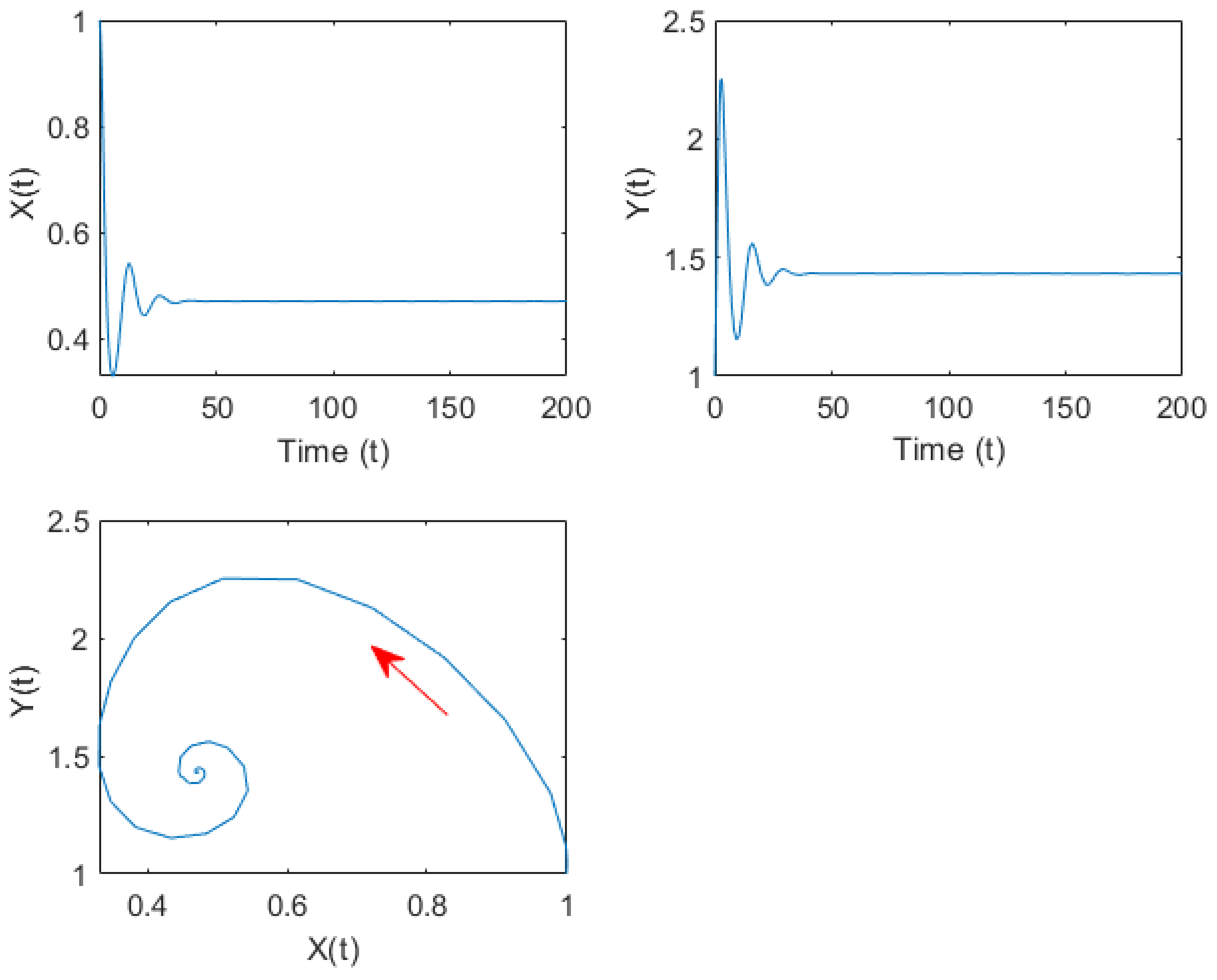
Case 1. .
Select parameters (A),
, and system (6) becomes:
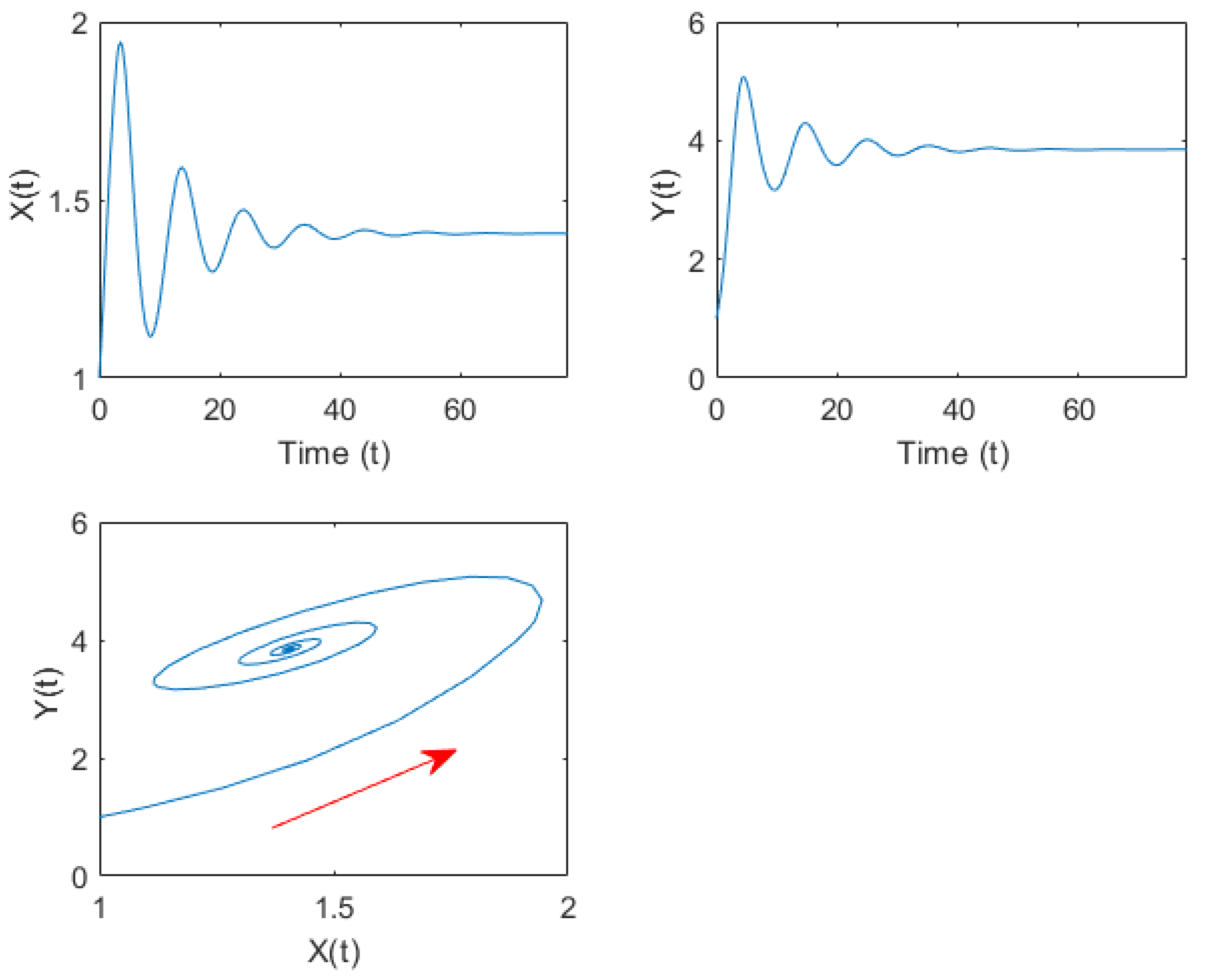
After calculation, the internal equilibrium can be determined as
, and
are true; according to Theorem 1, the internal equilibrium
of the system (31) is asymptotically stable, as shown in
Figure 1.
Case 2.
Still select the previous set of parameters.
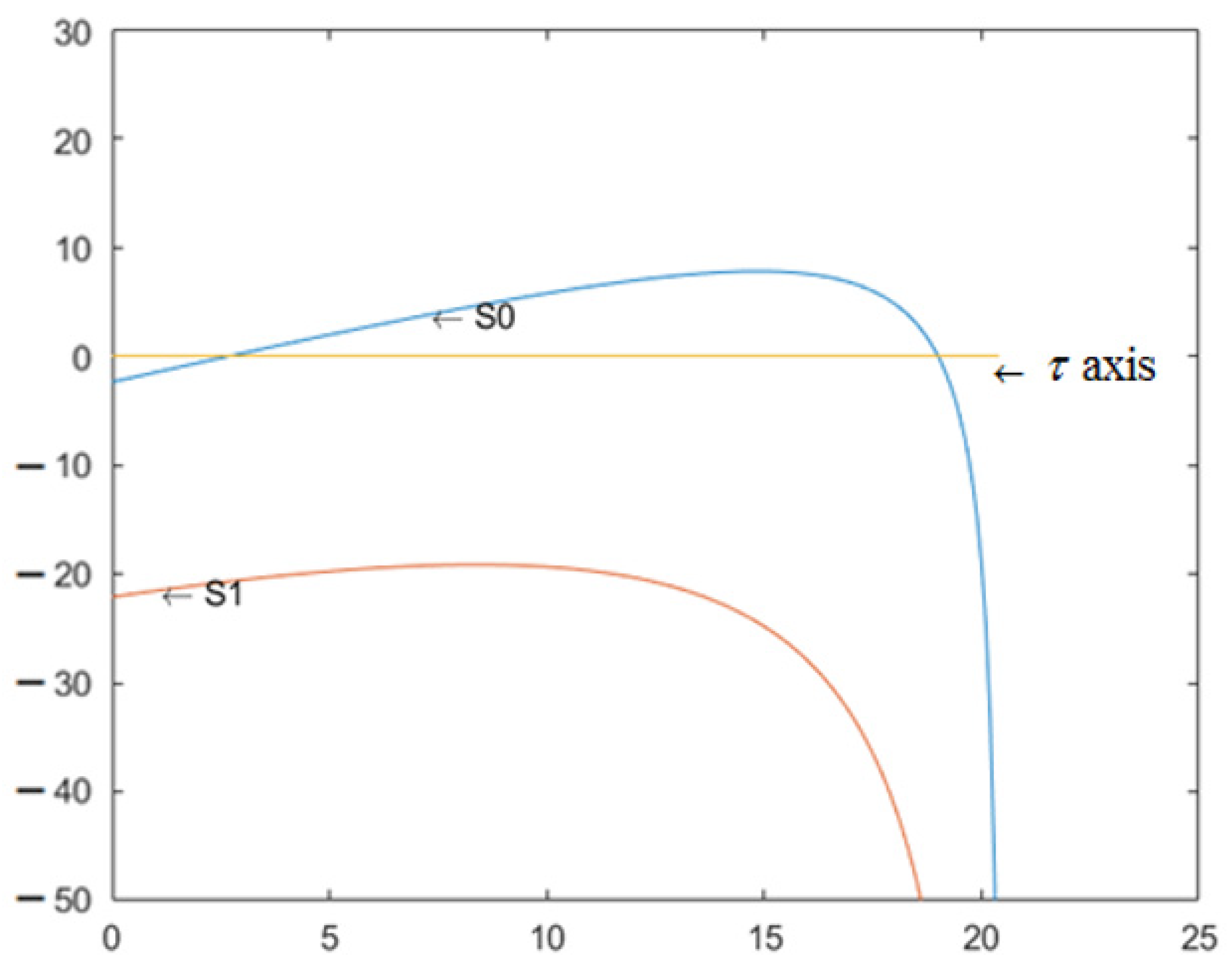
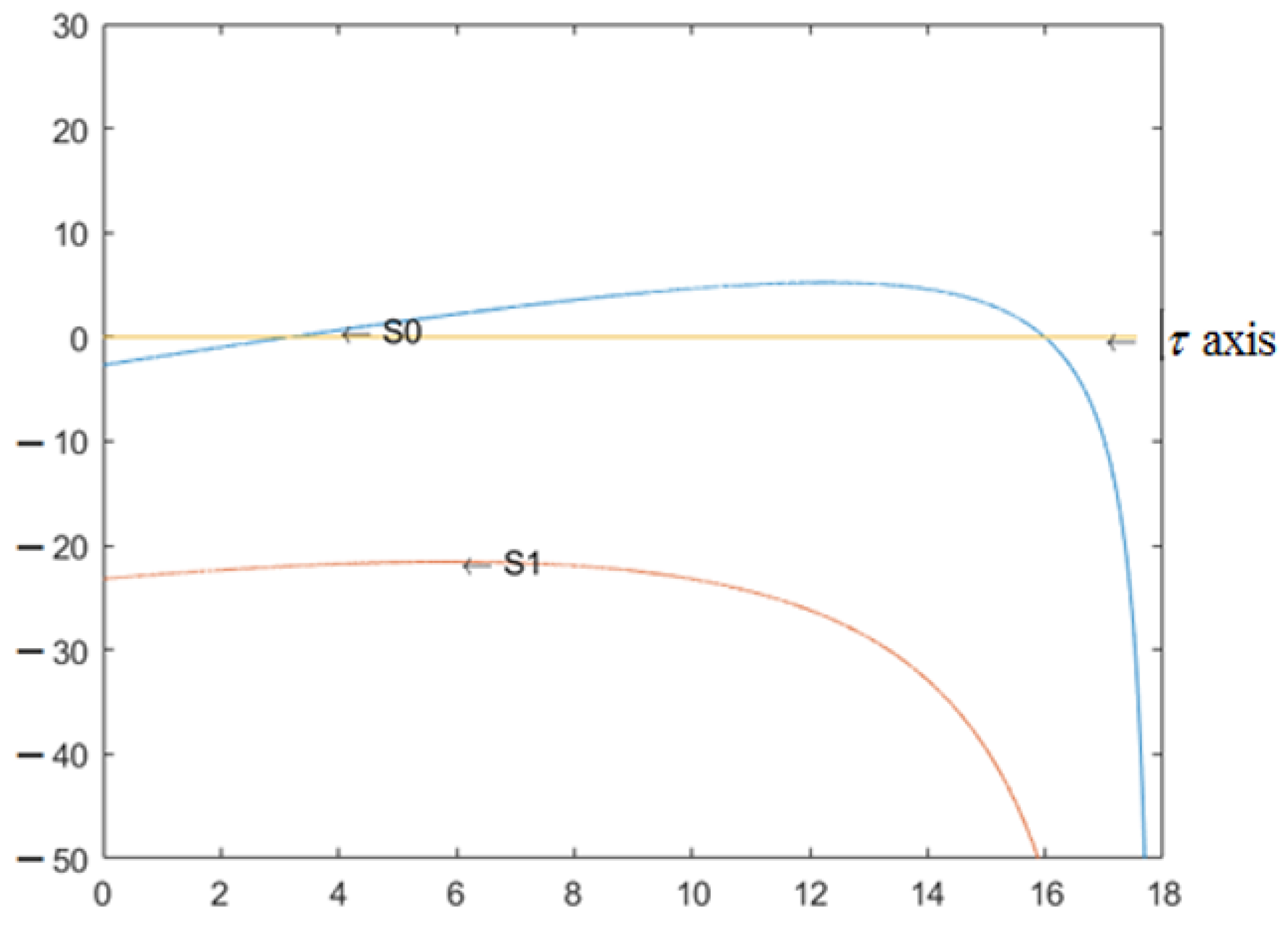
Figure 2 illustrates the curves of
and
as they change with
; it can be seen that
intersects with the
axis at two points; after calculation, they are
and
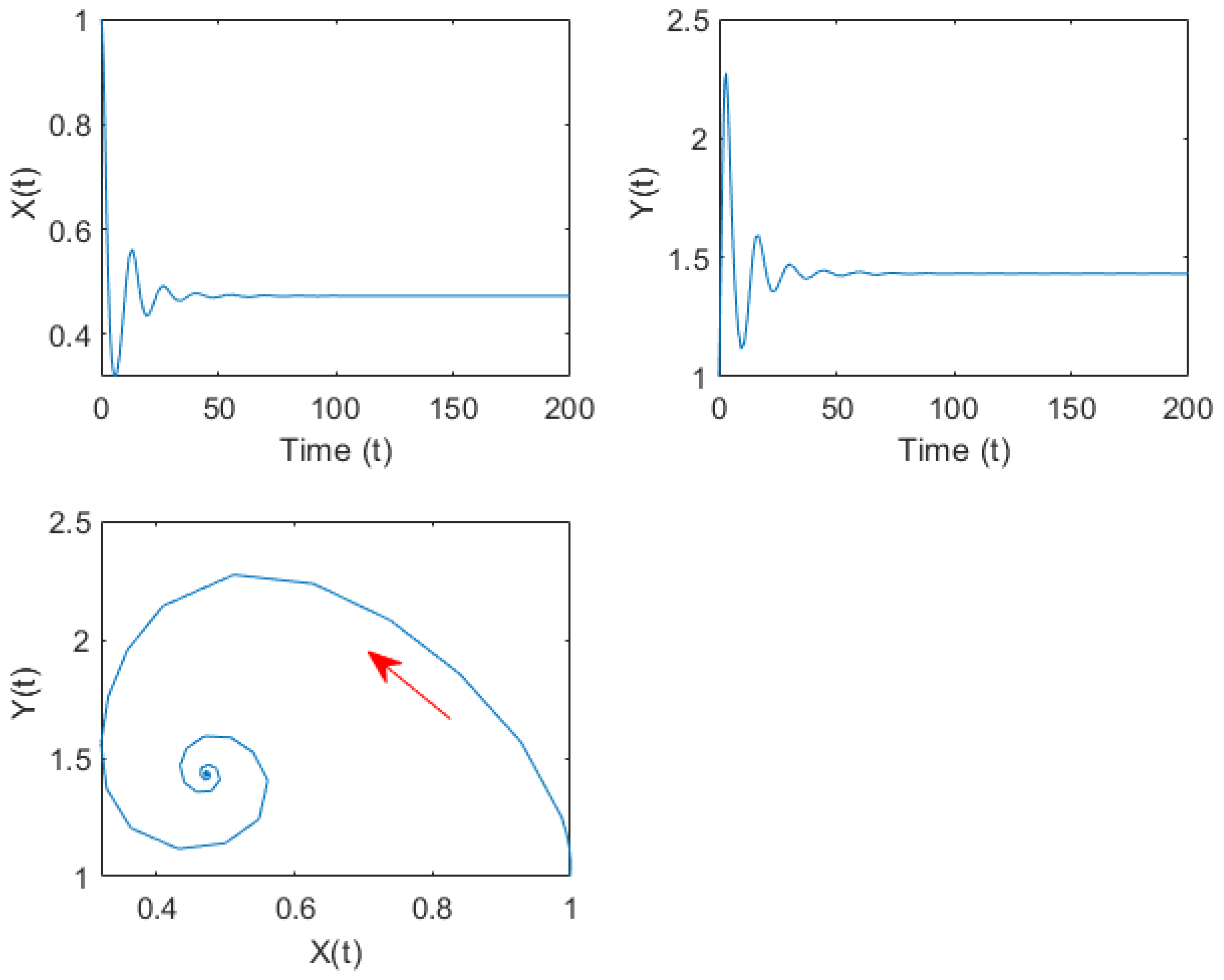
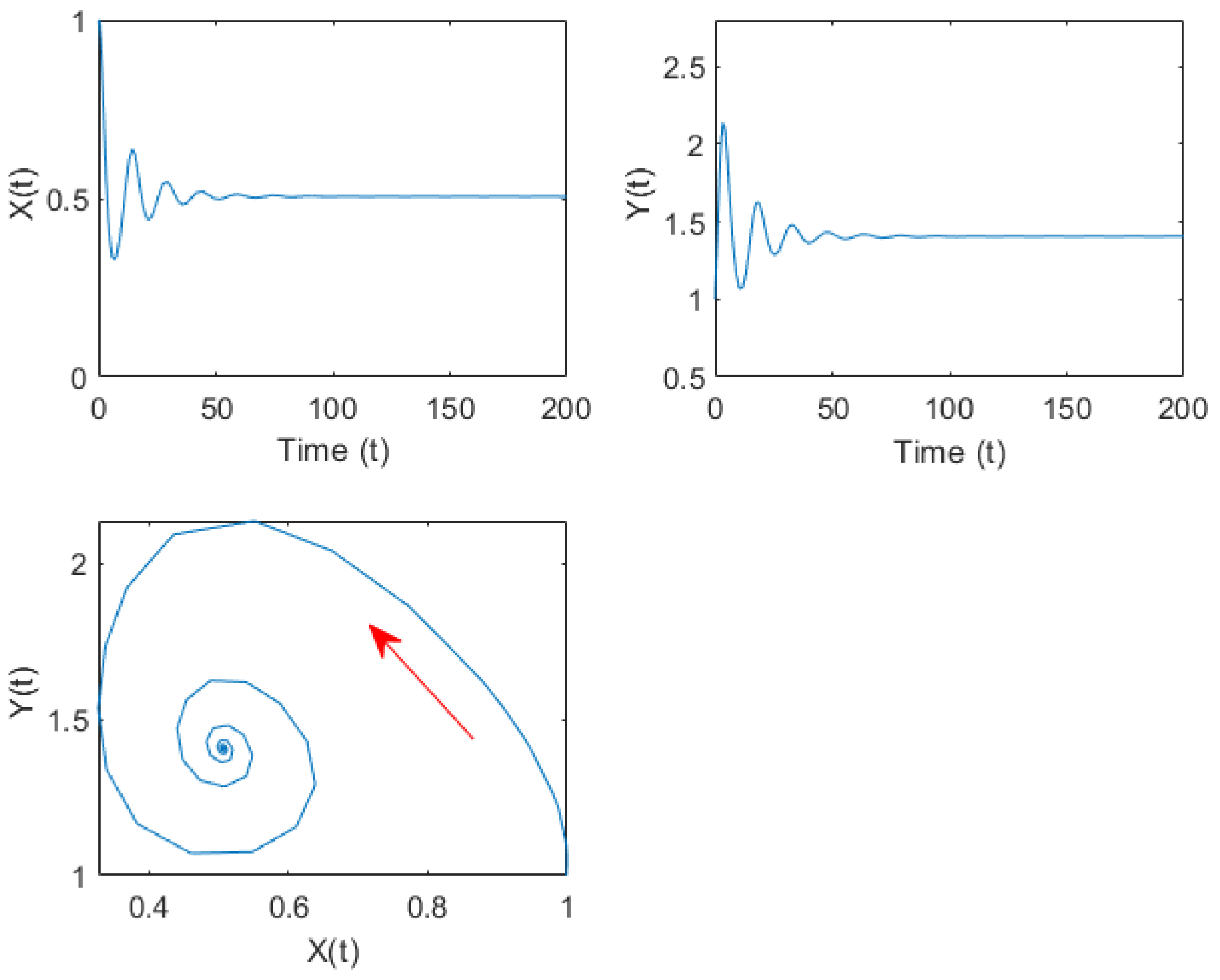
. According to Theorem 3, when
, the internal equilibrium
of system (31) is asymptotically stable, as shown in
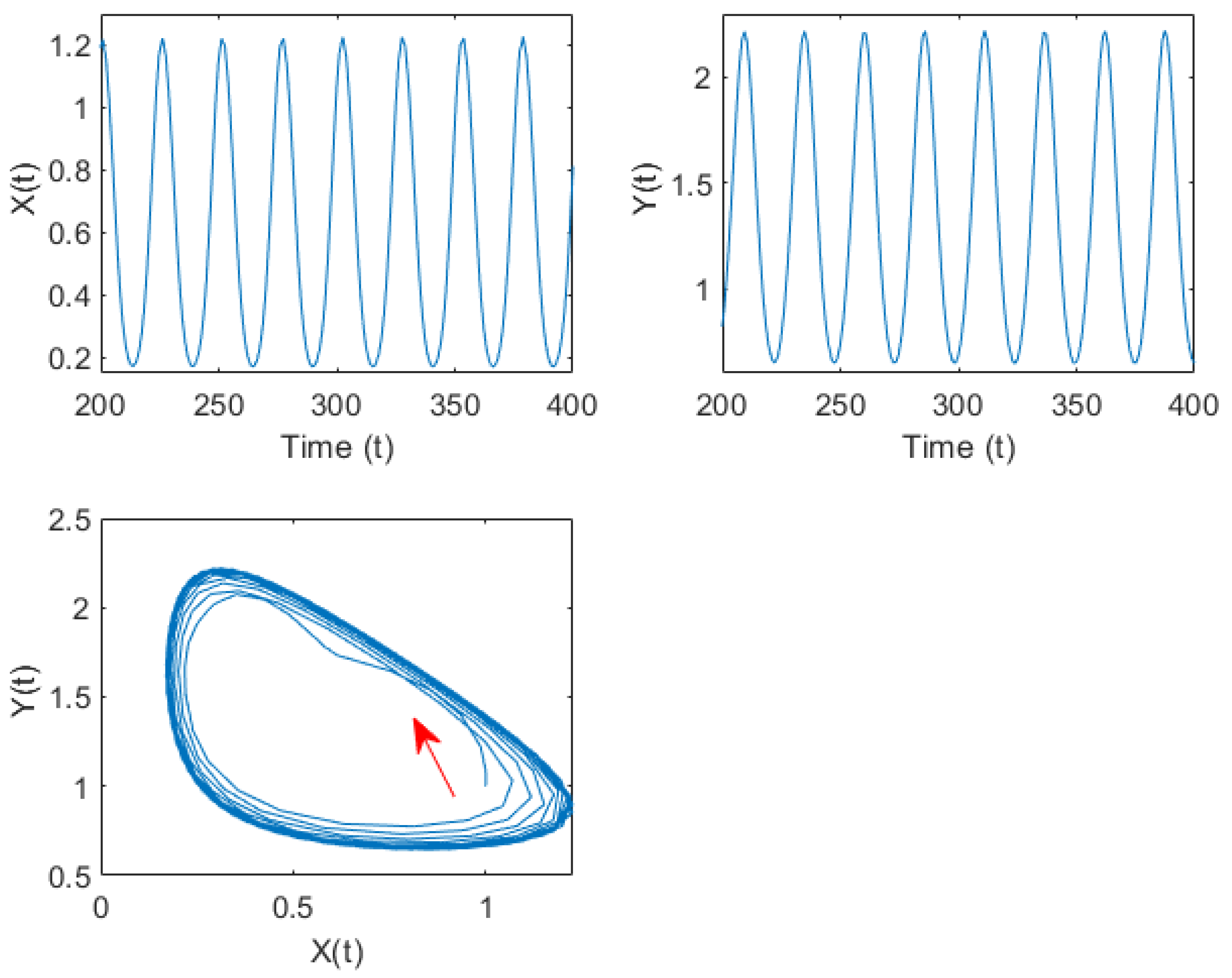
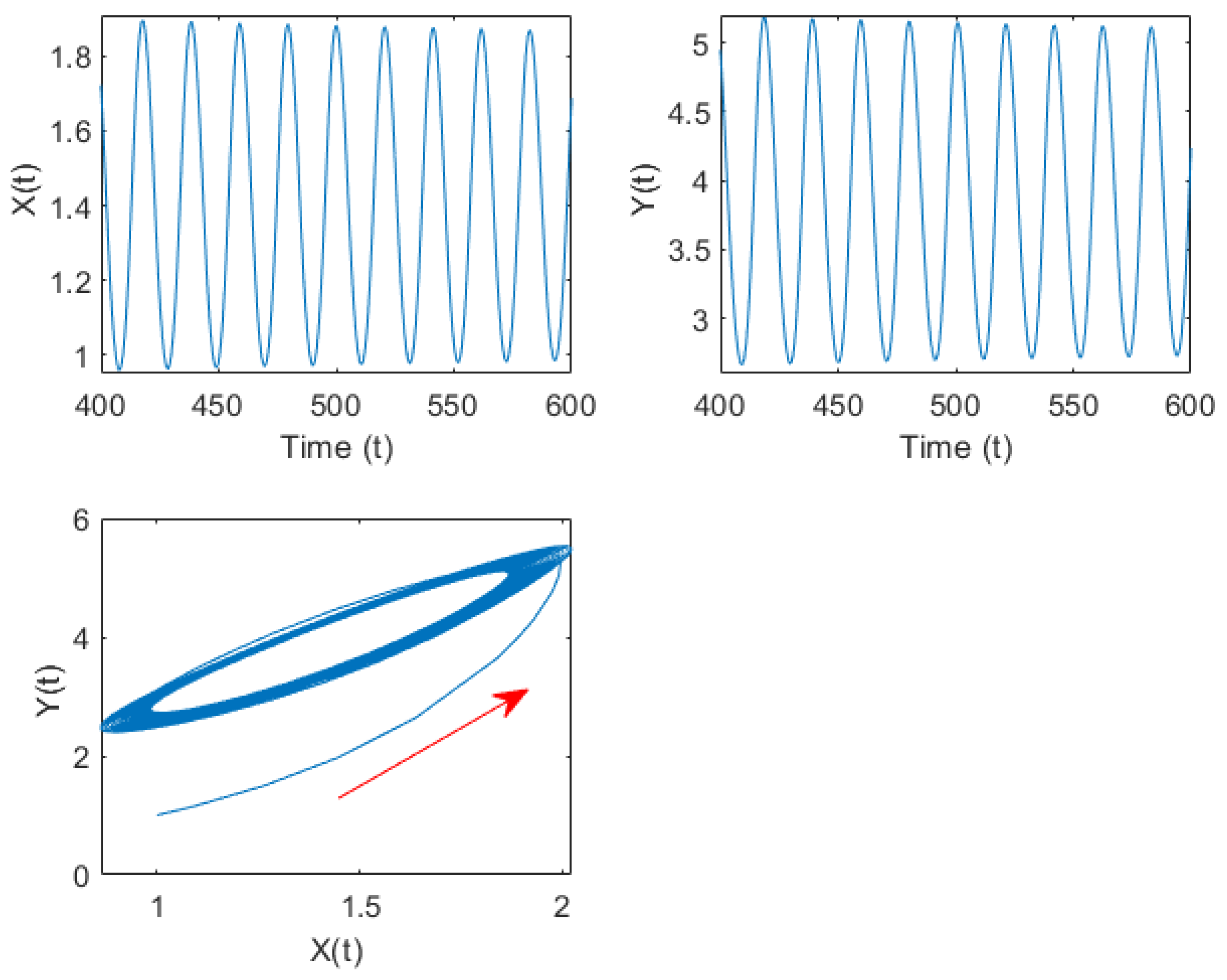
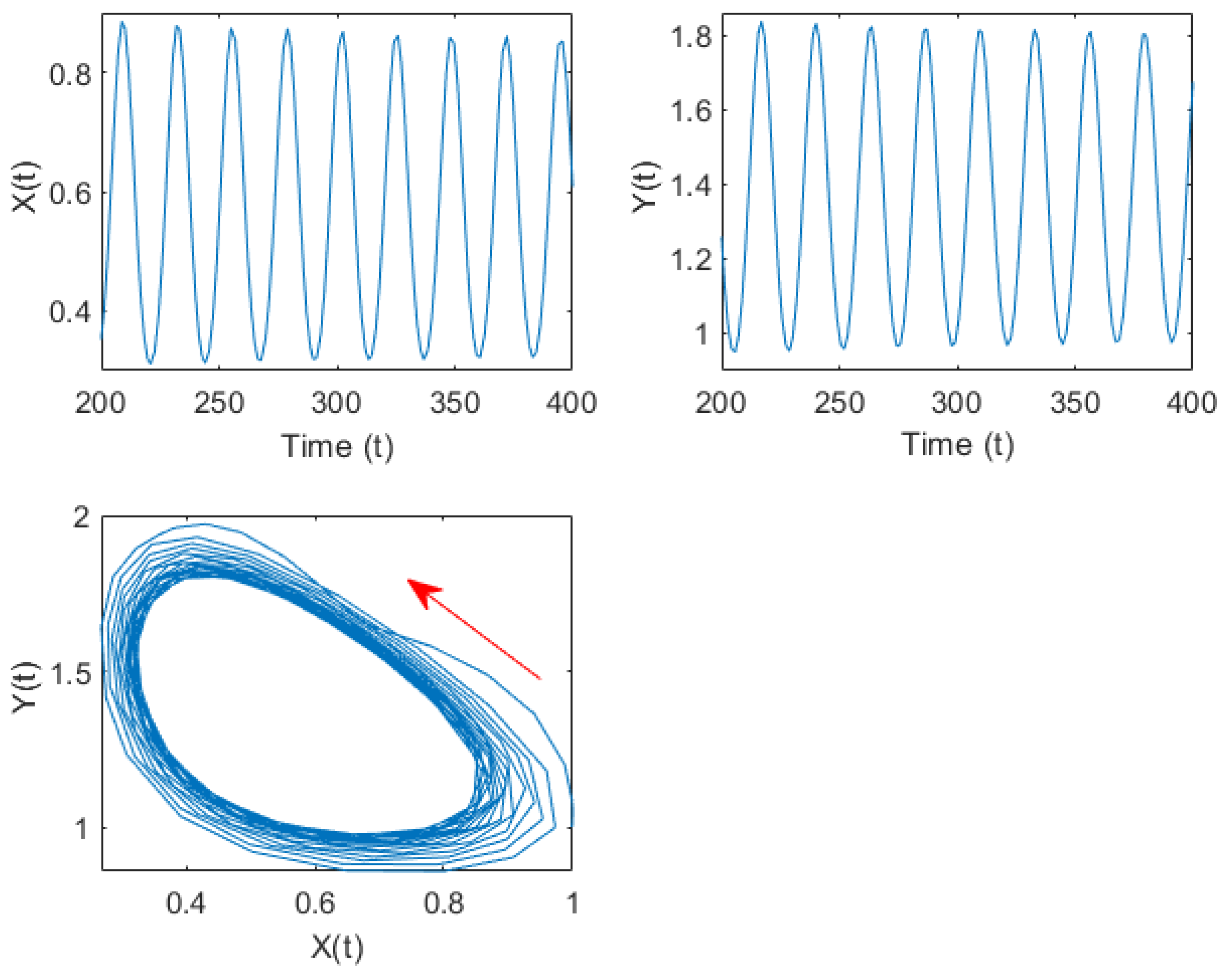
Figure 3. When
, the internal equilibrium
of system (31) is unstable. System (31) undergoes Hopf bifurcation at the internal equilibrium
, as shown in
Figure 4.
Case 3. .
Select parameters (B),
, and system (6) becomes:
Select
belongs to the stable interval,
is the bifurcation parameter, and
are true. After calculation, it can be concluded that
, so (
) is valid. Because
,
is true. At this time
, select
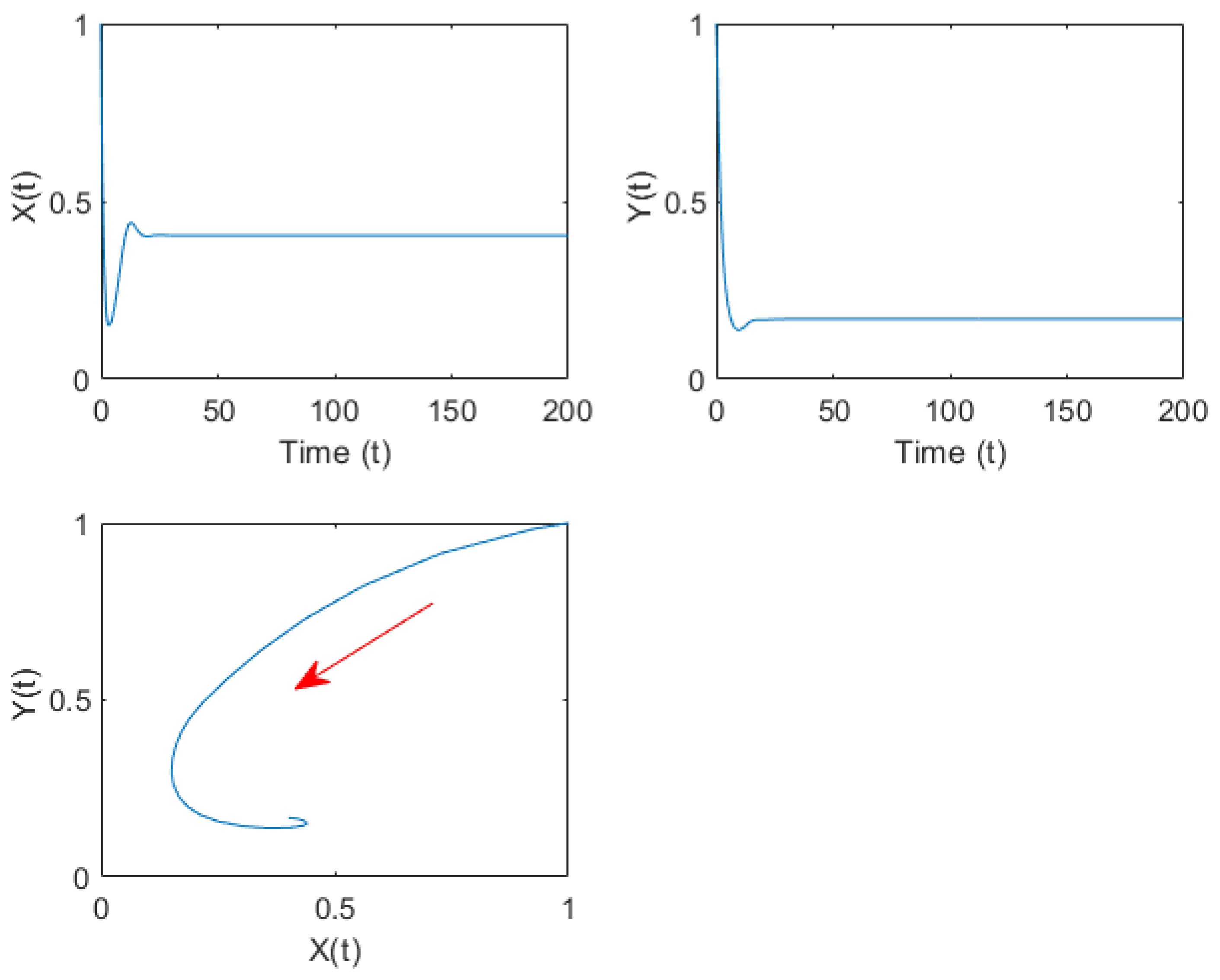
; according to Theorem 4, when
, the internal equilibrium
of the system (32) is asymptotically stable, as shown in
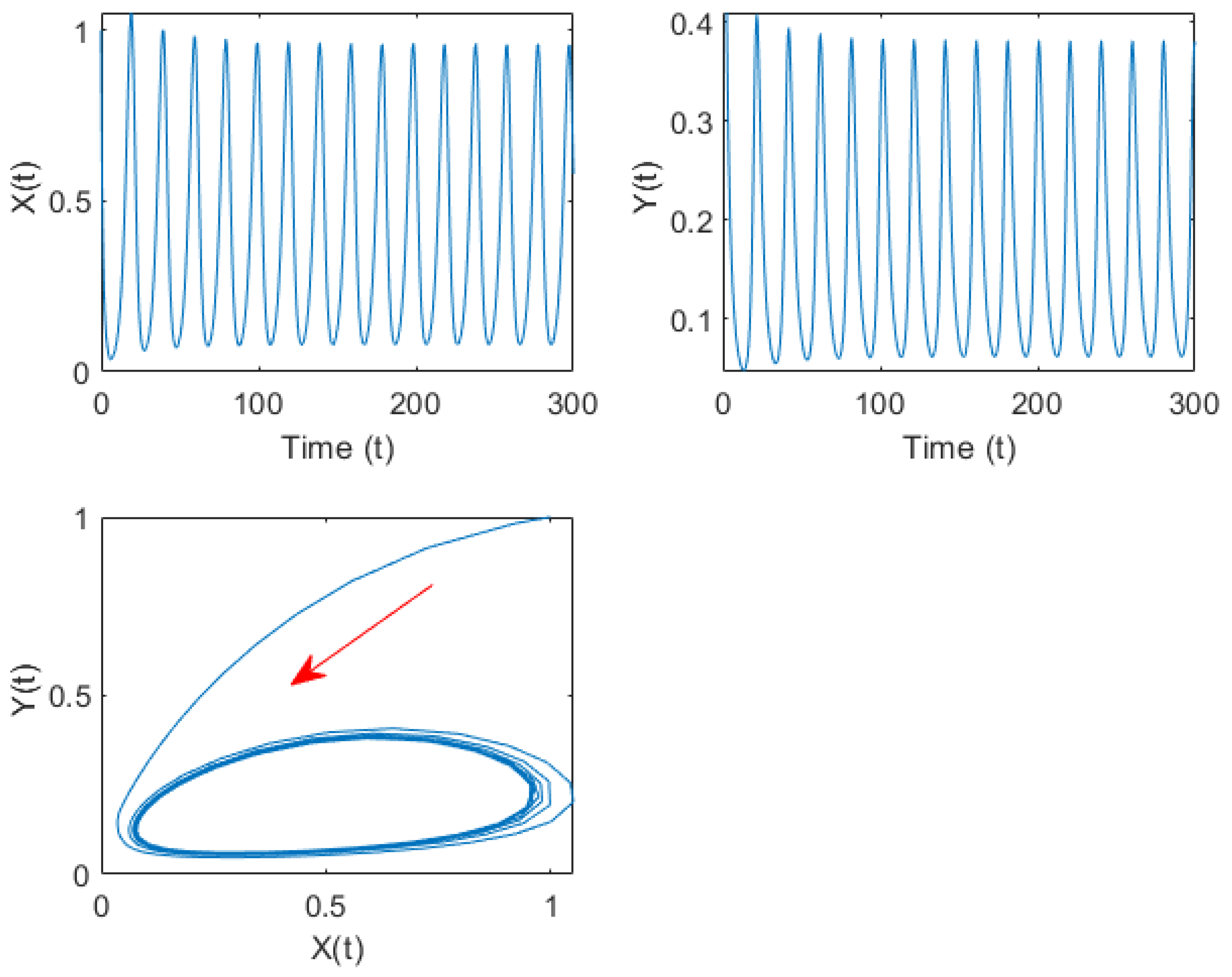
Figure 5. When
, the internal equilibrium
of the system (32) is unstable. System (32) undergoes Hopf bifurcation at the internal equilibrium
, as shown in
Figure 6.
Case 4.
Select parameters (C),
, and system (6) becomes:
The internal equilibrium of the system is
, so
is valid. After calculation,
are true. At this time
; according to Theorem 5, it can be concluded that, when
, the internal equilibrium
of the system (33) is asymptotically stable, as shown in
Figure 7. When
, the internal equilibrium
of the system (33) is unstable. System (33) undergoes Hopf bifurcation at the internal equilibrium
, as shown in
Figure 8.
Case 5.
Select parameters (D),
, and system (6) becomes:
Select
belongs to the stable interval,
is the bifurcation parameter, and
are true.
Figure 9 depicts the curves of
and
as they change with
. It can be seen that
intersects with the
-axis at two points, which are calculated as follows:
and
. According to Theorem 6, when
, the internal equilibrium
of the system (34) is asymptotically stable, as shown in
Figure 10. When
, the internal equilibrium
of the system (34) is unstable, and Hopf bifurcation occurs from the positive equilibrium
. System (34) undergoes Hopf bifurcation at the internal equilibrium
, as shown in
Figure 11.