1. Introduction
Let
P be a poset and
a net on an up-directed set
I with value in the poset
P. The concept of order convergence of nets in a poset
P was introduced by Birkhoff [
1], Mcshane [
2], Frink [
3], Rennie [
4] and Ward [
5]. It is worth noting that the authors may have attached different meanings to the order convergence. Following the formulation of Wolk [
6], we correspond to the following two modes of order convergence:
Definition 1 ([
1,
2,
3])
. A net in a poset P is said to o-converge
to an element (in symbol ) if there exist subsets M and N of P such that- (A0)
M is up-directed and N is down-directed;
- (B0)
;
- (C0)
For every and , holds eventually, i.e., there is such that for all .
Definition 2 ([
4,
5,
6])
. A net in a poset P is said to -converge
to an element (in symbol ) if there exist subsets M and N of P such that- (A2)
;
- (B2)
For every and , holds eventually.
A research topic concerning the
o-convergence and
-convergence, which are closely related to our work, is from the topological aspect. The
o-convergence in a poset
P may not be topological, i.e., there does not exist a topology
on the poset
P such that the
o-convergent class and the convergent class with respect to the topology
are equivalent. In [
7], based on the introduction of Condition(*) and the double continuity for posets, Zhou and Zhao proved that, for a double continuous poset
P with Condition(*), the
o-convergence in the poset
P is topological. As a further result, Condition (Δ), a weaker condition than Condition(*), and the
-doubly continuous posets were defined in [
8]. It was shown that, for a poset
P with Condition (Δ), the
o-convergence in the poset
P is topological if and only if the poset
P is
-doubly continuous. Following the ideal in [
8], Sun and Li [
9] studied the B-topology on posets and found that the
o-convergence in a poset
P is topological if and only if the poset
P is
-doubly continuous, which demonstrates the equivalence between the
o-convergence being topological and the
-double continuity of a poset. Moreover, the ideal-
o-convergence, a generalized form of
o-convergence established via ideals, was defined in posets by Georgiou et al. [
10,
11]. Also, the authors obtained that the ideal-
o-convergence in a poset
P is topological if and only if the poset
P is
-doubly continuous. This generalized the previous results on the
o-convergence.
On the other hand, the
-convergence is also not topological generally. To characterize these posets so that the
-convergence is topological, Zhao and Li [
12] studied the notions of
-double continuous posets and
-double continuous posets. Under some additional conditions, the
-convergence in these posets is topological. Ulteriorly, Li and Zou [
13] proposed the concept of
-doubly continuous posets and showed that the
-convergence in a poset
P is topological if and only if the poset
P is
-doubly continuous, meaning that they gave a sufficient and necessary condition for the
-convergence to be topological. Further, Georgiou et al. [
14] extended the
-convergence to be the ideal-
-convergence via ideals, and showed that the
-double continuity can equivalently characterize such a convergence to be topological.
From the order-theoretical aspect, by the definitions, one can readily verify that the
o-convergence implies the
-convergence, i.e., if a net
in a poset
P o-converges to an element
, then it
-converges to
x. However, the converse implication is not true. This fact can be demonstrated by the example in [
6]. Hence, in [
6], Wolk posed the following fundamental problem:
Problem 1. Under what conditions for a poset P do the o-convergence and -convergence in P agree?
A well-known result on this problem is that the
o-convergence and
-convergence in a lattice are equivalent. Then, Wolk [
6] obtained a result on the characterization of posets for the associated
o-inf convergence (a counterpart of
o-convergence) and
-inf convergence (a counterpart of
-convergence) being equivalent, which provides an approximate solution to the fundamental problem, using the concepts of Frink ideals and dual Frank ideals [
15].
Motivated by these results toward the problem mentioned above, in this paper, we continue to make some further investigations on the o-convergence and -convergence, hoping to clarify the order-theoretical condition of a poset P, which is sufficient and necessary for the o-convergence and -convergence to be equivalent.
To this end, in
Section 2, following the Frink ideal (the dual Frink ideal), the concepts of local Frink ideals (dually local Frink ideals) and ID-pairs in posets are further proposed, and then the relationship between ID-pairs and nets is presented.
Section 3 is devoted to the order-theoretical characterization of the local Frink ideal (the dually local Frink ideal) generated by a general set. Using this characterization, we prove that the ID-double continuity is the precise feature for those posets for which the two modes of order convergence are equivalent.
For the unexplained notions and concepts, one can refer to [
6,
16,
17].
2. Local Frink Ideal (Dually Local Frink Ideal) in Posets
We appoint some conventional notations to be used in the sequel. Let X be a set. We take to mean that F is a finite subset of the set X, including the empty set ∅. Given a poset P and . The notations and are used to denote the set of all upper bounds of K and the set of all lower bounds of L, respectively, i.e., and . Particularly, if the sets K and L are all reduced to be a singleton , then the notations and are reserved to denote the sets and , respectively.
Since the Frink ideal (the dual Frink ideal) in posets plays a fundamental role in the discussion of this section, we first review its definition.
Definition 3 ([
15])
. Let P be a poset.- (1)
A subset K of the poset P is called a Frink ideal if, for every , we have . Furthermore, a Frink ideal K is said to be normal if .
- (2)
A subset L of the poset P is called a dual Frink ideal if, for every , we have . Furthermore, a dual Frink ideal L is said to be normal if .
Based on the Frink ideal (the dual Frink ideal), we further define the local Frink ideal (the dually local Frink ideal) in posets.
Definition 4. Let P be a poset and .
- (1)
The subset K is called a local Frink ideal in Li f, for every and every , we have .
- (2)
The subset L is called a dually local Frink ideal in K if, for every and every , we have .
Example 1. Let be the set of all real numbers, in its usual order, and let . If we take and , then, by Definition 4, the interval K is a local Frink ideal in L and the interval L is a dually local Frink ideal in K.
Given a poset P and . We simply denote by the family of all local Frink ideals in L and, by , the family of all dually local Frink ideals in K.
Remark 1. Let P be a poset and . Then,
- (1)
From the logic viewpoint, it is reasonable to stipulate that . Thus, for every and every , we have if the poset P has the least element ⊥. Dually, for every and every , we have if the greatest element ⊤ exists in the poset P.
- (2)
If , then for every . And, dually, if , then for every .
- (3)
The subset K is a Frink ideal if and only if . And, dually, the subset L is a dual Frink ideal if and only if .
Proposition 1. Let P be a poset and .
- (1)
If , then the subset K is a Frink ideal.
- (2)
If , then the subset L is a dual Frink ideal.
Proof. (1): Suppose that . Then, we have for every and . This implies that . Thus, we conclude that for every . This shows that the subset K is a Frink ideal.
(2): The proof is similar to that of (1). □
However, the converse implications of Proposition 1 may not be true. This fact can be clarified in Example 7.
Definition 5. Let P be a poset. A pair consisting of subsets K and L of P is called an ID-pair in P if and . Moreover, an ID-pair in P is said to be nontrivial if one of the following conditions is exactly satisfied:
- (1)
, where denotes the cardinal of the poset P;
- (2)
and .
Example 2. Let , with the partial order ≤ defined by
Take and . Then, it is easy to see from Definitions 4 and 5 that the pair is a nontrivial ID-pair.
Proposition 2. Let be an ID-pair in a poset P. Then, the ID-pair is nontrivial if and only if for every and every .
Proof. (⇒): Let be a nontrivial ID-pair in a poset P. We consider the following cases:
- (i)
, i.e., the poset contains only one element p.
It is easy to check that for every and every .
- (ii)
.
Suppose that for some and . Then, we have and since is an ID-pair in the poset P. This implies that , which is a contradiction to the assumption that the ID-pair is nontrivial. Hence, we have that for every and every .
By (i) and (ii), we conclude that for every and every .
(⇐): Suppose that is an ID-pair such that for every and every . If , then the ID-pair is nontrivial by Definition 5. If , i.e., , then, by the assumption, we have and for all . It follows that for all . Hence, we conclude that . This shows, by Definition 5, that the ID-pair is nontrivial. □
In fact, given a poset P and a Frink ideal K (resp. a dual Frink ideal L) of the poset P, we can select a subset L (resp. a subset K) of P such that the pair is a nontrivial ID-pair.
Theorem 1. Let P be a poset.
- (1)
If K is a Frink ideal of the poset P, then the pair is a nontrivial ID-pair for some subset L of the poset P;
- (2)
If L is a dual Frink ideal of the poset P, then the pair is a nontrivial ID-pair for some subset K of the poset P.
Proof. (1): Suppose that K is a Frink ideal of P. Set . Now, we process to show that the pair is an ID-pair. Let and . We consider the following two cases:
- (i)
.
Since
K is a Frink ideal, by the definition of
L, we have
- (ii)
.
By the definition of
L, there exists
such that
for every
. This means that
for every
. Thus, we have
, which implies that
The combination of (i) and (ii) shows that the pair is an ID-pair in P. Finally, we prove that the ID-pair is nontrivial. Assume that . Let . Then, by the definition of L, there exists such that , which implies that . Since , we have , i.e., . Similarly, we can prove that . This means that , and thus we have . By Definition 5, it follows that the ID-pair is nontrivial.
(2): By a similar verification to that of (1). □
Example 3. Let P be a chain, i.e., for all , either or . For every , by Definition 4 we have that the set is a Frink ideal. Obviously, by Definitions 4 and 5, the set can be selected such that the pair is a nontrivial ID-pair in P.
Given a poset
P and a net
in the poset
P, an element
is called an
eventually lower bound of the net
provided that there exists
such that
for all
. An
eventually upper bound of the net
is defined dually. Following the notations of Wolk [
6], we also take the symbols
and
to mean the set of all eventually lower bounds of the net
and the set of all eventually upper bounds of the net
, respectively. If we denote
, then
and
. For a set
X, the symbol
means that
Y is a proper subset of the set
X, i.e.,
and
. In the following, we always take
to represent the ordinary order on
, the set of all positive integers.
Now, we can establish a correspondence between the nets and the ID-pairs:
Theorem 2. Let P be a poset. Then, a pair in P is a nontrivial ID-pair if and only if there exists a net in P such that and .
Proof. (⇐): Let be a pair of subsets of the poset P. Suppose also that is a net in the P such that and . For every and every , we consider the following cases:
- (i)
.
Since and , we have that for all . This implies that and for all . Hence, and .
- (ii)
and .
Since , for every , there exists such that . Take such that for all . Then, we have , which implies that , and . It follows that and .
- (iii)
and .
By a similar verification to that of (ii), we can also prove that , and .
- (iv)
and .
Since and , there exist such that and for all and . Take such that for all and . Then, we have , which implies that , and . Thus, and .
By (i)–(iv), Definition 4 and Proposition 2, we conclude that the pair is a nontrivial ID-pair in the poset P.
(⇒): Assume that the pair is a nontrivial ID-pair in the poset P. We take the following cases into consideration:
- (v)
Either the set K or the set L is infinite.
Without loss of generality, we can assume that the set K is infinite. As the ID-pair is nontrivial, we have that for every and every by Proposition 2. Let be the cardinal, linearly ordered by , of the set , and be a one-to-one function from onto for every and every . Put . For any , we define if and only if one of the following conditions is satisfied:
- (1)
, and ;
- (2)
and .
Now, one can readily check that the ordered set I is up-directed. Let the net in the poset P be defined by for every . Next, we proceed to prove that and . Let . Then, there exists such that . Take and with . Then, we have since the pair is a nontrivial ID-pair. According to the definition of I, it follows that for every , which implies that for every . Hence, we conclude that . This shows that . Thus, . Conversely, let . Set and . Then, by the definition of I, it is easy to see that for all . For every with , by the definition of I, we have and , which implies that . It follows that for every . This means that . Hence, we conclude that . This shows that . It can be similarly proved that .
- (vi)
Both the sets K and L are finite.
Since the pair is a nontrivial ID-pair in the poset P, it follows that , and . Let , well ordered by , denote the cardinal of the set , and be a one-to-one function from the cardinal onto the set . Set . For any , we define if and only if one of the following conditions is satisfied:
- (3)
and ;
- (4)
and .
It can easily be checked that the ordered I is up-directed. Let be the net in the poset P by defining for all . Now, it remains to show that and . Let . Then, we have . By the definition of the net , it follows that for all . This means that for all . Hence, we conclude that , which shows that . Conversely, let . Then, there exists such that . Since , for all , it follows that for all . This implies that . Hence, we have . This shows that . Therefore, . A similar verification can show that .
By (v) and (vi), we can conclude that there exists a net in the poset P such that and . Thus, the proof is completed. □
Example 4. Let with the partial order ≤ defined by
Consider the net defined bywhere the up-directed set is the set of all positive integers in its usual order. By the definition of the net , we have and . On the other hand, it follows from Definition 4 and Definition 5 that the pair is a nontrivial ID-pair. This demonstrates Theorem 2 in the case. The combination of Proposition 1 and Theorems 1 and 2 indicates that the eventually lower bounds and eventually upper bounds of a net are precisely a Frink ideal and a dual Frink ideal, respectively (see Corollary 1). However, they are not independent. Theorem 2 clarifies the correlation between the Frink ideal and the dual Frink ideal from the point of view of order; that is, the Frink ideal and the dual Frink ideal must be matched as a nontrivial ID-pair. Also, this is the initial motivation of introducing the local Frink ideal (the dually local Frink ideal) and ID-pair for posets in the sequel.
Corollary 1 ([
6]).
Let P be a poset and . Then,- (1)
The subset K is a Frink ideal if and only if for some net in the poset P;
- (2)
The subset L is a dual Frink ideal if and only if for some net in the poset P.
3. ID-Doubly Continuous Posets
Given a poset P and , let . Then, one can readily verify by Definition 4 that the intersection contains the set M and is again a local Frink ideal in the set N. This local Frink ideal is called the local Frink ideal generated by the set M and denoted by . Thedually local Frink ideal generated by the set N is defined dually, and denoted by . Next, we clarify the structure of and :
Proposition 3. Let P be a poset and . Then,
- (1)
;
- (2)
.
Proof. (1): Denote the set by . Then, it is easy to see that . Now, we proceed to prove that . Let and . We should consider the following cases:
- (i)
.
Since , it follows that for all , which implies that for all . This means that for all . Hence, we infer that .
- (ii)
.
It follows by the definition of
that, for every
, there exist
and
such that
. Take
and
. Then, we have that
,
and
This implies that , which means that for all . Thus, we conclude that by the definition of .
According to (i), (ii) and Definition 4, we show that .
To complete the proof, it suffices to prove that for every with . Let . Then, by the definition of , there exist and such that . This means that . Since and , it follows that . So, we have that . Consequently, we infer that .
(2): The proof is similar to that of (1). □
Lemma 1. Let P be a poset and . Then, we have that and , i.e., the pair is an ID-pair in the poset P.
Proof. We only show that ; the fact can be similarly proved. Let and . We consider the following cases:
- (i)
and .
If the least element ⊥ exists in the poset P, then we have that by Remark 1. It follows that . If the poset P has no least element, then by Remark 1 again. This shows that .
- (ii)
and .
By Proposition 3, there exist
and
such that
for all
. Take
and
. Then, we have that
,
and
It follows that , which implies that for all . Thus, by Proposition 3, we have that for all . This means that .
- (iii)
and .
Proceeding as in the proof of (ii), we can again have .
- (iv)
and .
By Proposition 3, there exist
and
such that
and
for all
and
. Set
and
. Then, we have that
,
and
This implies that , which concludes that for all . Hence, by Proposition 3, we have .
According to (i)–(iv) and Definition 4, we infer that . □
Lemma 2. Let P be a poset and . If , then we have .
Proof. Let . Then, one can readily check, by Proposition 3, that and . It follows that . □
We turn to define the ID-double continuity for posets. Since the ID-double continuity has a close relationship to Property A, proposed by Wolk, we review Property A and its dual form for posets in the following:
Definition 6 ([
6]).
A poset P has Property A
if, for every non-normal Frink ideal K with , there exists an up-directed subset such that . Dually, a poset P has Property DA
if, for every non-normal dual Frink ideal L with , there exists a down-directed subset such that . Definition 7. A poset P is called an ID-doubly continuous poset if, for every ID-pair in the poset P with , there exist an up-directed subset and a down-directed subset such that .
Example 5. (1) Every finite poset is ID-doubly continuous;
(2) Every lattice is ID-doubly continuous.
Suppose that P is a finite poset and is an ID-pair with . Then, we have that and . Since the pair is an ID-pair, by Definition 4 and Definition 5, it follows that and , which implies that and . This means that the singleton is an up-directed subset of K and also a down-directed subset of L such that . So, by Definition 7, the finite poset P is ID-doubly continuous.
The fact that every lattice is ID-doubly continuous can also be readily checked by Definition 7.
Proposition 4. Let P be a poset. If the poset P has Property A and Property DA, then it is an ID-doubly continuous poset.
Proof. Let be an ID-pair in the poset P with . Then, by Proposition 1, the set K is a Frink ideal. If , then we have that is an up-directed subset of K and . If , then K is a non-normal Frink ideal since . By Property A, it follows that there exists an up-directed subset such that . A similar verification can prove that there exists a down-directed subset such that . Hence, the poset P is ID-doubly continuous. □
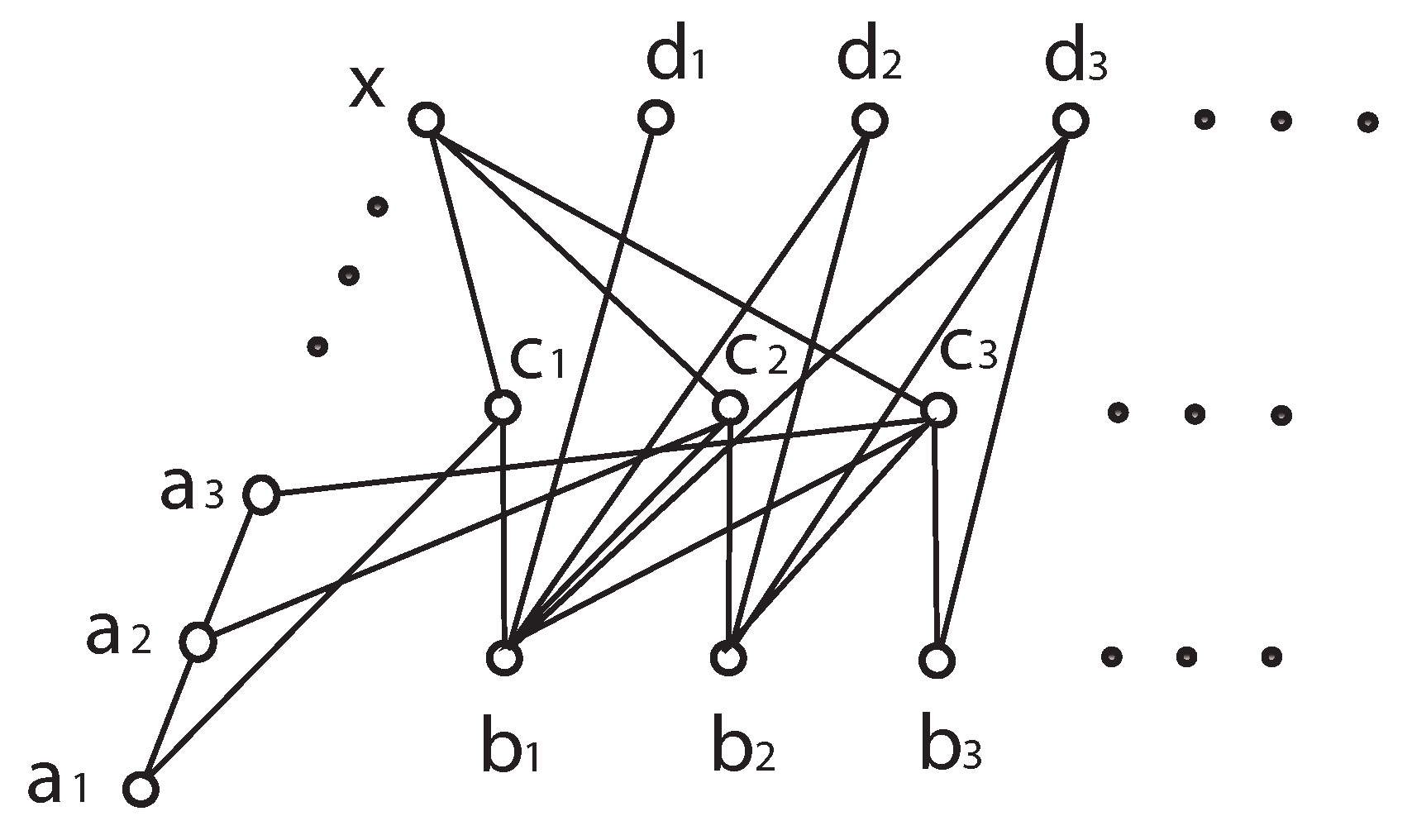
In general, an ID-doubly continuous poset may not possess Property A and Property DA. For such an example, one can refer to Example 7 in
Section 4.
Now, we arrive at the main result:
Theorem 3. A poset P is ID-doubly continuous if and only if the o-convergence and -convergence in the poset P are equivalent.
Proof. (⇒): Suppose that a poset
P is ID-doubly continuous. To prove the equivalence between the
o-convergence and
-convergence, it suffices to show that, for every net
in the poset
P, we have
Let . Then, by Definition 2, there exist subsets such that , and, for every and every , holds eventually. This means that and , which implies that and by Remark 1 and Theorem 2. According to Lemma 1 and 2, it follows that is an ID-pair with . Since the poset P is ID-doubly continuous, we have that for some up-directed subset and some down-directed subset . This concludes .
(⇐): Assume that the o-convergence and -convergence in a poset P are equivalent. Let be an ID-pair in the poset P with . Since for all and , the pair is a nontrivial ID-pair by Proposition 2. According to Theorem 2, there exists a net in the poset P such that and . Thus, we have . By the hypothesis, it follows that . This means that for some up-directed subset and some down-directed subset . So, the poset P is an ID-doubly continuous poset. □
By Example 5 and Theorem 3, we immediately have the following:
Example 6. (1) In every finite poset, the o-convergence and the -convergence are equivalent;
(2) In every lattice, the o-convergence and the -convergence are equivalent.
By Proposition 4 and Theorem 3, or by Definition 2 and Theorem 2 and 5 in [
6], we readily have the following:
Corollary 2. If a poset P has Property A and Property DA, then the o-convergence and -convergence in the poset P are equivalent.