


Abstract
Let be the complete 3-uniform hypergraph, where the vertex set is , in which the edge set is of all triples. Let denote the special tetrahedron with four edges, where each edge contains three vertices of degree 2. In this paper, we consider the decomposition and packing of a complete 3-uniform hypergraph of an fold special tetrahedron. Firstly, the necessary conditions for the existence of the fold decomposition are discussed in four distinct cases. Secondly, according to the recursive constructions, the required designs of small orders are found. For hypergraphs with large orders, they can be recursively generated using some designs of small orders. Then, it is proven that the above necessary conditions are sufficient. Finally, we prove that a maximum packing of a complete 3-uniform hypergraph exists for all and .
Keywords:
complete 3-uniform hypergraph; hypergraph decomposition; packing design; maximum packing; special tetrahedron; leave MSC:
05C65
1. Introduction
As efficient relational representation structures, graphs have been widely used for modeling pairwise relations. However, non-paired relations are difficult to effectively express using general simple graph structures. The emergence of hypergraphs provides a natural advantage for the expression of such relationships.
A hypergraph is defined as an ordered binary group , where is a finite set , the elements in are called vertices, is a family of finite non-empty subsets of , and the elements in are called hyperedges. If a hypergraph does not contain multiple hyperedges, that is, there are no repeated elements in its hyperedge , the hypergraph is called a simple hypergraph.
For a hypergraph, if every hyperedge has exactly vertices, such a hypergraph is called uniform. A 2-uniform hypergraph is a graph. A uniform hypergraph is called a complete uniform hypergraph if its hyperedge contains every subset of vertices exactly once. When , a completely uniform hypergraph is denoted as , where is the order of the hypergraph. Therefore, a complete 3-uniform hypergraph is a hypergraph with a vertex set , and its hyperedge set is 3-subsets of the vertex set . Each 3-subset occurs only once; that is to say, a complete 3-uniform hypergraph has hyperedges.
Let be a positive integer and be a uniform hypergraph, that is, is a hypergraph derived from , the vertices of which are those of , and the edges of which contain every edge of exactly times.
A commonly studied problem in combinatorics is the decomposition of hypergraphs into edge-disjoint sub-hypergraphs. Let be a uniform hypergraph and be a set of the uniform hypergraph. The decomposition of the hypergraph is its partitioning into sub-hypergraphs, each of which is isomorphic to a certain hypergraph of , which is denoted by design or . If only contains one type of hypergraph , it is denoted by . When , is replaced with .
Keevash [1] recently showed that for all and , the obvious necessary conditions for the existence of an design are sufficient for sufficiently large values of . Similar results were obtained by Glock, Kuhn, Lo, and Osthus [2,3], which included the corresponding asymptotic results for designs of order for all uniform hypergraphs . These results for uniform hypergraphs mirror the celebrated results of Wilson [4] for graphs. For , Feng Tao and Chang Yanxun [5] summed up the necessary conditions for the existence of .
Let be a non-negative integer. A design is an ordered triple , where is the set of vertices of , is the set of vertices of , is called a hole, and is the set sub-hypergraphs of , where each sub-hypergraph is isomorphic to a hypergraph in , each sub-hypergraph is called a block, and every edge of is required to be contained in a block of . Such a design is denoted as .
Let and be positive integers. Let be a set of vertices and be a family of hypergraphs whose vertices are defined on some subsets of . Then, every hypergraph in is isomorphic to a hypergraph in . Every hypergraph in is called a block. Let be a partition of , where is divided into non-empty subsets. Each non-empty subset is called a group. For an ordered triple , if each edge in the edge set of each block intersects any given group by one point at most, and, for any subset of , if the points in are from different groups, then is contained in exactly one block. Such a design is called a group-divisible design.
We use the usual exponential notation for the group-divisible designs. Then, type denotes that there are groups of size , . A group-divisible design of type can be denoted by , where the vertex set is . If contains only one hypergraph , we write as .
Let be a complete uniform hypergraph, . Then, packing is a binary , where is the finite vertex set of , and is the set of some sub-hypergraphs of , where each hypergraph of is isomorphic to a hypergraph in , called a block, and each edge of is contained in, at most, one block of . In this case, an packing design can be denoted by . When there is no packing such that the number of blocks in and the number of blocks in satisfy condition , then packing is called the maximum packing, denoted by . When , is replaced with . The same applies to hypergraph decomposition; when considering the packing design of hypergraphs, we mainly focus on the number of blocks.
For any subset of , let be the number of blocks containing . The leave of a packing is the uniform hypergraph spanned by all subsets of with multiplicity .
To enhance the understanding of hypergraph maximum packing, we give the following examples. First, in this paper, the symbol always denotes a hypergraph with vertices and edges , and such a hypergraph can be denoted as an ordered hextuple .
Example 1.
In this example, we first construct an on the point set . Its blocks, listed as follows:
It can be verified that the leave of the above packing contains three edges, , , and . Then, the above blocks form a maximum packing of .
In the theory of combinatorial mathematics, the study of graphs has been greatly improved. At present, many studies focus on the related problems of complete 3-uniform hypergraphs. Several authors have obtained many results on the decomposition, packing, and covering problems of 3-uniform hypergraphs, where is , and [5,6,7,8,9,10]. In 1987, Zbigniew LONC [11] defined the hyperstar, which is a 3-uniform hypergraph consisting of one vertex of degree and vertices of degree one, and it is denoted by . Necessary and sufficient conditions for the existence of decompositions of are given in [12] for and settled in [13] for any . Some results on maximum packings of are given in [14]. In 2014, Hoffman solved the packing and covering problems of any star [15]. Amber Armstrong [16] found the maximum packings of with copies of the symmetric triple-hyperstar with four edges. Ryan C. Bunge [17] resolved the problem of a maximum loose 3-cycle packing of a λ-fold complete 3-uniform hypergraph of order . The corresponding problems of tight six-cycle and tight nine-cycle decompositions of were resolved in [18,19].
Here, we are interested in the maximum packings of , where is a 3-uniform special tetrahedron with four edges [20]. The special tetrahedron is a hypergraph with a vertex set of , and its hyperedge set contains , as shown in Figure 1. The three vertices contained in each hyperedge appear twice, that is, vertex is contained in both the hyperedge and the hyperedge , so we call vertex “” a vertex of degree 2. Thus, each hyperedge of special tetrahedron contains three vertices of degree 2.
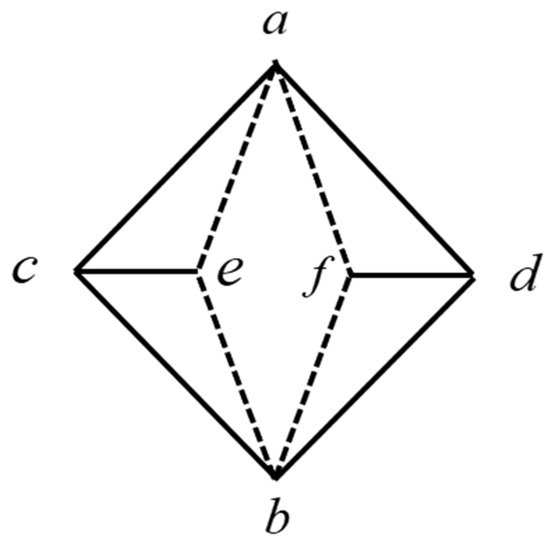
Figure 1.
The special tetrahedron (ST) of size 4, denoted as .
In this paper, we prove that for all , , a maximum packing of exists, where the leave has fewer than four edges. The rest of this paper is outlined as follows. Section 2 presents some related preliminaries, including notations, notions, and the method of analysis. In Section 3, we provide some small-order designs that are used to help prove the main conclusions of this paper. Other designs are listed in Appendix A. In Section 4, we prove the main results. We first show the decompositions and packings of simple hypergraphs. Based on the simple hypergraphs, we consider the decomposition of and its maximum packing of . In Section 5, we provide the conclusions of this work. In Section 6, we discuss the practical implications of the findings, especially their application in neural networks.
2. Preliminaries
2.1. Additional Notations and Terminology
Let . The complete tripartite 3-uniform hypergraph consists of the vertex set and the hyperedge set , where , , and for . The hypergraph is denoted by . Currently, this partition of is denoted by , where .
Let . The complete bipartite 3-uniform hypergraph consists of the vertex set and the hyperedge set , where , , and for . The hypergraph is denoted by . Currently, this partition of is denoted by .
For the complete 3-uniform hypergraph , the -fold maximum packing of the special tetrahedron is denoted by , and the -fold decomposition of the special tetrahedron is denoted by . When , is denoted by , and is denoted by .
2.2. Method of Analysis
Theorem 1.

Let , , and be non-negative integers. Let and . Under the given conditions, a partition of exists, as shown as Figure 2, which comprises isomorphic copies of each of the following:
Figure 2.
The partition of .
- if ;
- if ;
- , , , if ;
- , , , , if .
Proof of Theorem 1.
When and , then , and , , and are empty (i.e., without any edges), and the decomposition is trivial. Let , , , , and be pairwise-disjoint sets of vertices with , . Then, the above theorem has five cases:
- Case 1: When , , , the partition of is with the vertex set , and the decomposition is trivial.
- Case 2: When , , . Let , where the partition of is with the vertex set , and the decomposition is trivial.
- Case 3: When , , . Let , where the partitions of are two with each vertex set , two with each vertex set and the hole set , one with the vertex set , and one with the vertex set .
- Case 4: When , , . Let , where the partitions of are three with each vertex set , three with each vertex set and the hole set , three with each vertex set , three with each vertex set , and one with the vertex set .
- Case 5: When , , . Let , where the partition of is with each vertex set , with each vertex set and the hole set , with each vertex set , with each vertex set , and with the vertex set
According to Theorem 1, as long as and , the hypergraph can be decomposed to the union of the following subgraphs: , , , , and .
Combined with the number of hyperedges of and the characteristics of , we have and . When the order of satisfies the above conditions, the decomposition of hypergraph exists. At this point, in order to obtain the decomposition of the hypergraph , , we need to find the following design: , , , and of type and of type .
If the order of does not satisfy the above conditions, for these hypergraphs , their packing design is considered. To obtain the maximum packing of the hypergraph , we need to consider the following design: , , , and of type and of type .
Moreover, we can know that the decomposition of the hypergraph is the maximum packing without a leave. □
3. Some Small Orders
Next, we provide some small-order designs of packing, the decomposition design of which is the special packing design without a leave. The designs in the following and in Appendix A were constructed directly and are used to prove the main conclusions of this paper.
Example 1.
exists.
Proof of Example 1.
Let . All blocks consist of the base block under the action of +1 modulo 8 and the base block under the action of , where . □
Example 2.
of type exists.
Proof of Example 2.
Let . The base blocks for this design are given below. All other blocks can be obtained using the following base blocks of +1 modulo 8, where . , . □
Example 3.
exists, where .
Proof of Example 3.
Let . The base blocks for this design are given below. The maximum packing of consists of the following base blocks, and the leave consists of the edge , , and
Meanwhile, another exists. Let . The base blocks for this design are given below. The maximum packing of consists of the following base blocks and the leave consists of the edge , , and . , , , , , , , and □
Example 4.
exists, where .
Proof of Example 4.
Let . The base blocks for this design are given below. The maximum packing of consists of the following base blocks, and the leave consists of the edge , , , and .
Meanwhile, another exists, where . Let . The base blocks for this design are given below. The maximum packing of consists of the following base blocks, and the leave consists of the edge , , , and
□
Example 5.
of type exists.
Proof of Example 5.
Let . The base blocks for this design are given below. All other blocks can be obtained using the following base blocks of +1 modulo 8, where
□
4. Main Results
4.1. Decompositions and Packings of Simple Hypergraphs
There are no repeated elements in the hyperedge set of the hypergraph of 1-fold , so it is a simple hypergraph. In this section, we consider the 1-fold decomposition and packing of complete 3-uniform hypergraphs .
Theorem 2
([20]). exists if, and only if, .
Proof of Theorem 2.
We can easily know that the necessary conditions for the existence of are . Therefore, we need to prove its sufficiency. Let , where and . According to Theorem 1, it suffices to find the decompositions of , , , and , that is, , , and of type and of type . According to Examples A1–A9 and A12, we know that exists. □
Theorem 3.
If is an integer, then an of exists, where the leave has fewer than four edges.
Proof of Theorem 3.
According to Theorem 2, when , the decomposition of is the maximum packing, where the leave is empty. Hence, we need to only consider the maximum packing when , , and .
Let , where . According to Theorem 1, we only need to consider the maximum packing of , where a leave has four edges, and the decompositions of and , that is, , , and of type . According to Examples 1, 2, and 4, , , and of type exist.
Let , where . According to Theorem 1, we only need to consider the maximum packing of where a leave has three edges, and the decompositions of and , that is, , , and of type and of type . According to Examples 1, 2, 3, and 5, , , and of type and of type exist.
Let where . According to Theorem 1, we only need to consider the maximum packing of , where a leave has two edges and the decompositions of , , and , that is, , , , and of type and of type . According to Examples A5, A9, A10, A11, and A14 in Appendix A, the above construction exists. Thus, for , of exists, where the leave has fewer than four edges. □
4.2. Decompositions of Fold Hypergraphs
The leave of the maximum packing of a complete 3-uniform hypergraph is related to the decomposition of the -fold complete 3-uniform hypergraph. Without the loss of generality, let , where both a maximum packing, say , with a leave consisting of two edges and a maximum packing, say , with a leave consisting of two vertex-disjoint edges exist [17]. Hence,
is the decomposition of a 2-fold complete 3-uniform hypergraph.
Theorem 4.
Let be an integer. The necessary conditions for the existence of are as follows:
- If , then ;
- If , then ;
- If , then .
Proof of Theorem 4.
Because and , we must have and , that is, and . Because of , for and , and exist. denotes that the hyperedge set of a hypergraph is repeated times by the hyperedge set of a hypergraph . Because , for the necessary conditions for the existence of , the following four cases exist:
- Case 1: When , . Because of , we need to consider and ; thus, .
- Case 2: When , . Because of , we need to consider and ; thus, .
- Case 3: When , . Because of , we need to consider and ; thus, .
- Case 4: When , . Because of , we need to consider and ; thus, . □
According to the above Theorem 4, we can first consider the sufficiency of , . We can observe that when , the case of is the same as that for . We already know that exists according to Theorem 2. Then, the design in is repeated three times to obtain the design that needs. Thus, exists. We need to consider the sufficiency of , and .
Theorem 5.
exists if, and only if, .
Proof of Theorem 5.
When , the result follows from the fact that there are 2 copies of . Thus, we need to consider the cases of and .
When , two types of exist according to Example 4, denoted as and . Let and be the edges in the leaves of and , where both and have four edges. Then,
is a set of blocks such that each edge of is represented exactly twice. Therefore, we have an decomposition of .
When , let . According to Example A14, both a maximum packing of , say , with a leave consisting of two edges that share a single vertex, and a maximum packing of , say , with a leave consisting of two vertex-disjoint edges exist [17]. Let and be the leaves of and , respectively. Without the loss of generality, we may assume that , . Hence,
is a set of blocks such that each edge of is represented exactly twice. Therefore, we have an decomposition of .
Now, let , . It suffices to find the decompositions of (2-fold) , , and , that is, , , and of type . We already found . According to Examples 1 and 2, and exist. We know that the and follow from the fact that there are two copies of and . Hence, when , exists.
Now, let . It suffices to find the decompositions of (2-fold) , , , and , that is, , , and of type and of type . We already found . According to Examples A5, A9, A10, A11, and A14, , , and of type and of type exist. We know that , , , and follow from the fact that there are two copies of , , , and . Hence, when , exists. □
Theorem 6.
exists, if and only if .
Proof of Theorem 6.
When , the result follows from the fact that there are two copies of . Hence, we need to only consider the decomposition when .
Now, let and . It suffices to find the decompositions of (4-fold) , , and , that is, and of type and of type . We already found using Example A13. According to Examples 1, 2, and 5, , , and exist. We know that , , and follow from the fact that there are four copies of , , and . Thus, for , exists. To sum up, for , exists. □
4.3. Maximum Packing of Fold Hypergraphs
Theorem 7.
For , exists.
Proof of Theorem 7.
According to Theorem 6, when , the decomposition of is the maximum packing, the leave of which is empty. Thus, we only need to consider the case of .
When , two types of exist according to Example 3. Then, we denote the two types of packing as and . Let and be the edges in the leaves of and , where both and have three edges. Then,
is the maximum packing with the leave consisting of two edges . Therefore, exists.
Now, let , . It suffices to find decompositions of (2-fold) , , and , that is, , , and of type and of type . We already found . According to Examples 1, 2, and 5, and of type and of type exist. Therefore, for , exists. □
Theorem 8.
For , exists.
Proof of Theorem 8.
When , the result follows from the fact that there are three copies of , and the decomposition of is the maximum packing, the leave of which is empty. Hence, we need to only consider the 3-fold maximum packing when and .
When , let be a with the leave consisting of three edges, which exists according to Example 3, and let be with the leave consisting of two edges, which exists according to Theorem 7. Let and be the edges in the leaves of and . Without the loss of generality, we may assume that
Thus, according to the edge set , we can obtain a new block and an edge, denoted as and consisting of the edge . Then, the (multi-)set
is the maximum packing with the leave consisting of one edge. Thus, exists.
When , let be with the leave consisting of four edges, which exists according to Example 4, and let be with the empty leave, which exists according to Theorem 7. Let be the edges in the leave of . Then, the (multi-)set
is the maximum packing with the leave consisting of four edges. Hence, exists.
When , let be , consisting of two leaves, which exists according to Example 4, and let be , consisting of empty leaves, which exists according to Theorem 7. Let be the leaves of . Then, the (multi-)set
is the maximum packing consisting of two leaves. Hence, exists.
Let where . According to Theorem 1, we only need to consider the 3-fold maximum packing of where a leave has four edges and the 3-fold decompositions of and , that is, , , and of type . We already found . According to Examples 1 and 2, and of type exist. We know that and follow from the fact that there are three copies of and . Thus, for , exists.
Let where . According to Theorem 1, we only need to consider the 3-fold maximum packing of where a leave consists of one edge, and the 3-fold decompositions of and , that is, , , and of type and of type . We already found . According to Examples 1, 2, and 5, and of type and of type exist. We know that , , and follow from the fact that there are three copies of , , and . Thus, for , exists.
Let where . According to Theorem 1, we only need to consider the maximum packing of where a leave has two edges and the 3-fold decompositions of , , and , that is, , , and of type and and of type . We already found . According to Examples A5, A9, A10 and A11, and of type and and of type exist. We know that , , , and follow from the fact that there are three copies of , , , and . Thus, for , exists. □
5. Conclusions
Theorem 9.
exists if, and only if, the following cases are true:
- If , then ;
- If , then ;
- If , then .
Proof of Theorem 9.
According to Theorem 4, we obtained the necessary conditions for the existence of . For sufficiency, we will consider the following cases.
- Case 1. When , let , where is a positive integer. The result follows from the fact that there are copies of . According to Theorem 6, we prove that exists for all .
- Case 2. When , we have . Let and . The result follows from the fact that there are copies of and copies of . According to Theorem 4 and Theorem 6, we prove that and exist.
- Case 3. When , we have . Let and . The result follows from the fact that there are copies of and one copy of . According to Theorem 5 and Theorem 6, we prove that and exist. □
Theorem 10.
exists for all and .
Proof of Theorem 10.
When , according to Theorem 3, Theorem 7, and Theorem 8, we found that , , and exist. For , we prove that t exists according to Theorem 6, that is, exists with an empty leave. For , let and . We prove that the result follows from the fact that there are copies of and one copy of the (-fold) maximum packing, that is, . According to Theorem 3, Theorem 7, and Theorem 8, , and exist.
This completes the proof. □
6. Discussion
The decomposition and packing theory of hypergraphs not only accurately captures the non-pairedness of complex data relations but also provides more abundant expression means for neural networks to optimize their performance. Therefore, with the continuous development of data science and artificial intelligence, the research and application prospects of hypergraphs will be broader.
Author Contributions
Conceptualization, Y.Z.; Supervision, H.Z. All authors have read and agreed to the published version of the manuscript.
Funding
This research received no external funding.
Data Availability Statement
The data presented in this study are available on request from the corresponding author.
Conflicts of Interest
The authors declare no conflict of interest.
Appendix A
We provide some examples of the decomposition and maximum packing as follows.
Example A1.
exists, where .
Proof of Example A1.
Let . The base blocks for this design are given below. All other blocks can be obtained using the following base blocks of +1 modulo 5, where
□
Example A2.
exists, where .
Proof of Example A2.
Let . The base blocks for this design are given below. All other blocks can be obtained using the following base blocks of +1 modulo 7, where ,
□
Example A3.
exists, where .
Proof of Example A3.
Let . The base blocks for this design are given below. All other blocks can be obtained using the following base blocks of +1 modulo 10.
□
Example A4.
exists, where .
Proof of Example A4.
Let . The base blocks for this design are given below. All other blocks can be obtained using the following base blocks of +1 modulo 13, where
□
Example A5.
exists.
Proof of Example A5.
Let . The base blocks for this design are given below. All other blocks can be obtained using the following base blocks of +1 modulo 16.
□
Example A6.
of type exists.
Proof of Example A6.
Let . The base blocks for this design are given below. All other blocks can be obtained using the following base blocks of +1 modulo 16, where
□
Example A7.
of type
exists.
Proof of Example A7.
Let . The base blocks for this design are given below. All other blocks can be obtained using the following base blocks of +1 modulo 16, where ,
□
Example A8.
of type
exists.
Proof of Example A8.
Let . The base blocks for this design are given below. All other blocks can be obtained using the following base blocks of +1 modulo 16, where ,
□
Example A9.
of type
and
of type
exist.
Proof of Example A9.
Let . The base blocks for this design are given below. All other blocks can be obtained using the following base blocks of +1 modulo 16, where , . , , , .
We know that decomposes , where we already found . Hence, of type
exists. □
Example A10.
of type
exists.
Proof of Example A10.
Let . The base blocks for this design are given below. All other blocks can be obtained using the following base blocks of +1 modulo 16, where ,
□
Example A11.
exists.
Proof of Example A11.
Let with being the vertices in the hole. The base blocks for this design are given below. All other blocks can be obtained using the following base blocks in of +2 modulo 8, along with , where ,
□
Example A12.
exists.
Proof of Example A12.
Let with being the vertices in the hole. The base blocks for this design are given below. All other blocks can be obtained using the following base blocks in of +1 modulo 8, along with , where ,
□
Example A13.
exists, where .
Proof of Example A13.
Let the vertex set . The hyperedge set contains every edge in exactly four times. The base blocks for this design are given below. All other blocks can be obtained using the following base blocks of +1 modulo 7.
□
Example A14.
exists, where .
Proof of Example A14.
Let . The base blocks for this design are given below. The maximum packing of consists of the following base blocks in using +1 modulo 13 along with , where , . Meanwhile, the leave consists of the edges ,
□
References
- Keevash, P. The Existence of Designs. arXiv 2019, arXiv:1401.3665. [Google Scholar]
- Glock, S.; Kühn, D.; Lo, A.; Osthus, D. The Existence of Designs via Iterative Absorption. arXiv 2020, arXiv:1611.06827. [Google Scholar]
- Glock, S.; Kühn, D.; Lo, A.; Osthus, D. Hypergraph F-Designs for Arbitrary F. arXiv 2020, arXiv:1706.01800. [Google Scholar]
- Wilson, R.M. Decompositions of Complete Graphs into Subgraphs Isomorphic to a given Graph. In Proceedings of the Fifth British Combinatorial Conference, Aberdeen, Scotland, 14–18 July 1975; pp. 647–659. [Google Scholar]
- Feng, T.; Chang, Y. Decompositions of 3-Uniform Hypergraph K_v^{(3)} into Hypergraph K_4^{(3)}+e. arXiv 2010, arXiv:1005.4163. [Google Scholar]
- Wu, Y.; Chang, Y. Determination of the Packing Number D λ(3,W 4 (3),ν). Sci. China Ser. A Math. 2009, 52, 2537–2548. [Google Scholar] [CrossRef]
- Wu, Y. Decompositions of 3-Uniform Hypergraphs and Related Problems. Doctoral Dissertation, Beijing JiaoTong University: Beijing, China, 2010. [Google Scholar]
- Feng, T.; Chai, Z.; Chang, Y. Packings and coverings of complete 3-uniform hypergraph. Sci Sin. Math. 2012, 42, 619–633. [Google Scholar]
- Wu, Y.; Chang, Y. On the Covering Number c λ(3,W 4 (3), v). Acta Math. Appl. Sin. Engl. Ser. 2012, 28, 631–638. [Google Scholar] [CrossRef]
- Feng, T.; Chang, Y. Decompositions of the 3-Uniform Hypergraphs K v (3) into Hypergraphs of a Certain Type. Sci. China Ser. A 2007, 50, 1035–1044. [Google Scholar] [CrossRef]
- Lonc, Z. Decompositions of Hypergraphs into Hyperstars. Discret. Math. 1987, 66, 157–168. [Google Scholar] [CrossRef][Green Version]
- Mouyart, A.F.; Sterboul, F. Decomposition of the Complete Hypergraph into Delta-Systems II. J. Comb. Theory Ser. A 1986, 41, 139–149. [Google Scholar] [CrossRef][Green Version]
- Lonc, Z. Solution of a Delta-System Decomposition Problem. J. Comb. Theory Ser. A 1990, 55, 33–48. [Google Scholar] [CrossRef]
- Lonc, Z. Packing, Covering and Decomposing of a Complete Uniform Hypergraph into Delta-Systems. Graphs Comb. 1992, 8, 333–341. [Google Scholar] [CrossRef]
- Hoffman, D.G.; Roberts, D. Maximum Packings of Kn with K-Stars. Australas. J. Comb. 2014, 59, 206–210. [Google Scholar]
- Armstrong, A.; Bunge, R.C.; Duncan, W.; El-Zanati, S.I.; Koe, K.; Stutzman, R. On Maximum Packings of λ-Fold Complete 3-Uniform Hypergraphs with Triple-Hyperstars of Size 4. Electron. J. Graph Theory Appl. 2021, 9, 451. [Google Scholar] [CrossRef]
- Bunge, R.C.; Collins, D.; Conko-Camel, D.; El-Zanati, S.I.; Liebrecht, R.; Vasquez, A. Maximum Packings of the λ-Fold Complete 3-Uniform Hypergraph with Loose 3-Cycles. Opusc. Math. 2020, 40, 209–225. [Google Scholar] [CrossRef]
- Akin, M.; Bunge, R.C.; El-Zanati, S.I.; Hamilton, J.; Kolle, B.; Lehmann, S.; Neiburger, L. On Tight 6-Cycle Decompositions of Complete 3-Uniform Hypergraphs. Discret. Math. 2022, 345, 112676. [Google Scholar] [CrossRef]
- Bunge, R.C.; Darrow, B.D.; El-Zanati, S.I.; Hadaway, K.P.; Pryor, M.K.; Romer, A.J.; Squires, A.; Stover, A.C. On Tight 9-Cycle Decompositions of Complete 3-Uniform Hypergraphs. Australas. J. Comb. 2021, 80, 233–240. [Google Scholar]
- Liu, Z. Decomposition of Two Special Hypergraphs. Master’s Thesis, North China Electric Power University, Beijing, China, 2021. [Google Scholar]
Disclaimer/Publisher’s Note: The statements, opinions and data contained in all publications are solely those of the individual author(s) and contributor(s) and not of MDPI and/or the editor(s). MDPI and/or the editor(s) disclaim responsibility for any injury to people or property resulting from any ideas, methods, instructions or products referred to in the content. |
© 2024 by the authors. Licensee MDPI, Basel, Switzerland. This article is an open access article distributed under the terms and conditions of the Creative Commons Attribution (CC BY) license (https://creativecommons.org/licenses/by/4.0/).