

Abstract
In this paper, we consider the ergodic semilinear stochastic partial differential equation driven by additive noise and the long-time behavior of its full discretization realized by a spectral Galerkin method in spatial direction and an Euler scheme in the temporal direction, which admits a unique invariant probability measure. Under the condition that the nonlinearity is once differentiable, the optimal convergence orders of the numerical invariant measures are obtained based on the time-independent weak error, but not relying on the associated Kolmogorov equation. More precisely, the obtained convergence orders are in space and in time, where from the assumption is used to characterize the spatial correlation of the noise process. Finally, numerical examples confirm the theoretical findings.
Keywords:
stochastic partial differential equation; invariant measure; ergodicity; weak approximation MSC:
60H08; 60H35; 65C30
1. Introduction
(Stochastic) Differential equations are widely used in various fields of science (e.g., [1,2,3]). In order to find the hiding information of (stochastic) differential equations, it is necessary for us to analyze the properties of their solution (e.g., [4,5,6,7]). However, the solutions of most (stochastic) differential equations cannot be explicitly expressed, so we need to find numerical solutions (e.g., [8,9,10,11,12]). Over the last two decades, there have been plenty of research articles focusing on the design and analysis of approximations of invariant measures for stochastic differential equations (SDEs) and stochastic partial differential equations (SPDEs) (see [13,14,15,16,17,18,19,20,21,22]). In contrast to stochastic differential equations, approximations of invariant measures for SPDEs is, in our opinion, at an early stage and far from being well-understood. In the present paper, our aim is to make a further contribution to numerical invariant measures for SPDEs.
Let , d = 1, 2, 3 be a bounded open spatial domain with smooth boundary and let be a real separable Hilbert space endowed with the usual inner product and norm. Through the present paper, we consider the following semilinear SPDEs
where is a linear, densely defined, positive self-adjoint unbounded operator with compact inverse (e.g., with homogeneous Dirichlet boundary condition) in H, generating an analytic semigroup in H and is a deterministic mapping. Moreover, is an H-valued Q-Wiener process on a filtered probability space with respect to the normal filtration . Under further assumptions specified later, particularly including
it was shown in (Section 8.6 in [23]) that the mild solution is ergodic and it admits a unique invariant probability measure on . Moreover, if is the unique invariant measure of some numerical solution in a Hilbert space , the definition of ergodicity implies
Hence, to conduct the time-independent weak error analysis is a key to driving the error of the numerical invariant measure. However, this is not an easy thing.
Let be a projection operator from H to the finite-dimensional space , which is spanned by the first N eigenvectors of A. Then the fully-discretization of (1) is to find such that, for
where represents the time step size. The solution of (4) is ergodic and it admits a unique invariant measure (see Lemma 3). By applying the strategy in [24] without using the associated Komogorov equation, we do the time-independent weak error analysis and obtain the following weak error
where is a constant independent of . Note, that the weak error analysis in [24] was conducted on a finite time interval, but here it is time-independent and holds over a long time. Then, by using the time-independent weak error estimate (5) and the ergodicity, we obtain the error between and as follows
This indicates that the error of invariant measures has the same order as the time-independent weak error and that the convergence order relies on the regularity of the driven noise process. In particular, for the trace-class additive noise when (2) is fulfilled with , a classical convergence rate of order can be reached, even in multiple dimensions. The optimal convergence order is derived by a very careful use of the smoothing property of the semigroup and a family operators (see (10) and (79)) and the deterministic error estimates (see (100)).
Finally, we give some comments on a few works related to invariant measures for (1). The linear implicit Euler time semi-discretization was examined in [14] for (1) with space-time white noise. In [15], the authors studied a full discretization realized by a spectral Galerkin method in spatial direction and an Euler scheme in temporal direction for (1) with space-time white noise. In [25], a full-discrete exponential Euler approximation of the invariant measure for (1) driven by additive noise was analyzed. The analysis in [14,15,25] was based on the condition that the nonlinearity F is supposed to be twice Fréchet differentiable in H, i.e., , for all for some . Here we relax conditions on F by assuming that F is a differentiable mapping (see Remarks 1–3). We stress that, to the best of our knowledge, in all articles which deal with the error of numerical invariant measures of (1), the obtained order of convergence is of the suboptimal form (see [14,15,25]). Hence, our improved results are derived based on a weaker condition.
The outline of this paper is organized as follows. In the next section, some preliminaries and assumptions are collected to ensure the ergodicity of the mild solution to the problem (1) and a brief introduction to the Malliavin calculus is also given, which plays an insignificant role in the error analysis of the invariant measures. In Section 3 we prove that the weak error of the spatial-spectral Galerkin method does not depend on the time interval, which enables us to achieve the same order as the weak error for the error of invariant measure. Similarly to the semi-discretization, the time-independent weak error together with the error of invariant measures is given in Section 4 for the full discretization. Finally, numerical examples are presented to verify the theoretical results.
2. Stochastic Problem and Malliavin Calculus
Given a separable -Hilbert space , let be the Banach space of all linear bounded operators from H to H and by (resp. ) we denote the Banach space of all Borel bounded mappings (resp. a space of uniformly continuous and bounded mappings) endowed with the norm . Also, we denote by the Hilbert space consisting of all Hilbert–Schmidt operators from H into H, equipped with the scalar product and the norm
independent of the choice of orthonormal basis of H. If and , then and
2.1. Main Assumptions
In this subsection, we formulate main assumptions concerning the operator A, the nonlinear term , the noise process and the initial data , which will be used throughout this paper.
Assumption 1
(Linear operator A). Let be a bounded open spatial domain with smooth boundary and let be the real separable Hilbert space endowed with the usual inner product and the associated norm . Let be a densely defined, positive self-adjoint unbounded operator on H with compact inverse.
Such assumptions imply the existence of a sequence of nondecreasing positive real numbers and an orthonormal basis of H such that
Furthermore, generates an analytic semigroup satisfying, (see [14,15])
and for any , (see [26])
Throughout this article, we use generic constants which may vary at each appearance but are always independent of discretization parameters and t. By means of the spectral decomposition of A, we can also define the fractional powers of A in a simple way, e.g., . Then denote the Hilbert space with the inner product and the associated norm .
Assumption 2
(Nonlinearity). Suppose that is assumed to be a differentiable mapping satisfying, for some and
Further, let F satisfy a one-sided Lipschitz condition
Assumption 3
(Q-Wiener process). Let be a standard H-valued Q-Wiener process on the stochastic basis , where is a self-adjoint and positive definite bounded linear operator. Furthermore, let A and Q be commutable and satisfy
where is the parameter from (13).
It is well known that can be expressed in terms of its Fourier series, given by
where for is a sequence of real-valued independently and identically distributed Brownian motions, also is an orthonormal basis of eigenvectors of the operator Q and is a corresponding sequence of positive eigenvalues. Therefore, Q possesses a unique positive square root. Then we are able to introduce the real Hilbert space with the inner product , for all and the space consisting of all Hilbert Schmidt operators from to H. The above assumption is sufficient to ensure that the stochastic convolution enjoys the following spatial-temporal regularity results (see Lemma 2.1 in [27], (3.10) in [25]), for any
and for any
where C is a positive constant independent of .
Assumption 4
Remark 1.
Note that (14) is a sufficient condition to ensure that is ergodic (see Section 8.6 in [23]) and there exist plenty of nonlinear Nemytskii operators, which satisfy Assumption 2 (see Example 3.2 in [28]). In the most literature on the weak convergence ([14,15,25,29,30]), the mapping F is usually assumed to be two differentiable and satisfies (12) and (13) with an additional condition: there exists a constant
2.2. Regularity Results of the Model
This part is devoted to the space-time regularity properties of the mild solution to the underlying problem (1) over a long time. Existence, uniqueness, and regularity of mild solutions to (1) have been studied in [23]. A preliminary theorem is stated as follows.
Theorem 1.
Under Assumptions 1–4, the problem (1) admits a unique mild solution , given by
Moreover, there exists a constant such that, for any
By a slight modification of the proof of (Theorem 3.1 in [25]), we can easily show (22). The temporal-spatial regularity of mild solution (21) over a period of time is discussed in (Theorems 3.1 and 4.1 in [31]) and (Theorem 2.4 in [32]). Furthermore, following the standard argument in [31] combining with very careful use of the smoothing property of the corresponding semigroup , we can desire further regularity results over a long time.
Theorem 2.
Under Assumptions 1–4, the mild solution (21) enjoys the following regularity, for
and, for
where C is a positive constant independent of .
Proof of Theorem 2.
Before proving (23) and (24), one can readily show that
Further, this together with (10) and (11) and the Burkholder–Davis–Gundy type inequality yields
where in the last step we used the well-known fact of the Gamma function as follows
For the regularity in time we apply (10), (11) and (25)–(27) and the Burkholder–Davis–Gundy type inequality to obtain, for and any
Thus we complete the proof. □
2.3. Ergodicity
In this part, we consider the ergodicity of the mild solution . Before that, we introduce some concepts related to the ergodicity of . For any , the mapping
is a transition semigroup from into the Banach space and it also is a Markov semigroup on . Assuming that is a probability measure of on , is said to be invariant for , if
It is well known that Von Neumann theorem (Theorem 5.12 in [33]) ensures that the limit
always exists in . If in addition, it happens that
for all , and the mild solution are said to be ergodic.
Assumptions 1–4 are sufficient conditions to show that is ergodic, see (Section 8.6 in [23], [16,25]).
Theorem 3.
Under Assumptions 1–4, the mild solution is ergodic with a unique invariant probability measure ν.
2.4. The Stochastic Integral and Malliavin Calculus
Malliavin calculus is a standard technique to obtain weak convergence rates of numerical approximation of stochastic partial differential equations, for instance, see [30,34,35]. In this part, we introduce some concepts related to Malliavin calculus, especially the notation of Malliavin derivative and Malliavin integration by parts formula. For a more detailed introduction to Malliavin calculus, we refer to the classical monograph [36].
We now introduce the Malliavin derivative, which is an important operator of the Malliavin calculus. For a deterministic mapping , we define an isonormal process by
where the integral on the right-hand side is the usual Itô-integral. With this, we define to be the set of all smooth cylindrical random variables, for , ,
where represents the space of all real-valued -functions on with polynomial growth. Obviously, is a subset of the space . The Malliavin derivative of F, at time s, is defined as
where denotes the tensor product of and , that is for and
Thanks to the fact , the operator is well-defined and closable. Then we define by the closure of the set of smooth random variables in the space with the respective to the norm
and we obtain a well-defined extension of the operator . Additionally, we define the process by , which represents Malliavin derivative in the direction . Moreover, the chain rule of the Malliavin derivative is valid. For another separable Hilbert space , if , then and . Finally, the Malliavin derivative of the Itô integral with predictable and , for all satisfies the equation:
If , then , since the integral is -measurable.
The remainder of this section is concerned with the Mallivin integration by parts formula, which is significant in the weak analysis provided below. For any and adapted process , the following integration by parts formula is valid, (Lemma 2.1 in [37])
3. Spatial Semi-Discretization
In this section, we consider the spatial semi-discrete spectral Galerkin method for the considering problem (1) and show that the weak error of the spatial semi-discrete scheme does not depend on the time interval and the weak order is optimal. Then applying the weak error implies the convergence order of and , where and are invariant measures of the mild solution and that of the semi-discrete problem, respectively.
3.1. Spectral Galerkin Method and Its Ergodicity
For , we define a finite-dimensional subspace of H by span and the projection operator by
where are the N first eigenvectors of the dominant linear operator A. By the definition of , one can imply , for , and for
Now we introduce a Galerkin approximation of (1) in the finite-dimension space as follows
where is defined by and generates a strongly continuous semigroup , in . Note that the operators A and are commutable, e.g., . Analogously to the stochastic problem (1), the unique mild solution of (42) is given by
Assumptions 1–4 sufficiently ensure that the mild solution admits a unique invariant measure , see (Theorem 3.2 in [25]) and enjoys a similar temporal-spatial regularity as the mild solution (21) in Theorem 2.
Lemma 1.
Let Assumptions 1–4 hold. Then the mild solution (43) is ergodic with a unique invariant measure . Additionally, there exists a constant independent of and N such that, for
for
3.2. Weak Convergence for Spatial Semi-Discretization over Long Time
This part is devoted to the weak convergence of spectral Galerkin method (42). Before starting the proof of the weak convergence rate, we need to give the regularity of the Malliavin derivative of over a long time, which will play an essential role in our weak convergence analysis.
Lemma 2.
Let Assumptions 1–4 hold. Then the Malliavin derivative of satisfies, for
where C is a constant independent of and N.
Proof of Lemma 2.
Differentiating the equation (43) formally in the direction and using (38), chain rule and the fact that the initial value is deterministic imply, for
It is not difficult to check that this equation has a unique solution. Then we obtain
Note that , for and the operators A and are commutable. In view of (10) and the boundedness of , we have
Then by (27) and applying the Gronwall inequality, one can easily observe that
Finally, by taking an ON-basis , we can compute the -norm as follows
Hence, the proof of this lemma is complete. □
With the above preparation, we will follow the strategy used in [24] to derive the following time-independent weak error for the spectral Galerkin scheme.
Theorem 4.
Proof of Theorem 4.
By introducing two auxiliary processes and , we can separate the considered error term as
Firstly, we bound the term . By applying the second-order Taylor expansion and the Malliavin integration by parts formula (39) and using (17) and (41), one can find that
Further, applying the chain rule of the Malliavin derivative and (47) enables us to obtain
Thanks to (10), (27), (41) and (46), we obtain
In order to treat the term , we rewrite it as
Then we use the fact A and Q are commutable to derive
which together with (56) yields
Thus, this in combination with (54) and (59), we arrive at
Now it remains to bound . It follows from the Taylor formula and the condition that
Applying (10)–(12), (24), (27), and (41), we deduce
Finally, we turn our attention to the error . Recalling the two definitions and , we obtain by (21) and (43)
Then employing (10) and (12) implies
Thus to control , it suffices to bound J. Owing to (13), (23), (27), (41) and the first-order Taylor expansion, we find
Using the Gronwall inequality, one can derive
This together with (54)–(62) verifies the desired result (52). □
3.3. Spatial Semi-Discrete Approximation of the Invariant Law
Theorem 5.
Suppose that Assumptions 1–4 are valid. Let ν and be the corresponding unique invariant measures of and , respectively. For any , there exists a constant C independent of N such that
Proof of Theorem 5.
By the definition of ergodicity, we have the following two equations
Then, from the time-independent weak error in Theorem 4, it follows that
as required. □
Remark 2.
Note, that (15) is fulfilled with for the space-time white noise in one dimension. In this case, our convergence result yields a convergence order of , which is identical to the result in [25]. For the trace class noise (), our convergence result gives a convergence order of , which improves the error bound , for arbitrarily small in [25]. From the above analysis and Remark 1, one can know that our results improve that in [25] under a weaker setting.
4. Fully-Discretization
In this section, we first proceed to study a full discretization of (1) and provide some regularity estimates. Secondly, with the help of these estimates, the time-independent weak error is obtained. Finally, based on the ergodicity of the numerical solution and the time-independent weak error, we derive convergence order between invariant measures and , where is a unique invariant measure of the fully discrete numerical solution.
4.1. Fully Discrete Scheme and Its Ergodicity
Let , be the uniform time-step size and , . We discretize (42) with the linear implicit Euler method in time and the resulting fully-discrete problem is to find -adapted random variable such that, for
After introducing a family operators , , the solution of (71), similar to the semi-discrete case, can be expressed by the following form
The following lemma concerns the ergodicity and the spatial regularity of over a long time.
Lemma 3.
Let Assumptions 1–4 hold and . Then the solution of the fully-discrete problem (71) is ergodic with a unique invariant measure . Additionally, there exists a constant independent of and N such that
and, for any and
To show this lemma, we need to introduce some smooth properties of the operators . With the notation , one can write . As shown in the proof of (Theorem 7.1 in [38]), there exist two constants C and c such that
and
These two inequalities suffice to ensure that, for
Lemma 4.
Under Assumption 1, there exists a constant C independent of and such that the following estimates for hold, for any
where
Proof of Lemma 4.
The result (80) can be found in (Lemma 5.2 in [39]). The proof of (79) with is contained in the proof of (Lemma 5.2 in [39]). The case can be settled by the stability of . Thus, the intermediate cases follow by the interpolation technique. The estimates (78) in the case of can be shown in (Lemma 5.2 in [39]). It remains to show (78) for . By using the expansion of in terms of , we know
Thus, it suffices to show that there exists a constant C such that, for
Next, we consider two cases: and . For the case , we obtain by (76)
For the case of , one can easily observe that, for
and for any
which in conjunction with (83) and (84) implies the desired assertion (82). □
Proof of Lemma 3.
Under Assumptions 1–4, we can show the ergodicity of and the existence and uniqueness of the invariant measure by following the similar arguments as in the proof of (Theorem 4.7 in [25]). Hence, we omit it and only prove (73) and (74). For (73), we start at showing
To do this, we assume and and, then rewrite (72) as
which immediately implies
Thanks to (79) and the Burkholder–Davis–Gundy type inequality, there exists a constant C independent of N and m such that,
This together with (12) implies
For (86), it suffices to bound . Therefore, by (12), (14) and the fact , we obtain
where we used the Young inequality for all with . Since and , we have
Therefore, using (90) and (91) and summation on m results in
where in the last step we used the fact
This together with (89) shows (86). From (78), (86), (89) and the fact , it follows that
which shows (73). Concerning the temporal regularity of , we utilize (78)–(80) and the Itô isometry to obtain, for
where in the last inequality we used the following estimate
The proof of this lemma is complete. □
4.2. Weak Convergence for Full-Discretization over Long Time
Theorem 6.
Its proof is postponed. Define the fully discrete approximation operators , as
The following results on the error operators play a significant role in the time-independent weak error estimates of the fully discrete approximation.
Lemma 5.
Under Assumption 1, the following estimates hold.
- (i)
- For , it holds that for any
- (ii)
- For , it holds that for anywhere is a piecewise function defined in Lemma 4.
- (iii)
- For , it holds that for any
- (iv)
- For , it holds that for any
Proof of Lemma 5.
By the similar arguments of the proof of (Lemma 4.3 (i) in [26]), we can show (99). The estimates (101) and (102) can be handled by a simple modification of the proof of (Lemma 4.4 in [26]). It remains to prove (100). In order to validate (100), one can use (10) to obtain, for
It remains to bound As in (81), Parseval’s identity implies
Thus, it suffices to show that there exists a constant C independent of t and such that
For this, we consider two cases: and . For the case , using (77) and implies
For the case , using (85) with , (84) with and employing the fact lead to
which together with (106) shows (105) and completes the proof. □
Proof of Theorem 6.
Recalling the definition of in (87), we separate the error as
For , we use the Taylor expansion and Malliavin integration by parts formula (39) to obtain
To bound , employing (101) and the Itô isometry enables us to derive
With regard to , we use (47) to make a further decomposition as follows
In view of (10), (46) and (100), we obtain
where in the last inequality we used the fact that applying (27) and yields
As in (57), we reformulate the term as
and then, use (99) with and the fact A and Q are commutable to derive
This together with (110)–(112) implies
Now we focus on the term . Similarly to the semi-discrete case, we use the Taylor formula and the condition to decompose it as follows
where and is given by
To bound the first error term , we decompose it into four terms:
For , we utilize (99) with to derive
Employing (45) and (100) with and (102) with enables us to obtain
To bound the term , we assume and use Taylor’s formula to split it into three terms:
where in the equality we used the fact
From (10), (13) and (78), it follows that
As to , with the help of (12), (44) and (78), we can conclude that
Concerning , we employ (11) and (78), the Hölder inequality, the Itô isometry and the stochastic Fubini theorem(e.g., see Theorem 4.18 in [40]) to obtain
For the term , we first apply the Burkholder–Davis–Gundy type inequality and (101) with to obtain
and, then use (13), (17) and (89) to derive
As a result, the above estimates result in
Next, we turn our attention to the error , which obeys
By the similar argument in the proof of (91) together with (92), we arrive that
Then by (12) and (128), we have
With the above estimate and the fact , one can follow the same lines of the proof of (93) to show
Finally, in combination with (115), (116), (128) and (132), we complete the proof. □
4.3. Fully-Discrete Approximation of the Invariant Law
Theorem 7.
Suppose that Assumptions 1–4 are valid and . Let ν and be the corresponding unique invariant measures of and , respectively. For any , there exists a constant C independent of N, τ such that
Proof of Theorem 7.
Owing to Theorem 5, it suffices to bound . By the definition of ergodicity of , we have
which together with (6), (69) and (97) arrives at
To control , it suffices to bound . By (45) and the second-order Taylor expansion, we obtain
In order to treat , we utilize (12) and (44) and apply the fact and are independent of each other
For , we follow the same argument of the proof of (59) and (62) to derive
Hence, the proof of this theorem is complete. □
Remark 3.
For the space-time white noise in one dimension ((15) is fulfilled with ), Theorem 7 yields a temporal convergence rate of order for the error between ν and , which coincides with that in [14] for the backward Euler time semi-discretization and that in [25] for a fully-discrete exponential Euler scheme. Further, by specializing Theorem 7 to the trace class noise, we acquire the temporal convergence rate of order , which improves the bound , for arbitrarily small in [25]. To the best of our knowledge, the existing papers ([14,15,25]) analyzing the approximations of invariant measures for parabolic SPDEs with global Lipschitz nonlinearity, require that F is usually assumed to be two differentiable with (20). Hence, our improved results are derived based on a weaker condition.
5. Numerical Experiments
Some numerical tests are presented in this section to illustrate the previous findings. We consider the following semilinear stochastic parabolic equation in one dimension
In order to fulfill (15), we consider two kinds of noise including a space-time white noise case (STWN, ) and a trace class noise case (TCN, . Note, that Assumptions 1–4 are satisfied in our setting. Since the explicit solution is not available, it will be numerically approximated by a numerical method with a sufficiently small step-size. Additionally, the expectation is approximated by the Monte-Carlo approximation using an average of over 100 samples.
Firstly, we examine the ergodicity of the solution of (139). In Table 1 and Table 2, we present the expected value of the temporal averages . Numerical results suggest the temporal averages tend to a constant as M tends to infinity, for a fixed and all initial values in the whole space and may vary for different test functions , which indicates the solution of (71) is ergodic. Additionally, both the spatial and temporal weak errors listed in Table 3 show that these weak errors are independent of time T.
Table 1.
The temporal averages for different initial values.
Table 2.
The temporal averages for different test functions.
Table 3.
The spatial weak errors and the temporal weak errors.
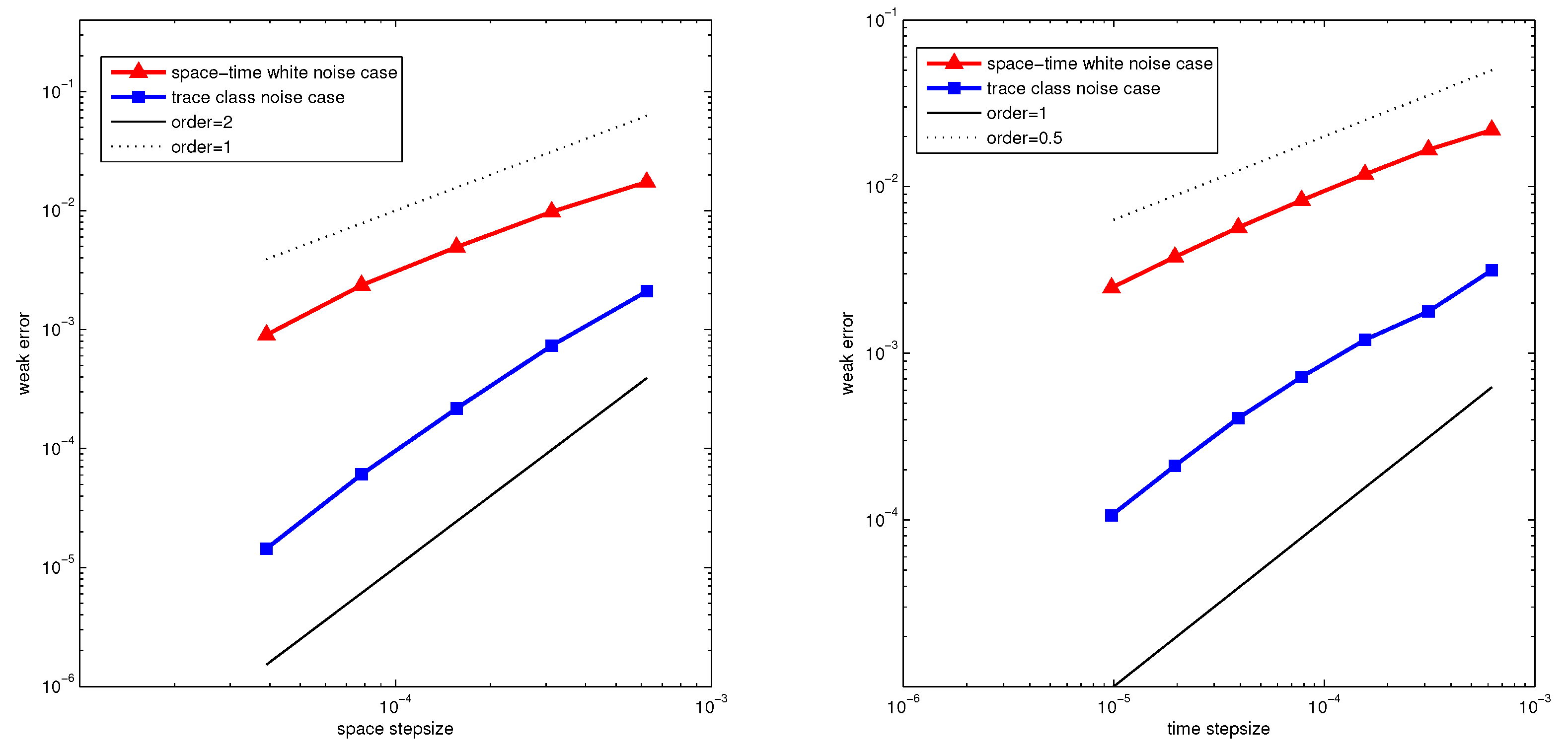
Next, we choose a time point and check the weak orders with being the initial value. In the left figure of Figure 1, we depict the weak errors in the space discretization by varying space step-sizes , , on a log-log scale, with a fixed parameter . One can observe that the weak error converges with order 2 for the trace class noise case and with order 1 for the space-white noise case, which is consistent with the theoretical estimate of Theorem 4. Note that here we take to compute the exact solution for the spatial discretization.
Figure 1.
The spatial weak convergence orders (left) and the temporal weak convergence orders (right).
We now fix and test the convergence rates in time of the proposed full-discrete scheme (71) by using the step-sizes . Again, the “exact” solution is computed by the proposed scheme (71) with a sufficiently small time step-size . In the right picture of Figure 1, the resulting weak errors in temporal direction are plotted. It can be seen that the decay of the error is consistent with our theoretical results.
6. Conclusions
This paper is devoted to the long-time behavior of the full discretization of an ergodic semilinear stochastic partial differential equation driven by additive noise. The full discretization is realized by a spectral Galerkin method in spatial direction and an Euler scheme in temporal direction, which admits a unique invariant probability measure. Compared with the existing works, we relax the condition on the nonlinearity F by assuming that F is once differentiable. Under the weaker condition, the optimal convergence orders of the numerical invariant measures are obtained based on the time-independent weak error, but not relying on the associated Kolmogorov equation. Finally, numerical examples confirm the theoretical findings. In the future, we will consider the ergodic non-globally Lipschitz continuous stochastic partial differential equation and are expected to the optimal convergence order of its numerical method.
Author Contributions
All authors contributed equally and significantly in writing this paper. Conceptualization, Software, Q.L.; Writing—Original Draft Preparation, R.Q. and Q.L.; Writing—Review and Editing, R.Q. All authors have read and agreed to the published version of the manuscript.
Funding
Qiu Lin was supported by the Research Fund for Yancheng Teachers University under 204040026. Ruisheng Qi was supported by NSF of China (No. 11701073) and by the Research Fund for Yancheng Teachers University under 204040025.
Data Availability Statement
The data used to support the findings of this study are included within the article.
Conflicts of Interest
The authors declare no conflict of interest.
References
- Wang, Y.; Xu, J.; Qiao, L. Improved amplification factor transport transition model for transonic boundary layers. AIAA J. 2023, 61, 3866–3882. [Google Scholar] [CrossRef]
- Shi, Y.; Lan, Q.; Lan, X. Robust optimization design of a flying wing using adjoint and uncertainty-based aerodynamic optimization approach. Struct. Multidiscip. Opti. 2023, 66, 110. [Google Scholar] [CrossRef]
- Guo, C.; Hu, J.; Wu, Y. Non-singular fixed-time tracking control of uncertain nonlinear pure-feedback systems with practical state constraints. TCAS-I 2023, 70, 3746–3758. [Google Scholar] [CrossRef]
- Columbu, A.; Frassu, S.; Viglialoro, G. Properties of given and detected unbounded solutions to a class of chemotaxis models. Stud. Appl. Math. 2023, 151, 1349–1379. [Google Scholar] [CrossRef]
- Li, T.; Frassu, S.; Viglialoro, G. Combining effects ensuring boundedness in an attraction-repulsion chemotaxis model with production and consumption. Z. Angew. Math. Phys. 2023, 74, 1–21. [Google Scholar] [CrossRef]
- Li, Y.; Kai, Y. Wave structures and the chaotic behaviors of the cubic-quartic nonlinear Schrödinger equation for parabolic law in birefringent fibers. Nonlinear Dyn. 2023, 111, 8701–8712. [Google Scholar] [CrossRef]
- Gu, Q.; Li, S.; Liao, Z. Solving nonlinear equation systems based on evolutionary multitasking with neighborhood-based speciation differential evolution. Expert Syst. Appl. 2023, 238, 122025. [Google Scholar] [CrossRef]
- Xu, J.; Liu, J.; Zhang, Z. Spatial–temporal transformation for primary and secondary instabilities in weakly non-parallel shear flows. J. Fluid Mech. 2023, 959, A21. [Google Scholar] [CrossRef]
- Yang, X.; Wu, L.; Zhang, H. A space-time spectral order sinc-collocation method for the fourth-order nonlocal heat model arising in viscoelasticity. Appl. Math. Comput. 2023, 457, 128–192. [Google Scholar] [CrossRef]
- Tian, Q.; Yang, X.; Zhang, H.; Xu, D. An implicit robust numerical scheme with graded meshes for the modified Burgers model with nonlocal dynamic properties. Comput. Appl. Math. 2023, 42, 246. [Google Scholar] [CrossRef]
- Zhang, H.; Liu, Y.; Yang, X. An efficient ADI difference scheme for the nonlocal evolution problem in three-dimensional space. J. Appl. Math. Comput. 2023, 69, 651–674. [Google Scholar] [CrossRef]
- Wang, W.; Zhang, H.; Jiang, X.; Yang, X. A high-order and efficient numerical technique for the nonlocal neutron diffusion equation representing neutron transport in a nuclear reactor. Ann. Nucl. Energy 2024, 195, 110163. [Google Scholar] [CrossRef]
- Abdulle, A.; Vilmart, G.; Zygalakis, K.C. High order numerical approximation of the invariant measure of ergodic SDEs. Siam J. Numer. Anal. 2014, 52, 1600–1622. [Google Scholar] [CrossRef]
- Bréhier, C.E. Approximation of the invariant measure with an euler scheme for stochastic pdes driven by space-time white noise. Potential Anal. 2014, 40, 1–40. [Google Scholar] [CrossRef]
- Bréhier, C.E.; Kopec, M. Approximation of the invariant law of spdes: Error analysis using a poisson equation for a full-discretization scheme. IMA J. Numer. Anal. 2017, 37, 1375–1410. [Google Scholar] [CrossRef]
- Bréhier, C.E.; Vilmart, G. High order integrator for sampling the invariant distribution of a class of parabolic stochastic pdes with additive space-time noise. Siam J. Sci. Comput. 2016, 38, A2283–A2306. [Google Scholar] [CrossRef]
- Chen, C.; Hong, J.; Wang, X. Approximation of invariant measure for damped stochastic nonlinear schrödinger equation via an ergodic numerical scheme. Potential Anal. 2017, 46, 323–367. [Google Scholar] [CrossRef]
- Hong, J.; Wang, X.; Zhang, L. Numerical analysis on ergodic limit of approximations for stochastic nls equation via multi-symplectic scheme. Siam J. Numer. Anal. 2017, 55, 305–327. [Google Scholar] [CrossRef]
- Mattingly, J.C.; Stuart, A.M.; Higham, D.J. Ergodicity for sdes and approximations: Locally lipschitz vector fields and degenerate noise. Stoch. Proc. Appl. 2002, 101, 185–232. [Google Scholar] [CrossRef]
- Mattingly, J.C.; Stuart, A.M.; Tretyakov, M.V. Convergence of numerical time-averaging and stationary measures via poisson equations. Siam J. Numer. Anal. 2010, 48, 552–577. [Google Scholar] [CrossRef]
- Denis, T. Second-order discretization schemes of stochastic differential systems for the computation of the invariant law. Stochastics 1990, 29, 13–36. [Google Scholar]
- Denis, T. Stochastic hamiltonian systems: Exponential convergence to the invariant measure, and discretization by the implicit euler scheme. Markov Process. Relat. 2002, 8, 163–198. [Google Scholar]
- Da Prato, G.; Zabczyk, J. Ergodicity for Infinite Dimensional Systems; Cambridge University Press: New York, NY, USA, 1996. [Google Scholar]
- Cai, M.; Gan, S.; Wang, X. Weak convergence rates for an explicit full-discretization of stochastic allen-cahn equation with additive noise. J. Sci. Comput. 2021, 86, 1–30. [Google Scholar] [CrossRef]
- Chen, Z.; Gan, S.; Wang, X. A full-discrete exponential euler approximation of invariant measure for parabolic stochastic partial differential equations. Appl. Numer. Math. 2020, 157, 135–158. [Google Scholar] [CrossRef]
- Kruse, R. Optimal error estimates of galerkin finite element methods for stochastic partial differential equations with multiplicative noise. IMA J. Numer. Anal. 2014, 34, 217–251. [Google Scholar] [CrossRef]
- Qi, R.; Wang, X. Optimal error estimates of galerkin finite element methods for stochastic allen-cahn equation with additive noise. J. Sci. Comput. 2019, 80, 1171–1194. [Google Scholar] [CrossRef]
- Wang, X. Weak error estimates of the exponential euler scheme for semi-linear spdes without malliavin calculus. Discret. Cont. Dyn. Syst. A 2016, 36, 481–497. [Google Scholar] [CrossRef]
- Tambue, A.; Ngnotchouye, J.M.T. Weak convergence for a stochastic exponential integrator and finite element discretization of stochastic partial differential equation with multiplicative & additive noise. Appl. Numer. Math. 2016, 108, 57–86. [Google Scholar]
- Wang, X.; Gan, S. Weak convergence analysis of the linear implicit euler method for semilinear stochastic partial differential equations with additive noise. J. Math. Anal. Appl. 2013, 398, 151–169. [Google Scholar] [CrossRef]
- Kruse, R.; Larsson, S. Optimal regularity for semilinear stochastic partial differential equations with multiplicative noise. Electron. J. Probab. 2012, 17, 1–19. [Google Scholar] [CrossRef]
- Wang, X.; Qi, R. A note on an accelerated exponential euler method for parabolic spdes with additive noise. Appl. Math. Lett. 2015, 46, 31–37. [Google Scholar] [CrossRef]
- Da Prato, G. An Introduction to Infinite-Dimensional Analysis; Springer Science & Business Media: Berlin, Germany, 2006. [Google Scholar]
- Andersson, A.; Larsson, S. Weak convergence for a spatial approximation of the nonlinear stochastic heat equation. Math. Comput. 2016, 85, 1335–1358. [Google Scholar] [CrossRef]
- Bréhier, C.E.; Debussche, A. Kolmogorov equations and weak order analysis for spdes with nonlinear diffusion coefficient. J. Math. Pure. Appl. 2018, 119, 193–254. [Google Scholar] [CrossRef]
- Nualart, D. The Malliavin Calculus and Related Topics; Springer: Berlin, Germany, 2006. [Google Scholar]
- Debussche, A. Weak approximation of stochastic partial differential equations: The nonlinear case. Math. Comput. 2011, 80, 89–117. [Google Scholar] [CrossRef]
- Thomée, V. Galerkin Finite Element Methods for Parabolic Problems; Springer: Berlin, Germany, 2006. [Google Scholar]
- Qi, R.; Wang, X. Error estimates of semi-discrete and fully discrete finite element methods for the cahn-hilliard-cook equation. Siam J. Numer. Anal. 2020, 58, 1613–1653. [Google Scholar] [CrossRef]
- Da Prato, G.; Zabczyk, J. Stochastic Equations in Infinite Dimensions; Cambridge University Press: Cambridge, UK, 2014. [Google Scholar]
Disclaimer/Publisher’s Note: The statements, opinions and data contained in all publications are solely those of the individual author(s) and contributor(s) and not of MDPI and/or the editor(s). MDPI and/or the editor(s) disclaim responsibility for any injury to people or property resulting from any ideas, methods, instructions or products referred to in the content. |
© 2023 by the authors. Licensee MDPI, Basel, Switzerland. This article is an open access article distributed under the terms and conditions of the Creative Commons Attribution (CC BY) license (https://creativecommons.org/licenses/by/4.0/).


