Abstract
Diffusion is an inevitable important factor in advertising dynamic systems. However, previous literature did not involve this important diffusion factor, and only involved the local stability of the advertising model. This paper develops a global stability criterion for the impulsive advertising dynamic model with a feedback term under the influence of diffusion. Since global stability requires the unique existence of equilibrium points, variational methods are employed to solve it in the infinite dimensional function space, and then a global stability criterion of the system is derived by way of the impulse inequality lemma and orthogonal decomposition of a class of Sobolev spaces. Numerical simulations verify the effectiveness of the proposed method.
Keywords:
Neumann boundary value; delayed feedback; global stabilization; advertisement model; time-delayed reaction–diffusion system MSC:
34K20
1. Introduction
Due to the promotion of advertising on the sales volume of goods, the advertising dynamic model has recently attracted researchers’ attention, and the stabilization of advertising dynamic models have been studied in series under impulse control [1,2,3]. Because the impulsive control involved in the advertising dynamic system is artificial, and the real market is flexible and difficult to grasp, impulsive macro measures may sometimes backfire, and not necessarily promote the stability of the financial system. Therefore, it is necessary to study the advertising dynamic model under impulsive disturbance. On the other hand, whether it is the number of people who are not aware of the existence of the product, or the number of potential consumers who are aware of the existence of the product but have not yet bought it, or the number of current consumers who have bought the product, the widespread diffusion effect constantly affects the change of these numbers. Therefore, this paper introduces a reaction–diffusion advertising dynamic model, and under impulsive disturbance, global stabilization of the reaction–diffusion advertising dynamic model is investigated. Since delayed feedback is the main feature of the commodity economy market, the global stability analysis of the reaction–diffusion pulse-delayed feedback advertising model is considered in this paper. Note that the reaction–diffusion advertising model in this paper is actually a parabolic partial differential equation system, and its solution exists in the infinite dimensional function space. Because bounded closed sets in infinite dimensional spaces lose compactness, some variational methods and techniques are usually necessary. In particular, by virtue of the property of the orthogonal decomposition of a Sobolev space into eigen-subspaces and the property of the first eigenvalue [4], this paper finally offers a global stability criterion under the influence of diffusion, in which the diffusion term plays a positive role, and examines the influence of the inevitable diffusion behavior in economic advertising activities. Additionally, the reaction–diffusion advertising model proposed in this paper reflects the regionality of the advertising economy, that is, the role of advertising is different between the areas where advertising is interesting and those far away from the advertising environment. Furthermore, advertisements also have certain boundaries, where three kinds of audience of advertisements stay unchanged. This means that the reaction–diffusion advertising model owns a Neumann zero boundary value.
As for the significance of this paper, the authors have to point out that the previous literature ignored the diffusion factor in advertising economic activities, which meant that the previous literature can only draw a local stability criterion. However, we know that the local stability criterion cannot be applied well in actual economic activities because the initial value may not be very close to the stable equilibrium point. In fact, the initial value of advertising was not rational when it first appeared. With the promotion of advertising activities and the promotion of pulse control measures, it led to the change of the number of various audiences with the help of the advertising effect. However, the global stability criterion obtained in this paper does not have the above restrictions on the initial value, which means that the global stability criterion in this paper can be better applied to advertising economic activities.
The main contributions are as follows.
- □
- The delayed feedback model proposed in this paper is more suitable for real advertising economics, because many effects of advertising in real life are always delayed. In fact, it takes a period of time for the audience to react after the advertisement is broadcast.
- □
- The impulse perturbation advertising model studied in this paper is closer to reality than the impulse control advertising model of the existing literature [1,2,3]. In fact, in economic advertising activities, we sometimes do not know which impulse behaviors promote the stability of the system and which behaviors undermine the stability of the system.
- □
- This is the first paper to study the global stabilization of the impulsive reaction–diffusion feedback advertising model with a Neumann zero boundary value. In fact, since the previous literature neglected the diffusion phenomenon that has a significant impact on the advertising model, these studies only involved the local stability of advertising models [1,2,3].
- Notations: Let be a bounded domain, and its smooth boundary is of class . Denote by the least positive eigenvalue of the Neumann zero boundary problem. To be specific, is the first positive eigenvalue of the Laplace operator on the Sobolev space . The corresponding eigenvalues and eigen functions satisfy and with , where forms a set of orthogonal bases in the Sobolev space , and represents the outer normal direction of . Furthermore, I represents the identity matrix. Denote by the maximum eigenvalue of symmetric matrix A, and by the minimum eigenvalue of symmetric matrix A.
2. System Description and Preliminaries
In [1], the following advertising dynamic system was studied:
which is equivalent to
Here, is the contact rate, and represents the test rate of the first purchase, and the conversion rate is denoted by . In addition, , where is the number of people who are not aware of the existence of the product, is the number of potential consumers who are aware of the existence of the product but have not yet bought it, and is the number of current consumers who have bought the product. Obviously, and are two equilibrium points of the above system.
Since advertisements have regional differences and delayed feedback effects, the following reaction–diffusion delay model is considered in this paper:
where obviously for Obviously, it is easily to verify that and are two equilibrium points of the reaction–diffusion feedback advertising dynamic Equation (1). It follows from the meanings of that is the meaningful goal equilibrium point, and another one has no research value. Let
then it is derived from Equation (1) that
Obviously for Moreover, the stability of the equilibrium point in Equation (1) is equivalent to the null solution of system (3), which can be rewritten as the equivalent vector-matrix format:
where , and
Under impulsive interference, one has from (4) that
where is a bounded domain with smooth boundary , and l represents the outer normal direction of . is a sequence of fixed impulsive instants, satisfying and . Additionally, , for all ,
Stability of null solution in system (6) is corresponding to that of the equilibrium point in the following system
The following lemmas will be used in our study.
Lemma 1.
(see [5]). Consider the following differential inequality:
where and is continuous except where it has jump discontinuities. The sequence satisfies , and Suppose that
(i)
(ii) where and there exist constants , such that
where , is the unique solution of equation
Then
In addition, if then
Considering the eigenvalue problem
The following Lemma can be derived from [4] and related literature [6,7,8].
Lemma 2.
For the eigenvalue problem (9), there exists a series of eigenvalues
In addition, there exits the following orthogonal decomposition for Sobolev space :
where is the space of the eigenfunctions corresponding to the eigenvalue and each is a finite dimensional space. Furthermore,
3. Main Results
Firstly, we need to prove that null solution is the unique stationary solution of the system (6).
Theorem 1.
If the following condition is satisfied,
then the null solution is the unique stationary solution of the system (6), and is the unique stationary solution of the system (7), where and are positive constants defined in (5), and the matrix inequality mentioned in (10) means that the matrix is positively definite symmetric.
Furthermore, if there exists a positive definite diagonal matrix P and a constant such that
if, in addition, there exists a constant such that and , where with and and is the unique solution of the equation
then the unique stationary solution of the system (6) is globally exponentially stable, and the unique stationary solution of the system (7) is globally exponentially stable, too.
Proof.
First of all, if there exists any stationary solution of the system (6) should satisfy
or
and
In order to prove the completeness, we need to derive Poincare inequality under the Sobolev space framework. Inspired by the proof of Lemma 2, for any real-valued function which belongs to and , we can also claim
where is the least positive eigenvalue of the following Neumann boundary problem
In fact, the eigenvalue properties’ theorems of elliptic operators illuminate that the Laplacian operator on the bounded domain with the Neumann zero boundary conditions is a self-adjoint one with a compact inverse, and then we know there is a series of non-negative eigenvalues and a series of corresponding eigenfunctions such that and In particular, corresponds to . Hence, we obtain
which together with variational methods and the Neumann zero boundary value yields
Similar to that of Lemma 2, the series of eigenfunctions is also an orthogonal basis such that for the above-mentioned , there exists a corresponding coefficients , satisfying
which together with (16) and the orthogonal basis implies
and so the claim (15) has been proven.
It follows by (13), the Poincare inequality (15), (5), and the boundedness of that
On the other hand, it follows from (14) that
Combining (17) and (18) results in
which contradicts the condition (10). Furthermore, the null solution is the unique stationary solution of the system (6), and is the unique stationary solution of the system (7).
Consider the following Lyapunov function:
then for ,
where .
Now the condition (i) of Lemma 1 is satisfied by (11) the following fact
Below, verify the condition (8) in Lemma 1. That is,
(2) where and there exist constants , such that
where , is the unique solution of equation
Then
Indeed,
Let with and then .
Let and , then yields
which means that the condition (8) is satisfied, and then Lemma 1 means
or equivalently,
Moreover, (20) yields
where .
Now, (21) yields that the unique stationary solution of the system (6) is globally exponentially stable, and the unique stationary solution of the system (7) is globally exponentially stable, too. □
Remark 1.
Theorem 1 originally gives a global stability criterion of reaction–diffusion delayed feedback financial system involved in advertisement. Because advertising involves regional economy, the mathematical model about advertisement has to involve a partial differential system and infinite dimensional function space, which causes the bounded set to lose compactness. In the proof of Theorem 1, the ingenious application of variational method in infinite dimensional space solves this mathematical difficulty, and then the uniqueness of the equilibrium solution is obtained. This is an innovation in the method of this article, which is different from that of the existing literature [1].
4. Numerical Examples
In this section, two examples are proposed to verify the effectiveness of Theorem 1 in the case of and , respectively.
Example 1.
Let then (see, e.g., [9]). Set , , and
then
Direct computation yields
and hence the condition (10) is satisfied. According to Theorem 1, the null solution is the unique stationary solution of the system (6), and is the unique stationary solution of the following system:
Moreover, let , , and such that
which means the condition (11) holds. Next, we can solve Equation (12) as follows:
Set then Let , then and . According to Theorem 1, the unique stationary solution of the system (6) is globally exponentially stable, and the unique stationary solution of the system (22) is globally exponentially stable, too.
Remark 2.
([9]). If , then ; if , then .
Remark 3.
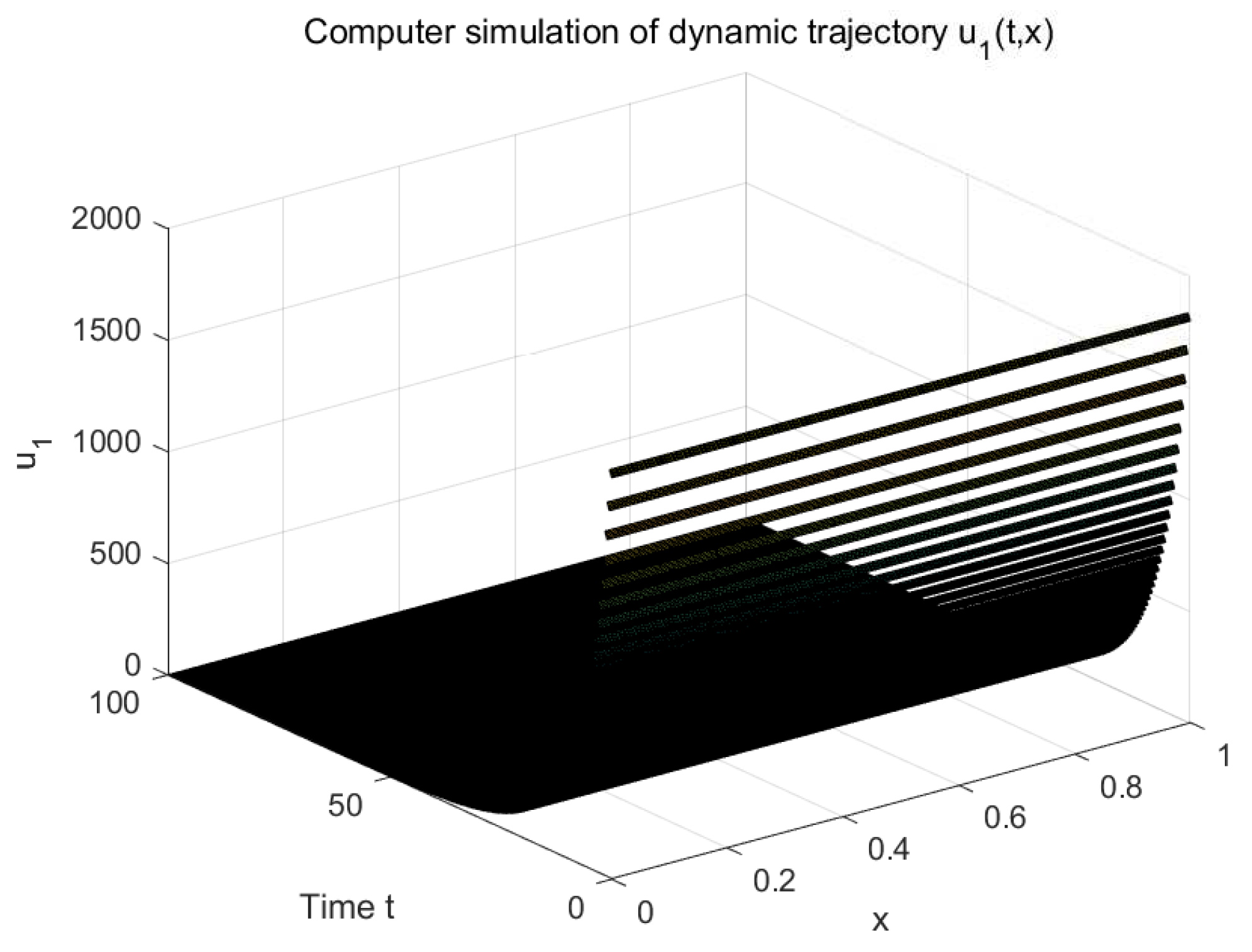
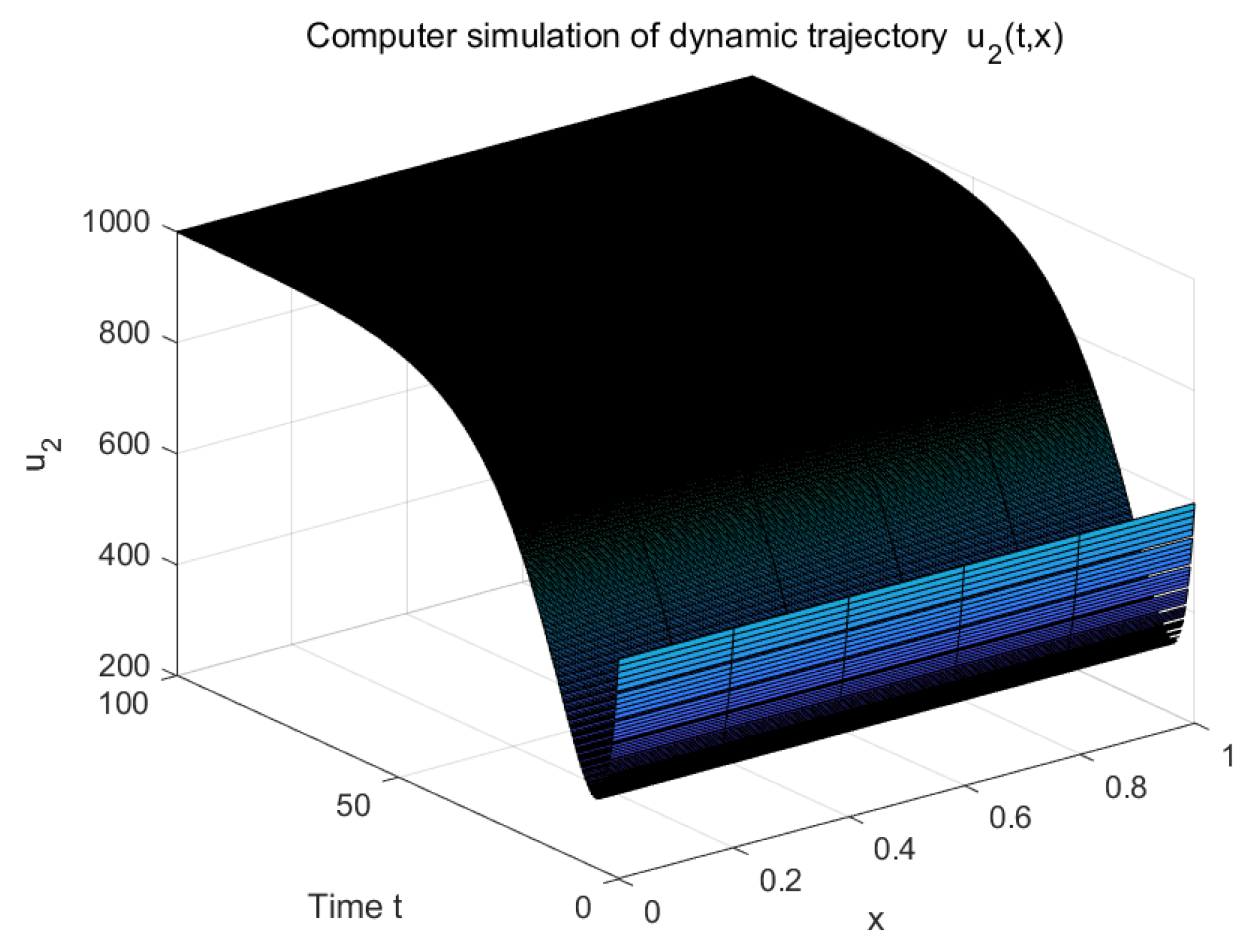
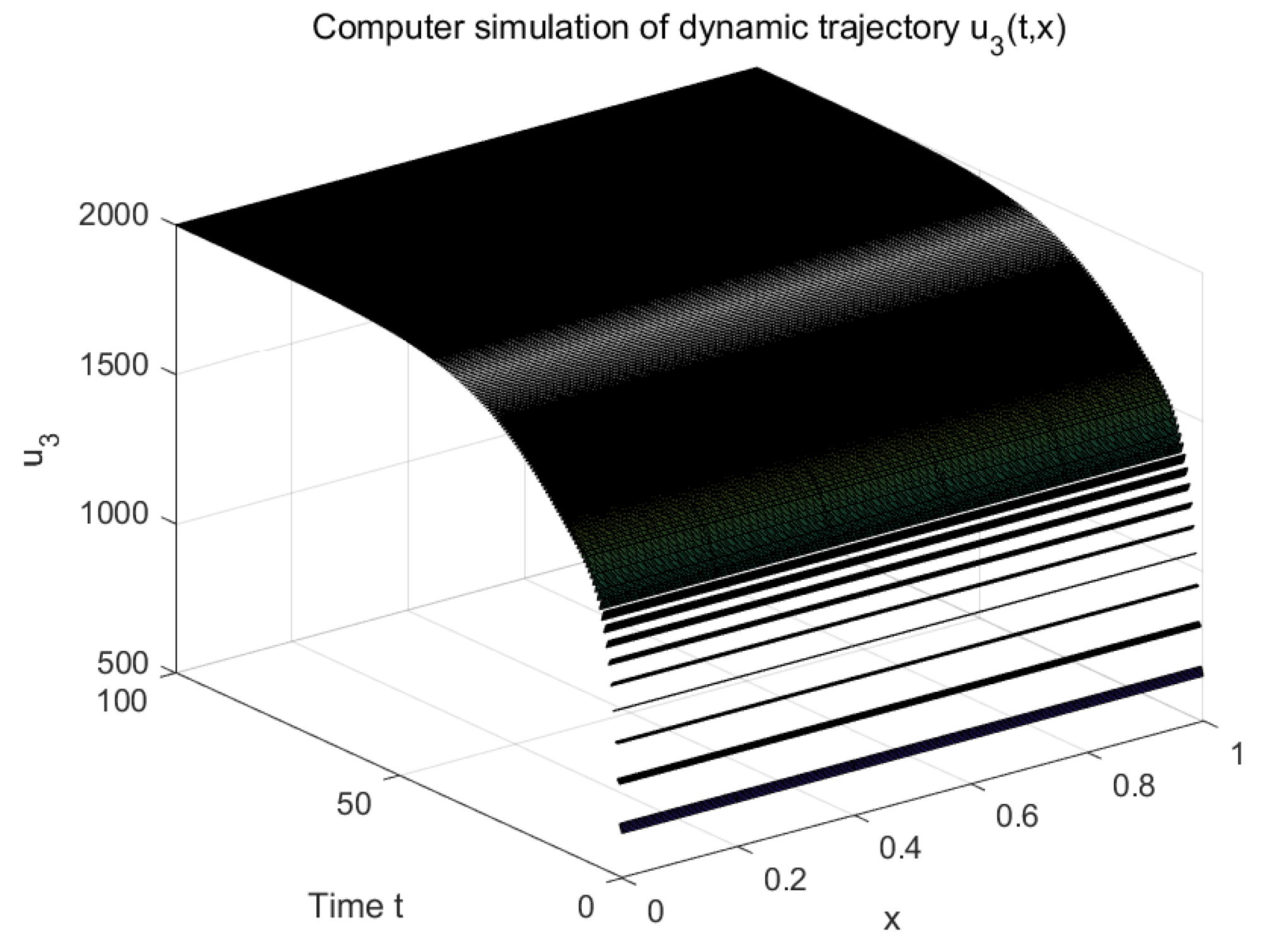
The numerical simulation shows that the equilibrium point of the reaction–diffusion advertising economic model is globally stable under moderate impulsive disturbance (see Figure 1, Figure 2 and Figure 3). However, in the previous literature, because the equilibrium point does not exist uniquely, its conclusion must be local stability. Unlike the subtle diffusion effect of the neural network system, the diffusion factors of the advertising economy model seriously affect the dynamic behavior of the advertising economy. Numerical examples demonstrate this.
Figure 1.
Dynamic locus of the state variable of the system (22).
Figure 2.
Dynamic locus of the state variable of the system (22).
Figure 3.
Dynamic locus of the state variable of the system (22).
Example 2.
Let then (see, e.g., [9]). Set , , , , and
then
Direct computation yields
and hence the condition (10) is satisfied. According to Theorem 1, the null solution is the unique stationary solution of the system (6), and is the unique stationary solution of the system (7).
Moreover, let , , and such that
which means the condition (11) holds. Next, we can solve Equation (12) as follows:
Set then , . Let , then and . According to Theorem 1, the unique stationary solution of the system (6) is globally exponentially stable, and the unique stationary solution of the system (7) is globally exponentially stable, too.
Remark 4.
Example 2 illuminates that the global stability result of Theorem 1 is still valid no matter whether the space is simplified as one dimension or two dimensions.
5. Conclusions
Motivated by some methods and ideas from the existing literature [1,2,3,4,5,9,10,11,12,13,14,15,16], the authors obtained the global stability criterion of the advertising model by using the variational method and the impulsive inequality theorem. As mentioned in the introduction, the global stability criterion has a better guiding role in social and economic practice than the local stability criterion in the known literature [1,2,3]. The global stability criterion in this paper shows that, no matter how bad the initial value is, as long as the appropriate impulse interval and impulse intensity are set, the number of various people in the advertising model will asymptotically approach the equilibrium point. Moreover, the effectiveness of the proposed methods is verified by numerical simulations. It is worth mentioning that delayed feedback and diffusion factors are inevitable in real advertising, so the delayed feedback reaction–diffusion advertising model in this paper better simulates the real advertising economic activities, which reflects the significance of this paper to a certain extent, too.
Author Contributions
Writing—original draft X.L.; participating in discussion literature and providing ideas and methods, X.Y. All authors have read and agreed to the published version of the manuscript.
Funding
This research was funded by Application Basic Research Project of Science and Technology Department of Sichuan Province (2020YJ0434).
Institutional Review Board Statement
Not applicable.
Informed Consent Statement
Not applicable.
Data Availability Statement
Not applicable.
Conflicts of Interest
The authors declare no conflict of interest.
References
- Sun, J.; Qiao, F.; Wu, Q. Impulsive control of a financial model. Phys. Lett. A 2005, 335, 282–288. [Google Scholar] [CrossRef]
- Chen, D.; Sun, J. Impulsive control of a advertising system. J. Biomath. 2005, 20, 17–22. [Google Scholar]
- Yao, H.; Li, X. Stability analysis of an advertising impulsive model. J. Jiangsu univ. (Nat. Sci. Ed.) 2009, 30, 100–103. (In Chinese) [Google Scholar]
- Tang, C.; Wu, X. Existence and multiplicity of solutions of semilinear elliptic equations. J. Math. Anal. Appl. 2001, 256, 1–12. [Google Scholar] [CrossRef]
- Yue, D.; Xu, S.; Liu, Y. Differential inequality with delay and impulse and its applications to design robust control. Control Theory Appl. 1999, 16, 519–524. (In Chinese) [Google Scholar]
- Lindqvise, P. On the Equation . Proc. Amer. Math. Soc. 1990, 109, 159–164. [Google Scholar]
- Rao, R.; Huang, J.; Li, X. Stability analysis of nontrivial stationary solution and constant equilibrium point of reaction-diffusion neural networks with time delays under Dirichlet zero boundary value. Neurocomputing 2021, 445, 105–120. [Google Scholar] [CrossRef]
- Rao, R.; Zhong, S. Existence of Exponential p-Stability Nonconstant Equilibrium of Markovian Jumping Nonlinear Diffusion Equations via Ekeland Variational Principle. Adv. Math. Phys. 2015, 2015, 812150. [Google Scholar] [CrossRef]
- Pan, J.; Liu, X.; Zhong, S. Stability criteria for impulsive reaction-diffusion Cohen-Grossberg neural networks with time-varying delays. Math. Comput. Model. 2010, 51, 1037–1050. [Google Scholar] [CrossRef]
- Li, D.; He, D.; Xu, D. Mean square exponential stability of impulsive stochastic reaction-diffusion Cohen-Grossberg neural networks with delays. Math. Comput. Simul. 2012, 82, 1531–1543. [Google Scholar] [CrossRef]
- Zhao, H.; Mao, Z. Boundedness and stability of nonautonomous cellular neural networks with reaction-diffusion terms. Math. Comput. Simul. 2009, 79, 603–1617. [Google Scholar] [CrossRef]
- Luo, Y.; Zhang, L.; Teng, Z.; Zheng, T. Analysis of a general multi-group reaction-diffusion epidemic model with nonlinear incidence and temporary acquired immunity. Math. Comput. Simul. 2021, 182, 428–455. [Google Scholar] [CrossRef]
- Elaiw, A.M.; Al Agha, A.D. Global Stability of a Reaction-Diffusion Malaria/COVID-19 Coinfection Dynamics Model. Mathematics 2022, 10, 4390. [Google Scholar] [CrossRef]
- Hymavathi, M.; Ibrahim, T.F.; Ali, M.S.; Stamov, G.; Stamova, I.; Younis, B.A.; Osman, K.I. Synchronization of Fractional-Order Neural Networks with Time Delays and Reaction-Diffusion Terms via Pinning Control. Mathematics 2022, 10, 3916. [Google Scholar] [CrossRef]
- Pan, J.; Zhong, S. Dynamical behaviors of impulsive reaction-diffusion Cohen-Grossberg neural network with delays. Neurocomputing 2010, 73, 1344–1351. [Google Scholar] [CrossRef]
- Hu, J.; Zhang, Q.; Meyer-Baese, A.; Ye, M. Finite-time stability and optimal control of a stochastic reaction-diffusion model for Alzheimer’s disease with impulse and time-varying delay. Appl. Math. Model. 2022, 102, 511–539. [Google Scholar] [CrossRef]
Disclaimer/Publisher’s Note: The statements, opinions and data contained in all publications are solely those of the individual author(s) and contributor(s) and not of MDPI and/or the editor(s). MDPI and/or the editor(s) disclaim responsibility for any injury to people or property resulting from any ideas, methods, instructions or products referred to in the content. |
© 2023 by the authors. Licensee MDPI, Basel, Switzerland. This article is an open access article distributed under the terms and conditions of the Creative Commons Attribution (CC BY) license (https://creativecommons.org/licenses/by/4.0/).