


Abstract
In this paper, we propose an inertial forward–backward splitting method for solving the modified variational inclusion problem. The concept of the proposed method is based on Cholamjiak’s method. and Khuangsatung and Kangtunyakarn’s method. Cholamjiak’s inertial technique is utilized in the proposed method for increased acceleration. Moreover, we demonstrate that the proposed method strongly converges under appropriate conditions and apply the proposed method to solve the image restoration problem where the images have been subjected to various obscuring processes. In our example, we use the proposed method and Khuangsatung and Kangtunyakarn’s method to restore two medical images. To compare image quality, we also evaluate the signal-to-noise ratio (SNR) of the proposed method to that of Khuangsatung and Kangtunyakarn’s method.
Keywords:
inertial technique; variational inclusion problem; forward–backward splitting method; fixed point problem; image restoration MSC:
49J40; 49N45
1. Introduction
One of the most significant aspects of image processing is image restoration. Image restoration refers to the technique of removing or reducing image degradation that may occur during the acquisition process. This has a number of useful applications in environmental design, motion picture special effects, old photo restoration and removing text and obstructions from photographs. Image restoration’s objective is to recreate a high-quality image X from a low-quality or damaged image Y. It is a classic, inadequately linear inverse problem, which can be formulated as
where X and Y are the original and degraded images, respectively, S is the matrix representing the linear irreversible degenerate operator and c is usually noise.
Many inverse problems necessitate the use of optimization. In fact, inversion is frequently presented as a solution to an optimization problem. As a result, many of these inversions are non-linear, non-convex and large-scale, posing some difficult optimization challenges. To find x such that the following is correct, optimization problems can be formulated as follows:
where is continuously differentiable. The variational inclusion problem (VIP) is one of the most fundamental optimizations for determining minimization. The following problems can be resolved: image restoration, machine learning, transportation and engineering. These problems will be solved by finding u in a real Hilbert space H such that the following holds.
where operators and . Tseng’s technique [1,2], the proximal point method [3,4,5], the forward–backward splitting method [6,7,8,9] and other methods for the variational inclusion problem have received great attention from an increasing number of researchers. The forward–backward splitting method is one of the most commonly used. This is how it is defined:
where with . Additionally, researchers have refined these methods by using relaxation and inertial techniques to give them more flexibility and acceleration. Alvarez and Attouch developed the inertial concept and proposed the inertial forward–backward approach, which is represented as follows:
The term is the technique for speeding up this method. The extrapolation factor is well-known in the inertial term. The inertial technique significantly improves the algorithm’s performance and has better convergence properties. Secondly, the convergence theorem was demonstrated for non-smooth convex minimization problems and monotone inclusions. The relaxed inertial forward–backward methods [10,11], the inertial proximal point algorithm [12,13] and the inertial Tseng’s type method [2,14] were all created as a consequence of this concentration on both methods.
Lorenz and Pock [10] recommended that the inertial forward–backward method for monotone operators be as follows:
It has been determined that algorithm (6) differs from algorithm (5) because where is a positive real sequence. The above-mentioned algorithms for the inertial term have weak convergence. Cholamjiak et al. [11] presented an improved forward–backward method for solving VIP using the inertial technique. The following describes their algorithm:
where . The numerical experiments and proof that the algorithm generated strong convergence results have been provided.
Khuangsatung and Kangtunyakarn’s modified variational inclusion problem (MVIP) [15,16] aims to determine such that
where with , and . Obviously, if for every , then MVIP implies VIP. Under the required conditions, they were able to devise a method to solve a family of nonexpansive fixed point mapping problems with finite dimensions and a family of finite variational inclusion problems. The following provides their method:
This paper’s purpose is to demonstrate an inertial forward–backward splitting method for solving the modified variational inclusion problem based on the concept of [11,15,16]. The proposed method modifies = method (18) for higher acceleration by using the inertial technique of Cholamjiak et al. [11]. We further show that it strongly converges under appropriate conditions. In addition, we apply the proposed method to solve the image restoration problem. Image restoration is an essential problem in digital image processing. During data collection, images usually suffer degradation. Blurring, information loss due to sampling and quantization effects and different noise sources can all be part of the degradation. The goal of image restoration is to estimate the original image from degraded data. Therefore, the proposed method could be used to solve image restoration problems where the images have suffered a variety of blurring operations. Medical imaging is the technique and process of imaging the interior of a body for clinical analysis and medical intervention, as well as providing a visual representation of the function of certain organs or tissues (physiology). Medical imaging also creates a database of normal anatomy and physiology so that abnormalities can be identified. Occasionally, disturbances occur during the photographing process, such as when X-ray film images are blurred or segments of the X-ray film are absent. In our example, we use the proposed method and the method of Khuangsatung and Kangtunyakarn to restore blurred and motion-damaged X-ray films of the brain and the right shoulder. We also compare the signal-to-noise ratio (SNR) of the proposed method to that of Khuangsatung and Kangtunyakarn’s method in order to determine the image quality.
An overview of the contents of this research is presented below: Section 2 compiles fundamental lemmas and definitions. In Section 3, the suggested methods are completely detailed. Applications for image restoration and numerical experimentation are covered in Section 4. The last section of the work presents the conclusion.
2. Preliminaries
This section involves the use of preliminary statements, lemmas and definitions. Assume H is a real Hilbert space and is nonempty, closed and convex with a norm and inner product . The nearest point projection of H onto K is denoted by ; that is, for all and . It implies that holds for all and [17,18].
Lemma 1
([18]). For every The following statements are accurate:
- (i)
- ;
- (ii)
- ;
- (iii)
- , .
A mapping is called -inverse strongly monotone. If there exists such that for every ,
Remark 1.
S is monotone and Lipschitz continuous, if S is α- inverse strongly monotone.
A self mapping Z on H is said to be nonexpansive if for all ,
A self mapping Z on H is said to be firmly nonexpansive if for all ,
or equivalently
Remark 2
([17]). Z is firmly nonexpansive iff is firmly nonexpansive. Obviously, the projection is firmly nonexpansive.
Theorem 1
([19]). Assume that is a nonexpansive mapping with a fixed point. For and fixed , the unique fixed point of the contraction converges strongly as to a fixed point of Z.
Lemma 2
([20]). Assume that and are sequences of nonnegative real numbers such that
where and . Then, the following holds:
- (i)
- is a bounded sequence, if for some
- (ii)
- , if and .
Lemma 3
([21]). Assume is a sequence of nonnegative real numbers such that
and
where is a sequence in is a sequence of nonnegative real numbers and and are real sequences such that
- (i)
- ;
- (ii)
- ;
- (iii)
- implies for each subsequence of real number of .
Then .
Proposition 1
([22]). Let H be a real Hilbert space. Let be fixed. Let and for all with . Then, we have
3. Main Result
A set-valued mapping is called monotone if for all and implies A monotone mapping T is maximal if its graph of T is not properly contained in the graph of any other monotone mapping. It is known that a monotone mapping T is maximal if and only if for for all implies A maximal monotone operator and ; its associated resolvent of order , defined by
where I denotes the identily operator, which is a firmly nonexpansive mapping from H to H with full domain, and the set of fixed points of coincides with the set of zeros of S. Note that
Lemma 4.
Let be a maximal monotone and for any be inverse strongly monotone with . Then, for ,
(i) ;
(ii) for ;
(iii)
for all . It follows that is nonexpansive mapping.
Proof.
(i) By the definition of ,
- (ii)
- Since then Let ; by the monotone of T, we obtain thatIt follows thatSince we obtain thatHence,
- (iii)
- Since T is maximal monotone, it is know that is firmly nonexpaxsive and so we havewhere and
Since is -inverse strongly monotone with , we derive that
Obviously, the mapping is nonexpansive. □
The following theorem is the strong convergence theorem under sutiable conditions of an inertial forward–backward splitting algorithm for solving the modified variational inclusion in a real Hilbert space.
Theorem 2.
Let K be a nonempty closed convex subset of a real Hilbert space H. Let be -inverse strongly monotone mapping with and let be a multi-valued maximal monotone mapping such that . Suppose that the sequence , generated by and
for all with and Let and Assume that the following conditions hold:
- (i)
- ,
- (ii)
- and ,
- (iii)
- for all and ,
- (iv)
Then, the sequence converges strongly to .
Proof.
For each , we put . Let be defined by
Using Lemma 1, we have
By our assumptions and Lemma 2(ii), we obtain that
Let Then
This show that is bounded by Lemma 2(i). Therefore, and are also bounded. We observe that
and
On the other hand, by Proposition 1 and Lemma 4(iii), we obtain that
Since , it follows that . By the boundedness of , , and condition (1), we see that In order to complete the proof, using Lemma 3, it remains to show that implies that for any subsequence of . Let be a subsequence of such that With these assumptions, we can deduce that
By the triangle inequality
Then, we have
Since , there is such that for all In particular, for all . By Lemma 4(ii), we have
Then, by (28), we obtain
This implies that
On the other hand, we have
By condition (i) and (30), we obtain
Let , for all Then, by Theorem 1, we have
By Lemma 1(ii) and Lemma 4(iii), we know that is nonexpansive. Thus
This shows that
Taking in (35), we obtain
On the other hand, we have
Therefore,
From condition (i), it also follows that
Hence, we obtain that By Lemma 3, we conclude that Therefore, as . This completes the proof. □
4. Numerical Result
In this section, we will demonstrate how our proposed method can be applied to solve the image recovery problem. In the example, we also compare the proposed method with the method of Theorem 3.1 [16] in terms of the signal-to-noise ratio (SNR) of the recovered image. This demonstrates the capacity of our proposed algorithm. We consider a linear inverse problem , where is an original image, is the observed image, is additive noise and is the blurring operation. We recover an approximation of the original image x using the Basis Pursuit denoise technique:
where and is a parameter that is relate to noise . Problem (41) is widely recognized as the least absolute selection and shrinkage operator problem (LASSO).
We focus on minimizing a special case of the LASSO problem (41), where and , where x is the original image, is the blurred matrix, is the blurred image by the blurred matrix for all . Observe that is evidently a smooth function with an -Lipschitz continuous gradient , where .
Example 1
(Figure 1, Figure 2, Figure 3, Figure 4, Figure 5, Figure 6, Figure 7, Figure 8, Figure 9 and Figure 10). Let be the deblurred image. We show how to solve the special case of the LASSO problem by using the flowchart in Figure 1. We will recover an original image . Let Consider a linear operator, which is a filtering , for a simple linearized model of image recovery, where is a motion blur specifying with motion length 21 pixels (len ) and motion orientation (), is a Gaussian blur of filter size with standard deviation , is a circular averaging filter with radius and is an averaging blur of filter size . In this experiment, we will use our proposed algorithm to solve problem (41). All parameters are set to the following values: and . As a basic stopping criterion, we deem 350 iterations sufficient.
The following numerical results are proposed: Figure 2 presents the original grayscale images for (a) X-ray film of the brain and (b) X-ray film of the right shoulder. Figure 3 and Figure 6 are blurred X-ray films of the brain and the right shoulder images with filtering in the part of degradation of Figure 1. In this example, we set . So, we have and . Figure 4a, X-ray films of the brain and the right shoulder images were obtained via Theorem 2. Figure 4b, X-ray films of the brain and the right shoulder images were obtained via Theorem 3.1 in [16] (Khuangsatung and Kangtunyakarn’s method). Figure 9 is an X-ray film of the brain image that was recovered via the proposed method that was tuned for the parameter λ.
Additionally, we use the signal-to-noise ratio (SNR),
to measure the quality of recovery; a higher SNR indicates a higher quality of recovery. The following numerical results are proposed: Figure 5 is the SNR results of Figure 4a,b. We see that the SNR of Figure 4a is higher than that of Figure 4b. This means that Figure 4a is better than Figure 4b. Figure 8 is the SNR results of Figure 7a,b. We also see that the SNR of Figure 7a is higher than that of Figure 7b. This means that Figure 7a is better than Figure 7b. Figure 10 is the SNR of Figure 9 when we select a higher value inside the specified range to produce a higher quality image than a lower value.
Remark 3.
Experimentally, the SNR value demonstrates that our proposed algorithm is more effective than the algorithm that was introduced by Khuangsatung and Kangtunyakarn [15,16] in solving the image recovery problem (41).
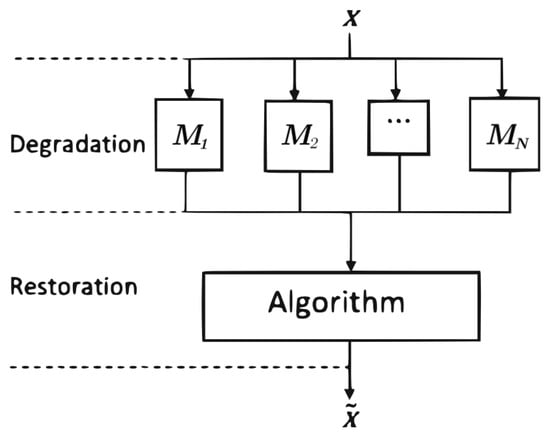
Figure 1.
The image restoration process flowchart.
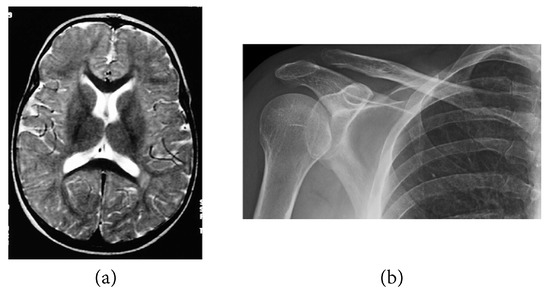
Figure 2.
Original grayscale images. (a) X-ray film of the brain image and (b) X-ray film of the right shoulder image.
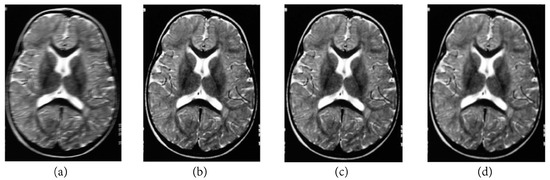
Figure 3.
Blurred X-ray film of the brain image with filtering by (a) , (b) , (c) and (d) .
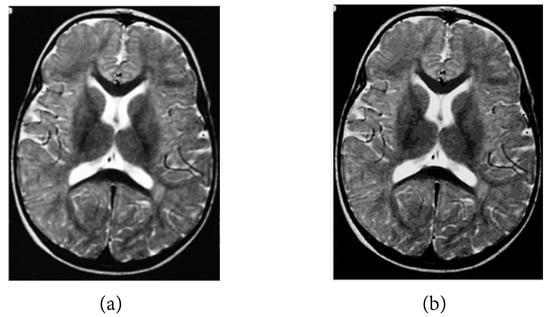
Figure 4.
(a) X-ray film of the brain image obtained via Theorem 2 and (b) X-ray film of the brain image obtained via Theorem 3.1 in [16].
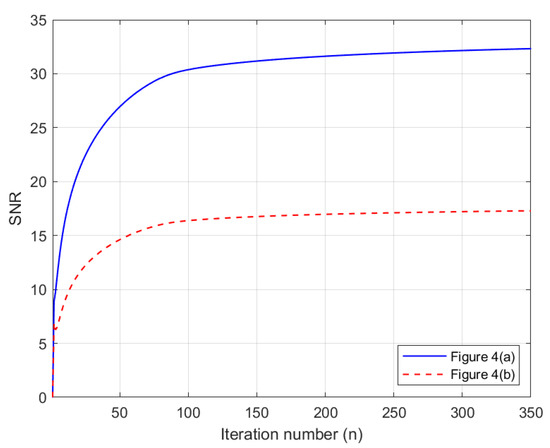
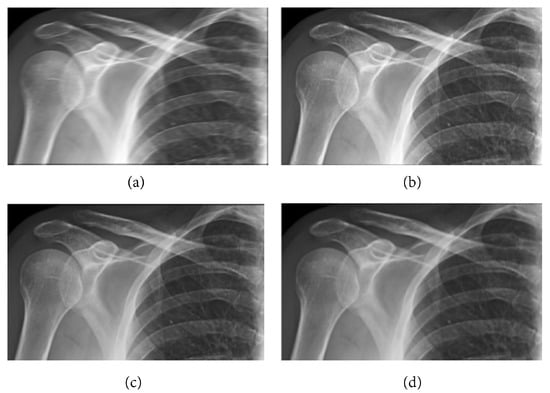
Figure 6.
Blurred X-ray film of the right shoulder image with filtering by (a) , (b) , (c) and (d) .
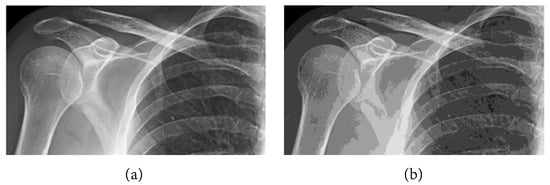
Figure 7.
(a) X-ray film of the right shoulder image obtained via Theorem 2 and (b) X-ray film of the right shoulder image obtained via Theorem 3.1 in [16].
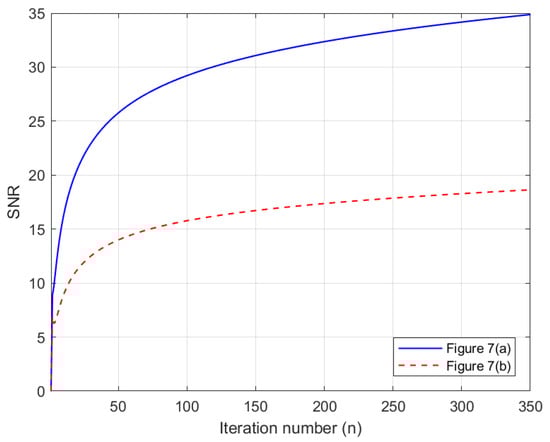
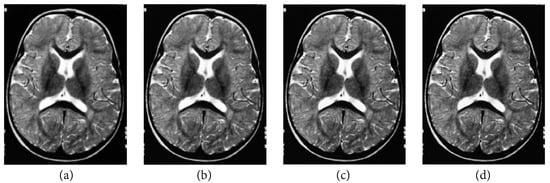
Figure 9.
X-ray film of the brain image obtained via Theorem 2 when Example 1 was tuned for the parameter by setting (a) = 0.25, (b) = 0.5, (c) = 0.75, (d) = 1.
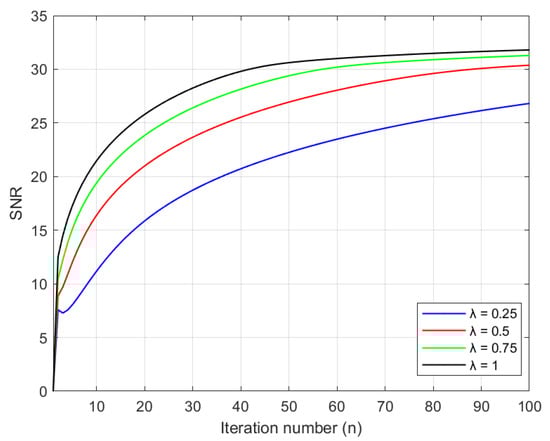
Figure 10.
The SNR of Figure 9a–d.
5. Conclusions
An inertial forward–backward splitting method is presented for solving modified variational inclusion problems. Obviously, under appropriate conditions, we demonstrate its strong convergence. Moreover, we apply the proposed method to solve the image restoration problem. In our application, we use the proposed method and Khuangsatung and Kangtunyakarn’s method to restore two medical images. To compare image quality, we also evaluate the signal-to-noise ratio (SNR) of the proposed method to that of Khuangsatung and Kangtunyakarn’s method. Finally, the SNR value demonstrates that our proposed algorithm is more effective than the algorithm that was introduced by Khuangsatung and Kangtunyakarn in solving the image recovery problem.
Author Contributions
Conceptualization, K.S. (Kanokwan Sitthithakerngkiet) and T.S.; methodology, K.S. (Kamonrat Sombut); software, K.S. (Kanokwan Sitthithakerngkiet) and T.S.; validation, A.A., K.S. (Kamonrat Sombut) and T.S.; formal analysis, T.S.; investigation, K.S. (Kamonrat Sombut); resources, K.S. (Kamonrat Sombut) and T.S.; writing—original draft preparation, K.S. (Kamonrat Sombut) and T.S.; writing—review and editing, T.S.; visualization, K.S. (Kamonrat Sombut); supervision, T.S.; project administration, K.S. (Kamonrat Sombut) and T.S.; funding acquisition, T.S. All authors have read and agreed to the published version of the manuscript.
Funding
This research was funded by National Science, Research and Innovation Fund (NSRF), King Mongkut’s University of Technology North Bangkok with Contract No. KMUTNB-FF-66-36.
Data Availability Statement
Not applicable.
Acknowledgments
The authors would like to thank King Mongkut’s University of Technology North Bangkok (KMUTNB), Rajamangala University of Technology Thanyaburi (RMUTT) and Nakhon Sawan Rajabhat University. We appreciate the anonymous referee’s thorough review of the manuscript and helpful suggestions for refining the presentation.
Conflicts of Interest
The authors declare no conflict of interest.
References
- Tseng, P. A modified forward–backward splitting method for maximal monotone mappings. SIAM J. Control Optim. 1998, 38, 431–446. [Google Scholar] [CrossRef]
- Seangwattana, T.; Sombut, K.; Arunchai, A.; Sitthithakerngkiet, K. A Modified Tseng’s Method for Solving the Modified Variational Inclusion Problems and Its Applications. Symmetry 2021, 13, 2250. [Google Scholar] [CrossRef]
- Bruck, R.E.; Reich, S. Nonexpansive projections and resolvents of accretive operators in Banach spaces. Houst. J. Math. 1977, 3, 459–470. [Google Scholar]
- Rockafellar, R.T. Monotone operators and the proximal point algorithm. SIAM J. Control. Optim. 1976, 14, 877–898. [Google Scholar] [CrossRef]
- Arunchai, A.; Seangwattana, T.; Sitthithakerngkiet, K.; Sombut, K. Image restoration by using a modified proximal point algorithm. AIMS Math. 2023, 8, 9557–9575. [Google Scholar] [CrossRef]
- Lions, P.L.; Mercier, B. Splitting algorithms for the sum of two nonliner operators. SIAM J. Numer. Anal. 1979, 16, 964–979. [Google Scholar] [CrossRef]
- Passty, G.B. Ergodic convergence to a zero of the sum of monotone operators in Hilbert space. J. Math. Anal. Appl. 1979, 72, 383–390. [Google Scholar] [CrossRef]
- Thong, D.V.; Cholamjiak, P. Strong convergence of a forward–backward splitting method with a new step size for solving monotone inclusions. Comput. Appl. Math. 2019, 38, 94. [Google Scholar] [CrossRef]
- Combettes, P.L.; Wajs, V.R. Signal recovery by proximal forward–backward splitting. Multiscale Model. Simul. 2005, 4, 1168–1200. [Google Scholar] [CrossRef]
- Lorenz, D.; Pock, T. An inertial forward–backward algorithm for monotone inclusions. J. Math. Imaging Vis. 2015, 51, 311–325. [Google Scholar] [CrossRef]
- Cholamjiak, W.; Cholamjiak, P.; Suantai, S. An inertial forward–backward splitting method for solving inclusion problems in Hilbert spaces. J. Fixed Point Theory Appl. 2018, 20, 1–17. [Google Scholar] [CrossRef]
- Caihua, C.; Shiqian, M.; Junfeng, Y. A General Inertial Proximal Point Algorithm for Mixed Variational Inequality Problem. SIAM J. Optim. 2015, 25, 2120–2142. [Google Scholar]
- Kesornprom, S.; Pholasa, N. Strong Convergence of the Inertial Proximal Algorithm for the Split Variational Inclusion Problem in Hilbert Spaces. Thai J. Math. 2020, 18, 1401–1415. [Google Scholar]
- Abubakar, A.; Kumam, P.; Ibrahim, A.H.; Padcharoen, A. Relaxed inertial Tseng’s type method for solving the inclusion problem with application to image restoration. Mathematics 2020, 8, 818. [Google Scholar] [CrossRef]
- Khuangsatung, W.; Kangtunyakarn, A. Algorithm of a new variational inclusion problem and strictly pseudononspreading mapping with application. Fixed Point Theory Appl. 2014, 209, 1–27. [Google Scholar] [CrossRef]
- Khuangsatung, W.; Kangtunyakarn, A. A theorem of variational inclusion problems and various nonlinear mappings. Appl. Anal. 2018, 97, 1172–1186. [Google Scholar] [CrossRef]
- Goebel, K.; Reich, S. Uniform Convexity, Hyperbolic Geometry and Nonexpansive Mappings; Marcel Dekker: New York, NY, USA, 1984. [Google Scholar]
- Takahashi, W. Nonlinear Function Analysis; Yokohama Publishers: Yokohama, Japan, 2000. [Google Scholar]
- Reich, S. Strong convergence theorems for resolvents of accretive operators in Banach spaces. J. Math. Anal. Appl. 1980, 75, 287–292. [Google Scholar] [CrossRef]
- Mainge, P.E. Inertial iterative process for fixed points of certain quasinonexpansive mappings. Set-Valued Anal. 2007, 15, 67–79. [Google Scholar] [CrossRef]
- He, S.; Yang, C. Solving the variational inequality problem defined on intersection of finite level sets. Abstr. Appl. Anal. 2013, 2013, 942315. [Google Scholar] [CrossRef]
- Cholamjiak, P. A generalized forward–backward splitting method for solving quasi inclusion problems in Banach spaces. Numer. Algorithms 1994, 8, 221–239. [Google Scholar] [CrossRef]
Disclaimer/Publisher’s Note: The statements, opinions and data contained in all publications are solely those of the individual author(s) and contributor(s) and not of MDPI and/or the editor(s). MDPI and/or the editor(s) disclaim responsibility for any injury to people or property resulting from any ideas, methods, instructions or products referred to in the content. |
© 2023 by the authors. Licensee MDPI, Basel, Switzerland. This article is an open access article distributed under the terms and conditions of the Creative Commons Attribution (CC BY) license (https://creativecommons.org/licenses/by/4.0/).