1. Introduction
All the graphs considered in this paper are finite, undirected, and simple. Notations not defined here refer to [
1]. For a graph
G, we always use
,
, and
to denote the vertex set, edge set, and number of vertices of
G, respectively. A graph
G with
n vertices is called an
n-graph. Suppose
H is a subgraph of
G and
u is a vertex of
G. We define the
neighborhood of
u in
H as
and the
degree of
u in
H as
. For two vertices
, we use
to denote a path between
u and
v in
H with
u and
v as end vertices, and use
,
to denote the distance between
u and
v in
H, i.e., the number of edges of the shortest path between
u and
v in
H. Suppose
is a nonempty subset of
. We use
and
to denote the graph obtained from
H by adding and deleting edges in
, respectively. If
, we write
and
instead of
and
, respectively. Let
denote the maximum degree of
H. For an integer
and a subset
X of
, we define
,
, and
.
Let be k graphs. The union graph of , denoted by , is a graph with vertex set and edge set ; if are pairwise vertex disjoint, we denote by or ; if each is isomorphic to Q, we abbreviate as . The join graph of , denoted by , is a graph obtained from by connecting any vertex of to each vertex of by an edge for each .
A subset U of is called an independent set of G if any two vertices of U are nonadjacent in G. We use to denote the independence number of a graph G. For an integer , we denote as an independent set of if ; otherwise, .
A tree is a connected acyclic graph. A maximal tree is a tree that cannot be extended by adding any more edges without creating a cycle. For a tree T, a leaf of T is a vertex v with . We use to denote the set of leaves in T. A spanning tree (resp. a Hamiltonian path) of a graph is a tree (resp. a path) containing all the vertices of the graph. A spanning k-ended tree (resp. k-ended tree) is a spanning tree (resp. a tree) with at most k leaves. Obviously, a Hamiltonian path is a spanning 2-ended tree.
Spanning
k-ended trees are important in various fields such as network design, graph theory, and communication networks. They provide a structured way to connect all the nodes in a network while ensuring efficient communication and minimizing unnecessary connections. In addition, they serve as fundamental components for algorithms in routing, broadcasting, and spanning tree protocols. Therefore, the existence and properties of spanning
k-ended trees are crucial for optimizing network design and performance. Ozeki and Yamashita [
2] pointed out that determining whether a graph has a spanning
k-ended tree or not is NP-complete. Since then, many scholars have studied the sufficient conditions for the existence of spanning
k-ended trees, such as degree sum conditions [
3,
4,
5,
6,
7,
8,
9].
The forbidden induced subgraph conditions are a set of criteria used to determine whether a given graph can have a spanning tree with specific properties. These conditions indicate which specific subgraphs are not allowed to be induced in the graph for such spanning trees to exist. Among all the forbidden induced subgraphs, the complete bipartite graph
is central. A graph that does not contain an induced subgraph isomorphic to
is called a
-free graph. Matthews and Sumner [
10] showed that a
-free
n-graph
G has a Hamiltonian path if
. Kano et al. [
11] gave a degree sum condition for a
-free graph to have a spanning
k-ended tree as follows.
Theorem 1 (Kano et al. [
11])
. Let G be a connected -free n-graph. If for any , then G has a spanning k-ended tree. For , Kyaw gave a sufficient condition for a -free graph to have a spanning k-ended tree.
Theorem 2. Let G be a connected -free n-graph.
- (1)
(Kyaw [
12])
If , then G has a Hamiltonian path.- (2)
(Kyaw [
13])
If , then G has a spanning 3-ended tree.
The Hamiltonian problem holds significant importance in graph theory and combinatorial optimization. It is crucial in determining whether a given graph contains a Hamiltonian cycle, which is a cycle that visits each vertex exactly once. The problem has applications in various fields, including computer science, logistics, and transportation, as it relates to the design of efficient routes, scheduling, and circuit layout. Furthermore, the study of the Hamiltonian problem has led to the development of important algorithms and heuristics, contributing to advancements in computational complexity and theoretical computer science. The problem also serves as a foundational concept for understanding and solving other NP-complete problems, making it a central focus of research in combinatorial optimization and algorithmic design.
Degree conditions and forbidden induced subgraph conditions are the two types of classical sufficient conditions for graphs to be Hamiltonian. As we all known, in the study of the existence of a Hamiltonian cycle, the degree sum of end vertices in a longest path is crucial. Bondy [
14] proved that if a 2-connected
n-graph has a longest path between
x and
y such that
, then
G is Hamiltonian or has a cycle of length at least
c. Sometimes, perhaps, the degree sum of the two end vertices of a longest path is smaller, but the degrees of their neighbors or vertices at distance two with them are larger, and we can replace them by some larger degree vertices in the right position so that we can construct a longest path with a larger degree sum of its end vertices. Therefore, we can construct a longer cycle. With the inspiration of this idea, Zhu, Li, and Deng [
15] proposed the definition of implicit-degree.
Definition 1 (Zhu, Li and Deng [
15])
. Let x be a vertex of G and let denote the set of vertices at distance two with x in G. Set . If and , then suppose that is the degree sequence of vertices of in G. The implicit-degree of x, denoted by , is defined asIf or , then we define .
Obviously,
for every vertex
. From the definition of implicit-degree, it coincides with the importance of a person’s friends or friends’ friends in a social network. We define
is an independent set of
if
; otherwise,
. Many classical results in graph theory that consider degree conditions can be extended to implicit-degree conditions, such as [
15,
16,
17]. We just give one example related to spanning trees to show this in detail.
Theorem 3 (Cai et al. [
18])
. Let G be a connected n-graph and be an integer. If , then G contains a spanning k-ended tree. Since
, the result of Broersma and Tuinstra [
3] is a corollary of Theorem 3 when
. In this article, we extend Theorem 2 by using
and
in place of
and
, respectively.
Theorem 4. Suppose G is a connected -free n-graph.
- (1)
If , then G has a Hamiltonian path.
- (2)
If , then G has a spanning 3-ended tree.
The proof of Theorem 4 will be given in
Section 3. Now, we present the following three examples. The first one shows that the lower bounds in Theorem 4 are better than those in Theorem 3; the second one shows that the lower bounds are sharp in Theorem 4; and the third one provides graphs which do not satisfy the conditions of Theorem 2, but satisfy the conditions of Theorem 3.
Example 1. Let G be a connected n-graph with . Theorem 3 shows that (1) G has a Hamiltonian path if ; (2) G has a spanning 4-ended tree if . Theorem 4 shows that, if G is -free, then and can be reduced to and , respectively.
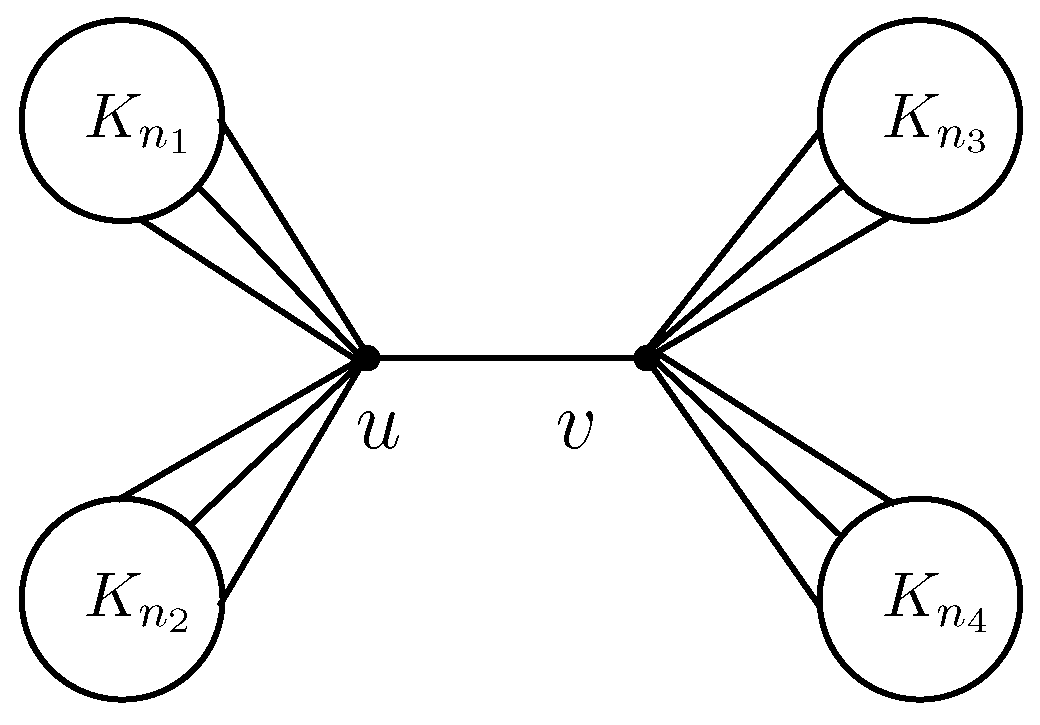
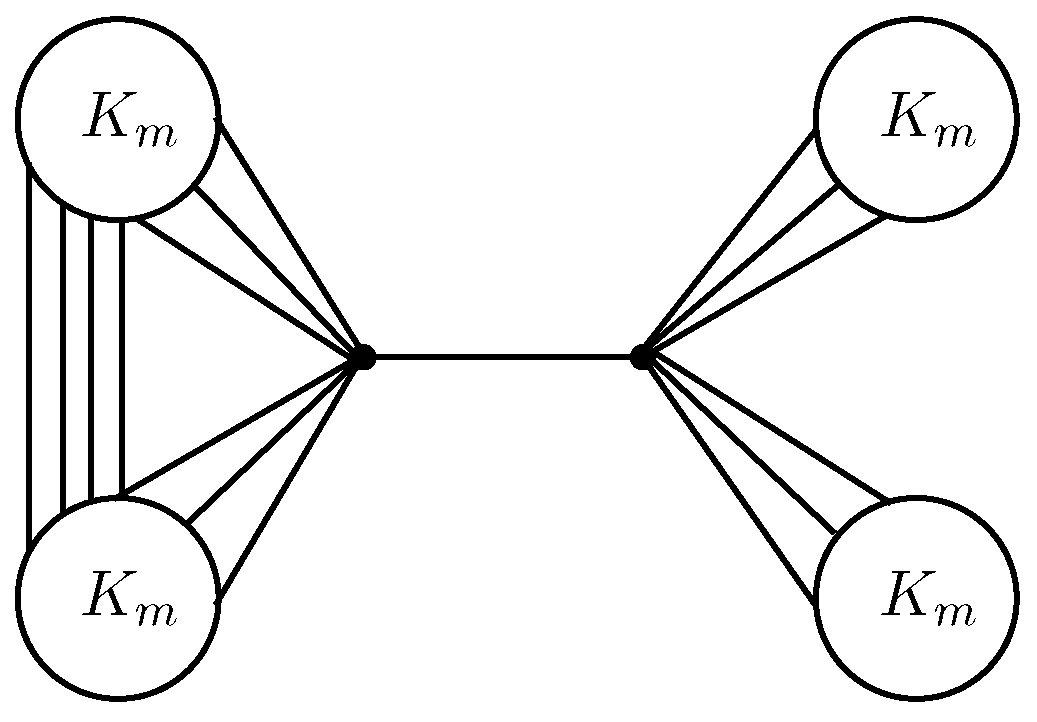
Example 2. (1) The graph indicates that the condition in Theorem 4 is sharp. Clearly, G has no Hamiltonian path. The vertex in has implicit-degree and every vertex in has implicit-degree m. So, . (2) The following graph G indicates that the condition in Theorem 4 is sharp. Let be a complete -graph for . The graph G is constructed with vertex set () and edge set (see Figure 1). It is easy to verify that and G has no spanning 3-ended tree. Without loss of generality, suppose . For each vertex , the degree and implicit-degree of x can be seen from in Table 1. Example 3. (1) Let with . Let be a graph constructed from the graph () by adding one edge between and for each , and deleting one edge between and . Where , , , and , and and denote the two vertices not adjacent to u. It is easy to verify that , , and has a Hamiltonian path . For each vertex , the degree and implicit-degree of x can be seen from Table 2. (2) Let be a graph constructed from the graph in Figure 1 with () by adding independent edges between and (see Figure 2). It is easy to verify that , , and contains a spanning 3-ended tree. This shows that Theorem 4 generalizes Theorem 2. 3. Proof of Theorem 4
Since the result of Theorem 4 (2) will be used in the proof of Theorem 4 (1), we prove Theorem 4 (2) firstly.
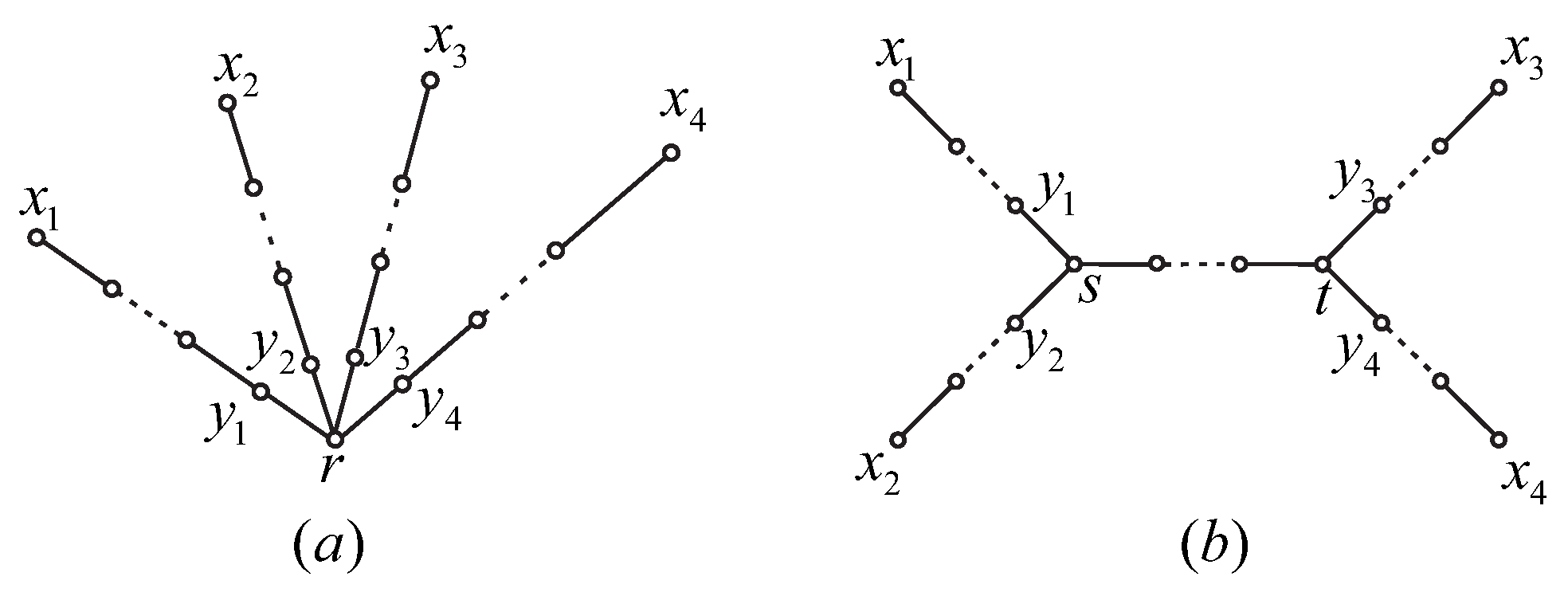
Proof of Theorem 4 (2). Let G be a connected -free n-graph with and let G have no spanning three-ended tree. Then, every spanning tree of G has at least four leaves. Choose a maximal tree T of G with exactly four leaves such that is minimal.
Since
T has exactly four leaves, we have
or
(see
Figure 3). Let
and
and
. Since
T is maximal,
.
If
, then
. Let
and
(see
Figure 3a). If
for some
, then
is a tree with four leaves such that
and
. This contradicts the choice of
T. So,
is an independent set of
G. Thus,
induces a
, a contradiction.
Next, we can assume
. Then,
. Let
(see
Figure 3b). We choose such a
T satisfying the following conditions.
(C1) The distance is as small as possible;
(C2) The degree sum is as large as possible, subject to (1).
Let be the component of such that and let be the unique vertex of with . We assume, without loss of generality, that . □
Claim 1. is an independent set of G.
Proof. If there are two vertices such that , then or is a three-ended tree such that , contrary to Lemma 1. □
Claim 2. for .
Proof. If there are two vertices such that , then or is a three-ended tree such that , contrary to Lemma 1. □
Claim 3. .
Proof. Suppose to the contrary that . We assume, without loss of generality, that there is a vertex such that . Then, is a tree with four leaves such that , and . But , contrary to the condition (C1). □
Claim 4. for each vertex .
Proof. Suppose that there is a vertex such that . Without loss of generality, we assume . Let and . Suppose that is the degree sequence of vertices of in G. By the definition of , we have and or . Denote and as the predecessor and successor of on the path , respectively. Without loss of generality, suppose . By Claims 1–3, there must exist a vertex for some and .
If , then, since are vertices in , there must exist a vertex such that . If , then . Since , . Since are l vertices in , there must exist a vertex such that . Therefore, in both cases, we can obtain a tree with four leaves such that , , and replaces as a new leaf of . Then, , contrary to condition (C2). □
Claim 5. For , if , then , where denotes the predecessor of z on the path .
Proof. Suppose z is a vertex of such that for some . Without loss of generality, we assume that and for some . Then, is a three-ended tree such that , contrary to Lemma 1. □
Claim 6. .
Proof. If there is a vertex , then, by Claim 1, induces a , a contradiction.
If there is a vertex , then, by Claim 3, . Let , where . We can assume . If for some , then by Claim 2 and by Claim 5. Thus, induces a by Claim 1, a contradiction.
If , then, without loss of generality, we assume . So there is a vertex such that and . If is an edge of T, then is a three-ended tree such that , contrary to Lemma 1. Otherwise, there is a vertex . By Claim 3, . Then, induces a by Claim 1, a contradiction. □
Next, we calculate . For convenience, for , we set , , , and , where . Clearly, for every .
Claim 7. For , , , , and are pairwise disjoint.
Proof. Clearly, and . By Claim 1, . By Claim 5, and . By Claim 6, . □
For
, by Claims 6 and 7, and the inclusion–exclusion principle, we have
Notice that
and
by Claim 3. By inequalities (
1) and (
2), we have
Therefore, by Claim 4, we have . So, ; this contradicts the condition . Now, we complete the proof of Theorem 4 (2).
□
Proof of Theorem 4 (1). Let
G be a connected
-free
n-graph with
but let
G have no Hamiltonian path. Since
, by Theorem 4 (2),
G has a spanning three-ended tree. Let
Since G has no Hamiltonian path, every tree in has exactly three leaves. We choose a longest path of such that is as large as possible. Then, . Let T be the tree in containing the path P. Then, is a path of T and one of the end vertices of H is adjacent to some vertex with in T. For convenience, set . Without loss of generality, we assume . In fact, by the choice of P, we have . □
Claim 8. is an independent set of G for every vertex .
Proof. If , then is a Hamiltonian path of G, a contradiction. Since , we have and for every vertex . So, is an independent set of G for every vertex . □
Claim 9. and .
Proof. If , then, by Lemma 2, there is a vertex such that . Thus, is another longest path of such that . This contradicts the choice of P. So, . Similarly, . □
Set .
Case 1. There is a vertex such that .
Subcase 1. .
Set , and . If there is a vertex , then is a tree in and is a path of longer than P, a contradiction. So, . Similarly, .
If there is a vertex
, then
(otherwise,
is a Hamiltonian path of
G, a contradiction). Thus,
is a tree in
, and
if
or
if
;
is a path of
longer than
P, a contradiction. So,
. Therefore,
, and
are pairwise disjoint. Note that
and
. We have
On the other hand, , a contradiction.
Subcase 2. .
Then, . Let (). We can assume that occur in this order along P. Let , for , and, . Clearly, . Since P is a longest path of , it is easy to verify that for , , for , and moreover, if , then for , and for .
If , then, by Lemma 3, .
If , then (otherwise, induces a , a contradiction). Thus, by Lemma 3, we have .
Next, suppose . Similarly to the case , we can ascertain that for . Since G is -free, for . By Lemma 3, we have for . Therefore, .
By the above discussion, for any , we have . On the other hand, , a contradiction.
Case 2. for every vertex .
Claim 10. and .
Proof. If , then and . Since for every vertex , we have . Then, by the definition of , there is a vertex such that , a contradiction.
If , then, by a similar argument to the one above, we can obtain a contradiction. If , then . Since for every vertex , we have . Then, by the definition of , there is a vertex such that , a contradiction. □
Subcase 3. .
Since P is a longest path of , we have and . Then, . Since for every vertex , for any . By the definition of , there is a vertex such that . Suppose is the first vertex in such that and is the last vertex in . We can assume . (Since, otherwise, there is a vertex such that and ).
Let Then,
Claim 11. is an independent set of G.
Proof. If , then is a Hamiltonian path of G, a contradiction. If , then is a Hamiltonian path of G, a contradiction. If , then is a Hamiltonian path of G, a contradiction. So, is an independent set of G. □
Claim 12. Proof. Set and .
If there is a vertex , then is a tree in and is a path of longer than P, this contradicts the choice of P. So, .
If there is a vertex
, then
is a Hamiltonian path of
G, a contradiction. So,
. Notice that
and
. Therefore,
□
Claim 13. .
Proof. Since G has no Hamiltonian path, . Set , and .
If there is a vertex
, then
is a tree in
and
is a path of
longer than
P, this contradicts the choice of
P. So,
. Similarly,
and
. Note that
. Therefore,
□
Claim 14. .
Proof. Since G has no Hamiltonian path, . By the choice of P, . Since G is -free, (otherwise induces a ). Set , and .
If there is a vertex
, then
is a tree in
and
is a path of
longer than
P, this contradicts the choice of
P. So,
. Similarly,
and
. Note that
. Therefore,
□
Since
P is a longest path of
, it is easy to verify that
. Therefore, by Claims 11–14, we have
On the other hand, , a contradiction.
Subcase 4. .
Then, . By a similar argument to the one in Subcase 3, there is a vertex such that . Suppose is the first vertex in such that and is the last vertex in . Clearly, . Similarly to the discussion in Claim 11, we can ascertain that is an independent set of G. Let
If there is a vertex
, then
is a Hamiltonian path of
G, a contradiction. So,
. Similarly,
,
, and
. Since
G is
-free,
(otherwise, if there is a vertex
, then
induces a
, a contradiction). Therefore, by Lemma 4,
Similarly,
and
Thus, we have
On the other hand, , a contradiction. Now, the proof of Theorem 4 (1) is completed.