Abstract
In this research article, we have proved strong and -convergence results for mapping satisfying condition via M-iteration process in CAT(0) spaces. Numerical examples are provided to show the superiority of our results over other existing results and to illustrate the faster convergence of the M iterative scheme as compared to many well-known iterative schemes. In this process, many results are improved in the current literature of CAT(0) spaces.
Keywords:
M-iteration process; mappings satisfying (RCSC) condition; strong convergence; Δ-convergence; CAT(0) space MSC:
47H09; 47H10
1. Introduction
The theory of fixed points plays a vital role in solving the nonlinear problems that arise in pure and applied sciences. Banach [1] studied the existence of fixed points for contraction mappings in 1922. He proved that a contraction mapping T defined on a closed nonempty subset N of a Banach space has a unique fixed point. To approximate the fixed point, he used the Picard iterative method (or successive approximation method), i.e., . But in the case of nonexpansive mappings, the Picard iterative method fails to converge to the fixed point. So, for the case of nonexpansive mappings, Browder [2] and Gohde [3] independently proved the same results in the framework of a uniformly convex Banach space. They stated that a nonexpansive mapping T on a nonempty bounded closed and convex subset N of a uniformly convex Banach space admits a fixed point. Similarly, for the fixed point approximation of different mappings, many iterative methods have been developed. Some of these iteration processes are in Maan [4], Ishikawa [5], Agarwal et al. [6], Thakur [7], Noor [8] and Abbas [9]. For more details on iteration processes, see [10,11,12,13,14,15,16,17] and references therein.
In 2008, Suzuki [18] studied the non-expansive mappings and introduced a new notion of Suzuki generalized non-expansive mapping (or mappings satisfying condition-). Many results have been obtained for this type of mapping in spaces (see, [9,19,20]).
In 2012, Karapinar [21] studied the condition and introduced a new condition called condition (Riech Chatterjee Suzuki ) as a generalization of condition (C).
In 2018, Ullah and Arshad [22] introduced a new three-step iteration process to approximate the fixed point of mapping satisfying condition (C), known as the M-iteration process, which is defined as:
Let (Banach space) and be a selfmap. Then, for any real sequence for , we have
They proved the speedier convergence behavior of the M-iteration process and compared it with Picard- and -iterative schemes with the help of a numerical example. They also proved the weak and strong convergence results in Banach spaces.
Let and be a metric space. Then a mapping is a geodesic joining the two points such that , and for all . The mapping is isometry and . The image of the geodesic is called a geodesic segment joining the points denoted by whenever it exists uniquely. The space is called a geodesic space whenever for every two points there exists a geodesic joining these points. If the space has only one geodesic joining each two points , then the space is called uniquely geodesic. A subset N is convex in if each geodesic segment (joining ) contained in N.
Let is a geodesic space, then a triangle in is called a geodesic triangle having three elements of , which denote the vertices of the triangle , i.e., and three geodesic segments, which denote the edges of , i.e., , . For any geodesic triangle , a triangle is called a comparison triangle if it satisfies
If , then an element is called a comparison element, if .
A geodesic space is called a space if there exists a comparison triangle for a geodesic triangle such that
where and .
This research article aims to prove some strong and -convergence theorems for mapping with condition using the M-iteration process in the spaces. The M-iteration in space is defined as:
where and can be any real sequence in (0,1).
2. Preliminaries
Let where is a metric space and is a self mapping, then a point is a fixed point of the mapping T if . The set , i.e., = denotes the set of all fixed points of mapping T.
Definition 1.
The mapping T is called non-expansive mapping if for , we have
Definition 2.
A self-mapping is said to be quasi if the set of fixed point and for all and , we have
Definition 3.
Let where is a metric space. Then satisfies condition (C) if for each , we have
Definition 4
([21]). Let (metric space). Then satisfies condition if for the mapping T satisfy
Example 1.
Suppose that and defined by
It is easy to show that T satisfies the (RCSC) condition but does not satisfy condition (C) at and .
Remark 1.
The above example shows that condition is the extension of condition (C).
Lemma 1
([23]). Let be a space. Then for and , there is a unique line segment i.e., such that
Lemma 2
([23]). For any and in Lemma 1, we have
Lemma 3
([21]). Let where is a space and be a self mapping with condition. Then for any and , T satisfies that
Lemma 4
([21]). Let such that N is closed and convex in space . Then for any , the self mapping with condition holds that
Lemma 5
([9]). Let such that N is closed in space . Let be a mapping with condition and a sequence bounded in N with and , then .
Lemma 6
([24]). Suppose that be a sequence in the interval for some . Let are sequences in the space such that, for some
then
Let is a space and is closed in . If a sequence is bounded in N, then for any , we define
(i) Asymptotic radius of the sequence at the point
(ii) Asymptotic radius of the sequence relative to the set N
(iii) Asymptotic center of the sequence relative to the set N
We know that has only one element (see [25]).
In 2008, Kirk and Panyanak [26] proved a weak convergence result in the framework of Banach spaces. They studied Lim’s [27] concept of -convergence and proved that a nonexpansive mapping admits a fixed point, where N is closed, convex, and bounded in space .
Definition 5
([26]). Let be a space. Then a sequence Δ-converges to an element if r is the unique asymptotic center of every sub sequence of . Here r is the called of and written as .
From the definition of -convergence we know that each space satisfies the Opial’s condition [28].
Lemma 7
([26]). Let is a space. Then every sequence bounded in has a sub-sequence , which is Δ-convergent.
Lemma 8
([23]). Let N be a closed convex and non-empty subset of . Then the asymptotic center of a bounded sequence is in the set N.
3. Convergence Results for Mapping with (RCSC) Condition
Some results of strong and -convergence are proved for the mapping satisfying condition via M iteration process in the framework of space . We start from a key lemma.
Lemma 9.
Let be a complete space and , closed and convex in . Assume that is a self mapping with (RCSC) condition and . If is a sequence defined by (2), then exists for each .
Proof.
Assume that and . Since T is a self-mapping with condition by Lemmas 2 and 3, we obtain
Using the inequality (3) we have
Similarly using the inequality (4) we have,
Hence the sequence is a non-increasing and bounded, which implies that, exists for each . □
Theorem 1.
Let be a complete space and , closed and convex in . Assume that is a self mapping with (RCSC) condition. Then a sequence defined by (2), is bounded if and only if and .
Proof.
Suppose that a sequence is bounded and . We need to prove that . For this we choose any . We are going to show that (i.e., ). Since T satisfies condition, so Lemma 4 suggests that
Hence . Since the space is uniformly convex, so contains only one element and thus we have . Hence it is proved that is the element of , i.e., .
Conversely, suppose that . We need to prove that and the sequence is bounded. For this we assume that be fix, then in Lemma 9, we have already proved that the sequence is bounded and exists. Put
Taking limsup on both sides, we have
By using Lemma 3, we have
Also by Lemma 9, we know that
Therefore
From Equation (10), we have
Using Lemma 6, we obtain
This completes the proof. □
Next, we prove a strong convergence result for mapping with condition in a compact domain.
Theorem 2.
Let be a complete space, is a closed convex and compact subset of , a self mapping satisfying (RCSC) condition and . Then, is a sequence defined by iteration (2) that will strongly converge to the fixed point of T.
Proof.
Since , so by Theorem 1, we know that is bounded and . Since N is a compact in , so has a sub-sequence such that , for some i.e., converges strongly to .
Using Lemma 4, we have
Taking on both sides we have
In the view of Theorem 1, . Now using and in the inequality (12), we obtain
This means that the sequence converges to , so i.e., . Lemma 9, suggests that exists. Therefore the strong limit of is . □
Now, we will prove the strong convergence results based on condition which was defined by Sentor and Dotson in [29].
Definition 6
([29]). Let subset of . Then a self mapping satisfies condition , if there exists a non-decreasing mapping with , for each and for all , where = .
Theorem 3.
Let is a complete space and , closed and convex in . Since be a self mapping satisfy (RCSC) condition with and a sequence defined by iteration (2). If the mapping T satisfies condition , then the sequence strongly converges to the fixed point of T.
Proof.
By Lemma 9, we know that exists for all , so exists. Let for some . If then the equation is true. Let . Now, for all gives that
yields the inequality
This shows that is bounded below and non-increasing, so exists. Also, Theorem 1 suggests that . It follows from the condition that
Also by the proof of Theorem 1, we know that . So inequality (14) becomes
Since the mapping is nondecreasing with and for each . Now from (15), we have
Next, we need to prove that is a Cauchy sequence in N. Let be chosen arbitrarily. Since , so there exists a natural such that for each
In particular,
So there must be such that
Now, for any , we have
Thus we see that the sequence is a Cauchy sequence in N. Since N is closed in , so N is complete and therefore must be converged to the point . As , this gives that . Since N is closed and T satisfies condition, so is closed and hence r is the fixed point of T. Thus, the sequence strongly converges to fixed point r of T. □
Finally, we suggest the -convergence results for mapping having -condition via the M-iteration process.
Theorem 4.
Let is complete space and , closed and convex in . Assume that is a self mapping satisfying (RCSC) condition with . Then a sequence defined by iteration (2) Δ-converges to a fixed point of T.
Proof.
By Theorem 1, we know that the sequence is bounded and . Now we assume that where is the subsequence of . In order to prove that -converges to the fixed point of T, we follow the two steps.
- (I)
- We prove that .
- (II)
- contains exactly one point.
Step-I To show . Let , then there is a sub-sequence of such that . Using Lemmas 7 and 8, the sequence has a sub-sequence with . Since is a sub-sequence of and so . Also, the mapping T satisfies the condition , using Lemma 4, we have
Taking limsup on both sides of the above inequality, we have
As , using Opial condition, we obtain
Hence, , i.e., .
Now, from Lemma 9, we have exists. So we need to prove that . On contrary, assume that , then by uniqueness property of asymptotic centers, we have
Consequently, . This is a contradiction and so . Hence, .
Step-II: To prove the -convergent of the sequence in the set we will prove that has only one element. If is a sub-sequence of , then Lemmas 7 and 8 suggest that the sequence has a subsequence such that . Let and . We have already proved that and . We contrarily suppose that , then exists and the asymptotic centers are unique, so we have
which is a contradiction, so . Therefore, . This completes the proof. □
4. Numerical Example
Now, we will construct a numerical example for mapping with (RCSC) condition to observe the efficiency of the M iteration process with the already-existing iteration process in the current literature.
Example 2.
Suppose that and the self mapping T are defined by
We will show that
- (i)
- T satisfies (RCSC) condition.
- (ii)
- T does not satisfy condition (C).
To prove these conditions, we have the following cases:
Case (a): Let , then and .
Case (b): Let , then = and = . Now
Case (c): When and . Then and . Now
Case (d): When and . Then and . Now
Hence, (i) is proved.
Next, we will prove the condition (ii). For this, we let and , then
but
.
Hence, we prove that T satisfies (RCSC) condition but fails to satisfy condition (C).
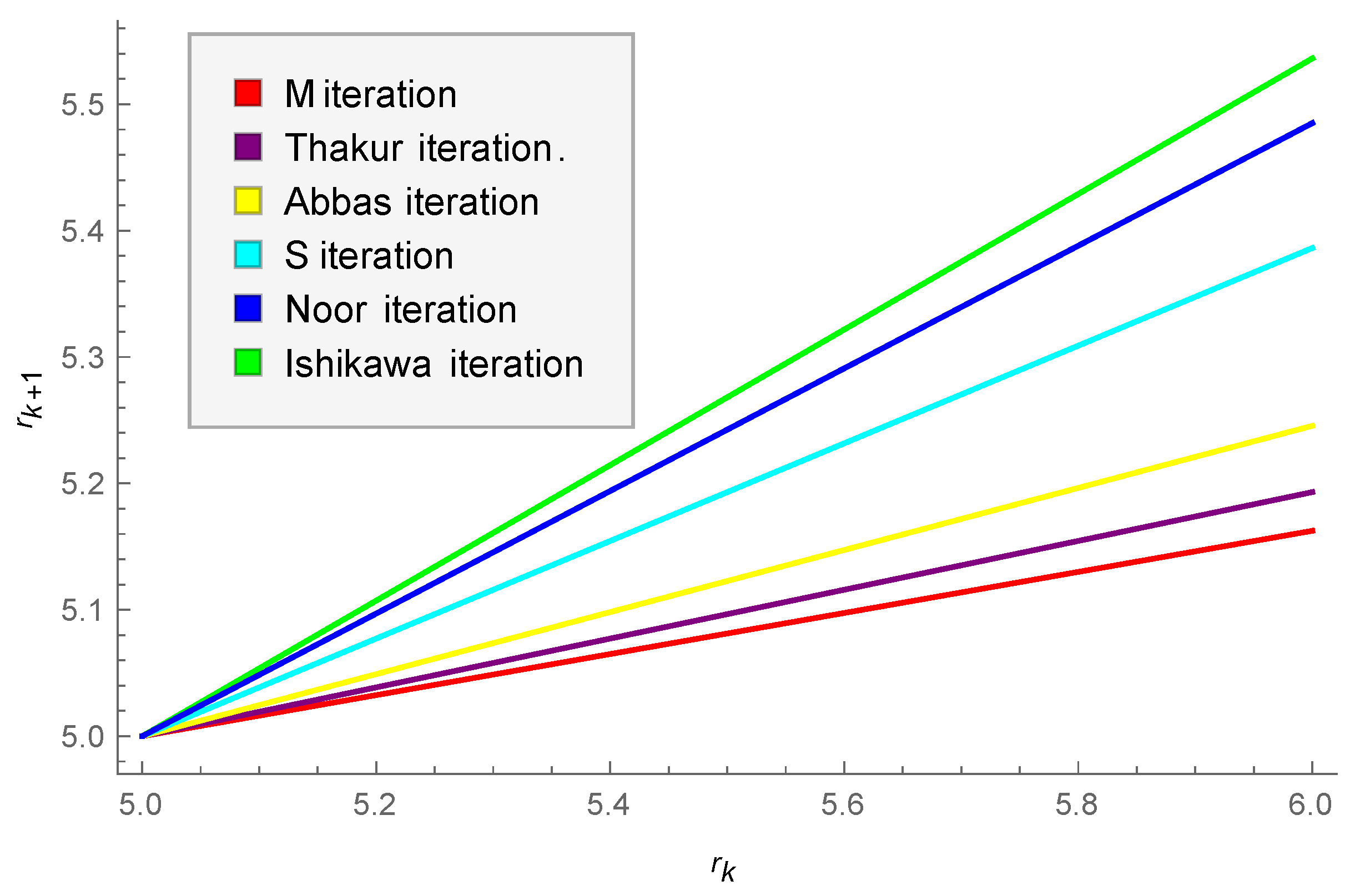
Now we let the parameters , and , for all . Table 1 and Figure 1 clearly show the speedy convergence of the M-iteration process to the fixed point of mapping T as compared to the other iteration processes, i.e., the Thakur, Abbas, S, Noor and Ishikawa iteration processes.
Table 1.
Computational values generated by the different iteration processes for the mapping T as given in Example 2.
Figure 1.
Convergence behaviors of M-iteration, Thakur, Abbas, S, Noor, Ishikawa to a fixed point of the self mapping T with parameters , and and initial guess .
5. Conclusions
The fixed-point results extending from the domain of linear spaces to the domain of nonlinear spaces has his own significance. Takahashi [30] suggests a new notion of convexity in the framework of metric spaces. This discovery initiated the study of different convexity structures in the context of metric spaces. Here in this paper, we have extended the linear version convergence results of mapping with (RCSC) condition (which is the extension of mapping with condition (C)) to the nonlinear framework of CAT(0) spaces for the M-iteration process. In this sense, our results Theorem 2, Theorem 3 and Theorem 4 are the two-fold extensions of Theorem , Theorem and Theorem of [22], respectively.
Author Contributions
Conceptualization, N.S. and K.U.; Formal analysis, K.U., H.B. and S.U.; Investigation, N.S., S.U. and H.B.; Writing—original draft preparation, N.S., H.B., H.A.N. and S.U.; Writing—review and editing, N.S., R.G. and H.A.N. All authors have read and agreed to the published version of the manuscript.
Funding
The authors extend their appreciation to Prince Sattam bin Abdulaziz University for funding this research work through the project number (PSAU/2023/01/90101).
Data Availability Statement
Data are contained within the article.
Acknowledgments
The authors are thankful to the editor and anonymous referees for their valuable comments and suggestions.
Conflicts of Interest
The authors declare no conflict of interest.
References
- Banach, S. Sur les operations dans les ensembles abstraits et leur application aux equations integrales. Fund. Math. 1922, 3, 133–181. [Google Scholar] [CrossRef]
- Browder, F.E. Nonexpansive nonlinear operators in a Banach space. Proc. Natl. Acad. Sci. USA 1965, 54, 1041–1044. [Google Scholar] [CrossRef] [PubMed]
- Gohde, D. Zum Prinzip der Kontraktiven Abbildung. Math. Nachr. 1965, 30, 251–258. [Google Scholar] [CrossRef]
- Mann, W.R. Mean value methods in iteration. Proc. Am. Math. Soc. 1953, 4, 506–510. [Google Scholar] [CrossRef]
- Ishikawa, S. Fixed points by a new iteration method. Proc. Am. Math. Soc. 1974, 44, 147–150. [Google Scholar] [CrossRef]
- Agarwal, R.P.; O’Regon, D.; Sahu, D.R. Iterative construction of fixed points of nearly asymtotically nonexpansive mappings. J. Nonlinear Convex Anal. 2007, 8, 61–79. [Google Scholar]
- Thakur, B.S.; Thakur, D.; Postolache, M. New iteration scheme for numerical reckoning fixed points of nonexpansive mappings. J. Inequal. Appl. 2014, 2014, 328. [Google Scholar] [CrossRef]
- Noor, M.A. New approximation schemes for general variational inequalities. J. Math. Anal. Appl. 2000, 251, 217–229. [Google Scholar] [CrossRef]
- Abbas, M.; Nazir, T. A new faster iteration process applied to constrained minimization and feasibility problems. Math. Vesnik 2014, 66, 223–234. [Google Scholar]
- Saleem, N.; Iqbal, I.; Iqbal, B.; Radenovíc, S. Coincidence and fixed points of multivalued F-contractions in generalized metric space with application. J. Fixed Point Theory Appl. 2020, 22, 81. [Google Scholar] [CrossRef]
- Saleem, N.; Vujaković, J.; Baloch, W.U.; Radenović, S. Coincidence point results for multivalued Suzuki type mappings using θ-contraction in b-metric spaces. Mathematics 2019, 7, 1017. [Google Scholar] [CrossRef]
- Saleem, N.; Agwu, I.K.; Ishtiaq, U.; Radenović, S. Strong Convergence Theorems for a Finite Family of Enriched Strictly Pseudocontractive mappings and ϕT-Enriched Lipschitizian mappings Using a New Modified Mixed-Type Ishikawa Iteration Scheme with Error. Symmetry 2022, 5, 1032. [Google Scholar] [CrossRef]
- Bashir, S.; Saleem, N.; Aydi, H.; Husnine, S.M.; Rwaily, A.A. Developments of some new results that weaken certain conditions of fractional type differential equations. Adv. Differ. Equ. 2021, 1, 359. [Google Scholar] [CrossRef]
- Okeke, G.A.; Abbas, M.; de la Sen, M. Fixed point theorems for convex minimization problems in complex valued CAT(0) spaces. Nonlinear Funct. Anal. Appl. 2020, 25, 671–696. [Google Scholar]
- Umudu, J.C.; Adewale, O.K. Fixed point results in uniform spaces via simulation functions. Int. J. Math. Sci. Optim. Theory App. 2021, 7, 56–64. [Google Scholar] [CrossRef]
- Khatoon, S.; Cholamjiak, W.; Uddin, I. Modified shrinking projection methods in CAT(0) space. Proc. Est. Acad. Sci. 2022, 71, 275–288. [Google Scholar] [CrossRef]
- Khatoon, S.; Cholamjiak, W.; Uddin, I. A modified proximal point algorithm involving nearly asymptotically quasi-nonexpansive mappings. J. Inequal. Appl. 2021, 2021, 83. [Google Scholar] [CrossRef]
- Suzuki, T. Fixed point theorems and convergence theorems for some generalized nonexpansive mapping. J. Math. Anal. Appl. 2008, 340, 1088–1095. [Google Scholar] [CrossRef]
- Basarir, M.; Sahin, A. On the strong and Δ-convergence of S–iteration process for generalized nonexpansive mappings on CAT(0) spaces. Thai J. Math. 2014, 12, 549–559. [Google Scholar]
- Nanjaras, B.; Panyanak, B.; Phuengrattana, W. Fixed point theorems and convergence theorems for Suzuki-generalized nonexpansive mappings in CAT(0) spaces. Nonlinear Anal. Hyb. Syst. 2020, 4, 25–31. [Google Scholar] [CrossRef]
- Karapinar, E. Remarks on Suzuki (C)-condition. In Dynamical System and Methods; Springer: New York, NY, USA, 2012. [Google Scholar]
- Ullah, K.; Arshad, M. Numerical reckoning fixed point for Suzuki’s generalized non-expansive mappings via new iteration process. Filomat 2018, 32, 187–196. [Google Scholar] [CrossRef]
- Dhompongsa, S.; Panyanak, B. On Δ-convergence theorems in CAT(0) spaces. Comput. Math. Appl. 2008, 56, 2572–2579. [Google Scholar] [CrossRef]
- Lawaong, W.; Panyanak, B. Approximating fixed points of nonexpansive nonself mappings in CAT(0) spaces. Fixed Point Theory Appl. 2010, 2010, 367274. [Google Scholar] [CrossRef][Green Version]
- Dhompongsa, S.; Kirk, W.A.; Panyanak, B. Nonexpansive set-valued mappings in metric and Banach spaces. J. Nonlinear Convex Anal. 2007, 8, 35–45. [Google Scholar]
- Kirk, W.A.; Panyanak, B. A concept of convergence in geodesic spaces. Nonlinear Anal. TMA 2008, 68, 3689–3696. [Google Scholar] [CrossRef]
- Lim, T.C. Remarks on some fixed point theorems. Proc. Am. Math. Soc. 1976, 60, 179–182. [Google Scholar] [CrossRef]
- Opial, Z. Weak and strong convergence of the sequence of successive approximations for non-expansive mappings. Bull. Am. Math. Soc. 1967, 73, 591–597. [Google Scholar] [CrossRef]
- Senter, H.F.; Dotson, W.G. Approximating fixed points of nonexpansive mappings. Proc. Am. Math. Soc. 1974, 44, 375–380. [Google Scholar] [CrossRef]
- Takahashi, T. A convexity in metric spaces and nonexpansive mappings. Kodai Math. Semin. Rep. 1970, 22, 142–149. [Google Scholar] [CrossRef]
Disclaimer/Publisher’s Note: The statements, opinions and data contained in all publications are solely those of the individual author(s) and contributor(s) and not of MDPI and/or the editor(s). MDPI and/or the editor(s) disclaim responsibility for any injury to people or property resulting from any ideas, methods, instructions or products referred to in the content. |
© 2023 by the authors. Licensee MDPI, Basel, Switzerland. This article is an open access article distributed under the terms and conditions of the Creative Commons Attribution (CC BY) license (https://creativecommons.org/licenses/by/4.0/).