Abstract
This paper investigates the local stability and stabilization criteria of sampled-data control systems, taking into account actuator saturation and peak-bounded exogenous disturbances. Specifically, this study introduces two innovations to extend the maximum upper bound of the sampling interval: two novel time integrals of the weighted state derivative are introduced to formulate an improved looped-functional; second, the introduction of two supplementary zero-equalities to improve the relationship among the components of the augmented state. Building on this, a set of linear matrix inequality-based stabilization conditions is derived. These conditions ensure that a closed-loop sampled-data system can become exponentially stable and achieve a guaranteed peak-to-peak performance in the domain of attraction. Finally, the efficacy of the proposed methodology is substantiated through both simulation and experimental results, focusing on the sampled-data control of an inverted pendulum system.
Keywords:
sampled-data control; peak-to-peak performance; actuator saturation; inverted pendulum system MSC:
93-08
1. Introduction
With the advancement of embedded systems, sampled-data systems (SDSs) have gained significant attention in the field of control due to their advantages of reliability, accuracy, ease of installation, and maintenance (refer to [1,2,3,4]). In this particular domain, numerous studies have focused on developing stability and stabilization criteria to extend the maximum upper bound of sampling interval, which can help reduce the computational burden and communication capacity. Specifically, ref. [5] proposed an input-delay model that characterizes SDSs as a class of continuous-time systems with time-delayed control inputs. Building on this model, ref. [6] explored a looped-functional that is not restricted to the positivity constraint, thereby offering the potential to relax the stability and stabilization criteria of the SDSs. Subsequently, ref. [7] introduced a two-sided looped function that can account for the system state information between two consecutive sampling times. Recently, ref. [8] extended this framework by including a zero integral function in the stability analysis process, while ref. [9] introduced novel discontinuous terms to relax the positive definiteness of the Lyapunov function. Furthermore, by considering single and double integrals for the state equation over the sampling interval, two previous papers [8,9] derived four zero-equalities with slack variables, facilitating the derivation of more flexible stability conditions. However, the methods in [7,8,9] still have the potential for improvement, as further system dynamics information associated with the sampling behavior can be effectively incorporated into the two-sided looped-functional. Moreover, the aforementioned zero-equalities are formulated in a bilinear form, which restricts their direct applicability in deriving linear matrix inequality (LMI)-based stabilization conditions for SDSs.
Meanwhile, numerous intensive studies have been conducted on the control problem of inverted pendulum systems (IPSs) due to their wide application in various engineering fields, including humanoid robots, aerospace engineering, and personal transportation devices (refer to [10,11,12,13,14]). It is important to note that IPSs, being mechanical systems, are inevitably influenced by persistent peak-bounded disturbances caused by external factors such as friction, vibrations, or shaking. However, as in [15,16,17,18], the majority of the sampled-data control techniques, designed using a loop functional approach, have mainly focused on attenuating the effects of energy-bounded disturbances while ensuring a guaranteed performance. To deal with the problem of peak-bounded disturbances, as demonstrated in [19,20], is to consider the peak-to-peak performance, which allows for analyzing the ratio of the peak performance output to the peak disturbance input. Additionally, it is crucial to consider the control saturation problem when designing a sampled-data control system, taking into account the limitations of real actuators and power supplies (see [21,22,23,24]). However, there is currently a lack of specific research achievements in the design of saturated sampled-data controllers for IPSs that ensure a guaranteed peak-to-peak performance.
Based on the aforementioned discussion, this paper aims to develop a method that can (1) extend the maximum upper bound of the sampling interval for sampled-data control systems, (2) ensure a guaranteed peak-to-peak performance, and (3) maintain the constraint of actuator saturation.
Furthermore, experimental verification of the proposed method is conducted by applying it to the sampled-data control synthesis problem of an actual IPS.
Consequently, the significant contributions of this paper toward less conservative stabilization conditions and results can be highlighted as follows:
- Note that the current time can be represented as two consecutive sampling times by utilizing additional time-varying parameters. By introducing two novel time integrals of the weighted state derivative, this paper makes the initial attempt to incorporate these parameters into the augmented state. This inclusion enables the utilization of the sawtooth-type characteristics of time-varying parameters during the stability analysis process. Furthermore, the proposed time integrals of the weighted state derivative play a crucial role in constructing an improved looped-functional that can contain a greater amount of system state information between two consecutive sampling times.
- In contrast to [8,9,15], this paper provides two additional zero-equalities that can improve the relationship among components of the augmented state, resulting in less conservative stabilization conditions. By reducing the number of zero-equalities, the proposed method offers the advantage of lowering the overall computational complexity owing to the utilization of fewer slack variables.
- In contrast to other existing studies that address the stabilization problem of SDSs with energy-bounded disturbances, this paper presents a set of stabilization conditions based on linear matrix inequalities (LMIs). These conditions ensure that the closed-loop sampled-data system achieves exponential stability and guarantees a peak-to-peak performance within the domain of attraction (DoA). Additionally, to design a practical sampled-data controller for IPSs, the actuator saturation constraint is also considered in this paper.
The remaining sections of this paper are structured as follows: Section 2 presents the objective of this paper. Section 3 provides the criteria for stability and stabilization. Section 4 demonstrates the application of the proposed method to an IPS. Finally, the contributions and achievements of this paper are summarized in Section 5.
Notations: Throughout this paper, denotes the set of non-negative integers, is the n-dimensional Euclidean space, and indicates the set of all real matrixes. For a square matrix , the notation means that is positive definite, means that is positive semi-definite, indicates , and represent the transpose and inverse of , respectively. The notation represents terms induced by symmetry in symmetric block matrixes, and ⊗ denotes the Kronecker product. The function returns the sum of diagonal matrix elements, gives the argument sign, and return the minimum and maximum matrix eigenvalues, respectively. The notation stands for the block-diagonal matrix, represents the column matrix, denotes null matrix, and represents the identity matrix. For any positive definite matrix and vector , the set represents an ellipsoid in ; the peak norm stands for , where is the Euclidean norm of ; and .
2. Problem Formulation
Let us consider the following continuous-time linear systems:
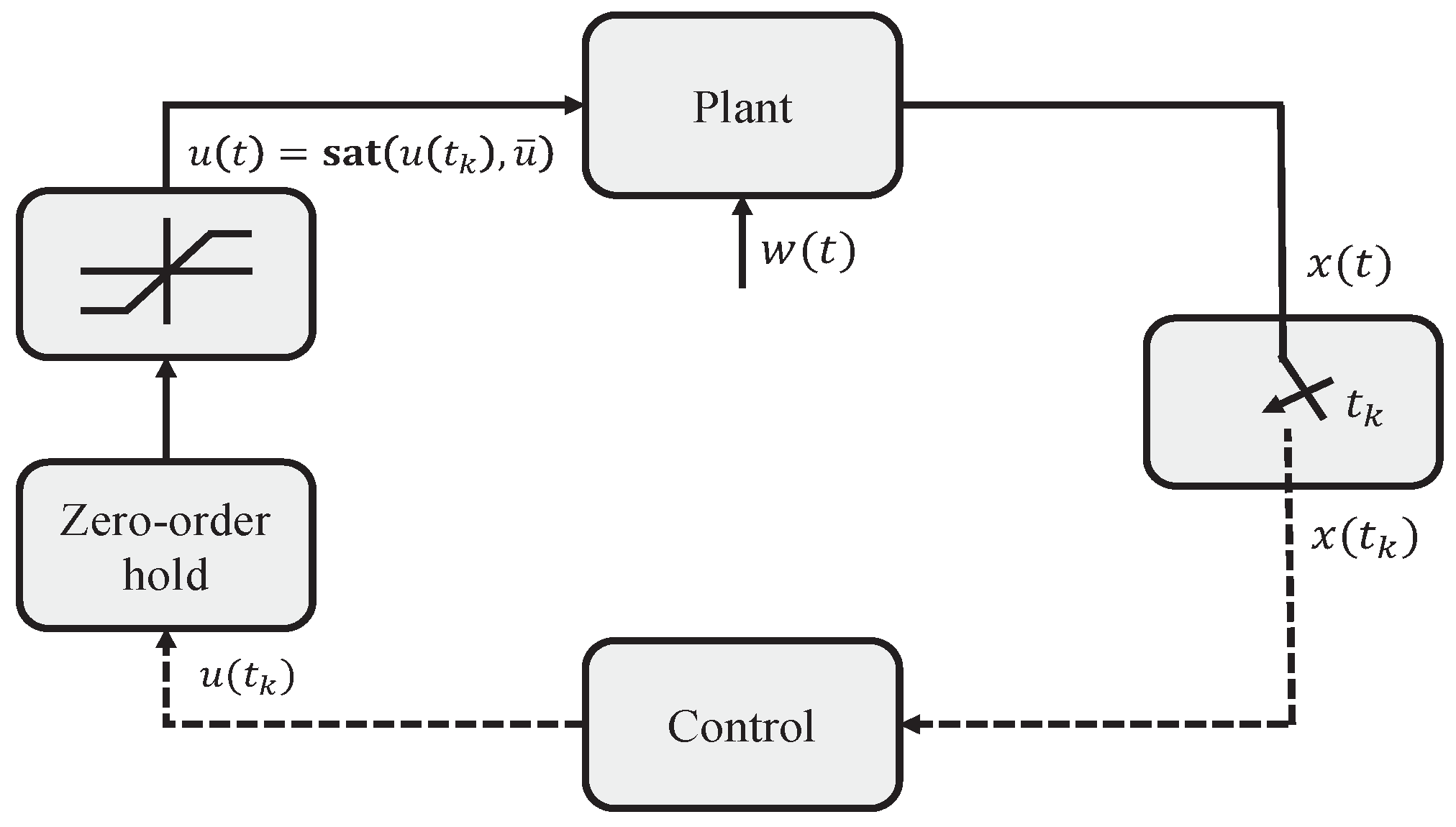
where vectors , , , and indicate the system state, the control input, the performance output, and the exogenous disturbances with a known peak norm , i.e., , respectively; , , , and are given system matrixes. In particular, as shown in Figure 1, the system state is measured at discrete sampling time such that and . Furthermore, sampling interval satisfies that
where and are the lower and upper bounds of the sampling interval.
Figure 1.
Sampled-data control systems with actuator saturation.
Additionally, this paper considers sampled-data control with respect to the following actuator saturation:
where indicates the sampled-data control input; denotes the saturation level; and the element of is given by
in which and represent the ℓth element of and , respectively. Furthermore, according to Theorem 1 in [25], if there exists an auxiliary control input subject to , then (3) can be rewritten as follows:
where and belong to the set of diagonal matrixes whose diagonal elements are either 1 or 0, and indicates the weighting function satisfying that
Subsequently, let us employ the following control law:
where and denote the control gains to be designed later.
Then, the resultant closed-loop system is represented from (1) and (4) as follows:
subject to
where .
The objective of this paper is to design the sampled-data controller (4) that satisfies both of the following requirements (refer to [19,20]):
- System (6) is exponentially stable in the absence of disturbances .
- For a prescribed scalar , an initial condition , and any non-zero disturbances , the performance output satisfies
The following free-matrix-based integral inequality is utilized to address the single-integral quadratic terms arising from the time-derivative of looped-functional.
Lemma 1
([26]). For a differentiable function for all , and a matrix , there exits matrixes and such that the following condition holds:
where , .
3. Main Results
Let us designate and , Then, the following block entry matrixes and augmented state will be utilized in the process of obtaining the stability and stabilization criteria:
and the following vectors will be used for brevity:
where
Remark 1.
In contrast to [8,9,15], this paper constructs two novel time integrals of the weighted state derivative, i.e., and . Accordingly, more additional information about (i) the sawtooth-type characteristics of the time-varying parameters and and (ii) the system state between two consecutive sampling times can be used to derive less conservative stability and stabilization criteria.
3.1. Stability Analysis
Now, let us establish the following Lyapunov functional-based candidate:
where
with , , ,
, , , , , , and .
Remark 2.
It is worth noting that and at , and and at . Thus, it is clear that , for all . Accordingly, the positive definiteness requirement of , , and can be excluded based on the looped-functional approach [6].
Lemma 2 offers the fundamental peak-to-peak stability criteria for sampled-data control systems subject to actuator saturation.
Lemma 2.
Proof of Lemma 2.
(Local stability) By multiplying (11) by and integrating it over , we have
which leads to
Thus, for , it follows from (13) that
which means that system (6) is exponentially stable.
Lemma 3.
For given positive scalars σ, γ, , , and , system (6) subject to (7) is exponentially stable with a guaranteed peak-to-peak performance in the DoA , if there exist positive definite matrixes , , , any matrixes , , , , , , , , , , , , and , , such that for , , and , the following conditions hold:
where
Proof of Lemma 3.
The time derivatives of (10) are given as follows:
Additionally, it is worth noting that
Furthermore, from
two additional zero-equalities are given as follows:
Also, from (6), it follows that
In particular, based on (2), Lemma 1 allows
where
Thus, by combining (21)–(31), and applying (32) and (33), we have
where , and
As a result, based on (5) and , condition (11) is ensured by the following conditions, for and :
which are converted into (19) by the Schur complement.
Next, the Schur complement of (20) yields
which implies that . □
Remark 3.
It should be noted that the zero-equalities in [8,9,15] cannot be directly applied to derive stabilization conditions of SDSs since they are formulated in bilinear form. To overcome these limitations, this paper provides two additional zero-equalities (29) and (30). These two zero-equalities enhance the relationship among the elements of and can be utilized to derive stabilization conditions in a less conservative manner. Further, this paper adopts two fewer zero-equalitiesthan [8,9,15], which plays a key role in reducing the number of variables (NoVs).
As a consequence of Lemma 3, Corollary 1 offers the LMI-based stability criteria for the sampled-data systems in the absence of disturbances
where and are given system matrixes.
Corollary 1.
For given positive scalars σ, , and , system (37) is exponentially stable, if there exist positive definite matrixes , , , any matrixes , , , , , , , , , , , and , , such that for and , the following conditions hold:
in which , , , and are defined in Lemma 3, and
Proof of Lemma 1.
Remark 4.
The NoVs required for Corollary 1 are . On the other hand, the NoVs for Theorem 1 in [8], Corrollary 1 in [9], Theorem 3 in [15], are , , and , respectively. Thus, it is clear that the proposed method requires a lower computational complexity than those of [8,9,15].
3.2. Stabilization Criteria
Based on Lemma 3, Theorem 1 presents the peak-to-peak stabilization conditions for SDSs subject to actuator saturation, formulated in terms of LMIs.
Theorem 1.
For given positive scalars σ, γ, , , μ, , , and , system (6) subject to (7) is exponentially stable with a guaranteed peak-to-peak performance in the DoA , if there exist positive definite matrixes , , , any matrixes , , , , , , , , , , , , , , , and , such that for , , and , the following conditions hold:
where and are given in Lemma 3, and
In addition, the control gains are reconstructed as and .
Proof of Lemma 1.
Let us establish the congruent transformation matrixes as follows:
which satisfy
Moreover, note that (43) and (44) ensure that the matrix is nonsingular. Then, by letting and using the replacement variables listed below
we can obtain
Thus, pre- and postmultiplying (19) by and yields (42), and pre- and postmultiplying (20) by and yields (43).
4. Numerical Validation
In this section, we utilize Corollary 1 to obtain comparative stability analysis results for three linear systems. Additionally, we utilize the stabilization criteria derived in Theorem 1 to design a sampled-data controller for a linearized IPS.
4.1. Comparison Examples
Let us consider three sampled-data linear systems, used in [8,9,15]:
For systems (46)–(48) and , Table 1 lists the maximum upper bound of the sampling interval obtained by Theorem 4 in [7], Theorem 1 in [8], Corrollary 1 in [9], Theorem 3 in [15], Theorem 2 in [26], and Corollary 1 with . As compared in Table 1, the proposed method offers a longer sampling interval for each system than [8,9,15] despite requiring a lower computational complexity.
Table 1.
Maximum upper bound of sampling interval for .
4.2. Application to Inverted Pendulum System
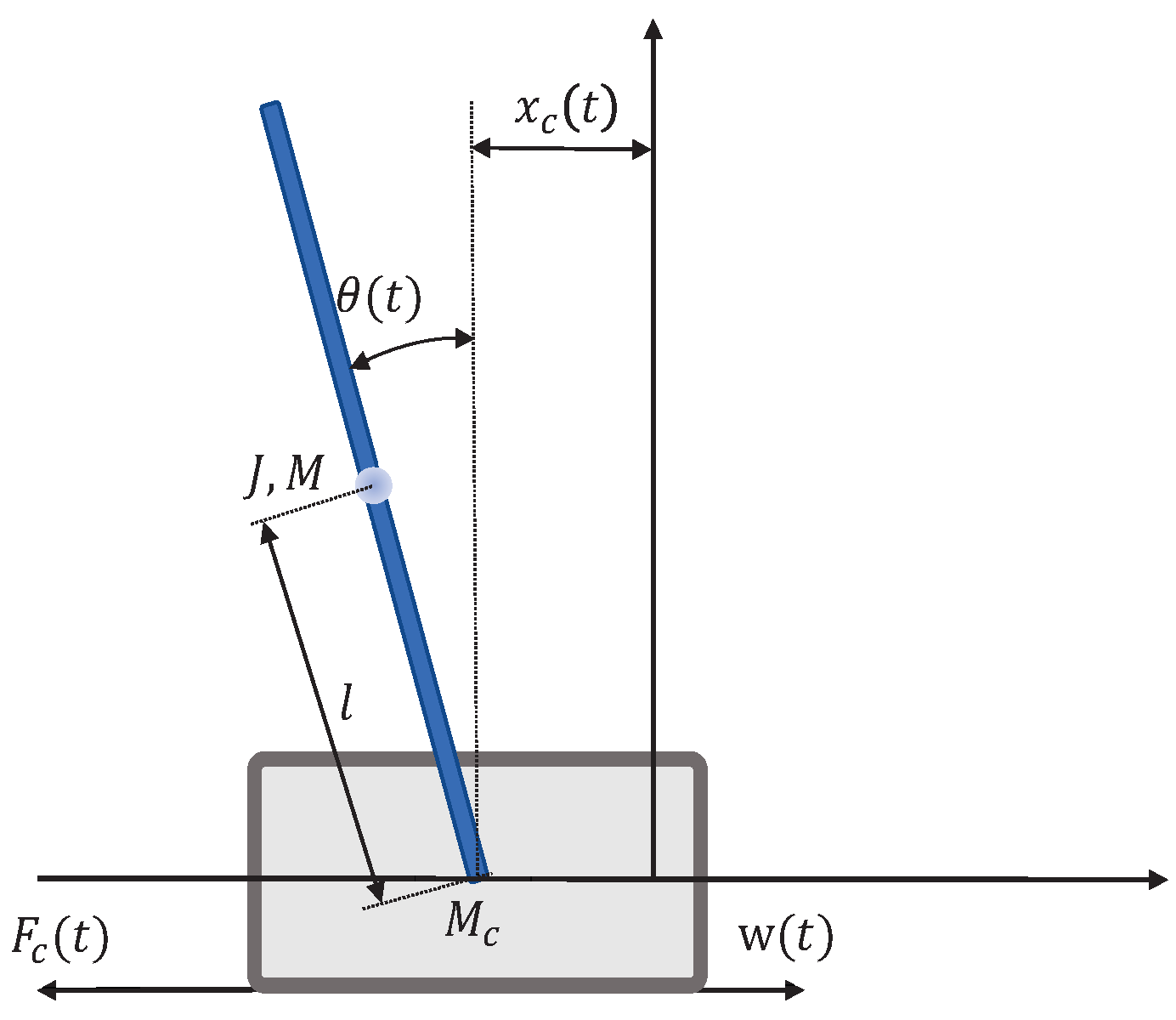
Let us consider the IPS shown in Figure 2, where is the cart position, is the pendulum angle, is the force applied to the cart to keep the pendulum stable around the equilibrium position, and indicates the exogenous disturbances due to friction. To be specific, the IPS parameters and their numerical values are listed in Table 2. As in [27], the motion dynamics of the inverted pendulum are given by
where the force is described as follows:
in which indicates the voltage control input applied to the cart motor. Then, by letting , , , and , the linearized model around the equilibrium position, i.e., , , and , is derived from (49)–(51) as follows:
where
in which
Figure 2.
Diagram of inverted pendulum system.
Table 2.
Inverted pendulum system parameters [27].
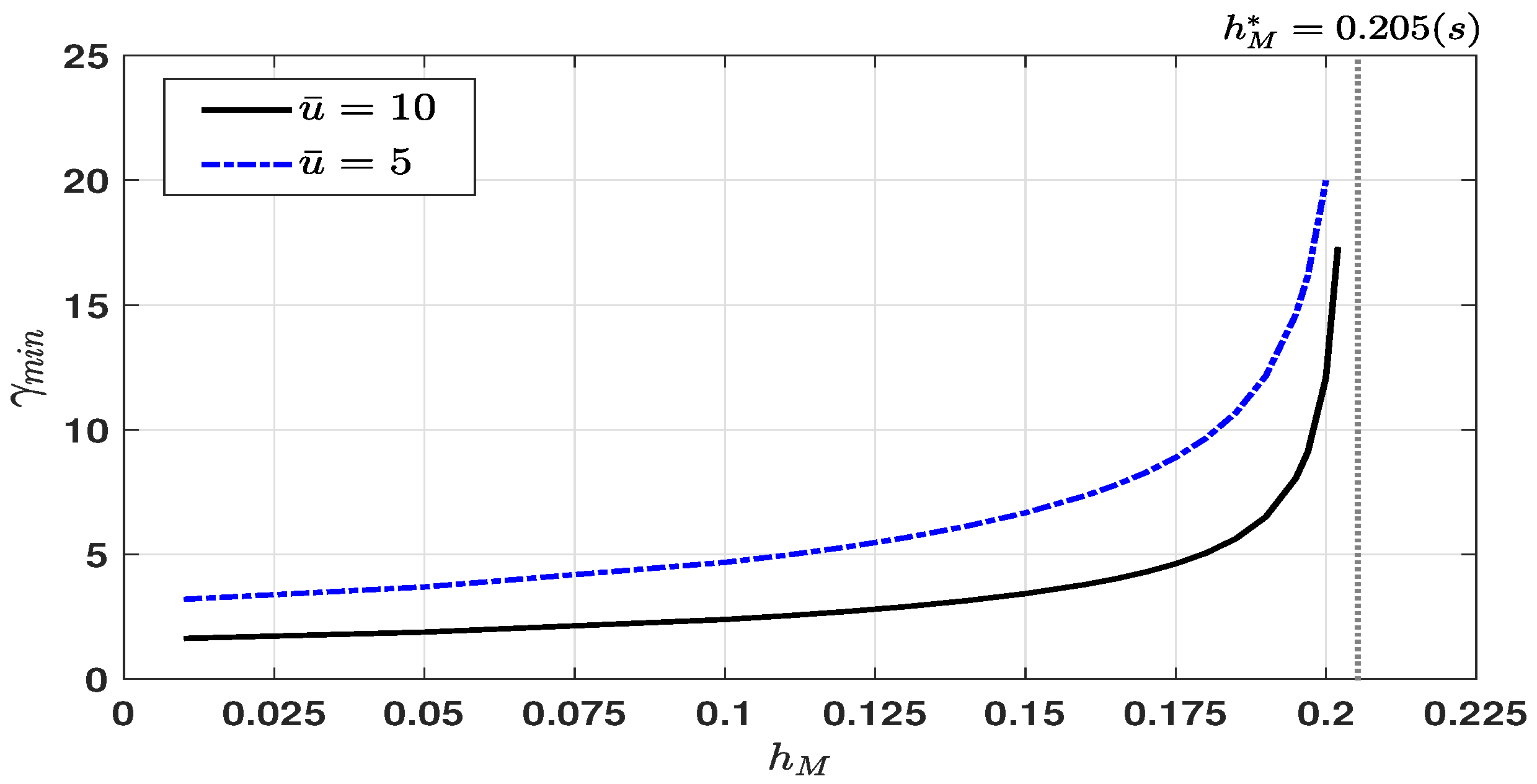
Let us recall (52) subject to and . Then, Theorem 1 with , , , offers as the maximum upper bound of the sampling interval with respect to . Furthermore, Figure 3 shows the minimum peak-to-peak performance level that varies according to the upper bound of sampling interval and the saturation level. It can be found from Figure 3 that the peak-to-peak performance deteriorates as the upper bound of the sampling interval increases and the saturation level decreases. In particular, is rapidly increased when the value of increases from to . Specifically, for the following three cases:
Remark 5 provides
Figure 3.
Minimum peak-to-peak performance level for and .
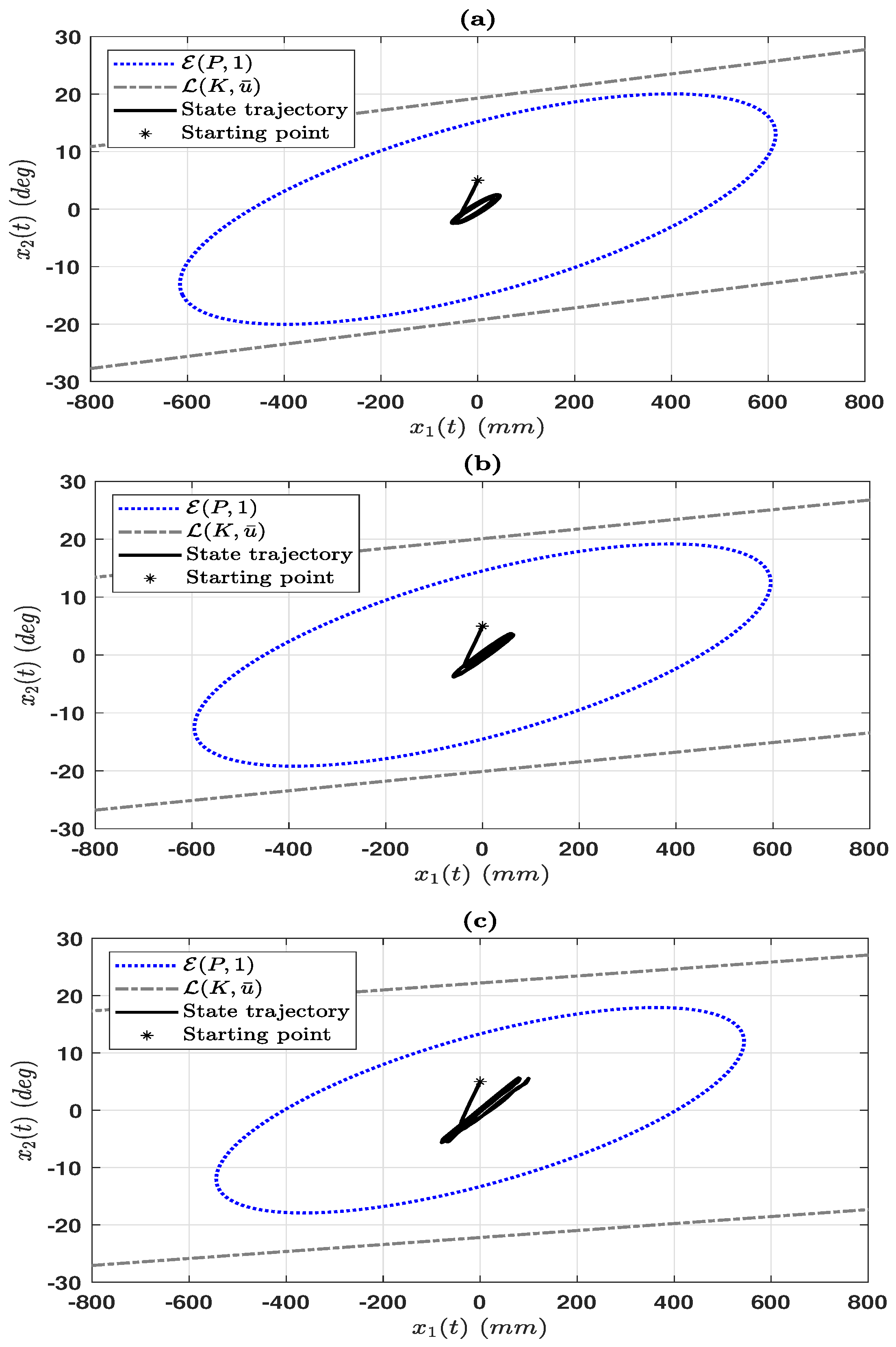
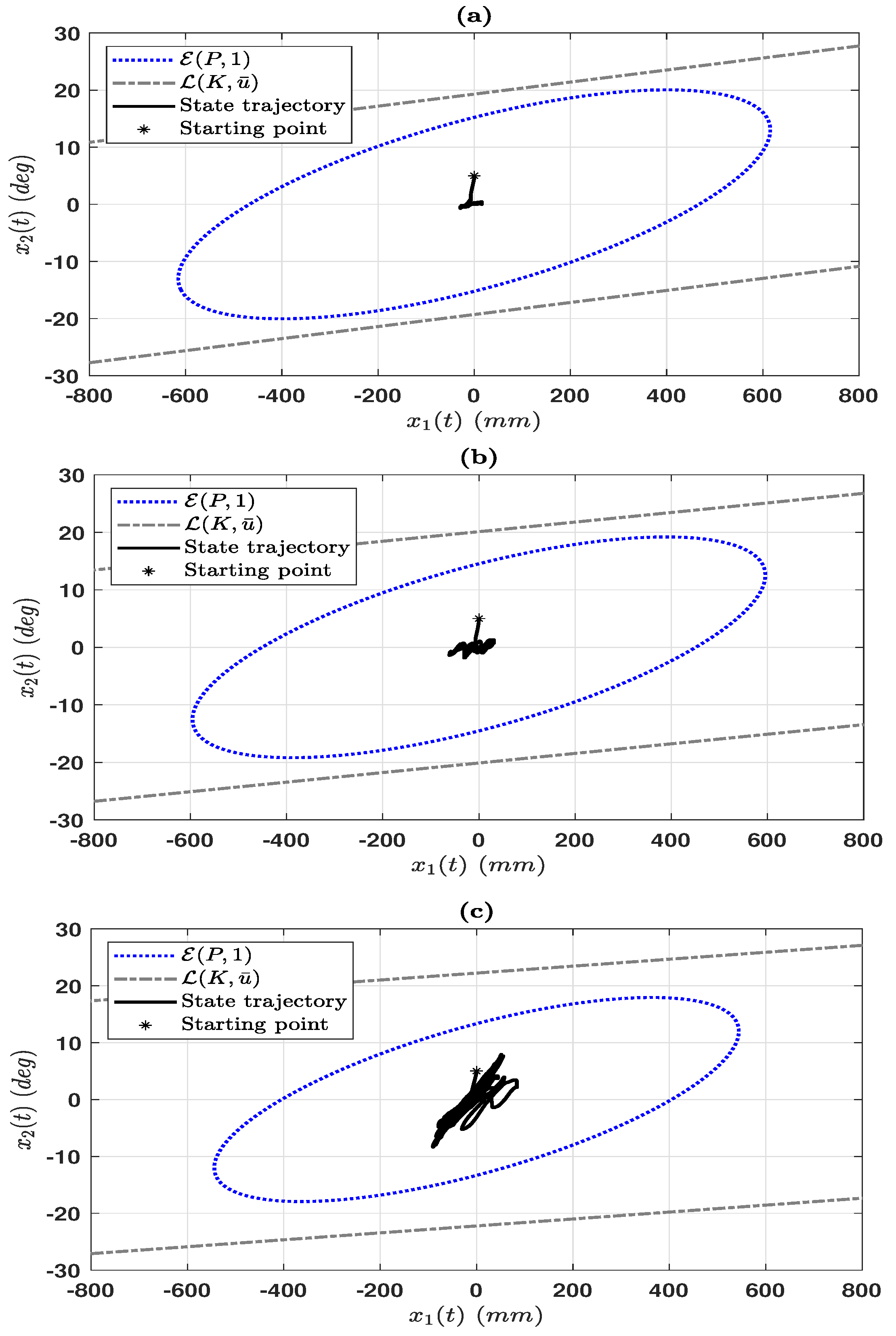
Based on (53)–(55), Figure 4 plots the state trajectory starting at (mm) and for each case, where the exogenous disturbance is given by . As can be seen from Figure 4, the size of DoA becomes smaller and the range of the state trajectory widens as increases from to .
Figure 4.
Simulation results: DoA and state trajectory for three cases: (a) , (b) , and (c) .
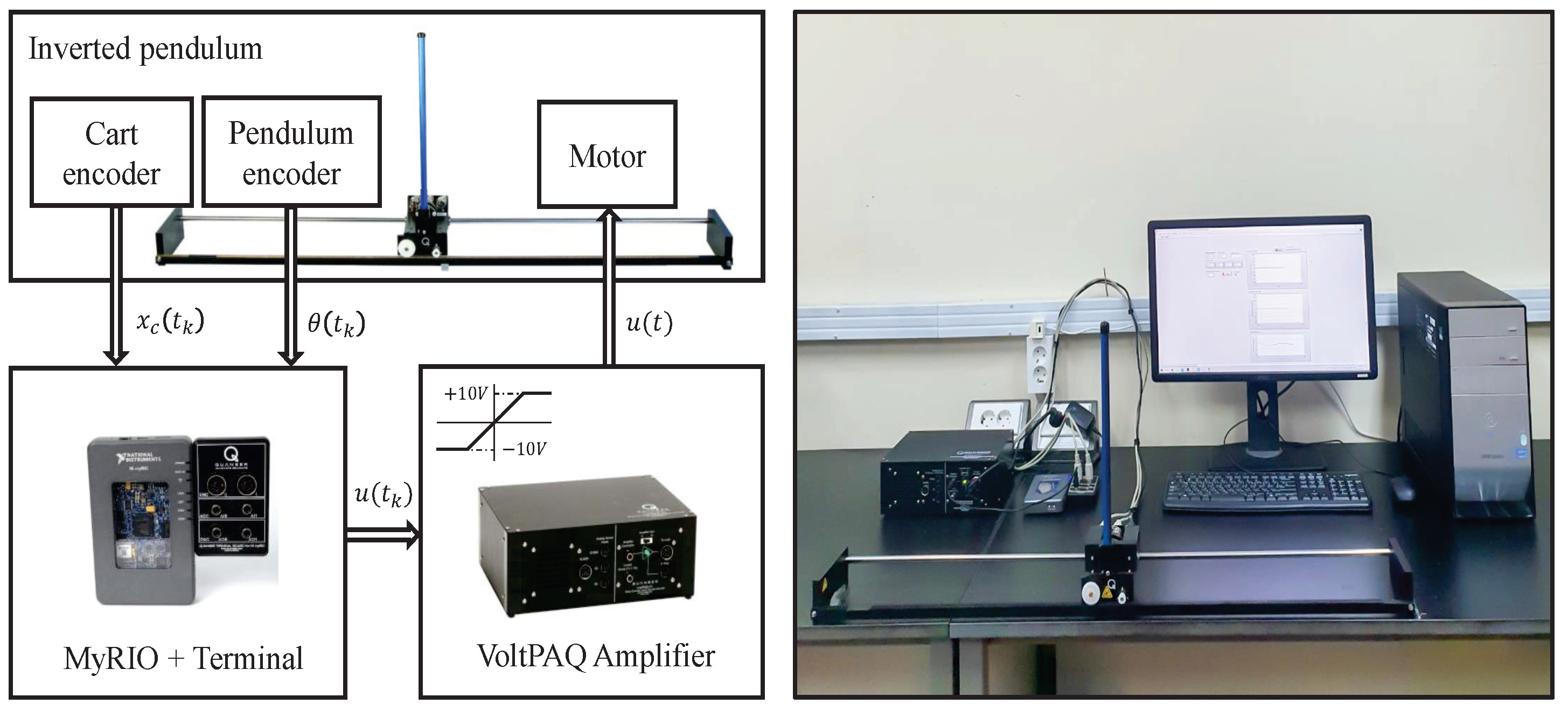
Subsequently, the block diagram and laboratory setup for experimental verification are depicted in Figure 5 (IP02 Linear Inverted Pendulum, Quanser Inc., 119 Spy Court, Markham, ON L3R 5H6, Canada), where a cart is driven by a Faulhaber Coreless DC Motor (2338S006) connected to a Faulhaber Planetary Gearhead Series 23/1; the cart position and the pendulum angle are measured using a quadrature incremental encoder; and the amplifier (VoltPAQ-X1) is used to amplify the control input to the motor voltage. At each sampling time, the cart position and pendulum angle are sampled and transferred to the controller embedded in the MyRIO instrument. Subsequently, the control input is generated according to the state-feedback control law given in (4) and then transferred to the VoltPAQ amplifier with the saturation level ± 10 (V). Ultimately, using the amplified voltage control input, the cart motor generates the force to balance the pendulum. Practically, based on (53)–(55), Figure 6 shows the experimental state trajectory starting at and for each case, which illustrates that the proposed method has a suitable ability to stabilize system (52) in the DoA.
Figure 5.
Block diagram and laboratory setup.
Figure 6.
Experiment results: DoA and state trajectory for three cases: (a) , (b) , and (c) .
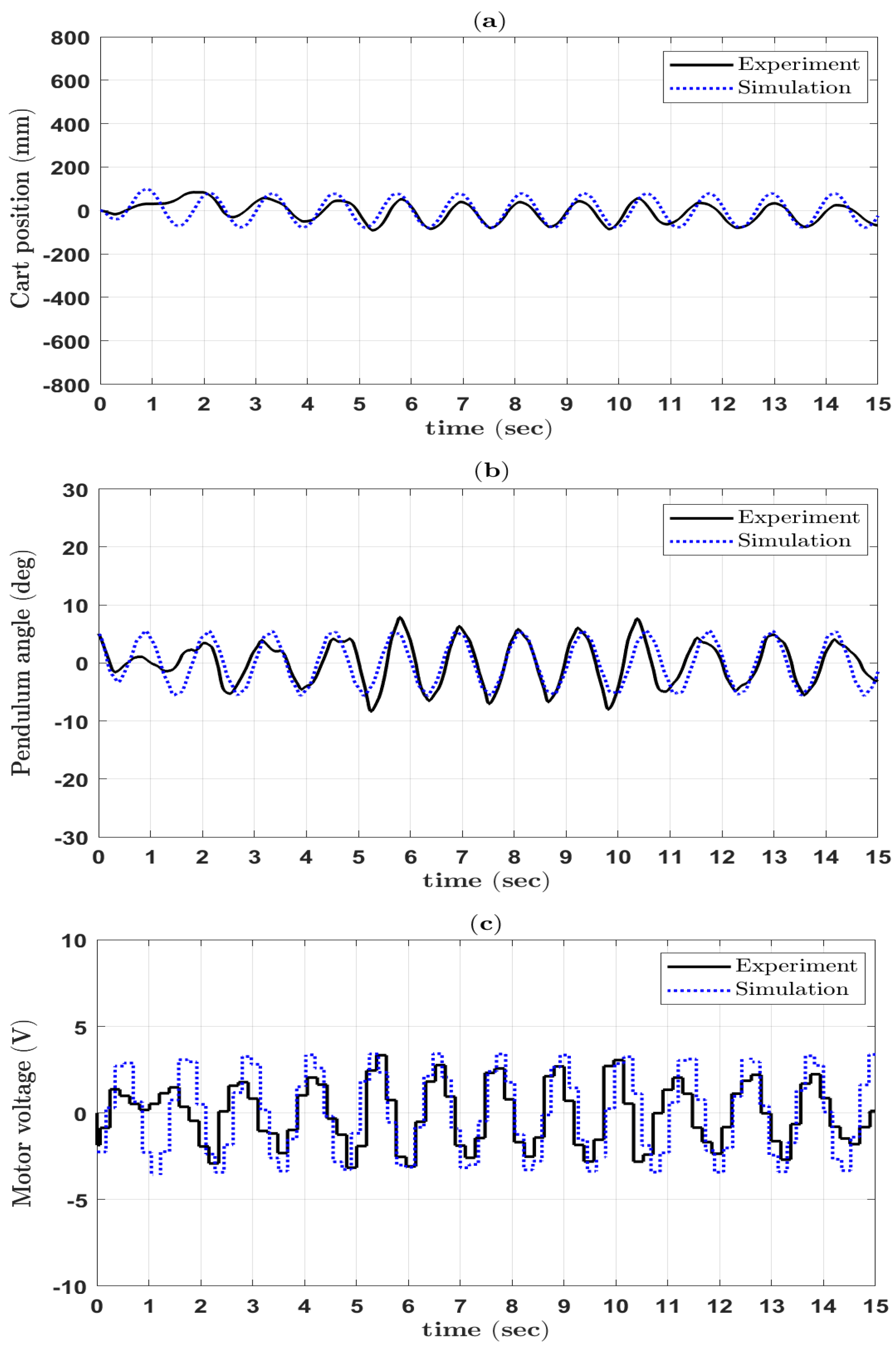
In particular, for , Figure 7a–c present the cart position, the pendulum angle, and the voltage control input, where is used as the exogenous disturbance acting on this control system. As shown in Figure 7a,b, the cart position and the pendulum angle are continuously affected by but operate stably within the allowable range. Also, from Figure 7c, it can be observed that the sampled-data voltage control input is generated subject to the saturation constraint .
Figure 7.
System state response and sampled-data control input.
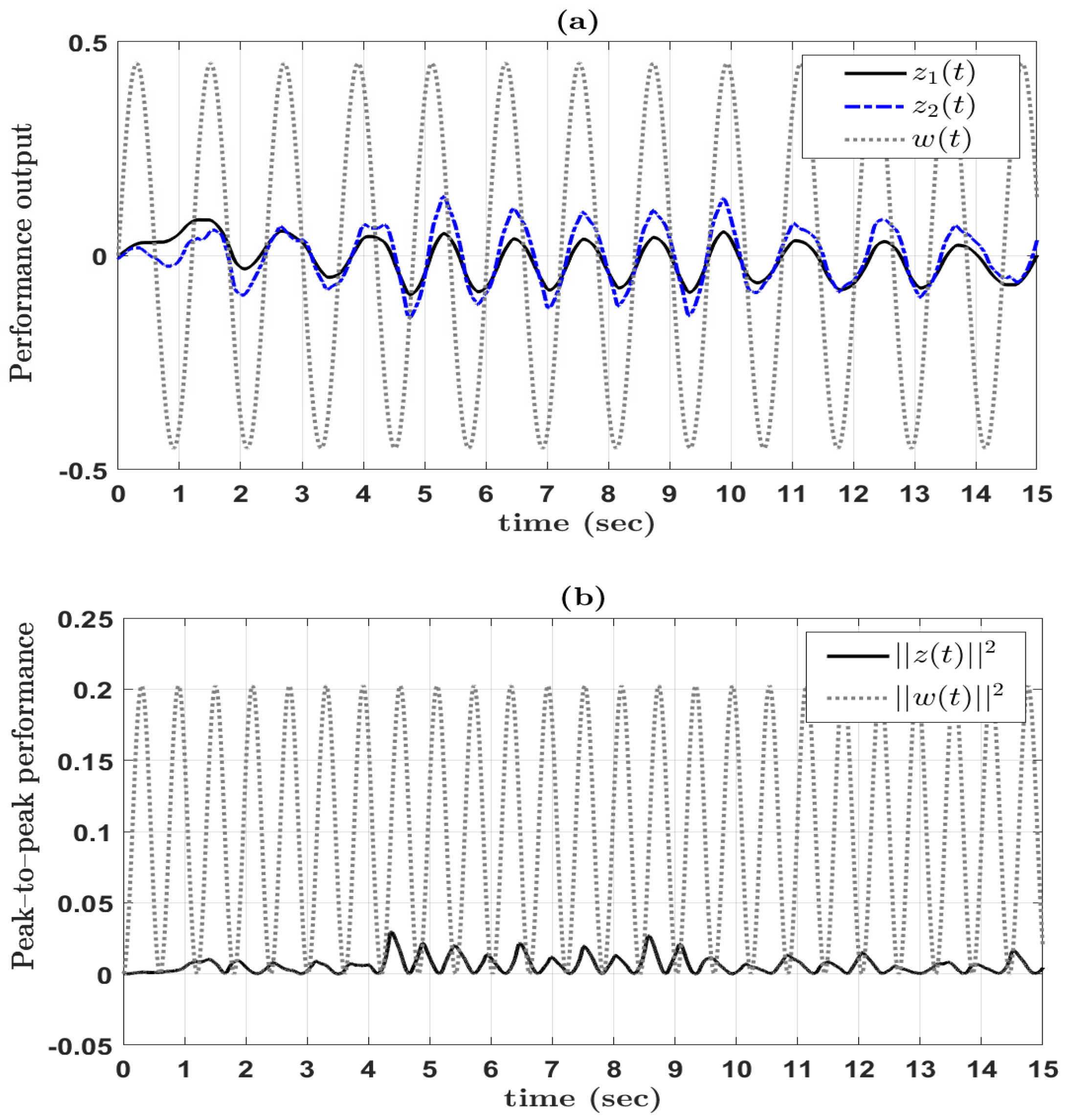
Finally, for and , i.e., , Figure 8a,b display the experimental performance output of (52) and its squared Euclidean norm, respectively,which demonstrates that the practical peak-to-peak performance satisfies
Figure 8.
Experiment results: (a) performance output , and (b) peak-to-peak performance.
Remark 6.
It should be noted that the linearized model (52) is developed under the assumption that there is no uncertainty in the system parameters. This assumption can create a gap between the mathematical model and the actual dynamic system, resulting in some errors between experimental and simulation results. To overcome this limitation, our future research will focus on developing robust T-S fuzzy control systems and multidimensional quasi-linear control systems.
5. Conclusions
This paper has proposed a method for designing an improved sampled-data controller for continuous-time linear systems with actuator saturation and peak-bounded exogenous disturbances. To be specific, two novel time integrals of the weighted state derivative have been introduced to construct an improved looped-functional. In addition, two additional zero-equalities have been utilized to obtain less conservative stability analysis criteria. Following that, a set of LMIs-based stabilization conditions has been developed to ensure that the closed-loop system achieves exponential stability with a guaranteed peak-to-peak performance in the DoA. Compared to other existing studies, the proposed method not only offers an improved maximum upper bound of sampling interval but also requires lower computational complexity. Finally, the effectiveness of the proposed method has been demonstrated through its successful implementation in an IPS.
Author Contributions
Conceptualization, S.H.K.; Data curation, K.H.N. and S.H.K.; Formal analysis, K.H.N. and S.H.K.; Funding acquisition, S.H.K.; Investigation, S.H.K.; Methodology, K.H.N. and S.H.K.; Project administration, S.H.K.; Resources, S.H.K.; Software, K.H.N.; Supervision, S.H.K.; Validation, K.H.N. and S.H.K.; Visualization, K.H.N. and S.H.K.; Writing—original draft, K.H.N. and S.H.K.; Writing—review & editing, K.H.N. and S.H.K. All authors have read and agreed to the published version of the manuscript.
Funding
This work was supported by the National Research Foundation of Korea Grant funded by the Korean Government (NRF-2023R1A2C1002635). This results was supported by “Regional Innovation Strategy(RIS)” through the National Research Foundation of Korea (NRF) funded by the Ministry of Education (MOE) (2021RIS-003).
Data Availability Statement
The authors confirm that the data supporting the findings of this study are available within the article.
Conflicts of Interest
The authors declare no conflict of interest.
References
- Lee, T.H.; Park, J.H. New methods of fuzzy sampled-data control for stabilization of chaotic systems. IEEE Trans. Syst. Man Cybern.-Syst. 2017, 48, 2026–2034. [Google Scholar] [CrossRef]
- Lv, X.; Li, X. Finite time stability and controller design for nonlinear impulsive sampled-data systems with applications. ISA Trans. 2017, 70, 30–36. [Google Scholar] [CrossRef] [PubMed]
- Nguyen, K.H.; Kim, S.H. Improved sampled-data control design of T-S fuzzy systems against mismatched fuzzy-basis functions. Appl. Math. Comput. 2022, 428, 127150. [Google Scholar] [CrossRef]
- Nguyen, K.H.; Kim, S.H. Improved stability and stabilization criteria of sampled-data control systems based on an improved looped-functional. Math. Comput. Simul. 2024, 215, 69–81. [Google Scholar] [CrossRef]
- Fridman, E.; Seuret, A.; Richard, J.-P. Robust sampled-data stabilization of linear systems: An input delay approach. Automatica 2004, 40, 1441–1446. [Google Scholar] [CrossRef]
- Seuret, A. A novel stability analysis of linear systems under asynchronous samplings. Automatica 2012, 48, 177–182. [Google Scholar] [CrossRef]
- Zeng, H.-B.; Teo, K.L.; He, Y. A new looped-functional for stability analysis of sampled-data systems. Automatica 2017, 82, 328–331. [Google Scholar] [CrossRef]
- Wang, X.; Sun, J.; Dou, L. Improved results on stability analysis of sampled-data systems. Int. J. Robust Nonlinear Control 2021, 31, 6549–6561. [Google Scholar] [CrossRef]
- Sheng, Z.; Lin, C.; Chen, B.; Wang, Q.-G. Stability analysis of sampled-data systems via novel Lyapunov functional method. Inf. Sci. 2022, 585, 559–570. [Google Scholar] [CrossRef]
- Sugihara, T.; Nakamura, Y.; Inoue, H. Real-time humanoid motion generation through ZMP manipulation based on inverted pendulum control. IEEE Int. Conf. Robot. Autom. 2002, 2, 1404–1409. [Google Scholar]
- Li, Z.; Yang, C. Neural-adaptive output feedback control of a class of transportation vehicles based on wheeled inverted pendulum models. IEEE Trans. Control Syst. Technol. 2011, 20, 1583–1591. [Google Scholar] [CrossRef]
- El-Bardini, M.; El-Nagar, A. Interval type-2 fuzzy PID controller for uncertain nonlinear inverted pendulum system. ISA Trans. 2014, 53, 732–743. [Google Scholar] [CrossRef] [PubMed]
- Lee, H.; Gil, J.; You, S.; Gui, Y.; Kim, W. Arm angle tracking control with pole balancing using equivalent input disturbance rejection for a rotational inverted pendulum. Mathematics 2021, 9, 2745. [Google Scholar] [CrossRef]
- Saleem, O.; Abbas, F.; Iqbal, J. Complex fractional-order LQIR for inverted-pendulum-type robotic mechanisms: Design and experimental validation. Mathematics 2023, 11, 913. [Google Scholar] [CrossRef]
- Lee, S.-H.; Selvaraj, P.; Park, M.-J.; Kwon, O.-M. Improved results on stability analysis of sampled-data systems via looped-functionals and zero equalities. Appl. Math. Comput. 2020, 373, 125003. [Google Scholar] [CrossRef]
- Nguyen, K.H.; Kim, S.H. Event-triggered Non-PDC filter design of fuzzy Markovian jump systems under mismatch phenomena. Mathematics 2022, 10, 2917. [Google Scholar] [CrossRef]
- Gao, Z.-M.; He, Y.; Liu, G.-P. New results on stability and performance analysis for aperiodic sampled-data systems via augmented Lyapunov functional. ISA Trans. 2022, 128, 309–315. [Google Scholar] [CrossRef]
- Nguyen, K.H.; Kim, S.H. Improved dissipativity-based sampled-data control synthesis of nonhomogeneous Markovian jump fuzzy systems against mismatched fuzzy-basis functions. Inf. Sci. 2022, 607, 1439–1464. [Google Scholar] [CrossRef]
- Abedor, J.; Nagpal, K.; Poolla, K. A linear matrix inequality approach to peak-to-peak gain minimization. Int. J. Robust Nonlinear Control 1996, 6, 899–927. [Google Scholar] [CrossRef]
- Ahn, C.K.; Shi, P.; Basin, M.V. Two-dimensional peak-to-peak filtering for stochastic Fornasini–Marchesini systems. IEEE Trans. Autom. Control 2017, 63, 1472–1479. [Google Scholar] [CrossRef]
- Zeng, H.-B.; Teo, K.L.; He, Y.; Xu, H.; Wang, W. Sampled-data synchronization control for chaotic neural networks subject to actuator saturation. Neurocomputing 2017, 260, 25–31. [Google Scholar] [CrossRef]
- Yan, Z.; Huang, X.; Liang, J. Aperiodic sampled-data control for stabilization of memristive neural networks with actuator saturation: A dynamic partitioning method. IEEE Trans. Cybern. 2021, 53, 1725–1737. [Google Scholar] [CrossRef]
- Fan, Y.; Huang, X.; Li, Y. Aperiodic sampled-data control for local stabilization of memristive neural networks subject to actuator saturation: Discrete-time Lyapunov approach. ISA Trans. 2022, 127, 361–369. [Google Scholar] [CrossRef] [PubMed]
- Kwon, W.; Park, J. Improved criteria of sampled-data master-slave synchronization for chaotic neural networks with actuator saturation. J. Frankl. Inst. 2023, 360, 5134–5148. [Google Scholar] [CrossRef]
- Hu, T.; Lin, Z.; Chen, B.M. An analysis and design method for linear systems subject to actuator saturation and disturbance. Automatica 2002, 38, 351–359. [Google Scholar] [CrossRef]
- Lee, T.H.; Park, J.H. Stability analysis of sampled-data systems via free-matrix-based time-dependent discontinuous Lyapunov approach. IEEE Trans. Autom. Control 2017, 62, 3653–3657. [Google Scholar] [CrossRef]
- Blondin, M.J.; Pardalos, P.M. A holistic optimization approach for inverted cart-pendulum control tuning. Soft Comput. 2020, 24, 4343–4359. [Google Scholar] [CrossRef]
Disclaimer/Publisher’s Note: The statements, opinions and data contained in all publications are solely those of the individual author(s) and contributor(s) and not of MDPI and/or the editor(s). MDPI and/or the editor(s) disclaim responsibility for any injury to people or property resulting from any ideas, methods, instructions or products referred to in the content. |
© 2023 by the authors. Licensee MDPI, Basel, Switzerland. This article is an open access article distributed under the terms and conditions of the Creative Commons Attribution (CC BY) license (https://creativecommons.org/licenses/by/4.0/).