Abstract
Systems composed of piecewise smooth differential (PSD) mappings have quantitatively been searched for answers to a substantial issue of limit cycle (LC) bifurcations. In this paper, LC numbers (LCNs) of a PSD system (PSDS) consisting of four regions are dealt with. A Melnikov mapping whose order is one is implicitly obtained by finding its originators when the system is perturbed under any nth degree of real polynomials. Then, the approach employing the Picard–Fuchs mapping is utilized to attain a higher boundary of bifurcation LCNs of systems composed of PSD functions with a global center. The method we used could be implemented to examine the problems related to the LC of other PSDS.
Keywords:
Melnikov function; limit cycles (LCs); Picard–Fuchs (PF) equation; piecewise smooth differential system (PSDS) MSC:
34C07; 34C28
1. Background and Literature
Planar Differential System (PDS) theory quantitatively searches for limit cycle numbers (LCNs) and their distributions. There exists a close association with the renowned 16th problem proposed by Hilbert [1]: given any polynomial differential system (PDS), what are the highest LCNs and their distributions? To tackle the issue, several approaches have been proposed, such as the approach based on the Melnikov function [2,3,4,5,6,7], the averaging method [8,9,10,11], the Picard–Fuchs (PF) equation method [12,13], the Chebyshev criterion [14,15,16,17,18], and the method to compute the Lyapunov constants [19,20,21,22].
The PF equation arises in the context of algebraic geometry and complex analysis, particularly when studying families of algebraic varieties or complex manifolds. In bifurcating LC analysis, the PF equation can be used to describe the behavior of LCs as parameters vary in a dynamical system. It helps in understanding how the properties of LCs change as system parameters are perturbed. In the study of LCs, the PF equation typically involves a complex parameter, and it describes how certain periods or integrals associated with the LCs vary with respect to this parameter. The solutions to the PF equation provide information about the monodromy of the LCs, which can be essential for understanding their stability and bifurcation behavior. In summary, the PF equation plays a role in the analysis of LCs by describing how certain complex integrals or periods associated with the cycles change as system parameters vary, shedding light on their bifurcation behavior.
To discuss further, Tian et al. studied LC bifurcations in systems composed of piecewise smooth second-order integrable mappings with invariant curves by utilizing the Melnikov mapping (MM) whose order is 1, deriving a lesser boundary for LCNs bifurcated based on the annulus period [2]. Gasull et al. considered mappings similar to the perturbed pendulum upon a cylinder under the perturbation of trigonometric polynomials and provided the higher boundaries pertinent to how many their related Melnikov mapping whose order is 1 generates zeros by covering areas related to oscillation and rotation [3]. Xiong and Han dealt with the issue of bifurcated LCs in the same nth-degree systems by utilizing a perturbation system composed of piecewise third-order polynomial mappings that has a generic heteroclinic hoop having a saddle point characterized by nilpotency and cusp and employed the expansion together with its coefficients of the first-order Melnikov mapping to attain at least LC, [6].
Llibre et al. developed a theory called averaging related to orders of both first and second to investigate the periodical results of systems composed of discontinuous piecewise differential functions consisting of arbitrary numbers of systems and dimensions whose differentiability conditions are at minimum [11]. In [12], Horozov and Iliev derived features of the systems called the PF that are fulfilled by the four fundamental integral expressions to explicit a higher boundary regarding how many zeros the integral called Abelian of near-Hamiltonians contains. Yang offered the PF approach to the research of LC bifurcations for differential equations characterized by non-smoothness having two exchanging lines [23]. Grau et al. presented a benchmark that gives a simple sufficient requirement to obtain a class of Abelian integrals to attain Chebyshev’s attribution [15]. The equivalence of the first two approaches was proven by [22].
Assume that the near-integrable differential system has the subsequent representation
where in , . For , an initial integral and its integration factor were characterized by and in Equation (1), respectively. Assume that Equation covers that includes periodical orbits represented by a class that encloses ( and ) is covered. We also have delineating and
was expressed as a Melnikov mapping whose order is 1 for (1), which has a substantial influence regarding the study of the bifurcations of LCs. For instance, if (2) is assumed to have a secluded 0 denoted by . Equation (1) contains a LC close to .
In the simulations of real-world phenomena having discontinuity such as biology [24], oscillations characterized by non-linearity [25], and mechanics coping with impacts and frictions [26,27], investigating LCNs and their relevant locations has been concentrated on lately. The issue could be evaluated as the elongation of the tiny Hilbert’s sixteenth question of the cases with discontinuity. An approach based on the Melnikov function was suggested to deal with systems composed of planar piecewise smooth Hamiltonian mappings consisting of two areas [28]. Deriving a mathematical representation for the Melnikov mapping whose order is 1 has a key function in the examination of LC bifurcations. This topic has been renewed very recently in some works such as [29,30]. Employing the theory called averaging based on the first order, the authors of [31] investigated LC bifurcations by using the steady isochronous epicenter whose orbits are periodical regarding
once perturbations of the LC bifurcations are applied to the systems composed of the entire second and third-order discontinuous polynomial differential functions having four regions.
The generic representation of a system composed of the piecewise smooth almost-integrable differentiable functions in the extents having two regions split by a -axis was given by
where . For , an initial integration (resp. ) for , (resp. ) and the integration quantity (resp. ) for (resp. ) are contained by that is assumed to have a collection of periodical orbits
enclosing (, ). Figure 1 depicts that (resp. ) was delineated by (resp. ). The Melnikov mapping whose order is 1 for (3) is expressed by
Figure 1.
A state sketch of Equation . For the sake of simplicity in its understanding we considered and .
The Relation (3) contains a LC close to iff in (4) including the secluded 0 in close to , see [31,32].
Considering the subsequent system in the plane having four regions
or
where , , . We also have
The Relation , , , and include first integrals and integration factors that correspond to and , and , and , and , respectively. Note that
To discuss further, multiplying (5) by , and . Then, subscript one will be omitted subsequently. One obtains
and
To make Equation contain a collection of orbits that are periodically close to (0, 0), an interval, , and , , , exist for all is assumed,
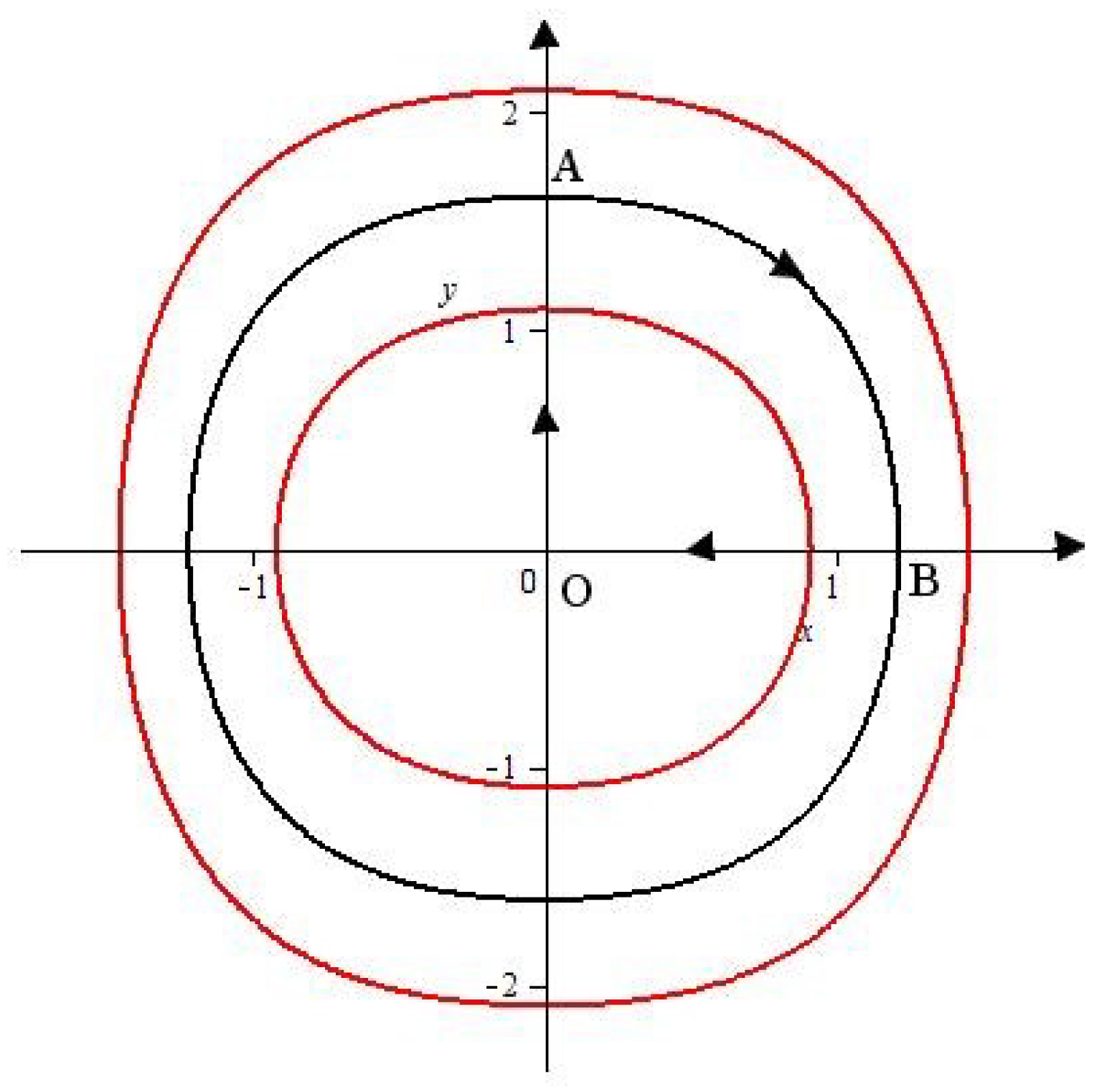
when and . Considering having , an arc in the form of an orbit, starts with A and ends at B delineated by ; having , an arc in the form of an orbit, starts with B and ends at C delineated by ; having an orbital arc starts with C and ends at D delineated by , and Equation includes , an arc in the form of an orbit, begins with D and finishes at A delineated by , , . Hence,
is an orbit (periodic) of enclosing (, ) for .
Therefore, denotes a collection of periodic orbits of satisfying
where O and each denote the origin and piecewise smooth. Figure 2 depicts that including an orientation in a clockwise manner is supposed. An interesting and important problem was to examine LCNs that was bifurcated based on .
Figure 2.
The shut trajectory of Equation . For the sake of simplicity in its understanding we considered and .
The remainder of this paper is unfolded as comes next. Section 2 provides a discussion and the main aim of this article in the form of a theorem. Toward this goal and to prove the theorem theoretically, Section 3 discusses that , a Melnikov mapping whose order is 1, and the PF mappings are expressed and fulfilled by the originators of . This work follows the discussions given recently in [33,34,35]. In terms of novelty, here by considering some piecewise smooth Liênard mappings with a small enough , a higher boundary for the LCNs bifurcated based on the annulus period is given for different values of n. The proof of the main result and the related discussions are furnished in Section 4. Finally, some concluding comments are brought forward in Section 5.
2. Primary Outcomes
The Melnikov mapping (MM) is a mathematical technique used in the study of bifurcating LCs in dynamical systems. It is named after mathematician V. K. Melnikov, who developed the method [36]. The MM is particularly useful for analyzing the stability of LCs in systems described by ordinary differential equations. When a dynamical system undergoes a bifurcation, such as a saddle-node or Hopf bifurcation, LCs can emerge or disappear. The MM is used to understand the conditions under which these LCs are born or annihilated.
The key idea behind the MM is to calculate the transverse intersections between the unstable and stable manifolds of the saddle equilibrium point (or the periodic orbit created by a Hopf bifurcation). These transverse intersections, called “Melnikov integrals”, are computed along a certain direction in phase space. If these integrals are nonzero, they indicate that the unstable and stable manifolds intersect transversely, implying the potential existence of a LC in the vicinity. By analyzing the Melnikov integrals and their behavior as system parameters change, researchers can determine whether LCs are created or destroyed during a bifurcation. This information is crucial for understanding the bifurcation dynamics and the stability of LCs in dynamical systems.
Proposition 1.
Assumed that the parts represented by (I) and (II) hold, a MM whose order is 1 for Equation (9) were expressed by
Additionally, when and for some . Equation (9) contains a unique LC close to for all small enough.
In this work, by employing the first-order MM (14), the LCNs for the subsequent systems that are characterized by piecewise smooth Liénard mappings are examined.
where , . The Equation leads to
Figure 3 depicts that (0, 0) was called the epicenter, implementing Equation (14) and the PF mapping, a higher boundary for the LCNs bifurcating based on the around of the annulus period for Equation ’s origin.
Figure 3.
The state sketch of Equation .
The following theorem is the major contribution of this article.
3. M() Represented Algebraically through Mathematical Analysis
For , we have
One also can write now
By conducting direct computations. Thus, Equation (17) could be rewritten as
having zeroes, where , needs to be predicted. To this end, the derivation of the algebraic representation of in Equation (18) is conducted.
Lemma 1.
For , we have
where , and represent ξ-th degree polynomials having
Proof.
Differentiating Equation (16) regarding , one obtains
Multiplication of Equation (20) by , integrating over , one has
Assume that bisects positive and -axes at the set of points denoted by A and B, respectively. Figure 3 depicts that is supposed to be the interior of . One gets for , the following
Hence,
Multiplication of Equation (16) by and integrating over leads to
The first equality in (19) is now proven via induction over l. So, (24) implied that it held for . Suppose that equivalence held for , . By using (23) one has for the following
Using the induction hypothesis, one obtains the initial equivalence in (19). Now we have
where and denote polynomials in -th degree satisfying
Thus, , . This finishes the proof. □
Employing Lemma 1, one can attain the subsequent proposition directly.
Proposition 2.
For ,
where in and denote fixed values and , and denote ξ-th degree polynomials having
Proof.
When then the conclusion is derived directly by using Lemma 1. If , based on Equation (18) we obtain
is attained, where the subscript , , taking 0, 1, 2 was a fixed value implying the conclusion be held. One can prove the conclusions for similarly. The proof is finished. □
Lemma 2.
Let and satisfy the subsequent PF mappings
and
respectively.
4. Establishing Theorem 1
Assume that denotes isolated zero numbers of on reckoning with the multiplicity. From (28), is attained, where c denotes a real fixed value. Thus,
If , then based on Equations (26) and (27)
is attained, where represents a-th degree polynomial having at most k. Note that Equation (36) and some computations lead to and
where (resp. ) represents an -th degree polynomial with at most (resp. ). Thus, for and ,
Hence, for the following relation
is attained. Subsequently, the number of zeros of on will be estimated.
Let . Based on Equation (35), the following relation is obtained:
Now, considering Lemma 2 and a similar reasoning as in [38] for , we obtain
Hence, from (37) and (38), for , the following relation:
is attained. If , then from (18), we attain
Based on Equation (23), is attained. Hence, . Noting that for , contains at most two 0s in . When , an easy computation gives . Because
where is the interior of . Therefore, does not contain zero in . The proof finishes now.
We investigated LC bifurcations in systems composed of PSD mappings, specifically focusing on LCNs within a PSDS consisting of four regions. We employed a Melnikov mapping of order one to analyze the system’s behavior when perturbed by nth-degree real polynomials. This approach provides valuable insights into the bifurcation behavior of PSDS systems with a global center. The practical implications of this research extend to various applications where understanding LCs is critical. For instance, in the study of dynamical systems, these findings can help predict and control oscillatory behavior, which is prevalent in diverse fields, including engineering, biology, and physics. By determining the LCNs around critical points in such systems, engineers can make informed decisions to optimize performance and stability. The mathematical representation of the Melnikov function and the application of recurrence formulas further contribute to a comprehensive understanding of the system’s behavior. It is important to note that the higher boundary derived from Theorem 1 is not always optimal. This suggests that there may be room for further refinement and exploration, particularly in determining the lower boundary for LCNs.
5. Conclusions
In the article, a system composed of planar third-order Liénard mappings with a global epicenter having at most
LCs around the critical point by utilizing a first-order Melnikov function containing four zones is shown. Recurrence formulas have been applied to get the comprehensive mathematical representation of a MM whose order is 1 that could be stated as combinations of , and with polynomial coefficients. Afterward, bifurcating LCNs near the critical point by employing PF and the Riccati equation is determined. The higher boundary given by Theorem 1 is not optimal generally. The lesser boundary for LCNs could not be given because verifying the coefficient independence for the polynomials of , and has been difficult, which will be the future direction of the conducted research.
Author Contributions
Conceptualization, E.Z., J.Y. and S.S.; formal analysis, E.Z., J.Y. and S.S.; funding acquisition, E.Z., J.Y. and S.S.; investigation, E.Z., J.Y. and S.S.; methodology, E.Z., J.Y. and S.S.; supervision, E.Z., J.Y. and S.S.; validation, E.Z., J.Y. and S.S.; writing—original draft, E.Z., J.Y. and S.S.; writing—review and editing, E.Z., J.Y. and S.S. All authors have read and agreed to the published version of the manuscript.
Funding
This work was supported by NSFC (12161069), the Natural Science Foundation of Ningxia (2022AAC05044), the Key Program of Higher Education of Henan (21A110023), the Innovation Studio for Model Workers and Craftsmen Talents of the Education, Science, Culture, Health and Sports of Henan ([2021] No. 21), and The Key Cultivation Project for Academic and Technical Leaders of Zhengzhou College of Finance and Economics (ZCFE) [2021] No. 20).
Data Availability Statement
Not applicable.
Acknowledgments
The authors thank two anonymous referees for some suggestions and corrections on an earlier version of this work.
Conflicts of Interest
The authors declare no conflict of interest.
References
- Hilbert, D. Mathematical problems. Bull. Am. Math. Soc. 1902, 8, 437–479. [Google Scholar] [CrossRef]
- Tian, Y.; Shang, X.; Han, M. Bifurcation of limit cycles in a piecewise smooth near-integrable. J. Math. Anal. Appl. 2021, 504, 125578. [Google Scholar] [CrossRef]
- Gasull, A.; Geyer, A.; Mañosas, F. On the number of limit cycles for perturbed pendulum equations. J. Differ. Equ. 2016, 261, 2141–2167. [Google Scholar] [CrossRef]
- Ramirez, O.; Alves, A.M. Bifurcation of limit cycles by perturbing piecewise non-Hamiltonian systems with nonlinear switching manifold. Nonlinear Anal. Real World Appl. 2021, 57, 103188. [Google Scholar] [CrossRef]
- Tian, Y.; Han, M. Hopf and homoclinic bifurcations for near-Hamiltonian systems. J. Differ. Equ. 2017, 262, 3214–3234. [Google Scholar] [CrossRef]
- Xiong, Y.; Han, M. Limit cycles appearing from a generalized heteroclinic loop with a cusp and a nilpotent saddle. J. Differ. Equ. 2021, 303, 575–607. [Google Scholar] [CrossRef]
- Yu, P.; Li, F. Bifurcation of limit cycles in a cubic-order planar system around a nilpotent critical point. J. Math. Anal. Appl. 2017, 453, 645–667. [Google Scholar] [CrossRef]
- Cen, X.; Li, S.; Zhao, Y. On the number of limit cycles for a class of discontinuous quadratic differential systems. J. Math. Anal. Appl. 2017, 449, 314–342. [Google Scholar] [CrossRef]
- Li, S.; Zhao, Y.; Li, J. On the number of limit cycles of a perturbed cubic polynomial differential center. J. Math. Anal. Appl. 2013, 404, 212–220. [Google Scholar] [CrossRef]
- Llibre, J.; del Rio, J.; Rodriguez, J. Averaging analysis of a perturbated quadratic center. Nonlinear Anal. 2001, 46, 45–51. [Google Scholar] [CrossRef]
- Llibre, J.; Mereu, A.; Novaes, D. Averaging theory for discontinuous piecewise differential systems. J. Differ. Equ. 2015, 258, 4007–4032. [Google Scholar] [CrossRef]
- Horozov, E.; Iliev, I. A Linear estimate for the number of zeros of Abelian integrals with cubic Hamiltonians. Nonlinearity 1998, 11, 1521–1537. [Google Scholar] [CrossRef]
- Zhao, Y.; Zhang, Z. A Linear estimate of the number of zeros of Abelian integrals for a kind of quartic Hamiltonians. J. Differ. Equ. 1999, 155, 73–88. [Google Scholar] [CrossRef]
- Gasull, A.; Lázaro, J.T.; Torregrosa, J. On the Chebyshev property for a new family of functions. J. Math. Anal. Appl. 2012, 387, 631–644. [Google Scholar] [CrossRef]
- Grau, M.; Ma nosas, F.; Villadelprat, J. A Chebyshev criterion for Abelian integrals. Trans. Amer. Math. Soc. 2011, 363, 109–129. [Google Scholar] [CrossRef]
- Huang, J.; Liu, C.; Wang, J. Abelian integrals in unfoldings of codimension 3 singularities with nilpotent linear parts. J. Math. Anal. Appl. 2017, 449, 884–896. [Google Scholar] [CrossRef]
- Ma nosas, F.; Villadelprat, J. Bounding the number of zeros of certain Abelian integrals. J. Differ. Equ. 2011, 251, 1656–1669. [Google Scholar] [CrossRef]
- Yang, J.; Zhao, L. The perturbation of a class of hyper-elliptic Hamilton system with a double eight figure loop. Qual. Theory Dyn. Syst. 2017, 16, 317–360. [Google Scholar] [CrossRef]
- Gasull, A.; Torregrosa, J. A new approach to the computation of the Lyapunov constants, in The Geometry of Differential Equations and Dynamical Systems. Comput. Appl. Math. 2001, 20, 149–177. [Google Scholar]
- Han, M.; Yu, P. Normal Forms, Melnikov Functions, and Bifurcation of Limit Cycles; Springer: New York, NY, USA, 2012. [Google Scholar]
- Li, F.; Liu, Y.; Yu, P. Bi-center problem and bifurcation of limit cycles from nilpotent singular points in Z2-equivariant cubic vector fields. J. Differ. Equ. 2018, 265, 4965C–4992C. [Google Scholar] [CrossRef]
- Han, M.; Romanovski, V.G.; Zhang, X. Equivalence of the Melnikov function method and the averaging method. Qual. Theory Dyn. Syst. 2016, 15, 471C–479C. [Google Scholar] [CrossRef]
- Yang, J. Picard–Fuchs equation applied to quadratic isochronous systems with two switching lines. Int. J. Bifurc. Chaos 2020, 30, 2050042. [Google Scholar] [CrossRef]
- Krivan, V. On the Gause predator-prey model with a refuge: A fresh look at the history. J. Theoret. Biol. 2011, 274, 67–73. [Google Scholar] [CrossRef]
- Teixeira, M. Perturbation theory for non-smooth systems. In The Encyclopedia of Complexity and Systems Science; Springer: New York, NY, USA, 2009. [Google Scholar]
- Di Bernardo, M.; Budd, C.; Champneys, A.; Kowalczyk, P. Piecewise-Smooth Dynamical Systems, Theory and Applications; Springer: London, UK, 2008. [Google Scholar]
- Leine, R.I.; Van Campen, D.H. Bifurcations in non-smooth dynamic systems. SIAM Rev. 2008, 50, 629–701. [Google Scholar]
- Liu, X.; Han, M. Bifurcation of limit cycles by perturbing piecewise Hamiltonian systems. Int. J. Bifurc. Chaos Appl. Sci. Eng. 2010, 20, 1379–1390. [Google Scholar] [CrossRef]
- Yang, J.; Zhao, L. Bifurcation of limit cycles of a piecewise smooth Hamiltonian system. Qual. Theory Dyn. Syst. 2022, 21, 142. [Google Scholar] [CrossRef]
- Chen, J.; Han, M. Bifurcation of limit cycles by perturbing a piecewise linear Hamiltonian system. Qual. Theory Dyn. Syst. 2022, 21, 34. [Google Scholar] [CrossRef]
- Itikawa, J.; Llibre, J.; Mereu, A.C.; Oliveira, R. Limit cycles in uniform isochronous centers of discontinuous differential systems with four zones. Discret. Contin. Dyn. Syst. Ser. B 2017, 22, 3259–3272. [Google Scholar] [CrossRef]
- Li, S.; Cen, X.; Zhao, Y. Bifurcation of limit cycles by perturbing piecewise smooth integrable non-Hamiltonian systems. Nonlinear Anal. RWA 2017, 34, 140–148. [Google Scholar] [CrossRef]
- Liu, S.; Hana, M.; Li, J. Bifurcation methods of periodic orbits for piecewise smooth systems. J. Differ. Equ. 2021, 275, 204–233. [Google Scholar] [CrossRef]
- Li, J.; Guo, Z.; Zhu, S.; Gao, T. Bifurcation of periodic orbits and its application for high-dimensional piecewise smooth near integrable systems with two switching manifolds. Commun. Nonlinear Sci. Numer. Simul. 2023, 116, 106840. [Google Scholar] [CrossRef]
- Yang, J.; Zhao, L. Bifurcation of limit cycles by perturbing piecewise smooth integrable differential systems with four zones. arXiv 2017. [Google Scholar] [CrossRef]
- Zhang, Z.-F.; Li, B.Y. High order Melnikov functions and the problem of uniformity in global bifurcations. Ann. Mat. Pura Appl. 1992, 161, 181–212. [Google Scholar]
- Hu, N.; Du, Z. Bifurcation of periodic orbits emanated from a vertex in discontinuous planar systems. Commun. Nonlinear Sci. Numer. Simulat. 2013, 18, 3436–3448. [Google Scholar] [CrossRef]
- Wang, Y.; Han, M.; Constantinescu, D. On the limit cycles of perturbed discontinuous planar systems with 4 switching lines. Chaos Solitons Fractals 2016, 83, 158–177. [Google Scholar] [CrossRef]
Disclaimer/Publisher’s Note: The statements, opinions and data contained in all publications are solely those of the individual author(s) and contributor(s) and not of MDPI and/or the editor(s). MDPI and/or the editor(s) disclaim responsibility for any injury to people or property resulting from any ideas, methods, instructions or products referred to in the content. |
© 2023 by the authors. Licensee MDPI, Basel, Switzerland. This article is an open access article distributed under the terms and conditions of the Creative Commons Attribution (CC BY) license (https://creativecommons.org/licenses/by/4.0/).