Abstract
In this paper, we focus on the numerical solution of the second kind of Volterra integral equation with a highly oscillatory Fourier kernel. Based on the calculation of the modified moments, we propose four collocation methods to solve the equations: direct linear interpolation, direct higher order interpolation, direct Hermite interpolation and piecewise Hermite interpolation. These four methods are simple to construct and can quickly compute highly oscillatory integrals involving Fourier functions. We present the corresponding error analysis and it is easy to see that, in some cases, our proposed method has a fast convergence rate in solving such equations. In some cases, our proposed methods have significant advantages over the existing methods. Some numerical experiments demonstrating the efficiency of the four methods are also presented.
MSC:
65R20
1. Introduction
Volterra integral equations occur widely in all areas of mathematical physics, such as electromagnetic scattering [1], transient scattering problems [2], acoustic scattering problems [3], the subdiffusive and superdiffusive regime [4], transport dynamics [5], static and quasi-static electrodynamics [6], and virus transmission models [7,8,9]. Moreover, in 1995, Berrone [10] introduced a heat transfer model while studying the changes in the state of materials at specific temperatures:
For the study of the numerical solution of a scalar retarded potential integral equation posed on an infinite flat surface,
where u is the unknown function, if and u and a satisfy , for any . Davis and Ducan [2] obtained the following equation by taking the Fourier transform
where denotes the Bessel function of the first kind and of order zero. When , the kernel function is highly oscillatory.
In [11], Beezley and Krueger obtained an equivalent formula to the Helmholtz equation, which is expressed as
where denotes Green’s function and denotes the convolution . There are situations in which this equation can be solved explicitly, such as when
or
Here, is the first kind of the first-order modified Bessel function, and is the first kind of the second-order Bessel function. For more details, see [11,12].
In recent decades, lots of methods have been proposed to solve Volterra integral equations. For example, Linz [13] proposed the classical product–integral technique to solve Volterra integral equations of the first type with a highly oscillatory kernel. Anderssen and White [14] proposed the use of approximations for the kernel function k and the unknown function u, respectively, to solve Volterra integral equations of the first type. Levin [15] proposed a collocation method for approximating integrals of rapidly oscillatory functions. Levin [16] analyzed the rate of convergence of a collocation method and showed that the error decreases with increasing frequency. Uddin [17] constructed a numerical scheme for approximation of a class of Volterra integral equations of convolution type with highly oscillatory kernels. Xiang and Brunner [18] proposed three collocation methods to solve the Volterra integral equation with weakly singular highly oscillatory Bessel kernels. Xiang and Wu [19] presented a piecewise constant and linear collocation methods for approximation of the solution to a Volterra integral equation with weakly singular highly oscillatory trigonometric kernels. Wu [20] compared collocation methods on graded meshes with those on uniform meshes for a Volterra integral equation with weakly singular highly oscillatory Fourier kernels. Fang, He and Xiang [21] proposed two Hermite-type collocation methods in the study of a Volterra integral equation with a highly oscillatory Bessel kernel, and the corresponding error analysis and numerical experiments were given. Ma and Kang [22] presented a frequency-explicit convergence analysis of collocation methods for Volterra integral equations with weakly singular highly oscillatory kernels. Ma, Fang and Xiang [23] studied the rate of convergence of the direct Filon method for Volterra integral equations with Fourier kernels. Liu and Ma [24] introduced a kind of generalized multi-step collocation method for Volterra integral equations with highly oscillatory Fourier kernels, and studied two convergence analyses. Research into solving the Volterra equation with time and space variables is also quite well established. For example, Yang, Wu and Zhang [25] and Jiang, Wang, Wang and Zhang [26] proposed a space–time spectral-order Sinc collocation method to deal with the singularity of the equation. They presented a predictor–corrector compact difference scheme for a nonlinear fractional differential equation. Tian, Yang, Zhang and Xu [27] constructed an implicit robust difference method with graded meshes for the modified Burgers model with nonlocal dynamic properties. Yang, Zhang and Tang [28] presented a high-order method based on the orthogonal spline collocation (OSC) method for the solution of the fourth-order subdiffusion problem. Zhang, Yang, Tang and Xu [29] proposed an orthogonal spline collocation (OSC) method to solve the fourth-order multi-term subdiffusion equation. In considering these techniques, some authors have made great contributions to the numerical solution methods for highly oscillatory problems, such as collocation methods [30,31], Filon–Clenshaw–Curtis quadratures [32,33], the Levin method [34], fast multipole methods [35], Clenshaw–Curtis algorithms [36], Clenshaw–Curtis–Filon-type methods [37], BBFM–collocation [38] and so on.
It is well known that integral equations with highly oscillatory kernels are prominent in many fields such as astronomy, computerized tomography, electromagnetic and seismology. For the study of highly oscillatory problems, classical quadrature rules, such as the Newton–Cotes rule, the Clenshaw–Curtis rule or the Gauss rule, cannot compute such integrals. Therefore, we consider the following Volterra integral equation with a highly oscillatory Fourier kernel,
where is a known smooth function, is the frequency and is an unknown function. When , Equation (1) is a highly oscillatory integral equation. Furthermore, the convergence rate of solving Equation (1) improves from for the method in the literature [23] to for the method in this paper.
Regarding the study of highly oscillatory integral equations, Linz [13] proposed the classical product–integral technique for solving Volterra integral equations of the first kind, and we present the computational procedure of this method to solve Equation (1).
First, we divide the integration interval into N equal parts to obtain the sub-integration interval of width h, where On each interval , approximate by .
Then, we get
where
Then, Equation (2) can be written as
Solving Equation (3) yields
This paper is composed of the following sections: The background of the equations and the current research status are given in Section 1. Section 2 introduces the direct linear interpolation collocation method, Section 3 leads to the direct high order interpolation collocation method, Section 4 studies the direct Hermite interpolation collocation method, and Section 5 discusses the piecewise Hermite interpolation collocation method. Section 6 contains the error analysis of the method in our paper, and Section 7 contains the numerical experiments.
2. Direct Linear Interpolation Collocation Method (DL)
Volterra [39] introduced the classical theory of linear Volterra integral equations. Brunner [31] gave a resolvent representation of the solution by applying Picard’s iterative method to solve such integral equations.
Let denote the linear Volterra integral operator defined by
where the kernel is continuous on
Lemma 1
([31,39]). Let and let R denote the resolvent kernel associated with K. Then, for any Equation (1) has a unique solution , which is given by
Let be the collocation points, satisfying , and let
denote the linear interpolation through points and .
At any collocation point, we have
In particular, when , . Then, from Equation (7), we get
where means the modified moment, which is given by
and is the Gamma function defined as
.
is a Kummer hypergeometric function that can be efficiently computed for smaller [40],
This power series is convergent for all and x if . For larger , it can be computed as [40],
and if , the above equation takes “+”. Conversely, if , the above equation takes “−” and the remaining term satisfies
the operation of that appears above is
3. Direct High-Order Interpolation Collocation Method (DO)
In this section, we will introduce the direct higher interpolation collocation method to solve Equation (1).
Let be the collocation points, satisfying , then let
denote an interpolation polynomial with the property where
As Equation (1) holds at any of the collocation points, we have
It follows from Equations (10) and (11) that
where denotes an approximation of . In particular, when , there is .
Solving Equation (12) yields
where denotes the modified moment, calculated as (9).
4. Direct Hermite Interpolation Collocation Method (DH)
In this section, we will give the direct Hermte interpolation collocation method to solve Equation (1) and give some Lemmas. For simplicity, we write Equation (1) as
Lemma 2
([23,31]). Assume that the function is adequately smooth. Then, for
where .
Lemma 3
([23,31]). Assume that the function is adequately smooth. Then, derivatives of the solution of Equation (1) can be written as
where if
Remark 1
([23,31]). Since ,
we obtain that is uniformly bounded in .
If the interpolation condition satisfies , then it is called Hermite interpolation. Choosing two points and and Hermite interpolation, we have
where
denote the basic polynomial with respect to and .
As Equation (15) holds at every collocation point, we have
It follows from Equations (11), (14) and (16) that
where is an approximation of .
From Equations (17) and (18), we get
Combining Equations (19) and (20) yields
,
where
5. Piecewise Hermite Interpolation Collocation Method (PH)
In this section, we present the piecewise Hermite interpolation collocation method to solve Equation (1).
Based on the piecewise Hermite interpolation, we know that
where
denotes the polynomial of the function through nodes and . Then, we have
Thus, we can get
where
and denotes the moment
The specific calculation formula can be written as
6. Error Analysis
In this section, the convergence analysis of our proposed collocation method will be given. Before that, we give some lemmas.
We shall use the order symbols O in the same sense as in refs. [41,42]. If is bounded as , we write
Lemma 4
([23]). Let be a smooth real-valued function on with for all and fixed values of r. Moreover, suppose and . Then, we have
Lemma 5
([43]). Suppose that and with , then we have
,
where , denotes the smallest integer that is not less than x.
Lemma 6
([44]). Suppose that , for all and , then we get
,
where , denotes the smallest integer that is not less than x.
Lemma 7
([41,44]). Suppose that is Nth differentiable and , then for , we have
,
where,
.
Theorem 1.
Using direct linear interpolation, the error for solving Equation (1) satisfies
.
Proof.
For Equation (1) at any collocation point, there is
Let the variables , then we get
Approximating by , we have
It follows from Equations (24) and (25) that
It is assumed that the error at the interpolation point is Then, we can obtain
where is the linear interpolation residual term. Substituting Equation (27) into Equation (26) yields
Therefore, we can express the interpolation error at the point as
According to Lemma 4, we get that when . By the nature of the direct linear interpolation of the residual term, we have
Applying Lemma 6, we have
Therefore, we can get
□
Theorem 2.
The error estimate for solving Equation (1) using direct higher-order interpolation is
.
Proof.
Based on the fact that Equation (1) holds at any collocation point, we have
Approximating by , we have
Equations (30) and (31) yield
When the error at the interpolation point is , we get
where is the interpolation residual term. Then, Equation (32) can be written as
Substituting Equation (33) into Equation (34), we get
The interpolation error at is thus found to be
By transforming the variables , and noting that , then we obtain
Applying Lemma 4, we get that . According to the property of the direct higher interpolation residual term, we have
Then, applying Lemma 6, we have
Therefore, we can get
□
Theorem 3.
The error estimate obtained by solving Equation (1) using the direct hermite interpolation method is
Proof.
Approximating by , we have
It follows from Equations (37)–(40) that
Based on Hermite interpolation, the error function is expressed as follows
where is the residual term of Hermite interpolation. Furthermore, the errors at the collocation point satisfy . Substituting Equation (43) into Equations (41) and (42), respectively, we have
Combining Equations (44) and (45) yields
,
where
Applying Lemma 4, we can get that when . According to the property of direct Hermite interpolation of the residual term, we have
According to Lemmas 4 and 6, we get
Therefore, we can get
.
□
Theorem 4.
The error estimate obtained by solving Equation (1) using the piecewise hermite interpolation method is
Proof.
In the case of the piecewise Hermite interpolation collocation method, we have
Approximate by , and we have
It follows from Equations (47) and (48) that
where and . A similar argument to that used in Theorem (3) shows that
By using the generalized discrete Gronwall inequality, the desired results can be derived [31]. □
7. Numerical Experiments
In this section, we present numerical experiments that are consistent with the convergence analysis in Section 6. denotes direct linear interpolation, denotes direct higher order interpolation, denotes direct Hermite interpolation and denotes piecewise Hermite interpolation.
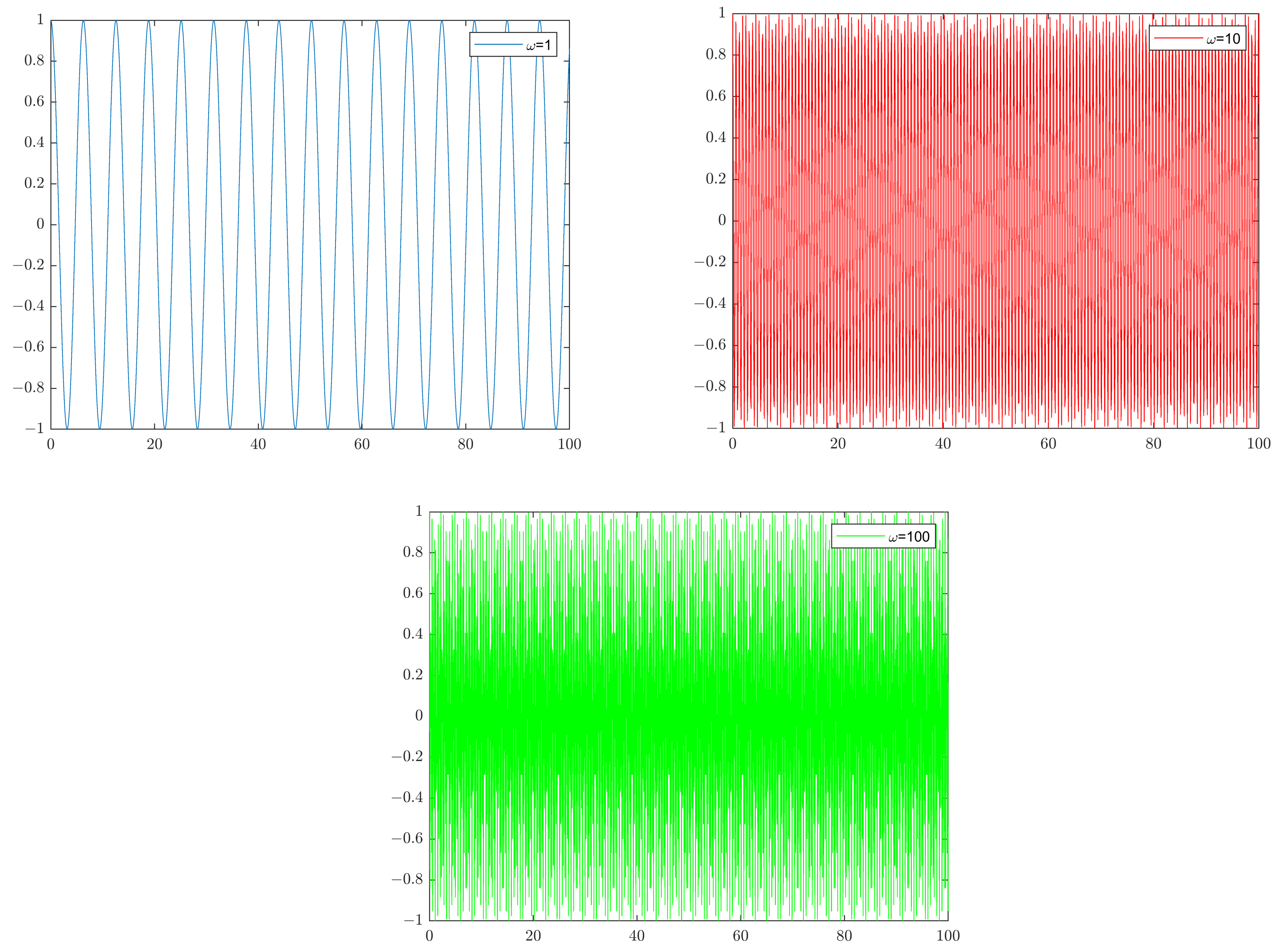
From Figure 1, we can see that the oscillation of the function depends only on ; the larger , the higher the oscillation.
Figure 1.
functions.
Example 1.
We consider the following equation
When , then the exact solution of the equation is .
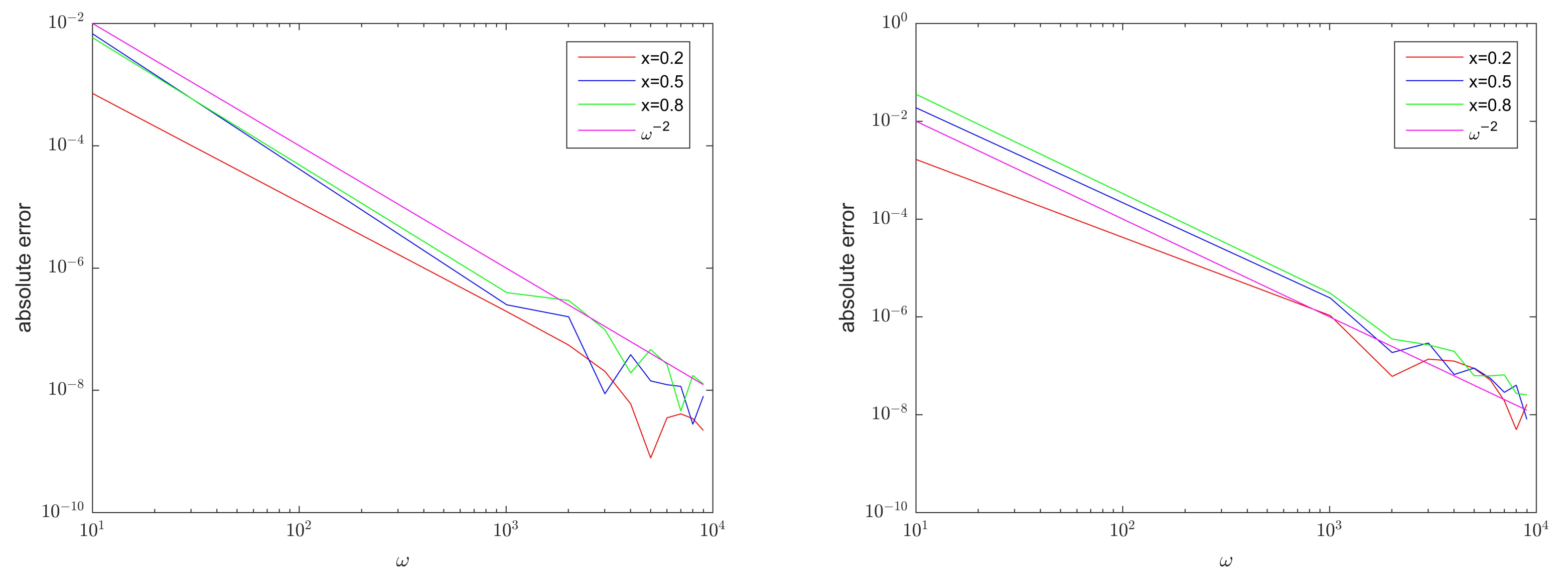
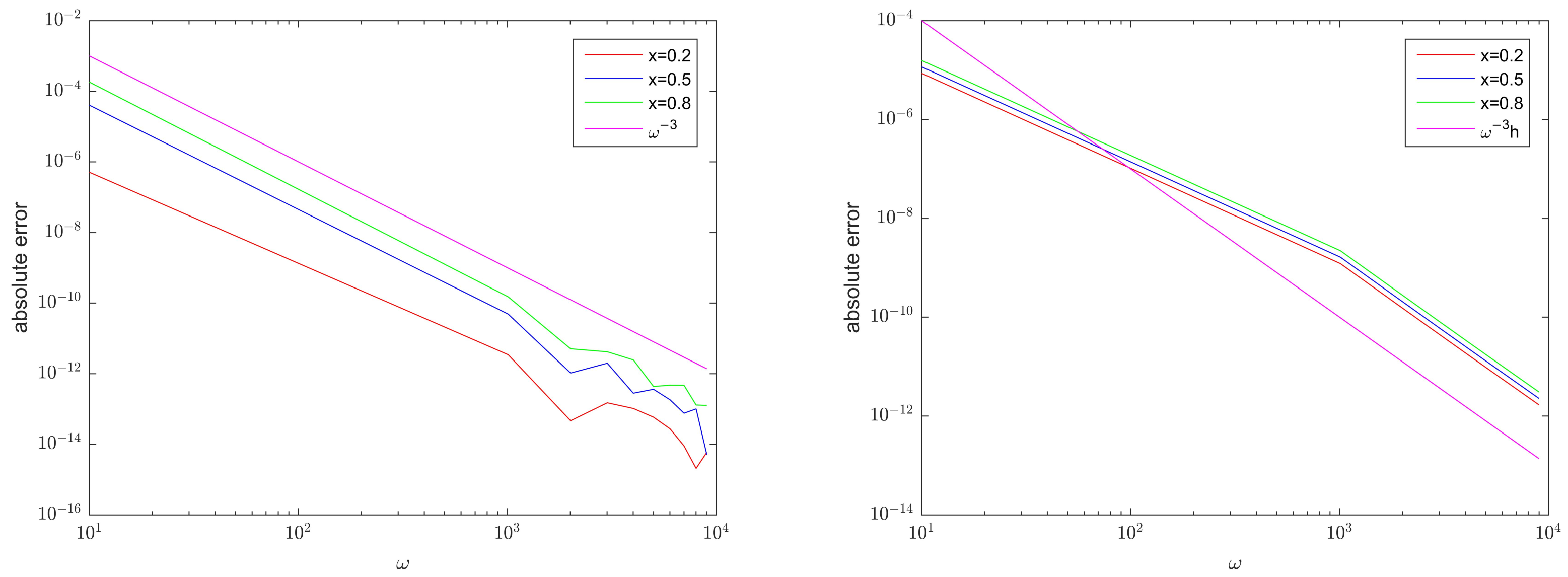
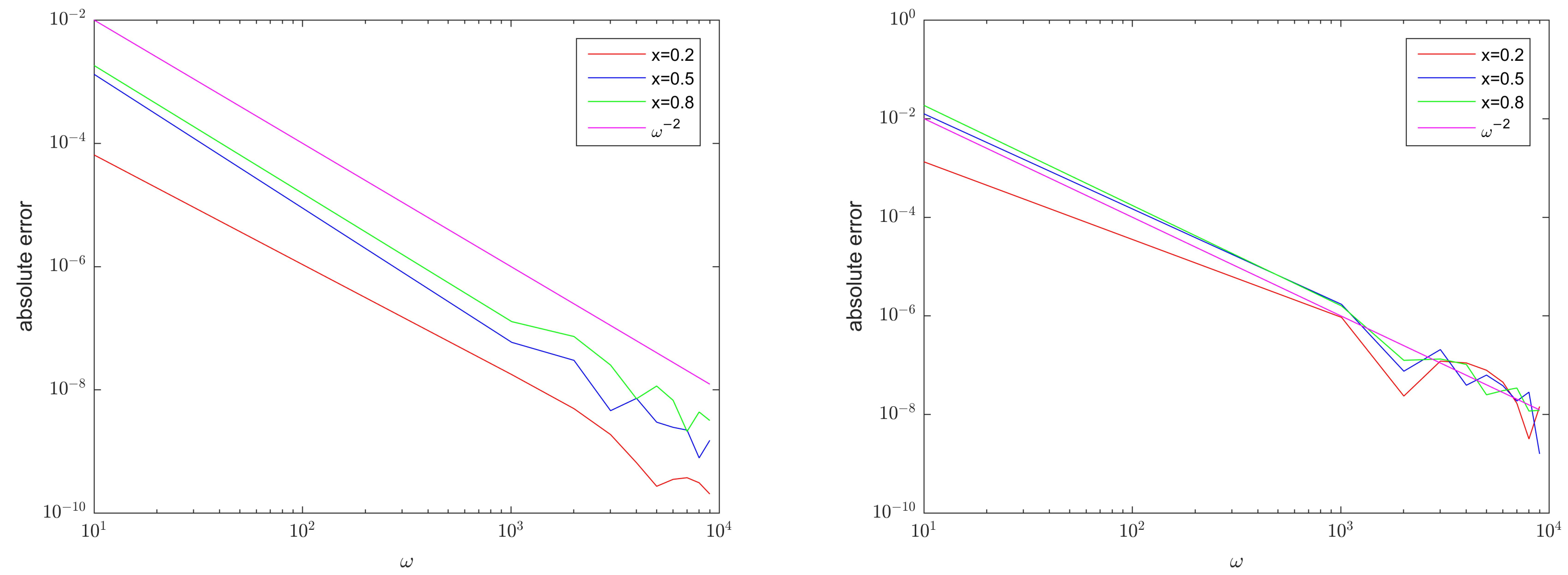
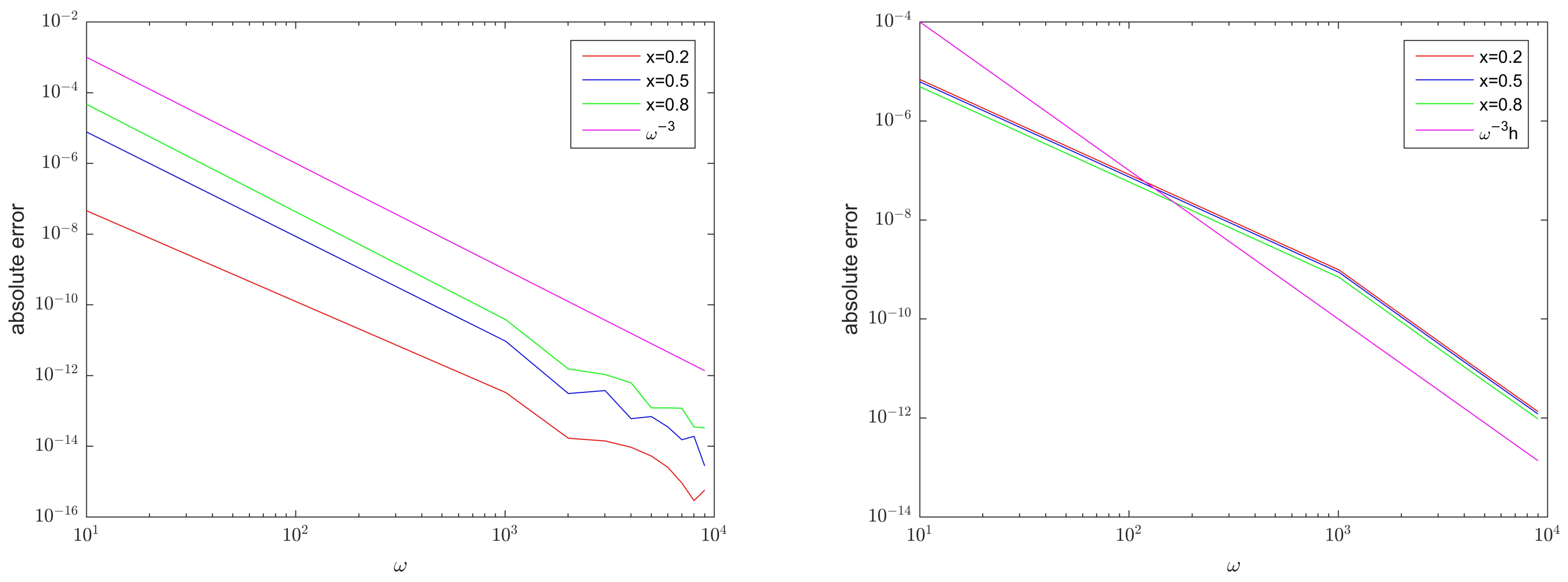
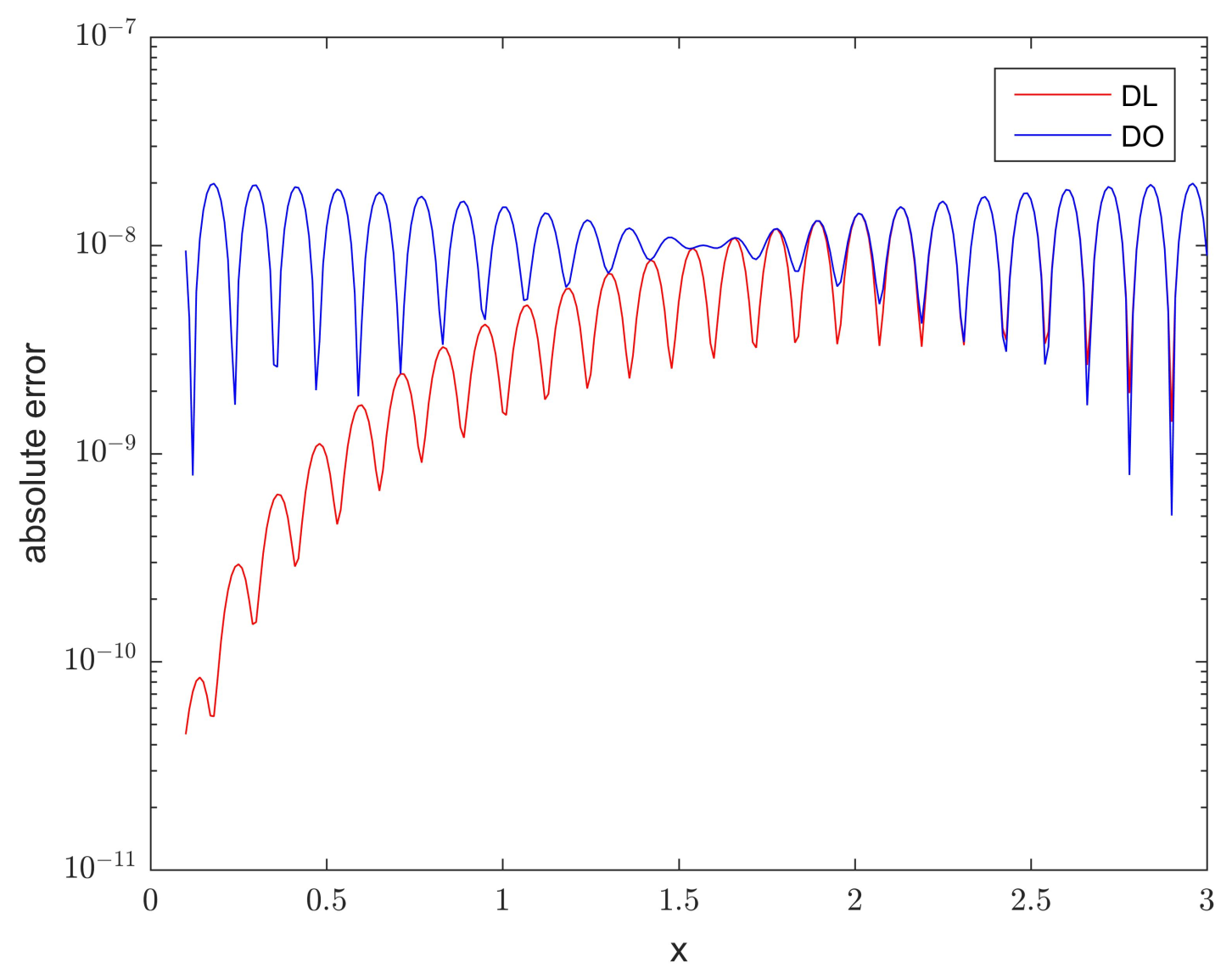
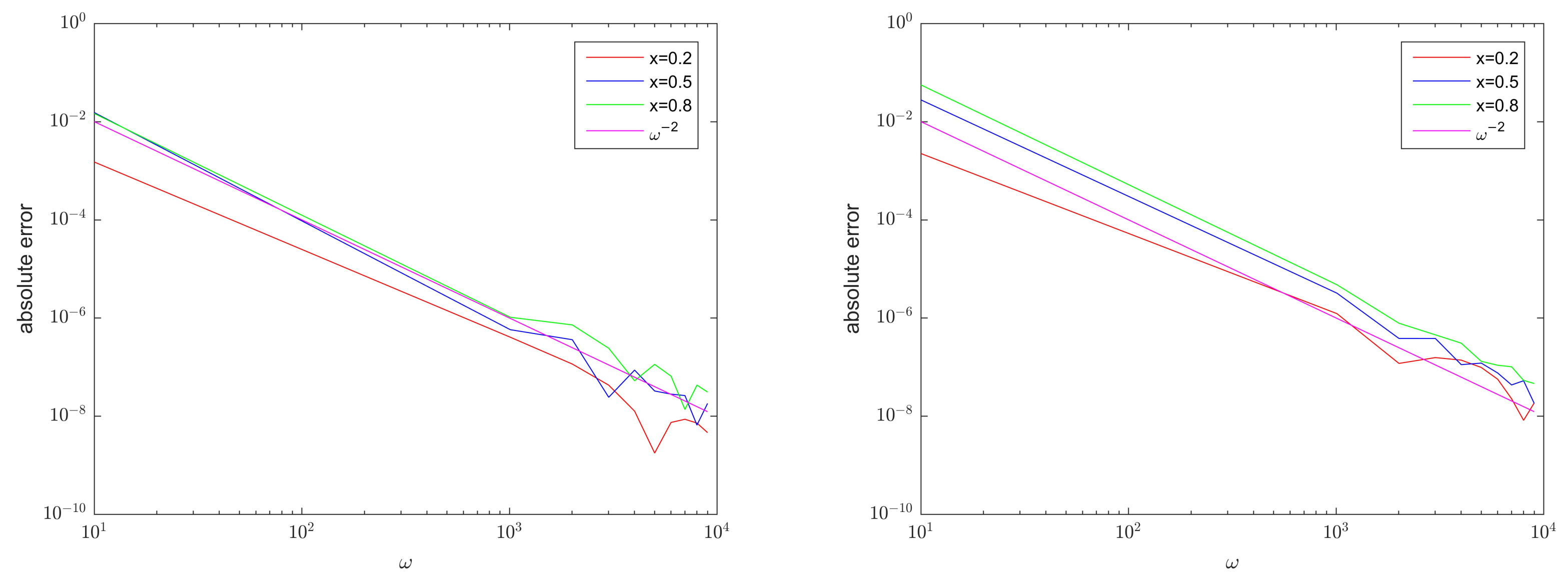
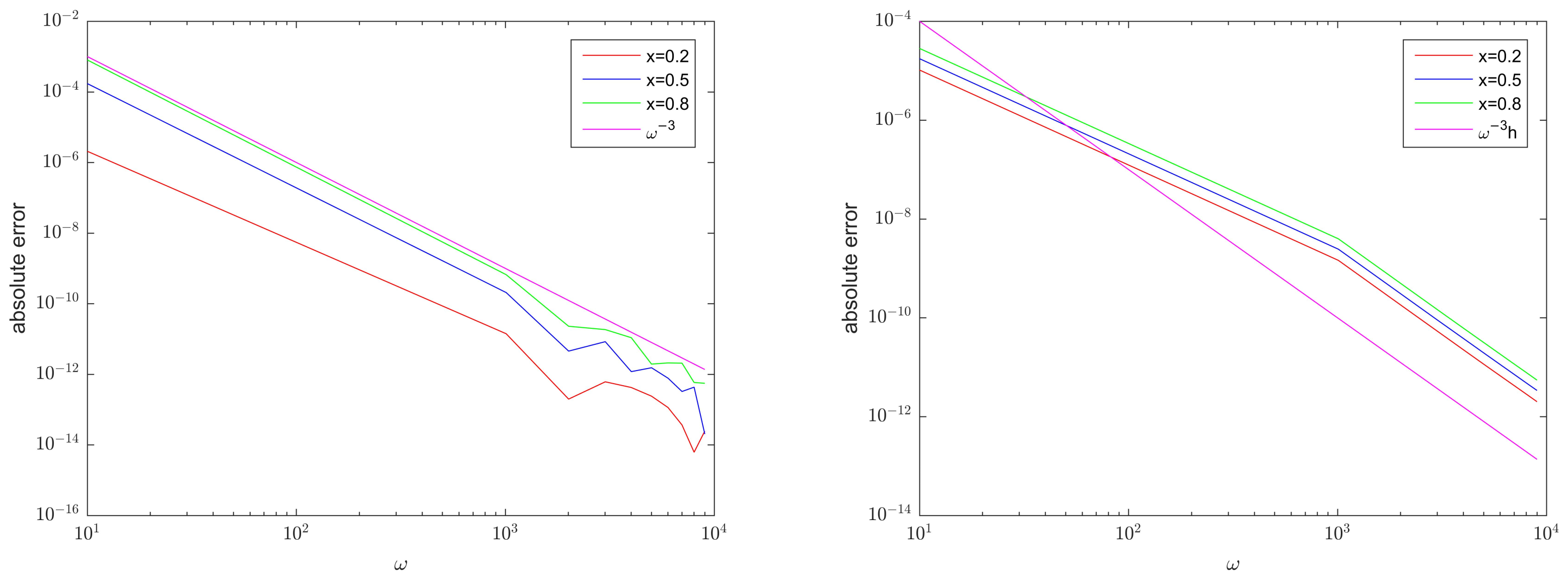
Table 1, Table 2, Table 3, Table 4, Table 5 and Table 6 show the errors of our proposed methods for solving Equation (1)at collocation points 0.2, 0.4,0.6 and 0.8. And the error in solving the equation with step size h for the piecewise Hermite interpolation collocation method is given in Table 1, Table 4 and Table 6. In Figure 2, Figure 3, Figure 4, Figure 5, Figure 6, Figure 7 and Figure 8, we give the error plots for solving Equation (1) using the methods of this paper. Where in Figure 2, Figure 3, Figure 4 and Figure 5, Figure 7 and Figure 8, plots of the error with at the points and are given for our four proposed methods. In Figure 6, we present the curves of the variation in the error with x for solving Example 2 using the direct linear interpolation collocation method and the direct higher interpolation collocation method when omega = 10,000. It can be seen that the direct higher interpolation collocation method is more stable than the direct linear collocation method in solving the equation.
Table 1.
The absolute error of the piecewise Hermite interpolation method for solving Example 1 varies with the step size h when .
Table 2.
Comparison of the step size for the product–integration technique in ref. [13] with the absolute error obtained by solving Example 1 by each of the four methods we propose, where the step size for the piecewise Hermite.
Table 3.
Absolute error of the four methods to solve Example 2, where the step size for piecewise Hermite interpolation.
Table 4.
Absolute error of the piecewise Hermite interpolation method for solving Example 2 varies with the step size h when .
Table 5.
Absolute error of the four methods to solve Example 3, where the step size for piecewise Hermite interpolation.
Table 6.
Absolute error of the piecewise Hermite interpolation method for solving Example 3 varies with the step size h when .
Figure 2.
The absolute errors at points and are solved by direct linear interpolation (left) and direct higher order interpolation (right) for Example 1.
Figure 3.
The absolute errors at points and are solved by direct Hermite interpolation (left) and piecewise Hermite interpolation (right) with the step for Example 1.
Figure 4.
The absolute errors at points and are solved by direct linear interpolation (left) and direct higher order interpolation (right) for Example 2.
Figure 5.
The absolute errors at points and are solved by direct Hermite interpolation (left) and piecewise Hermite interpolation (right) with the step for Example 2.
Figure 6.
The error plot with x for Example 2 is solved by the direct linear interpolation collocation method and the direct higher interpolation collocation method when .
Figure 7.
The absolute errors at points and are solved by direct linear interpolation (left) and direct higher order interpolation (right) for Example 3.
Figure 8.
The absolute errors at points and are solved by direct Hermite interpolation (left) and piecewise Hermite interpolation (right) with the step for Example 3.
Example 2.
We consider the following equation
When , then the exact solution of the equation is .
Example 3.
We consider the following equation
When , then the exact solution of the equation is .
From the graphs and tables of the above numerical experiments, it is easy to see that each of our four proposed collocation methods has its own merits and all of them can efficiently solve the second kind of Volterra integral equations with highly oscillatory Fourier kernels.
8. Conclusions
Volterra integral equations with highly oscillatory kernels have a wide range of applications in mathematical physics and are a hot topic for mathematicians. At present, the theoretical study of this type of integral equation is quite mature. Based on the calculation of the modified moments, solving highly oscillatory problems is usually considered to be effective. Accordingly, four collocation methods (direct linear interpolation, direct higher order interpolation, direct Hermite interpolation and piecewise Hermite interpolation) are proposed in this paper to solve the second kind of Volterra integral equation with a highly oscillatory Fourier kernel. These four methods can solve this class of integral equation efficiently and they all have the characteristic of decreasing error with increasing frequency. In comparison with the classical technique of product integration, the four methods we propose have higher convergence rates. The presented convergence analysis and numerical experiments demonstrate the effectiveness of our proposed methods.
However, in this paper, we have only discussed solving Volterra integral equations with highly oscillating Fourier kernels, and in future work, the four methods we have proposed can be used to try to solve integral equations with different highly oscillating kernels.
Author Contributions
Validation, G.Z.; Writing—review & editing, J.W. and C.F. All authors have read and agreed to the published version of the manuscript.
Funding
This research was funded by Hunan Provincial Natural Science Foundation of China (No. 2022JJ30276, 2021JJ30297), the scientific research project of Hunan provincial department of Education (No. 22A0478), and the Graduate Research and Innovation Project of Hunan Province under Grant (No. CX20221219).
Conflicts of Interest
The authors declare no conflict of interest.
References
- Bao, G.; Sun, W. A fast algorithm for the electromagnetic scattering from a large cavity. SIAM J. Sci. Comput. 2005, 27, 553–574. [Google Scholar] [CrossRef]
- Davies, P.J.; Duncan, D.B. Stability and convergence of collocation schemes for retarded potential integral equations. SIAM J. Numer. Anal. 2004, 42, 1167–1188. [Google Scholar] [CrossRef]
- Langdon, S.; Chandler-Wilde, S.N. A wavenumber independent boundary element method for an acoustic scattering problem. SIAM J. Numer. Anal. 2006, 43, 2450–2477. [Google Scholar] [CrossRef]
- Fa, K.S.; Wang, K.G. Integro-Differential Equations Associated with Continuous-Time Random Walk. Int. J. Mod. Phys. B 2013, 27, 1330006. [Google Scholar] [CrossRef]
- Metzler, R.; Klafter, J. The random walk’s guide to anomalous diffusion: a fractional dynamics approach. Phys. Rep. 2000, 339, 1–77. [Google Scholar] [CrossRef]
- Ramm, A.G.; Charlot, J. Theory and Applications of Some New Classes of Integral Equations; Springer: New York, NY, USA, 1980. [Google Scholar]
- Tuan, N.H.; Mohammadi, H.; Rezapour., S. A mathematical model for COVID-19 transmission by using the Caputo fractional derivative. Chaos Solitons Fractals 2020, 140, 110107. [Google Scholar] [CrossRef]
- Mohammadi, H.; Rezapour, S.; Jajarmi, A. On the fractional SIRD mathematical model and control for the transmission of COVID-19: The first and the second waves of the disease in Iran and Japan. ISA Trans. 2022, 124, 103–114. [Google Scholar] [CrossRef] [PubMed]
- Mohammadi, H.; Papp, E.; Cahill, L.; Rennie, M.; Banko, N.; Pinnaduwage, L.; Lee, J.; Kibschull, M.; Dunk, C.; Sled, J.G.; et al. HIV antiretroviral exposure in pregnancy induces detrimental placenta vascular changes that are rescued by progesterone supplementation. Sci. Rep. 2018, 8, 6552. [Google Scholar] [CrossRef]
- Berrone, L.R. Local positivity of the solution to Volterra integral equations and heat conduction in materials that may undergoes changes of phase. Math. Note 1995, 38, 79–93. [Google Scholar]
- Beezley, R.S.; Krueger, R.J. An electromagnetic inverse problem for dispersive media. J. Math. Phys. 1985, 26, 317–325. [Google Scholar] [CrossRef]
- Kristensson, G. Direct and Inverse Scattering Problems in Dispersive Media-Green’s Functions and Invariant Imbedding Techniques. Methoden Verfahr. Math. Phys. 1991, 37, 105–119. [Google Scholar]
- Linz, P. Product integration methods for Volterra integral equations of the first kind. BIT Numer. Math. 1971, 11, 413–421. [Google Scholar] [CrossRef]
- Anderssen, A.S.; White, E.T. Improved numerical methods for Volterra integral equations of the first kind. Comput. J. 1971, 14, 442–443. [Google Scholar] [CrossRef][Green Version]
- Levin, D. Fast integration of rapidly oscillatory functions. J. Comput. Appl. Math. 1996, 67, 95–101. [Google Scholar] [CrossRef]
- Levin, D. Analysis of a collocation method for integrating rapidly oscillatory functions. J. Comput. Appl. Math. 1997, 78, 131–138. [Google Scholar] [CrossRef]
- Uddin, M.; Khan, A. A Numerical Method for Solving Volterra Integral Equations with Oscillatory Kernels Using a Transform. Numer. Anal. Appl. 2021, 14, 379–387. [Google Scholar] [CrossRef]
- Xiang, S.; Brunner, H. Efficient methods for Volterra integral equations with highly oscillatory Bessel kernels. BIT Numer. Math. 2013, 53, 241–263. [Google Scholar] [CrossRef]
- Xiang, S.; Wu, Q. Numerical solutions to Volterra integral equations of the second kind with oscillatory trigonometric kernels. Appl. Math. Comput. 2013, 223, 34–44. [Google Scholar] [CrossRef]
- Wu, Q. On graded meshes for weakly singular Volterra integral equations with oscillatory trigonometric kernels. J. Comput. Appl. Math. 2014, 263, 370–376. [Google Scholar] [CrossRef]
- Fang, C.; He, G.; Xiang, S. Hermite-type collocation methods to solve Volterra integral equations with highly oscillatory Bessel kernels. Symmetry 2019, 11, 168. [Google Scholar] [CrossRef]
- Ma, J.; Kang, H. Frequency-explicit convergence analysis of collocation methods for highly oscillatory Volterra integral equations with weak singularities. Appl. Numer. Math. 2020, 151, 1–12. [Google Scholar] [CrossRef]
- Ma, J.; Fang, C.; Xiang, S. Modified asymptotic orders of the direct Filon method for a class of Volterra integral equations. J. Comput. Appl. Math. 2015, 281, 120–125. [Google Scholar] [CrossRef]
- Chen, H.; Liu, L.; Ma, J. Analysis of generalized multistep collocation solutions for oscillatory Volterra integral equations. Mathematics 2020, 8, 2004. [Google Scholar] [CrossRef]
- Yang, X.; Wu, L.; Zhang, H. A space-time spectral order sinc-collocation method for the fourth-order nonlocal heat model arising in viscoelasticity. Appl. Math. Comput. 2023, 457, 128192. [Google Scholar] [CrossRef]
- Jiang, X.; Wang, J.; Wang, W.; Zhang, H. A Predictor–Corrector Compact Difference Scheme for a Nonlinear Fractional Differential Equation. Fractal Fract. 2023, 7, 521. [Google Scholar] [CrossRef]
- Tian, Q.; Yang, X.; Zhang, H.; Xu, D. An implicit robust numerical scheme with graded meshes for the modified Burgers model with nonlocal dynamic properties. Comput. Appl. Math. 2023, 42, 246. [Google Scholar] [CrossRef]
- Yang, X.; Zhang, H.; Tang, J. The OSC solver for the fourth-order sub-diffusion equation with weakly singular solutions. Comput. Math. Appl. 2021, 82, 1–12. [Google Scholar] [CrossRef]
- Zhang, H.; Yang, X.; Tang, Q.; Xu, D. A robust error analysis of the OSC method for a multi-term fourth-order sub-diffusion equation. Comput. Math. Appl. 2022, 109, 180–190. [Google Scholar] [CrossRef]
- Teriele, H. Collocation methods for weakly singular second-kind Volterra integral equations with non-smooth solution. IMA J. Numer. Anal. 1982, 2, 437–449. [Google Scholar]
- Brunner, H. Collocation Methods for Volterra Integral and Related Functional Differential Equations; Cambridge University Press: Cambridge, UK, 2004. [Google Scholar]
- Xiang, S.; He, G.; Cho, Y.J. On error bounds of Filon-Clenshaw-Curtis quadrature for highly oscillatory integrals. Adv. Comput. Math. 2015, 41, 573–597. [Google Scholar] [CrossRef]
- Gao, J.; Iserles, A. A generalization of Filon–Clenshaw–Curtis quadrature for highly oscillatory integrals. BIT Numer. Math. 2017, 57, 943–961. [Google Scholar] [CrossRef]
- Ma, J.; Liu, H. A well-conditioned Levin method for calculation of highly oscillatory integrals and its application. J. Comput. Appl. Math. 2018, 342, 451–462. [Google Scholar] [CrossRef]
- Zhang, Q.; Xiang, S. On fast multipole methods for Volterra integral equations with highly oscillatory kernels. J. Comput. Appl. Math. 2019, 348, 535–554. [Google Scholar] [CrossRef]
- Kayijuka, I.; Ege, Ş.M.; Konuralp, A.; Topal, F.S. Clenshaw–Curtis algorithms for an efficient numerical approximation of singular and highly oscillatory Fourier transform integrals. J. Comput. Appl. Math. 2021, 385, 113201. [Google Scholar] [CrossRef]
- Xiang, S.; Cho, Y.J.; Wang, H.; Brunner, H. Clenshaw–Curtis–Filon–type methods for highly oscillatory Bessel transforms and applications. IMA J. Numer. Anal. 2011, 31, 1281–1314. [Google Scholar] [CrossRef]
- Wu, Q.; Hou, W. Efficient BBFM-collocation for weakly singular oscillatory Volterra integral equations of the second kind. Int. J. Comput. Math. 2022, 99, 1022–1040. [Google Scholar] [CrossRef]
- Volterra, V. Sulla inversione degli integrali definiti. Atti R. Accad. Sci. Torino 1896, 31, 311–323. [Google Scholar]
- Abramowitz, M.; Stegun, I.A. Handbook of Mathematical Functions with Formulas, Graphs, and Mathematical Tables; US Government Printing Office: Washington, DC, USA, 1964.
- Erdelyi, A. Asymptotic representations of Fourier integrals and the method of stationary phase. J. Soc. Ind. Appl. Math. 1955, 3, 17–27. [Google Scholar] [CrossRef]
- Xiang, S.; Wang, H. Fast integration of highly oscillatory integrals with exotic oscillators. Math. Comput. 2010, 79, 829–844. [Google Scholar] [CrossRef]
- Liu, G.; Xiang, S. Clenshaw-Curtis-type quadrature rule for hypersingular integrals with highly oscillatory kernels. Appl. Math. Comput. 2019, 340, 251–267. [Google Scholar] [CrossRef]
- Xu, Z.; Xiang, S. Computation of Highly Oscillatory Bessel Transforms with Algebraic Singularities. arXiv 2016, arXiv:1605.08568. [Google Scholar]
Disclaimer/Publisher’s Note: The statements, opinions and data contained in all publications are solely those of the individual author(s) and contributor(s) and not of MDPI and/or the editor(s). MDPI and/or the editor(s) disclaim responsibility for any injury to people or property resulting from any ideas, methods, instructions or products referred to in the content. |
© 2023 by the authors. Licensee MDPI, Basel, Switzerland. This article is an open access article distributed under the terms and conditions of the Creative Commons Attribution (CC BY) license (https://creativecommons.org/licenses/by/4.0/).