Abstract
This paper investigates the dynamics of non-autonomous competitive systems of difference equations with asymptotically constant coefficients. We are mainly interested in global attractivity results for such systems and the application of such results to the evolutionary population of competition models of two species.
Keywords:
competitive; discrete dynamical systems; difference equations; evolutionary; non-autonomous systems; stability MSC:
39A10; 39A20; 92D25
1. Introduction
In this paper, we give some global attractivity results for a non-autonomous competitive systems of difference equations,
where f is non-decreasing in the first variable and is non-increasing in the second variable, and g is non-increasing in the first variable and is non-decreasing in the second variable. Here, and are sequences which are assumed to be asymptotically constant. Our results are motivated by the results for global attractivity of non-autonomous systems of difference equations via linearization in [1], which have significant applications in the mathematical biology of single species [2]. Our techniques are based on difference inequalities, which was a major method used in [2]. The obtained results hold when the limiting system of difference equations is in a hyperbolic case and cannot be extended to the non-hyperbolic case as in [3]. Now we extend the applications from single species models in [2] to the case of two species competition models. Then we apply our results to evolutionary population competition models, which have been considered lately by Cushing, Elaydi, and others, see [4,5,6,7,8,9,10]. A typical result in [2], which will be extended to the competitive planar systems is Theorem 1 [2]:
Theorem 1.
Consider the difference equation
where f is a continuous, nondecreasing function, , and the limiting difference equation is
Assume that there exists such that every solution of difference equation
converges to a constant solution for every . If
then every solution of the difference Equation (2) satisfies
The global attractivity results for the first order autonomous difference equation that will be used in simulations in this paper were proved by Elaydi and Sacker [11] and Singer [12].
Theorem 2
([11]). Let be a continuous function in equation
Then, the following statements are equivalent:
As an immediate consequence of the Theorem 2, we have the following important result on global asymptotic stability.
Corollary 1
([11]). Let be a fixed point of a continuous map f on the closed and bounded interval . Then, is globally asymptotically stable relative to if and only if
for all , and are not periodic points.
The next result, known as the Singer theorem, see [12], is a very useful and efficient tool for establishing the global dynamics of first order difference equations.
Theorem 3.
Assume that f is with an equilibrium point such that f satisfies the negative feedback condition, that is, if and if . Assuming that the Schwarzian derivative
for all , then if , then is globally asymptotically stable. Now, condition is equivalent to local stability or non-hyperbolicity of the equilibrium .
Another result we use is the following result from [13], Theorem 1.18:
Theorem 4.
Let be a continuous, non-decreasing function in Equation (4). Then every solution is monotonic and so it converges to an equilibrium.
In this paper, we will use the so-called “north-east” partial ordering of the space and defined it in the following way:
and the so-called ”south-east” partial ordering of the space defined by
This paper is organized as follows. The next section contains the main results on asymptotic dynamics of non-autonomous systems of difference equations of competitive type in state variables in the plane. The final section presents the application of the main results to the evolutionary (Darwinian) systems of difference equations when, in addition to state variables, we introduce equations or systems of equations that describe dynamics of the traits, which affect the coefficients of state variables.
2. Main Results
This section contains our main results.
Lemma 1.
Assume that
(a) , is a competitive map, i.e., are the functions with the following properties:
(i) f is non-decreasing in the first variable and is non-increasing in the second variable,
(ii) g is non-increasing in the first variable and and is non-decreasing in the second variable;
(b) , , are sequences of the real components in such that and
Then,
Proof.
The proof follows by induction. Since
by using properties of monotonicity of the functions f and g, we obtain
i.e.,
Analogously, the proof that follows in the same fashion, and so does the proof of (6). □
Theorem 5.
Consider the following non-autonomous system of difference equations:
where and is a competitive map. Assume that
and let
be the limiting system of difference equations of (7). Also, assume that there exists such that every solution of the system
converges to a constant for every , , .
Proof.
For arbitrary and there exists such that for the following
holds. So we have
By Lemma 1, we obtain
where satisfies
and satisfies
Inequalities (9) imply
i.e.,
where , , and .
Since , where , (10) implies that
□
Example 1.
Consider the following system of difference equations modelling competition, [14,15]
where , , and . This system has the following equilibrium points:
(a) , which is locally asymptotically stable if and ;
(b) for and , which is a saddle point;
(c) every point , if , which is a non-hyperbolic point;
(d) every point , if , which is a non-hyperbolic point, and
(e) every point on the x-axis and every point on the y-axis if , which is a non-hyperbolic point.
It implies from the Jacobi matrix of the map , which has the form
so that, for example,
has eigenvalues and , while
has eigenvalues .
The fact that is globally asymptotically stable if and follows by using the Lyapunov function of the form of the map F. Namely, if , , , , and , we have that
Since , as then equilibrium point is globally asymptotically stable when and .
If we consider the following non-autonomous system
where and then, by using Theorem 5 taking and , all solutions of System (12) globally asymptotically converge to for and , and for all and .
Theorem 6.
Consider the following non-autonomous competitive system:
Assume that and
and let
be the limiting system of System (13). Also, assume that there exists such that every solution of the system
converges to a constant for every , , .
Proof.
For arbitrary and , there exists such that for , the following holds:
This implies that
By Lemma 1, we obtain
where satisfies
and satisfies
Inequalities (15) imply
i.e.,
where , , and .
Since , where , (16) implies that
□
Theorem 7.
Consider the following non-autonomous competitive system
Assume that and
and let
be the limiting system of System (17). Also, assume that there exists such that every solution of the system
converges to a constant for every , , , , and .
Proof.
For arbitrary , there exists such that for , the following
holds. This implies that
Since F is a competitive map, Lemma 1 implies
where satisfies
and satisfies
Inequalities (19) imply
i.e., (16), where , , and .
Since , where , (16) implies that
□
Theorem 8.
Consider the following non-autonomous Leslie–Gower model:
Proof.
For arbitrary , there exists such that for , the following
holds. This implies that the following inequalities are satisfied for
Since is a competitive map, Lemma 1 implies
where satisfies
and satisfies
Inequalities (22) imply
i.e.,
where , , and .
Since , where , (23) implies that
□
Remark 2.
Note that System (21) has a unique equilibrium point , for , , which is locally asymptotically stable. By using Lyapunov function of the form of the map , we can conclude that the equilibrium point is globally asymptotically stable for and . Namely, if , , and , , we have that
Since , as , then equilibrium point is globally asymptotically stable.
Example 2.
The competitive system considered in [14,15,16] was System
, for all positive values of parameters , and non-negative initial conditions , where the global dynamics was described. We found all values of parameters for which the unique equilibrium solution of (24) was globally asymptotically stable. Consider now the nonautonomous version of System (24):
, for non-negative initial conditions , where each of positive valued sequences satisfies:
The limiting system for (25) is System (24). So, for all values of parameters for which the unique equilibrium solution of System (24) is globally asymptotically stable, we have that
for every solution of non-autonomous system (25).
Example 3.
The competitive system considered in [17] was System
, for all positive values of parameters , and non-negative initial conditions , where the global dynamics was described. We found all values of parameters for which the unique equilibrium solution of (24) was globally asymptotically stable. Consider now the nonautonomous version of System (24):
, for non-negative initial conditions , where each of the positive valued sequences satisfies:
The limiting system for (27) is System (26). So, for all values of parameters for which the unique equilibrium solution of System (26) is globally asymptotically stable, we have that
for every solution of non-autonomous system (27).
Example 4.
The competitive system considered in [18] was System
, for all positive values of parameters , and non-negative initial conditions , where the global dynamics was described for all values of parameters. System (28) has between one and three equilibria, and the number of equilibria determines global behavior of this system. Here and are considered as constant stockings of two species which are in competition with Leslie–Gower type. We found in [18] that the unique equilibrium solution of (28) was globally asymptotically stable. We also found sufficient conditions for system (28) to have a unique equilibrium solution.
Consider now the nonautonomous version of System (28):
, for non-negative initial conditions , where each of the positive valued sequences satisfies:
The limiting system for (29) is System (28). So for all values of parameters for which the unique equilibrium solution of System (28) is globally asymptotically stable we have that
for every solution of non-autonomous system (29). For instance, as a consequence of Theorem 5 in [18], we have the following result:
3. Examples of Competitive Evolutionary Models
In this section, we consider some competitive evolutionary models using the Beverton–Holt function and its modifications.
One of the reasons that model parameters can change in time is Darwinian evolution, which is a case that will be briefly explained here. The detailed explanation is given in [5,6,7,8,10,19]. Suppose v is a quantified, phenotypic trait of an individual that is subject to evolution. If we assume the per capita contribution to the population made by an individual depends on its trait v, then depends on both x and v. It might happen that this contribution also depends on the traits of other individuals. We can model this situation by assuming that f also depends on the mean trait u in the population so that . A canonical way to model Darwinian evolution is to model the dynamics of and the mean trait by means of the equations
where , see [19].
Equation (32) asserts that the population dynamics can be modeled by assuming the individual trait v is equal to the population mean. Equation (33) (called Lande’s or Fisher’s or the breeder’s equation) prescribes that the change in the mean trait is proportional to the fitness gradient, where fitness in this model is denoted by . The modeler decides on an appropriate measure of fitness, which is often taken to be f or . The constant of proportionality is called the speed of evolution. It is related to the variance of the trait in the population, which is assumed to be constant in time. Thus, if , no evolution occurs (there is no variability) and one has a one-dimensional difference Equation (32) for just population dynamics. If evolution occurs , then the model is a two dimensional system of difference equations with state variable . The term in Equation (32) can be vector. Similarly, mean trait can be vector as well. Also, can be scalar while can be vector—case when evolution depends on several traits.
Example 5.
Now, we investigate the following competitive evolutionary model where the two growth coefficients a and b depend on two independent traits and :
where and are twice differentiable functions on their domains. The third and fourth equations of system (34) are called Fisher’s or Lande’s equations, see [19].
The fixed points of the functions and are and , respectively, where and are critical points of a and b.
If and are locally asymptotically stable, that is, if the following inequalities hold:
then there exist open neighborhoods and of and , respectively, such that
This implies that the non-autonomous system formed by the first two equations in (34) is asymptotic to the following limiting system:
System (36) has a unique equilibrium point for and , which is locally asymptotically stable.
Based on Theorem 5 and using Example 1, we obtain the following result:
Theorem 9.
Example 6.
From and , we obtain and . In the following, we will use . Since , , , and , condition (35) is satisfied if
Then, there exist open neighborhoods and of and , respectively, such that
Also, the non-autonomous system formed by the first two equations in (37) is asymptotic to the following limiting system:
Based on Theorem 9, we obtain the following two results.
1. If and , then equilibrium point is globally asymptotically stable, i.e., every solution of (38) satisfies
for all and .
2. If , , and , then all solutions of non-autonomous system (37) globally asymptotically converge to , for all points and .
This shows that and are bifurcation parameters in this model.
Example 7.
The coefficients of difference equations of state variable may depend on several traits. These traits might be decoupled or coupled. In the case when they are decoupled there will be a single Fisher’s equation for each trait.
For instance, consider the Leslie–Gower evolutionary model:
with two Fisher’s equations
, with all positive coefficients for . The dynamics of two equations in (40) follow from any of Theorems 2, 3 or 4.
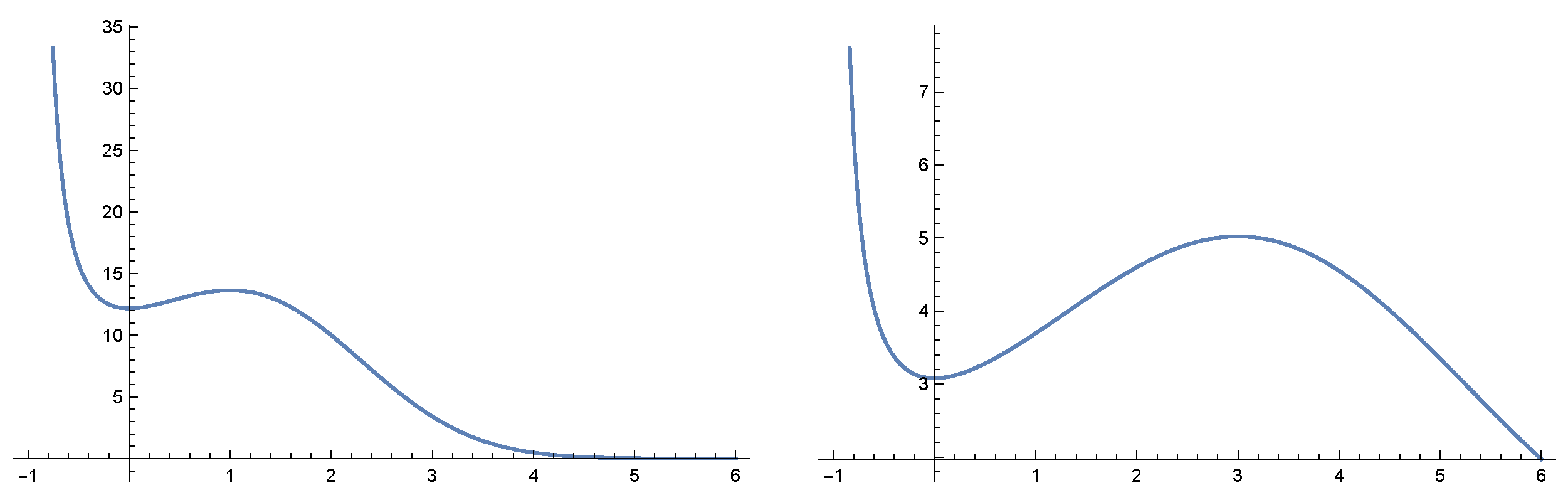
Figure 1.
The graphs of fitness functions for Equation (40) for the parameter values , , and , .
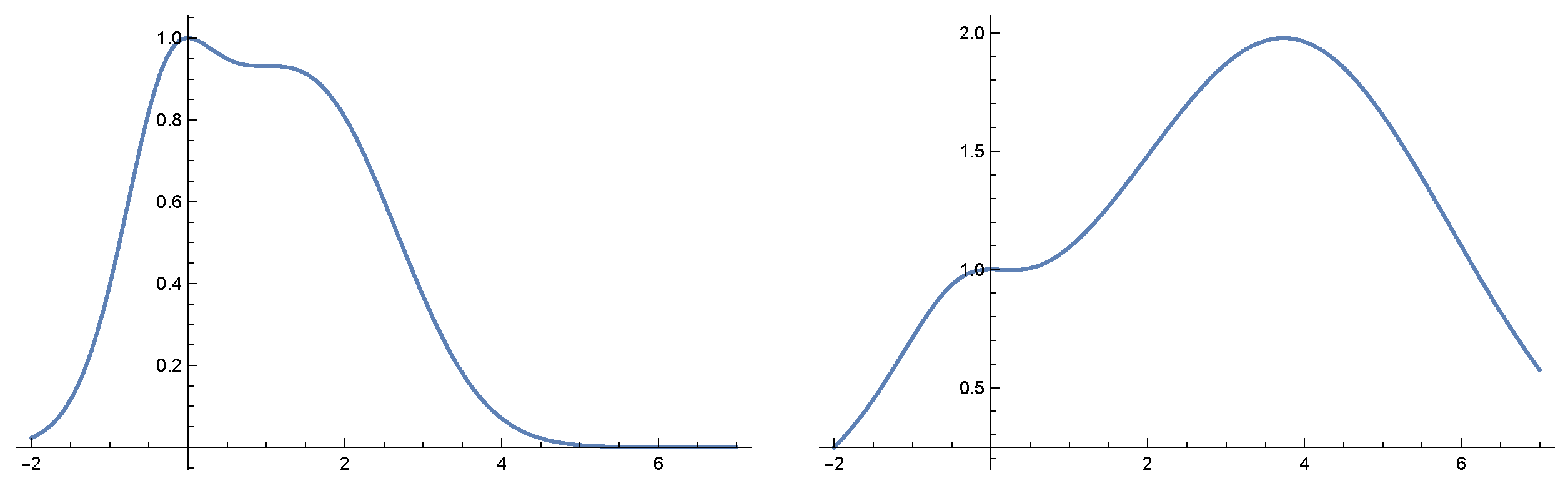
Figure 2.
The graphs of fitness functions for Equation (40) for the parameter values , , and , .
Based on known results for dynamics of Leslie–Gower model and Beverton–Holt’s equations, we get the following results.
Theorem 10.
- (i)
- (ii)
- (iii)
- (iv)
- (v)
- Assume that and . If every solution of (39) converges to the interior positive equilibrium, which happens ifor
Proof.
Example 8.
Consider the first two equations of System (34), where
(see Figure 3) and Fisher’s equation has the form
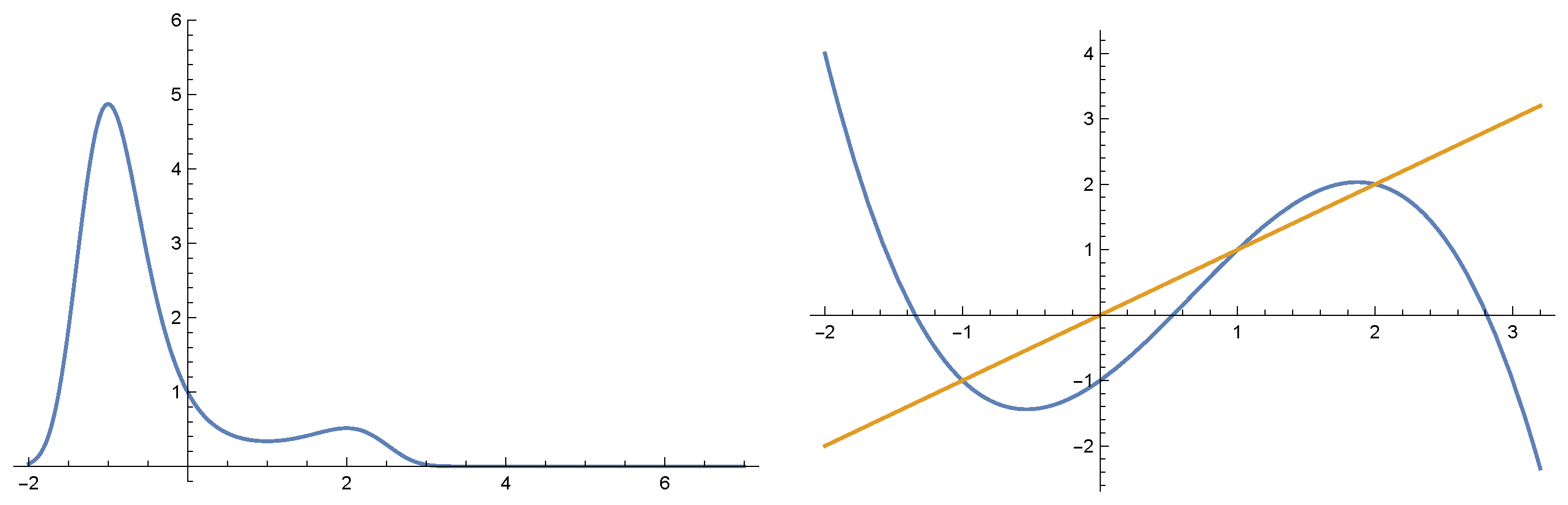
Figure 3.
The graph of fitness function for Equation (43) for parameter values and the graph of the right hand side of Fisher’s equation for . The figure shows the immediate basins of attraction for the equilibrium points and 2.
Equation (43) has three equilibrium solutions and . Straightforward local stability analysis implies that is always a repeller, while is locally asymptotically stable when and is locally asymptotically stable when . In addition, the function satisfies the negative feedback condition in the neighborhood of the equilibrium solutions and , for the values of , which are less than and respectively. Finally the Schwarzian derivative given as
is negative in all points. In view of Theorem 3, both equilibrium solutions are globally asymptotically stable within their immediate basins of attractions (part of basin of attraction which contains the equilibrium) which are given as:
(see Figure 3).
Since and , we conclude that the equilibrium is ESS (evolutionary stable), since it is located at a global maximum of the fitness function, see [5,6,19].
An analysis of second and third iterate of a map f and a bifurcation diagram of trait equation (using the speed of evolution as a bifurcation parameter) indicates that period three solutions exist and so period doubling route to chaos is possible. For instance, when the Fisher’s equation has three period-two solutions and six period three solutions such as in Table 1.
Table 1.
Period-two and period-six solutions.
Example 9.
Consider the Leslie–Gower evolutionary model:
with a single Fisher’s equation
, with all positive coefficients for .
The equilibrium points of Fisher’s Equation (45) are solutions of the following equation:
which implies that there exist one negative equilibrium point , and zero equilibrium . The critical points of the function are and , where h reaches the maximum , and reaches a minimum at . Since
then the following claims hold:
- (i)
- if , then there exist two equilibrium points: and ,
- (ii)
- if , then there exist three equilibrium points: , and ,
- (iii)
- if , then there exist four equilibrium points: , , , and , where .
The equilibrium points and are locally asymptotically stable and the equilibrium points and are locally repellers. By using Theorem 4, we see that and are globally asymptotically stable with the corresponding basins of attractions:
- (i)
- if , then ,
- (ii)
- if , then and ,
- (iii)
- if , then and .
The fitness function is
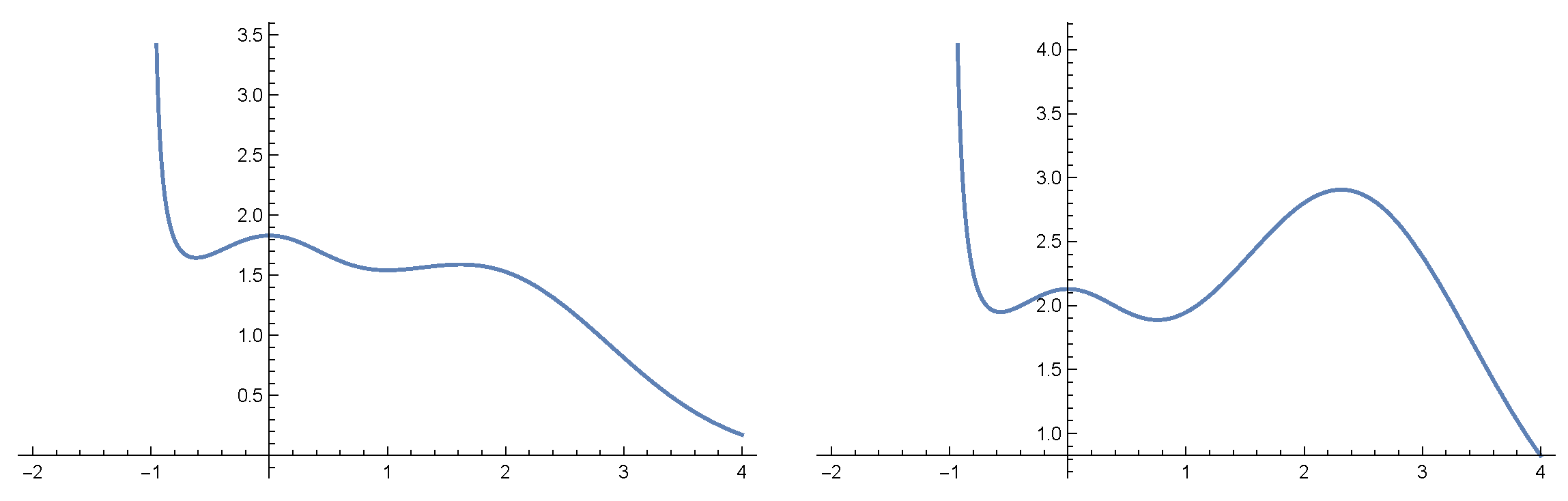
In view of Theorem 3, the equilibrium solutions and are globally asymptotically stable within their immediate basins of attractions. One of them is ESS (evolutionary stable) and that is the one located at a global maximum of the fitness function, see [5,6,19]. The second equilibrium is evolutionary convergent but is not an ESS since it does not yield a global maximum of the fitness function, see [5,6,19]. Figure 4 indicates that the position of the global maximum depends on parameter p.
4. Conclusions
In this paper, we give some global attractivity results for non-autonomous competitive systems of difference equations (1) where f is non-decreasing in the first variable and is non-increasing in the second variable, and g is non-increasing in the first variable and is non-decreasing in the second variable. Here, and are sequences that are assumed to be asymptotically constant. Such systems appear in many recent applications in evolutionary (Darwinian) dynamics, where, in addition to dynamics of state variables, we are interested in the dynamics of traits that affect the coefficients of state variables. Our techniques are based on the method of difference inequalities, and the obtained results hold when the limiting system of difference equations is in a hyperbolic case. We extend some asymptotic results from single species models to the case of two species competition models. We apply our results to evolutionary population competition models, which have been considered lately by Ackleh, Cushing, Elaydi, and others. We illustrate our results with Leslie–Gower evolutionary model where Fisher’s trait equation is a sigmoid Beverton–Holt equation, with up to four equilibrium points, only one of which is ESS (evolutionary stable) and that is, according to the theory in Vincent and Brown [19], exactly the equilibrium where the fitness function attains its global maximum, see Example 9.
Author Contributions
Conceptualization, M.R.S.K. and M.N.; methodology, M.R.S.K., M.N. and Z.N; software, M.R.S.K., M.N. and Z.N.; validation, M.R.S.K., M.N., Z.N. and S.T.; formal analysis, M.R.S.K., M.N., Z.N. and S.T.; investigation, M.R.S.K., M.N. and Z.N.; writing—original draft preparation, M.R.S.K., M.N. and Z.N.; writing—review and editing, M.R.S.K., M.N. and Z.N.; visualization, M.R.S.K., M.N. and Z.N.; supervision, M.R.S.K., M.N. and Z.N. All authors have read and agreed to the published version of the manuscript.
Funding
This research received no external funding.
Data Availability Statement
No applicable.
Conflicts of Interest
The authors declare no conflict of interest.
References
- Bilgin, A.; Kulenović, M.R.S. Global attractivity for non-autonomous difference equation via linearization. J. Comp. Anal. Appl. 2017, 23, 1311–1322. [Google Scholar]
- Bilgin, A.; Kulenović, M.R.S. Global Asymptotic Stabilty for Discrete Single Species Population Models. Discret. Dyn. Nat. Soc. 2017, 2017, 5963594. [Google Scholar] [CrossRef]
- Burgić, D.; Kalabušić, S.; Kulenović, M.R.S. Non-hyperbolic Dynamics for Competitive Systems in the Plane and Global Period-doubling Bifurcations. Adv. Dyn. Syst. Appl. 2008, 3, 229–249. [Google Scholar]
- Ackleh, A.S.; Cushing, J.M.; Salceanu, P.L. On the dynamics of evolutionary competition models. Nat. Resour. Model. 2015, 28, 380–397. [Google Scholar] [CrossRef]
- Cushing, J.M. An evolutionary Beverton–Holt model. In Theory and Applications of Difference Equations and Discrete Dynamical Systems; Springer Proceedings in Mathematics & Statistics 102; Springer: Heidelberg, Germany, 2014; pp. 127–141. [Google Scholar]
- Cushing, J.M. One Dimensional Maps as Population and Evolutionary Dynamic Models. In Applied Analysis in Biological and Physical Sciences; Springer Proceedings in Mathematics & Statistics 186; Springer: New Delhi, India, 2016; pp. 41–62. [Google Scholar]
- Cushing, J.M. Difference equations as models of evolutionary population dynamics. J. Biol. Dyn. 2019, 13, 103–127. [Google Scholar] [CrossRef] [PubMed]
- Elaydi, S.; Kang, Y.; Luis, R.; Luis, Y. The effects of evolution on the stability of competing species. J. Biol. Dyn. 2022, 16, 816–839. [Google Scholar] [CrossRef] [PubMed]
- Mokni, K.; Elaydi, S.; CH-Chaoui, M.; Eladdadi, A. Discrete evolutionary population models: A new approach. J. Biol. Dyn. 2020, 14, 454–478. [Google Scholar] [CrossRef] [PubMed]
- Cushing, J.M. A Darwinian Ricker Equation. In Proceedings of the Progres on Difference Equations and Discrete Dynamical Systems, 25th ICDEA, London, UK, 24–28 June 2019; pp. 231–243. [Google Scholar]
- Elaydi, S. An Introduction to Difference Equations, 3rd ed.; Undergraduate Texts in Mathematics; Springer: New York, NY, USA, 2005. [Google Scholar]
- Elaydi, S. Discrete Chaos, 2nd ed.; Chapman & Hall/CRC Press: Boca Raton, FL, USA, 2000. [Google Scholar]
- Kulenović, M.R.S.; Merino, O. Discrete Dynamical systems and Difference Equations with Mathmatica; Chapmanand Hall/CRC: Boca Raton, FL, USA; London, UK, 2002. [Google Scholar]
- Kulenović, M.R.S.; Nurkanović, M. Asymptotic behavior of a competitive system of linear fractional difference equations. Adv. Differ. Equ. 2006, 2006, 19756. [Google Scholar] [CrossRef]
- Kulenović, M.R.S.; Nurkanović, M. Asymptotic behavior of a system of linear fractional difference equations. Adv. Differ. Equ. 2005, 2005, 741584. [Google Scholar] [CrossRef]
- Kulenović, M.R.S.; Merino, O.; Nurkanović, M. Dynamics of Certain Competitive System in the Plane. J. Differ. Equ. Appl. 2012, 18, 1951–1966. [Google Scholar] [CrossRef]
- Kulenović, M.R.S.; Nurkanović, M. Global Behavior of a Two-dimensional Competitive System of Difference Equations with Stocking. Mat. Comput. Model. 2012, 55, 1998–2011. [Google Scholar] [CrossRef]
- Basu, S.; Merino, O. On the global behavior of solutions to a planar system of difference equations. Comm. Appl. Nonlinear Anal. 2009, 16, 89–101. [Google Scholar]
- Vincent, T.L.; Brown, J.S. Evolutionary Game Theory, Natural, Selection, and Darwinian Dynamics; Cambridge University Press: Cambridge, UK; New York, NY, USA, 2005. [Google Scholar]
- Kulenović, M.R.S.; McArdle, D. Global Dynamics of Leslie–Gower Competitive Systems in the Plane. Mathematics 2019, 7, 76. [Google Scholar] [CrossRef]
Disclaimer/Publisher’s Note: The statements, opinions and data contained in all publications are solely those of the individual author(s) and contributor(s) and not of MDPI and/or the editor(s). MDPI and/or the editor(s) disclaim responsibility for any injury to people or property resulting from any ideas, methods, instructions or products referred to in the content. |
© 2023 by the authors. Licensee MDPI, Basel, Switzerland. This article is an open access article distributed under the terms and conditions of the Creative Commons Attribution (CC BY) license (https://creativecommons.org/licenses/by/4.0/).