


Abstract
The field of mathematics that studies the relationship between algebraic structures and graphs is known as algebraic graph theory. It incorporates concepts from graph theory, which examines the characteristics and topology of graphs, with those from abstract algebra, which deals with algebraic structures such as groups, rings, and fields. If the vertex set of a graph is fully made up of the zero divisors of the modular ring , the graph is said to be a zero-divisor graph. If the products of two vertices are equal to zero under (modn), they are regarded as neighbors. Entropy, a notion taken from information theory and used in graph theory, measures the degree of uncertainty or unpredictability associated with a graph or its constituent elements. Entropy measurements may be used to calculate the structural complexity and information complexity of graphs. The first, second and second modified Zagrebs, general and inverse general Randics, third and fifth symmetric divisions, harmonic and inverse sum indices, and forgotten topological indices are a few topological indices that are examined in this article for particular families of zero-divisor graphs. A numerical and graphical comparison of computed topological indices over a proposed structure has been studied. Furthermore, different kinds of entropies, such as the first, second, and third redefined Zagreb, are also investigated for a number of families of zero-divisor graphs.
Keywords:
algebraic graph theory; algebraic structure graph; commutative ring; zero-divisor graphs; MSC:
05C30; 05C25; 05C31
1. Introduction
Topological indices and algebraic graph theory are two closely linked subjects that focus on the mathematical study of graphs, having applications in chemistry, physics, computer science and social networks. Topological indices and algebraic graph theory are linked by a shared interest in graph analysis and representation. Although topological indices are a specific set of numerical measurements obtained from graph topology, algebraic graph theory gives mathematical tools and notions for studying graph features, which can be used to analysis and understand topological indices and vice versa.
A molecular graph is a type of topological representation of a molecule that represents the structure and connections of a molecule. These molecular graphs characterize numerous chemical aspects of molecules, such as their organic, chemical, or physical properties. They are critical in applications such as quantitative structure–activity relationship (QSAR) and quantitative structure–property relationship (QSPR) research, digital screens, and computational drug design [1,2]. Many topological indices have been used to characterize molecular graphs and many of these indices are good graph descriptors [3,4]. Furthermore, several of these indices have been discovered to correspond well with the organic, chemical, or physical characteristics of molecules [5,6,7,8,9,10,11,12,13,14,15,16,17]. As a result, they serve an important role in understanding and predicting molecular behavior and characteristics in a variety of chemical and pharmacological situations.
Graphs in mathematics are made up of vertices (which represent atoms) and edges (which represent chemical bonds). A molecular graph is a graph that represents the structure and connectivity of molecules and acts as a topological representation of the molecule. These molecular graphs are analyzed using a variety of topological indices, including distance-based topological indices, degree-based topological indices, and other derived indices. Distance-based topological indices, in particular, have an important role in chemical graph theory, notably in chemistry [18,19]. Each type of topological index offers unique information about the molecular graph and many have been presented to study different aspects of chemical compounds. Topological indices help in the analysis of molecular structures, property prediction, drug design, and other areas of chemical research.
Degree-based topological indices have undergone extensive research and have shown significant connections to various properties of the molecular compounds under study. The relationship between these indices is remarkably strong. Among the topological indexes derived from distance and degree in [20], degree-based topological indices stand out as the most widely recognized examples of such invariants. Numerical values exist that establish connections between the molecular structure and various physical properties, chemical reactivities and biological activities. These numerical values, known as topological indices, associate the molecular shape with specific physical properties, artificial reactivities, and natural biological activities [21,22].
In 1948, Shannon introduced the concept of entropy through his seminal paper [23]. Entropy, when applied to a probability distribution, serves as a measure of the predictability of information content or the uncertainty of a system. Subsequently, the application of entropy extended to graphs and chemical networks, enabling a deeper understanding of their structural information. Graph entropies have recently gained significance in various domains, including biology, chemistry, ecology, sociology, among others. The idea of entropy, which derives from statistical mechanics and information theory, quantifies how random or unpredictable a system is. Even though entropy is most frequently related to information theory, it may also be used to examine complex systems, networks, and patterns in algebraic structures and graphs. A detailed survey on the application of algebraic entropies over algebraic structure has been presented in [24]. The degree of each atom holds paramount importance, leading to substantial research in graph theory and network theory to explore invariants that have long served as information functionals in scientific studies. The chronological sequence of graph entropy measurements utilized to analyze biological and chemical networks [25,26,27]. Further, Das et al. investigated various results on topological indices and entropies in their research articles [28,29,30,31,32,33].
A graph that depends on algebraic structures such as group theory, number theory, and ring theory is known as an algebraic graph. In the field of algebraic graph theory, various problems are still open; the number of components problem of a graph, which depends on the modular relation, still remains a conjuncture. There are several algebraic graphs based on the algebraic structure that has been studied, but here we are going to discuss a zero-divisor graph that depends on the set of zero divisors of a ring R. A graph is known as a zero-divisor graph whose vertex set is the zero divisors of the modular ring , and two vertices will be adjacent to each other if their product will be zero under (mod n) [34]. The zero-divisor graph for is shown in Figure 1. For further understanding related to algebraic structure graphs and their properties, reader should can study [35,36,37,38,39,40].
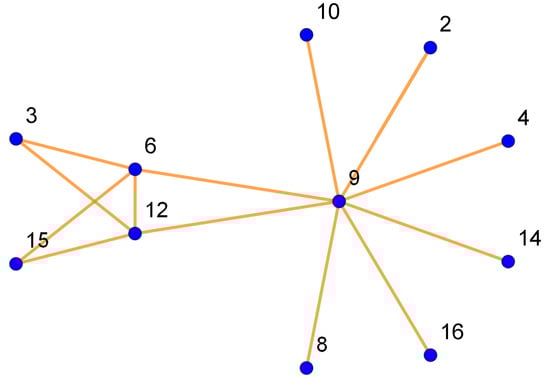
Figure 1.
The zero-divisor graph for .
The rest of the work is arranged as follows: In Section 2, some basic terminology related to topological indices are given to understand the proposed work. In Section 3 and Section 4, various topological indices over zero-divisor graphs and are discussed, respectively. Further, in these sections the behavior of investigated topological indices via numeric tables and three-dimensional discrete plotting are observed numerically and graphically. In Section 5, three kinds of entropies, i.e., first, second, and third redefined entropies, are founded over the families of zero-divisor graphs. In the last section, concluding remarks and further future works are discussed with detail.
2. Basic Terminology Related to Topological Indices and Entropies
In this section, we will discuss some well-known existing topological indices for various families of graphs [41,42,43,44,45,46,47,48,49] and M -polynomial [3,8], namely, first Zagreb , second Zagreb , second modified Zagreb , general Randics , inverse general Randics , third symmetric divisions , fifth symmetric divisions , harmonic , inverse sum , and forgotten topological index .
In chemical graph theory, the -polynomial is a topological index used to characterize the molecular structure of organic molecules. Researchers can acquire insights into the structural factors that determine the properties of molecules by analyzing the coefficients of different terms in the -polynomial. The -polynomial is defined as [3,8]
The relationship between -polynomial and topological indices are given in Table 1.

Table 1.
Relation between -polynomial and topological indices.
In 2013, Ranjini et al. introduced the first, second, and third redefined version of the Zagreb indices [50],
The concept of entropy was introduced by Chen et al. in 2014 [51], and is defined as
The remaining entropies were found in [52], which are defined as
- First redefined Zagreb entropy: ifThen
- Second redefined Zagreb entropy: ifThen
- Third redefined Zagreb entropy: ifThen
3. -Polynomial and Topological Indices for Zero-Divisor Graph
Let be a modular ring with unity and be the product of two modular rings. A non-zero element z of a modular ring is said to be a zero divisor if there exists another non-zero element y of such that the product of z and y will be zero under the modulo n. In other words, two non-zero elements will be zero divisors to each other if their product will be zero. Similarly, two non-zero elements , from will be zero, divisors to each other if the product of both will be zero such that under modulo . In this section, polynomial and topological indices for the zero-divisor graph with numerically and graphically behavior are discussed. The zero-divisor graph as shown in Figure 2.

Figure 2.
The zero-divisor graph .
Lemma 1.
Let be a zero-divisor graph over with distinct primes (), then M-polynomial is
Proof.
Let be a zero-divisor graph over with distinct primes (). The cardinality function of edge partition for is;
By Equation (6);
Substituting the value from (18) in above equation, we then have
This one is a desired relation (17). □
Theorem 1.
Let be a zero-divisor graph over with distinct primes (); then
Proof.
Let be a zero-divisor graph over with distinct primes (). First, we will find the following terms: , , , , and by using the -polynomial from Equation (17). Let ; then
By adding Equations (24) and (25), then substituting .
By substituting in Equation (26);
By substituting in Equation (29);
By substituting in Equation (27);
By substituting in Equation (30);
□
The numerical and graphical comparisons of , , , , and over zero-divisor graphs are given in Table 2 and Figure 3, respectively.
Table 2.
Numerical comparison between topological indices, namely, , , , , and over zero-divisor graphs .
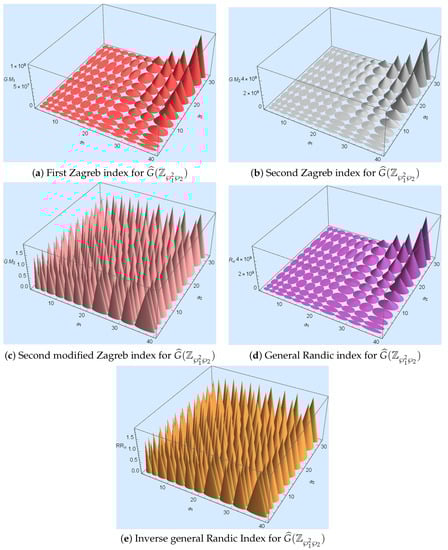
Figure 3.
The three-dimensional discrete plot of first Zagreb, second Zagreb, second modified Zagreb, general Randic, and Inverse general Randic index for .
Theorem 2.
Let be a zero-divisor graph over with distinct primes (); then
Proof.
Let be a zero-divisor graph over with distinct primes (). By adding (24) and (25);
By substituting in Equation (43) the third symmetric division index becomes;
After some more simplification, we have
By applying on Equation (28);
Similarly;
By substituting in Equation (48) the fifth symmetric division index becomes;
After some more simplification, we have the desired result.
For the harmonic index, we will first find the value of J;
Applying on (50), we have
The harmonic index is,
Applying on (53), we have
The inverse sum index is,
By adding Equations (55) and (56).
The forgotten topological index is,
□
The numerical and graphical comparisons of , , , , , and over zero-divisor graphs are given in Table 3 and Figure 4, respectively.
Table 3.
Numerical comparison between topological indices, namely, , , , , and over zero-divisor graphs .

Figure 4.
The three-dimensional discrete plot of third symmetric division, fifth symmetric division, harmonic, inverse sum and forgotten topological index for .
4. -Polynomial and Topological Indices for Zero-Divisor Graph
In this section, polynomial and topological indices for zero-divisor graph with numerically and graphically behavior are discussed. The zero-divisor graph as shown in Figure 5.
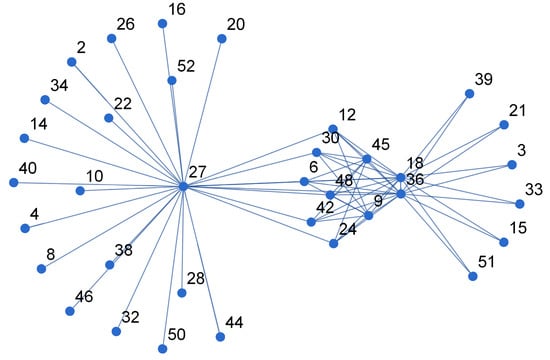
Figure 5.
The zero-divisor graph .
Lemma 2.
Let be a zero-divisor graph over with distinct primes (), then M-polynomial is
Proof.
Let be a zero-divisor graph over with distinct primes (). The cardinality function of edge partition for is;
By using Equation (6),
Using the data from Equation (60), we have
This one is a desired relation (59). □
Theorem 3.
Let be a zero-divisor graph over with distinct primes (), then
Theorem 4.
Let be a zero-divisor graph over with distinct primes (), then
The numerically and graphically comparison of , , , and over zero-divisor graphs is given in Table 4 and Figure 6, respectively.
Table 4.
Numerically comparison between topological indices namely , , , and over zero-divisor graphs .

Figure 6.
Three-dimensional discrete plot of third symmetric division, fifth symmetric division, harmonic, inverse sum, and forgotten topological index for .
5. Entropies for the Zero-Divisor Graphs
In this section, three kind of entropies—namely the first, second, and third redefined Zagreb entropies—are founded over zero-divisor graphs .
Lemma 3.
Let be a zero-divisor graph over with distinct primes (); then
Proof.
□
Theorem 5.
Let be a zero-divisor graph over with distinct primes (); then
6. Conclusions
The mathematical framework used to analyze graphs and their characteristics using algebraic structures and techniques is known as algebraic graph theory. It enables researchers to conduct more systematic and rigorous graph analysis, allowing them to discover correlations between graph attributes and comprehend how different symmetries and structural aspects of molecules and crystals impact their behavior. Entropy is a notion adopted from information theory and statistical mechanics in graph theory. It quantifies the degree of uncertainty or unpredictability associated with a graph or a particular attribute of a graph. We have investigated several topological indices, namely first Zagreb, second Zagreb, second modified Zagreb, general Randic, inverse general Randic, third symmetric division, fifth symmetric division, harmonic, inverse sum, and forgotten topological by means of -polynomial for certain families.
Further, different kinds of entropies such as the first, second, and third redefined Zagreb are investigated over proposed families of graphs. In future work, if anyone can generalize this study for each zero-divisor graph, then this result is very interesting for researchers working in the area of algebraic graph theory.
Author Contributions
The material is the result of the joint efforts of A.S.A., S.A., N.H., A.M.M., Y.S. and A.A. All authors have read and agreed to the published version of the manuscript.
Funding
This article is supported by Princess Nourah bint Abdulrahman University Researchers Supporting Project number (PNURSP2023R231), Princess Nourah bint Abdulrahman University, Riyadh, Saudi Arabia.
Data Availability Statement
No data were used to support this study.
Acknowledgments
The authors extend their appreciation to Princess Nourah bint Abdulrahman University for funding this research under Researchers Supporting Project number (PNURSP2023R231), Princess Nourah bint Abdulrahman University, Riyadh, Saudi Arabia.
Conflicts of Interest
The authors declare no conflict of interest.
References
- Zahid, M.A.; Naeem, M.; Baig, A.Q.; Ggao, W. General fifth M-Zagreb indices and fifth M-Zagreb polynomials of crystal cubic carbon. Util. Math. 2018, 109, 929. [Google Scholar]
- Cotton, F.A.; Wilkinson, G.; Murillo, C.A.; Bochmann, M. Advanced Inorganic Chemistry; John Wiley and Sons Inc.: Hoboken, NJ, USA, 1999. [Google Scholar]
- Deng, H.; Yang, J.; Xia, F. A general modeling of some vertex-degree based topological indices in benzenoid systems and phenylenes. Comput. Math. Appl. 2011, 61, 3017–3023. [Google Scholar] [CrossRef]
- Gao, W.; Wang, Y.; Basavanagoud, B.; Jamil, M.K. Characteristics studies of molecular structures in drugs. Saudi Pharm. J. 2017, 25, 580–586. [Google Scholar] [CrossRef] [PubMed]
- Gayathri, P.; Priyanka, U.; Priyanka, U. Degree based topological indices of zig zag chain. J. Math. Inform. 2017, 11, 83–93. [Google Scholar] [CrossRef]
- Gutman, I. Some properties of the Wiener polynomial. Graph Theory Notes N. Y. 1993, 125, 13–18. [Google Scholar]
- Kier, L.B.; Hall, L.H. Molecular Connectivity in Structure-Activity Analysis; John Wiley and Sons: New York, NY, USA, 1986. [Google Scholar]
- Li, X.; Shi, Y. A survey on the Randic index. MATCH Commun. Math. Comput. Chem. 2008, 59, 127–156. [Google Scholar]
- Alaeiyan, M.; Natarajan, C.; Sathiamoorthy, G.; Farahani, M.R. The eccentric connectivity index of polycyclic aromatic hydrocarbons (PAHs). Eurasian Chem. Commun. 2020, 2, 646–651. [Google Scholar] [CrossRef]
- Khalaf, A.; Jalil, M.; Hussain, S.; Afzal, D.; Afzal, F.; Maqbool, A. M-polynomial and topological indices of book graph. J. Discret. Math. Sci. Cryptogr. 2020, 23, 1217–1237. [Google Scholar] [CrossRef]
- Cancan, M.; Ediz, S.; Farahani, M.R. On ve-degree atom-bond connectivity, sum-connectivity, geometric-arithmetic and harmonic indices of copper oxide. Eurasian Chem. Commun. 2020, 2, 641–645. [Google Scholar] [CrossRef]
- Imran, M.S.A.; Bokhary, U.H.; Manzoor, S.; Siddiqui, M.K. On molecular topological descriptors of certain families of nanostar dendrimers. Eurasian Chem. Commun. 2020, 2, 680–687. [Google Scholar] [CrossRef]
- Farahani, M.R. Some connectivity indices and Zagreb index of polyhex nanotubes. Acta Chim. Slov. 2012, 59, 779–783. [Google Scholar]
- Randic, M. Characterization of molecular branching. J. Am. Chem. Soc. 1975, 97, 6609–6615. [Google Scholar] [CrossRef]
- Zhou, B.; Gutman, I. Relations between Wiener, hyper-Wiener and Zagreb indices. Chem. Phys. Lett. 2004, 394, 93–95. [Google Scholar] [CrossRef]
- Ahmad, Z.; Naseem, M.; Naseem, M.; Jamil, M.K.; Nadeem, M.F.; Wang, S. Eccentric connectivity indices of titania nanotubes TiO2[m;n]. Eurasian Chem. Commun. 2020, 2, 712–721. [Google Scholar] [CrossRef]
- Ahmad, Z.; Naseem, M.; Naseem, M.; Jamil, M.K.; Siddiqui, M.K.; Nadeem, M.F. New results on eccentric connectivity indices of V-Phenylenic nanotube. Eurasian Chem. Commun. 2020, 2, 663–671. [Google Scholar] [CrossRef]
- Babujee, J.B.; Ramakrishnan, S. Topological indices and new graph structures. Appl. Math. Sci. 2012, 6, 5383–5401. [Google Scholar]
- Deutsch, E.; Klavar, S. M-polynomial and degree-based topological indices. Iran. J. Math. 2015, 6, 93102. [Google Scholar]
- Dobrynin, A.A.; Entringer, R.; Gutman, I. Wiener index of trees: Theory and applications. Acta Appl. Math. 2001, 66, 211–249. [Google Scholar] [CrossRef]
- Dimitrov, D. On structural properties of trees with minimal atom-bond connectivity index IV: Solving a conjecture about the pendent paths of length three. Appl. Math. Comput. 2017, 313, 418–430. [Google Scholar] [CrossRef]
- Chaudhry, F.; Shoukat, I.; Afzal, D.; Park, C.; Cancan, M.; Farahani, M.R. M-polynomials and degree-based topological indices of the molecule copper(I) oxide. J. Chem. 2021, 2021, 6679819. [Google Scholar] [CrossRef]
- Shannon, C.E. A mathematical theory of communication. Bell Syst. Tech. J. 1948, 27, 379–423. [Google Scholar] [CrossRef]
- Goldsmith, B.; Salce, L. Algebraic entropies for Abelian groups with applications to the structure of their endomorphism rings: A survey. In Groups, Modules, and Model Theory—Surveys and Recent Developments; Droste, M., Fuchs, L., Goldsmith, B., Strüngmann, L., Eds.; Springer: Cham, Switzerland, 2017; pp. 135–174. [Google Scholar] [CrossRef]
- Huang, W.; Zhang, Y.; Yu, Y.; Xu, Y.; Xu, M.; Zhang, R.; Dieu, G.J.D.; Yin, D.; Liu, Z. Historical data-driven risk assessment of railway dangerous goods transportation system: Comparisons between Entropy Weight Method and Scatter Degree Method. Reliab. Eng. Syst. Saf. 2021, 205, 107236. [Google Scholar] [CrossRef]
- Julietraja, K.; Venugopal, P.; Prabhu, S.; Arulmozhi, A.K.; Siddiqui, M.K. Structural analysis of three types of PAHs using entropy measures. Polycycl. Aromat. Compd. 2022, 42, 4101–4131. [Google Scholar] [CrossRef]
- Nie, C.-X.; Fu, S. Entropy of graphs in financial markets. Comput. Econ. 2021, 57, 1149–1166. [Google Scholar] [CrossRef]
- Das, K.C.; Ali, A. On a conjecture about the second Zagreb index. Discret. Math. Lett. 2019, 2, 38–43. [Google Scholar]
- Das, K.C.; Shang, Y. Some extremal graphs with respect to Sombor index. Mathematics 2021, 9, 1202. [Google Scholar] [CrossRef]
- Das, K.C.; Ghalavand, A.; Ashrafi, A.R. On a conjecture about the Sombor index of graphs. Symmetry 2021, 13, 1830. [Google Scholar] [CrossRef]
- Das, K.C.; Levik, A.S.; Cangul, I.N.; Shang, Y. On sombor index. Symmetry 2021, 13, 140. [Google Scholar] [CrossRef]
- Das, K.C.; Dehmer, M. A conjecture regarding the extremal values of graph entropy based on degree powers. Entropy 2016, 18, 183. [Google Scholar] [CrossRef]
- Mondal, S.; Das, K.C. Degree-Based Graph Entropy in Structure Property Modeling. Entropy 2023, 25, 1092. [Google Scholar] [CrossRef]
- Livingston, P.S. Structure in Zero-Divisor Graphs of Commutative Rings. Master’s Thesis, University of Tennessee, Knoxville, TN, USA, 1997. [Google Scholar]
- Mahmood, M.K.; Ali, S. A novel labeling algorithm on several classes of graphs. Punjab Univ. J. Math. 2017, 49, 23–35. [Google Scholar]
- Shahbaz, A.; Mahmood, K. New Numbers on Euler’s Totient Function with Applications. J. Math. Ext. 2019, 14, 61–83. [Google Scholar]
- Shahbaz, A.; Mahmood, M.K. A paradigmatic approach to investigate restricted totient graphs and their indices. Comput. Sci. 2021, 16, 793–801. [Google Scholar]
- Shahbaz, A.; Mahmood, M.K.; Shum, K.P. Novel classes of integers and their applications in graph labeling. Hacettepe J. Math. Stat. 2021, 5, 1–17. [Google Scholar]
- Shahbaz, A.; Mahmmod, M.K.; Ganfornina, R.M.F. A paradigmatic approach to investigate restricted hyper totient graphs. AIMS Math. 2021, 6, 3761–3771. [Google Scholar]
- Mahmood, M.K.; Ali, S. On super totient numbers, with applications and algorithms to graph labeling. Ars Comb. 2019, 143, 29–37. [Google Scholar]
- Brockler, F.M.; Doglic, T.; Graovac, A.; Gutman, I. On a class of distance-based molecular structure descriptors. Chem. Phys. Lett. 2011, 503, 336–338. [Google Scholar] [CrossRef]
- Ekimov, E.A.; Sidorov, V.A.; Bauer, E.D.; Mel’Nik, N.N.; Curro, N.J.; Thompson, J.D.; Stishov, S.M. Superconductivity in diamond. Nature 2004, 428, 542–545. [Google Scholar] [CrossRef]
- Afzal, F.; Hussain, S.; Afzal, D.; Razaq, S. Some new degree based topological indices via M-polynomial. J. Inf. Optim. Sci. 2020, 41, 1061–1076. [Google Scholar] [CrossRef]
- Gao, W.; Iqbal, Z.; Ishaq, M.; Sarfraz, R.; Aamir, M.; Aslam, A. On eccentricity-based topological indices study of a class of porphyrin-cored dendrimers. Biomolecules 2018, 8, 71. [Google Scholar] [CrossRef]
- Gao, W.; Wu, H.; Siddiqui, M.K.; Baig, A.Q. Study of biological networks using graph theory. Saudi J. Biol. Sci. 2018, 25, 1212–1219. [Google Scholar] [CrossRef] [PubMed]
- Hu, Y.; Li, X.; Shi, Y.; Xu, T.; Gutman, I. On molecular graphs with smallest and greatest zeroth-order general Randic index. MATCH Commun. Math. Comput. Chem. 2005, 54, 425–434. [Google Scholar]
- Yang, H.; Zhang, X. The independent domination numbers of strong product of two cycles. J. Discret. Math. Sci. Cryptogr. 2018, 21, 1495–1507. [Google Scholar] [CrossRef]
- Ivanciuc, O. Chemical graphs, molecular matrices and topological indices in chemoinformatics and quantitative structure-activity relationships. Curr.-Comput.-Aided Drug Des. 2013, 9, 153–163. [Google Scholar] [CrossRef]
- Kang, S.M.; Zahid, M.A.; Virk, A.U.R.; Nazeer, W.; Gao, W. Calculating the degree-based topological indices of dendrimers. Open Chem. 2018, 16, 681–688. [Google Scholar] [CrossRef]
- Ranjini, P.S.; Lokesha, V.; Usha, A. Relation between phenylene and hexagonal squeeze using harmonic index. Int. J. Graph Theory 2013, 1, 116–121. [Google Scholar]
- Chen, Z.; Dehmer, M.; Shi, Y. A note on distance-based graph entropies. Entropy 2014, 16, 5416–5427. [Google Scholar] [CrossRef]
- Manzoor, S.; Siddiqui, M.K.; Ahmad, S. On entropy measures of molecular graphs using topological indices. Arab. J. Chem. 2020, 13, 6285–6298. [Google Scholar] [CrossRef]
Disclaimer/Publisher’s Note: The statements, opinions and data contained in all publications are solely those of the individual author(s) and contributor(s) and not of MDPI and/or the editor(s). MDPI and/or the editor(s) disclaim responsibility for any injury to people or property resulting from any ideas, methods, instructions or products referred to in the content. |
© 2023 by the authors. Licensee MDPI, Basel, Switzerland. This article is an open access article distributed under the terms and conditions of the Creative Commons Attribution (CC BY) license (https://creativecommons.org/licenses/by/4.0/).