1. Introduction
Quantum calculus (sometimes called
q-calculus) is known as the study of calculus with no limits. Note that
q-calculus can be reduced to ordinary calculus if we stipulate that limit
q tends to 1. It was first studied by the famous mathematician Euler (1707–1783). In 1910, F. H. Jackson [
1] determined the definite
q-integral known as the
q-Jackson integral. Quantum calculus has many applications in several mathematical areas such as combinatorics, number theory, orthogonal polynomials, basic hypergeometric functions, mechanics, quantum theory and theory of relativity; see, for instance, refs. [
2,
3,
4,
5,
6,
7] and the references therein. The book by V. Kac and P. Cheung [
8] covers the fundamental knowledge and basic theoretical concepts of quantum calculus.
In 2013, J. Tariboon and S. K. Ntouyas [
9,
10] defined the
-derivative and
-integral of a continuous function on finite intervals and proved some of its properties. In 2020, S. Bermudo, P. Korus and J. E. Napoles Valdes [
11] defined the
-derivative and
-integral of a continuous function on finite intervals. Many well-known integral inequalities such as Hölder, Hermite–Hadamard, trapezoid, Ostrowski, Cauchy–Bunyakovsky–Schwarz, Grüss and Grüss–Čebyšev inequalities have been studied in the concept of
q-calculus. Based on these results, there are many outcomes concerning
q-calculus.
The Hermite–Hadamard–Fejér integral inequality has been proven in [
12] as follows:
Theorem 1 ([12]). Let be a convex function. Thenwhere is integrable and symmetric about , i.e., . Recently, there have been many works about quantum integral inequalities, especially quantum Hermite–Hadamard–Fejér-type inequalities. Interested readers can see [
13,
14,
15,
16,
17,
18] and the references therein.
Let I be an interval in the real line . Consider for appropriate .
Definition 1. A function is called convex with respect to η (η-convex), iffor all and . In fact, the above definition geometrically says that if a function is
-convex on
I, then it is a graph between any
and is on or under the path starting from
and ending at
. If
should be the endpoint of the path for every
, then we have
and the function reduces to a convex one. Note that by taking
in (
2), we obtain
for any
and
, which implies that
for any
. Also, if we take
in (
2), we obtain
for any
There are simple examples about the -convexity of a function.
Example 1. - (i)
Consider a function defined as:and define a bifunction η as , for all It is not hard to check that f is an η-convex function but not a convex one. - (ii)
Define a function asand a bifunction as Then f is an η-convex function but is not convex.
In 2017, M. R. Delavar and M. De La Sen [
19] presented some generalizations of Fejér-type inequalities related to
-convex functions, which improve the right and left sides of (
1), respectively.
This paper generalizes and extends some well-known results for Hermite–Hadamard–Fejér integral inequality for -convex functions via quantum integrals. The results presented here would extend some of those in the existing literature.
2. Preliminaries
Now, we recall the following well-known basic concepts of quantum calculus on finite intervals, which are essential in proving our main results.
Let be an interval and be a constant. The - and -derivative of a function at a point is defined as follows:
Definition 2 ([11]). Let be a continuous function and let . Then the -derivative of f on at x is defined asIt is obvious that Analogously, the -derivative of f on at x is defined asIt is obvious that A function
f is
- and
-differentiable on
if
and
exist for all
. Also, if
in (
3) or if
in (
4), then
, where
is the
q-derivative of the function
f defined as
Let us elaborate on the above definitions with the help of examples.
Example 2. Let and . Then for , we haveNote that when , we have Moreover, for , we haveNote that when , we have J. Tariboon and S. K. Ntouyas [
9] defined the
-integral as follows:
Definition 3 ([9]). Let be a continuous function. Then the q-integral on is defined as:for . S. Bermudo, P. Korus and J. E. Napoles Valdes [
11] defined the
-integral as follows:
Definition 4 ([11]). Let be a continuous function. Then the q-integral on is defined as:for . If
in (
5) or
in (
6), then we have the classical
q-integral. Also, taking
and
in (
5), we obtain
Similarly, if
and
in (
6), then
Example 3. Let . Define a function by for ; we haveand For some other useful details regarding quantum calculus, interested readers are referred to [
8,
11].
The following simple lemma is required.
Lemma 1. Assume that . Then
- (i)
;
- (ii)
If , then .
Proof. Assertions (i) and (ii) are consequences of this fact
□
Lemma 2. Let be - and -integrable on and symmetric about . Then Proof. Since
g is symmetric, we obtain
Therefore,
□
3. Main Results
In this section, we obtain some new quantum analogues of Hermite–Hadamard–Fejér-type inequalities for -convex functions, which improve the right and left sides of Hermite–Hadamard–Fejér-type inequalities.
Theorem 2. Let be a q-integrable on and an η-convex function with η bounded from above on . If is a q-integrable on , then the following inequalities hold:and Proof. Since
f is an
-convex function on
, we have
for all
.
We put
t instead of
in (
10) and then add that inequality with (
10); we obtain
Equivalently,
In (
11), we replace
a with
b; we obtain
From inequalities (
11), (
12) and using assertion (i) of Lemma 1, we have
Now, if in (
10) we put
a instead of
b and add that inequality with (
10), then
for all
, which is equivalent to
If we change
a with
b and
t with
in (
10), then add that inequality with (
10), we obtain
for all
.
Equivalently,
By multiplying inequality (
13) with
and then
-integrating with respect to
t over
, we obtain
That is,
which is inequality (
7).
Similarly, by multiplying inequality (
14) and (
15) with
and then
-integrating with respect to
t over
, we obtain
and
respectively.
Using direct computation and variable changing to obtain inequalities (
8) and (
9). □
From this theorem, we can state the following corollary.
Corollary 1. Let be a q-integrable on and η-convex function with η bounded from above on . If is a q-integrable on , then the following inequalities hold:and Proof. After multiplying inequalities (
13)–(
15) with
and then
-integrating with respect to
t over
, we use direct computation to obtain inequalities (
16)–(
18), respectively. □
Theorem 3. Let be a q-integrable on and η-convex function with η bounded from above on . If is a q-integrable on and symmetric about , then the following inequalities hold:and Proof. If the function
g is symmetric on
, then
and
By inequalities (
7) and (
9) in Theorem 2, we obtain the desired inequalities (
19) and (
20), respectively. □
From Corollary 1, Theorem 3 and Lemma 2, we can state the following corollary.
Corollary 2. Let be a q-integrable on and η-convex function with η bounded from above on . If is a q-integrable on and symmetric about , then the following inequalities hold:and Proof. If the function
g is symmetric on
, then
and
By inequalities (
16) and (
18) in Theorem 1, we obtain the desired inequalities (
21) and (
22), respectively. □
Remark 1. Inequalities (19)–(22) give a refinement for the right side of Theorem 1 in quantum integral inequalities. The following statements hold: - (i)
If , then Theorems 2 and 3 reduce to ([19], Theorem 2.1); - (ii)
If and , then we recapture the right side of Theorem 1.
Theorem 4. Let be a q-integrable on and η-convex function with η bounded from above on . If is a q-integrable on , then the following inequalities hold: Proof. Since we have
then by using the concept of
-convexity
for any
. Multiplying inequality (
24) with
and
-integrating over
t, we have
Using assertion (ii) of Lemma 1 implies that
Also from assertion (i) of Lemma 1
Now, we use direct computation to obtain (
23). □
From this theorem, we can state the following corollary.
Corollary 3. Let be a q-integrable on and η-convex function with η bounded from above on . If is a q-integrable on , then the following inequalities hold: Proof. After multiplying inequality (
24) with
and then
-integrating with respect to
t over
, we use direct computation to obtain inequality (
25). □
Theorem 5. Let be a q-integrable on and η-convex function with η bounded from above on . If is a q-integrable and symmetric on , then the following inequalities hold: Proof. Assume that
g is symmetric on
; it is clear that
and
We applied these relations to Theorem 4; we completed the proof. □
Remark 2. Inequality (26) gives a refinement for the left side of Theorem 1 in quantum integral inequalities. The following statements hold: - (i)
If , then Theorems 4 and 5 reduce to ([19], Theorem 2.3); - (ii)
If and , then we recapture the left side of Theorem 1.
4. Example
In this section, we give some examples to demonstrate our main results.
Example 4. Define functions by and by . Consider a bifunction as Then f is an η-convex function.
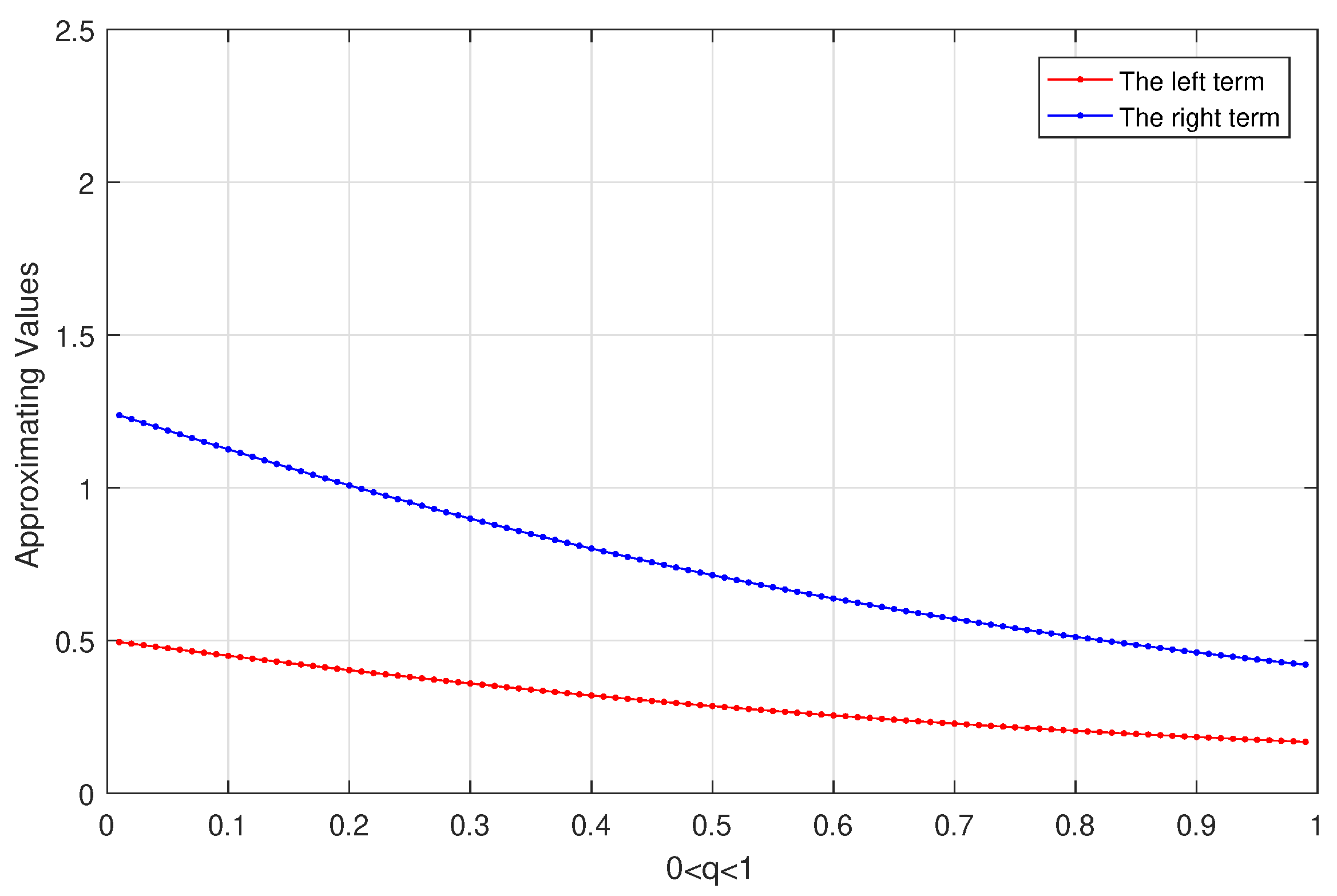
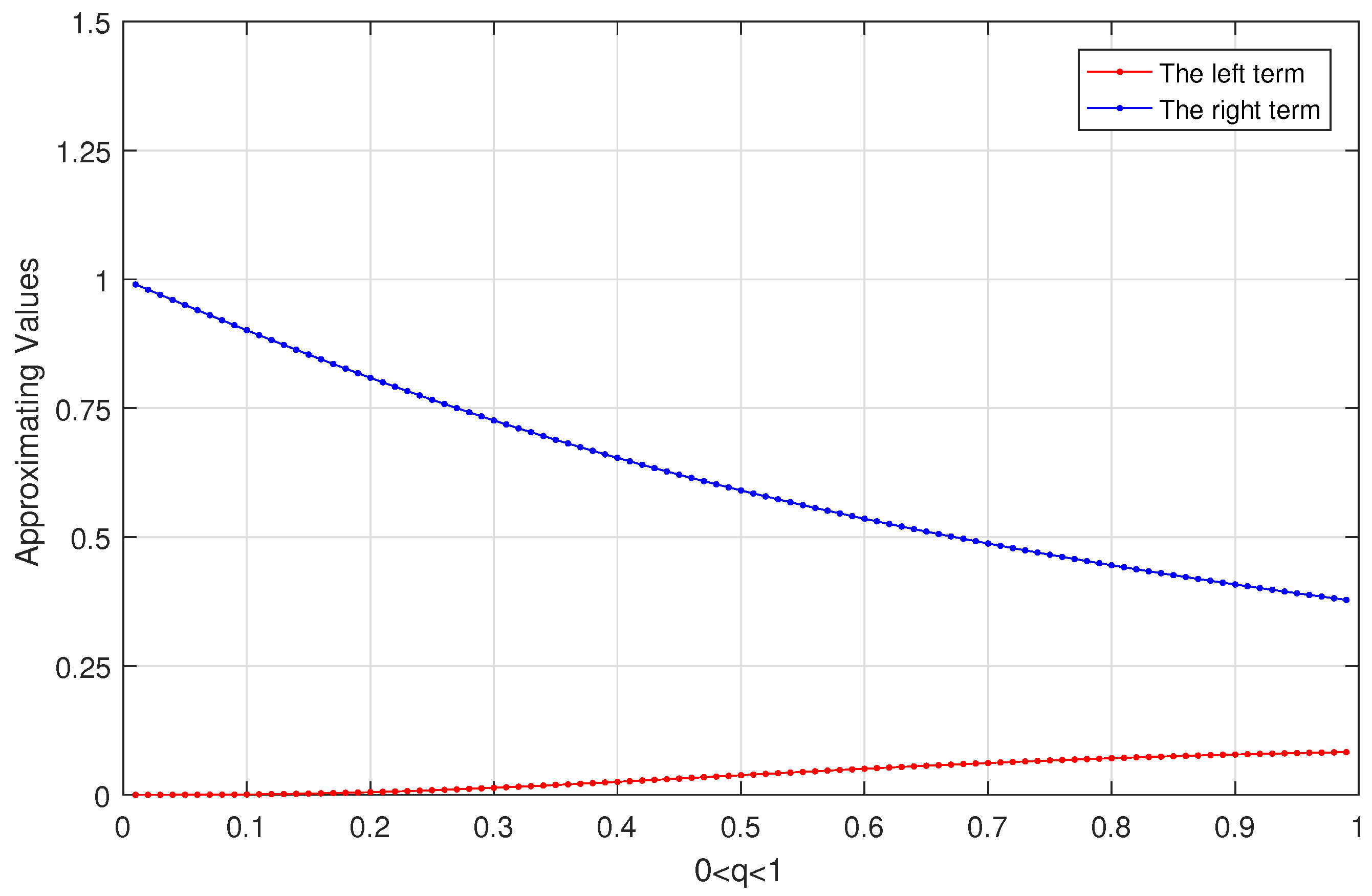
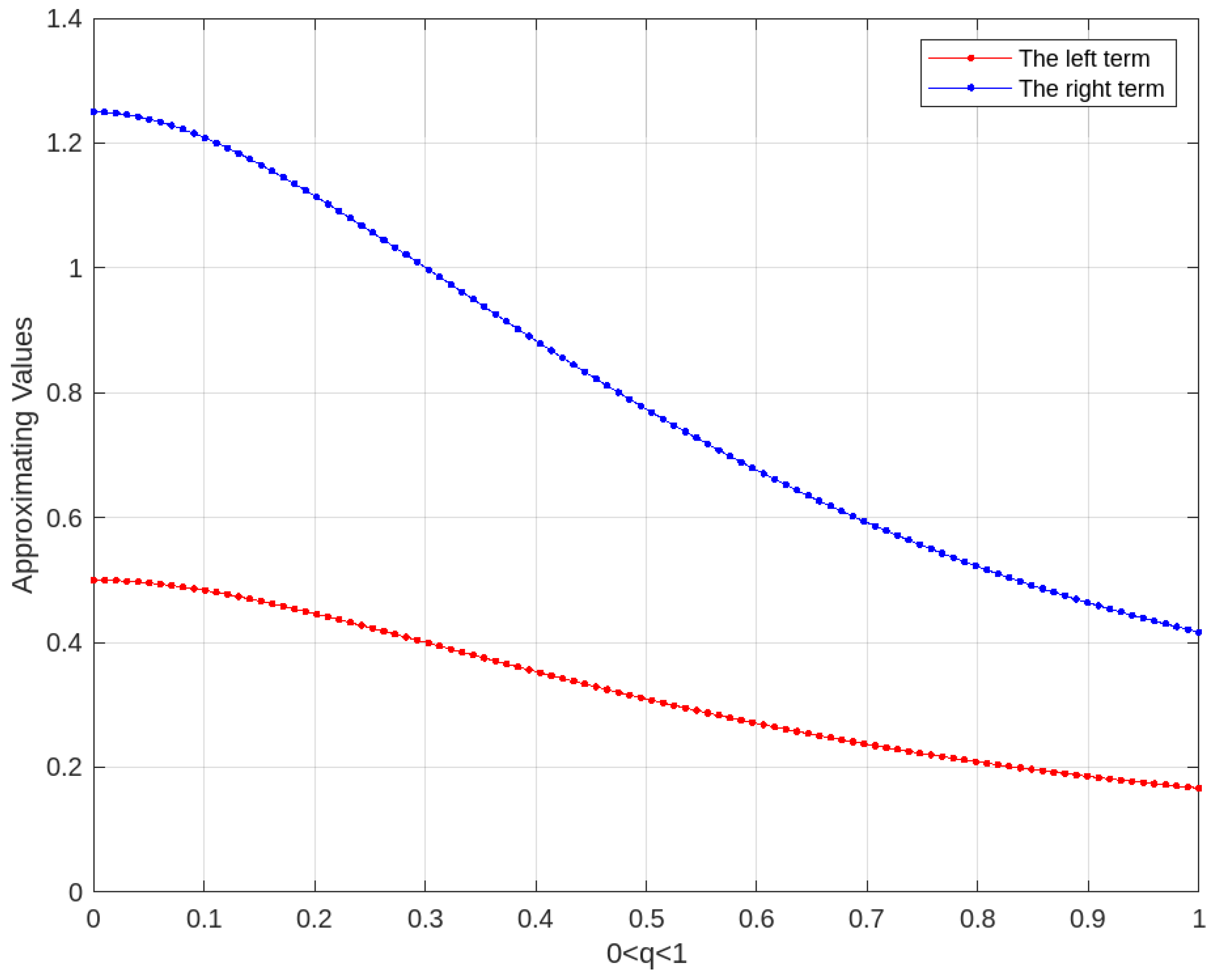
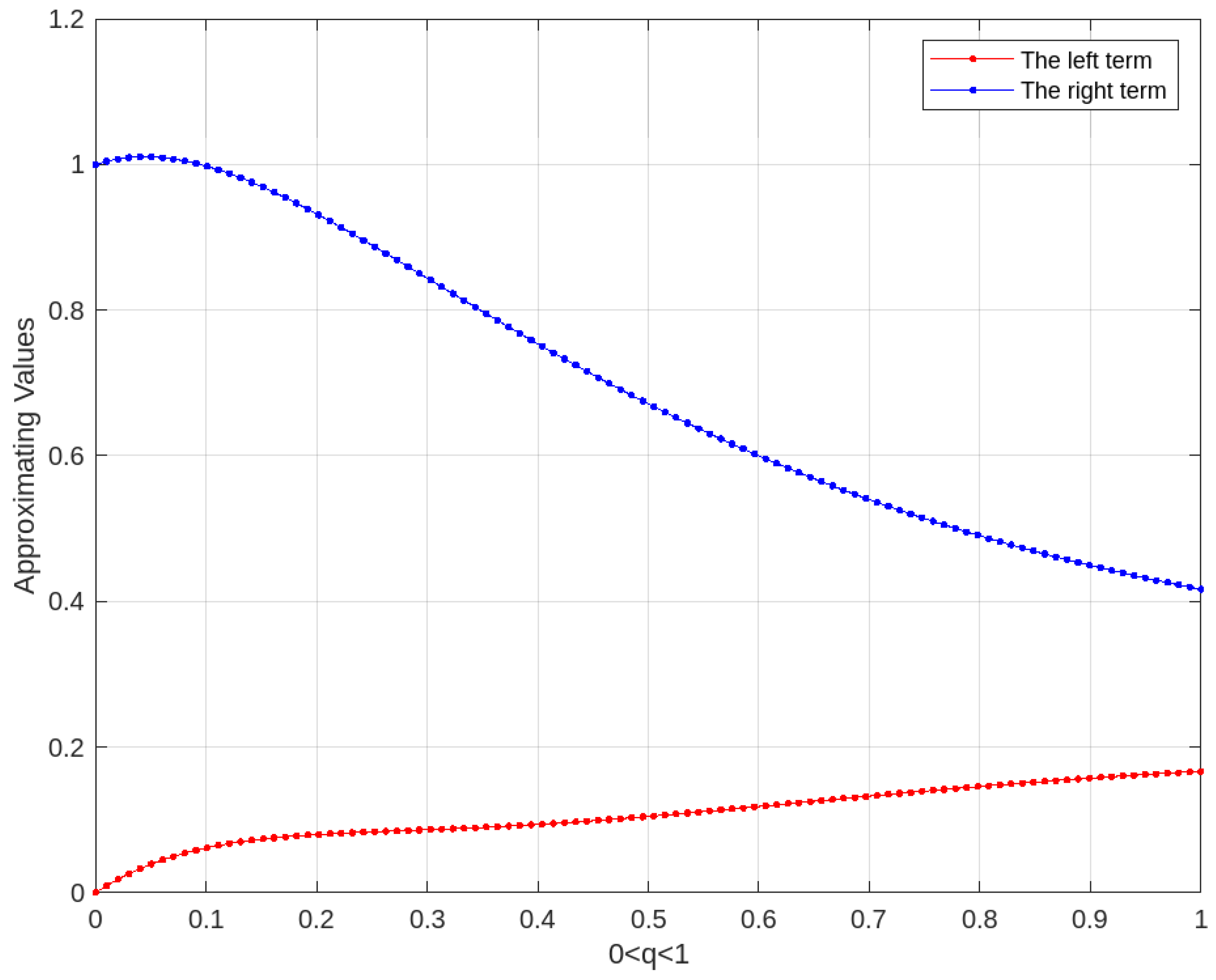
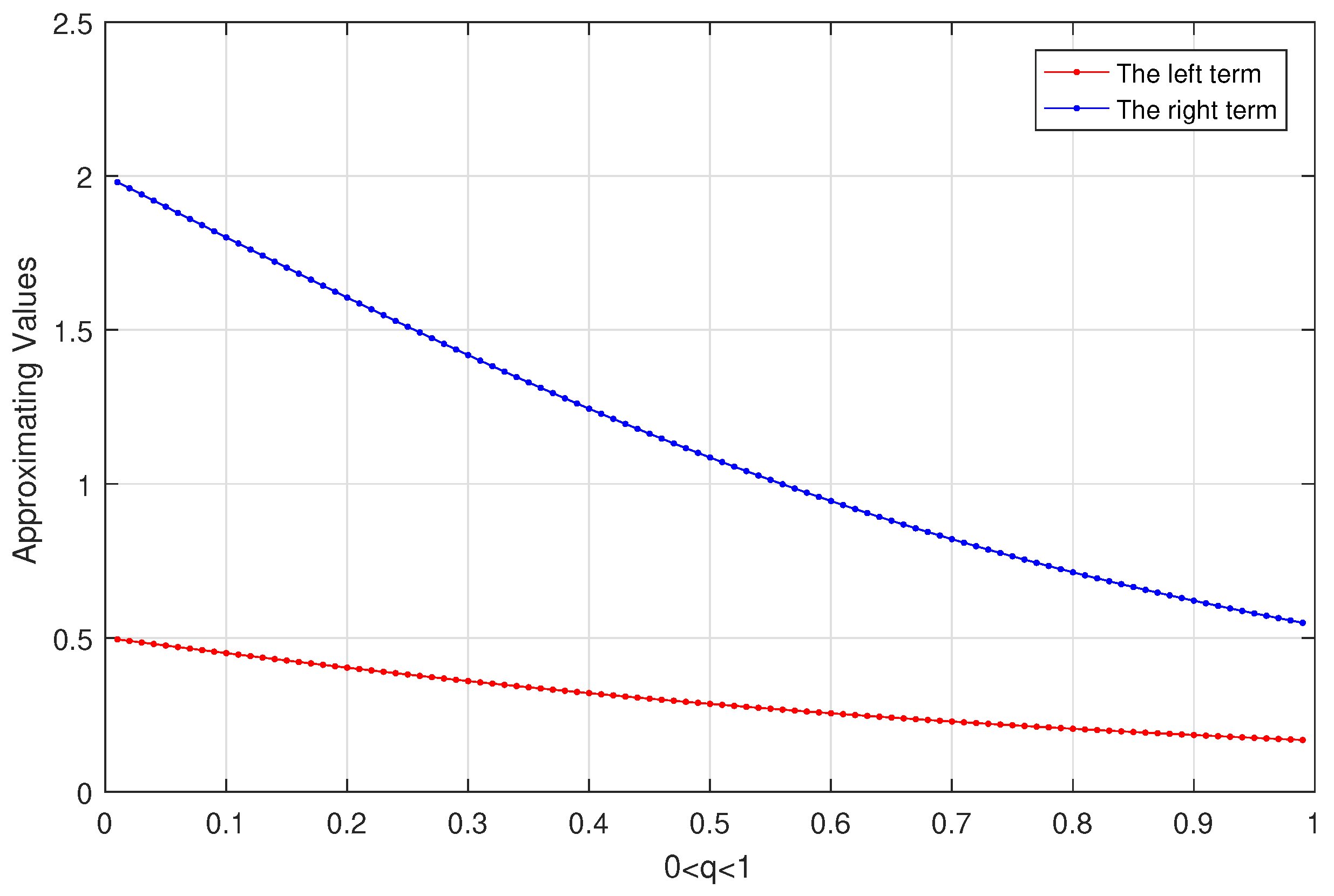
From Theorem 2, the left side of inequalities (7) and (8) become The right side of inequality (7) becomesand the right side of the inequality (8) becomesWe use Matlab software to calculate the left term and right term, as shown in Figure 1 and Figure 2, which demonstrates the results described in inequalities (7) and (8) of Theorem 2. From Theorem 2, the left side of inequality (9) becomesand the right side of inequality (9) becomesWe use Matlab software to calculate the left term and right term, as shown in Figure 3, which demonstrates the results described in inequality (9) of Theorem 2. Example 5. Define functions by and by . Consider a bifunction asThen f is an η-convex function and g is symmetric about . From Theorem 3, the left side of inequalities (19) becomesand the right side of inequality (19) becomesWe use Matlab software to calculate the left term and right term, as shown in Figure 4, which demonstrates the results described in inequality (19) of Theorem 3. From Theorem 3, the left side of inequalities (20) becomesand the right side of inequality (20) becomesWe use Matlab software to calculate the left term and right term, as shown in Figure 5, which demonstrates the result described in inequality (20) of Theorem 3. 5. Conclusions
The convexity of a function is a basis for many inequalities in mathematics. It should be noted that in new problems related to convexity, a general idea of the convex function is required to obtain relevant results. One of these overviews is the concept of the -convex function, which can be summarized by many inequalities associated with convex functions, especially the famous Fejér inequality, by evaluating the difference between the left and middle terms and between the right and middle terms of this inequality. Moreover, we derived some new quantum analogues of Hermite–Hadamard–Fejér-type inequalities for -convex functions. It is expected that this paper may stimulate further research in this field.
Author Contributions
Conceptualization, K.N. and H.B.; investigation, N.A., K.N. and H.B.; formal analysis, N.A., K.N. and H.B.; funding acquisition, K.N.; software, N.A. and K.N.; validation, N.A., K.N. and H.B.; visualization, K.N. and H.B.; writing—original draft, N.A. and K.N.; writing—review and editing, K.N. All authors have read and agreed to the published version of the manuscript.
Funding
This work has received scholarship under the Post-Doctoral Training Program from Khon Kaen University, Thailand (Grant no. PD2565-02-05).
Data Availability Statement
Not applicable.
Conflicts of Interest
The authors declare no conflict of interest.
References
- Jackson, F.H. On a q-definite integrals. Quart. J. Pure. Appl. Math. 1910, 41, 193–203. [Google Scholar]
- Jackson, F.H. q-difference equations. Am. J. Math. 1910, 32, 305–314. [Google Scholar] [CrossRef]
- Bangerezaka, G. Variational q-calculus. J. Math. Anal. Appl. 2004, 289, 650–665. [Google Scholar] [CrossRef]
- Annyby, H.M.; Mansour, S.K. q-Fractional Calculus and Equations; Springer: Helidelberg, Germany, 2012. [Google Scholar]
- Ernst, T. A Comprehensive Treatment of q-Calculus; Springer: Basel, Switzerland, 2012. [Google Scholar]
- Ernst, T. A History of q-Calculus and a New Method; UUDM Report; Uppsala University: Uppsala, Sweden, 2000. [Google Scholar]
- Gauchman, H. Integral inequalities in q-calculus. J. Comput. Appl. Math. 2002, 47, 281–300. [Google Scholar] [CrossRef]
- Kac, V.; Cheung, P. Quantum Calculus; Springer: New York, NY, USA, 2002. [Google Scholar]
- Tariboon, J.; Ntouyas, S.K. Quantum calculus on finite intervals and applications to impulsive difference equations. Adv. Differ. Equ. 2013, 2013, 282. [Google Scholar] [CrossRef]
- Tariboon, J.; Ntouyas, S.K. Quantum integral inequalities on finite intervals. J. Inequal. Appl. 2014, 2014, 121. [Google Scholar] [CrossRef]
- Bermudo, S.; Korus, P.; Napoles Valdes, J.E. On q-Hermite–Hadamard inequalities for general convex functions. Acta Math. Hungar. 2020, 162, 364–374. [Google Scholar] [CrossRef]
- Fejér, L. Über die fourierreihen. Math. Naturwiss. Anz Ungar. Akad. Wiss. 1906, 24, 369–390. [Google Scholar]
- Chen, F.; Wu, S. Fejér and Hermite–Hadamard type inequalities for harmonically convex functions. J. Appl. Math. 2014, 2014, 386806. [Google Scholar] [CrossRef]
- Huy, V.N.; Chung, N.T. Some generalizations of the Fejér and Hermite–Hadamard inequalities in Holder spaces. J. Appl. Math. Inform. 2011, 29, 859–868. [Google Scholar]
- Sarikaya, M.Z. On new Hermite Hadamard Fejér type integral inequalities. Stud. Univ. Babes-Bolyai Math. 2012, 57, 377–386. [Google Scholar]
- Arunrat, N.; Nakprasit, K.M.; Nonlaopon, K.; Tariboon, J.; Ntouyas, S.K. On Fejér-type inequalities via (p,q)-calculus. Symmetry 2021, 13, 953. [Google Scholar] [CrossRef]
- Mehmood, S.; Mehmood, H.M.; Mohammed, P.O.; Mohammed, E.A.; Zafar, F.; Nonlaopon, K. Fejér-type midpoint and trapezoidal inequalities for the operator ω1,ω2-preinvex functions. Axioms 2023, 12, 16. [Google Scholar] [CrossRef]
- Latif, M.A. Some companions of Fejér-type inequalities using GA-convex functions. Mathematics 2023, 11, 392. [Google Scholar] [CrossRef]
- Delavar, M.R.; De La Sen, M. On generalization of Fejér-type inequalities. Commun. Math. Appl. 2017, 8, 31–43. [Google Scholar]
| Disclaimer/Publisher’s Note: The statements, opinions and data contained in all publications are solely those of the individual author(s) and contributor(s) and not of MDPI and/or the editor(s). MDPI and/or the editor(s) disclaim responsibility for any injury to people or property resulting from any ideas, methods, instructions or products referred to in the content. |
© 2023 by the authors. Licensee MDPI, Basel, Switzerland. This article is an open access article distributed under the terms and conditions of the Creative Commons Attribution (CC BY) license (https://creativecommons.org/licenses/by/4.0/).