1. Introduction
A matrix
is referred to as a nonsingular
H-matrix [
1] if its comparison matrix
defined by
is a nonsingular
M-matrix. In other words,
.
H-matrices have significant applications in many fields, such as numerical analysis [
2], control theory [
3], mathematical programming [
4], parallel algorithms in computer science [
5], partial differential equations [
6] and so on. One intriguing problem is to determine upper bounds for the infinity norm of the inverse of H-matrices. This is because such bounds can be utilized to analyze the convergence of matrix splitting and matrix multi-splitting iterative methods for solving large-scale linear systems [
7] as well as linear complementarity problems [
4]. Moreover, due to the importance of the matrix condition number
, where
, estimating the infinity norm of the inverse matrices is a potential issue.
A traditional approach to finding upper bounds for the infinity norm of the inverse of nonsingular matrices involves utilizing the definition and properties of a given matrix class. For further details, please refer to [
8,
9,
10,
11,
12,
13]. This work has its origins in 1975 when Varah [
14] proposed a straightforward and refined upper bound for the infinity norm of the inverse of the strictly diagonally dominant (SDD) matrices class, which is one of the most vital subclasses of
H-matrices. A matrix
is defined as an SDD matrix if, for each
,
Theorem 1 ([
14,
15]).
If is an SDD matrix, then Bound (
1) is commonly referred to as Varah’s bound and is applicable only to SDD matrices. Consequently, many researchers have investigated the infinite norm bound for the inverse matrix of broader of
H-matrices. For example, Liu et al. [
16] obtained the following upper bound on doubly strictly diagonally dominant (DSDD) matrices, which extend SDD matrices on
H-matrices.
Theorem 2 ([
16]).
Let , , be a DSDD matrix. Then In addition, there are other types of matrices such as
S-strictly diagonally dominant (
S-SDD) matrices [
17,
18] and Nekrasov matrices [
8,
12], among others [
9,
19,
20].
Recently, a meaningful subclass of
H-matrices, called Dashnic–Zusmanovich-type (DZT) matrices, has been proposed by Zhao et al. [
21]. It is defined as follows:
Definition 1. A matrix is called a DZT matrix if, for any , the setis nonempty, where represents the sum of the absolute values of the off-diagonal elements in the i-th row of A corresponding to the set S, i.e.,when , we omit S for convenience. Later, Li et al. proposed the following infinite norm bound for the inverse matrix of DZT matrices.
Theorem 3 ([
10]).
Let be a DZT matrix. Then From an application standpoint, obtaining a tight upper bound for
is crucial. When the denominator of the upper bound given by (
4) is tiny, the upper bound obtained by Theorem 3 may be too large. Hence, it is of great theoretical and practical significance to explore a better bound on
with a DZT matrix
A.
It is well established that for any given
H-matrix
A, a positive diagonal matrix exists that can scale
A (by multiplying it from the right) into an SDD matrix. While Zhao et al. [
21] demonstrated that a DZT matrix is indeed an
H-matrix, they did not provide the corresponding scaling matrix. In this work, we derive the scaling matrix for DZT matrices to address this gap.
This paper presents a method for constructing scaling matrices for DZT matrices and uses their special structure to establish a sufficient condition for the Schur complement of a DZT matrix to be an SDD matrix. This, in turn, allows us to derive new upper bounds for the infinity norm of the inverse of a DZT matrix based on the Schur complement. The validity and superiority of the obtained bounds are illustrated by some numerical examples with random variables. Finally, we propose a lower bound for the smallest singular value using the proposed bound.
2. Schur Complement-Based Infinity Bounds for the Inverse of DZT
Matrices
Let us begin by reviewing the concept of the Schur complement. Given nonempty index sets
, we use
to represent the complement of
with respect to
N. The submatrix of
that lies in the rows indexed by
and the columns indexed by
is denoted by
. We use
as shorthand for
. If
is invertible, the Schur complement of
A with respect to
is denoted by
or simply
, and it is equal to
For a given nonempty subset
, there exists a permutation matrix
P such that
Since the inverse of a permutation is also a permutation matrix, the infinity norm of the inverse of a permutation matrix is equal to 1. Therefore, for a nonsingular matrix
A, we have
So we just need to focus on
. Let
be a given nonempty subset of
N; note that
hence
Then, combining Lemma 2 of [
11], the upper bound for
is measured by
where
Therefore, the problem is transformed into estimating the upper bounds of
,
,
and
. More generally, to simplify notation, the problem is transformed into estimating the upper bounds of
,
,
and
, where
can apply the results associated with
. Next, we will give the upper bounds for
and
, when
A is an SDD matrix. We need to use the following lemma.
Lemma 1 ([
1]).
Suppose is an H-matrix, then We are now ready to present upper bounds for and when A is an SDD matrix.
Lemma 2. Let , , be an SDD matrix, , . Thenwhere and . Proof. Since
A is an SDD matrix, by Lemma 1, we have
Let
and
, where
, then
. From (
2), we have
Considering the
i-th equation of the system of linear equations
, we obtain
which implies
Let
. Hence, by the following equation:
one immediately obtains:
While for
, similarly to the proof of Theorem 4.1 in [
16], we can easily obtain that
The proof is completed. □
Next, we will discuss for a DZT matrix A.
It is well known that for a given
H-matrix
A, there exists a positive diagonal matrix that scales
A (by multiplying it from the right) to produce an SDD matrix. Although Zhao et al. [
21] have proved that a DZT matrix must be an
H-matrix, they do not give the scaling matrix. Next, we will give the scaling matrix for a DZT matrix to complete this point. Moreover, our procedure for proving the conclusion that each DZT matrix is an
H-matrix is much simpler.
Given a matrix
, denote
where
is defined as (
3). If there is no confusion,
,
and
stand for
,
and
, respectively. Obviously,
. Let
denote the cardinality of
.
Theorem 4. If is a DZT matrix, then the matrix withis a positive diagonal matrix such that is an SDD matrix, where ε only needs to satisfyFurthermore, A is an H-matrix. Proof. It suffices to prove that is an SDD matrix. Note that for any .
Since
satisfies (
13), we have
Therefore, through calculation, we can obtain that
Hence, is an SDD matrix, so A is an H-matrix. □
Based on the scaling matrix of the DZT matrix obtained by Theorem 4, we give a result about the Schur complement of the DZT matrix.
Theorem 5. Suppose is a DZT matrix and α is a nonempty proper subset of N. If α satisfies , then is an SDD matrix. Denote and , then for Furthermore, Proof. For the DZT matrix
A, we can construct its scaling matrix
D according to Theorem 4, such that
is an SDD matrix. Observe that
Since
, then
. So, we obtain
. It is a well-established fact that the Schur complement of an SDD matrix is also an SDD matrix [
22]. Hence,
is an SDD matrix. By Theorem 1 of [
23], for
, we obtain
By the fact that
is an SDD matrix and (
1), it follows that
□
Next, by utilizing the relation between the original matrix and the Schur complement and Theorem 5, we obtain a new upper bound for as follows.
Theorem 6. Let be a DZT matrix with . Thenwhere . Proof. If
A is an SDD matrix, then
. This implies that
in (
16) can only be set
, and then
In this case, (
16) can be reduced to the bound (
2). The conclusion is valid.
Next, we discuss the case when A is not an SDD matrix.
From (
5), it follows that
where
Since
A is a DZT matrix and not an SDD matrix, then
is a nonempty proper subset of
N. Choose
to satisfy
, then
is an SDD matrix. By Theorem 2,
follows in virtue of (
1). By Theorem 5, we obtain that
By Lemma 2, we have
and
To sum up the above inequalities, the conclusion (
16) follows. □
In practice, is very easy to solve. In particular, by setting in Theorem 6, we obtain a result with greater applicability as follows.
Theorem 7. Let be a DZT matrix . Thenwhere . 3. Numerical Examples
In this section, we will show the validity and superiority of Theorem 7 through some examples.
Example 1. Consider the matrix from [10,21]: As shown in [
10], by Theorem 3, it follows that
. Obviously,
and
. If we apply Theorem 7, we obtain that
Let us now consider an example of a complex matrix.
Example 2. Consider the complex matrix:where i is the imaginary unit. Through calculation, we obtain that
,
,
,
,
,
,
and
. Thus,
A is a DZT matrix. By applying Theorem 3, it follows that
. However, if we apply Theorem 7, we obtain
In fact,
Therefore, Theorem 7 is more tighter than Theorem 3 in this example.
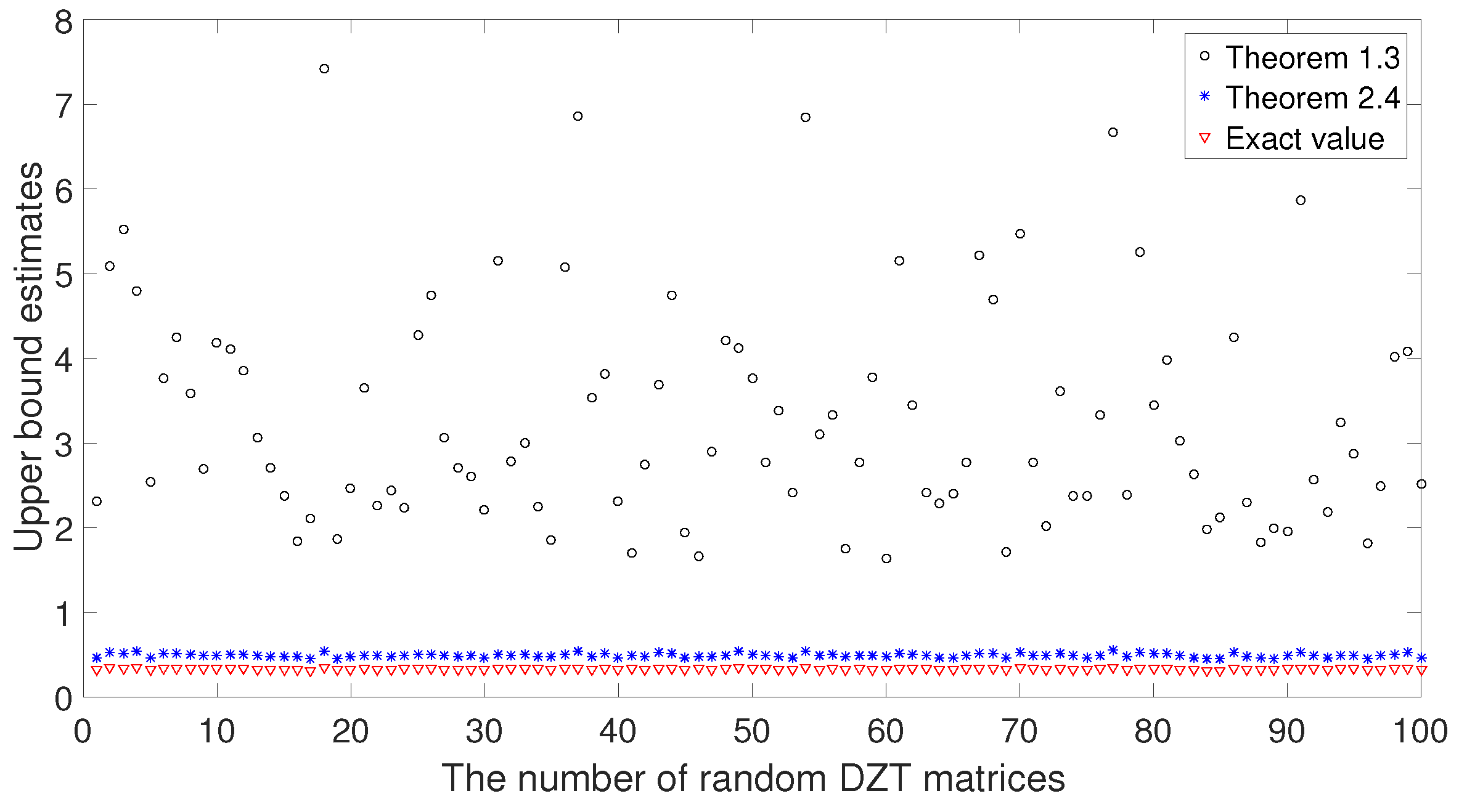
Example 3. Consider the first 100 DZT matrices generated by the following form:where independently obeys a uniform distribution from 0 to 1. We then compare the infinite norm bound between Theorems 3 and 7. As shown in
Figure 1, the infinite norm bound in Theorem 7 is better than that in Theorem 3.
To assess the stability of the upper bounds as the matrix dimension increases, we test the following example.
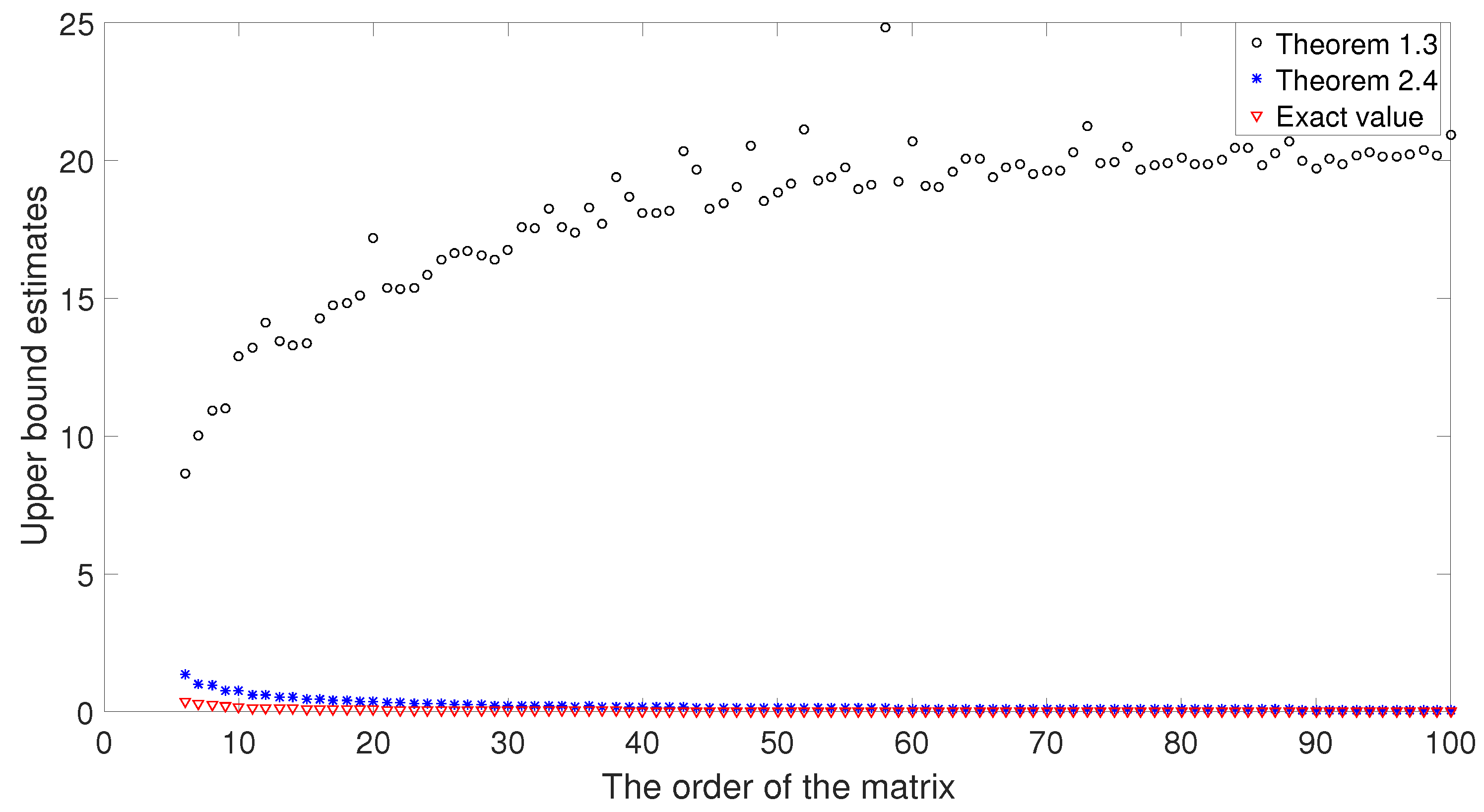
Example 4. Consider the following family of matrices of increasing order: where is the largest integer not exceeding , and all independently obey a uniform distribution from 0 to 1. As shown in
Figure 2, as
n increases, the upper bound given by Theorem 3 tends to increase, while the bound given by Theorem 7 decreases and approaches the exact value. The effectiveness and superiority of Theorem 7 are illustrated.
4. Applications to the Smallest Singular Value for DZT Matrix
The infinite norm bound of the inverse matrix can be used to bound the smallest singular value. The singular values of
A are denoted by
The smallest singular value represents important properties of matrices. For a square matrix, A indicates its nonsingularity and distance from singular matrices. Additionally, is a key component in the spectral condition number , which is crucial in assessing numerical calculations involving A. Thus, estimating the smallest singular value is meaningful.
Varah [
14] presented the following lower bound for
with an SDD matrix
A.
Theorem 8. If and its transpose are both SDD matrices, then In addition, many researchers obtained other results for the smallest singular value; see [
11,
13,
24] and references therein. Based on Theorem 7, a new lower bound for
is obtained.
Theorem 9. If and its transpose are both DZT matrices, thenwhere is defined as in Theorem 7. Proof. Since
is a DZT matrix, it follows from Theorem 7 that
By the following noted inequality [
24]:
we have
which implies that
From
, the conclusion follows. □
5. Discussion
The primary objective of this study is to obtain a tighter upper bound on the infinity norm of the inverse of DZT matrices. The numerical results are consistent with the expected results. The upper bound is obtained using a method based on Schur’s complement. In this process, we obtain a construction method for the positive diagonal matrix of a DZT matrix after right-multiplying by a positive diagonal matrix to become a strictly diagonal dominant matrix. This is rare and makes up for the shortcomings of existing research on DZT matrices. Furthermore, we provide a sufficient condition that the Schur complement of a DZT matrix is an SDD matrix (see Theorem 5), which includes the condition of Theorem 3.4 in Reference [
1]. Therefore, Theorem 5 can be regarded as an improvement of Theorem 3.4 in Reference [
25] to some extent. Although Reference [
1] discusses that DZT matrices are subclasses of a certain class of
H-matrices under two conditions, it is not perfect. The conclusions of this paper are expected to provide reference for further improving the closure of the Schur complement of DZT matrices. In fact, exploring the upper bound of the infinity norm of the inverse matrix not only helps to estimate the lower bound of the minimum singular value but also can be applied to linear complementarity problems and the pseudospectra localization of eigenvalues, which can be found in References [
10,
26,
27] and their corresponding references. This is also one of our future research works.