Abstract
This study proposes a two-stage MCDM model that combines Delphi and decision-making trial and evaluation laboratory methods based on spherical fuzzy sets (SF-Delphi and SF-DEMATEL) to analyze the motivation and demotivation factors affecting employee satisfaction in the Vietnamese logistics service industry. In the first stage, the SF-Delphi approach is used to gather expert opinions and develop consensus on the significance of criteria. In the second stage, the SF-DEMATEL technique explores causal linkages between the criteria and identifies root causes of the issues. Based on a comprehensive literature review and feedback from 40 experts, this study identified crucial factors affecting employee satisfaction related to both motivation and demotivation aspects. The findings of this study provide recommendations for managers to improve employee satisfaction, such as establishing clear and detailed wage and bonus rules, offering training courses, developing a positive work culture, recognizing employee efforts, and addressing poor treatment by supervisors and inadequate leadership support. Furthermore, the proposed model accurately identifies essential elements, represents uncertainty, adapts to various contexts, has resilience and accuracy, and has practical implications for mitigating demotivating factors and enhancing motivation, thereby positively influencing employee satisfaction in the logistics service industry.
Keywords:
motivation; demotivation; employee satisfaction; logistics service industry; spherical fuzzy sets; Delphi; DEMATEL; Vietnam MSC:
97M30; 91B02; 62P05; 91B84
1. Introduction
Logistics is a crucial aspect of commercial and economic systems, playing a significant role in the global economy. In Vietnam, the logistics industry is thriving and productive, with an average annual growth rate of 14–16% and a value of around USD 40–42 billion per year. Vietnam’s status as an emerging logistics market was confirmed by Agility’s 2022 ranking, which placed it as the 11th top market out of 50 [1]. Additionally, Vietnam’s logistics performance index (LPI) ranking by the World Bank in 2023 places it at 43rd out of 139 countries and fourth in the ASEAN region, following Singapore, Malaysia, and Thailand [2].
It is vital to approach the logistics industry with caution, diligence, and foresight due to its vast and varied activities worldwide. Challenges can arise depending on the job’s stage and type, such as meeting deadlines for document completion, complying with new import/export regulations, ensuring transportation compliance, meeting transparency requirements in goods production, and navigating time zones or cultural differences with agents [3]. Handling these complex and demanding challenges requires highly skilled individuals who can work under pressure. As such, human resource management (HRM) plays a critical role in understanding employee satisfaction, which significantly impacts the success of service sectors such as logistics [4].
To optimize productivity and engagement within a workforce, leaders and managers must understand the factors contributing to employee satisfaction. However, numerous previous studies [5,6,7,8] have shown that using quantitative analysis to study employee satisfaction can be challenging due to the intangible nature of employee motivation and demotivation [9]. Furthermore, quantitative analysis fails to account for the inherent uncertainty and imprecision of human behavior, leading to a limited ability to comprehend the complexity of employee satisfaction. Qualitative analysis, on the other hand, can provide more profound comprehension of the underlying factors that influence employee behavior, but it can be resource-intensive and struggles to quantify the interrelationships among various factors [10]. Consequently, a comprehensive research approach is necessary to identify and quantify the interrelationships among factors related to employee motivation and demotivation.
To address this problem, multiple criteria decision making (MCDM) presents a viable solution by developing and implementing decision-making models for issues that incorporate multiple criteria or decision attributes in situations where uncertainties and incomplete information exist. The features commonly utilized can be imprecise and capable of being represented as fuzzy information [11]. Fuzzy set theory, initially proposed by Zadeh [12], has received significant attention from researchers worldwide who have explored its theoretical and practical aspects. Researchers have extended general fuzzy sets since 1965, resulting in various extensions, such as type-2 fuzzy sets by Zadeh [13], intuitionistic fuzzy sets by Atanassov [14], neutrosophic sets by Smarandache [15], hesitant fuzzy sets by Torra [16], Pythagorean fuzzy sets by Yager [17], picture fuzzy sets by Cuong [18], and spherical fuzzy sets by Mahmood et al. [19] and Kahraman and Gündoğdu [20], which have gained popularity in the literature. Spherical fuzzy sets (SFSs) are the recent extension of fuzzy sets, allowing experts to express their indeterminacy, membership, and non-membership degrees as long as they are within the unit sphere, which is a notable feature that distinguishes SFSs from other fuzzy set models [4]. As a result, MCDM-model-based SFSs have been applied in various fields, such as international trade [21], vaccination [22], supply chain management [23], tourism and hospitality management [4], etc.
In the context of HRM problems, it is appropriate to employ an MCDM approach that utilizes SFSs to capture the uncertainty and ambiguity inherent in expert evaluations. Among the various MCDM models, the Delphi and decision-making trial and evaluation laboratory (DEMATEL) methods represent a balanced approach between quantitative and qualitative analysis, including subjective judgments and linguistic variables typically ignored by conventional research methods [24]. Notably, the Delphi method serves as a useful MCDM tool for verifying crucial factors before evaluating them. The DEMATEL model is better suited than the analytic hierarchy process (AHP) and analytic network process (ANP) models for exploring the interrelationships among the various factors. The DEMATEL model evaluates the interrelationships among factors, capturing both direct and indirect relationships, leading to a more comprehensive understanding of the factors influencing employee motivation and demotivation. Unlike previous studies reviewed in this literature, this study aims to better reflect the interrelationships between criteria that directly affect the decision-making process. Rather than treating criteria as independent concepts, this research proposes a two-stage, data-driven approach that combines SFS and MCDM models to comprehensively analyze and evaluate the significant factors that impact employee satisfaction in the Vietnamese logistics service industry from both motivational and demotivational perspectives.
The research questions guiding this study are as follows:
- (i)
- What are the critical factors that impact employee satisfaction from both motivation and demotivation perspectives in the logistics service industry in Vietnam?
- (ii)
- What is the nature of the interrelationships between these from both motivation and demotivation perspectives in the logistics service industry in Vietnam?
The following research goals are expected to be realized by this study:
- (i)
- Identify the critical factors that impact employee satisfaction from both motivation and demotivation perspectives in the logistics service industry in Vietnam.
- (ii)
- Quantify the interrelationships among these factors from both motivation and demotivation perspectives in the logistics service industry in Vietnam.
Remarkably, in contrast to prior studies such as [25,26,27,28], the proposed model, which comprises SF-Delphi and SF-DEMATEL, involves fully computing SFSs to detect and measure the interdependencies among the critical factors impacting employee satisfaction in the Vietnamese logistics service industry, thereby leveraging the strengths of both SFS and MCDM models.
The structure of this study is organized into several sections. Section 2 presents a comprehensive literature review covering related theories, employee motivation and demotivation perspectives, and previous research that applied MCDM models in HRM. Section 3 describes spherical fuzzy sets and the proposed method. Section 4 presents a case study from Vietnam, including the main results and discussion. Finally, conclusions, implications, and suggestions for further investigation are summarized in Section 5.
2. Literature Review
2.1. Theoretical Frameworks
Employee satisfaction is crucial to any organization’s success, and various theories have been proposed to understand it better.
Maslow’s hierarchy of needs theory [29] is often used in HRM research to understand employee behavior, which states that human needs can be organized into a hierarchy, starting with basic physiological needs, such as food, water, and shelter, and progressing to higher needs, such as safety, love and belonging, esteem, and self-actualization. Maslow suggests that employees are motivated by fulfilling these needs, and once a lower-level need is met, the employee is motivated by the next higher need [30]. Additionally, it can provide a valuable framework for understanding the different levels of needs that must be met to increase employee satisfaction and motivation. By including this theory in the theoretical framework, this study can provide a comprehensive understanding of the factors that impact employee satisfaction in the Vietnamese logistics service industry.
Herzberg’s two-factor theory [31] is another popular theory that explains the impact of hygiene and motivators on employee motivation and satisfaction. Hygiene factors are associated with the work environment, such as salary, working conditions, and company policies, and although they can prevent dissatisfaction, they do not necessarily motivate employees. On the other hand, motivators are linked to the nature of the work, such as job recognition, growth opportunities, and achievement, and can lead to satisfaction and motivation [32]. This theory is relevant to the present study as it emphasizes the importance of both environmental and intrinsic factors in influencing employee satisfaction. Additionally, equity theory [33] suggests that employees are motivated by the perceived fairness of their treatment in the workplace. Employees compare their inputs (effort, skills, experience) to their outputs (salary, recognition, promotion) with their peers. If they perceive inequity, they may become demotivated, leading to lower productivity and satisfaction [34]. This theory highlights the importance of fairness and the negative impact of perceived inequity on employee motivation and satisfaction.
Similarly, Victor Vroom’s expectancy theory [35] implies that employees are motivated by the expectation that their efforts will lead to desired outcomes. The theory proposes that employees make decisions based on their belief that their efforts will lead to good performance, which leads to rewards such as recognition, promotion, and pay raises. Thus, employees are more motivated when they perceive a clear relationship between their efforts, performance, and rewards [36]. Moreover, self-determination theory highlights that people are naturally motivated to pursue their goals and interests and that autonomy, competence, and relatedness are essential for intrinsic motivation. Autonomy refers to the need for control over one’s work and environment, competence refers to the need to feel competent and capable of achieving goals, and relatedness refers to the need for social connection and belongingness [37].
By integrating these theories into the theoretical framework, the study can thoroughly examine the factors that affect employee satisfaction, encompassing both motivational and demotivational aspects. The suggested approach can aid stakeholders in devising strategies and implementing practices that increase employee motivation while mitigating demotivation. This, in turn, can lead to improvements in HRM practices in the Vietnamese logistics service sector.
2.2. Employee Satisfaction, Motivation and Demotivation
Employee satisfaction refers to an employee’s level of contentment or fulfilment with their job and work environment [38]. It encompasses various aspects, such as job satisfaction, pay and benefits, opportunities for growth and development, recognition and appreciation, workplace relationships, and work-life balance. High employee satisfaction can increase motivation, productivity, and organizational commitment. It can also result in lower employee turnover rates and absenteeism, as satisfied employees are more likely to remain with their current employer. Employee satisfaction is essential for the success of any organization as it plays a significant role in attracting and retaining talented employees, maintaining a positive organizational culture, and ultimately achieving business objectives. Therefore, organizations must prioritize employee satisfaction and implement strategies to ensure employees feel valued and supported in their roles.
Employee motivation is the driving force that propels individuals to take action and make decisions to achieve their goals [39]. In the workplace, motivation is the willingness of employees to exert and maintain an effort towards reaching organizational goals. There are two types of motivation: intrinsic and extrinsic [40]. Extrinsic motivation includes external incentives, such as salary, promotions, benefits, and work environment, while intrinsic motivation includes the internal drive to use one’s talents, meet challenges, and receive recognition for accomplishments. High levels of employee motivation are linked with increased job satisfaction and engagement. The concept of motivation is complex and influenced by various factors, including working conditions, resource availability, infrastructure, supervision, training, and career advancement opportunities [40,41]. The interactions between employees and their workplaces affect the development of motivation, making it a psychological and transactional process [6,42].
Employee demotivation refers to the state of lowered motivation or even the absence of motivation among employees, which can negatively impact their job performance, health, and overall well-being [43]. It can be caused by poor leadership, lack of organizational support, unfulfilled needs and expectations, or a hostile work environment [44]. Demotivated employees experience frustration, disappointment, and low morale, leading to decreased productivity, absenteeism, and turnover [45]. Therefore, management must identify and address the causes of employee demotivation by implementing various policies and strategies to improve their job satisfaction, well-being, and engagement.
2.3. Motivation Categories
(A) Compensation and benefits: This dimension includes salary, bonuses, benefits, and perks. Intrinsically motivated employees (i.e., who genuinely enjoy their work) and those who are motivated by extrinsic rewards (i.e., pay and perks) both perform better for both themselves and their companies, with lesser burnout, fewer physical symptoms, and higher levels of commitment [46].
(B) Career growth and development: This dimension includes factors such as opportunities for advancement, training, and development. Employees who feel they have opportunities to grow and develop their skills may be more motivated and invested in their work. Opportunities for training are generally linked to greater motivation levels, are widely seen as motivators, and are favorably correlated with satisfaction [41,47,48]. According to workers’ employment intentions, the likelihood of receiving a promotion is a negative predictor of their intention to quit, indicating that extrinsic incentives also favorably affect their levels of commitment [49].
(C) Work environment and culture: This dimension includes workplace safety, cleanliness, and culture. Employees who work in a positive and supportive environment may be more motivated and engaged. The interactions between people and their work environment lead to motivation, which is a psychological and transactional process [6]. According to [50,51], workplace improvement can impact performance and behaviors by encouraging self-motivated actions and demoralizing ineffective personnel.
(D) Recognition and feedback: This dimension includes positive feedback, constructive criticism, and recognition for good performance. This is when someone is acknowledged for a job well done, feels appreciated for accomplishing or finishing a task, and is given the appropriate credit for it [8]. Employees who receive regular feedback and recognition for their work may be more motivated and engaged.
(E) Organizational support: This dimension includes organizational communication, organizational justice, organizational commitment, and employee retention strategies. When an organization supports employees, they may feel more inspired and committed [52].
(F) Management style: This dimension includes leadership, trust in management and purposeful work. The motivation of employees is directly impacted by management style [5]. People may feel more motivated when they work with appropriate leadership and trust the organization’s governance.
Reviewing previous research papers and referring to experts’ recommendations, our study proposes 38 factors divided into six dimensions. The names and meanings of the factors are presented in Table 1.
Table 1.
Employees’ motivation factors.
2.4. Demotivation Categories
Likewise, there are several broad categories into which the demotivating causes for workers in the logistic service industry can be divided. The following examples of dimensions are possible:
(G) Poor Management: This dimension includes factors such as lack of supervisor support, poor communication, and inadequate management. It is believed that three main organizational management theories have been supported [53,54,55,56]. These include the “distributive justice theory”, which emphasizes equity in resource distribution; the “procedural justice theory”, which emphasizes fairness in the procedures and decisions that lead to results; and the “interactional justice theory”, which emphasizes the fairness that employees experience at work when interacting with others. Employees under poor management may feel undervalued and unsupported, decreasing motivation and engagement. Particularly, inadequate leadership support affects employees’ perceptions regarding insufficient support from their leaders. It is related to the organization’s overall management and how leaders are perceived in their roles. Demotivation in a workplace can also result from people’s perceptions of organizational politics, in which people behave to further their interests at the expense of others or in opposition to organizational aims [57].
(H) Inadequate compensation and benefits: This dimension includes low pay, lack of benefits, and inadequate perks. The biggest issue causing employee demotivation is the issue of low pay and salaries [58]. Poor pay leads to discontent and a lack of motivation. Employees who feel they are not fairly compensated for their work may become demotivated and disengaged.
(I) Lack of career growth and development opportunities: This dimension includes limited opportunities for advancement, lack of training and development, and poor career paths [59]. The ability to advance one’s career inside an organization is provided by career development. A lack of professional development would make it difficult for logistics and supply chains to hold onto their critical human assets in a growing market where logistical knowledge is in short supply [60].
(J) Poor work environment and culture: This dimension includes workplace safety, cleanliness, job security, workload pressure, and culture. All organizations have traditions that shape their culture and affect employees’ behavior. Demotivating factors in this category include those specific to the organization, including organizational culture and ethics, leadership, and decision-making [43]. Furthermore, a lack of freedom can undermine control and ownership over one’s work. High workloads can positively or negatively impact creativity and performance at work. On the positive side, the intellectually demanding nature of a project can make up for excessive workloads. On the negative side, when employees are under too much pressure to complete their tasks, it can result in stress, mistakes, and a general drop in productivity [61]. On the other hand, inept leadership behavior can have a negative impact on employee satisfaction. It refers to the inappropriate behavior of leaders, such as disrespect, discrimination, or favoritism, which can create a hostile work environment and culture. This is similar to the way that poor physical surroundings can impact inspiration for creativity and depress morale if they are not viewed as attractive [62]. Employees who work in a harmful or toxic work environment may become demotivated and disengaged from their work.
(K) Lack of recognition and feedback: This dimension includes factors such as lack of feedback, criticism without guidance, and lack of recognition for good performance [63]. Employees will become demotivated in a workplace with a feedback system that only emphasizes the poor aspects of their job and does not praise the good or provide constructive criticism [64].
After evaluating prior research publications and consulting expert recommendations, our analysis suggests 21 factors broken down into the five dimensions mentioned earlier. Table 2 lists the names and definitions of the factors.
Table 2.
Employees’ demotivation factors.
2.5. MCDM Methods in HRM Sector
In recent years, MCDM methods have gained popularity in human resource management to achieve organizational sustainability. MCDM models are of value in HRM due to the complexity of the decision-making processes involved in managing employees, such as employee selection, promotion, training, performance evaluation, and compensation. By employing MCDM techniques, HR managers can make more informed and objective decisions, considering the various criteria and trade-offs involved. AHP has been applied in various HRM-related decision-making processes, such as recruitment and selection [65], performance evaluation [66] and employee retention [67].
Among commonly used MCDM models in HRM, the technique for order preference by similarity to ideal solution (TOPSIS) has been widely applied. For instance, Saeidi et al. [68] introduced a new approach that combines stepwise weight assessment ratio analysis (SWARA) and TOPSIS methods to prioritize factors and alternatives in sustainable HRM problems. Similarly, Lai et al. [69] applied MCDM methods to identify potential talents in a high-tech company’s sales and marketing team, while Stević et al. [70] used MCDM to evaluate and motivate drivers in an international transport company.
Regarding employee productivity and selection, Knežević et al. [71] integrated fuzzy sets and TOPSIS to analyze employee productivity in selected D-electrical power supply companies operating in Serbia. Thus, Safari et al. [72] ranked bank branches based on employee empowerment using fuzzy AHP and Vlse Kriterijumska Optimizacija Kompromisno Resenje (VIKOR) methods to determine the weights of the criteria and rank the branches based on eight indexes that have a significant impact on employee empowerment. These studies provide valuable insights into the practical application of MCDM methods in real-world employee productivity and selection scenarios.
To evaluate different aspects of HRM, Kalvakolanu et al. [73] applied a combination of Entropy, CRiteria Importance Through Inter-criteria Correlation (CRITIC), and TOPSIS methods to measure job satisfaction levels of airport employees through a shorter variant of the Minnesota Satisfaction Questionnaire (MSQ). Esangbedo et al. [66] used two new hybrid MCDM methods to evaluate human resource information systems provided by different vendors. Grey-PA-FUCOM combines the simple point-allocation method and the advanced FUCOM method. At the same time, the grey regime is an extension of the classical regime method based on grey system theory, while Malebye et al. [74] proposed an objective selection sequence for job candidates, which involves a quantitative/mathematical measure and two other independent measures to validate the decision taken. The approach combines statistics and operations research (StoR) methods, such as SAW, TOPSIS, and WP. SAW is used in the first-cut selection process, while TOPSIS and WP validate selections.
In summary, the existing literature has demonstrated the potential of MCDM methods to solve various HRM problems. MCDM methods offer a flexible and practical decision-making approach in complex situations where multiple criteria must be considered. Incorporating multiple criteria and decision-makers’ preferences can help organizations make informed and objective decisions, improve their productivity, and enhance their competitiveness in the marketplace. These studies illustrate the various applications and benefits of MCDM in HRM contexts, including sustainable HRM, talent identification, employee motivation, productivity analysis, recruitment, and supplier selection.
2.6. Research Gaps
Despite the growing popularity of MCDM methods in HRM contexts, there is a lack of research on the application of MCDM in analyzing motivation and demotivation factors impacting employee satisfaction in the logistics service sector, particularly in Vietnam. Therefore, there is a need for a comprehensive MCDM model that can identify and prioritize critical factors and how they affect employee satisfaction in the logistics service industry in Vietnam.
In addition, there is a gap in the literature on combining SFS and MCDM models in HRM contexts. Furthermore, established MCDM models have limitations in handling complex and multidimensional problems, such as employee satisfaction. In particular, pairwise comparisons among various factors can be time-consuming and prone to errors, and the assumption of independence among decision criteria is often not valid in real-world situations. Thus, it is necessary to investigate the efficacy of the spherical fuzzy decision-making approach in the field of HRM. To overcome these limitations, this study proposes a two-stage Delphi and DEMATEL method based on spherical fuzzy sets for analyzing the motivation and demotivation factors affecting employee satisfaction in the Vietnamese logistics service.
The proposed method can incorporate subjective judgments and linguistic variables often overlooked in traditional research methods, and it can capture both direct and indirect relationships among factors, providing a more comprehensive understanding of the factors influencing employee satisfaction. In the first stage, the SF-Delphi method is applied to identify the vital motivation and demotivation factors affecting employee satisfaction. The SF-Delphi method helps to remove unsuitable factors effectively and reach a consensus among experts, and the use of SFSs can handle uncertainty and imprecision in the experts’ judgments. In the second stage, the SF-DEMATEL method evaluates the interrelationships among the identified factors.
The proposed research can contribute to the existing literature by providing insights into the application of MCDM and SFSs in HRM contexts and its potential benefits for organizations in the Vietnamese logistics service industry context.
3. Methodology
3.1. Spherical Fuzzy Sets (SFSs)
According to Mahmood et al. [19] or Kahraman and Gündoğdu [20], when it comes to complex issues, individuals tend to convey their level of satisfaction, abstention, and dissatisfaction in different ways. In response to this, the concept of SFSs was developed, which includes the degree of membership α(x), the neutral-membership degree β(x), and the non-membership degree γ(x), ultimately providing a more comprehensive understanding of the situation. Spherical fuzzy linguistic scales are presented in Figure 1 and Table 3.
Figure 1.
Representations of SFSs [4].
Table 3.
Linguistic scales.
Definition 1.
Spherical fuzzy set of the universe is denoted as follows:
and
with , for each , and for hesitancy levels of to .
Definition 2.
Basic operations of SFS are presented as follows. Let and
be two SFSs.
Union operation
Intersection operation
Addition operation
Multiplication operation
Multiplication by
scalar;
Power of
Definition 3.
For these SFSs
and
, the following are valid under the condition :
Definition 4.
Spherical weighted arithmetic mean (SWAM) concerning ;
;
, SWAM is defined as follows:
Definition 5.
Spherical weighted geometric mean (SWGM) concerning ;
;
, SWGM is defined as follows:
3.2. Proposed Model of SF-Delphi and SF-DEMATEL
3.2.1. Research Process
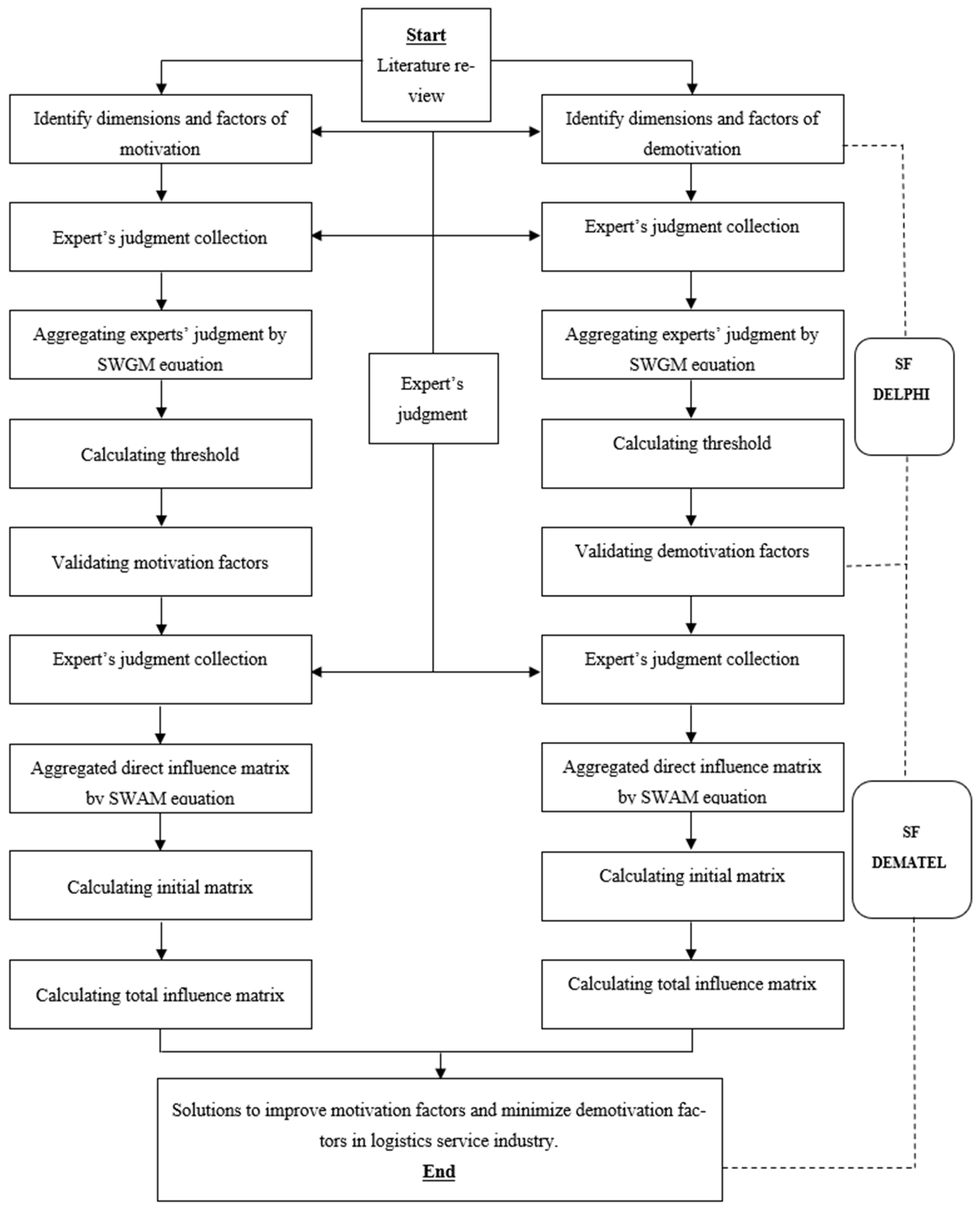
The proposed model includes a two-stage procedure of the SF-Delphi and SF-DEMATEL methods, as shown in Figure 2.
Figure 2.
Proposed research framework.
The research process began with the author establishing research goals and conducting a literature review on HRM and employee satisfaction from both motivation and demotivation aspects.
A panel of experts was then selected based on their expertise and background in the logistic service industry, and university scholars researched HRM to obtain expert opinions. The experts were questioned about the dimensions and factors that enhance employee satisfaction from both the motivation and demotivation aspects.
The SF-Delphi technique was used in the first analysis stage to determine the most crucial dimensions and factors. In the second stage, the SF-DEMATEL method was utilized to identify the causal connections between the factors and dimensions of preference and to determine the degree of impact of each dimension and factor related to employee motivation and demotivation.
The data was processed using Microsoft Office 2021’s Excel functions, and Origin 2022 software was used to create visual representations of the study’s results.
3.2.2. SF-Delphi Method
The details of the SF-Delphi technique proposed by Nguyen [4] in 2022 are demonstrated below:
Step 1: To aggregate experts’ opinions.
The experts use the linguistic terms in Table 2 to evaluate the list of potential dimensions and factors in the context of this study. The SWAM operator is used to obtain the significance vector for each indicator [20], and it is shown in Equations (17) and (18):
Step 2: To defuzzy the aggregated criteria score.
Equation (19) is applied to obtain the score of each criterion.
Step 3: A threshold is attained using Equation (20) to validate the list of critical criteria. If , criterion is removed, and if , criterion is valid.
3.2.3. SF-DEMATEL Method
This study introduces a new approach to the SF-DEMATEL method that employs full spherical fuzzy operators in the computation process without the normalization step used in previous studies [25,26,27,28]. The steps of the extended SF-DEMATEL method are outlined as follows:
Step 1: Creating direct influence matrices following the expert’s evaluation.
To describe the expert’s assessment of the influence of the criteria, Equation (21) is applied to obtain the score index (SI) value using the linguistic scales in Table 4.
Table 4.
Linguistics scales of SF-DEMATEL.
The direct influence matrix form () is created in Equation (22) based on the expert pairwise comparisons:
where n is a factor, is the direct influence matrix and is the spherical fuzzy value of the impact of factor ith to jth by expert.
Step 2: Creating a matrix of pooled direct influence .
To combine the individual judgments of the decision-makers, the next step involves creating a matrix of pooled direct influence (). The SWAM process is employed using Equation (16) as the basis to generate the aggregated direct influence matrix in Equation (23).
where is the aggregated SF value of the impact of criterion ith to jth.
Step 3: Building the initial direct influence matrix (X).
The SF value of each comparison contains three dimensions, including membership (α), non-membership (β), and hesitancy level (γ). The normalization of matrix (D) will be carried out to produce the initial direct influence matrix (X), after dividing them into three submatrices Equation (24). Equation (25) describes the final matrix form in this stage.
where s is the normalization index
Step 4: Calculating the total influence matrix (T).
Using Equation (26), the submatrices of X are changed into the submatrices of (T). The (T) matrix in Equation (27) is created by combining these matrices.
The impact from factor ith to jth is represented by the SF value of the (T) matrix, where (T) is the total influence matrix, (X) is the direct influence matrix, is the indirect influence matrix, and is the SF value of the (T) matrix.
Step 5: The spherical fuzzy column () and row sum () calculation.
Row sum () and column sum () spherical fuzzy values are computed using Equations (28) and (29), respectively.
Step 6: Evaluating the significance of relation and prominence.
Defuzzification into crisp numbers, shown as score values using Equation (19).
The ( value describes the degree of importance of factors and the values describe the cause and effect among factors.
If value greater than zero, the factor belongs to the “cause” group.
If value lower than zero, the factor belongs to the “effect” group.
Step 7: Drawing Network Relations Map (NRM).
In this research, establishing a threshold value is crucial for obtaining the digraph from the total influence matrix (T), which provides information about the impact of one factor on another. The decision-maker must determine the threshold value to filter out insignificant effects, ensuring that only effects greater than the threshold value are displayed in the digraph. The average of the elements in the matrix (T) is computed to establish the threshold value. The NRM visualizes the relationship between factors based on their prominence and relation in Step 6. The NRM consists of two axes, the “Prominence” axis and the “Relation” axis, which are horizontal and vertical, respectively. In the NRM, a single arrow represents a one-way impact of one factor on another, while a double arrow represents a two-way interrelationship between two factors. This distinction is important because it can help identify feedback loops and other complex relationships between factors. By analyzing the NRM, decision-makers can gain insights into the relationships between different factors and identify which factors are most influential in the system.
4. Case Study
4.1. Expert Selection
The SF-Delphi survey participants are not selected randomly; instead, they are carefully chosen based on their knowledge and experience in a specific field relevant to the research topic [75]. While there is no established rule for the panel size, it is generally believed that a larger panel will lead to more reliable group judgments [76,77]. It has been suggested that each area of expertise should have a minimum of 10 to 18 panel members [78,79]. Given the complexity of the dimensions and factors involved in this study, the author aimed for a minimum sample size of 40 participants. The survey was created using Google Forms and distributed via email to 56 specialists. Out of those, 40 responses were received and included in the research. The selected experts had at least 15 years of experience in the logistics industry and worked in some well-known universities in Vietnam; their profiles are presented in Table 5.
Table 5.
Experts’ Profiles.
4.2. Results of the SF-Delphi Technique
4.2.1. Results of Motivation Categories
In this study, secondary sources and experts’ feedback were used to list 38 potential indicators. It was anticipated that the test would take 30 min to complete and was split into two parts. Section 1 collected demographic data, such as position, years of experience, education, and industry sector. The questionnaire was only circulated once permission had been obtained, and the invites were initially delivered by email. Data were gathered from November 2022 to February 2023 utilizing an online survey using Google Forms in both English and Vietnamese. Experts’ opinions after collection were converted from linguistic to spherical fuzzy numbers (Table 3). The SWAM operator was then used to integrate the experts’ judgments, and then score functions were calculated by Equation (19) to determine the threshold value. The SF-Delphi method results are displayed in Table 6. Based on comparisons between the score values () of each criterion and the threshold (), seven motivation factors, including M3, M6, M8, M16, M19, M27, and M30 were rejected.
Table 6.
The SF-Delphi method results in motivation categories.
4.2.2. Results of Demotivation Categories
The experts also assessed a list of 21 factors of demotivation factors. As a result, only M15 was rejected because the score function value (0.419) was lower than the threshold value (0.878), as shown in Table 7.
Table 7.
The SF-Delphi method results in demotivation categories.
4.3. Results of SF-DEMATEL Method
4.3.1. SF-DEMATEL Results of Employee Motivation Factors
The second poll was conducted with 40 experts who participated in the first phase after using the Delphi approach to identify 31 significant elements affecting employee motivation. The survey asked experts to evaluate the impact of each pair of factors using the linguistic scale shown in Table 3. The SF-DEMATEL method results of motivation are presented in Table 8, Table 9, Table 10, Table 11, Table 12 and Table 13, and the influence relation maps is displayed in Figure 3, Figure 4, Figure 5, Figure 6, Figure 7, Figure 8 and Figure 9.
Table 8.
The SF-DEMATEL results of employee motivation dimensions.
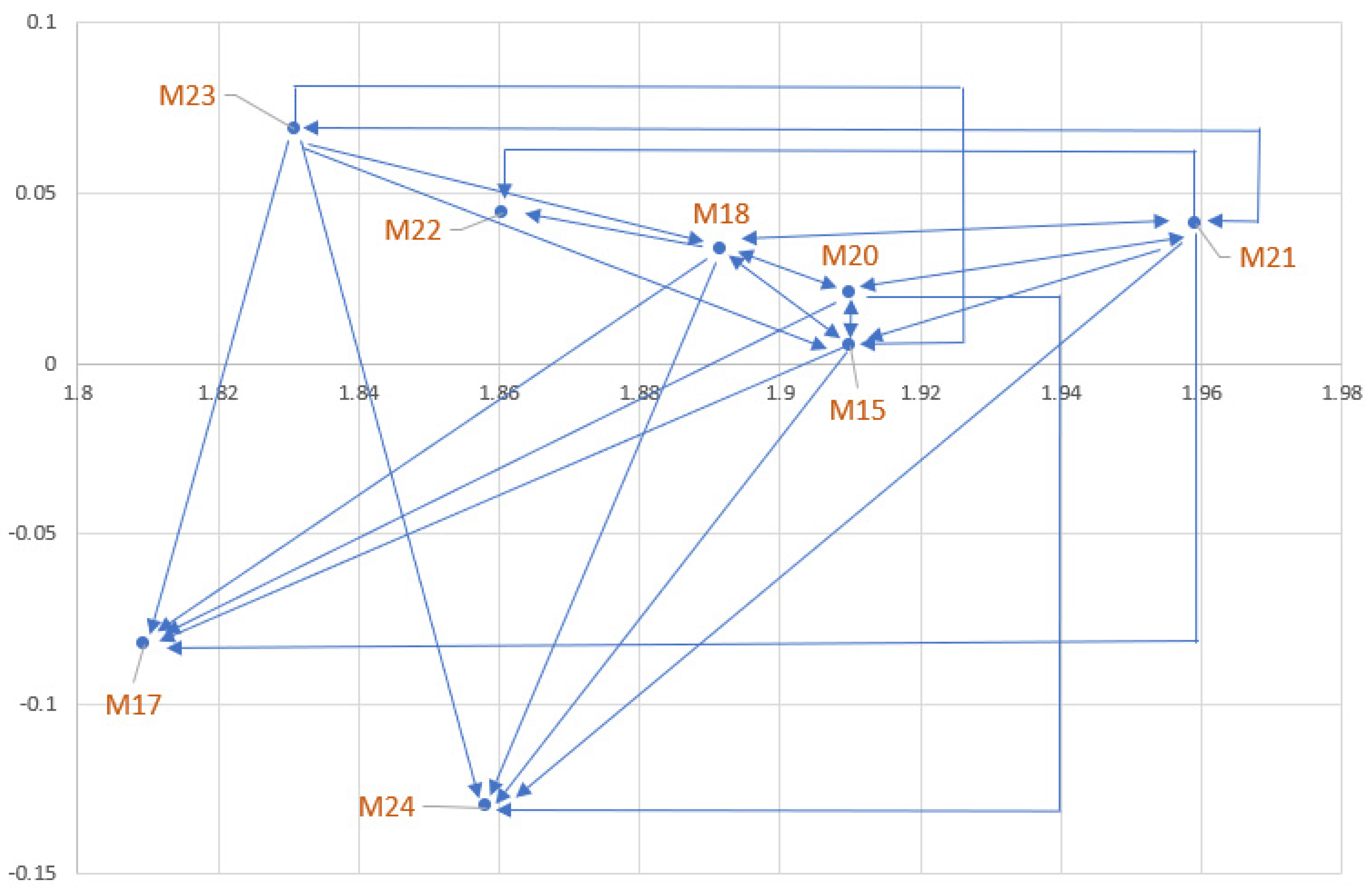
Based on the data presented in Table 8, it can be seen that A was the most important causal factor affecting the motivation of employees because it had the largest () value and had a positive value (). Furthermore, C was the second-most significant causal factor, followed by D and B, respectively. Considering that E and F had low () values, they are two effect factors. E and F are two factors that were impacted by all four factors, according to the influence relationship map among the dimensions in Figure 3.
Figure 3.
Network relations map of employee motivation dimensions.
However, E and F did not have an impact on one another. In addition, in the cause group, factors A, C, and D. A and D had mutual effects and impacted on factor B. Therefore, to improve the motivation of employees, it is necessary to focus resources on improving A, C, and D, and then factors B, E, and F will be simultaneously addressed.
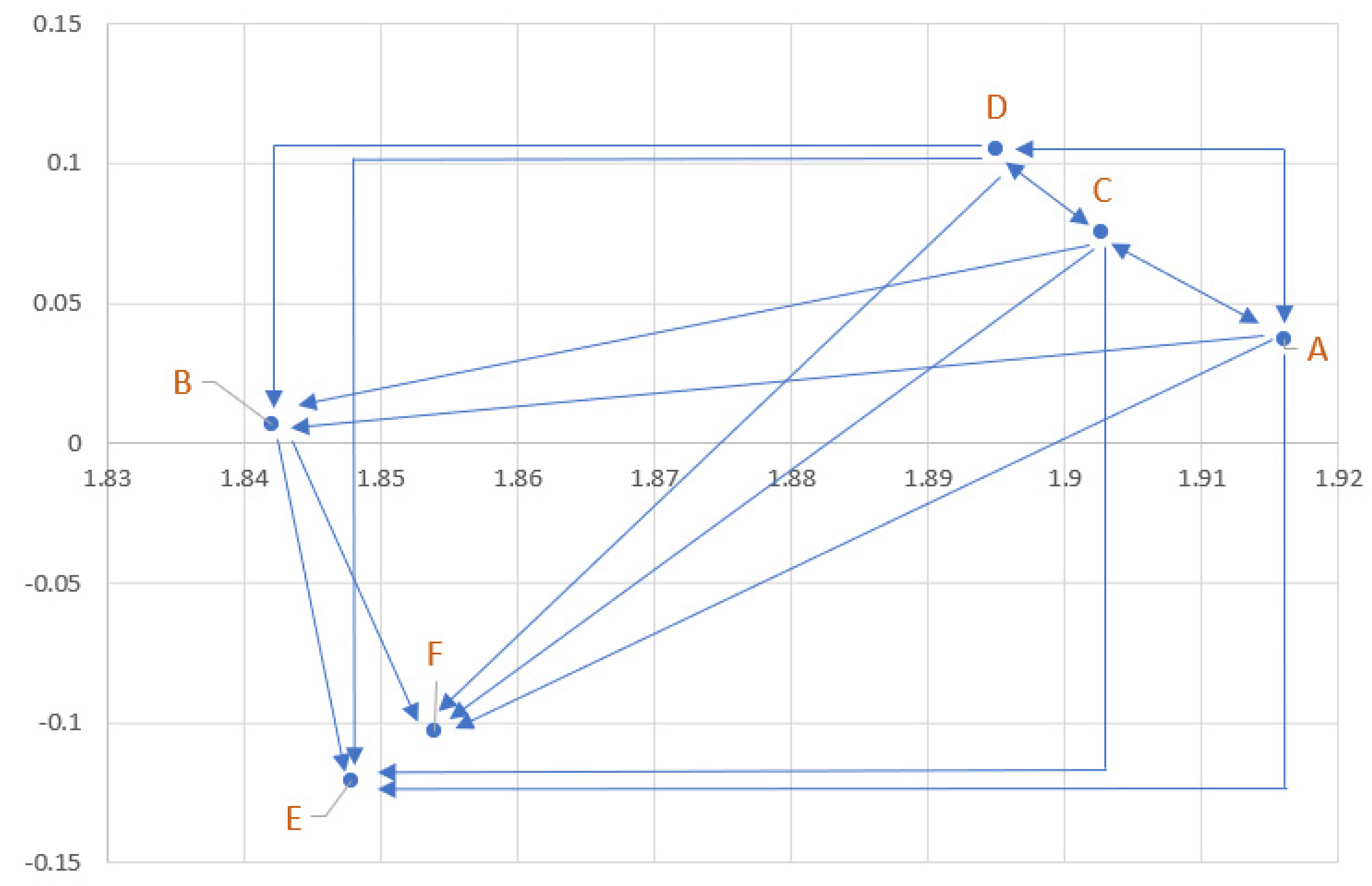
Next, Table 9 presents SF-Dematel results between factors in compensation and benefits, and Figure 4 presents an impact relationship among them. The results show that, M2, M5 and M7 are cause factors by the positive () values, in which M2 is the most significant factor with the greatest () value. Similarly, due to their () value lower than 0, M1, M4 and M8 are the affected factors.
Table 9.
The SF-DEMATEL results of compensation and benefits.
Table 9.
The SF-DEMATEL results of compensation and benefits.
| Factor | Classification | |||
|---|---|---|---|---|
| M1 | Equity in pay | 1.4349 | −0.2188 | Effect |
| M2 | Base salary | 1.7833 | 0.2167 | Cause |
| M4 | Relaxation allowances | 1.4966 | −0.0443 | Effect |
| M5 | Bonus structure | 1.5713 | 0.0349 | Cause |
| M7 | Health insurance | 1.5047 | 0.1408 | Cause |
| M8 | Retirement benefits | 1.3897 | −0.1294 | Effect |
Considering the direction of the arrow, it can be seen that M2 and M7 affect all the remaining factors and affect each other. Therefore, it is necessary to concentrate on exploiting these two factors to have a suitable compensation and benefits system.
Figure 4.
Network relations map of compensation and benefits.
Similarly, in the dimension of career growth and development, M10, M11, and M12 are the primary factors that contribute to a rise in employee motivation due to the positive () values. In particular, M10 is the most critical factor, followed by M11 and M12, respectively. The factors of the affected group include M13 and M14; all three cause factors influence these factors. The results are shown in Table 10 and Figure 5.
Table 10.
The SF-DEMATEL results in career growth and development.
Table 10.
The SF-DEMATEL results in career growth and development.
| Factor | Classification | |||
|---|---|---|---|---|
| M10 | Professional development | 1.9232 | 0.0768 | Cause |
| M11 | Opportunities for creativity and innovation | 1.9098 | 0.0221 | Cause |
| M12 | Training | 1.8797 | 0.0714 | Cause |
| M13 | Opportunities for social connection | 1.8410 | −0.0575 | Effect |
| M14 | Challenging work | 1.8312 | −0.1128 | Effect |
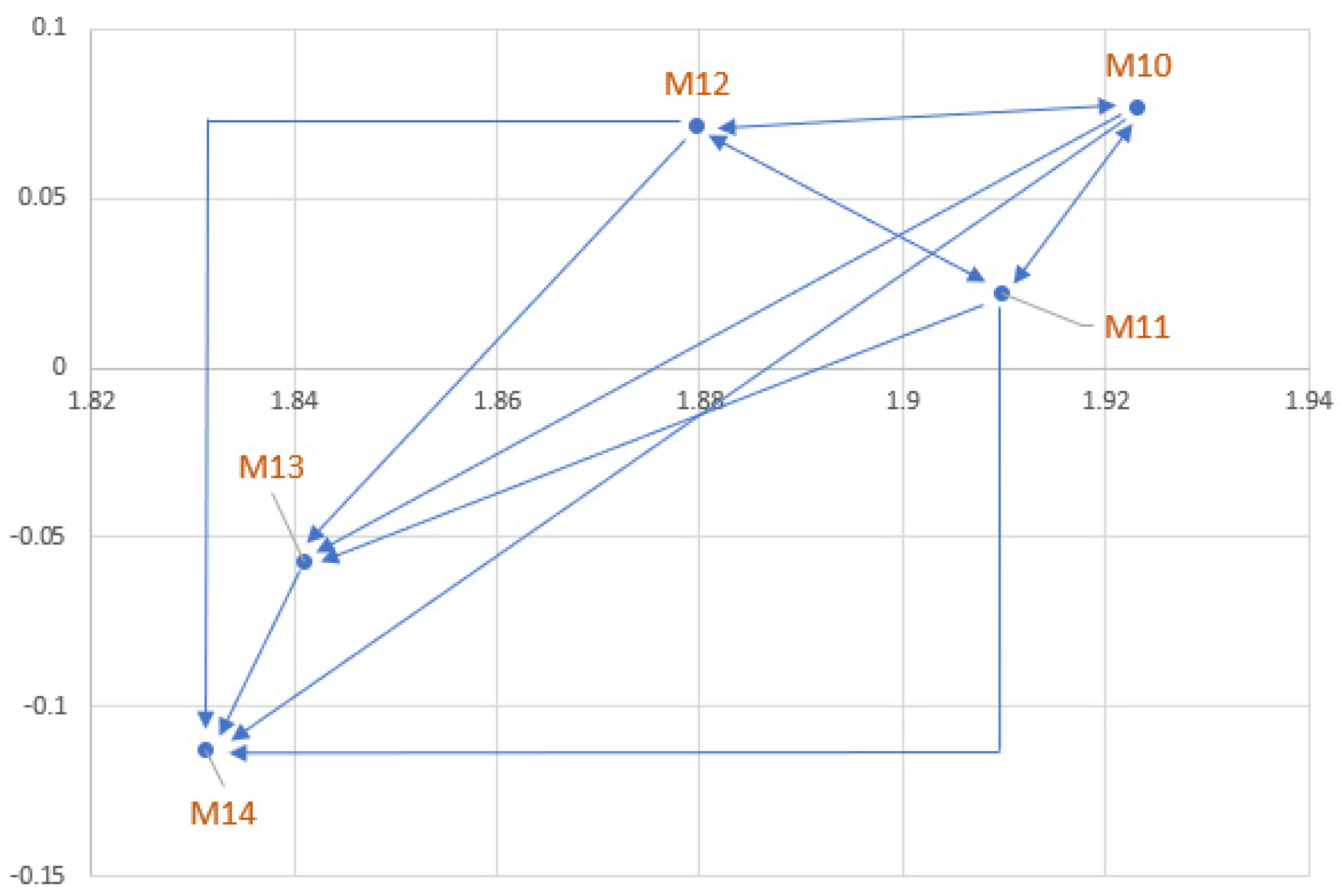
Figure 5.
Network relations map of career growth and development.
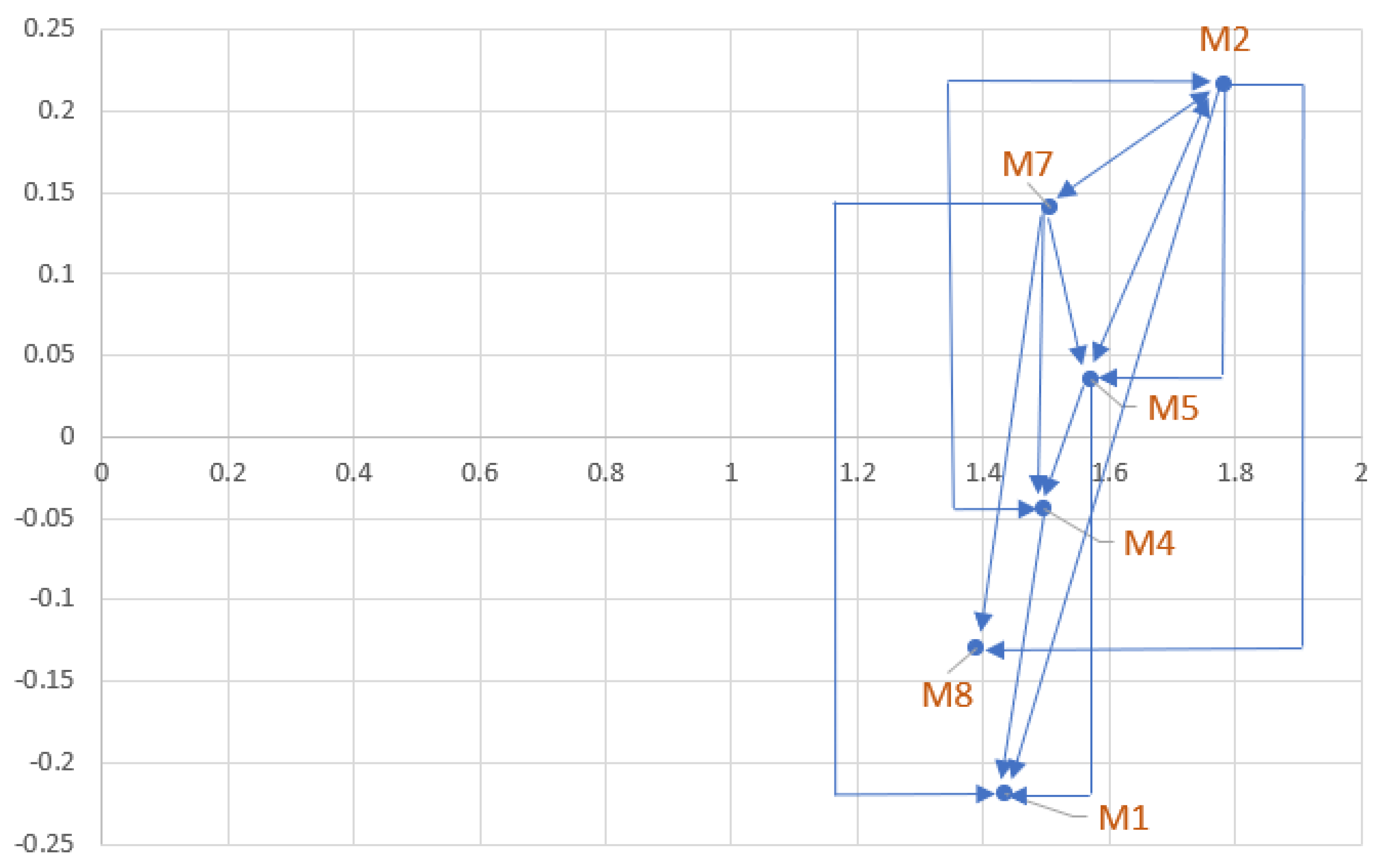
The work environment and culture dimension has eight factors, as listed in Table 11; the results show that M15, M18, M20, M21, M22, and M23 are cause factors, in which the three most important reasons are M21, M15, and M20, respectively. The other two factors are M17 and M24, acting as factors affected by negative () values. The direction of the arrow in Figure 6 shows how the M21 influences all the other variables. Hence, this aspect must be highlighted most when attempting to create a pleasant work environment for staff members.
Table 11.
The SF-DEMATEL results of work environment and culture.
Table 11.
The SF-DEMATEL results of work environment and culture.
| Factor | Classification | |||
|---|---|---|---|---|
| M15 | Work-life balance | 1.9099 | 0.0051 | Cause |
| M17 | Resources and support | 1.8094 | −0.0825 | Effect |
| M18 | Job security | 1.8916 | 0.0334 | Cause |
| M20 | Workload | 1.9099 | 0.0208 | Cause |
| M21 | Positive work culture | 1.9592 | 0.0408 | Cause |
| M22 | Social support | 1.8605 | 0.0442 | Cause |
| M23 | Physical environment | 1.831 | 0.0685 | Cause |
| M24 | Autonomy | 1.8582 | −0.1303 | Effect |
Figure 6.
Network relations map of work environment and culture.
One of the critical dimensions for motivation is the dimension of recognition and feedback. The measurement findings and the relationships between the factors are displayed in Table 12 and Figure 7 below.
Table 12.
The SF-DEMATEL results of recognition and feedback.
Table 12.
The SF-DEMATEL results of recognition and feedback.
| Factor | Classification | |||
|---|---|---|---|---|
| M25 | Positive feedback and constructive criticism | 1.8404 | 0.1596 | Cause |
| M26 | Recognition | 1.8628 | 0.0976 | Cause |
| M28 | Employee empowerment | 1.7272 | −0.2575 | Effect |
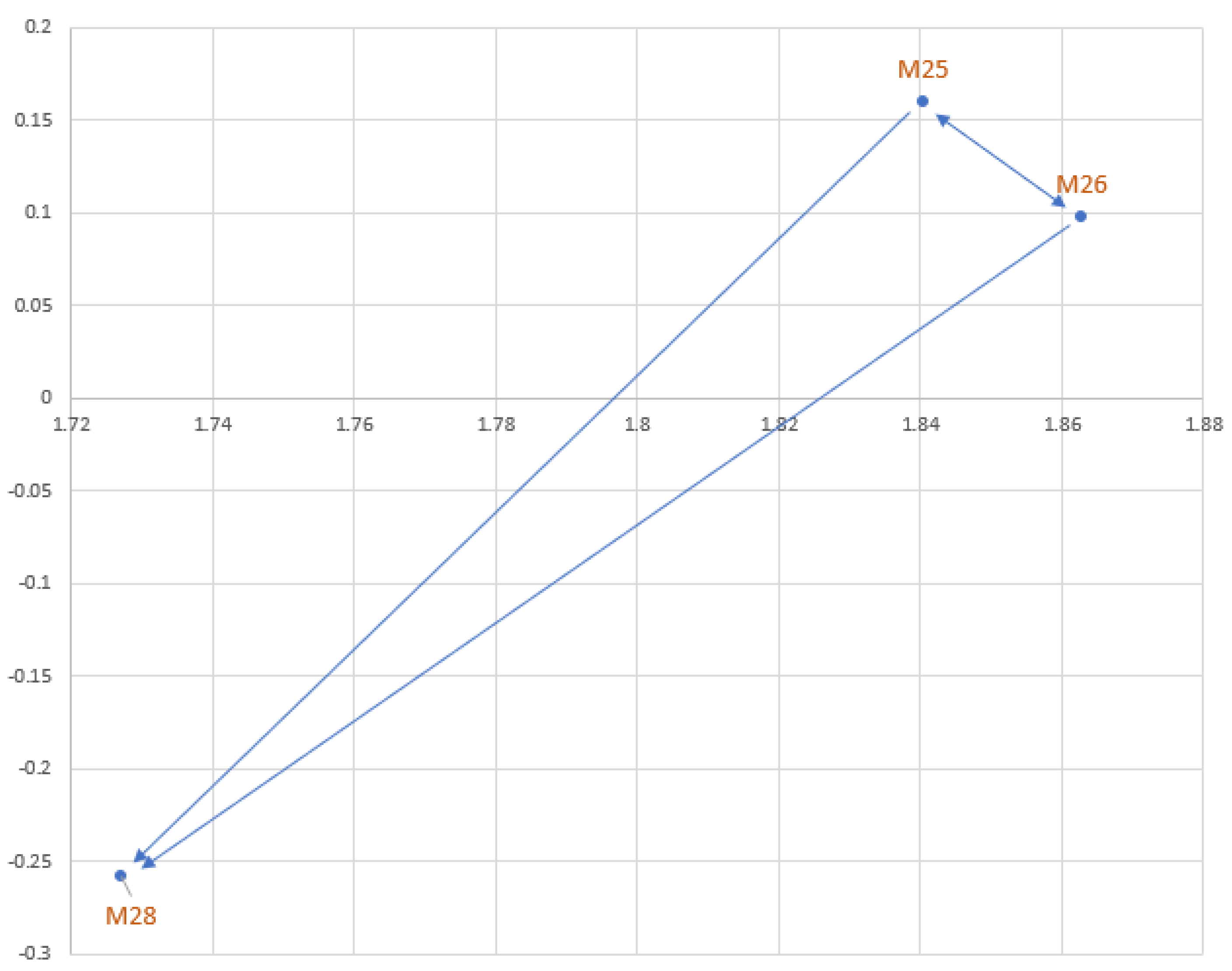
The results show that M25 and M26 are the cause factors because of positive () values. M25 and M26 impact the remaining factors and impact each other. In particular, M26 is the most crucial factor, with the largest () value. The factor acting as an affected factor is M28.
Figure 7.
Network relations map of recognition and feedback.
Likewise, Table 13 and Figure 8 demonstrate the outcomes of the organizational support dimension. M29 is the most significant factor because it has the highest () value, but because it has a negative () value, M29 belongs to the effect group. With positive (), M31, M33, M34 and M35 are identified as cause factors. As a result, it is crucial to concentrate on enhancing the components that contribute to the problem, particularly the M35 factor, because it has the second highest () value and affects the other factors, including M29.
Table 13.
The SF-DEMATEL results of organizational support.
Table 13.
The SF-DEMATEL results of organizational support.
| Factor | Classification | |||
|---|---|---|---|---|
| M29 | Perceived organizational support | 1.964 | −0.020 | Effect |
| M31 | Organizational support | 1.916 | 0.030 | Cause |
| M32 | Organizational communication | 1.868 | −0.100 | Effect |
| M33 | Employee retention strategies | 1.859 | 0.010 | Cause |
| M34 | Organizational commitment | 1.804 | 0.013 | Cause |
| M35 | Organizational justice | 1.933 | 0.067 | Cause |
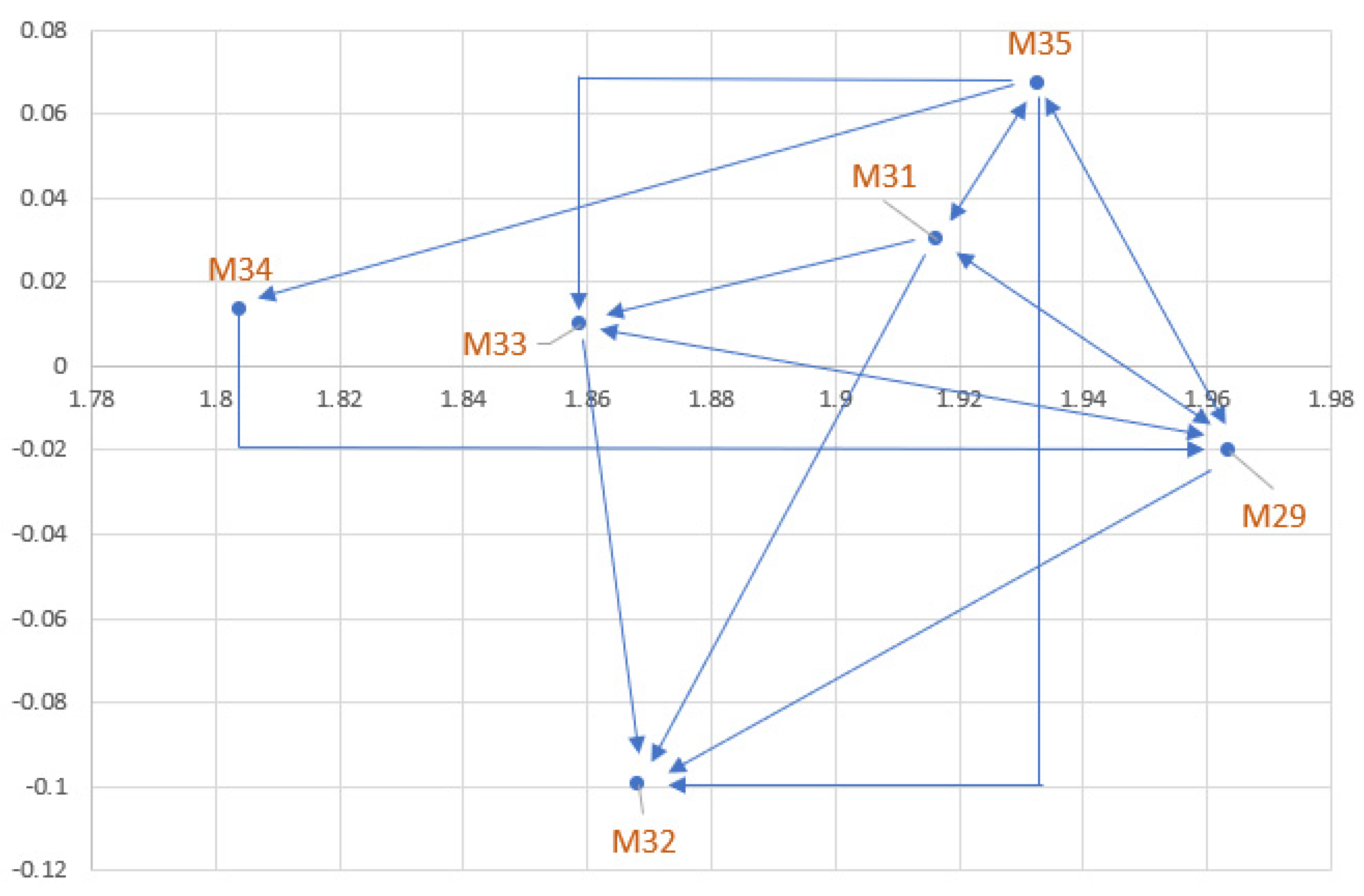
Figure 8.
Network relations map of organizational support.
Lastly, Table 14 illustrates the management style dimension’s measurement results. The outcome demonstrates that M37 is this dimension’s sole and most significant element. M37 influences the other two factors in the group, while M36 and M38 also have the opposite effect, as shown in Figure 9.
Table 14.
The SF-DEMATEL results of management.
Table 14.
The SF-DEMATEL results of management.
| Factor | Classification | |||
|---|---|---|---|---|
| M36 | Trust in management | 1.577 | −0.023 | Effect |
| M37 | Leadership | 1.922 | 0.079 | Cause |
| M38 | Purposeful work | 1.602 | −0.056 | Effect |
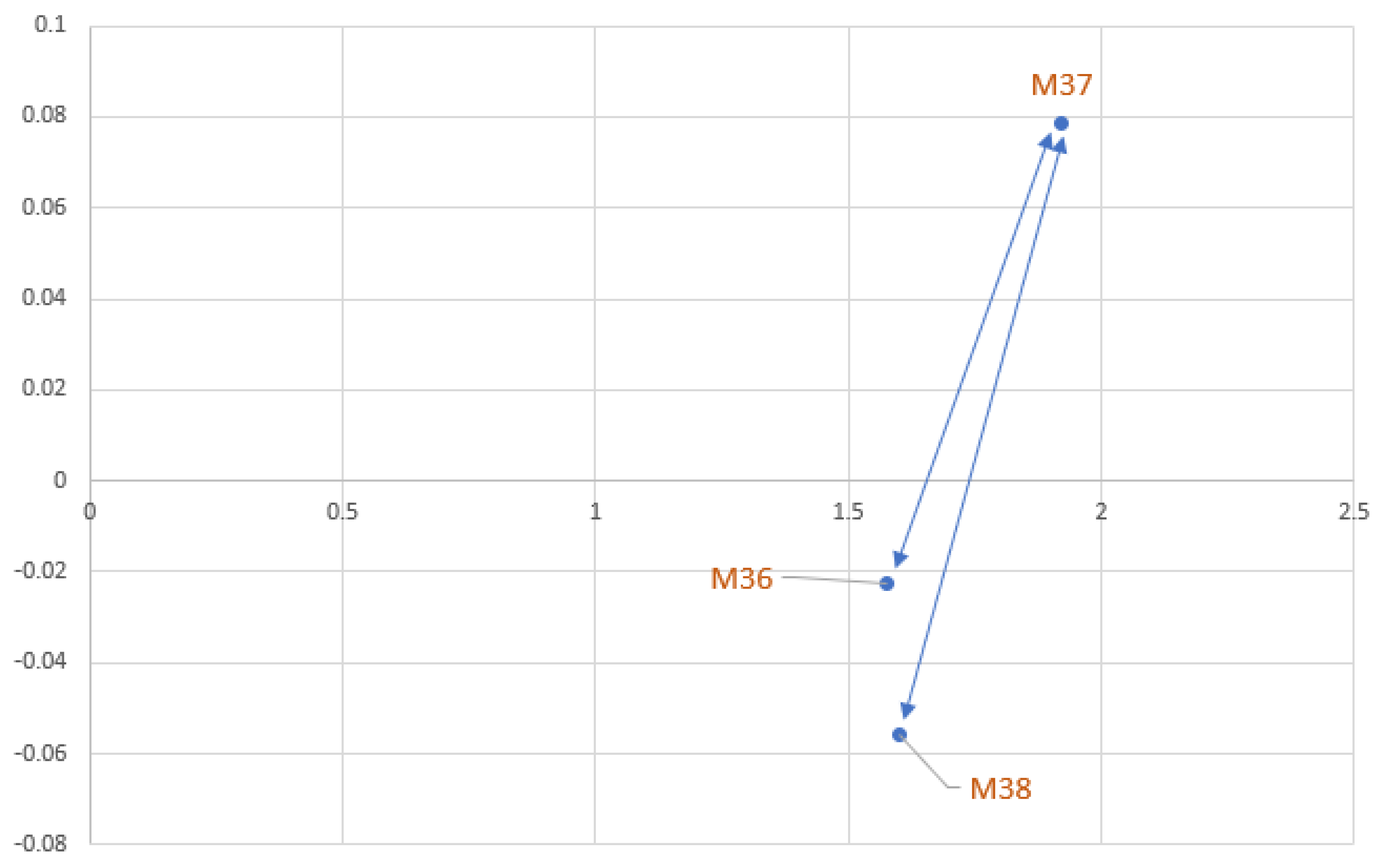
Figure 9.
Network relations map of management style.
4.3.2. SF-DEMATEL Results of Employee Demotivation Dimension
The results of the SF-DEMATEL method for 20 factors belonging to the demotivation categories are presented in Table 15, Table 16, Table 17, Table 18, Table 19 and Table 20 and in Figure 10, Figure 11, Figure 12, Figure 13, Figure 14 and Figure 15.
First, five dimensions are investigated for their importance and relationship. J and K are recognized as the effect dimensions since the () values are less than zero. G, H, and I, however, are the cause dimensions. G is the most significant factor because its () value is the highest.
Table 15.
The SF-DEMATEL results of employee demotivation dimensions.
Table 15.
The SF-DEMATEL results of employee demotivation dimensions.
| Dimension | Classification | ||
|---|---|---|---|
| G Inadequate compensation and benefits | 1.8808 | 0.0527 | Cause |
| H Poor management | 1.6910 | 0.0018 | Cause |
| I Lack of career growth and development opportunities | 1.8155 | 0.1845 | Cause |
| J Poor work environment and culture | 1.6431 | −0.1870 | Effect |
| K Lack of recognition and feedback | 1.6764 | −0.0520 | Effect |
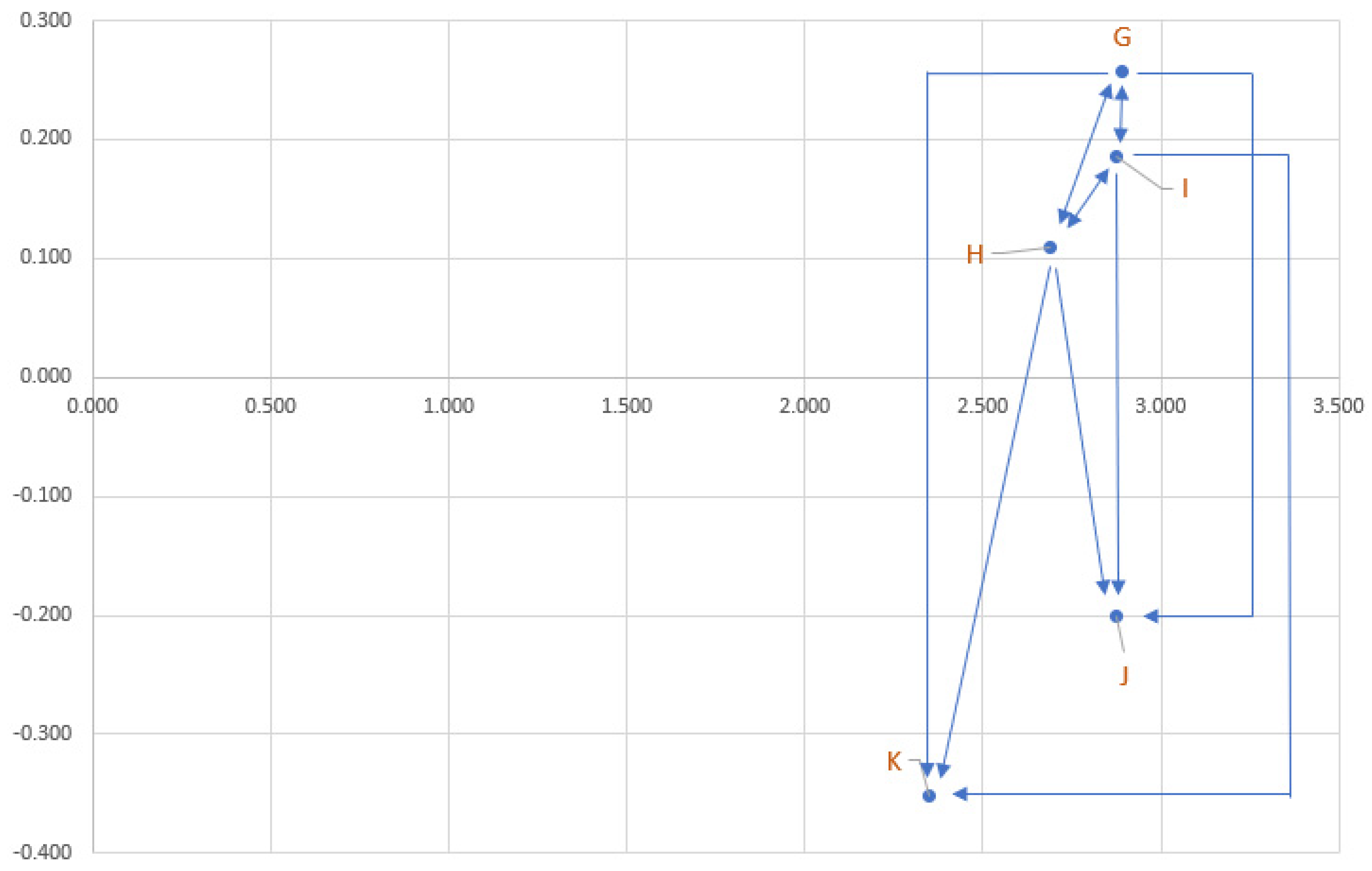
Regarding the arrow direction of the factors, it can be seen that all causal factors influence K and J. In contrast, G, H, and I affect all other factors, and they have a reciprocal relationship. Therefore, decision-makers should address the cause factors, especially G, to minimize employee demotivation, as shown in Table 15 and Figure 10.
Figure 10.
Network relations map of employee demotivation dimensions.
For the first dimension, Table 16 and Figure 11 indicate the outcomes of an inadequate compensation and benefits dimension. DM1 and DM2 are causative factors because the (r − c) values are higher than zero. Moreover, considering the direction of the arrow, DM2 not only has the largest () value, but also affects all factors in the group. Therefore it is necessary to focus on solving DM2.
Table 16.
The SF-DEMATEL results for inadequate compensation and benefits.
Table 16.
The SF-DEMATEL results for inadequate compensation and benefits.
| Factor | Classification | |||
|---|---|---|---|---|
| DM1 | Back pay | 1.806 | 0.029 | Cause |
| DM2 | Inadequate salaries and rewards | 1.972 | 0.028 | Cause |
| DM3 | Unfair pay in comparison to colleagues | 1.832 | −0.057 | Effect |
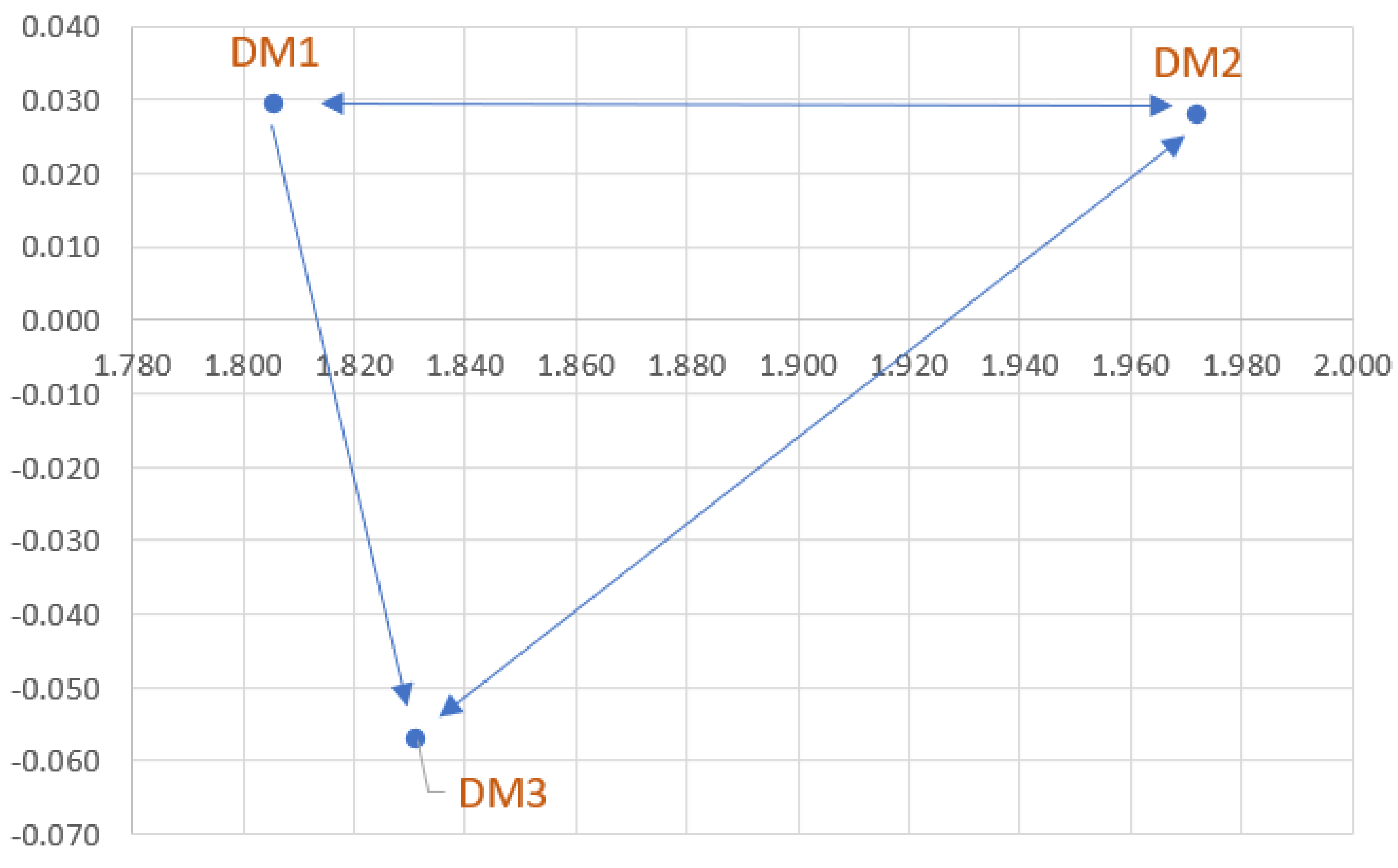
Figure 11.
Network relations map of inadequate compensation and benefits.
Moreover, DM5, DM6, and DM7 belong to the cause group due to the positive () values and DM4 and DM8 belong to the effect group because of the negative () values. Because DM7 is the causal factor with the highest () value, it is essential to pay attention to it if management is to be improved. In Table 17 and Figure 12, the results are displayed.
Table 17.
The SF-DEMATEL results from poor management (H).
Table 17.
The SF-DEMATEL results from poor management (H).
| Factor | Classification | |||
|---|---|---|---|---|
| DM4 | Poor organization ethics | 1.506 | −0.062 | Effect |
| DM5 | Inadequate leadership support | 1.585 | 0.030 | Cause |
| DM6 | Poor management | 1.583 | 0.069 | Cause |
| DM7 | Bad treatment by supervisors | 1.834 | 0.166 | Cause |
| DM8 | Working excessively long hours | 1.617 | −0.203 | Effect |
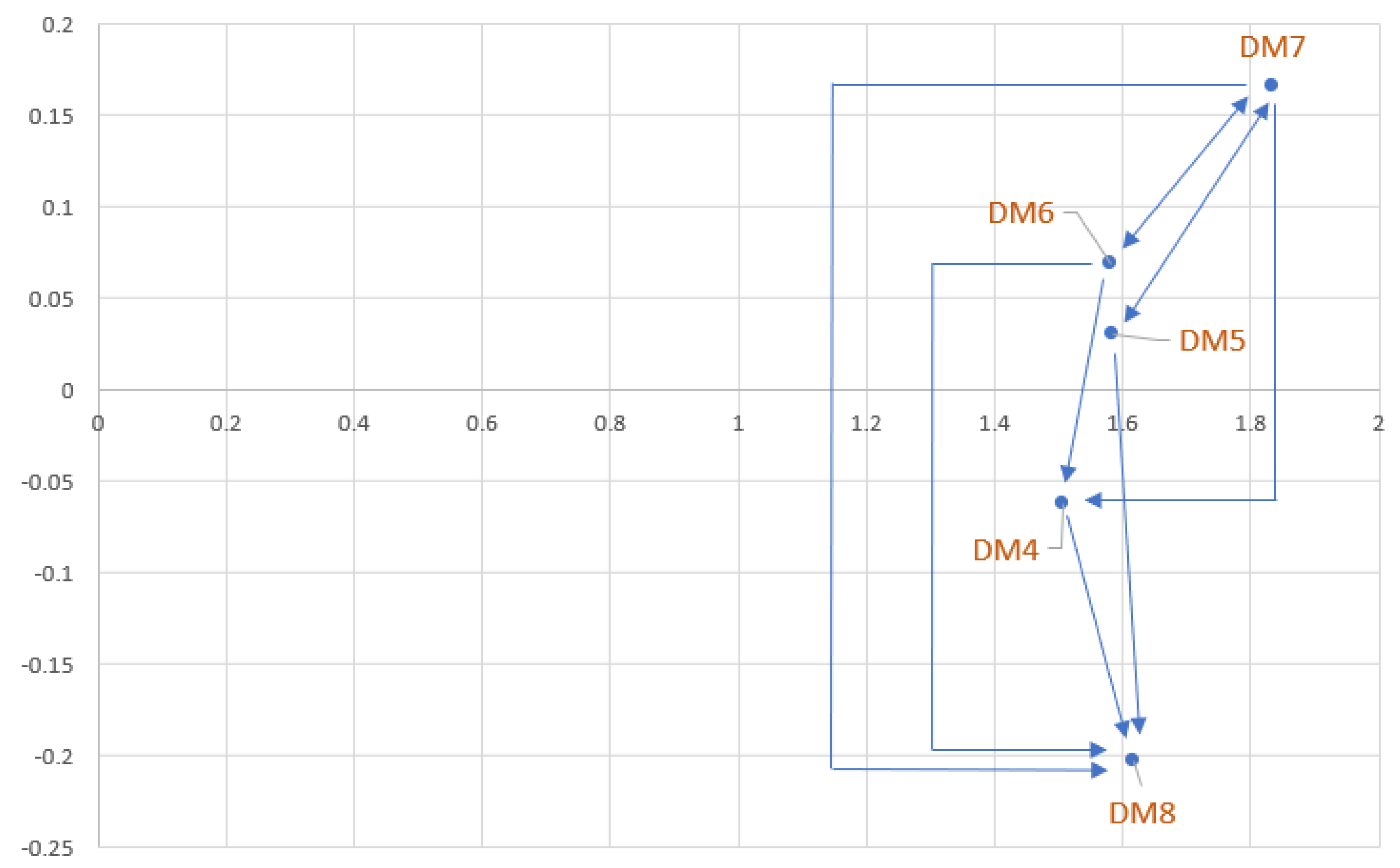
Figure 12.
Network relations map of poor management.
Similarly, the lack of career growth and development opportunities has three factors, and DM9 is both the cause and the most essential factor that needs to be improved. DM10 and DM11, the other two factors, are the effect factors. Table 18 and Figure 13 show the measurement results.
Table 18.
The SF-DEMATEL results for a lack of career growth and development opportunities (I).
Table 18.
The SF-DEMATEL results for a lack of career growth and development opportunities (I).
| Factor | Classification | |||
|---|---|---|---|---|
| DM9 | Inadequate opportunity for career promotion | 1.859 | 0.141 | Cause |
| DM10 | Underutilization of skill | 1.524 | −0.019 | Effect |
| DM11 | Inadequate training and development | 1.456 | −0.122 | Effect |
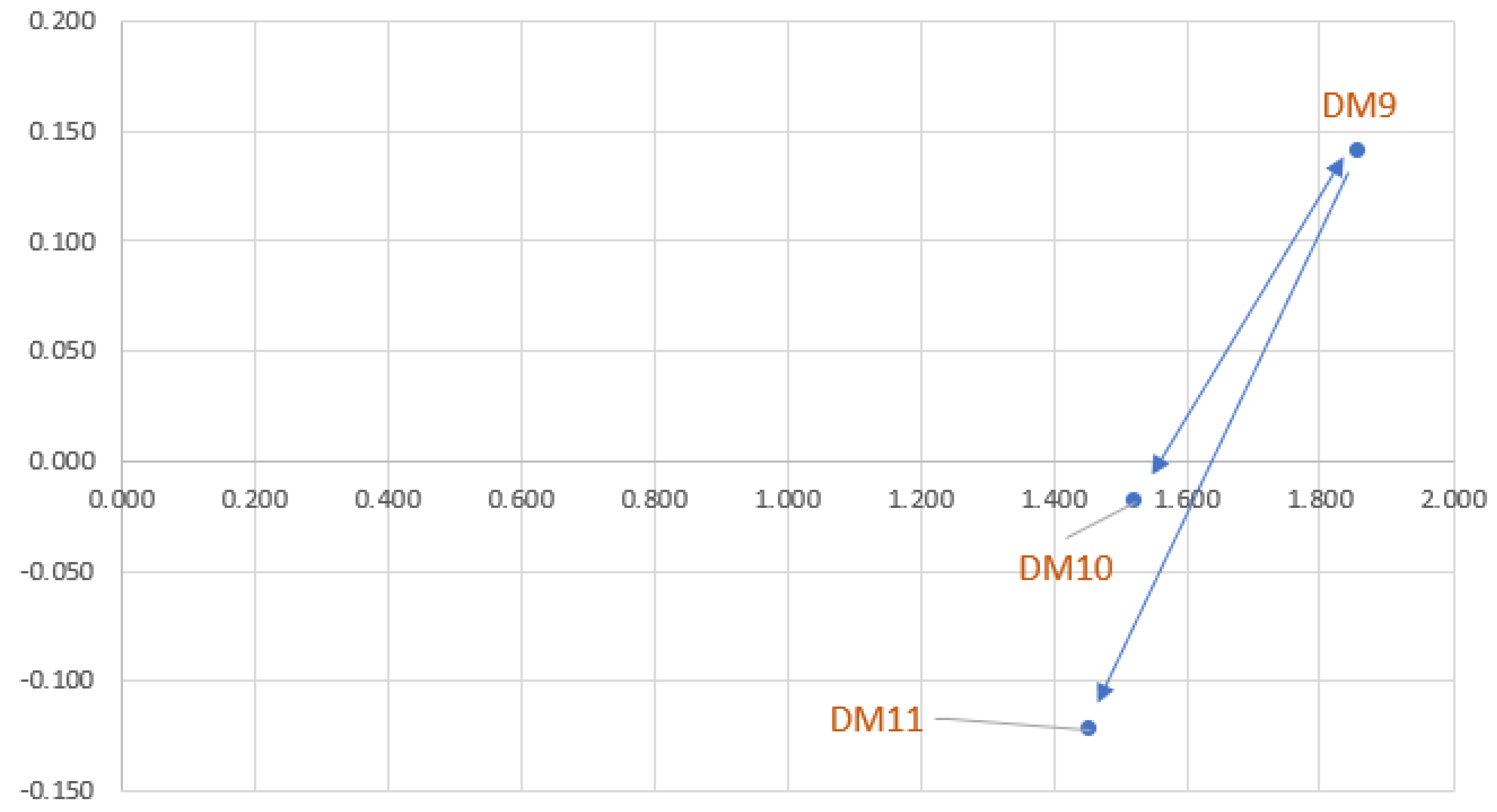
Figure 13.
Network relations map of a lack of career growth and development opportunities.
The next crucial dimension to be investigated is poor work environment and culture (Table 19). Due to the positive () value, the factors DM13, DM14 and DM17 are the influencing factors; on the other hand, DM12, DM 16 and DM18 are the factors affected by the negative () value. DM13 was identified as the most critical factor and should be improved because it affects all the remaining factors in the group, as shown in Figure 14.
Table 19.
The SF-DEMATEL results for poor work environment and culture (J).
Table 19.
The SF-DEMATEL results for poor work environment and culture (J).
| Factor | Classification | |||
|---|---|---|---|---|
| DM12 | Inadequate freedom in the day-to-day conduct of work | 1.844 | −0.036 | Effect |
| DM13 | Lack of job security | 1.926 | 0.075 | Cause |
| DM14 | Poor working environment | 1.856 | 0.111 | Cause |
| DM16 | Unsafe work conditions | 1.869 | −0.126 | Effect |
| DM17 | Unhealthy competition among co-workers | 1.872 | 0.041 | Cause |
| DM18 | Excessive workload pressure | 1.868 | −0.064 | Effect |
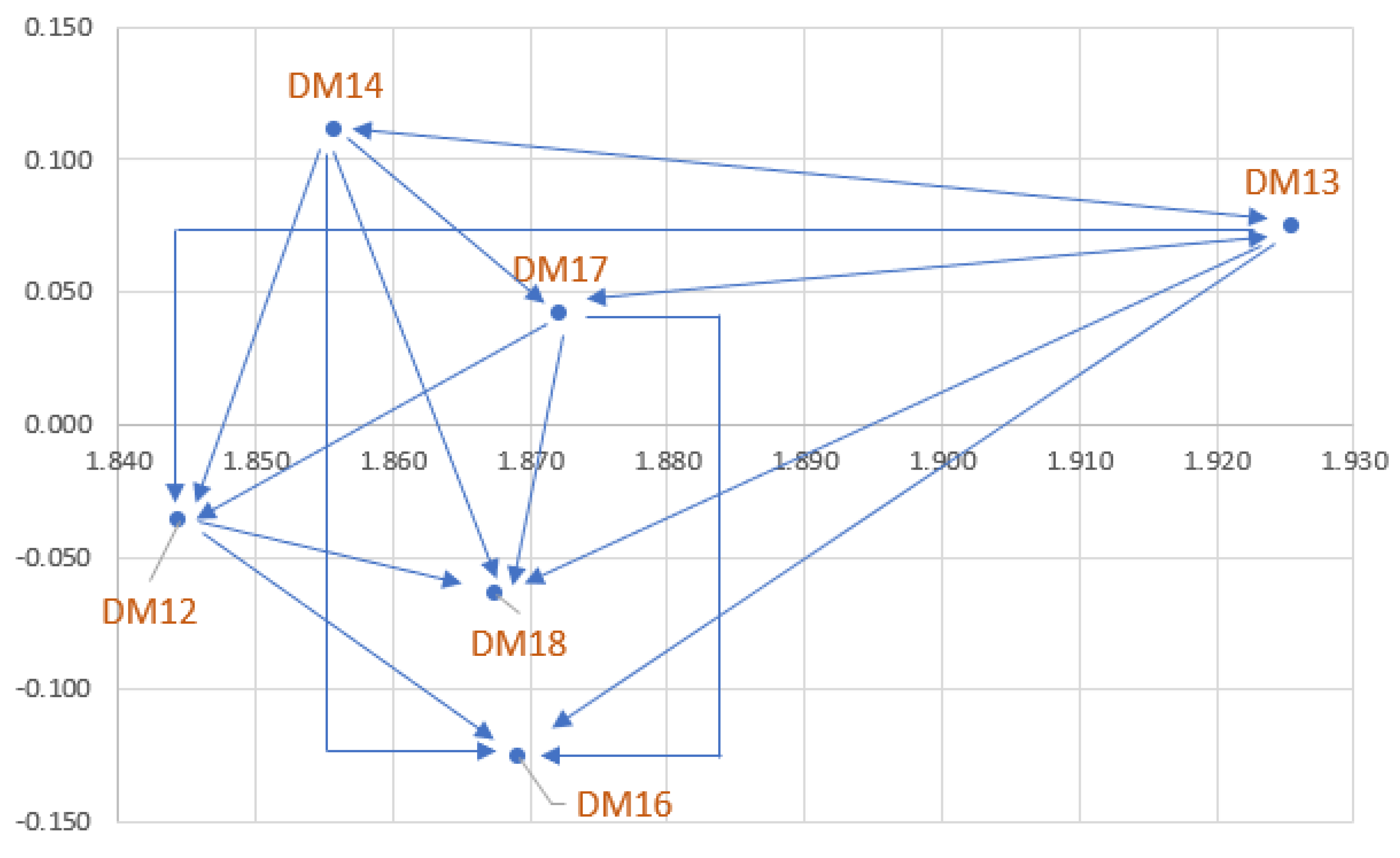
Figure 14.
Network relations map of poor work environment and culture.
Finally, the measurement results of lack of recognition and feedback dimension are presented in Table 20. The group’s most significant causal element was found to be DM21; nevertheless, when the arrow’s direction was considered in Figure 15, it became clear that DM21 had no impact on DM19. On the other hand, DM19 affects DM21 and DM20. Decision-makers must be concerned not just with DM21 but also with DM19 to improve this dimension because DM19 is a causal factor.
Table 20.
The SF-DEMATEL results for a lack of recognition and feedback (K).
Table 20.
The SF-DEMATEL results for a lack of recognition and feedback (K).
| Factor | Classification | |||
|---|---|---|---|---|
| DM19 | Poor feedback and inappropriateevaluation system | 2.086 | 0.086 | Cause |
| DM20 | Low participation in decision making | 2.248 | −0.116 | Effect |
| DM21 | Lack of recognition | 2.383 | 0.030 | Cause |
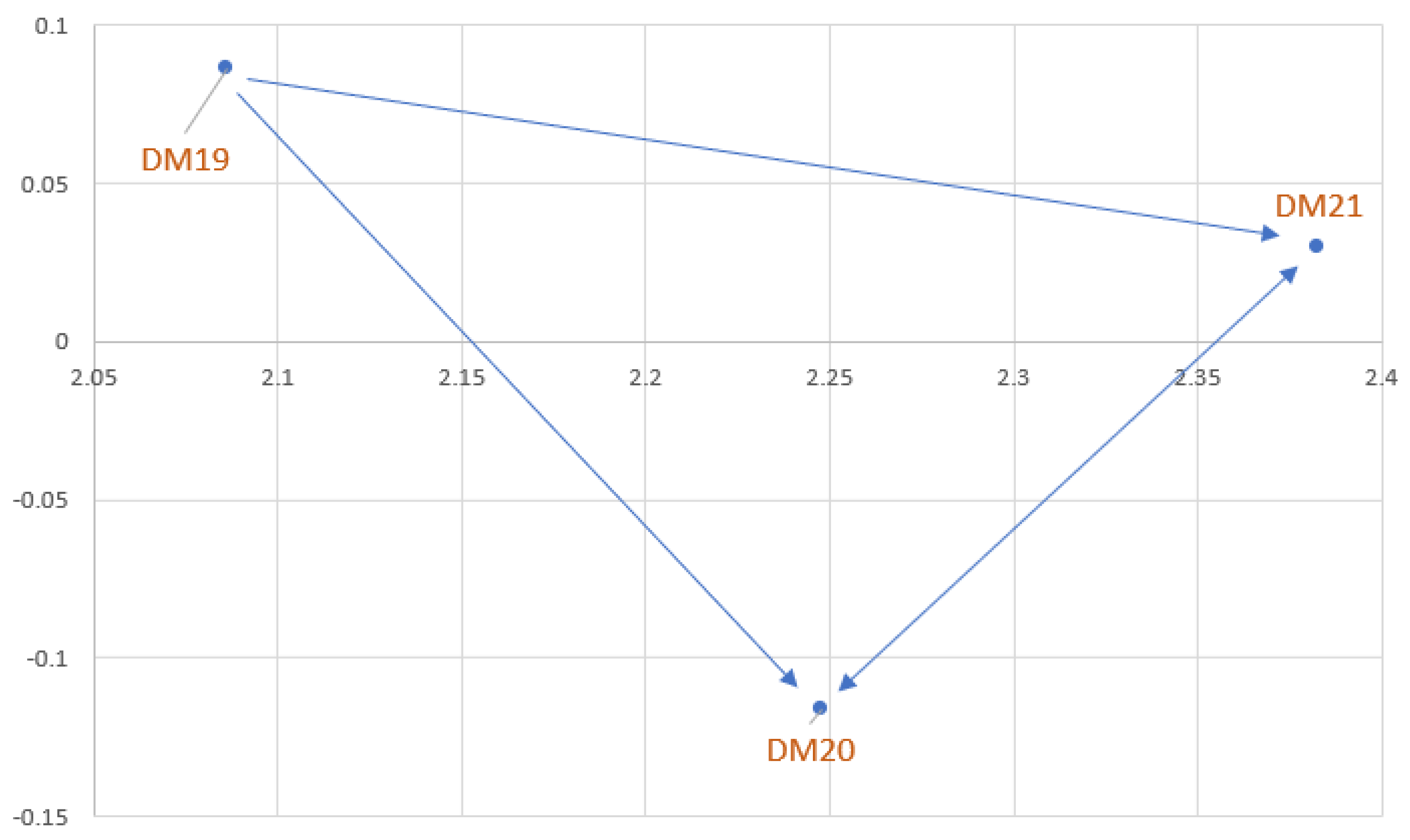
Figure 15.
Network relations map of lack of recognition and feedback (K).
4.4. Discussion
In the first stage, this study identified motivation categories, including six dimensions affecting employee satisfaction. The dimensions of compensation and benefits (A), career growth and development (B), work environment and culture (C), and recognition and feedback (D) were classified under the cause group. Conversely, organizational support (E) and management (F) fell under the effect group. Based on the study results, managers in logistics service firms should prioritize recognition and feedback (D) as it has the highest relationship compared to other dimensions, such as compensation and benefits (A), career growth and development (B), and work environment and culture (C). This prioritization is crucial in enhancing employee motivation as recognition and feedback (D) have a significant causal effect.
Compensation and benefits (A) have the most substantial impact within the cause group and are essential for enhancing employees’ work performance. Previous studies [5,80] have supported this by showing that high-income employees contribute more to the organization, and higher salaries lead to increased job satisfaction. Therefore, it is crucial for companies to establish a reasonable salary and bonus system that takes into account employees’ demands and regularly investigates them [81].
In addition, career growth and development (B) is also critical for retaining top talent. According to Deloitte, employees who receive regular career development opportunities are ten times more likely to stay with their current organization than those who do not receive such opportunities [82]. Employees who feel they have a future in the organization and opportunities for career advancement are more motivated to work harder and remain loyal to the company [83]. Therefore, investing in employee training and development programs can improve employee motivation and the organization’s overall retention rate.
The impact of the work environment and culture (C) on employee motivation is undeniable, as it directly affects the organization’s performance. Research consistently shows that a positive work environment, which includes safety, proper facilities and equipment, and a healthy atmosphere, enhances job satisfaction and boosts employee motivation [6,84,85]. However, creating an ideal workplace is a significant investment for organizations, as it requires substantial financial and human capital. Despite this, organizations must prioritize creating a positive and supportive work environment to retain employees, ensure motivation, and promote overall job satisfaction. These efforts can substantially impact the organization’s long-term success and growth.
Furthermore, recognition and feedback (D) is vital in developing a positive work culture where employees feel appreciated and valued. Maslow’s theory suggests that recognition encourages employees to exceed their duties and to take the initiative [29]. By recognizing their achievements, employees feel a sense of accomplishment and are motivated to continue performing at a high level. Additionally, recognition and feedback can improve employee retention rates, as employees are more likely to stay with an organization that values and appreciates their work. Therefore, organizations must establish a formal recognition program that acknowledges and rewards employees for their hard work and dedication.
In the second stage, it is essential to identify the factors that contribute to employee demotivation, as these factors can harm a company’s productivity and performance. The study reveals that insufficient compensation and benefits (G), poor management (H) and a lack of career growth and development opportunities (I) are the primary drivers of employee demotivation. On the other hand, poor work environment and culture (J) and inadequate recognition and feedback (K) are lesser causes of demotivation. Therefore, companies must prioritize addressing inadequate compensation and benefits, poor management, and a lack of career growth and development opportunities to eradicate employee demotivation. By doing so, firms can foster a positive work environment that promotes employee satisfaction and motivation, resulting in heightened productivity and performance.
The role of compensation and benefits in employee motivation and demotivation cannot be overstated, particularly in industries such as logistics that involve high workloads and require professional competence. This aligns with the theories of Maslow and Herzberg [86], which stress the importance of financial incentives in motivating employees. However, while sufficient compensation and benefits can boost employee motivation, inadequate ones can also lead to demotivation. As such, firms must establish a fair and just system of salary and bonuses to prevent employee demotivation. Beyond insufficient compensation and benefits (G), addressing poor work environment and culture (J) and lack of career growth and development opportunities (I) are also vital in preventing employee demotivation. Such factors can have a significant impact on employee satisfaction and motivation, which, in turn, can influence productivity and performance. Therefore, logistics service firms should prioritize developing positive work environments that promote employee satisfaction, address poor management practices, and offer opportunities for career growth and development.
Finally, it is widely recognized that the absence of career advancement and growth opportunities is a critical factor in employee demotivation in the Vietnamese logistics industry [3]. As the majority of workers in this industry are young adults, they have a strong desire for training and development opportunities that can help them progress in their careers. The lack of such opportunities can lead to disengagement and a decline in motivation among employees. To address this issue, HR professionals must provide employees with opportunities for growth and development that can keep them motivated and committed to their work. This can not only improve retention rates but also contribute to the overall success of the organization [59].
The optimal functioning of an organization is significantly contingent upon its human resources. Consequently, it is essential for managers to possess a comprehensive understanding of the factors that influence employee performance. Critical determinants of employee satisfaction include personal motivators and demotivators. Therefore, this study made three substantial contributions to the HRM literature as follows:
Firstly, this study proposed a novel approach that considers multiple criteria to synthesize the principal dimensions and factors of employee satisfaction from both motivation and demotivation perspectives. This leads to a more comprehensive understanding of HRM problems and ultimately enhances employee satisfaction. The use of SFSs sets them apart from other fuzzy sets because they define membership, non-membership, and hesitant degrees independently. Furthermore, the membership functions are defined on a spherical surface, providing a wider range of options for experts to express their preferences compared to other fuzzy sets. This feature enables accounting for uncertain and ambiguous information in the process of rating the relative importance of factors, leading to more accurate results.
Secondly, this study contributed to the advancement of the methodological calculation process by developing a fully completed spherical fuzzy MCDM technique (SF-Delphi-SF-DEMATEL), which is an improvement over previous studies that only applied partial SFS operations, thereby, leading to a more robust and data-driven decision-making process.
Thirdly, this study made significant contributions to the theoretical and methodological development of the HRM field, providing insights into effective decision-making across various contexts. These insights are valuable not only for HRM but also for other fields, such as finance and economics, where complex decisions require careful consideration.
5. Conclusions, Implications, Limitations, and Future Work
5.1. Conclusions
In this study, the spherical fuzzy MCDM model, which integrates multiple decision-making techniques, successfully achieved all the research objectives. Firstly, the model’s distinct features, such as the use of fully completed spherical fuzzy operations, set it apart from previous decision-making methods. Secondly, the SF-Delphi approach was employed in the preliminary phase to validate 31 critical factors of employee motivation and 20 factors of demotivation based on the consensus opinions of 40 experts. Thirdly, the SF-DEMATEL technique identified the root causes of motivators and demotivators affecting employee satisfaction in the Vietnamese logistics service industry by exploring the causal linkages among both nominated dimensions and factors. Finally, the insights gained from the proposed model has provided guidance for developing effective interventions and policies to enhance employee satisfaction in the logistics service industry. In summary, the effectiveness of the proposed model highlights its potential to improve decision-making in various fields, including HRM, finance, and economics.
5.2. Theoretical Implications
The theoretical implications of this study are significant for both researchers and practitioners in HRM.
Firstly, this study’s identification of the 11 main dimensions that impact employee satisfaction related to both motivation and demotivation perspectives provides valuable insights for managers and HR professionals in the logistics industry. Focusing on these critical areas can effectively improve employee motivation and reduce demotivation, ultimately enhancing overall employee satisfaction and organizational performance.
Secondly, this study provides additional evidence to support the significance of specific dimensions of employee motivation, such as compensation and benefits, work environment and culture, and recognition and support. While previous research has identified these factors as necessary, this study reinforces their importance in the logistics service industry. This information can guide future research to investigate further and confirm the impact of these factors on employee satisfaction and retention, leading to improved productivity and overall organizational success.
Thirdly, this study provides insights into the factors that have causal relationships with employee motivation and demotivation in the logistics industry. These findings can help stakeholders identify potential areas for improving employee satisfaction and develop appropriate interventions to address any issues.
Finally, drawing on related theories of employee satisfaction, this study provides valuable insights into the complex nature of employee satisfaction in the logistics industry. Specifically, it emphasizes the importance of addressing both physical and psychological factors in the workplace and highlights the need for significant financial and human resources investments to enhance employee motivation and reduce demotivators in further analysis.
5.3. Managerial Implications
The findings of the study have significant managerial implications for the logistics sector. To improve employee engagement and motivation, human resource managers must focus on several key elements related to pay and bonuses, including base salary, bonus structure, inadequate salaries and rewards, and back pay.
Firstly, regarding pay and bonuses, it is essential to establish a clear and detailed system of wage and bonus rules and make timely payments. Inadequate salaries and rewards, as well as back pay, can significantly demotivate employees, leading to reduced job satisfaction and employee turnover. To retain and motivate employees, human resource managers should prioritize developing a competitive compensation structure that includes base salary and bonus structures.
Secondly, career growth and development opportunities are another crucial factor in enhancing employee motivation. Logistics service firms must provide employees with opportunities for professional development, creativity, and innovation and offer career advancement opportunities. Lack of growth and development opportunities can lead to employees feeling undervalued, leading to reduced job satisfaction and employee turnover.
Thirdly, the working environment and culture play a critical role in employee motivation. A positive work culture, work-life balance, and workload are essential factors in this dimension. Managers in the logistics service sector must develop a collaborative, trusting, and respectful workplace atmosphere, provide flexible work arrangements, good vacation time, and manage workloads in a sensible manner to keep employees motivated and engaged.
Fourth, recognition, positive feedback, and constructive feedback also motivate employees. Therefore, companies must consistently recognize and reward employees’ efforts and create a reward system for their contributions. This can include offering incentives for meeting performance targets, providing bonuses, and creating a culture of appreciation through positive feedback and constructive criticism.
Finally, to mitigate employee demotivation, organizations must address issues related to poor treatment by supervisors, inadequate leadership support, and ineffective management. This requires providing management-level members with capacity-building training and fostering a charismatic leadership image. Effective leadership involves appropriate delegation, evaluating and rewarding constructive alternatives, and fostering team engagement, while charismatic leadership involves setting an example for subordinates and creating a sense of pride in being part of the team. By improving management practices and fostering positive leadership, organizations can increase employee motivation and ultimately improve overall performance.
5.4. Limitations and Future Work
Although the fully completed two-stage spherical fuzzy MCDM model made significant contributions in identifying the main factors that affect employee satisfaction and their causal relationships in the logistics service industry, the study has certain limitations that require attention.
Firstly, the study did not consider the “weight” of the experts in the analysis, relying only on their subjective evaluations without considering their years of experience and expertise. To enhance the validity of the findings, increasing the number of experts and considering their weights in future research is necessary. Secondly, while involving experts (e.g., master’s and Ph.D.s) is valuable, involving employees directly in the testing process could provide a more accurate representation of the proposed method’s effectiveness and practicality in real-world situations. Future studies may consider involving employees to further validate the model’s effectiveness in the logistics service industry. Thirdly, the study only focused on the logistics service sector in Vietnam, limiting the generalizability of the results to other industries and countries. Future research can use a similar approach to analyze employee motivation and demotivation in different businesses, nations, or areas to address this issue. Fourthly, the study did not consider other potential factors influencing employee satisfaction, such as technological advancements and the effects of globalization. Therefore, exploring these factors in future research can improve the accuracy and applicability of the proposed model. Finally, while the proposed model provides a valuable tool, further research is necessary to overcome the identified limitations and improve the model’s accuracy and applicability in different contexts.
Funding
This research received no external funding.
Data Availability Statement
All the data generated or analyzed during the study are available upon request.
Conflicts of Interest
The authors declare no conflict of interest.
References
- Vietnam Logistics Business Association. Vietnam International Logistics. Available online: https://vilog.vn/en/overview/ (accessed on 11 April 2023).
- World Bank. Logistics Performance Index 2023. Available online: https://lpi.worldbank.org/international/global (accessed on 11 April 2023).
- Nguyen, H.P. Human Resource Management of Logistics in Vietnam: Status and Policy Solutions. Int. J. Innov. Creat. Chang. 2020, 11. [Google Scholar]
- Nguyen, P.-H. Spherical Fuzzy Decision-Making Approach Integrating Delphi and TOPSIS for Package Tour Provider Selection. Math. Probl. Eng. 2022, 2022, 29. [Google Scholar] [CrossRef]
- Smithers, G.L.; Walker, D.H.T. The Effect of the Workplace on Motivation and Demotivation of Construction Professionals. Constr. Manag. Econ. 2000, 18, 833–841. [Google Scholar] [CrossRef]
- Thi Hoai Thu, N.; Wilson, A.; McDonald, F. Motivation or Demotivation of Health Workers Providing Maternal Health Services in Rural Areas in Vietnam: Findings from a Mixed-Methods Study. Hum. Resour. Health 2015, 13, 91. [Google Scholar] [CrossRef]
- Kikulwe, E.M.; Okurut, S.; Ajambo, S.; Nowakunda, K.; Stoian, D.; Naziri, D. Postharvest Losses and Their Determinants: A Challenge to Creating a Sustainable Cooking Banana Value Chain in Uganda. Sustainability 2018, 10, 2381. [Google Scholar] [CrossRef]
- Anisah, C.; Wisesa, A. The Impact of Covid-19 towards Employee Motivation and Demotivation Influence Employee Performance: A Study of Sayurmoms. Eqien J. Ekon. Dan Bisnis 2021, 8, 371–380. [Google Scholar] [CrossRef]
- Sukamolson, S. Fundamentals of Quantitative Research. Lang. Inst. Chulalongkorn Univ. 2007, 1, 1–20. [Google Scholar]
- Yauch, C.A.; Steudel, H.J. Complementary Use of Qualitative and Quantitative Cultural Assessment Methods. Organ. Res. methods 2003, 6, 465–481. [Google Scholar] [CrossRef]
- Butdee, S.; Phuangsalee, P. Uncertain Risk Assessment Modelling for Bus Body Manufacturing Supply Chain Using AHP and Fuzzy AHP. Procedia Manuf. 2019, 30, 663–670. [Google Scholar] [CrossRef]
- Zadeh, L.A. Fuzzy Sets. Inf. Control. 1965, 8, 338–353. [Google Scholar] [CrossRef]
- Zadeh, L.A. The Concept of a Linguistic Variable and Its Application to Approximate Reasoning—I. Inf. Sci. 1975, 8, 199–249. [Google Scholar] [CrossRef]
- Atanassov, K.T. Intuitionistic Fuzzy Sets. Intuit. Fuzzy Sets 1999, 35, 1–137. [Google Scholar]
- Smarandache, F. Neutrosophy: Neutrosophic Probability, Set, and Logic: Analytic Synthesis & Synthetic Analysis. Am. Res. Press 1998, 105, 97–99. [Google Scholar]
- Torra, V. Hesitant Fuzzy Sets. Int. J. Intell. Syst. 2010, 25, 529–539. [Google Scholar] [CrossRef]
- Yager, R.R. Pythagorean Fuzzy Subsets. In Proceedings of the 2013 Joint IFSA World Congress and NAFIPS Annual Meeting (IFSA/NAFIPS), Edmonton, AB, Canada, 24–28 June 2013; pp. 57–61. [Google Scholar]
- Cuong, B.C.; Kreinovich, V. Picture Fuzzy Sets. J. Comput. Sci. Cybern. 2014, 30, 409–420. [Google Scholar]
- Mahmood, T.; Ullah, K.; Khan, Q.; Jan, N. An Approach toward Decision-Making and Medical Diagnosis Problems Using the Concept of Spherical Fuzzy Sets. Neural Comput. Appl. 2019, 31, 7041–7053. [Google Scholar] [CrossRef]
- Kutlu Gündoğdu, F.; Kahraman, C. Spherical Fuzzy Sets and Decision Making Applications. In Proceedings of the International Conference on Intelligent and Fuzzy Systems, Istanbul, Turkey, 23–25 July 2019; pp. 979–987. [Google Scholar]
- Nguyen, P.-H.; Dang, T.-T.; Nguyen, K.-A.; Pham, H.-A. Spherical Fuzzy WASPAS-Based Entropy Objective Weighting for International Payment Method Selection. Comput. Mater. Contin. 2022, 72, 2055–2075. [Google Scholar] [CrossRef]
- Nguyen, P.H.; Tsai, J.F.; Dang, T.T.; Lin, M.H.; Pham, H.A.; Nguyen, K.A. A Hybrid Spherical Fuzzy MCDM Approach to Prioritize Governmental Intervention Strategies against the COVID-19 Pandemic: A Case Study from Vietnam. Mathematics 2021, 9, 2626. [Google Scholar] [CrossRef]
- Nguyen, T.-L.; Nguyen, P.-H.; Pham, H.-A.; Nguyen, T.-G.; Nguyen, D.-T.; Tran, T.-H.; Le, H.-C.; Phung, H.-T. A Novel Integrating Data Envelopment Analysis and Spherical Fuzzy MCDM Approach for Sustainable Supplier Selection in Steel Industry. Mathematics 2022, 10, 1897. [Google Scholar] [CrossRef]
- Gabus, A.; Fontela, E. World Problems, an Invitation to Further Thought within the Framework of DEMATEL. Battelle Geneva Res. Cent. Geneva Switz. 1972, 1–8. [Google Scholar]
- Gündogdu, F.K.; Kahraman, C. (Eds.) Optimal Site Selection of Electric Vehicle Charging Station by Using Spherical Fuzzy TOPSIS Method. In Decision Making with Spherical Fuzzy Sets; Springer: Berlin/Heidelberg, Germany, 2021; pp. 201–216. [Google Scholar]
- Özdemirci, F.; Yüksel, S.; Dinçer, H.; Eti, S. An Assessment of Alternative Social Banking Systems Using T-Spherical Fuzzy TOP-DEMATEL Approach. Decis. Anal. J. 2023, 6, 100184. [Google Scholar] [CrossRef]
- Erdoğan, M.; Kaya, İ.; Karaşan, A.; Çolak, M. Evaluation of Autonomous Vehicle Driving Systems for Risk Assessment Based on Three-Dimensional Uncertain Linguistic Variables. Appl. Soft Comput. 2021, 113, 107934. [Google Scholar] [CrossRef]
- Gül, S. Spherical Fuzzy Extension of DEMATEL (SF-DEMATEL). Int. J. Intell. Syst. 2020, 35, 1329–1353. [Google Scholar] [CrossRef]
- Maslow, A.H. A Theory of Human Motivation. Psychol. Rev. 1943, 50, 370–396. [Google Scholar] [CrossRef]
- Rasskazova, E.; Ivanova, T.; Sheldon, K. Comparing the Effects of Low-Level and High-Level Worker Need-Satisfaction: A Synthesis of the Self-Determination and Maslow Need Theories. Motiv. Emot. 2016, 40, 541–555. [Google Scholar] [CrossRef]
- Hinton, B.L. An Empirical Investigation of the Herzberg Methodology and Two-Factor Theory. Organ. Behav. Hum. Perform. 1968, 3, 286–309. [Google Scholar] [CrossRef]
- Lee, B.; Lee, C.; Choi, I.; Kim, J. Analyzing Determinants of Job Satisfaction Based on Two-Factor Theory. Sustain. 2022, 14, 12557. [Google Scholar] [CrossRef]
- Pritchard, R.D. Equity Theory: A Review and Critique. Organ. Behav. Hum. Perform. 1969, 4, 176–211. [Google Scholar] [CrossRef]
- Watters, E.R. Factors in Employee Motivation: Expectancy and Equity Theories. J. Color. Polic. Off. J. Color. Assoc. Chiefs Police 2021, 6, 970. [Google Scholar]
- Heneman, H.G.; Schwab, D.P. Evaluation of research on expectancy theory predictions of employee performance. Psychol. Bull. 1972, 78, 1–9. [Google Scholar] [CrossRef]
- Matthews, B.; Daigle, J.; Cooper, J. Causative Effects of Motivation to Transfer Learning among Relational Dyads: The Test of a Model. Eur. J. Manag. Bus. Econ. 2020, 29, 297–314. [Google Scholar] [CrossRef]
- Allah Pitchay, A.; Aboue Eliz, N.M.; Ganesan, Y.; Mydin, A.A.; Ratnasari, R.T.; Mohd Thas Thaker, M.A. Self-Determination Theory and Individuals’ Intention to Participate in Donation Crowdfunding. Int. J. Islam. Middle East. Financ. Manag. 2022, 15. [Google Scholar] [CrossRef]
- Richmond, V.P.; McCroskey, J.C. Management Communication Style, Tolerance for Disagreement, and Innovativeness as Predictors of Employee Satisfaction: A Comparison of Single-Factor, Two-Factor, and Multiple-Factor Approaches. Ann. Int. Commun. Assoc. 1979. [Google Scholar] [CrossRef]
- Yusoff, W.F.W.; Kian, T.S.; Idris, M.T.M. Herzberg’s Two Factors Theory on Work Motivation: Does Its Work for Todays Environment. Glob. J. Commer. Manag. 2013, 2, 18–22. [Google Scholar]
- Franco, L.M.; Bennett, S.; Kanfer, R. Health Sector Reform and Public Sector Health Worker Motivation: A Conceptual Framework. Soc. Sci. Med. 2002, 54, 1255–1266. [Google Scholar] [CrossRef] [PubMed]
- Dieleman, M.; Cuong, P.V.; Anh, L.V.; Martineau, T. Identifying Factors for Job Motivation of Rural Health Workers in North Viet Nam. Hum. Resour. Health 2003, 1, 10. [Google Scholar] [CrossRef]
- Adair, J.E. Leadership and Motivation: The Fifty-Fifty Rule and the Eight Key Principles of Motivating Others; Kogan Page Publishers: London, UK, 2006; ISBN 0749447982. [Google Scholar]
- Oyedele, L.O. Analysis of Architects’ Demotivating Factors in Design Firms. Int. J. Proj. Manag. 2013, 31, 342–354. [Google Scholar] [CrossRef]
- Kakepoto, I.; Hadina, H.; Omar, N.O.M.; Omar, H. Conceptions on Low Motivation of Engineers in Engineering Workplace of Pakistan. Eur. J. Bus. Manag. 2012, 4, 149. [Google Scholar]
- Aung, Z.M.; San Santoso, D.; Dodanwala, T.C. Effects of Demotivational Managerial Practices on Job Satisfaction and Job Performance: Empirical Evidence from Myanmar’s Construction Industry. J. Eng. Technol. Manag. 2023, 67, 101730. [Google Scholar] [CrossRef]
- Dill, J.; Erickson, R.J.; Diefendorff, J.M. Motivation in Caring Labor: Implications for the Well-Being and Employment Outcomes of Nurses. Soc. Sci. Med. 2016, 167, 99–106. [Google Scholar] [CrossRef]
- Mbaruku, G.M.; Larson, E.; Kimweri, A.; Kruk, M.E. What Elements of the Work Environment Are Most Responsible for Health Worker Dissatisfaction in Rural Primary Care Clinics in Tanzania? Hum. Resour. Health 2014, 12, 38. [Google Scholar] [CrossRef] [PubMed]
- Mutale, W.; Ayles, H.; Bond, V.; Mwanamwenge, M.T.; Balabanova, D. Measuring Health Workers’ Motivation in Rural Health Facilities: Baseline Results from Three Study Districts in Zambia. Hum. Resour. Health 2013, 11, 8. [Google Scholar] [CrossRef] [PubMed]
- Tourangeau, A.E.; Cummings, G.; Cranley, L.A.; Ferron, E.M.; Harvey, S. Determinants of Hospital Nurse Intention to Remain Employed: Broadening Our Understanding. J. Adv. Nurs. 2010, 66, 22–32. [Google Scholar] [CrossRef] [PubMed]
- Jex, S.M.; Britt, T.W. Organizational Psychology: A Scientist-Practitioner Approach; John Wiley & Sons: Hoboken, NJ, USA, 2014; ISBN 1118724070. [Google Scholar]
- Mitchell, T.R.; Daniels, D. Observations and Commentary on Recent Research in Work Motivation. Motiv. Work Behav. 2003, 7, 225–254. [Google Scholar]
- Chillakuri, B.; Vanka, S. Understanding the Effects of Perceived Organizational Support and High-Performance Work Systems on Health Harm through Sustainable HRM Lens: A Moderated Mediated Examination. Empl. Relations 2022, 44. [Google Scholar] [CrossRef]
- Bies, R.J. Interactional Justice: Communication Criteria of Fairness. Res. Negot. Organ. 1986, 1, 43–55. [Google Scholar]
- Colquitt, J.A. On the Dimensionality of Organizational Justice: A Construct Validation of a Measure. J. Appl. Psychol. 2001, 86, 386. [Google Scholar] [CrossRef]
- Rose, T.; Manley, K. Motivation toward Financial Incentive Goals on Construction Projects. J. Bus. Res. 2011, 64, 765–773. [Google Scholar] [CrossRef]
- Umphress, E.E.; Labianca, G.; Brass, D.J.; Kass, E.; Scholten, L. The Role of Instrumental and Expressive Social Ties in Employees’ Perceptions of Organizational Justice. Organ. Sci. 2003, 14, 738–753. [Google Scholar] [CrossRef]
- Kacmar, K.M.; Bozeman, D.P.; Carlson, D.S.; Anthony, W.P. An Examination of the Perceptions of Organizational Politics Model: Replication and Extension. Hum. Relat. 1999, 52, 383–416. [Google Scholar] [CrossRef]
- Kaming, P.F.; Olomolaiye, P.O.; Holt, G.D.; Harris, F.C. What Motivates Construction Craftsmen in Developing Countries? A Case Study of Indonesia. Build. Environ. 1998, 33, 131–141. [Google Scholar] [CrossRef]
- Pak, K.; Kooij, D.T.A.M.; De Lange, A.H.; Van Veldhoven, M.J.P.M. Human Resource Management and the Ability, Motivation and Opportunity to Continue Working: A Review of Quantitative Studies. Hum. Resour. Manag. Rev. 2019, 29, 336–352. [Google Scholar] [CrossRef]
- Ding, M.J.; Kam, B.H.; Zhang, J.Y.; Jie, F. Effects of Human Resource Management Practices on Logistics and Supply Chain Competencies–Evidence from China Logistics Service Market. Int. J. Prod. Res. 2015, 53, 2885–2903. [Google Scholar] [CrossRef]
- Amabile, T.; Gryskiewicz, S.S. Creativity in the R & D Laboratory; Center for Creative Leadership: Greensboro, NC, USA, 1987; ISBN 0912879289. [Google Scholar]
- Haner, U. Spaces for Creativity and Innovation in Two Established Organizations. Creat. Innov. Manag. 2005, 14, 288–298. [Google Scholar] [CrossRef]
- Laub, J.A. Assessing the Servant Organization; Development of the Organizational Leadership Assessment (OLA) Model. Dissertation Abstracts International. Procedia Soc. Behav. Sci. 1999, 60, 308. [Google Scholar]
- Moss, S.E.; Sanchez, J.I. Are Your Employees Avoiding You? Managerial Strategies for Closing the Feedback Gap. Acad. Manag. Perspect. 2004, 18, 32–44. [Google Scholar] [CrossRef]
- Nguyen, P.H. GA-GDEMATEL: A Novel Approach to Optimize Recruitment and Personnel Selection Problems. Math. Probl. Eng. 2022, 2022, 1–17. [Google Scholar] [CrossRef]
- Esangbedo, M.O.; Bai, S.; Mirjalili, S.; Wang, Z. Evaluation of Human Resource Information Systems Using Grey Ordinal Pairwise Comparison MCDM Methods. Expert Syst. Appl. 2021, 182, 115151. [Google Scholar] [CrossRef]
- Yildiz, D.; Temur, G.T.; Beskese, A.; Bozbura, F.T. A Spherical Fuzzy Analytic Hierarchy Process Based Approach to Prioritize Career Management Activities Improving Employee Retention. J. Intell. Fuzzy Syst. 2020, 39, 6603–6618. [Google Scholar] [CrossRef]
- Saeidi, P.; Mardani, A.; Mishra, A.R.; Cajas Cajas, V.E.; Carvajal, M.G. Evaluate Sustainable Human Resource Management in the Manufacturing Companies Using an Extended Pythagorean Fuzzy SWARA-TOPSIS Method. J. Clean. Prod. 2022, 370, 133380. [Google Scholar] [CrossRef]
- Lai, Y.L.; Ishizaka, A. The Application of Multi-Criteria Decision Analysis Methods into Talent Identification Process: A Social Psychological Perspective. J. Bus. Res. 2020, 109, 637–647. [Google Scholar] [CrossRef]
- Stević, Ž.; Brković, N. A Novel Integrated FUCOM-MARCOS Model for Evaluation of Human Resources in a Transport Company. Logistics 2020, 4, 4. [Google Scholar] [CrossRef]
- Knežević, S.P.; Mandić, K.; Mitrović, A.; Dmitrović, V.; Delibašić, B. An FAHP-TOPSIS Framework for Analysis of the Employee Productivity in the Serbian Electrical Power Companies. Manag. Sustain. Bus. Manag. Solut. Emerg. Econ. 2017, 22, 47. [Google Scholar] [CrossRef]
- Safari, H.; Cruz-Machado, V.A.; Faghih, A.; Heidari, M.; Rabor, F.M. Assessment Employee Empowerment through Combination of FAHP and VIKOR Methods. In Advances in Intelligent Systems and Computing; Janusz, K., Ed.; Systems Research Institute: Warszawa, Poland, 2014. [Google Scholar]
- Kalvakolanu, S.; Sama, H.R.; Mathew, M.; Somasekhar, D. Measuring Job Satisfaction Levels of Airport Employees Using Entropy, Critic and TOPSIS Methods. Int. J. Bus. Excell. 2022, 27, 1–22. [Google Scholar] [CrossRef]
- Malebye, W.P.R.; Seeletse, S.M.; Rivera, M.A. Merit Measures and Validation in Employee Evaluation and Selection. Probl. Perspect. Manag. 2015, 13, 66–78. [Google Scholar]
- Akins, R.B.; Tolson, H.; Cole, B.R. Stability of Response Characteristics of a Delphi Panel: Application of Bootstrap Data Expansion. BMC Med. Res. Methodol. 2005, 5, 37. [Google Scholar] [CrossRef]
- Murphy, M.K.; Black, N.A.; Lamping, D.L.; McKee, C.M.; Sanderson, C.F.; Askham, J.; Marteau, T. Consensus Development Methods, and Their Use in Clinical Guideline Development. Health Technol. Assess. 1998, 2, 1–88. [Google Scholar] [CrossRef]
- Nguyen, P.; Tran, L.; Nguyen, H.B.; Ho, T.P.; Duong, Q.; Tran, T. Unlocking the Potential of Open Innovation through Understanding the Interrelationship among Key Determinants of FDI Attractiveness. J. Open Innov. Technol. Mark. Complex. 2023, 9, 100021. [Google Scholar] [CrossRef]
- Okoli, C.; Pawlowski, S.D. The Delphi Method as a Research Tool: An Example, Design Considerations and Applications. Inf. Manag. 2004, 42, 15–29. [Google Scholar] [CrossRef]
- Nguyen, P.H.; Nguyen, T.L.; Le, H.Q.; Pham, T.Q.; Nguyen, H.A.; Pham, C.V. How Does the Competitiveness Index Promote Foreign Direct Investment at the Provincial Level in Vietnam? An Integrated Grey Delphi–DEA Model Approach. Mathematics 2023, 11, 1500. [Google Scholar] [CrossRef]
- Delaney, J.T.; Huselid, M.A. The Impact of Human Resource Management Practices on Perceptions of Organizational Performance. Acad. Manag. J. 1996, 39, 949–969. [Google Scholar] [CrossRef]
- Davidescu, A.A.; Apostu, S.-A.; Paul, A.; Casuneanu, I. Work Flexibility, Job Satisfaction, and Job Performance among Romanian Employees—Implications for Sustainable Human Resource Management. Sustainability 2020, 12, 6086. [Google Scholar] [CrossRef]
- Zhou, A.J.; Fey, C.; Yildiz, H.E. Fostering Integration through HRM Practices: An Empirical Examination of Absorptive Capacity and Knowledge Transfer in Cross-Border M&As. J. World Bus. 2020, 55, 100947. [Google Scholar]
- Rao, K.; Stenger, A.J.; Wu, H.-J. Training Future Logistics Managers: Logistics Strategies within the Corporate Planning Framework. J. Bus. Logist. 1994, 15, 249. [Google Scholar]
- Chatterjee, S.; DuttaGupta, S.; Upadhyay, P. Sustainability of Microenterprises: An Empirical Analysis. Benchmarking An Int. J. 2018, 25, 919–931. [Google Scholar] [CrossRef]
- Chang, R.-D.; Zuo, J.; Zhao, Z.-Y.; Soebarto, V.; Lu, Y.; Zillante, G.; Gan, X.-L. Sustainability Attitude and Performance of Construction Enterprises: A China Study. J. Clean. Prod. 2018, 172, 1440–1451. [Google Scholar] [CrossRef]
- Aghayeva, K.; Ślusarczyk, B. Analytic Hierarchy of Motivating and Demotivating Factors Affecting Labor Productivity in the Construction Industry: The Case of Azerbaijan. Sustainability 2019, 11, 5975. [Google Scholar] [CrossRef]
Disclaimer/Publisher’s Note: The statements, opinions and data contained in all publications are solely those of the individual author(s) and contributor(s) and not of MDPI and/or the editor(s). MDPI and/or the editor(s) disclaim responsibility for any injury to people or property resulting from any ideas, methods, instructions or products referred to in the content. |
© 2023 by the author. Licensee MDPI, Basel, Switzerland. This article is an open access article distributed under the terms and conditions of the Creative Commons Attribution (CC BY) license (https://creativecommons.org/licenses/by/4.0/).