1. Introduction
A risk measure involves mapping
, where
is a set of loss random variables or risks. Risk measures were well used in solvency risk management to determine the required capital for risks. Among others, expectile, introduced in Newey and Powell [
1] as the minimizers of asymmetric quadratic loss functions in the context of regression, is one of the most important risk measures in risk management. For a risk
X with
, the expectile of
X at a confidence level
, written as
, is defined as the unique minimizer of the following problem:
where
. Equivalently,
is the unique solution to the equation
Note that the above definition (1) is well-defined for any risk
X with finite mean.
Bellini et al. [
2] showed that the expectile for
is a coherent risk measure (whose definition, as introduced by Artzner et al. [
3], will be given later). Starting from this seminal paper in risk management, expectiles are gaining popularity in econometric literature studies and actuarial science (e.g., Bellini et al. [
2] and Cai and Weng [
4]). An expectile has the property of elicitability, which is an essential and desirable property in backtesting and forecasting (e.g., Gneiting [
5] and Kratz et al. [
6]). In addition, Ziegel [
7] showed that the expectile is the only coherent risk measure class that has elicitability. See Bellini et al. [
2], Ziegel [
7], Embrechts et al. [
8], and the references therein for more discussions on the properties of expectiles.
From the point view of solvency risk management, based on the definition of (
1), if
x is the required capital for the risk
X, then
and
are viewed as the shortfall risk and the over-required capital risk, respectively. For
, we can rewrite (
1) as
,
. With
serving as the required capital, the ratio of the expected shortfall risk to the expected over-required capital risk is
. Obviously, it is desired that the expected shortfall risk is not larger than the expected over-required capital risk or that the ratio satisfies
or equivalent
, which is a necessary and sufficient condition for the expectile
to be a coherent risk measure.
As argued by Mao and Cai [
9], the shortfall risk and the over-required capital risk in the expectile definition are evaluated under the probability measure or the distribution of
X. A decision-maker may have different attitudes toward the different outcomes of risks, and it is reasonable to employ more conservative risk measures than expectations to evaluate the risks. The tail value-at-risk (TVaR), the expected shortfall (ES), and the conditional VaR (CVaR) of
X at a confidence level
, defined as
are other important examples of coherent risk measures used in finance and insurance risk management, where
is the left-continuous inverse of
, defined by
for
. One can verify that
for any
and it reduces to the expectation when
, which is a natural alternative conservative risk measure compared to the expectation of evaluating the risk. In this paper, we intend to employ TVaR instead of the expectation to evaluate the two risks in (
1) and require the ratio to be equal to a given confidence level in which we generalize the definition of the classic expectile. The new risk measure is called the TVaR-based expectile.
In this paper, we first show that the TVaR-based expectile is well-defined, and we study its basic properties as risk measures. In particular, we give the equivalent characterization of the TVaR-based expectile being a coherent risk measure. As a generalization of the expectile, the TVaR-based expectile does not admit a closed form, which makes the estimation of the risk measure difficult. When the prudentiality level is close to 1, a preliminary step to the estimation involves the obtention of asymptotic expansions for the target risk measure. Such expansions allow quantifying bias terms and are fundamental in the derivation of asymptotic normality results for estimators at extreme levels, see, e.g., Cai et al. [
10], Daouia et al. [
11], and Zhao et al. [
12]. Such asymptotic expansions can lead to better understanding of the risk measures and plug-in estimators at extreme levels (Daouia et al. [
11]), and are very useful in practice as there is empirical evidence that financial risks have the properties of heavy tails. In this paper, we study the asymptotic expansions of TVaR-based expectiles for heavy-tailed risks with confidence levels close to 1. The results obtained in this paper recover the asymptotic expansions of the expectile given by Mao et al. [
13].
The work of Delage and Ye [
14] involves distributionally robust optimization (DRO) and has been recognized as the diagram in modeling distribution uncertainty. Motivated by recent advances in DRO in risk management (Blanchet et al. [
15] and Li [
16]), we studied the worst-case TVaR-based expectile based on moment information, which recovers the worst-case expectile. Based on this closed form of the worst-case TVaR-based expectile, we reduce the distributionally robust portfolio selection problem to a convex quadratic program. Numerical results are also presented to illustrate the performance of the new risk measures compared with classic risk measures, such as tail value-at-risk-based expectiles.
Throughout the paper, let be an atomless probability space, where is a set of possible states of nature and is -algebra on . Let be the spaces of all random variables and the spaces of all integrable random variables on , respectively, i.e., and . For a random variable , we denote by the cumulative distribution function (cdf) of X under the probability , i.e., , .
2. TVaR-Based Expectile
In this section, we present the formal definition of the TVaR-based expectile and study its properties as risk measures. We first give an auxiliary lemma, which guarantees that the definition of the TVaR-based expectile is well-defined.
Lemma 1. For , , the equation of x:has a unique solution, which also equals the unique solution towhere F is the distribution function of X. Proof. We first show that for
and
, it holds that
and
where
F is the distribution function of
X. Note that
Note that
. We have
where the last equality follows from
. We next consider two cases. If
, then
for
and, thus,
For
, then
By taking the derivatives of
and
, we have (
4) and (
5) holding. It, thus, follows that the equation
is equivalent to (
3). It suffices to show the solution is unique. Denote
It can be verified that
is a strictly decreasing function in the support of
F,
and
. Moreover, note that the solution to (
3) must lie in the support of
F. Hence, the solution to
, i.e., Equation (
3), is unique. This completes the proof. □
Now, we introduce the TVaR-based risk measure of the expectile as follows.
Definition 1. For a risk X, , and ,the TVaR-based expectile of X, denoted by , is the unique solution to the equation When , then reduces to the classic expectile with level . In particular, we identify the following two special classes of TVaR-based expectiles.
- (i)
If
, i.e., the decision-maker has the same risk attitude to the shortfall risk
and the over-required capital risk
, and he/she uses the same TVaR to evaluate the two risks, in this case, the TVaR-based expectile of
X, denoted by
, is the unique solution to the equation
- (ii)
If
,
, i.e., the decision maker is risk neutral to the shortfall risk
and is risk averse to the over-required capital risk
, and he/she uses the expectation and TVaR to evaluate the two risks, respectively, in this case, the TVaR-based expectile of
X, denoted by
, is the unique solution to the equation
By changing the parameters in the definition of the TVaR-based expectile, we can flexibly obtain different risk measures based on the purpose of risk evaluation. In the next subsection, we will study the properties of TVaR-based expectiles as risk measures.
2.1. Basic Properties
We next study the basic properties of the TVaR-based expectile introduced in Definition 1 as a risk measure. We list some desired properties of the risk measures as follows.
- (P1)
Monotonicity: for all , such that is almost surely (a.s.).
- (P2)
Translation invariance: for all and all .
- (P3)
Positive homogeneity: for all and all .
- (P4)
Subadditivity: for all .
It is well-known that a risk measure satisfying the above four properties is called a coherent risk measure, which is introduced by Artzner et al. [
3].
Proposition 1. For , let be defined by (7). We have the following result. - (i)
satisfies (P1) monotonicity, (P2) translation-invariance, and (P3) positive homogeneity.
- (ii)
satisfies (P4) subadditivity if and only if and .
- (iii)
increases in α and and decreases in .
- (iv)
.
Proof. - (i)
The results follow from standard manipulation based on the definition (
7).
- (ii)
The necessary and sufficient conditions follow directly from Theorem 3.2 of Mao and Cai [
9].
- (iii)
The result can be verified directly based on (
3).
- (iv)
Note that for any
,
and
and, thus,
and
Therefore, by the definition of
, we have
and, thus,
. This completes the proof. □
By Proposition 1, we immediately obtain the following result.
Corollary 1. For , the TVaR-based expectile is a coherent risk measure if and only if and . In this case, the TVaR-based expectile reduces to the expectile at level α.
2.2. Asymptotic Expansion of TVaR-Based Expectile for Extreme Risks
We investigate the asymptotic properties of
defined by (
7) for extreme risks. We first view
as a fixed weight on the shortfall risk and let
in the definition of
. In this case, we denote that
, i.e.,
is the unique solution to the following equation
We study the asymptotic properties of when the confidence level converges to 1.
We first recall the definition of regular variation, which is an essential concept in defining the heavy-tailed risks. A function
h is said to be
regularly varying at point
, denoted as
,
, if
For a random variable
X, let
be its cumulative distribution function.
X is said to be
regularly varying at both tails, denoted as
,
, if
and
. Here,
and
are called the indexes of regular variations. To state the results, let
denote the quantile of
X at level
, defined by
where
F is the distribution of
X.
Proposition 2. Let X be a random variable, such that it regularly varies at both tails with indexes and defined by the solution to (10). Then we have if ,and if , Proof. We only show the case that
is the proof for
and is similar by taking
. When
, we have
, then
, which is larger than
. Hence, we have
as the solution to
where
If
, then the equation is
and the solution is
. It is well-known that
Hence, we have
. If
, then we have for
close to 1,
and, thus,
If
, then
is the solution to
that is,
By Proposition 1.1 of Zhu [
17] or Mao et al. [
18], we have
Substituting this into (
12) yields
Combining this with (
11), we complete the proof. □
Remark 1. - (i)
In general, we could not obtain similar asymptotic results for the case . The reason is that even if , we may have converging to ∞ or 0 as . Let X be a symmetric distribution about and . Then .
- (ii)
From Proposition 2, we have , which means the right tail is heavier than the left tail of X, then the is asymptotically determined by the right tail and is asymptotic equivalent to , multiplied by some constant. In contrast, if , which means the right-tail is lighter than the left tail of X, then the is asymptotically determined by the left tail and is asymptotic equivalent to , multiplied by some constant.
In the following proposition, we investigate the asymptotic properties of as goes to 1.
Proposition 3. Let X be a random variable with the survival function , such that , and are defined by the solution to (10), . Then we have Proof. First note that as
,
converges to infinity. Then, for the
that is large enough, we have
as no less than
and
. Hence, for the
that is large enough, we have
as the unique solution to
i.e., (
12). Similar to the proof of Proposition 2, substituting (
13) into (
12) yields (
14). We complete the proof. □
If
, then
reduces to the classic expectile
. The asymptotics result in (
14) reducing to
It is worth mentioning that this recovers the asymptotic expansion of the classic expectile in Mao et al. [
13].
4. Empirical Results
To demonstrate the viability and robustness of the proposed approach, a robust optimal portfolio strategy was determined using Python programming. A total of 10 stocks from diverse sectors of the Chinese stock market were selected to comprise the portfolio. The stock codes that make up the portfolio in the empirical study are shown in the
Table 1 and
is a 10-dimensional vector where
represents the ith stock return for
We obtained the daily closing prices for these 485 stocks from cn.investing.com for the period from 1 January 2020 to 31 December 2021. The
Table 2 shows key characteristics of the 10 stock returns, such as the mean, variance, and correlation coefficients.
We present below the comparative models used in the empirical studies, mainly the classical portfolio model, the
equally weighted portfolio model, and the portfolio model based on the risk measure CVaR. According to Harry Markowitz [
21], the core idea of the traditional portfolio model is the strategy of minimizing variance to achieve the optimal weighting based on the presumption that the expected return is greater than the risk-free return. The
equally weighted model is an equally weighted investment strategy in which the total capital is dynamically allocated equally to each asset in the portfolio. This is a simple but highly effective strategy. However, in the presence of large stocks with high volatility, many optimal strategies will be biased toward the investment strategy. The primary idea of the CVaR-based portfolio model is to determine the optimal weights based on the available data in order to minimize the CVaR under conditions of returns that are greater than predicted.
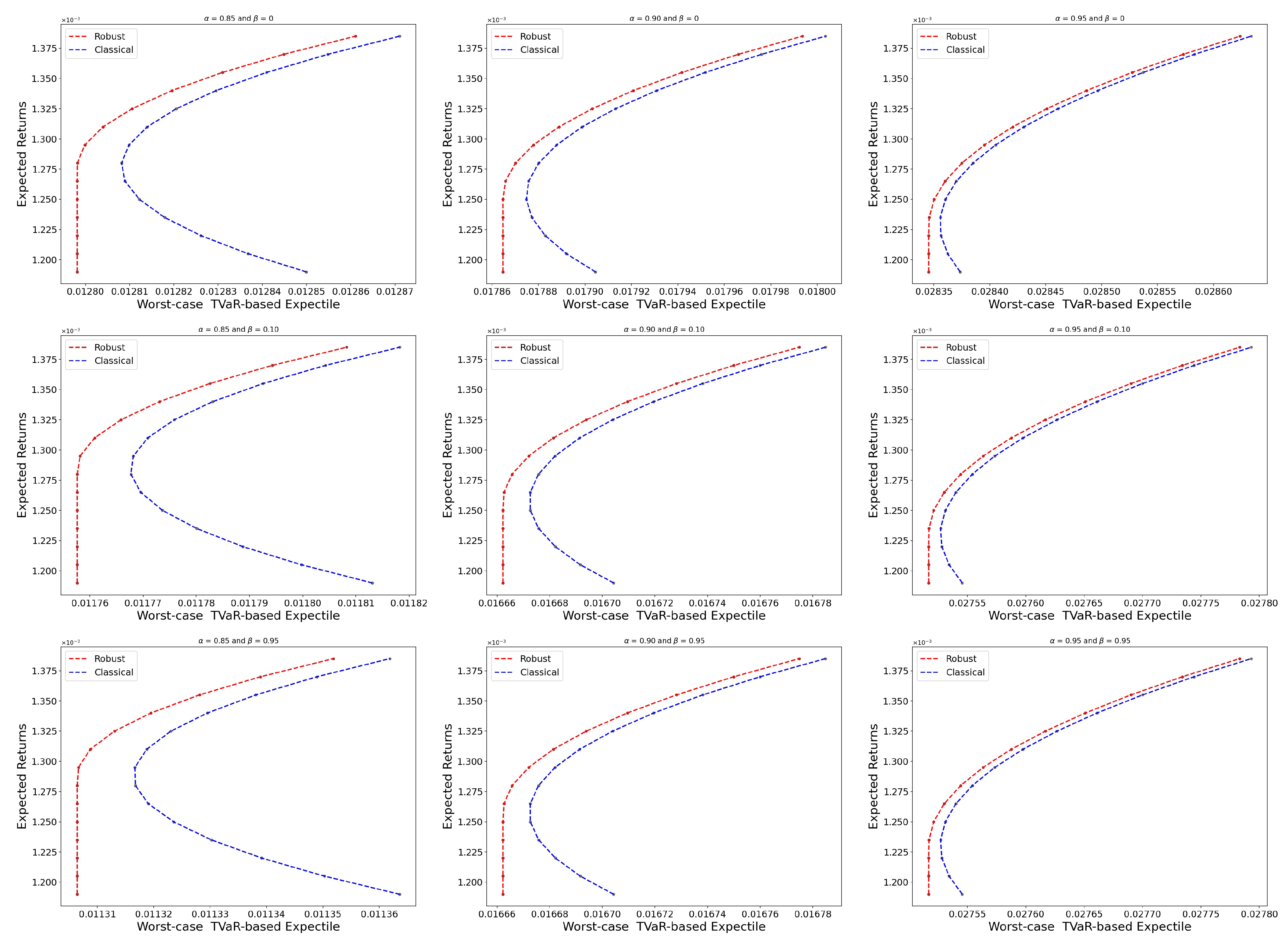
We obtain the worst-case TVaR-based expectile by setting various anticipated returns and inserting them into the theorem, where
, and
, respectively. The
Figure 1 displays the worst-case efficiency bounds generated by the robust portfolio and classical portfolio models. Note that the classical portfolio model is based on the mean-variance model to compute the optimal weights to bring into Equation (
19) in order to obtain the largest risk exposure achievable using the classical portfolio strategy.
Given the same desired return, the worst-case TVaR-based expectile of a robust portfolio strategy is less than the corresponding risk of a classical portfolio strategy. This is intuitive, as the objective of the robust model is to minimize the worst-case TVaR-based expectile. The following is an empirical examination of the performance of the robust portfolio model.
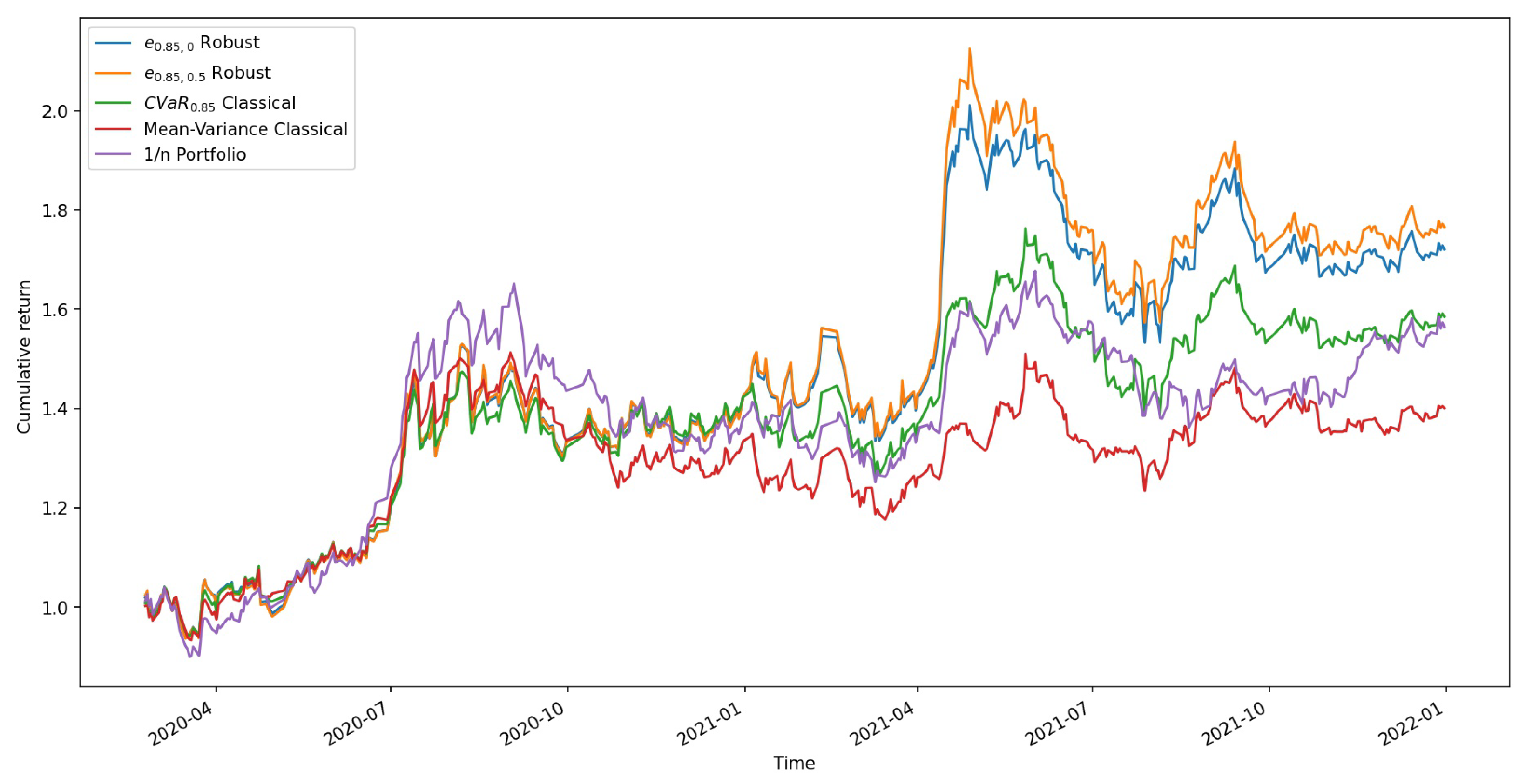
Using the first 30 days of stock data, and assuming an initial asset value of 1 and a sliding time window of 30 days, we determine the optimal weight vector for the various strategy models. Then, we utilize this weight vector for the following day’s investment and the return vector for that day to obtain the new asset value. Following this approach and advancing the data, we can finally obtain the cumulative returns for the various investment strategies from 2020 to 2022. The results are displayed in the
Figure 2.
The general trend in cumulative return values indicates a minor decline in the market in early 2020 due to COVID-19. During the decline, the robust portfolio was much more stable than other investment strategies, experiencing smaller decreases than other strategies. Due to the well-controlled epidemic in China, the subsequent swift recovery of the Chinese economy, and the general outstanding performance of the stock market, the portfolio has steadily gained value, with the equal-weighted investment model demonstrating the highest returns.
Nevertheless, due to market volatility, the other investment strategies lost more than the robust investment strategy during the stock market decline in 2021; therefore, the final findings indicate that the robust portfolio has the best cumulative return, followed by the CVaR-based portfolio model and finally the equal-weighted model and the mean-variance model. As a result, the robust investment model performs admirably in terms of both its robustness and its cumulative returns.
5. Conclusions
In this paper, to better capture the tail risk, we propose a class of new risk measures called TVaR-based expectiles. The basic properties of risk measures, such as monotonicity, translation invariance, positive homogeneity, and subadditivity are studied. In particular, the equivalent characterization of coherency is given. For a better understanding of TVaR-based expectiles for extreme risks, asymptotic expansions with respect to quantiles were investigated. In addition, the closed-form of the worst-case TVaR-based expectile under the moment uncertainty set was obtained, and based on this closed-form, the distributionally robust portfolio selection problem with the principle of the TVaR-based expectile was reduced to a convex quadratic program. The empirical results for financial data were given to illustrate the performance of the new risk measure compared with the classic expectile and TVaR. Compared with the classic expectile, our TVaR-based expectiles employ more conservative risk measures than expectations to evaluate the risks and, thus, put more weight on the tail risk, which is more reasonable in practice.