


Abstract
Let be a family of sets in (always ). A set is called -convex, if for any pair of distinct points , there is a set , such that and . A set of four points is called a rectangular quadruple, if is a non-degenerate rectangle. If is the family of all rectangular quadruples, then we obtain the right quadruple convexity, abbreviated as -convexity. In this paper we focus on the -convexity of complements, taken in most cases in balls or parallelepipeds.
MSC:
52A01; 52A37
1. Introduction
In 1974, the third author proposed at the meeting on Convexity in Oberwolfach the investigation of the following general convexity concept. Let be a family of sets in (always ). A set is called -convex, if for any pair of distinct points , there is a set , such that and [1].
Let . If, for , there exists a set , such that and , then we say that enjoy the -property in M.
If, for any , there exists a non-degenerate rectangle F, such that and , then we call the set M rectangularly convex, or r-convex, for short.
In [1] a very simple characterization of planar convex bodies which are r-convex is presented, but only as a conjecture. The characterization in the unbounded case is given in [1], not only in the plane, but also in the much harder 3-dimensional case.
For the case of planar convex bodies, the characterization was proven only for some particular families of sets, in [1] and by K. Böröczky in [2]. The general conjecture from 1980 is still open.
A set of four points is called a rectangular quadruple, if is a non-degenerate rectangle. If is the family of all rectangular quadruples, then we obtain the right quadruple convexity, abbreviated as -convexity. This notion has been introduced by Li, Yuan and Zamfirescu in [3], where the -convexity was also investigated in several directions. The motivation for studying the -convexity mainly came from the astonishing lack of knowledge about the rectangular convexity. More generalizations of r-convexity can be seen in [4].
For distinct points , let denote the line-segment from x to y, the line through , the hyperplane through x orthogonal to , and the hypersphere of diameter . For any compact set , the circumsphere of K is the smallest hypersphere containing K in its convex hull.
For any two affine subspaces , means that is parallel to , and means that they are orthogonal.
For a point and an affine subspace , let denote the orthogonal projection of x on L.
For , we denote by its convex hull, by its affine hull and by its relative interior, boundary and closure, which means in the topology of . Put , for . Such a set is called a polytope (polygon for ). We call a polytope, which is congruent with the Cartesian product of line-segments on the coordinate axes, a parallelepiped. Thus, all (planar) angles at the vertices of a parallelepiped are right.
A convex body is a compact convex set in with non-empty interior.
The space of all convex bodies in , equipped with the Pompeiu-Hausdorff metric, is a Baire space. We say that most convex bodies have a property , if those not enjoying P form a set of first Baire category in .
For a convex body , let denote the set of all its extreme points, i.e. points not interior to any line-segment included in M.
For any real number and point , let be the ball (always considered compact) of centre x and radius r.
In this short paper we focus on the -convexity of complements, taken in most cases in balls or parallelepipeds.
2. -Convexity of Complements
Li, Yuan and Zamfirescu [3] proved that the complement of any bounded set in is -convex. Here, we obtain the same, for open convex sets instead of bounded sets.
Theorem 1.
If is an open set and an open convex set different from Q, then is -convex.
Proof.
Let and . Suppose . At a and b, consider the supporting hyperplanes and of , respectively. For , if , then at least one (closed) half-hyperplane with , does not meet L. If , then take with , arbitrarily. Consider the analogous half-hyperplane . Its orthogonal projection onto meets . Now, choose and , both in M. Then is a suitable rectangular quadruple.
For , if and , then perhaps and cannot be chosen such that the intersection of with be more than . In that case, has two small diametrically opposite arcs, one starting at a and the other at b, both in M. Thus, is the diagonal of a rectangle with all its vertices in M.
If , the proof is easy. □
Notice that Q and L may be unbounded; also, M may be simply connected.
Theorem 2.
If is a parallelepiped and a convex body, then is -convex.
Proof.
Assume ; by Theorem 1, have the -property in .
Now, suppose that at least one of , say x, belongs to the boundary of K. If , then we are done for any , by using the orthogonal projections of y on an edge and a facet of K meeting at x, with .
Suppose . If lie on parallel facets of K respectively, then there are another two points in forming with a rectangular quadruple. If y lies on a facet orthogonal to or in , then take two points , such that and . Again, is a rectangular quadruple.
Let now , . First, assume . Consider . If is a supporting line of L, we can choose distinct from x, such that . If not, we choose a short line-segment disjoint from . If , then take . Suppose . For in the same half-plane of boundary , take . For in different half-planes, there are two antipodal points in close to . In all cases, (or in the latter case) is a suitable rectangular quadruple.
For , consider a plane parallel to an edge of a facet containing x. Now, working in the rectangle , we are in the case , if is a planar convex body. If not, the proof becomes trivial. □
Theorem 3.
Let be a ball. If is a closed set, then is -convex.
Proof.
Let and . If or , then we can easily find another two points in M forming with a rectangular quadruple.
Suppose . Then has two small opposite arcs of a great circle in M, starting at . They provide rectangular quadruples. □
Theorem 4.
Suppose is a parallelepiped. If is a closed set, then is -convex.
Proof.
Let and .
Case 1. . We find forming together with a rectangular quadruple.
Case 2. . We find a rectangle (or ) of small width, with all vertices in M. □
3. Complements of Polygons
Theorem 5.
If is a disc and a regular n-gon concentric with D, then is -convex.
Proof.
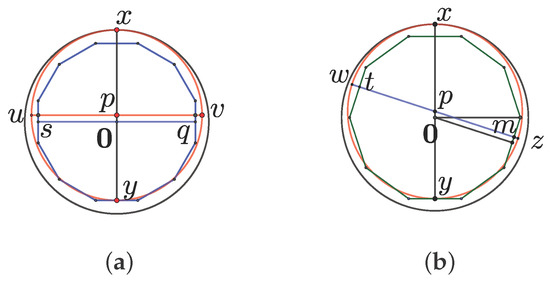
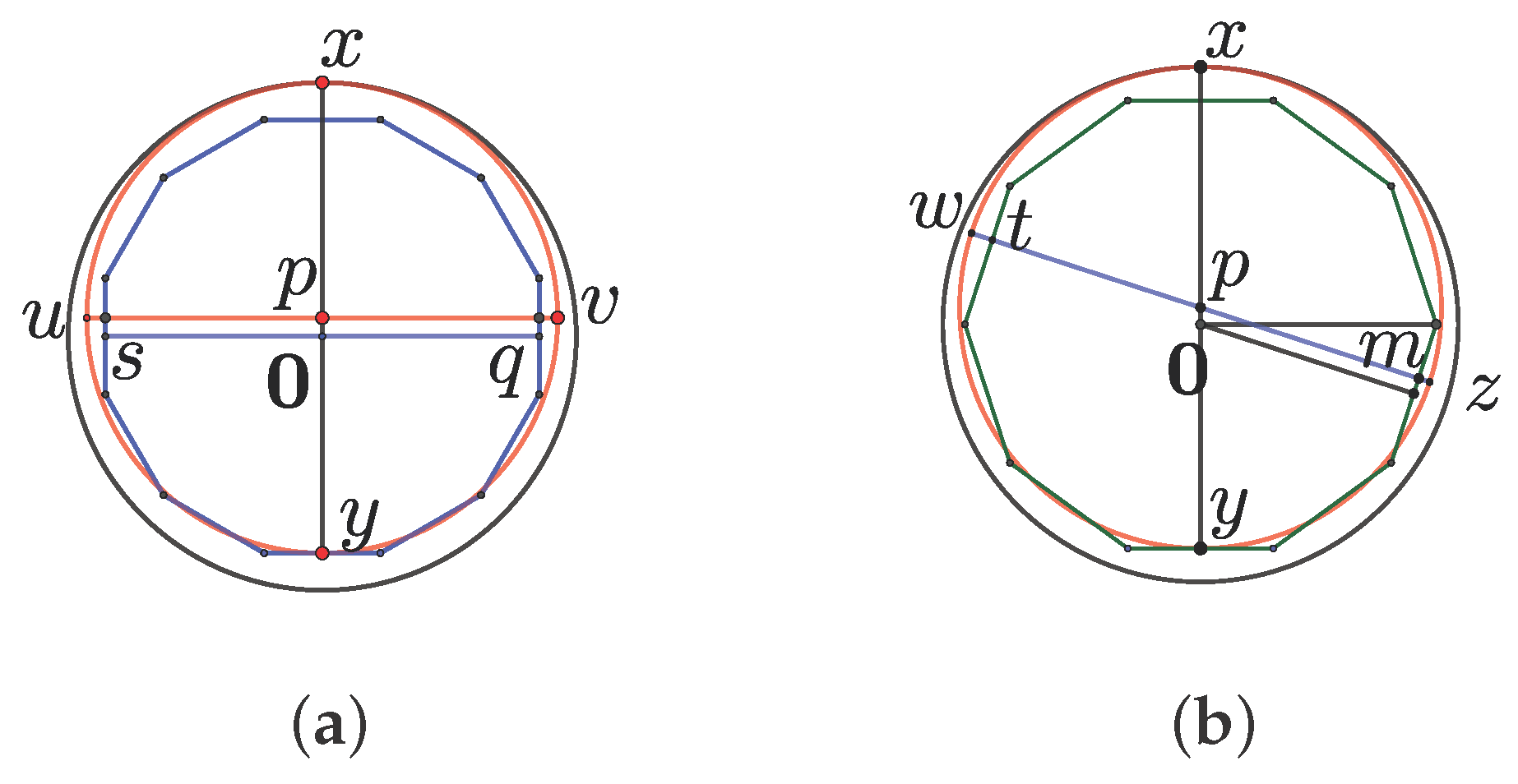
Assume that the centre of D is and its radius 1. For any , let be the supporting line of D at x. For any , denote by the edge of containing y. Suppose orthogonal to both and , and . Let the diameter of be orthogonal to , and set . If the side-length of P is , we have . Put .
If , then , because , where are the midpoints of the edges of P met by , see Figure 1a. For , we consider a diameter of forming with the angle , see Figure 1b. Let , such that and are separated by p on . We have and
Figure 1.
n is even. (a) ; (b) .
Hence, . A fortiori, , as .
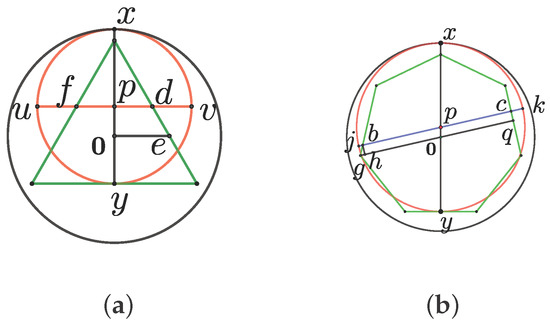
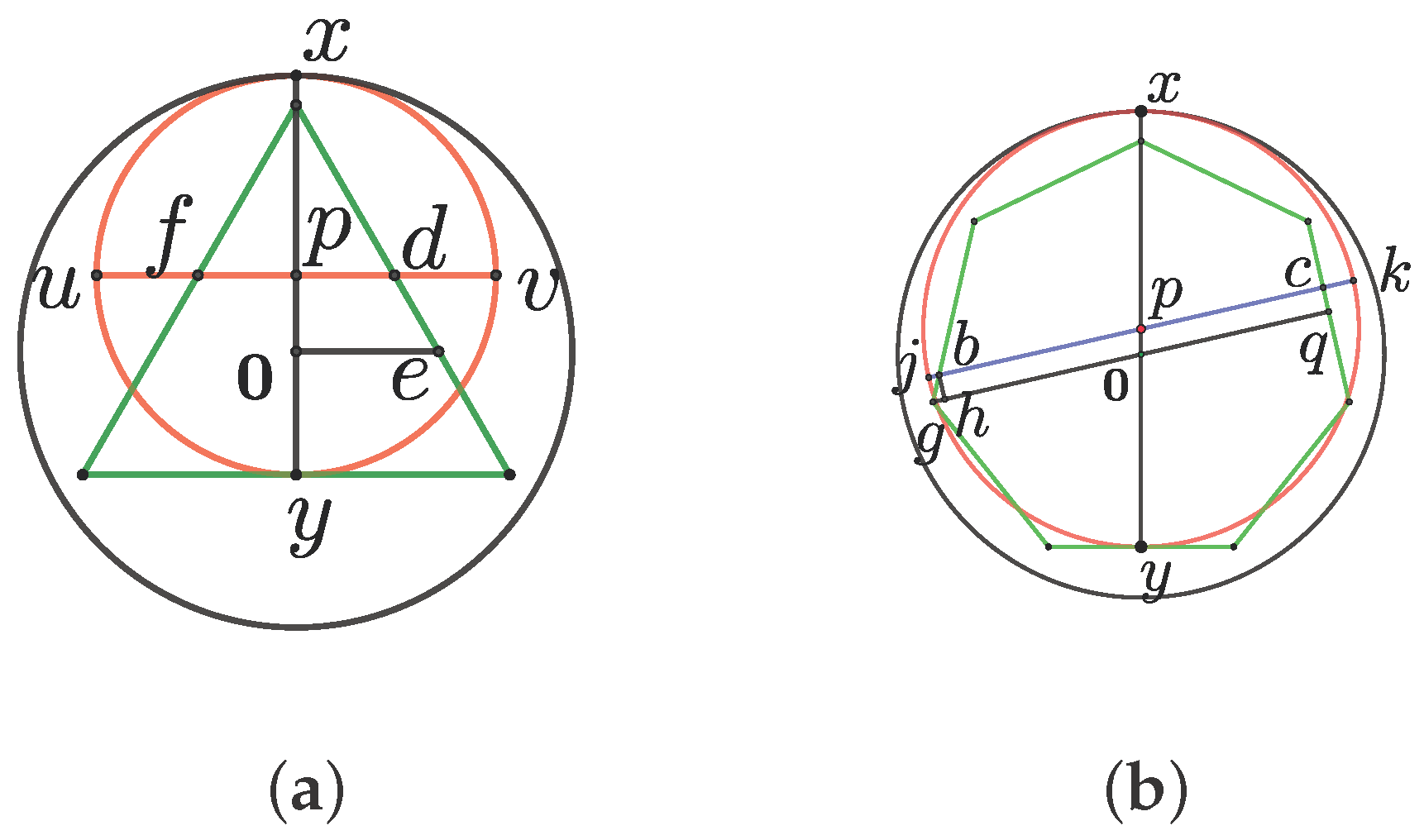
Suppose n is odd. If , then , see Figure 2a.
Figure 2.
n is odd. (a) ; (b) .
This is immediately seen. Thus, .
If , then take a diameter of forming with the angle , see Figure 2b. Let . The choice of guarantees the existence of and , such that and . Note that q is the midpoint of a side of P. Because
. Let
We have
The inequality yields
Because ,
which implies that . For all cases, we find (or or in , forming together with a rectangular quadruple lying in . □
Is the restriction to regular polygons in Theorem 5 essential? Take . Is a result similar to Theorem 5 valid for arbitrary triangles? Our next theorem affirmatively answers this question, but adds a condition on the size.
Theorem 6.
Let be a unit disc, T a triangle with its circumcircle concentric with D. If the radius of is no more than , then is -convex.
Proof.
Let , be the centre of D and . Consider orthogonal to both and , defined as in the preceding proof.
Suppose T is a non-acute triangle; thus, is the midpoint of . Assume that the radius of is . If and , such that b and e are not separated by , we find out that are collinear. Only in case , is a half-circle. Then the four points , x and lie in . In case T is obtuse, we have the same rectangular quadruple in M. If , then the intersection of and can not determine a diameter of . We can easily choose two antipodal points of in M different from .
If T is an acute triangle and y is the midpoint of , then is lager than . Assume that contains a half-circle of . Then is at least , contradicting the assumption that T is an acute triangle. Hence, there are always two antipodal points of , forming together with a rectangular quadruple in M. □
4. Generic Results
In this section, like in the previous one, we consider complements of interiors of convex bodies in discs. We want now to see what happens with most of them.
Consider a convex body . Let be the set of all points , such that the vector v is external normal at v to K. In other words, and some supporting line H at v are orthogonal, and H does not separate from .
For , and denote the lower and the upper curvature radius of at x (see H. Busemann [2], p. 14). If , the common value is the curvature radius and its inverse is the curvature of K at x.
Theorem 7.
Let be a disc of centre . For most convex bodies , at each point , the upper curvature of is at least .
Proof.
We may consider only convex bodies K with and , as those K not satisfying these conditions form a nowhere dense set.
For , let be the set of all , such that, for some , , where is the disc of centre o, such that and . Clearly, at such a point x, the lower radius of curvature of is at least .
We show now that, for every n, is nowhere dense in .
Let be open. We choose a polygon . Every point is a vertex of P or lies on an edge orthogonal to x. We may choose P such that no point of is a vertex of P belonging to an edge orthogonal to x.
If , take close to the endpoints of and replace P by
After doing so for all (finitely many) points which are not vertices of P, we obtain a convex body .
It is easily checked that . As is closed, a whole neighborhood of Q is disjoint from . Thus, is nowhere dense. Therefore, is of first Baire category.
This implies that, for most , at every , the lower radius of curvature of is at most . The theorem is proved. □
Theorem 8.
Let be the unit disc of centre and a convex body. If, at each point , , then is -convex.
Proof.
We verify the -property at . The only interesting case is for (internal) normal to both K and D (). In this case, . By hypothesis, . So, has points outside of K arbitrarily close to x, and includes a whole arc in containing y. Thus, diametrally opposite points different from can be found in . The -property at is verified. □
Theorem 9.
Let be a disc. For most convex bodies , is -convex.
Proof.
We may assume that D is the unit disc of centre . For most convex bodies , and . By Theorem 7, at each point , .
Hence, by Theorem 8, is -convex. □
5. Conclusions
The conjectured characterization of r-convexity in the plane does not leave much hope for a great variety of convex bodies to be -convex, the two notions being equivalent in the convex case. But for non-convex sets our paper revealed a lot of diversity.
Author Contributions
Conceptualization, T.Z. and L.Y.; writing—original draft preparation, X.H.; writing—review and editing, T.Z.; supervision, T.Z.; project administration, L.Y. All authors have read and agreed to the published version of the manuscript.
Funding
The work is support by NSF of China (12271139, 11871192), the Program for Foreign experts of Hebei Province (2019–2021), the program for 100 Foreign Experts Plan of Hebei Province, the Program of China Scholarships Council (202108130139).
Data Availability Statement
Not applicable.
Conflicts of Interest
The authors declare no conflict of interest.
References
- Blind, R.; Valette, G.; Zamfirescu, T. Rectangular convexity. Geom. Dedicata 1980, 9, 317–327. [Google Scholar] [CrossRef]
- Busemann, H. Convex Surfaces; Interscience Publishers: New York, NY, USA, 1958. [Google Scholar]
- Li, D.; Yuan, L.; Zamfirescu, T. Right quadruple convexity. Ars Math. Contemp. 2018, 14, 25–38. [Google Scholar] [CrossRef]
- Yuan, L.; Zamfirescu, T. Generalized convexity. Acta Math. Sin. in press.
Disclaimer/Publisher’s Note: The statements, opinions and data contained in all publications are solely those of the individual author(s) and contributor(s) and not of MDPI and/or the editor(s). MDPI and/or the editor(s) disclaim responsibility for any injury to people or property resulting from any ideas, methods, instructions or products referred to in the content. |
© 2022 by the authors. Licensee MDPI, Basel, Switzerland. This article is an open access article distributed under the terms and conditions of the Creative Commons Attribution (CC BY) license (https://creativecommons.org/licenses/by/4.0/).