Abstract
Authentication protocols are often used in smart grids to deliver the necessary level of security. A huge number of clients in such a system, however, provides the attacker with the ability to clone them, for example. Device fingerprints, or Physically Unclonable Functions (PUF), have been investigated as an authentication feature to thwart such attacks. In order to accomplish the necessary security in smart grid neighborhood area network communications and to prevent unwanted physical access to smart meters, a former study designed a lightweight authentication system in this way. The suggested protocol uses PUFs to reduce physical attacks. As a consequence, the server/meter impersonation attack is one of the many assaults that this protocol is thought to be secure against. On the other hand, it is generally acknowledged that no security solution should be trusted unless its security has been verified by independent researchers. As a result, this paper assesses the security of this protocol against a typical adversary who has access to or influences over the messages carried over the public channel. This study demonstrates that the attacker is simply capable of impersonating the server for the meter and vice versa. In addition, the suggested attacks desynchronize them, making the adversary the only one capable of interacting with the meter in the role of the legal server rather than the latter. Each of the proposed attacks is extremely effective, and their success probability is almost 1. Finally, a modification is suggested that successfully fixes the protocol’s security weaknesses. The security proof of the improved protocol has been done through the Scyther tool. The computational cost comparison shows that the overhead of the proposed protocol compared to the former scheme is 4.85%, while it withstands various attacks, including traceability, desynchronization, impersonation, man-in-the-middle, and secret disclosure attacks.
Keywords:
Internet of things; IoT; smart grid; smart city; key agreement; physically unclonable functions; security MSC:
94A60; 68M12; 68Pxx
1. Introduction
Smart grids play an important role in smart cities and are a promising technology for improving power system reliability, flexibility, and efficiency. Information and communication technologies are the basic infrastructure in a smart grid. However, assuming that the network is accessed and controlled by adversaries, this technology poses significant risks. To overcome such disadvantages, authentication protocols play an important role in determining whether a user is a friend or foe. An authentication protocol is a series of information exchanges between two or more parties to determine whether a specific party is legitimate or not. In distributed systems, such as Internet of Things (IoT) systems and smart grids, edge clients/devices are distributed throughout the field. Hence, it could not be possible to use physical protection in many cases, and, as a result, they are vulnerable to adversarial access. Such an adversary, for example, may read their memory and attempt to clone them. If there is a human involved in the authentication process, it is possible to use other factors to provide a higher level of security. Smart card-based user name and password, for example, may be used to increase the security in that case [1,2,3,4] or the user’s biometrics [5,6,7,8]. However, the main challenge for employing multifactor authentication for many embedded devices, such as smart meters, is the fact that they should work 24/4 and be independent of the operator in many cases. Hence, researchers find a dual fingerprint for devices, which is known as a physically unclonable function (PUF) [9,10,11,12,13,14]. Although it could be a promising solution (assuming that PUFs behave fully reliable and randomly), the response is not entirely random, and the proposed protocol could be a target of modeling attacks [15,16,17,18,19], if the adversary accesses the PUF’s input/output.
1.1. Motivation
Following the provided argument, to realize their full potential, smart grid applications require a dependable, lightweight, and fast authentication system [20]. One of the most difficult security challenges in the smart grid is protecting the meters, as well as embedded devices in general, from security breaches that could have disastrous consequences [21]. Among the various proposals to improve the security of smart grids, those that consider physical access to meters are more realistic and can achieve a higher level of security [22]. The reason is that the meters are distributed throughout the field, and an adversary can always access them to read their memory, for example, to clone them. As a result, security based on stored credentials could not withstand attacks based on such access. A common approach to providing security against this type of attack is multi-factor authentication, and among various approaches, using a physically unclonable function (PUF) as a hardware fingerprint has recently received a lot of attention [22]. However, such a solution should provide sufficient security requirements to be applicable to transferring sensitive data.
1.2. Challenge
A former study proposed a lightweight mutual authentication for smart grid neighborhood area network communications based on PUF [23]. Designers provided formal and informal security analysis and claimed protection against a variety of attacks, including impersonation. However, this protocol, similar to any other security solution, should be investigated independently to highlight its pros and cons. To the best of our knowledge, no independent detailed security analysis for this protocol has been reported in the literature. Hence, this paper is aimed at addressing this shortage by shedding light on its security.
1.3. Our Contribution
The main contribution of this paper is to shed light on the security of a PUF-based authentication protocol for smart grid applications, which has been recently proposed in a former study [23]. Although the protocol is very lightweight and has several interesting features that make it a good candidate for the target application, this paper shows that the adversary can easily impersonate the server or the meter and can also desynchronize them permanently. Following the proposed attack in this paper, the adversary could be the only entity that can communicate with the meter as the legitimate server. In addition, an amendment is proposed that effectively addresses the protocol’s security flaws.
1.4. Related Works
Following the protocol discussed in this paper, i.e., [23], nearly the same team of authors [24,25,26] and other researchers [27,28] proposed or analyzed new related schemes, which are worth noting in this section to highlight later advances in this field of research. Among those studies, [26] dedicated to designing a PUF on an FPGA. They specifically proposed an FPGA-based Anderson PUF and tested it on Spartan-6 family Xilinx XC6SLX9 FPGAs. Their finding shows that the proposed structure increases the unpredictability of the designed PUF while decreasing the required area overhead. Aghapour et al. proposed a lightweight protocol [25] that provides mutual authentication using a hash function as the main cryptographic primitive. Although the proposed protocol considered smart grid neighborhood area network communications, it does not employ PUF and by nature, any node can tamper with such an application. In addition, one of the messages is computed as where is a random value, is a data packet, and is the latest shared key. The shared key is updated after each successful session, first by the smart meter and then by the gateway NG. However, assuming the adversary allows to receive the message properly and update its session key to but blocks the sent message to NG, then they desynchronized because does not keep a copy of . Even in that case, the protocol does not provide full security of if it is assumed has enough low entropy and can be predicted by the adversary because . Hence the expected complexity of finding is while it should be , where denotes the entropy function. In a later research, Aghapour et al. [24] proposed another protocol for smart grid applications that again uses the hash function to provide desired security. An interesting feature of this protocol is the use of a hash key chain to provide forward secrecy. However, if the adversary has access to , it can tamper with it. In addition, in this protocol, the NG’s command is sent in plain text, which may not be desirable in some applications. Baghestani et al. [27] recently examined the security of a proposed authentication protocol by Kumar et al. [29] and demonstrated that smart meters are traceable in that protocol. Besides that, they proposed an elliptic curve cryptography (ECC)-based authentication protocol for smart grid applications. However, ECC is very time-consuming and may not be applicable in constrained environments. In addition, it also does not provide security against cloning attacks because it does not use PUF. Moreover, it can not withstand advanced attacks such as key compromise impersonation. Among the most recent research in this field is [30], which proposes a lightweight PUF-based authentication protocol for smart grid applications. Although the proposed protocol has interesting features compared to other related works such as [31,32], it has two important drawbacks. First, in a part of the protocol, the meter identifier is sent over a public channel plain, which is enough to trace it and compromise its anonymity. The second drawback is sending the PUF’s response to the network gateway. Hence, it could be a target for modeling attack by an insider.
Therefore, there is still enough room to do research in this field and design a secure protocol for smart grid applications. On the other hand, any new protocol should be evaluated by third parties to ensure its security, which emphasizes the necessity of this research and other related works.
1.5. Paper Organization
In the remainder of this article, the necessary notations and a description of the former protocol are provided in Section 2. Then, in Section 3, the conducted attacks against this protocol are introduced. In Section 4, the improved protocol and its evaluation are presented. Finally, the paper is concluded in Section 6.
2. Review of Former Scheme
Each phase of the former protocol, which has been proposed by Kaveh and Mosavi [23] and we call it KM-protocol, is briefly explained in the following section, using the list of notations in Table 1.
Table 1.
Used notations.
As previously stated, KM-protocol is a lightweight authentication protocol for smart grids. The proposed protocol takes into account a neighborhood area network (NAN) in which a neighborhood gateway (NG) collects electricity data from hundreds of smart meters (SM). To gain a better understanding of the PUF-based KM-protocol, it is explained how it works in this section, and then its vulnerabilities are shown in the following section. The KM-protocol is divided into two phases: secure installation and secure communication. Secure Installation Phase: A smart meter must be registered by a neighborhood gateway before communication begins. As a result, the smart meter first sends and a from the PUF function to NG, where . This data is saved in the database of the NG. As a result, the NG can use them in the authentication process, and the deletes from its memory.
Secure communication Phase: The following are the steps in the authentication process:
- Step one:
- 1.
- The of the is sent to the NG.
- Step two: The NG searches its database for a field that matches the received. If a duplicate item is discovered, then:
- 1.
- It obtains the associated for the received and generates two random numbers, and .
- 2.
- Then A and V are calculated as and , where is the timestamp of NG.
- 3.
- NG replies to .
- Step three: Upon receiving the messages, given , the calculates and obtains and from , where should be almost similar with the ’s timestamp . Afterwards, given and , it verifies V and if the verification is passed:
- 1.
- By generating a random number , calculates a new challenge as .
- 2.
- Based on the new response , it generates .
- 3.
- Then computes E and as and .
- 4.
- Finally it transfers to NG and deletes all stored variables.
- Step four: After receiving the messages, by using the NG obtains , and . Then in order to verify , it computes . If the verification holds, the NG:
- 1.
- Compares with the existing report format. If the comparison holds, it accepts the messages.
- 2.
- NG calculates as the new challenge and saves as a new CRP for the next authentication process.
- 3.
- It accepts all messages and finishes a successful mutual authentication process.
Because the KM-protocol employs the concatenation (‖) and XOR (⊕) operations in its computation, the given property in Equation (1) is recalled:
where x, y, u, and v are appropriate strings. This property is used in the proposed analysis.
3. Cryptanalysis of KM-Protocol
Although the designer of the KM-protocol [23] claimed optimum security against various attacks in the context, important attacks against the KM-protocol are presented in this section using the same adversarial model and an ideal PUF model. More specifically, assuming that the adversary eavesdrops and stores the sent messages from NG to , i.e., and . The timestamp in this message is , which is known to all participants, including the adversary. Furthermore, assuming the adversary intends to impersonate NG to at a desired time , it computes and sends to when sends its , where . It is obvious that:
After receiving the message, given , the calculates and obtains and from , and verifies whether:
As a result, following Equations (2) and (3), the adversary will be authenticated by with a probability of ‘1’, at any time . It shows that, contrary to what the designers claim, the KM-protocol is vulnerable to impersonation attacks.
Next, a impersonation attack is proposed that will desynchronize both and NG. Consider a valid session between and NG in which sends its to NG and receives and again computes and transfers . The adversary stores , and but prevents NG form receiving , where , and . As a result, NG does not update its record. The adversary then does the following procedure:
- 1.
- Sends to NG.
- 2.
- NG retrieves the related and generates and and computes and and replies to the , which is impersonated by the adversary.
- 3.
- The adversary computes . Given that timestamp is a public value, the adversary can compute and extract and from . Next, the adversary computes , and returns to NG.
- 4.
- NG obtains as follows:It also obtains as follows:and verifies whether:
Following the above attack, the adversary was successfully authenticated as a legitimate . NG, on the other hand, calculates as a new challenge, saves as a new CRP for the next authentication process, and deletes from its database. It means that NG has a new that is almost certainly not a valid CPR for the embedded PUF within . Therefore, NG is no longer recognized as valid by , indicating that the adversary successfully desynchronized them. The adversary who stored , and is now the only entity that can communicate with as a result of the proposed NG impersonation attack.
4. Proposed Protocol
In this section, the KM-protocol is modified as little as possible to counter the proposed attack in this paper, and the security and efficiency of the revised protocol are discussed in comparison to the original protocol.
Suggested Remedy
The main reason for carrying out the proposed attacks is the adversary’s ability to manipulate messages via the XOR operation. Hence, to avoid the proposed attacks, it is recommended to overcome the adversary’s current control over the transferred messages.
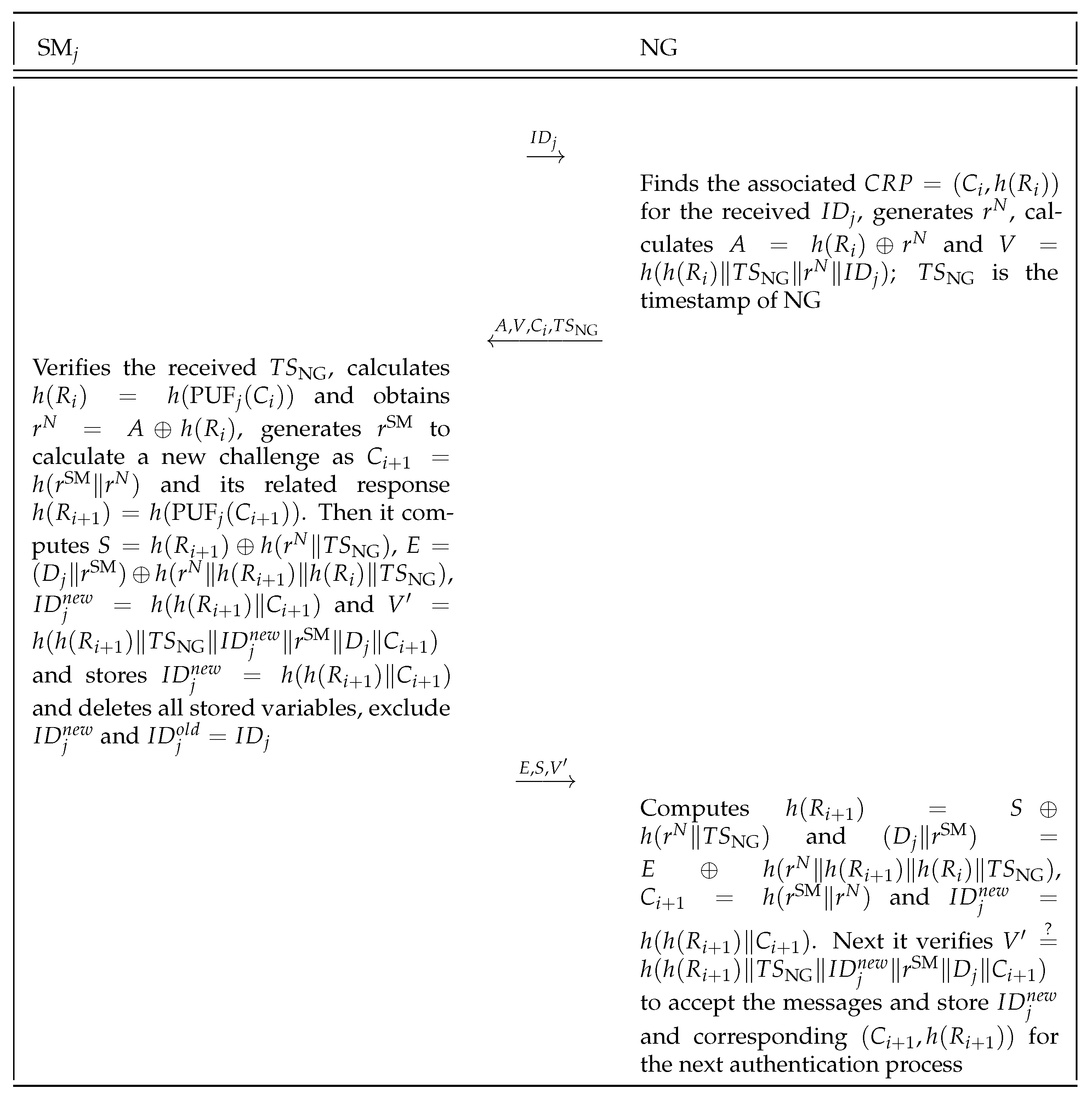
To be more precise, similar to the KM-protocol, the improved protocol also includes two phases: secure installation and secure communication. The secure installation phase is unaffected by the revised protocol, except that are sent to the NG instead of the KM-protocol’s . However, the steps in the authentication process (authentication phase) is revised as follows:
- Step one:
- 1.
- sends its to the NG, if it fails uses the .
- Step two: NG looks up the associated with the received and generates a random number . Following that, A and V are calculated as and , where is the NG timestamp. Then NG responds to with .
- Step three: When the messages are received, verifies the received and, given , calculates and obtains . Following that, it verifies V before generating a random number in order to calculate a new challenge as . Then it computes , , and . Finally it transfers to NG, stores new and deletes all stored variables, exclude and .
- Step four: After receiving the messages, NG computes and , and . Next it verifies whether to accept the messages. Then, NG stores and corresponding for the next authentication process.
The authentication phase of the improved protocol is depicted in Figure 1.
Figure 1.
Mutual authentication phase of proposed protocol.
5. Security and Cost Evaluation of the Improved Protocol
When the computations of V and in the KM-protocol and the proposed protocol are compared, it is clear that the main difference is that ⊕ is replaced with ‖ and is included in the computation of . These changes successfully prevent the proposed attacks. Following this fix, it is extremely difficult to impersonate NG or by replaying a message with a timestamp at another timestamp. Furthermore, any change in A, E, or S affects or , and is not verified by NG. Hence, the proposed meter impersonation attack will fail as well. On the other hand, the adversary cannot perform the proposed desynchronization attack if s/he cannot impersonate the meter . In the rest of this section, the security of the proposed protocol is presented in more detail. Through the analysis, an active adversary with access to the transferred messages over the public channels, i.e., , is considered, where:
5.1. Replay Attack
Through a replay attack, the adversary aims to use an eavesdropped message from an early time at a later time to impersonate a protocol entity. The current timestamp is used in the computation of and in the proposed protocol, similar to the KM-protocol. Hence, this protocol does not suffer from replay attacks.
5.2. Impersonation Attack
Given that it is not feasible to do a replay attack; the adversary should manipulate the transferred messages to do a successful impersonation attack. In order to impersonate NG, the adversary must return a valid tuple , which corresponds to the current timestamp . However, it is not possible to compute without first knowing . However, the only way to get that value is from , which is masked by a new random value, or from the previous , which is masked by once more. Hence, the adversary has no significant chance to impersonate NG. To impersonate SM, however, the adversary must return a valid set of and for the given time . On the other hand, and the adversary requires to compute it. Given that the only way to get that value is via or , that are masked, this protocol does not suffer from impersonation attacks.
5.3. Traceability and Anonymity
As long as the protocol’s entities have not participated in a successful session, and remain unaffected in the proposed protocol, but they will be randomized in the next session as and . The adversary cannot track the target SM for an extended period of time because and are also masked. Other parameters, such as and V, are randomized by session-dependent ephemeral values and therefore cannot be traced. Hence, this protocol provides long-term untraceability.
5.4. Secret Disclosure Attack
In the proposed protocol, the secret parameter is the PUF’s response and it is masked by ephemeral values through different sessions, i.e., and . Hence, the adversary has no chance to retrieve the PUF’s response, which guarantees the protocol’s security against secret disclosure attacks.
5.5. Man-in-the-Middle Attack
If the adversary is able to change the transferred messages without being detected, then it has conducted a successful man-in-the-middle attack. The structure of and have been selected such that the integrity of the transferred messages is guaranteed. Therefore, the proposed protocol provides the desired security against man-in-the-middle attacks.
5.6. Permanent De-Synchronization Attack
To do a permanent desynchronization attack, the adversary should successfully do an impersonation attack or act as a man-in-the-middle. Following Section 5.2 and Section 5.5, the adversary has no chance to conduct such attacks. Hence, the proposed protocol resists permanent desynchronization attacks.
5.7. Modeling Attack
To do a modeling attack, the adversary needs access to several challenge/response pairs of the target PUF. Any adversary that monitors the channel has access to the challenges, but the responses are masked by ephemeral session-dependent values. Hence, such an adversary cannot model the embedded PUF. Because it has access to the exact response of PUF, a malicious NG can do this against the KM-protocol. However, in the proposed protocol, it has , not the exact . Therefore, the proposed protocol does not suffer from a modeling attack.
5.8. Scyther
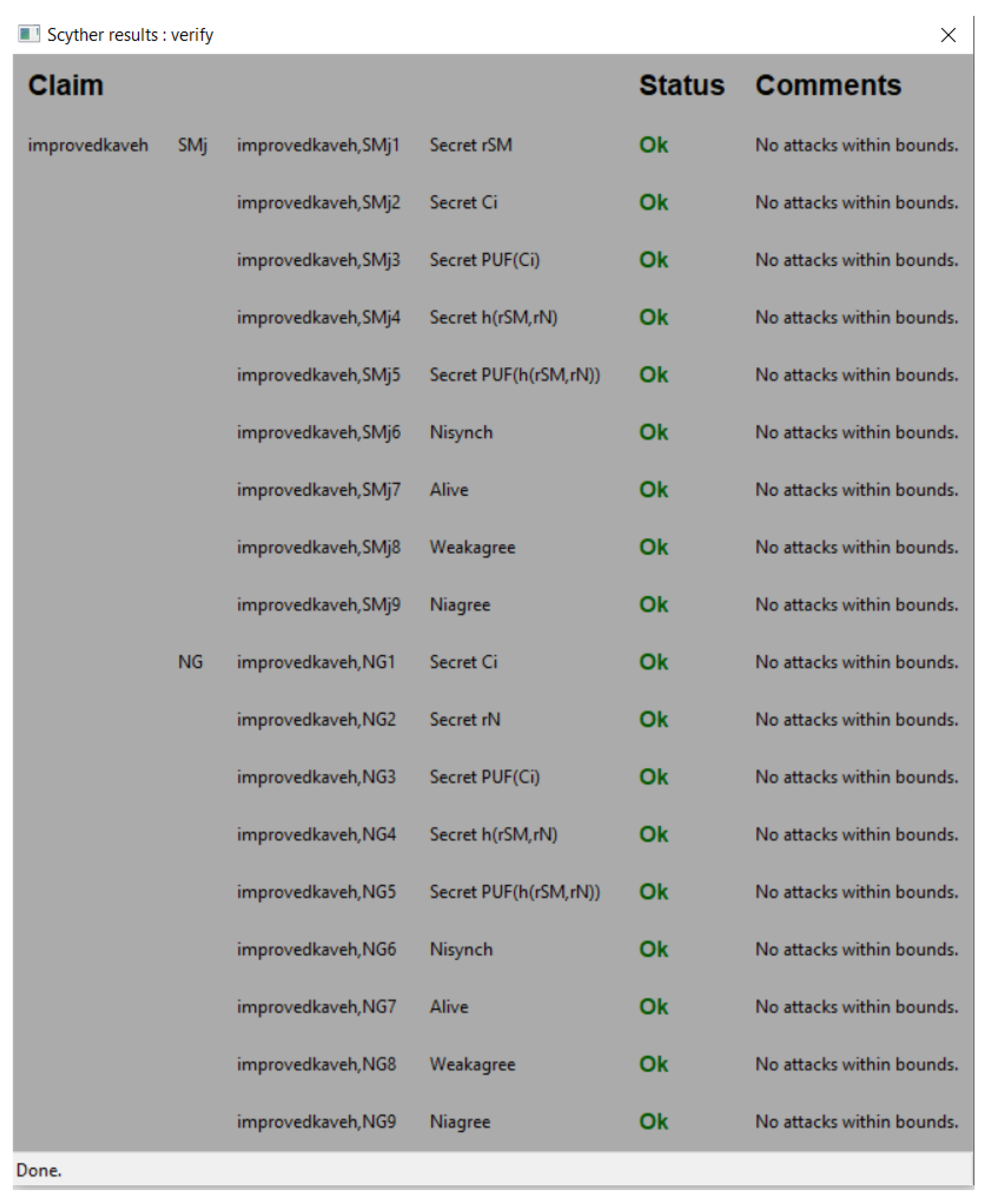
To verify the security of the proposed protocol formally, it has been modeled using SPDL and verified by the Scyther tool [33]. The evaluation results are represented in Figure 2, which confirms the security of the proposed protocol.
Figure 2.
Security evaluation of the proposed protocol using Scyther tool.
5.9. Cost Analysis
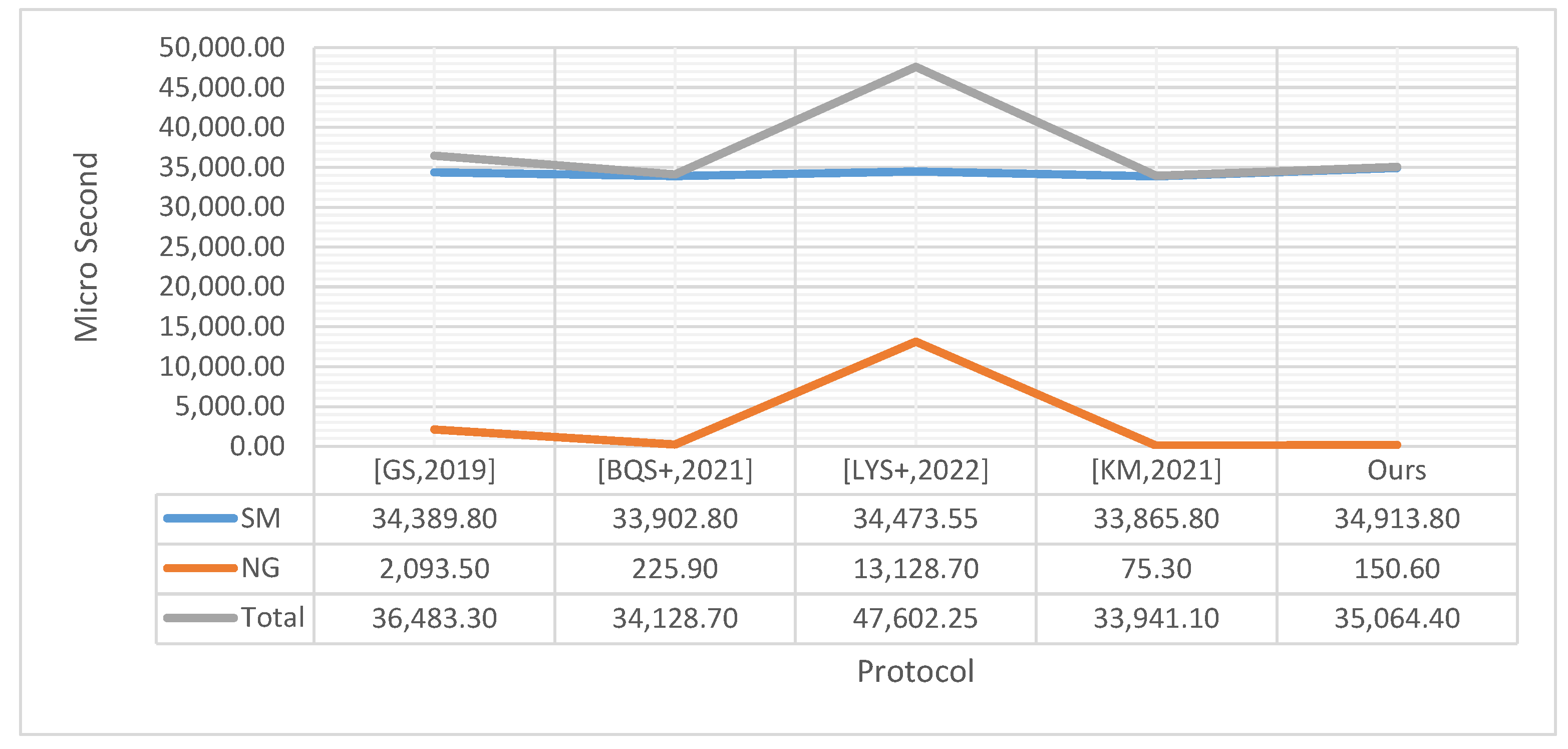
The computational cost of the improved protocol with KM-protocol and other related protocols for smart grids is compared and represented in this section. Through this analysis, , , , , and are used respectively to denote the computational time of a call to symmetric encryption/decryption, a one-way hash function, a PUF operation, the data generation and reproduction algorithm of the fuzzy extractor, and ECC point-multiplication. The expected time of those primitives is quoted from [30] and presented in Table 2, taking into account an embedded platform with a quad-core Cortex-A72 (ARM v8) 64-bit SoC at 1.5 GHz as NG and a MSP430FR5969 microcontroller as the meter. Since the PUF output is noisy, a fuzzy extractor should be used while regenerating the PUF response. Hence, to be fair, that time is added to the protocols whenever it is applicable, e.g., in the KM-protocol and the proposed protocol.
Table 2.
Cost comparison of different primitives in micro-second, when a Quad-core Cortex-A72 (ARM v8) 64 bit SoC 1. 5GHz as NG and a MSP430FR5969-microcontroller as the meter1 [30].
The details of each protocol computation and the approximate computation time based on the above-mentioned setup are provided in Table 3 and also depicted in Figure 3. Following the provided comparison, the overhead of the proposed protocol compared to the KM-protocol is only 4.85%, which is acceptable compared to the provided security level.
Table 3.
Cost comparison of different protocols versus the proposed protocols.
Figure 3.
Comparison of the computational cost of the proposed protocol and related protocols ( [GS,2019] [31]; [BQS+,2021] [32]; [LYS+,2022] [30]; [KM,2021] [23]; Ours: Figure 1).
6. Conclusions
This paper proposes several successful and efficient attacks against a recently proposed PUF-based protocol for smart grid applications, i.e., KM-protocol. The adversary can impersonate any protocol party, such as NG or , after monitoring a KM-protocol session and initiating another consequence session. Furthermore, following the proposed “SM” impersonation attack, “NG” and “SM” will be permanently desynchronized. The legitimate NG, on the other hand, can no longer communicate with the target , whereas the adversary can communicate with at any time.
Minor changes to the KM-protocol were proposed to counter the proposed attacks and remedy the KM-protocol, which almost entirely prevent the aforementioned flaws at insignificant extra cost when compared to the original protocol.
It is worth noting that the KM-protocol sends the meter identifier, i.e., , over the public channel, which allows for a traceability attack and compromises the meter’s anonymity. This attack was taken into account in the proposed alternative; however, it is still possible to trace a meter as long as it has not participated in a successful session of the protocol. One simple solution is to mask its identifier in the first step, such as by sending . Although the such protocol provides anonymity in this manner, the outcome is not scalable. It is possible to revise the protocol to provide scalability as well, but this will increase the protocol’s cost, so it is left for future work.
Author Contributions
N.B.: Conceptualization, Methodology, Validation, Writing; M.S.: Experimentation, Validation, Writing—review & editing, S.A. Conceptualization, Methodology, Experimentation, Validation, Writing—review & editing, M.H.M.: Experimentation, Validation, review & editing, O.H.A.: Experimentation, Validation, Writing—review & editing; M.H.: Methodology, Designing, Experimentation, Validation, Supervision, Review, Funding & editing; A.H.M.: Experimentation, Designing, Validation, Writing—review & editing. All authors have read and agreed to the published version of the manuscript.
Funding
This research received no external funding.
Institutional Review Board Statement
Not applicable.
Informed Consent Statement
Not applicable.
Data Availability Statement
For any supplementary material, please contact the corresponding authors.
Conflicts of Interest
The authors declare no conflict of interest.
Abbreviations
The following abbreviations are used in this manuscript:
| IoT | Internet of Things |
| SG | Smart Grid |
| NAN | Neighborhood Area Network |
| SM | Smart Meter |
| NG | Neighborhood Gateway |
| PUF | Physically Unclonable Function |
| A Challenge-Response Pair | |
| Timestamp | |
| The unique identifier |
References
- Juang, W.S.; Chen, S.T.; Liaw, H.T. Robust and Efficient Password-Authenticated Key Agreement Using Smart Cards. IEEE Trans. Ind. Electron. 2008, 55, 2551–2556. [Google Scholar] [CrossRef]
- Tsai, J.L.; Lo, N.W.; Wu, T.C. Novel Anonymous Authentication Scheme Using Smart Cards. IEEE Trans. Ind. Inform. 2013, 9, 2004–2013. [Google Scholar] [CrossRef]
- Shunmuganathan, S.; Saravanan, R.D.; Palanichamy, Y. Secure and Efficient Smart-Card-Based Remote User Authentication Scheme for Multiserver Environment. Can. J. Electr. Comput. Eng. 2015, 38, 20–30. [Google Scholar] [CrossRef]
- Odelu, V.; Das, A.K.; Goswami, A. A Secure Biometrics-Based Multi-Server Authentication Protocol Using Smart Cards. IEEE Trans. Inf. Forensics Secur. 2015, 10, 1953–1966. [Google Scholar] [CrossRef]
- Badhib, A.; Alshehri, S.; Cherif, A. A Robust Device-to-Device Continuous Authentication Protocol for the Internet of Things. IEEE Access 2021, 9, 124768–124792. [Google Scholar] [CrossRef]
- Zhang, R.; Xiao, Y.; Sun, S.; Ma, H. Efficient Multi-Factor Authenticated Key Exchange Scheme for Mobile Communications. IEEE Trans. Dependable Secur. Comput. 2019, 16, 625–634. [Google Scholar] [CrossRef]
- Ryu, J.; Oh, J.; Kwon, D.; Son, S.; Lee, J.; Park, Y.; Park, Y. Secure ECC-Based Three-Factor Mutual Authentication Protocol for Telecare Medical Information System. IEEE Access 2022, 10, 11511–11526. [Google Scholar] [CrossRef]
- Liu, Z.; Guo, C.; Wang, B. A Physically Secure, Lightweight Three-Factor and Anonymous User Authentication Protocol for IoT. IEEE Access 2020, 8, 195914–195928. [Google Scholar] [CrossRef]
- Adeli, M.; Bagheri, N.; Martín, H.; Peris-Lopez, P. Challenging the security of “A PUF-based hardware mutual authentication protocol”. J. Parallel Distrib. Comput. 2022, 169, 199–210. [Google Scholar] [CrossRef]
- Cao, J.; Li, S.; Ma, R.; Han, Y.; Zhang, Y.; Li, H. RPRIA: Reputation and PUF-Based Remote Identity Attestation Protocol for Massive IoT Devices. IEEE Internet Things J. 2022, 9, 19174–19187. [Google Scholar] [CrossRef]
- Aminian Modarres, A.M.; Sarbishaei, G. An Improved Lightweight Two-Factor Authentication Protocol for IoT Applications. IEEE Trans. Ind. Inform. 2022, 1–11. [Google Scholar] [CrossRef]
- Cho, Y.; Oh, J.; Kwon, D.; Son, S.; Lee, J.; Park, Y. A Secure and Anonymous User Authentication Scheme for IoT-Enabled Smart Home Environments Using PUF. IEEE Access 2022, 10, 101330–101346. [Google Scholar] [CrossRef]
- Li, S.; Zhang, T.; Yu, B.; He, K. A Provably Secure and Practical PUF-Based End-to-End Mutual Authentication and Key Exchange Protocol for IoT. IEEE Sens. J. 2021, 21, 5487–5501. [Google Scholar] [CrossRef]
- Lounis, K.; Zulkernine, M. T2T-MAP: A PUF-Based Thing-to-Thing Mutual Authentication Protocol for IoT. IEEE Access 2021, 9, 137384–137405. [Google Scholar] [CrossRef]
- Xu, Y.; Lao, Y.; Liu, W.; Zhang, Z.; You, X.; Zhang, C. Mathematical Modeling Analysis of Strong Physical Unclonable Functions. IEEE Trans. Comput.-Aided Des. Integr. Circuits Syst. 2020, 39, 4426–4438. [Google Scholar] [CrossRef]
- Shi, J.; Lu, Y.; Zhang, J. Approximation Attacks on Strong PUFs. IEEE Trans. Comput.-Aided Des. Integr. Circuits Syst. 2020, 39, 2138–2151. [Google Scholar] [CrossRef]
- Zhang, J.; Shen, C.; Guo, Z.; Wu, Q.; Chang, W. CT PUF: Configurable Tristate PUF Against Machine Learning Attacks for IoT Security. IEEE Internet Things J. 2022, 9, 14452–14462. [Google Scholar] [CrossRef]
- Uddin, M.; Majumder, M.B.; Rose, G.S. Robustness Analysis of a Memristive Crossbar PUF Against Modeling Attacks. IEEE Trans. Nanotechnol. 2017, 16, 396–405. [Google Scholar] [CrossRef]
- Liu, J.; Zhao, Y.; Zhu, Y.; Chan, C.H.; Martins, R.P. A Weak PUF-Assisted Strong PUF With Inherent Immunity to Modeling Attacks and Ultra-Low BER. IEEE Trans. Circuits Syst. I Regul. Pap. 2022, 69, 4898–4907. [Google Scholar] [CrossRef]
- Patil, V.C.; Kundu, S. Realizing Robust, Lightweight Strong PUFs for Securing Smart Grids. IEEE Trans. Consumer Electron. 2022, 68, 5–13. [Google Scholar] [CrossRef]
- Boyapally, H.; Mathew, P.; Patranabis, S.; Chatterjee, U.; Agarwal, U.; Maheshwari, M.; Dey, S.; Mukhopadhyay, D. Safe is the New Smart: PUF-Based Authentication for Load Modification-Resistant Smart Meters. IEEE Trans. Dependable Secur. Comput. 2022, 19, 663–680. [Google Scholar] [CrossRef]
- Mall, P.; Amin, R.; Das, A.K.; Leung, M.T.; Choo, K.R. PUF-Based Authentication and Key Agreement Protocols for IoT, WSNs, and Smart Grids: A Comprehensive Survey. IEEE Internet Things J. 2022, 9, 8205–8228. [Google Scholar] [CrossRef]
- Kaveh, M.; Mosavi, M.R. A Lightweight Mutual Authentication for Smart Grid Neighborhood Area Network Communications Based on Physically Unclonable Function. IEEE Syst. J. 2020, 14, 4535–4544. [Google Scholar] [CrossRef]
- Aghapour, S.; Kaveh, M.; Martín, D.; Mosavi, M.R. An Ultra-Lightweight and Provably Secure Broadcast Authentication Protocol for Smart Grid Communications. IEEE Access 2020, 8, 125477–125487. [Google Scholar] [CrossRef]
- Aghapour, S.; Kaveh, M.; Mosavi, M.R.; Martín, D. An Ultra-Lightweight Mutual Authentication Scheme for Smart Grid Two-Way Communications. IEEE Access 2021, 9, 74562–74573. [Google Scholar] [CrossRef]
- Lotfy, A.; Kaveh, M.; Martín, D.; Mosavi, M.R. An Efficient Design of Anderson PUF by Utilization of the Xilinx Primitives in the SLICEM. IEEE Access 2021, 9, 23025–23034. [Google Scholar] [CrossRef]
- Baghestani, S.H.; Moazami, F.; Tahavori, M. Lightweight Authenticated Key Agreement for Smart Metering in Smart Grid. IEEE Syst. J. 2022, 16, 4983–4991. [Google Scholar] [CrossRef]
- Zerrouki, F.; Ouchani, S.; Bouarfa, H. PUF-based mutual authentication and session key establishment protocol for IoT devices. J. Ambient. Intell. Humaniz. Comput. 2022, 1–19. [Google Scholar] [CrossRef]
- Kumar, P.; Gurtov, A.V.; Sain, M.; Martin, A.P.; Ha, P.H. Lightweight Authentication and Key Agreement for Smart Metering in Smart Energy Networks. IEEE Trans. Smart Grid 2019, 10, 4349–4359. [Google Scholar] [CrossRef]
- Liu, F.; Yan, Y.; Sun, Y.; Liu, J.; Li, D.; Guan, Z. Extremely Lightweight PUF-based Batch Authentication Protocol for End-Edge-Cloud Hierarchical Smart Grid. Secur. Commun. Netw. 2022, 2022, 9774853. [Google Scholar] [CrossRef]
- Gope, P.; Sikdar, B. Privacy-Aware Authenticated Key Agreement Scheme for Secure Smart Grid Communication. IEEE Trans. Smart Grid 2019, 10, 3953–3962. [Google Scholar] [CrossRef]
- Badar, H.M.S.; Qadri, S.; Shamshad, S.; Ayub, M.F.; Mahmood, K.; Kumar, N. An Identity Based Authentication Protocol for Smart Grid Environment Using Physical Uncloneable Function. IEEE Trans. Smart Grid 2021, 12, 4426–4434. [Google Scholar] [CrossRef]
- Cremers, C. CISPA. Available online: https://people.cispa.io/cas.cremers/publications/index.html (accessed on 17 December 2022).
Disclaimer/Publisher’s Note: The statements, opinions and data contained in all publications are solely those of the individual author(s) and contributor(s) and not of MDPI and/or the editor(s). MDPI and/or the editor(s) disclaim responsibility for any injury to people or property resulting from any ideas, methods, instructions or products referred to in the content. |
© 2022 by the authors. Licensee MDPI, Basel, Switzerland. This article is an open access article distributed under the terms and conditions of the Creative Commons Attribution (CC BY) license (https://creativecommons.org/licenses/by/4.0/).