Abstract
In this paper, we study the properties of Germeier’s scalarization applied for solving multicriteria games. The equilibria and the equilibrium values of such games, as a rule, make sets, and the problems of parametrizing and approximating these sets arise. Shapley proved that Nash equilibrium of multicriteria matrix game can be found by solving a two-parametric family of scalar games obtained with the help of linear scalarization of the criteria vector. We show that Germeier’s scalarization parametrizes the equilibria of the multicriteria game by using one-parametric family of scalar games. Germeier’s scalarization has certain advantages over the linear one, and we suggest it for approximating the multicriteria game equilibria with a finite set. For two-criteria games with matrices, we show by examples that there is no continuity of the values of scalar games in the scalarizing parameters. We prove one-sided (from the left or from the right) continuity for the game values. As a result, we come to convergence in Hausdorff metric for the set of equilibrium values obtained for -net on the simplex of scalarizing parameters to the value of the multicriteria game as . The constructed finite approximation may be helpful in practical applications, where players try to find a compromise in an iterative negotiating procedure under multiple criteria.
Keywords:
vector optimization; finite multicriteria game; Germeier’s scalarization; multicriteria game equilibrium; parametrization of the equilibrium set; finite approximation of the equilibrium set MSC:
91A05; 91A35; 91B50; 90B50; 90C29; 90C31
1. Introduction
A multicriteria game is usually considered as the extension of a scalar game in the case when players have vector valued payoff functions. Such problems appear when players, or, in general, decision makers, have more than one goal and these goals cannot be a priori reduced to the only criterion (see Refs. [1,2,3,4] for recent models, problems, and settings). For example, the two criteria auction is considered in the evaluation of the mortgage loans with minimizing both the term of the contract and the monthly premium [5]. Matrix games with multicriteria payoffs were firstly considered by Shapley [6]. He proposed to extent the idea of Nash equilibrium for such games (see Definition 2 below). Then this idea was developed by many researches including [7,8,9,10,11]. The definition of Nash equilibrium in the multicriteria case leads to a multicriteria optimization, which is a rather complicated problem with a lot of research done in the area mostly devoted to approximating the nondominated set [12,13] or to techniques of choosing a decision from the set of nondominated alternatives [14,15].
The main problem for multicriteria games is that the best responses of a player form a very wide set, and the equilibrium points also form a set, and it may be hard for players to find a compromise solution. Thus, it is interesting to propose a method for finding a finite approximation for the set of equilibria of the multicriteria game to make any practical application possible. Our idea is to use the scalarizing method because, at first, it was successfully used by Shapley for parametrizing the solution of a multicriteria matrix game and, secondly, it allows to parametrize the nondominated set.
Many papers are devoted to the selection of a proper equilibrium from the set. For example, in Ref. [16], the Nash arbitration scheme is applied. The authors of Ref. [17] use an approach based on additional utility functions. These functions are scalar; therefore, they may be considered as a particular case of scalarizing functions without scalarizing the whole set (this approach corresponds to the choice from the set). Nevertheless, the nature of multicriteriality appears in the fact that utility functions are not known a priori. Any vector from the multicriteria game solution (called agnostic Nash equilibrium in Ref. [17]) may be chosen. However, here, a question arises: is it possible to approximate Shapley’s solution with the union of the solutions obtained from some finite set of utility functions? We try to answer this question in the present paper.
Further to illustrate the idea, we limit ourselves with two person zero-sum finite multicriteria game. Such games are widely used, as may be seen in the review of Ref. [18].
To make our reasoning clear, we introduce some definitions and the main results for multicriteria optimization and the scalarizing method.
1.1. Multicriteria Optimization
Multicriteria maximization considers the problem of finding
It is usually assumed that F is a continuous vector function and X is a compact set of alternatives. The set of all possible values of F for the given set X is denoted by and it is called the feasible set. To solve the multicriteria problem means to find nondominated alternatives and/or nondominated values of the vector function. Dominance is usually considered with respect to Pareto relation or weak Pareto relation, and Max (or Min) of a vector function is understood as the set of efficient (Pareto) or weakly efficient points in the criterion space [12,19,20,21].
Definition 1.
Pareto optimal (efficient) alternatives in multicriteria maximization forms the set
The set of all Pareto optimal (efficient) points is called the Pareto frontier (Pareto front or Pareto set).
Further we consider the set of weakly efficient (nondominated) alternatives
and the corresponding weakly efficient values and of the vector function F in multicriteria maximization and minimization, respectively. These sets include all Pareto points and also weakly nondominated ones.
1.2. Scalarization
Scalarization [12,14,20,21] is one of the methods applied for multicriteria optimization. This method reduces the problem of finding one of the sets in (1) or the Pareto frontier (which is also the set) to a parametric family of scalar optimization problems. Linear scalarizing function (LS) changes the initial vector function with the weighted sum of its partial criteria:
It is well-known [14,21] that the Pareto frontier of a convex feasible set Z is parametrized with linear scalarizing function: for a Pareto point there exists such that
and if this equality is satisfied for some , , then is Pareto efficient.
Convexity requirement for the feasible set restricts the application of the linear scalarization. It is especially important for multicriteria games, because the set of possible game values in multicriteria case is not convex [8,9]. Therefore we consider a scalarizing function suitable for nonconvex sets [14,20]. The idea was put forward by Yu.B. Germeier at the end of the 1960s. It corresponds to the concept of fair allocation of limited resources introduced by Rawls [22] and is widely used for decision making (in particular, in data networks [23]). It realizes the idea of measuring, for example, social welfare or network users’ demands as (weighted) the worst-off member of society or user. Germeier proved that for , is weakly efficient if and only if there exists the vector , such that . The function is called the Germeier’s combination (in Russian literature) and the weighed Chebyshev metric (in English language literature). Further investigations [11,24,25,26] have widened Germeier’s result for the modified function
We refer to it as Germeier scalarizing function (GS). Here and further (and similar) denotes the interval of all integers between 1 and K included.
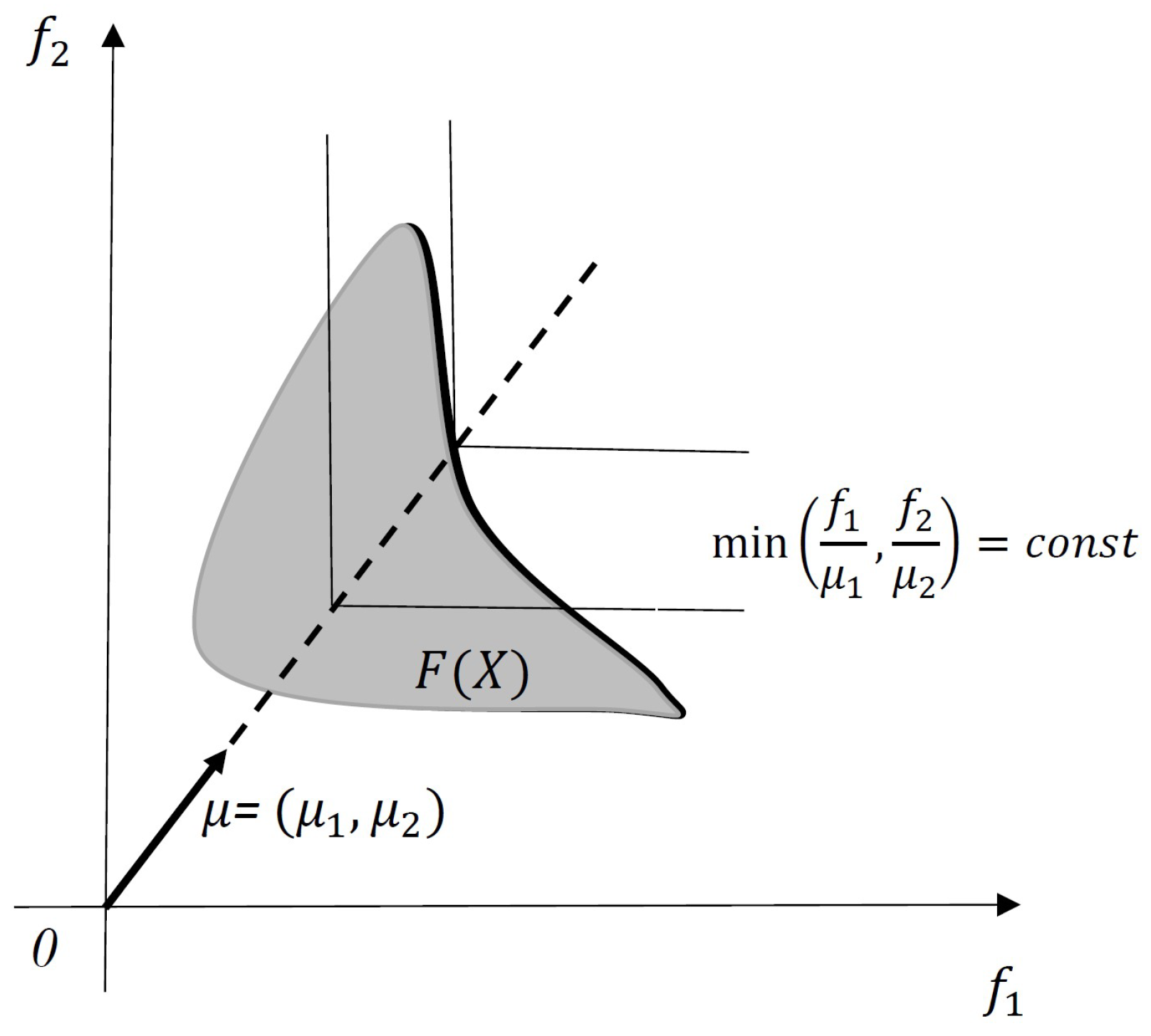
Figure 1 illustrates how GS (2) works in a multicriteria maximization problem. The feasible set (the set of all feasible values of the vector function) is shown (shaded) in the criterion space, i.e., on plane. Level curves of the function are presented for the given . The particular level curve is a cone with the vertex determined by the equality . The maximal value of along the ray is achieved at the point, where the cone vertex lies on the Pareto frontier of (in bold). This point has the coordinates .
Figure 1.
Germeier’s scalarization in the two-criteria max problem.
The function is continuous in while F is continuous, and
under some regularity conditions [25]. Therefore Germeier’s scalarizing function is successfully used for parametrizing and approximating nonconvex weakly efficient sets. Further development of Germeier’s idea leads to a combination of GS and LS [27,28] and to the scalarizing functions of the form (see [19]). Nevertheless, GS (2) looks better for finite approximation [25] than other types of scalarizing functions.
1.3. Two Person Zero-Sum Multicriteria Game
Consider a multicriteria (MC) game of two players having opposite goals: Player 1 wants to maximize a vector function and Player 2 tries to minimize the same function. Player 1 chooses strategy and Player 2’s strategy is , and we come to the game . Following classic game theoretic concepts it is easy to rewrite the definition of Nash equilibrium for multicriteria case [7].
Definition 2.
A pair of strategies , , is called the multicriteria Nash equilibrium outcome or just multicriteria Nash equilibrium if
As mentioned above, here and from now on we will consider Max and Min as the sets of weakly nondominated values of the vector function. Such an approach defines the widest possible of MC game solutions [7]. Shapley [6] proved that the set of MC equilibria for an MC finite game can be represented as a set of solutions of scalar games.
Another idea for solving MC games comes from the attempts of using maxmin and minmax in multicriteria case [29]. In a scalar game, maxmin defines a player’s security strategy [30], and the equilibrium in a zero-sum scalar game exists when maxmin of the payoff is equal to minmax of the payoff. However, what should be understood by maxmin for a vector function? There are two competing approaches for combining the sets of Min and Max. One of them unites the feasible sets for each particular player’s strategy [31,32], the other considers the intersection of such sets widened with nonfeasible points (evaluations) [19,24,33]. The main disadvantage of the first approach is a lack of meaningful interpretation, while the second one leads to underestimated values.
In our papers [24,26] we have developed a second approach. Based on the approach, we consider vector evaluations for the points from the initial feasible set. This allows us to formulate the concept of the solution for an MC game with opposite interests [34] as the set of points in criterion space belonging both to MC maxmin and minmax. We find the class of MC games “in evaluations” for which such a solution is not empty. Zero-sum games have empty intersections of Player 1’s MC maxmin and Player 2’s MC minmax in the nondegenerate case [34,35]. To overcome this problem, we introduce [36,37] a new concept of MC mixed extension for which MC maxmin and minmax are equal for the same player. For this concept, relations between MC mixed strategy equilibrium set and MC maxmin are presented in Ref. [38]. A detailed analysis of different concepts for MC game value can be found in Ref. [11]. In the present paper, we turn back to the classic (initial) concept of a mixed strategy solution of an MC matrix game introduced by Shapley (see Definition 2).
Consider a finite multicriteria zero-sum two person game. In this case, kth partial criterion forms an -matrix , . Component of the matrix stands for Player 1’s gain and Player 2’s loss for kth criterion when Player 1 chooses strategy i (matrix row) and Player 2 chooses strategy j (matrix column), , . The chosen pair is the pure strategy outcome of the game. It determines vector of Player 1’s gains and Player 2’s losses. When the players use mixed strategies, assuming that is the probability that Player 1 chooses row i and is the probability that Player 2 chooses column j, we come to the mixed strategy outcome with and , where
The averaged criteria vector () is the gain of Player 1 and the loss of Player 2 according to standard mixed extension of the multicriteria game [6]. We obtain multicriteria zero-sum game with gain/loss vector function
Shapley [6] studied game , assuming that its solution is the Nash equilibrium generalized for the multicriteria case. As a rule, the solution and the value of the MC game are sets. According to Shapley, the solution (or set of equilibria) of is the set of outcomes
and the value (or set of equilibrium values) of is the set
Any pair of strategies in (3) is called MC equilibrium in the game , and the corresponding is called the equilibrium value.
According to Refs. [6,7], the sets and can be obtained with the aid of linear scalarization applied to the partial criteria of . Equilibrium outcomes and equilibrium values of the scalar games
form the sets of equilibrium outcomes and equilibrium values of the MC game . Here and further for a normal form scalar game [30,39], we write minus in the payoff function of Player 2 because she/he minimizes her/his losses (in (4), the payoff is equal to convex combination of partial criteria).
The scalar games in (4) are not zero-sum for . Nevertheless, the equilibrium exists in each of the games due to Nash’s theorem [40]. For each pair of parameters, it can be found as a mixed strategy equilibrium of the finite bimatrix game with matrices and by solving a system of linear equations (see, for example, in Ref. [30]). However, parametrization of the sets and by the equilibria of scalar games (4) may be not convenient, in particular, due to practical reasons [10,36]. In addition, such a parametrization does not allow to compare the set of MC game equilibrium values with MC maxmin and MC minmax, because the latter cannot be parametrized by maxmins and minmaxes of the LS [11,41,42]. The present paper studies parametrization of and based on Germeier’s scalarization with the main purpose of proposing the finite approximation of .
In Section 2, we apply Germeier’s scalarization to the solution (3) of the MC matrix game in mixed strategies and substantiate the parametrization of with the aid of Germeier’s scalarizing function. In Section 3, we discuss the obtained result and compare with MC maxmin and MC minmax parametrized with GS. In Section 4, we examine a finite approximation of the set of equilibria (and the equilibrium values) of the MC game. In Section 5, we give a short review of the close results, and the conclusions in Section 6 summarize our research.
2. Germeier’s Scalarization in MC Games
Scalarization is not only useful for parametrizing and approximating MC game value, as may also be used by a decision maker who wants to compare nondominated vector payoffs, keeping in mind some certain meaning. For example, she/he may consider weights of relative importance of the criteria or coefficients that show the degree of achievements of some target values. When the decision maker uses LS, she/he solves the problem of total profit maximization, while GS improves the worst compliance with the target among the criteria. According to Rawls [22], the latter is called a fair allocation.
The MC game may be considered as a competition between two teams, and their members rely on the partial criteria. The criteria values depend on the strategies of the members of both teams. In this case, fair optimization leads to GS as a measure for efficiency of the decisions made [10]. In addition, GS is a useful tool for searching, analyzing, and describing the solutions of MC games.
In a zero-sum multicriteria game, Player 1 faces the multicriteria maximization
(for the fixed ). Germeier’s scalarization (2) specifies the corresponding parametric family of scalar functions
For the fixed , the minimizing Player 2 solves the multicriteria minimization
that is reduced to parametric minimization of GS
To further simplify the reasoning, we suppose that all elements of matrices () are positive rational numbers. For definiteness, let them be no less than 1 and no greater than 10. Then , . The payoff of Player 2 is negative, and this leads to some distinctions between proofs of the results in the current section and those given for the weak equilibrium in Ref. [10].
Now we show that Germeier’s scalarization allows us to describe and in multicriteria zero-sum game with one-parametric family of scalar games
Proposition 1.
For all there exists such that is Nash equilibrium in .
Proof.
Let us choose, as in Refs. [20,25], the vector of Germeier’s scalarizing function having components
1. We obtain
Indeed, let be a maximizer in (7). Then If the equality is satisfied, then (7) is proven. If strong inequality is satisfied, then, by definitions of and ,
i.e., , since under the assumptions made. Hence,
However, according to Refs. [6,7], is an equilibrium in a game from (4), i.e., there exists such that
The obtained contradiction proves (7).
2. Similarly , i.e., , if
Let . Then . However, for strict inequality we have
i.e., . Since then
i.e., does not minimize LS, which contradicts (8). As a result, we prove that there exists an equilibrium in the game that coincides with the MC equilibrium . □
Remark 1.
If we do not suppose , part 2 of the proof is not true for .
Thus, any MC equilibrium in the MC game can be obtained with the aid of GS with the same value of a scalarizing parameter for both players. Under the assumptions the inverse statement is true.
Proposition 2.
For any , Nash equilibrium in the game belongs to .
Proof.
Let and , (note that ). Then, according to GS properties (see Section 1.2 and Ref. [25] for details),
□
Let us emphasize that existence of Nash equilibrium in the scalar game for any follows from Nash’s theorem [30], because in the considered case of the finite game, is concave in p and is concave in q on the convex compact set .
It follows from the proof of Proposition 1 that at equilibrium for (6), i.e., Germeier’s scalarizing functions for both players are equal. One can also see the equality between the partial criteria divided by the corresponding scalarizing coefficients. It means the equality between the normalized partial gains for Player 1 and losses for Player 2. The value they are equal to is the sum of the vector function components at the MC equilibrium. Furthermore, the following interesting result takes place.
Proposition 3.
For any at any Nash equilibria of the game either
and , or μ does not satisfy (6) for , and
Proof.
Let us choose and let be an equilibrium in the game (5). For the equilibrium, we construct according to (6) (replacing index 0 with *). Then we have . On the other hand, since maximizes , then and , i.e., . If the vectors are equal, then , because and are positive and . Hence, has the same properties as . If there exists k such that , i.e.,
then it follows from that . Thus, the equality is impossible.
Notice that, by definitions of , when there exist such k and l, for which and . Therefore, and from what was proved above. We have that for this . □
It follows from Proposition 3 and the proof of Proposition 1 that for the description of the set , it is enough to consider only those , for which for some equilibrium of the game . We denote the set of these GS parameters by . In particular, under the assumptions we have made, for . The solutions of game (5) for do not add any new MC equilibrium to in comparison to those obtained for . Further, we denote by the set of GS’s scalarizing parameters that contain for certain.
If , then all ratios are equal at the equilibrium , for which . Thus, GS allows us to obtain the following necessary conditions of being MC equilibrium in the multicriteria matrix game. There exists such that
We have equations for variables. In particular, for two criteria games , p and q satisfy the equality . Further we write or instead of in the case of . In these notations, (9) takes the form This relation allows us to express in terms of and vice versa. However, one should take into account and .
The number of equations grows together with K (no matter how many pure strategies the players have), and it is not obvious that system (9) is compatible. Nevertheless, it is compatible for from (6) and its solution leads (by the proof of Proposition 1) to at least one vector of mixed strategies , that is an equilibrium in the scalar game , i.e., the equilibrium of the MC game. Thus, a solution of (9) that belongs to exists for all (by Proposition 3). The question of how to use (9) for finding is still open. It is clear that the set is not described explicitly. Besides, it is not enough to use (9) for obtaining an equilibrium in the game . However, Equation (9) help to find all pure strategy MC equilibria for the multicriteria matrix game.
Proposition 4.
If for , then is Nash equilibrium in the scalar game with
Proof.
Conditions (9) for pure strategies take the form
and allow us to write in the needed way. □
Thus, if is a pure strategy MC equilibrium, then it is also a pure strategy equilibrium in the bimatrix game with matrices and , where
The inverse is also true by Proposition 2. Therefore, if we find pure strategy equilibria (if exist) for the games , , we construct all pure strategy MC equilibria for the MC game . A fast algorithm for finding a pure strategy equilibrium in a bimatrix game is suggested in Ref. [43]. Assuming to be integer or rational numbers for all , we can choose at once from Proposition 4 as basic knots of -net for approximating (see Section 4).
Notice that the game has the pure strategy equilibrium , if the corresponding pair is a pure strategy saddle point (solution) of the zero-sum matrix game with the matrix . Indeed, let be a pure strategy equilibrium in the game with the matrix A. Then for the bimatrix game with payoff functions
for defined in Proposition 4, we obtain
For strict inequality, we have hence, and . The latter contradicts to the fact that is a saddle point for A. The same reasoning can be performed for Player 2.
This property may be convenient for finding MC equilibria, although it follows from the parametrization of with linear scalarizing function, and any convex combination of may provide sufficient condition instead of the sum of the matrices. As a reminder, we cannot limit ourselves with saddle points of the similar matrix games when we construct the whole set using LS. All equilibria of the bimatrix games for different weights used by different players should be found as well [6]. There is no need to solve games with mismatched scalarizing parameters when GS is used.
3. Properties of GS-Based Parametrization for Multicriteria Game Value
3.1. MC Maxmin and MC Minmax
The constructed one-parametric representation of the set gives a similar parametrization for the value of the MC game . Namely, for the positive payoff vector function,
For , the equalities
are satisfied (for some ), and vector inequalities (for all equilibria of the game ) are fulfilled for all other positive according to Proposition 3. In addition, it follows from the proof of Proposition 1 that is not changed if we take only in (10). Formula (10) allows us to obtain the following parametric relations between the value of zero-sum MC game and MC maxmin and MC minmax.
According to Ref. [26], MC maxmin and MC minmax of the vector payoff for Player 1 are the sets and that can be parametrized using GS in the following way:
We do not consider because the corresponding and do not belong to the feasible set for certain. MC maxmin and MC minmax of Player 2’s vector loss are represented as
respectively. The following inequalities take place:
Indeed, it is well-known that maxmin is not greater than minmax for scalar functions [20,30], therefore and . One can see that
i.e., . The same reasoning leads to , so all the inequalities in (11) are proved. Inequalities (11) justify the possibility to interpret (and ) as the set of compromise values (and outcomes) in the MC matrix game.
Notice that based on the approach by Refs. [24,38], we can consider the wider concept of MC game value with the same . For (1), weakly efficient values of the vector function F can be represented as weakly efficient points of the Edgeworth–Pareto hull (eph) [13,19] of the function. For the considered settings, eph is defined as
Then we obtain the following enveloping sets for MC maximum and minimum:
Some weakly efficient points may not belong to (or in our case), but they may serve as evaluations that make sense for compromise or when both players are faced with additional uncertainty. Here we do not focus on obviously unreal evaluations and limit ourselves with an intersection with .
Using the extended sets of evaluations (12), (13) instead of standard MC maximum and MC minimum and applying results from Refs. [24,38], we come to the following MC game value “in evaluations” for Player 1:
For Player 2 a similar set is
As it is proved in Proposition 3, the sets have common points for and . For other , only inequalities are satisfied. Thus and , and consequently, . However, this inclusion does not imply the equality between and because is not convex. Nevertheless, let us emphasize once again that the MC equilibrium set is the same for both statements. The difference is in different evaluations for the same . However, the players may prefer to use instead of . For these sets, inequalities (11) are also fulfilled.
Vector functions are continuous because functions and
are continuous in on (see [24]), and the same is satisfied for : its maxmin and minmax are continuous in .
Further we investigate the continuity of taking into account the possible plurality of equilibrium values in the scalar game . Denote the set of all equilibrium values for a given by
3.2. Geometric Presentation and Examples
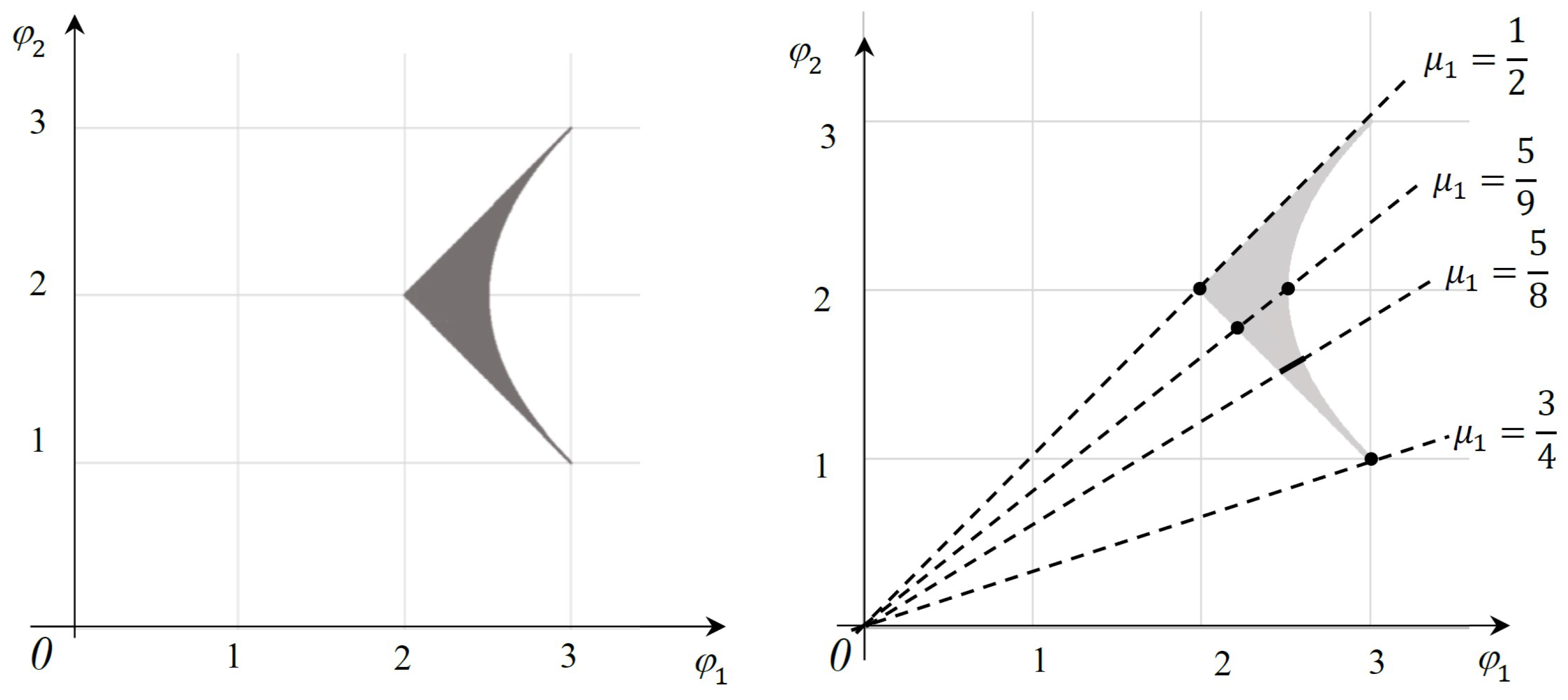
Let us see what we can say about as a subset of . According to definition of , for any , there exists the equilibrium in the game so that it is related with via (6). Condition (6) means that belongs to the ray in the criterion space (the plane is similar to Figure 1). The ray goes from the origin in the direction of (see Figure 2 on the right for with , 5/9, and 3/4 for the Example (14) below). It is obvious that if the ray , , does not intersect the feasible set , then (according to definition of ) . However, the inverse statement is not true: there may be no equilibrium values on the ray that intersects . In particular, if is a singleton that consists of the only pure strategy outcome, then this specific outcome is the equilibrium in the game for all (whether the ray intersects with the feasible set or not). In this case, consists of the only one that corresponds to this outcome according to (6). The uniqueness of MC equilibrium is possible for singular MC case when all matrices of the game have the same pure strategy outcome as the saddle point (for example, equilibrium in dominant strategies [30]). The uniqueness of the equilibrium for all means its continuity in .
Figure 2.
Game (14). Criterion space with the feasible set (on the left) and the sets of equilibrium values (in bold) for scalar games , , and (on the right).
More complicated situations are illustrated by the MC game with the following bimatrix payoff:
Applying mixed strategies we come to bilinear criteria of the payoff function with
Here and further in two-criteria games we write only the first component of the strategy vector and of the parameter vector because the second components are defined uniquely. The feasible set for (14) is shown in Figure 2 on the left in the criterion space, i.e., on the plane of partial criteria .
For , the unique outcome is the equilibrium in the game . The corresponding equilibrium value is equal to (2, 2), i.e., . However, solving (9), we find the outcomes (, ) and (, ), and the corresponding values of form the segment connecting points (2, 2) and (3, 3) in the criterion space. This segment is the intersection of the ray with the set , but the equilibrium is only (2, 2). There is no intersection of the ray with for , and there is only the equilibrium for such in the game for (14). It gives the MC equilibrium value (2, 2), i.e., that is already found for .
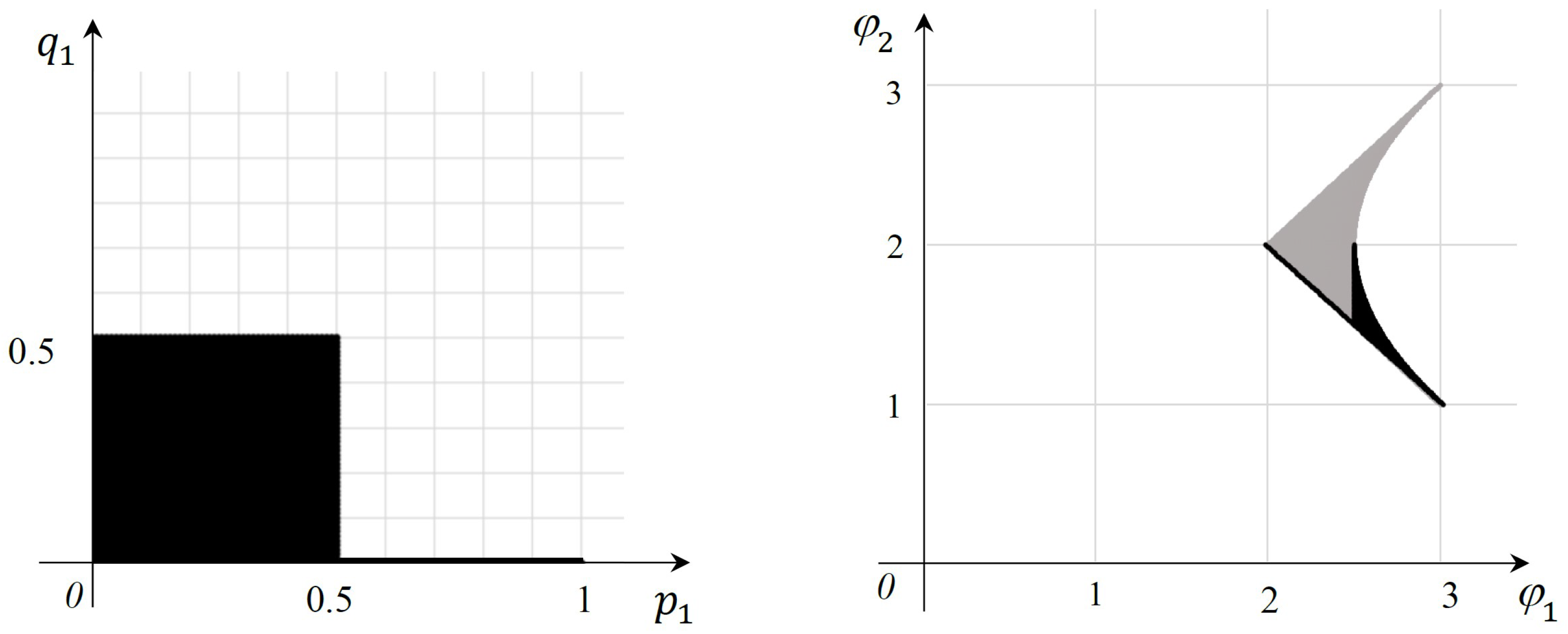
Notice that there is no convergence of the values of on the solutions of (9) for , i.e., values on the solutions of (9) are not continuous in . All such (with ) do not belong to , but they allow to find MC equilibrium for game (14) as the solution of the game . On the other hand, for the solutions of (9) and the corresponding segments in the criterion space converge in Hausdorff metric to the mentioned segment (between (2, 2) and (3, 3)) for . The equilibrium value in the scalar games with (14) (see Figure 3 on the right) is unique for and moves to south-east from . For the equilibrium values, we obtain that when for , although it is not true for the values of on the solutions of (9) for .
Figure 3.
Game (14). The set of equilibrium outcomes in the plane of the first strategies’ components (on the left) and equilibrium values (in bold) in the criterion space (on the right).
Continuity of in the Hausdorff metric is also correct for . There are two or more equilibria for in the game with (14) and the only one exists for with . The set is composed of all with . Continuity of at is one-sided: converges in Hausdorff metric for . This property is sufficient for approximating in the game (14). The set of equilibrium values for the MC game with (14) is shown in bold in Figure 3 on the right. Further we solve the game in explicit form (see in Figure 3 on the left).
Notice that and (i.e., ) increase in for all . Therefore, the only optimal response of Player 2 is for all . The best response strategy for Player 1 depends on . It is easy to see that , i.e., , and because Thus, the first part of for the game with (14) is the set of equilibria
The corresponding values of (with ) form the segment with the endpoints (2, 2) and (2.5, 1.5) (see Figure 3 on the right). For , we have and the unique solution with , . The equilibrium value coincides with the left angle point of (see Figure 2). For , the solution has , , but it is not unique as we will discuss. For intermediate value , one can find the equilibrium with , .
If , Player 1’s payoff function increases in for all , and the optimal strategy has . However, the corresponding Player 2’s optimal response is , which does not satisfy the considered case, hence there is no equilibrium. For we have . Any is suitable for if it leads to , and for other we have again. In particular, for , we come to the second equilibrium with . If , we have , and the optimal response is for . Thus, we come to . Notice that belongs to with both equilibrium outcomes differing in the sum of partial criteria equal to 4 and 4.5, respectively.
If , one of the criterion of Player 2 increases and the other decreases in . Therefore, we find the possible pair for from the equality of the weighted criteria, which gives
Conditions and imply . Hence, for , all equilibrium outcomes are in . Similarly, for , the optimal response for Player 2 is found from (15) in the form
with the same conditions for . The set of equilibria of the game can be obtained for all as the set of solutions of the system
For , (16) is equivalent to an arbitrary of inclusions and therefore may have many solutions. In particular, for , we find all the symmetric equilibria from (15): is a root of the quadratic equation under the condition . This parametric family of equilibria is denoted by . The corresponding equilibrium values form a curved line in the criterion space (see Figure 3 on the right). Its upper point corresponds to the equilibrium found for in the above. The second equilibrium for is symmetric one. The unique equilibrium is for and for all .
It follows from (15) that for each with , the equilibrium values form the whole segment, connecting an equilibrium value on the curved line for symmetric equilibria with a point on the line continuing on the bound of . The line corresponds to . These segments are the values of calculated for solutions of (9) for . For example, for , (15) gives the family of outcomes such that . Here, varies from 1/2 to 0 for all , and both values satisfied the inequalities of the case under consideration. In particular, composes the equilibrium pair with , and makes the equilibrium pair with , and so on.
The set for consists of not only points from , but also from the segment adjoining to the curved line corresponding to the set of symmetrical equilibria . The left end points of all such segments lie on the perpendicular, dropped from (2.5, 2) into (2.5, 1.5) inside in the criterion space (see Figure 3 on the right). These points correspond to the solutions of (15) for , . The set of these equilibrium outcomes is denoted by (in , varies from 1/2 to 0 when runs from 5/9 to 5/8). The remaining points of the segments of equilibrium values for are obtained when varies from to 0 together with running from 0 to .
Thus, we construct for the multicriteria game (14). The whole set is shown in Figure 3 on the left ( is abscissa and is ordinate), its part corresponds to the horizontal segment, the part is the diagonal of the shaded square, and is its right side. The segment gives south-west bound of the feasible set and provides the lower part of its east bound. On the curved line , the value decreases from 4.5 to 4 when decreases from 1/2 to 0, i.e., when increases from 5/9 to 3/4. The sum also decreases from 4.5 to 4 on the vertical segment in the criterion space, but this segment is interior for the feasible set (although is on the bound of ). Figure 2 and Figure 3 demonstrate nontriviality of the form of the set of equilibrium values even in a very simple MC game (14), for which multicriteriality is significant for only one outcome in pure strategies.
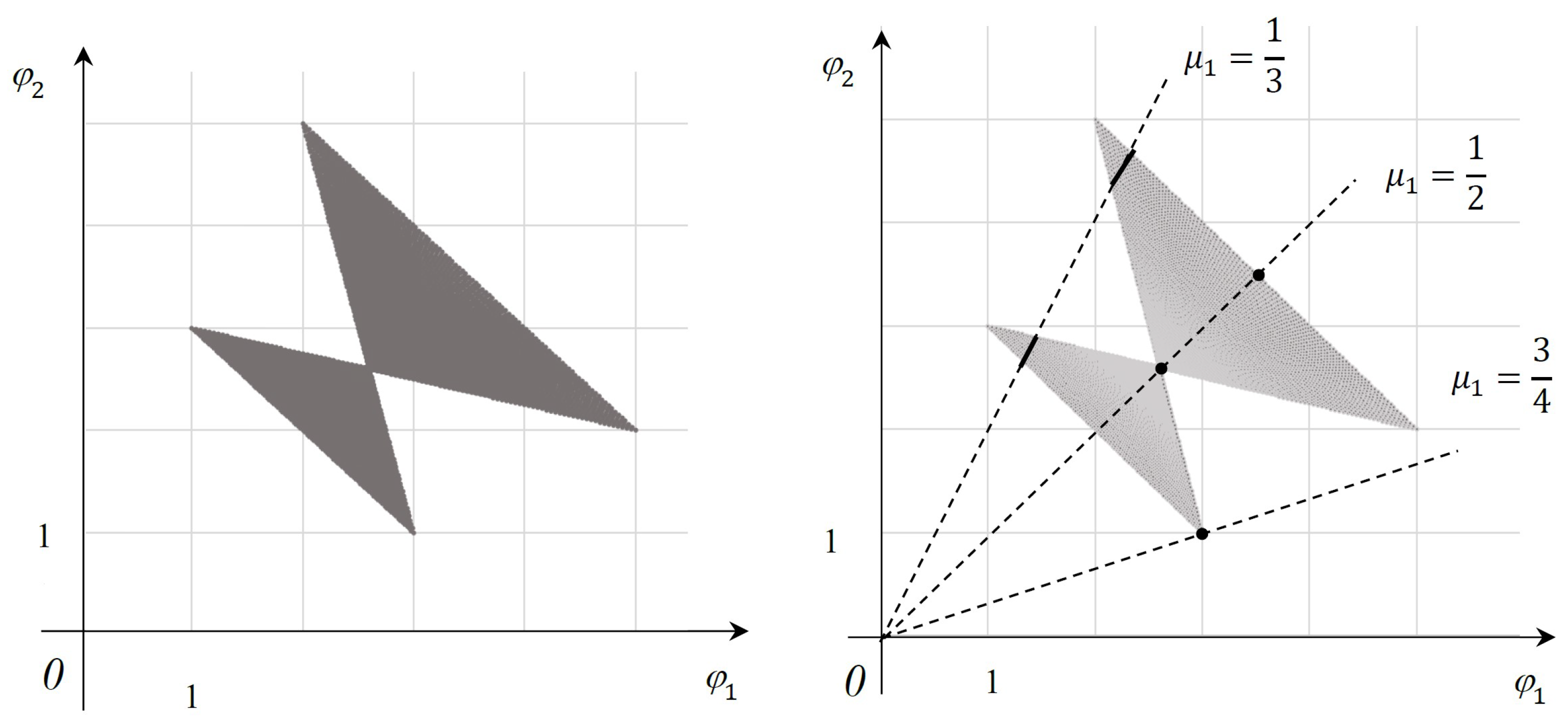
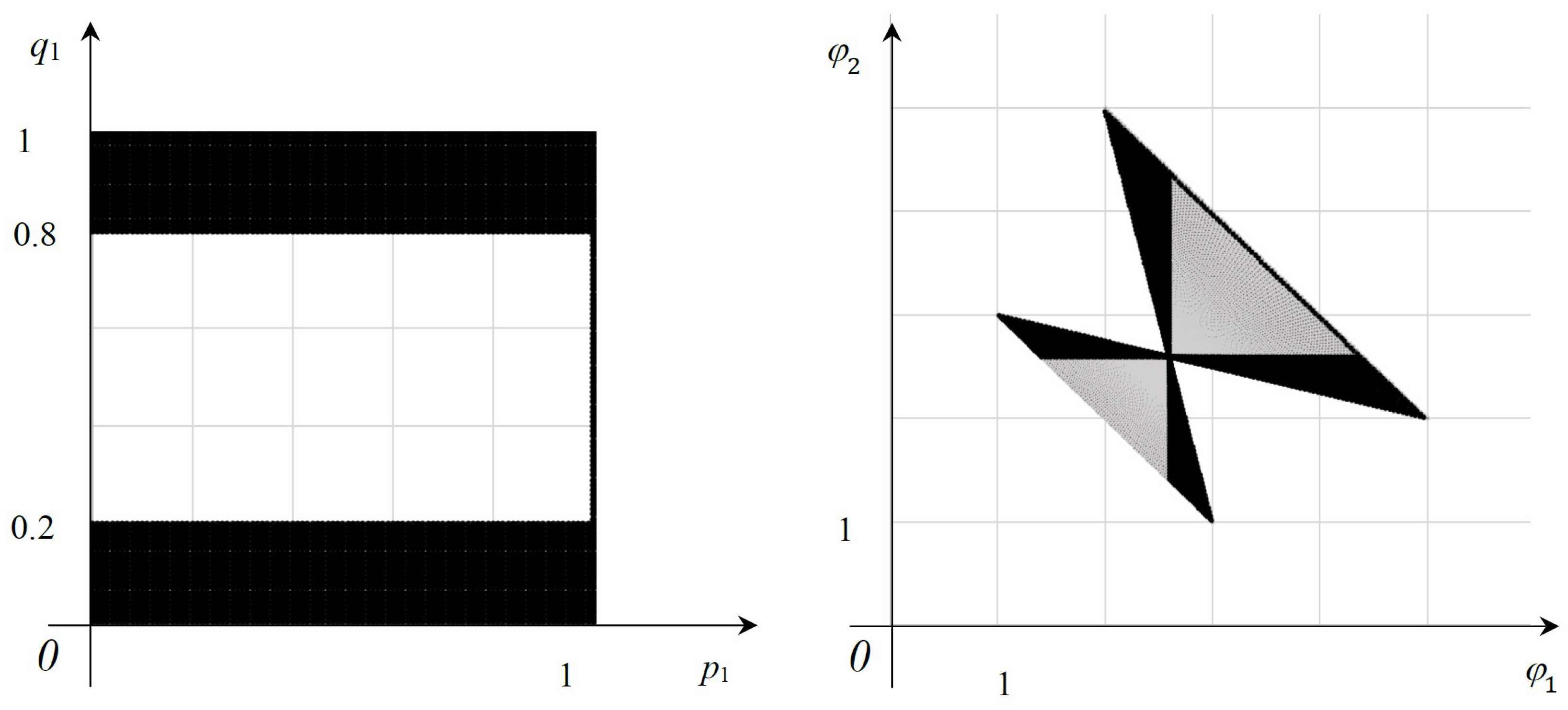
Another interesting example is the complete multicriteria matrix game with
(see Figure 4 and Figure 5). The feasible set for (17) is shown in Figure 4 on the left. The equilibrium values , , and of the corresponding scalar games are presented in Figure 4 on the right. The set is given in Figure 5 on the right. The set of solutions is shown in Figure 5 on the left on the coordinate plane . There are a lot of equilibrium values in this game, but (in contrast to the example from Ref. [41]). We also notice that is asymmetrical (it does not include the interval (0.2, 0.8) of the ordinate axis), despite the symmetry in bimatrix (17). We can see that is continuous in although the sets of equilibrium values are nonconvex (disconnected) for the scalar games . Continuity means that GS may be used for approximating the set of MC equilibrium values. It should be emphasized that (14) and (17) are rather representative examples of two-person two criteria MC games (in Ref. [8], they are called envelope and butterfly, respectively).
Figure 4.
Game (17). The feasible set (on the left) and the sets of equilibrium values (in bold) for some scalar games (on the right).
Figure 5.
Game (17). The set of equilibrium outcomes (on the left) and the set of equilibrium values (on the right).
As it is known, the set of Nash equilibria of an arbitrary scalar game is not necessarily continuous in its parameters in general case [30,44]. Unfortunately, the set of equilibrium values of the game is not necessarily continuous in in our (particular) case, as the example of game (14) shows for . However, one-sided continuity of is satisfied for this game. Thus, the specificity of the MC matrix game gives the hope that it is possible to use GS for approximating the set of equilibrium values of the MC game without continuity of in .
4. Approximating the Set of Equilibrium Values Using GS
We suggest the following idea of approximation for and the set of equilibrium values. Let be a finite -net on consisting of the points , , such that : . Here and further denotes norm in (i.e., the maximum absolute of a vector components) and denotes norm in , i.e., , . At first, we include all vectors determined in Proposition 4 into . Elements of the -net between these vectors and between the vectors and bound vectors of may be chosen uniformly component-wise under the condition . Let denote a -net on for each . Find a solution of the game and let . If , then and turn to the next point from . If the equality is not satisfied, then find such indices k for which and/or . After all points from are analyzed, we turn to the neighboring point from nearest to on the component k.
Consider the case in detail. Here, if , then
and
Consequently, for rather small such that we still have
for . Hence, , which maximizes , also maximizes and . Similarly, , which minimizes , also minimizes and , as for . Thus, is still a solution of the new game . The values of and change for this solution at the new point , moreover increases and decreases, tending to the equality for The equilibrium value is . If , then let . We may run by the points from for . Notice that inequality between components of GS remains for , and the difference between new values of and increases after the recalculation. Therefore, if is used for choosing a new point , then the obtained does not belong to for and there is no sense to consider this point. The relation between partial criteria may be changed for other equilibrium outcomes of the game .
For an arbitrary K, is also obtained from in such a way that kth component for which
increases, and , for which , decreases. If the component which realizes changes, then we possibly obtain a new MC equilibrium. For (i.e., for ), we fix the equilibrium outcome and consider the next one until the approximation of the equilibrium values set of the game is constructed. Then we turn to any of the neighboring in not chosen previously. If the equality of and is not satisfied for several considered equilibrium outcomes of , then may be chosen for any of them. Thus, turning from to and calculating the equilibria of the scalar game that form , we obtain the representative set of equilibrium values of the MC game . Further, we investigate when these values make a -net on the set , i.e., we justify the possibility of approximation theoretically.
Let be the set of equilibria in the game . In addition, we denote an outcome by r for brevity. Consider an arbitrary vector and define the function
Then
Indeed, according to the proof [30] of Nash theorem on existence of the equilibrium,
Consequently,
Since , then this maximum is equal to 0 (for the equilibrium outcomes). Hence
and we come to (18). Now we prove the following lemma.
Lemma 1.
The set of equilibrium outcomes in the game is upper semicontinuous on in the Hausdorff metric.
Proof.
The function is continuous in both variables simultaneously. The function is continuous in r and simultaneously (see, for example, in Ref. [28]). The set is not empty for all . Representation
allows to prove upper semicontinuity of the mapping on (strict proof also may be found in Ref. [28]). □
We may directly prove that is upper semicontinuous since it is closed (because is continuous). Besides, we notice that closeness of and continuity of imply closeness of , i.e., the latter mapping is also upper semicontinuous on . We come to the following property.
Property 1.
Let be an isolated point on (i.e., there are no points from in the sufficiently small neighborhood in ), corresponding to MC equilibrium according to (6). If there is only the equilibrium in the game , then for all , starting from some t, we have for any solution of the game .
Proof.
Assuming the contrary, we obtain by Lemma 1 the sequence of equilibria of the game . This is the sequence of MC equilibria for which and . However, this contradicts the isolation of . Indeed, , and for corresponding to according to (6). If , then . We come to contradiction with the uniqueness of in the game . Otherwise is not isolated. □
The isolated MC equilibrium can be found with the use of points from . Similarly, based on Lemma 1, we prove that points from allow us to find an approximation of the outcome that gives the unique equilibrium value for some .
Property 2.
If the set consists of the only point for , then for all in the Hausdorff metric.
Proof.
According to Lemma 1, any convergent sub-sequence of equilibrium outcomes of the games , which are MC equilibria, has a MC equilibrium as a limit. This MC equilibrium belongs to . The uniqueness of such a value leads to the statement of the property. □
In particular, there exists for . This solves the problem of approximating partially isolated (from one side for ) equilibrium values in the case of the unique equilibrium for a game .
The case of nonunique equilibria is more complicated. Lemma 1 only allows to state that
and the inclusion may be strict. Below we show for case that strict inclusion is fulfilled not for all variants of approaching to . For a general MC matrix game, we notice the following.
For , there exists -approximation (constructed with the help of GS) on -net in for the equilibrium values that belongs to with their -neighborhood (in norm) in the criterion space. Indeed, consider and , which is the nearest to in the norm . We have , , according to the construction of . Then for
The denominator of the last fraction in (19) is equal to because components of h are small. Since under the assumption of the initial problem, then for we have . With (19) and (7), this leads to .
The performed reasoning may be generalized to the case of the one-sided -neighborhood of in , because there are at least two points from in the neighborhood of , which is not situated on the bound of .
Consider the case .
Property 3.
If for there exists such that for all , then for there exists such that . Similarly for , when .
Here and further denotes the subset of the set of equilibrium values , connected with the given according to (6). The upper index 0 is omitted for equilibrium values if it does not lead to misunderstanding.
Proof.
It is obvious for and . (Since , then , i.e., .) □
For two criteria case, Property 3 may also be generalized in the following way.
Property 4.
For , if for there exists such that for all there exists such that , then there exist and such that for .
Proof.
Choose , then for we obtain for , because . If , then . If , then . □
Lemma 2.
In case, if for there exists such that for all there exists such that the function is continuous on , , for all , then for any there exist , , and such that .
Proof.
Choosing and , we come to for , and is continuous on as the function of . If , then , , , and the statement of the Lemma follows from continuity of . Assume that all different values of form the segment on the ray in the criterion space (i.e., ), and there is no other sequence . However, such a situation is impossible (see Appendix A for proof). □
Notice that Proof of Lemma 2 (see Appendix A) considers all the possible variants of the equilibrium outcomes and the corresponding values independently of the presence of other equilibria in the neighborhood of . In particular, there may be only two equilibrium values on the ray , as it is in the game (14) for . Existence of and such that and for all in the neighborhood of , for which from the left or from the right, is proved for all , in the two criteria games. Therefore, the Proof of Lemma 2 directly leads to
Proposition 5.
For , for all , there exists such that for any , there exist , , , such that and .
In addition, it may be noticed from Appendix A that there exists an equilibrium outcome in the neighborhood of a pure strategy equilibrium or equilibrium with a pure strategy of one of the players with one strategy remaining unchanged (for two criteria games).
It follows from Proposition 5 that the mappings and are one-sided lower semicontinuous on at points . The set is compact, and this leads to uniform one-sided lower semicontinuity for the considered mappings, and, as a sequence, to their uniform one-sided (from the left or from the right) continuity due to Lemma 1. Thus, we prove the possibility of approximating the set of equilibrium values for the simplest case of MC zero-sum game.
Proposition 6.
For , there exists such that for any , there exists such that for all there exist , such that .
Proposition 7.
For , there exists such that for any , there exists such that for all there exist , such that .
Corollary 1.
For , the sets and converge in Hausdorff metric to and , respectively, for , where is ϵ-net on the set .
We do not generalize the obtained results for arbitrary in this paper. Our main aim is to show the principal possibility of GS being used for approximating the solution of a MC game. Even for the considered simplest case of a two-criteria game, the equilibrium set and the set of equilibrium values of the game have nontrivial forms (see Figure 3 and Figure 5). In particular, the set on Figure 3 is not only nonconvex but also contains curved parts. However, may be considered as a set of compromises in the MC zero-sum game, and therefore it is important to not miss the equilibrium outcomes acceptable for both players even when they correspond to the isolated equilibrium value. We prove that GS helps to do this.
A lot of papers are devoted to the problem of finding the equilibrium in scalar games (parametric games and are scalar for the fixed values of parameters), in particular [45,46,47,48]. Therefore, we do not pay attention to the problem as well as to the numerical methods of finding optimum (see Refs. [49,50] for review).
5. Discussion
The sets and are represented with the aid of parametric families of the sets of equilibrium outcomes and values of scalar games. However, these sets are not continuous in scalarizing parameters. In Ref. [44], the author suggests to extend the set of equilibrium outcomes and considers the approximate (not exact) equilibria. Continuity in the Hausdorff metric of the set of approximate equilibria in parameters is proved in Ref. [44]. This fact allows us to construct the corresponding approximation for and . After that the -net (finite approximation) of the set of approximate equilibria may be applied, as we suggested in the above. However, the question is whether the approximation of the approximate equilibrium is exact equilibrium.
The papers [36,37] suggest another definition of the set of equilibrium values in MC matrix games in mixed strategies. It is justified from the point of decision-making that averaging over the partner’s mixed strategy may be done, not before, but after scalarization (a similar setting is considered in Ref. [17]). In this case, LS and GS lead to different sets of MC game value. Moreover, LS gives the standard set , and GS lets us construct a wider set of evaluations of equilibria values for Players 1 and 2 in the forms
Here and are equilibrium values for the parametric family of scalar games
According to Ref. [37],
where , . The possibility of finite approximation for the introduced sets is not studied yet.
Approximation properties for the sets and , from Section 3.1 are proved in Refs. [24,26]. The possibility of approximating (based on its parametrization with GS) is proved in the present paper for the same cases as , in particular, for two criteria games. The proof follows from the uniform continuity of in , and from Proposition 7 about finite approximation of with solutions of scalar games (which are used for defining , ), if for small enough , we limit ourselves with .
The set that was introduced by Shapley is the widest of the concepts of MC game equilibrium values, except what we obtain for (20). Therefore, this set is not empty. For Pareto efficient MC maximum and minimum, conditions for nonemptiness of the MC game solutions and values are represented in Ref. [51]. Such solutions are called strong equilibria. In addition, the authors of Ref. [51] find the conditions for stability of the set of strong equilibria with respect of the perturbation of MC game parameters. We plan to investigate the stability of GS-based parametrization of in our future research.
6. Conclusions
In this paper, we prove some properties of the Germeier’s scalarization, which is applied for parametrizing the sets of equilibrium outcomes and equilibrium values of MC matrix games. In particular, we find a one-parametric family of scalar two-person games to represent MC game equilibria. We obtain the inequalities between parameterized values of MC game, MC maxmin, and MC minmax, which allow us to interpret the equilibrium value as a set of compromises in a zero-sum MC game. Thus, we are interested in a finite approximation of the set (to assist the players to come to an agreement). However, examples in Section 3 demonstrate that the approximation problem is not trivial (see also examples in Refs. [8,9]). Despite this, we prove the possibility of approximating the sets of equilibrium values and equilibrium outcomes with GS in the case of two criteria matrix game . We hope that the obtained results encourage researchers to further study GS and its application to MC problems.
Author Contributions
Conceptualization, N.N. and I.P.; methodology, N.N.; formal analysis, I.P.; investigation, N.N. and I.P.; writing—original draft preparation, N.N. and I.P.; writing—review and editing, N.N. and I.P.; visualization, I.P.; supervision, N.N.; project administration, I.P. All authors have read and agreed to the published version of the manuscript.
Funding
This research received no external funding.
Informed Consent Statement
Not applicable.
Data Availability Statement
Data sharing not applicable.
Conflicts of Interest
The authors declare no conflict of interest. The funders had no role in the design of the study; in the collection, analyses, or interpretation of data; in the writing of the manuscript; or in the decision to publish the results.
Abbreviations
The following abbreviations are used in this manuscript:
| MC | Multicriteria |
| LS | Linear scalarizing function |
| GS | Germeier’s scalarizing function |
Appendix A. Completion of the Proof of Lemma 2
Let , , and . Consider the case when all different values of form the segment on the ray in the criterion space (i.e., ), and there is no other sequence . Let us show in detail that such a situation is impossible. For simplification, we perform the reasoning for the games with two pure strategies for both players.
1. Suppose at first that is the pure strategy equilibrium, for certainty, , i.e., . Here . If Player 2 chooses , then there are the following cases in dependence on the relations between the components of the game matrices:
(1) and . Here remains the component of Player 1’s optimal response in the neighborhood of (regardless of the value of in GS);
(2) on the contrary, supposing that is the best response of Player 1 for (for both criteria at once), we come to the contradiction with assumption that is the equilibrium;
(3) and . For all
The first criterion in (A1) increases in , the second one decreases, therefore the pure strategy maximizes only when . Due to the definition of , the equality is fulfilled here, and the response for remains optimal for any with in a -neighborhood of . Notice that for inverse inequalities, the condition for suitable changes inversely, namely, . ( is bounded because and .) Similar situations appear for the swapped players (taking into account that Player 1 maximizes, and Player 2 minimizes). The only nontrivial case exists here, when the optimal responses remain the same for the mismatched change of for Player 1 and 2 in case (3). This leads to the following subcases:
(3.1)
i.e., the outcome is the equilibrium for the first criterion for both players (in the scalar game with the matrix ), and this is not true for the second criterion. Here remains optimal for all with for Player 1 (see case (3) in the above) and with for Player 2, since the maximum in is on the first criterion but decreases for the increasing . Thus, in this subcase, for replaced by , one of the players is forced to avoid the pure strategy as the equilibrium. Without loss of generality, assume that is greater than . Then, for Player 1’s first row, Player 2’s response is , . The strategy provides the equality of both components in :
For small enough , the value in (A2) is rather small positive. It does not change the optimal choice of the first row by Player 1 as a response to Player 2’s strategy . Indeed, for increasing , for all due to and (A1). We come to the equilibrium outcome , which differs from only by . When slightly varies from , (A2) leads to small , which stands for the difference between and (taking into account that (A2) is fulfilled for when according to definition of );
(3.2) Signs of inequalities are inverse to (3.1), i.e., is the equilibrium for the second criterion. This outcome is replaced with close for all such that , and with for such that ( is sufficiently small);
(3.3)
i.e., is better for the first criterion and such that , is better for the second criterion for Player 1. However, for Player 2, is better for the second criterion and such that , is better for the first one. For we have, as in sub-case (3.1), that < . It follows from (A1) that Player 1 chooses as a response to Player 2’s choice of the first column. The situation is inverse for Player 2: she/he chooses the first column as a response for the first row. Thus, the pure strategy equilibrium does not change;
(3.4) Signs of inequalities are inverse to (3.3), then for such that .
We have considered all possible pure strategy cases and we have shown that for any pure strategy equilibrium and for , corresponding to according to (6), there exists a semi-neighborhood of such that for sufficiently small there is , for which either is equilibrium in (possibly, not unique) or with one of the pure components ( or ) is equilibrium, and it is in the -neighborhood of . Thus, we come to the contradiction with the assumption written in the beginning of Appendix.
2. Now, let Player 1 have a pure equilibrium strategy (with ) and Player 2 have a equilibrium mixed strategy with in . Then . Here and further is ith row of and denotes the dot product. According to (6) . We can repeat the reasonings (1)–(3) for instead of , and obtain the conditions of being Player 1’s optimal response for when deviates from . Thus, there exists a semi-neighborhood of such that for all in it .
Consider Player 2 when Player 1 uses , and is replaced with close vector . Possible cases are similar to (1)–(3) for Player 2:
(4)
for any small enough for any sign of . This is equivalent to , , i.e., the first and the second column are equivalent for Player 2 when Player 1 chooses the first row. This leads to being one of the optimal responses for , and for all in a neighborhood of ;
(5)
for any small enough (this is equivalent to ), and there exists such that and
However, this contradicts to . We come to the same conclusion if we swap criteria 1 and 2 or suppose that the inequality with is satisfied for both criteria;
(6) The following case for all remains: either and , or vice versa. This case is equivalent up to renumbering to the variant, where , (in analogue to case (3) for Player 2, see also (3.1) and (3.3)). Increasing the first component of (decreasing the second one) leads to decreasing and increasing (increasing the second component has the opposite effect). The best response for Player 1’s minimizes for in a neighborhood of . The best response (depending on and ) with satisfies
Player 2 optimizes in (A3) in dependence on and may have any sign (taking into account ) in contrast to (A2). Equality (A3) is fulfilled for when because is the optimal response for in the game . Therefore, (A3) leads to small , which measures the difference between and when slightly differs from . Thus, can be found from (A3).
Let us analyze how the change of Player 2’s strategy from to influences Player 1’s optimal response for a small enough (not greater than component-wise, i.e., in norm) change of .
(6.1) If case (1) is satisfied for Player 1 for under strict inequalities, then her/his optimal response for the mentioned small change of remains. Otherwise for to be optimal, (more precisely, changing , which leads to changing ) should have a specified sign. Let = for both k. Hence, the rows are equivalent for Player 1 as the response for (regardless of ). Then the first row is chosen for with if , and with for the inverse inequalities, since
However, if the signs in inequalities are different for different criteria, for example, , and , then Player 1’s optimal response depends on , and the following sub-cases are possible:
(6.1.1) If , then for small enough and . Therefore for is determined by the first partial criterion, thus is the optimal response;
(6.1.2) If , then for the value of is determined by the second partial criteria and
and again ;
(6.1.3) Let . If , then the significance of the first criterion increases and, therefore, Player 1’s payoff () also increases, when she/he chooses in response to .
If , but the signs of the expressions in the brackets are inverse to that considered in (6.1), then for , is the component of the equilibrium for . In the other sub-cases of (6.1), the numbers of criteria should be swapped and the signs of should be changed.
(6.2) If case (3) is satisfied for Player 1 for , i.e.,
then Player 1’s optimal response to is pure strategy only if . The equality is satisfied here for the considered equilibrium according to the definition of . At the same time, the response for remains optimal for all such that in some -neighborhood of , and the optimality remains for close . For the inverse inequalities in case (6.2), the proof is carried out similarly. The inequality for suitable inverses, i.e., the semi-neighborhood is with .
It follows from the considered cases in item (2) that there exists such semi-neighborhood of , that for small enough there may be found , for which there exists the equilibrium in the game , situated in the -neighborhood of . The situation does not change for the equilibria with a pure strategy for Player 2 and a mixed strategy for Player 1.
3. Consider the remaining values , , , for which the equilibrium outcome is mixed: , . According to (6), . Notice that values differ by the sum of components in the denominator in (6). When we choose one of the values , we fix this sum.
At the beginning of the proof, we have made the assumption that there is no such that when . In previous items, we come to a contradiction with the following assumption: we justify that the equilibrium outcome or close to it exists for from some semi-neighborhood of . To finish the proof, we need to obtain the same result for the mixed strategies. Each of them is the optimal response to the partner’s strategy, therefore they should satisfy the equality between the components of GS:
Let us clarify what happens when from the -neighborhood of is taken instead of . Consider all the possible cases.
(7) If
for any with a small enough absolute value, then , i.e., it does not matter for Player 1, which row to choose in response to regardless of . Thus, is one of the optimal responses. In the particular case, the set of optimal responses for is P. Formally, , , and therefore, because of (A4) for . Notice that for , there may be no equality between the weighted partial criteria in spite of p being the optimal response for . Therefore, we study how changes when is replaced with .
For in some -neighborhood of , (depending on and ) with minimizes . This optimal response of Player 2 is either a pure strategy or satisfies the equality . This means . A small increase of the first component of (decreasing the second one) within Q leads to an increase or decrease of (that is, the kth partial criterion) in dependence on the sign of
and vice versa for increasing the second component of . If (A5) is equal to zero for , then substituting for q does not influence , i.e., Player 2’s optimal response for , regardless of , is any strategy q, including . Thus, remains one of the equilibrium outcomes in the game . Further we consider the less trivial sub-cases.
(7.1) The value of (A5) is positive for both partial criteria. This means that q with for is better for Player 2 than , which contradicts with . Similarly, if (A5) is negative for , then Player 2 can choose q with for . The reasoning does not change for the case when one of the criteria in (A5) is equal to zero.
(7.2) The value of (A5) is positive for one of the partial criteria (let the first one) and negative for the other. Consider with , . Then for small enough Player 2’s GS for is determined by the second partial criterion (due to (A4) for ) and it decreases for only. We obtain the condition for (in dependence on the sign of ). However, according to the condition of the sub-case, the first criterion increases when increasing . Therefore, decreasing with increasing is limited by the point of the weighted partial criteria equality (weights do not influence the monotonicity). As a result, is situated near when minimizing . Let us analyze Player 1’s response to under these conditions. Player 1’s GS for is determined by the first criterion, which increases for simultaneously with the decrease of the second partial criterion, but still realizes in a small enough -positive semi-neighborhood of . Thus, Player 1’s optimal response for is also determined from the equality , to which satisfies according to the construction of . We come to the equilibrium in the -neighborhood of . If (A5) is positive for and negative for , then the reasoning should be repeated for with for and swapped numbers of criteria.
(8) If
for some nonzero with a small enough absolute value, and , then it contradicts with ; the same is satisfied for the swapped criteria or if the inequality is fulfilled for both criteria.
(9) The last case. For any nonzero absolutely small enough , either
or the inequalities are inversed. This means (up to renumbering of rows), that , . Then for suitable (absolutely small enough) , the signs of the inequalities remain for with . Consequently, decreases in for and increases in for . Therefore, the optimal response to is determined from the equality . Similarly, for the response to with sufficiently small , the signs (A5) remain when is changed with . As for sub-case (7.2), , which minimizes , satisfies the equality. Therefore, is the equilibrium in the game and it is close to .
(9.1) If (A5) is satisfied either for or for , then according to (7.1) we come to the contradiction that is the equilibrium.
(9.2) Let (A5) be equal to zero for . For , the value of in the nearest neighborhood of is determined by the second partial criterion, its maximization in p under conditions of case (9) means that . The function is equal to for sufficiently small . Since , for instead of , (A5) is positive for and negative for . Minimization of leads to for and to in the inverse case. If , then the minimum value does not depend on , and is one of Player 2’s optimal responses to . For strict inequalities, we obtain equilibrium from the equality, and it is in the neighborhood of , as in the above.
We come to the contradiction with the assumption that there exists a segment of the equilibrium values on the ray , such that there is no tendency of for from the left or from the right to at least one of . Lemma 2 is proved.
References
- Bhatia, K.; Pananjady, A.; Bartlett, P.; Dragan, A.; Wainwright, M.J. Preference learning along multiple criteria: A game-theoretic perspective. Adv. Neural Inf. Process. Syst. 2020, 33, 7413–7424. [Google Scholar]
- Rettieva, A. Multicriteria Dynamic Games with Asymmetric Horizons. In Proceedings of the International Conference on Mathematical Optimization Theory and Operations Research, MOTOR 2022, Petrozavodsk, Russia, 2–6 July 2022; Springer: Cham, Switzerland, 2022; pp. 264–278. [Google Scholar]
- Debnath, A.; Bandyopadhyay, A.; Roy, J.; Kar, S. Game theory based multi criteria decision making problem under uncertainty: A case study on Indian Tea Industry. J. Bus. Econ. Manag. 2018, 19, 154–175. [Google Scholar] [CrossRef]
- Rass, S.; König, S.; Alshawish, A. R Package ‘HyRiM’: Multicriteria Risk Management Using Zero-Sum Games with Vector-Valued Payoffs That Are Probability Distributions; Version 2.0.0; Austrian Institute of Technology (AIT): Seibersdorf, Austria, 2020. [Google Scholar]
- De Smet, Y. Multi-criteria auctions without full comparability of bids. Eur. J. Oper. Res. 2007, 177, 1433–1452. [Google Scholar] [CrossRef]
- Shapley, L.S. Equilibrium Points in Games with Vector Payoffs. Nav. Res. Logist. Quaterly 1959, 6, 57–61. [Google Scholar] [CrossRef]
- Voorneveld, M.; Vermeulen, D.; Borm, P. Axiomatizations of Pareto Equilibria in Multicriteria Games. Games Econ. Behav. 1999, 28, 146–154. [Google Scholar] [CrossRef][Green Version]
- Tanaka, T.; Higuchi, M. Classification of matrix types for multicriteria two-person zero-sum matrix games. IFAC Proc. Vol. 2000, 33, 659–668. [Google Scholar] [CrossRef]
- Borm, P.; Vermeulen, D.; Voorneveld, M. The structure of the set of equilibria for two person multicriteria games. Eur. J. Oper. Res. 2003, 148, 480–493. [Google Scholar] [CrossRef][Green Version]
- Zapata, A.; Mármol, A.M.; Monroy, L.; Caraballo, M.A. A Maxmin Approach for the Equillibria of Vector-Valued Games. Group Decis. Negot. 2019, 82, 415–432. [Google Scholar] [CrossRef]
- Kreines, E.M.; Novikova, N.M.; Pospelova, I.I. Multicriteria Competitive Games as Models in Operations Research. Comput. Math. Math. Phys. 2020, 60, 1570–1587. [Google Scholar] [CrossRef]
- Miettinen, K. Nonlinear Multiobjective Optimization; Springer: New York, NY, USA, 1998. [Google Scholar]
- Lotov, A.V.; Bushenkov, V.A.; Kamenev, G.K. Interactive Decision Maps: Approximation and Visualization of Pareto Frontier; Springer: New York, NY, USA, 2004. [Google Scholar]
- Noghin, V.D. Reduction of the Pareto Set. An Axiomatic Approach; Springer: Cham, Switzerland, 2018. [Google Scholar]
- Podinovski, V.V. Maximum likelihood solutions for multicriterion choice problems. Eur. J. Oper. Res. 2020, 286, 299–308. [Google Scholar] [CrossRef]
- Rettieva, A.N. Solutions of dynamic multicriteria games: Classical and untraditional approaches. Autom. Remote Control 2021, 82, 902–910. [Google Scholar] [CrossRef]
- Röpke, W.; Roijers, D.; Nowe, A.; Rǎdulescu, R. On nash equilibria in normal-form games with vectorial payoffs. Auton. Agents Multi-Agent Syst. 2022, 36, 53. [Google Scholar] [CrossRef]
- Ibrahim, M.A.R.; Jaini, N.I.; Khalif, K.M.N.K. A comprehensive review of hybrid game theory techniques and multi-criteria decision-making methods. J. Phys. Conf. Ser. 2021, 1988, 12–56. [Google Scholar] [CrossRef]
- Podinovskij, V.V.; Noghin, V.D. Pareto-Optimal’nye Reshsniia Mnogokriterial’nykh Zadach (Pareto-Optimal Solutions of Multicriteria Problems); Fizmatlit: Moscow, Russia, 2007. (In Russian) [Google Scholar]
- Germeier, Y.B. Vvedenie v Teoriyu Issledovaniia Operatsij (Introduction to the Theory of Operations Research); Nauka: Moscow, Russia, 1971. (In Russian) [Google Scholar]
- Ehrgott, M. Multicriteria Optimization, 2nd ed.; Springer: Heidelberg, Germany, 2005. [Google Scholar]
- Rawls, J. A Theory of Justice; Harvard University Press: Cambridge, MA, USA, 1971. [Google Scholar]
- Ogryczak, W.; Luss, H.; Pioro, M.; Nace, D.; Tomaszewski, A. Fair optimization and networks: A survey. J. Appl. Math. 2014, 25, 1–25. [Google Scholar] [CrossRef]
- Novikova, N.M.; Pospelova, I.I. Multicriterion Decision Making Under Uncertainty. Math. Prog. Ser. B 2002, 92, 537–554. [Google Scholar] [CrossRef]
- Smirnov, M.M. On the logical scalarization of criteria in the problem of approximation of the Pareto set. Zh. Vyschisl. Mat. Mat. Phys. 1996, 36, 62–74. [Google Scholar]
- Pospelova, I.I. Classification of vector optimization problems with uncertain factors. Comput. Math. Math. Phys. 2000, 40, 820–836. [Google Scholar]
- Krasnoshchekov, P.S.; Morozov, V.V.; Popov, N.M.; Fedorov, V.V. Hierarchical design schemes and decompositional numerical methods. J. Comput. Sist. Sci. Int. 2001, 40, 754–763. [Google Scholar]
- Morozov, V.V.; Sukharev, A.G.; Fedorov, V.V. Issledovanie Operatsij v Zadachakh i Uprazhneniiakh (Operations Research in Problems and Exercises). Exercise Book; Vysshaya Shkola: Moscow, Russia, 1986. (In Russian) [Google Scholar]
- Blackwell, D. An Analog of the Minimax Theorem for Vector Payoffs. Pac. J. Math 1956, 6, 1–8. [Google Scholar] [CrossRef]
- Moulin, H. Théorie des Jeux Pour l’économie et la Politique; Hermann: Paris, France, 1981. [Google Scholar]
- Tanaka, T. Two types of minimax theorems for vector-Valued Functions. J. Optim. Theory Appl. 1991, 68, 321–334. [Google Scholar] [CrossRef]
- Zhukovskiy, V.I.; Salukvadze, M.E. The Vector-Valued Maximin; Academic Press: New York, NY, USA, 1994. [Google Scholar]
- Jentzsch, G. Some thoughts on the theory of cooperative games. Ann. Math. Studies 1964, 52, 407–442. [Google Scholar]
- Kreines, E.M.; Novikova, N.M.; Pospelova, I.I. Multicriteria two-person games with opposite interests. Comput. Math. Math. Phys. 2002, 42, 1430–1444. [Google Scholar]
- Morosov, V.V. Smeshannye strategii v igre s vektornymi vyigryshami (Mixed strategies in the game with vector payoffs). Vestn. Mosk. Univ. Ser. 15 Comp. Math. Cybern. 1978, 4, 44–49. (In Russian) [Google Scholar]
- Novikova, N.M.; Pospelova, I.I. Scalarization Method in Multicriteria Games. Comput. Math. Math. Phys. 2018, 58, 180–189. [Google Scholar] [CrossRef]
- Novikova, N.M.; Pospelova, I.I. Mixed strategies in vector optimization and Germeier’s convolution. J. Comput. Syst. Sci. Int. 2019, 58, 601–615. [Google Scholar] [CrossRef]
- Kreines, E.M.; Novikova, N.M.; Pospelova, I.I. Equilibria and Compromises in Two-Person Zero-Sum Multicriteria Games. J. Comput. Syst. Sci. Int. 2020, 59, 871–893. [Google Scholar] [CrossRef]
- Vasin, A.A.; Morozov, V.V. Teoriia igr i Modeli Matematicheskoi Ekonomiki (Game Theory and Models of Mathematical Economics). Textbook; MAKS Press: Moscow, Russia, 2005. (In Russian) [Google Scholar]
- Nash, J.F. Non Cooperative Games. Ann. Math. 1951, 54, 286–295. [Google Scholar] [CrossRef]
- Novikova, N.M.; Pospelova, I.I.; Zenyukov, A.I. Method of convolution in multicriteria problems with uncertainty. J. Comput. Syst. Sci. Int. 2017, 56, 774–795. [Google Scholar] [CrossRef]
- Novikova, N.M.; Pospelova, I.I. Applying the Linear Scalarization in Multicriteria Maximin Problems. Moscow Univ. Comput. Math. Cybern. 2021, 45, 71–80. [Google Scholar] [CrossRef]
- Corley, H.W. A Regret-Based Algorithm for Computing All Pure Nash Equilibria for Noncooperative Games in Normal Form. Theor. Econ. Lett. 2020, 10, 1253–1259. [Google Scholar] [CrossRef]
- Feinstein, Z. Continuity and sensitivity analysis of parameterized Nash games. Econ. Theory Bull. 2022, 10, 233–249. [Google Scholar] [CrossRef]
- Antipin, A. Gradient approach of computing fixed points of equilibrium problems. J. Glob. Optim. 2002, 24, 285–309. [Google Scholar] [CrossRef]
- Antipin, A.S.; Vasil’ev, F.P.; Delavarkhalafi, A. Regularization methods with penalty functions for finding Nash equilibria in a bilinear nonzero-sum two-person game. Comput. Math. Math. Phys. 2005, 45, 783–793. [Google Scholar]
- Herings, P.J.-J.; Peeters, R. A Globally Convergent Algorithm to Compute All Nash Equilibria for n-Person Games. Ann. Oper. Res. 2005, 137, 349–368. [Google Scholar] [CrossRef]
- Chen, Z.; Deng, X.; Huang, W.; Li, H.; Li, Y. On Tightness of the Tsaknakis-Spirakis Algorithm for Approximate Nash Equilibrium. In Algorithmic Game Theory. SAGT 2021. Lecture Notes in Computer Science; Caragiannis, I., Hansen, K.A., Eds.; Springer: Cham, Switzerland, 2021. [Google Scholar]
- Polyak, B.T. Introduction to Optimization; Optimization Software, Inc., Publications Devision: New York, NY, USA, 1987. [Google Scholar]
- Nocedal, J.; Wright, S.J. Numerical Optimization, 2nd ed.; Springer: New York, NY, USA, 2006. [Google Scholar]
- Zhang, Y.; Chang, S.S.; Chen, T. Existence and Generic Stability of Strong Noncooperative Equilibria of Vector-Valued Games. Mathematics 2021, 9, 3158. [Google Scholar] [CrossRef]
Disclaimer/Publisher’s Note: The statements, opinions and data contained in all publications are solely those of the individual author(s) and contributor(s) and not of MDPI and/or the editor(s). MDPI and/or the editor(s) disclaim responsibility for any injury to people or property resulting from any ideas, methods, instructions or products referred to in the content. |
© 2022 by the authors. Licensee MDPI, Basel, Switzerland. This article is an open access article distributed under the terms and conditions of the Creative Commons Attribution (CC BY) license (https://creativecommons.org/licenses/by/4.0/).