Abstract
In this paper, a tensor splitting AOR iterative method for solving the -tensor absolute value equation is presented. Some sufficient conditions for the existence of the solution to the tensor absolute value equation are given. Under suitable conditions, the new method is proved to be convergent. Finally, some numerical examples demonstrate that our new method is effective.
MSC:
15A69; 15A72; 65H10
1. Introduction
Recently, the study of tensors has become a hot research field due to its numerous fields of application, such as tensor complementary problems [1,2,3], numerical partial differential equations [4], image processing [5] and data mining [6]. With the development of the tensor problem, the solution to the tensor absolute value equation has been paid more and more attention. In this paper, we consider the tensor absolute value equation (TAVE):
where is an m-order, n-dimensional tensor; and the right-hand are both n-dimensional vectors; and . The tensor absolute value equation is a further extension of the matrix absolute value equation. Du et al. [7] proved that TAVE (1) is equal to a certain class of structural tensor complementarity problems, and they solved it with the Levenberg–Marquardt method. Bu and Ma [8] proposed some tensor splitting methods and proved the existence of positive solutions for solving TAVE (1), with being a nonsingular -tensor. Ning et al. [9] studied a tensor-type successive over-relaxation method and tensor-type accelerated over-relaxation method for solving TAVE (1) when is a nonsingular -tensor. More generally, Guo and Gu [10] introduced the following tensor generalized absolute value equation (TGAVE):
where is also an m-order n-dimensional tensor, and they proposed a smoothing Newton method to solve it. Ling et al. [11] provided the existence of solutions of TGAVE (2) with the help of degree theory and proved that TGAVE (2) has at least one solution under some checkable conditions. Jiang and Li [12] analyzed the existence of solutions of TGAVE (2) and proposed a SOR iterative algorithm to solve this equation. Apparently, (2) covers (1), when is an m-order n-dimensional unit tensor.
In addition, when is a zero tensor, TGAVE (2) is expressed as the tensor equation:
There are many methods for solving (3) when is a nonsingular -tensor. For example, the Jacobi method, the Gauss–Seidel method, the Newton method [13], the tensor splitting method [14], and the preconditioned tensor splitting method [15]. The -tensor has been widely used in evolutionary game dynamics and high-order Markov chains. Wang et al. [16] proposed a preprocessing AOR iterative method for solving (3) when the coefficient tensor is a nonsingular -tensor. When is an -tensor, Wang et al. [17] theoretically proved that (3) has a unique positive solution with positive right-hand side , and also proved that (3) has a negative solution.
To our knowledge, TAVE (1) has been studied in recent years, and there is not much literature on it. It is observed that many of the current research works aim at TAVE (1), which is an -tensor, and the results of studies about TAVE (1) with as an -tensor are relatively rare. Additionally, TAVE (1) of the -tensor is a further extension of the -matrix absolute value equation [18]. Based on these motivations, a tensor splitting AOR iterative method to solve TAVE (1) when is an -tensor is intensively studied in this paper, and we illustrate the effectiveness of this method through some numerical examples in Section 4.
The main structure of this paper is as follows. In Section 2, we introduce some notation, definitions, and lemmas. In Section 3, we give some sufficient conditions for the existence of the solution of TAVE (1). Then we give a tensor splitting AOR iterative algorithm and prove the convergence of the algorithm. In Section 4, the results of some numerical examples are given.
2. Preliminaries
We first introduce some notation relevant to this paper. Let , , and be the real field, the set of all n-dimensional real vectors, and the set of all m-order n-dimensional real tensors, respectively. Remember , O, and are a null vector, a null matrix, and a null tensor, respectively. Let . The order means that . If , that is, , the tensor is called a nonnegative tensor. An m-order n-dimensional unit tensor is given by
Next, we summarize some definitions and lemmas related to this paper. We introduce the definitions of -tensor, -tensor, and -tensor.
Definition 1
([19]). is called an -tensor if there exist a nonnegative tensor and a positive real number such that
If , then is called a nonsingular -tensor.
Definition 2
([19]). Let . We call another tensor the comparison tensor of if
Definition 3
([19,20]). Let . We call a tensor an -tensor, if its comparison tensor is an -tensor; we call it a nonsingular -tensor, if its comparison tensor is a nonsingular -tensor. We call an -tensor, if it is a nonsingular -tensor with all the diagonal elements
The following introduces the majorization matrix and the order-2 left-inverse of the tensor.
Definition 4
([21]). Let . The majorization matrix of is defined as an matrix with its entries
Definition 5
([22]). Let . If is a nonsingular matrix and , we call the order-2 left-inverse of .
Definition 6
([14]). Let . If has an order-2 left-inverse, then is called a left-invertible tensor or left-nonsingular tensor.
Tensor H-splitting and H-compatible splitting are introduced next.
Definition 7
([14]). Let . is said to be a splitting of if is left-nonsingular, or a convergent splitting if .
Definition 8
([16]). Let . The splitting is called
- (1)
- H-splitting if is a left-nonsingular tensor and is a nonsingular -tensor;
- (2)
- H-compatible splitting if is a left-nonsingular tensor and .
Lemma 1
([16]). Let . If is an H-splitting, then and are nonsingular -tensors and .
Lemma 2
([16]). Let . If the splitting is an H-compatible splitting and is a nonsingular -tensor, then it is an H-splitting and .
From the above Lemmas 1 and 2, we have the following lemma.
Lemma 3.
Let is an -tensor. Then all H-(compatible) splittings of are convergent.
Proof.
Assume that is an H-(compatible) splitting. Since is an -tensor, is a nonsingular -tensor. By Lemmas 1 and 2, we get . □
Finally, for tensor Equation (3) with as an -tensor, the existence theorem for a positive solution and a negative solution is in the following lemmas.
Lemma 4
([17]). If is an -tensor, then for every positive vector , the tensor Equation (3) has a unique positive solution.
Lemma 5
([17]). Let be an -tensor. For every positive vector and an odd m, if is a solution of
then the tensor equation (3) has a negative solution: .
3. Main Results
3.1. Existence and Uniqueness of Solutions of TAVE (1)
First of all, we discuss the conditions for the existence and uniqueness of the solution of TAVE (1).
Theorem 1.
Let . If the diagonal elements and the comparison matrix can be written as with and , then for every positive vector , TAVE (1) has a unique positive solution.
Proof.
Since , we get
and then we obtain . Suppose that . According to , we have
which means that is a nonsingular -tensor; that is, is also a nonsingular -tensor. Thus, is an -tensor. By Lemma 4, the tensor equation
has a unique positive solution for every positive vector . Additionally, TAVE (1) can be converted to the tensor Equation (4) when . Hence, for every positive vector , TAVE (1) has a unique positive solution. □
Theorem 2.
Proof.
It is known from the proof of Theorem 1 that is an -tensor. By Lemma 5, it follows that for every positive vector and an odd m, if is a solution of the tensor Equation (4), then so is ; that is,
From the conditions of Theorems 1 and 2, we proved that is an -tensor. Therefore, we have the following two corollaries.
Corollary 1.
Let . If is an -tensor, then for every positive vector , TAVE (1) has a unique positive solution.
3.2. Tensor Splitting AOR Iterative Method
In [16], the preconditioned tensor splitting AOR iterative method was proposed to solve the tensor Equation (3) by Wang et al. Next, based on the method of [16], we give a tensor splitting AOR iterative method for solving TAVE (1).
From Theorems 1 and 2, we proved that TAVE (1) can be converted to the tensor Equation (4) when or m is an odd number and , where is the solution of (4). Thus, we can get the solution of TAVE (1) by solving the tensor Equation (4). First of all, a splitting of the tensor into
If exists, then an iterative formula for solving the tensor Equation (4) can be written as
where and . The tensor denotes the iterative tensor of the splitting method. Let
where ; ; and D and are the diagonal and the strictly lower triangle part of , respectively. If
then the splitting method (5) is called the AOR method. Additionally, the iteration tensor of the AOR method is given by , where are real parameters with . In particular, the AOR method becomes the SOR method when , the AOR method becomes the Gauss–Seidel method when , and the AOR method becomes the Jacobi method when and . The corresponding tensor splitting AOR iterative method for solving TAVE (1) is given as follows.
Next, we give the convergence theorem of Algorithm 1.
| Algorithm 1 Tensor splitting AOR iterative method. |
|
Theorem 3.
Let be an -tensor.
(1) If , then ;
(2) If ( and is a nonsingular -tensor, then .
Proof.
According to the AOR splitting of (5), we have
(1) Due to , we obtain
Since is an -tensor, the diagonal tensor is nonsingular. Additionally, , so is a left-nonsingular tensor. Therefore, the splitting of is an H-compatible splitting. From Lemma 3, we can get that the AOR splitting of (5) is convergent. So .
(2) It can be seen from the proof of (1) that is a left-nonsingular tensor. While (, we have
As is a nonsingular -tensor, is an H-splitting. Hence, by Lemma 3, we know that the AOR splitting of (5) is convergent. In other words, . □
4. Numerical Examples
In this section, we verify the effectiveness of Algorithm 1 through some numerical examples. All tests were performed in Matlab 2018b with configuration: Intel(R) Core(TM)i5-8265 CPU @ 1.60 GHz 1.80 GHz. The number of iterations is denoted by IT, and the CPU time in seconds is denoted by CPU(s). We set the maximum number of iterations as and the stopping tolerance as .
Example 1.
Let an -tensor
and the right-hand side .
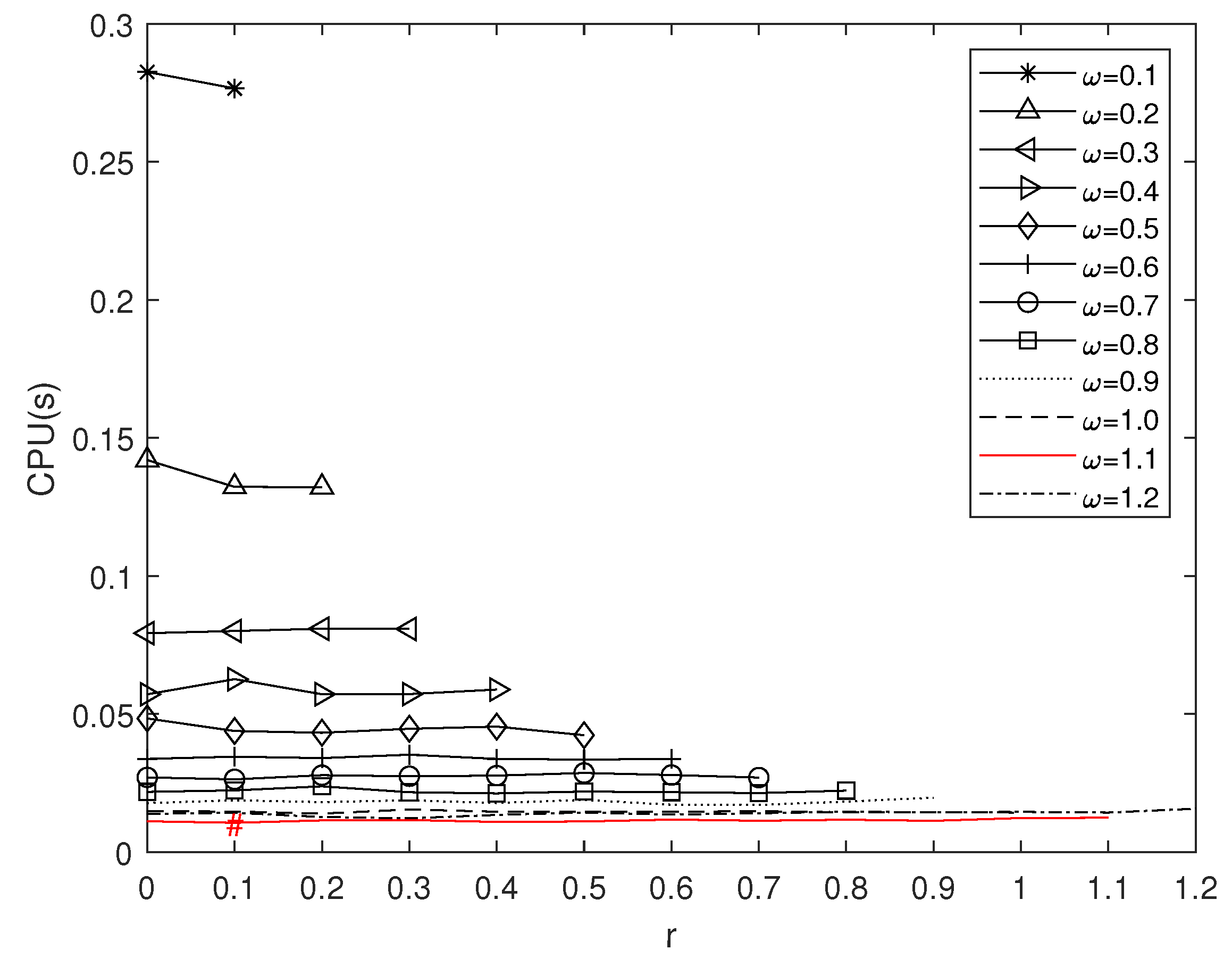
It is easy to prove that is also an -tensor and the AOR splitting of is convergent when and . Let the initial value . The numerical results of Algorithm 1 are shown in Figure 1, where the values of range from to in intervals of 0.1 and the values of r from 0 to in intervals of 0.1.
Figure 1.
The numerical results of Example 1.
As can be seen in Figure 1, Algorithm 1 effectively solves TAVE (1). Of the parameters and r in this experiment, the value of has a greater impact on the running time of the algorithm. The values of optimal parameters and r in Example 1 were between 1.1 and 0.1. The minimum CPU time was 0.01042 s, which is represented by “#” in Figure 1, and the number of iteration steps was 13.
Example 2.
Let
where is a nonnegative tensor with and the right-hand side .
By [23], we know that is a nonsingular -tensor, so is an -tensor. Let the initial value . For the SOR method, we took the values of range from 0.1 to 1.0 in intervals of 0.1. For the AOR method, we took the values of range from to in intervals of 0.1 and the values of r from 0 to in intervals of 0.1. For , and 300, we solved TAVE (1) by the Jacobi method, Gauss–Seidel method, SOR method, and AOR method. The numerical results are shown in Table 1, where and r are the optimal parameters.
Table 1.
The numerical results of Example 2.
It can be seen in Table 1 that if we take the optimal parameters and r, the AOR method and SOR method are more effective than the Jacobi method and Gauss–Seidel method for solving TAVE (1) with , and 300. In particular, the AOR method is optimal. Furthermore, we found that the number of iteration steps decreases as n () increases in these four methods. Therefore, our algorithm may be more efficient for solving the large-scale problems.
Example 3.
Let be generated randomly by MATLAB and
where, . Let , , and
The right-hand side is .
It is easy to see that , , so is an -tensor. We took the initial value . We took the values of from to with intervals of 0.1 and the values of r from 0 to with intervals of 0.1. For different and r, we solved TAVE (1) with , and 50 by Algorithm 1. All numerical results are depicted in Figure 2, and the numerical results under the optimal parameters and r are shown in Table 2.
Figure 2.
The numerical results of Example 3. (a) n = 4; (b) n = 10; (c) n = 30; (d) n = 50.
Table 2.
The numerical results of Example 3 with optimal parameters and r.
5. Conclusions
In this paper, a tensor splitting AOR iterative method was presented to solve the -tensor absolute value equation. The convergence of the new method was analyzed. Some numerical examples verified the effectiveness of the new method. In the future, we will explore theoretical optimal parameters for our algorithm, and study more efficient algorithms for solving TAVE (1). Our AOR iterative method may be applied to control problems [24,25,26,27,28], which will be research by our team in future.
Author Contributions
All authors contributed equally and significantly in writing this article. All authors have read and agreed to the published version of the manuscript.
Funding
This work was supported by Natural Science Foundation of China (11661027), the Guangxi Natural Science Foundation (2020GXNSFAA159143), and the Innovation Project of GUET Graduate Education (2021YCXS114).
Institutional Review Board Statement
Not applicable.
Informed Consent Statement
Not applicable.
Data Availability Statement
Not applicable.
Conflicts of Interest
The authors declare no conflict of interest.
References
- Che, M.; Qi, L.; Wei, Y. Positive-definite tensors to nonlinear complementarity problems. J. Optim. Theory Appl. 2016, 168, 475–487. [Google Scholar] [CrossRef] [Green Version]
- Bai, X.; Huang, Z.; Wang, Y. Global uniqueness and solvability for tensor complementarity problems. J. Optim. Theory Appl. 2016, 170, 72–84. [Google Scholar] [CrossRef] [Green Version]
- Wang, X.; Che, M.; Wei, Y. Global uniqueness and solvability of tensor complementarity problems for -tensors. Numer. Algorithms 2020, 84, 567–590. [Google Scholar] [CrossRef]
- Khoromskij, B.N. DIFaddend Tensor numerical methods for multidimensional PDEs: Theoretical analysis and initial applications. ESAIM Proc. Surv. 2015, 48, 1–28. [Google Scholar] [CrossRef]
- Qi, L.; Yu, G.; Wu, E. Higher order positive semi-definite diffusion tensor imaging. Siam J. Imaging Sci. 2010, 3, 416–433. [Google Scholar] [CrossRef] [Green Version]
- Eldén, L. Matrix methods in data mining and pattern recognition. Int. Stat. Rev. 2007, 75, 409–438. [Google Scholar]
- Du, S.; Zhang, L.; Chen, C.; Qi, L. Tensor absolute value equations. Sci. China Math. 2018, 61, 1695–1710. [Google Scholar] [CrossRef] [Green Version]
- Bu, F.; Ma, C. The tensor splitting methods for solving tensor absolute value equation. Comput. Appl. Math. 2020, 39, 178. [Google Scholar] [CrossRef]
- Ning, J.; Xie, Y.; Yao, J. Efficient splitting methods for solving tensor absolute value equation. Symmetry 2022, 14, 387. [Google Scholar] [CrossRef]
- Guo, X.; Gu, W. A smoothing newton method for tensor generalized absolute value equations. Adv. Math. (China) 2020, 49, 761–768. [Google Scholar]
- Ling, C.; Yan, W.; He, H.; Qi, L. Further study on tensor absolute value equations. Sci. China Math. 2020, 63, 2137–2156. [Google Scholar] [CrossRef] [Green Version]
- Jiang, Z.; Li, J. Solving tensor absolute value equation. Appl. Numer. Math. 2021, 170, 255–268. [Google Scholar] [CrossRef]
- Ding, W.; Wei, Y. Solving multi-linear system with -tensors. J. Sci. Comput. 2016, 68, 689–715. [Google Scholar] [CrossRef]
- Liu, D.; Li, W.; Vong, W. The tensor splitting with application to solve multi-linear systems. J. Comput. Appl. Math. 2018, 330, 75–94. [Google Scholar] [CrossRef]
- Li, W.; Liu, D.; Vong, W. Comparison results for splitting for solving multi-linear systems. Appl. Numer. Math. 2018, 134, 105–121. [Google Scholar] [CrossRef]
- Wang, X.; Che, M.; Wei, Y. Preconditioned tensor splitting AOR iterative methods for H-tensor equations. Numer. Linear Algebra Appl. 2020, 27, e2329. [Google Scholar] [CrossRef]
- Wang, X.; Che, M.; Wei, Y. Existence and uniqueness of positive solution for -tensor equations. Appl. Math. Lett. 2019, 98, 191–198. [Google Scholar] [CrossRef]
- Wang, H.; Liu, H.; Cao, S. A verification method for enclosing solutions of absolute value equations. Collect. Math. 2013, 64, 17–38. [Google Scholar] [CrossRef]
- Ding, W.; Qi, L.; Wei, Y. -tensors and nonsingular -tensors. Linear Algebra Its Appl. 2013, 439, 3264–3278. [Google Scholar] [CrossRef]
- Wang, X.; Wei, Y. H–tensors and nonsingular H-tensors. Front. Math. China 2016, 11, 557–575. [Google Scholar] [CrossRef]
- Pearson, K. Essentially positive tensors. Int. J. Algebra 2010, 4, 421–427. [Google Scholar]
- Liu, W.; Li, W. On the inverse of a tensor. Linear Algebra Its Appl. 2016, 495, 199–205. [Google Scholar] [CrossRef]
- Xie, Z.; Jin, X.; Wei, Y. Tensor methods for solving symmetric -tensor systems. J. Sci. Comput. 2018, 74, 412–425. [Google Scholar] [CrossRef]
- Singh, A.; Shukla, A.; Vijayakumar, V.; Udhayakumar, R. Asymptotic stability of fractional order (1,2] stochastic delay differential equations in banach spaces. Chaos Solitons Fractals 2021, 150, 111095. [Google Scholar] [CrossRef]
- Vijayakumar, V.; Nisar, K.; Chalishajar, D.; Shukla, A.; Malik, M.; Alsaadi, A.; Aldosary, S. A note on approximate controllability of fractional semilinear integrodifferential control systems via resolvent operators. Fractal Fract. 2022, 6, 73. [Google Scholar] [CrossRef]
- Vijayakumar, V.; Panda, S.; Nisar, K.; Baskonus, H. Results on approximate controllability results for second-order Sobolev-type impulsive neutral differential evolution inclusions with infinite delay. Numer. Methods Partial. Differ. Equ. 2021, 2, 1200–1221. [Google Scholar] [CrossRef]
- Shukla, A.; Sukavanam, N.; Pandey, D. Complete controllability of semi-linear stochastic system with delay. Rend. Del. Circ. Mat. Di Palermo 2015, 64, 209–220. [Google Scholar] [CrossRef]
- Shukla, A.; Patel, R. Existence and optimal control results for second-order semilinear system in Hilbert spaces. Circuits Syst. Signal Process. 2021, 40, 4246–4258. [Google Scholar] [CrossRef]
Publisher’s Note: MDPI stays neutral with regard to jurisdictional claims in published maps and institutional affiliations. |
© 2022 by the authors. Licensee MDPI, Basel, Switzerland. This article is an open access article distributed under the terms and conditions of the Creative Commons Attribution (CC BY) license (https://creativecommons.org/licenses/by/4.0/).