2. Preliminaries
In this section, we will introduce some lemmas to prove our main results.
In a hypergraph H, let be the set of all -semi walks of length k, and be the set of all -semi walks of length k. Denote , then , that is, the number of closed semi-walks of length k in H.
For two hypergraphs G and H with and , if for any , we say . Moreover, if and there exists some such that , then we write . Similarly, if for any , we call , further if , and there is some such that , we write .
For a hypergraph H, let . By applying the -shrinking on each edge in , denote the resulted edge by , let . For , let and , respectively. Further, denotes the hypergraph obtained from H by deleting edges in and adding edges in . Similarly, we can attain hypergraph .
Lemma 1 ([
1]).
For a hypergraph H, let be defined as above, respectively. For and , if and , then . and denote two disjoint connected hypergraphs and , , respectively. denotes the hypergraph obtained from and by identifying v of with w of .
Lemma 2 ([
1]).
Let and be two disjoint connected hypergraphs with and , respectively. If , then . Lemma 3 ([
1]).
Let e be a cut edge of hypergraph H with and . When and , . H is a connected
r-uniform hypergraph. Let
and
be two disjoint
r-uniform loose paths, where
. Denote
as the hypergraph obtained from
H,
and
by coalescing
as a new vertex, denoted by
u. Obviously, if
, then
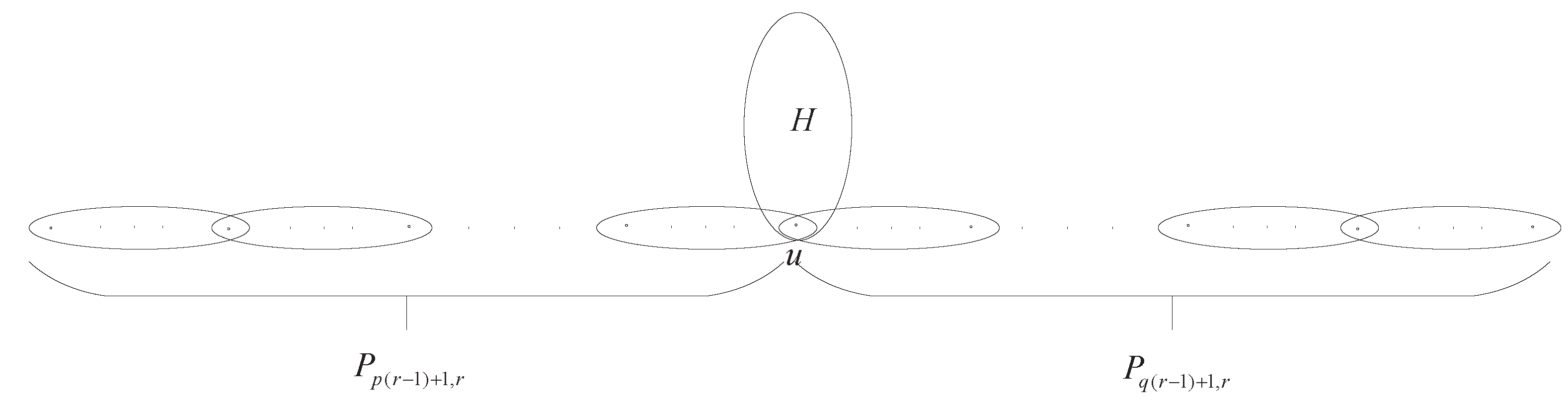
(as shown in
Figure 1).
Lemma 4. Let be a hypergraph defined as above (as shown in Figure 1). If , . Proof. Let
be the loose paths defined in (1) and (2), respectively. In
, if
,
, and if
,
. Let
. After applying the
-shrinking on
of
, the resulting hypergraph is denoted by
. Let
Q be the hypergraph obtained from
by adding
at
. After applying the
-shrinking on
of
Q, the resulting hypergraph is denoted by
. In
G, we have
Suppose that
and
. For any
,
W can be decomposed into
, where
is either a walk which consists of a
-section of
with length
and a
-section of length 1, or a walk which consists of a
-section of
with length
and a
-section of length 1, and
is a
-section of
G with length
. Then, we have
For , is isomorphic to a proper subgraph of , then we have for and for and . Furthermore, we find . Therefore, we obtain for and there exists an integer such that . Thus, we obtain . By Lemma 2, we obtain . Since and , thus we have . □
Let
be the two loose paths defined in (1) and (2) respectively. For convenience, let
,
and
, respectively. Let
be an edge of a connected
r-uniform hypergraph
H. Denote
as the
r-uniform hypergraph obtained from
H,
and
by identifying
of
H with
of
and identifying
of
H with
of
, as shown in
Figure 2.
Lemma 5. Let be the r-uniform hypergraph as shown in Figure 2. If and , . Proof. If
in
, let
. For simplicity, let
. We obtain
by applying the
-shrinking of
. Denote
and
, where
. Since
and
,
is isomorphic to a proper subgraph
. For any
,
W can be decomposed into two sections according to whether it passes
(namely
) or not. Then
Suppose that W passes through , then we construct a mapping f as follows:
- (i)
If , we replace in W by ;
- (ii)
If , we replace in W by ;
- (iii)
If , we replace in W by .
If , we construct a mapping as follows: . Obviously, . Since is isomorphic to a proper subgraph of , is an injection but not a bijection from to .
If , we can decompose W into , where
- (i)
is the longest -section;
- (ii)
is the longest -section;
- (iii)
is the longest -section;
- (iv)
is the longest -section;
- (v)
is the longest -section.
Now, we construct a mapping , where
- (i)
is the longest -section;
- (ii)
is the longest -section;
- (iii)
is the longest -section;
- (iv)
is the longest -section.
Then
. Further, we construct a mapping
,
Obviously, and is injective but not bijective from to . Then , that is, . By Lemma 2, we have . □
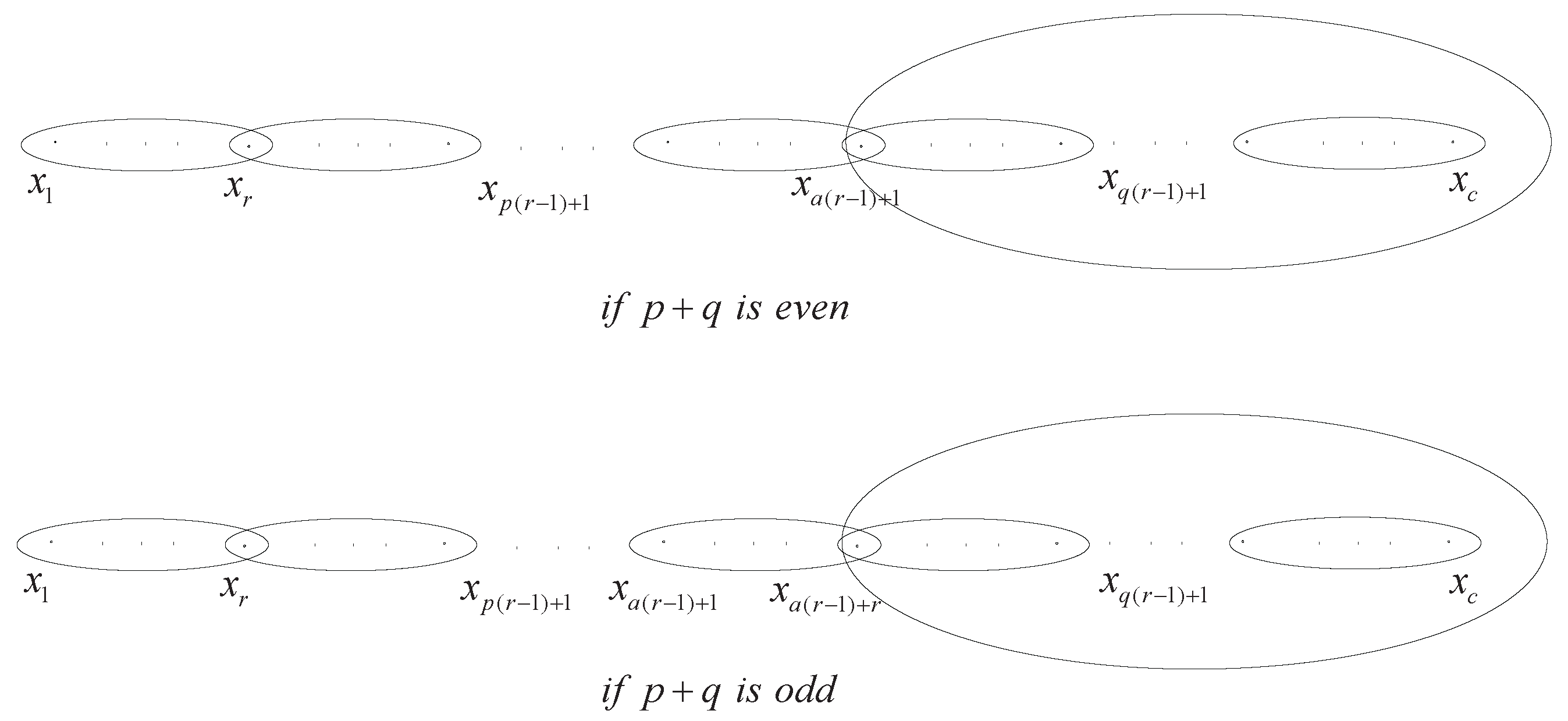
Lemma 6. Let be three integers with , and (that is, the largest integer is no more than ). In a connected r-uniform hypergraph H, let be a path with length l and , and and . Further if is even, is a loose path; if is odd, is a loose path (as shown in Figure 3). Then and for any . Proof. If is even, by applying the -shrinking of P, let be the component containing and be the component containing . Obviously, is a loose path and is isomorphic to a proper subgraph of .
In H, we can classify -closed walks of length into two types according to whether they pass or not. Namely, we obtain . Let W be a walk passing , where . We construct a mapping as follows: we replace for by for in W.
For , we construct a mapping as follows: let . We can check . Since is isomorphic to a proper subgraph of , is an injection but not a bijection from to .
For , we decompose W into , where and are semi-edge walks in P, and is as long as possible. Let , and we can check .
Finally, for
, we can construct a mapping
as follows:
Obviously,
. Since
is an injection but not bijective,
is an injection but not bijective from to . Then we obtain .
By the same procedure as that for being even, we can prove that Lemma 6 holds for being odd. □
Corollary 1. For an integer , let be the unique cycle in a unicyclic r-uniform hypergraph H. Suppose that is the hypergraph obtained from H by moving edges in from to . Then .
Proof. Let . Applying Lemma 6 for and implies that . Now the result follows from Lemma 2. □
Note that the result of Corollary 1 holds for any and because we can rewrite the cycle C as .
3. Extremal -Uniform Unicyclic Hypergraph on Minimum
In this section, we determine the extremal r-uniform unicyclic hypergraph with minimum .
Let be the class of the connected r-uniform unicyclic hypergraph with order n and unique cycle , where and . For convenience, for any , let and for and . If , it is easy to see that . Let be the components of , where for . So we can denote H by .
Lemma 7. Let . Then for The equality holds if, and only if, , where is a loose path of length .
Proof. It is trivial if or 2. Suppose that .
Case 1. There is at least one vertex in with a degree of at least 3. Denote u as a vertex of a degree of at least 3. The distance is as large as possible in . Denote as all the edges containing u in H. By u-shrinking on for , denote the components by . Without loss of generality, let .
Subcase 1.1 If , , is a pendant path at u. Repeatedly by Lemma 4, we obtain a hypergraph with smaller by replacing by a pendant path P of length at u.
If , we obtain the desirable result.
Subcase 1.2 If , , is not a pendant path at u, then there is at least one edge in with at least three vertices of degree 2. We choose such an edge by requiring that is as large as possible, where for . Then, there are two pendant paths at different vertices of e; let P and Q be pendant paths at vertices and of e, respectively. Denote p and q as the lengths of P and Q. Then , and . Let , by Lemma 5, , we can obtain a hypergraph with smaller by reusing Lemma 5, where is a pendant path at u for any .
Denote as the lengths of the pendant path at u in , where and . Suppose without loss of generality that . Then , where . Let , by Lemma 5, .
We can obtain a hypergraph with smaller by attaching a pendant path P of length at u by reusing Lemma 4.
If , we obtain the desired result. Otherwise, repeating the above process on , we will obtain our desired result.
Case 2. There is no vertex with degree at least 3 in .
It is trivial for . When , similar to the proof in Subcase 1.2, we obtain the desirable result. □
Applying Lemma 7, we have the following results.
Corollary 2. Let be a hypergraph obtained from by replacing each by a loose path with for . Then , and the equality holds if, and only if, .
Theorem 1. Let be a connected r-uniform unicyclic hypergraph with and , where is a path attached at in for . Then Proof. Without loss of generality, let be the pendant path at . is the unicyclic hypergraph obtained from by moving from to . By Lemma 2 and Corollary 1, . By repeating the process on every pendant path, we conclude that . □
The following theorem shows that the extremal r-uniform unicyclic hypergraph with minimum is .
Theorem 2. For , let H be a r-uniform unicyclic hypergraph with n vertices, then and the equality holds if, and only if, .
4. Extremal -Uniform Unicyclic Hypergraph on Maximum
In this section, we obtain the extremal r-uniform unicyclic hypergraphs with the largest .
Lemma 8. Let . Then and the equality holds if, and only if, , where is a hyperstar with center and .
Proof. It is trivial if . Now we assume .
Let be the hypergraph with largest in and the diameter of be for . Next, we prove for .
Without loss of generality, let be a diametral path of , where and .
We denote by R the component of which contains . Let . Then, we have and . By Lemma 4, we obtain . Obviously, . By Lemma 3, we have . This contradicts the maximality of . So we obtain . By the same procedure, we have , for . Thus, we have . □
Lemma 9. Let be a connected r-uniform unicyclic hypergraph with and , where is a r-uniform hyperstar with center for . Thenwhere is a hyperstar with center and . Proof. We denote by the component of which contains . Let . Then, we have and . By Lemma 4, we obtain . Obviously, . By Lemma 3, we have . That is to say, , where is a hyperstar with center and .
Repeatedly by the above process on , we will obtain the desirable result. □
Lemma 10. For and , , where are hyperstars with centers for . Let e be the edge containing . Let be the r-uniform unicyclic hypergraph obtained from H by moving each edge of from to . Then, .
Proof. If , the equality holds. Let , and be the unique cycle of H. Applying Lemma 9, , where . Repeatedly by the above process, we have . □
Lemma 11. For , , where and are two hyperstars with centers and and . Let be the r-uniform unicyclic hypergraph obtained from by moving all edges in from to . Then, .
Proof. Let
,
. Let
and
. We have
and
. Then we obtain
Since , is isomorphic to a proper subgraph of . Then we have for , for and and for . Furthermore, we have . Thus, we obtain . By Lemma 3, we have , where is an edge.
Then we show that the hypergraph obtained from has a larger by moving an edge in from to . Repeat the above process to obtain the desired result. □
Theorem 3. For , let H be a r-uniform unicyclic hypergraph with n vertices. Then with equality if, and only if, , where is a hyperstar with center .
Proof. Denote H as a r-uniform unicyclic hypergraph with n vertices; we denote it by with and , where is a r-uniform hypertree for .
Case 1..
By repeating the use of Lemmas 8, 9 and 11, it is easy to obtain our desirable result.
Case 2..
By repeating our use of Lemmas 8 and 9, we can obtain a r-uniform unicyclic hypergraph satisfying , where . we obtain a r-uniform unicyclic hypergraph with by Lemma 10, where and is a hyperstar with center , and is a hyperstar with center .
By Lemma 11, we obtain a r-uniform unicyclic hypergraph satisfying , where . We can obtain our desirable result. □