Novel Generalized Proportional Fractional Integral Inequalities on Probabilistic Random Variables and Their Applications
 , , , and
Abstract
1. Introduction
2. Preliminaries
- ()
- The RL-fractional integral operator defined as in [25] with ;
- ()
- The Hadamard fractional integral operator defined as in [25] with ;
- ()
- The Katugampola fractional integral operator defined as in [26] with for ;
- ()
- The conformable fractional integral operator defined as in [27] with for ;
- ()
- The generalized conformable fractional integral operator defined as in [28] with .
- ()
- If we input , and in Definition 4, it yields that the classical expectation ;
- ()
- If we input , and in Definition 7, it yields that the classical variance ;
- ()
- If we input , and in Definition 9, it yields that the classical moment of order r: ;
- ()
- ()
- If we input in Definitions 4–8, it yields Definitions – in [40].
- ()
- For , the h satisfies
- ()
- For and , we have the well-known property .
3. Main Results
- For any and ,provided that ;
- The integral inequalityis true for all and .
- For every , , and , then
- The inequalityis also true for each .
- For every α, and ,where ;
- The integral inequalityis also true for each α, and .
- ()
- By setting in Theorem 2, Theorem 2 deduces to Theorem 1;
- ()
- By setting and in Theorem 2, then Theorem 2 deduces to Theorem in [34];
- ()
- By setting and in of Theorem 2 then Theorem 2 deduces the first part of Theorem 1 as in [33];
- ()
- By setting and in of Theorem 2, then Theorem 2 deduces the last part of Theorem 1 as in [33];
- ()
- If we input , we have Theorem in [40].
4. Some Examples
- (i)
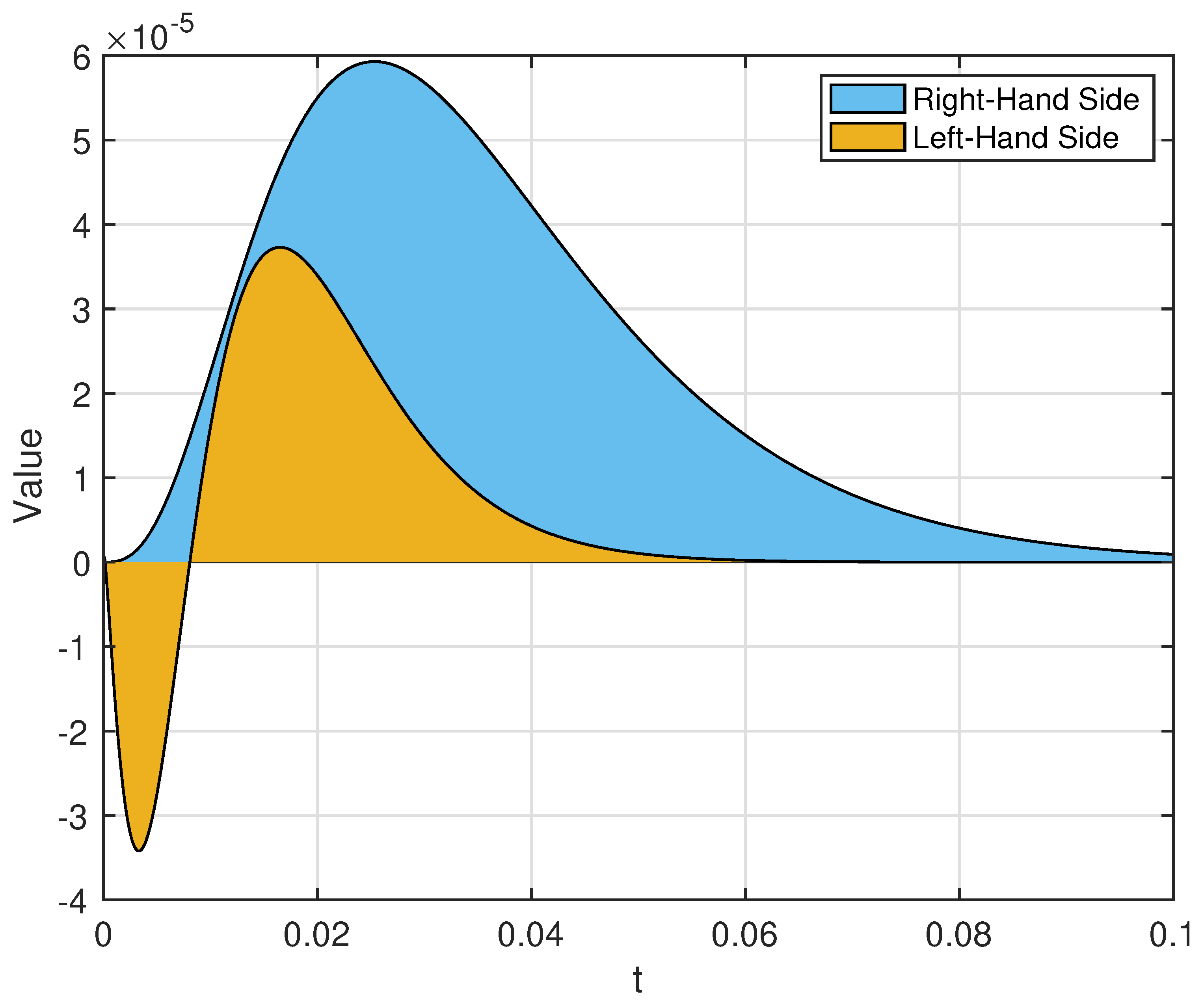
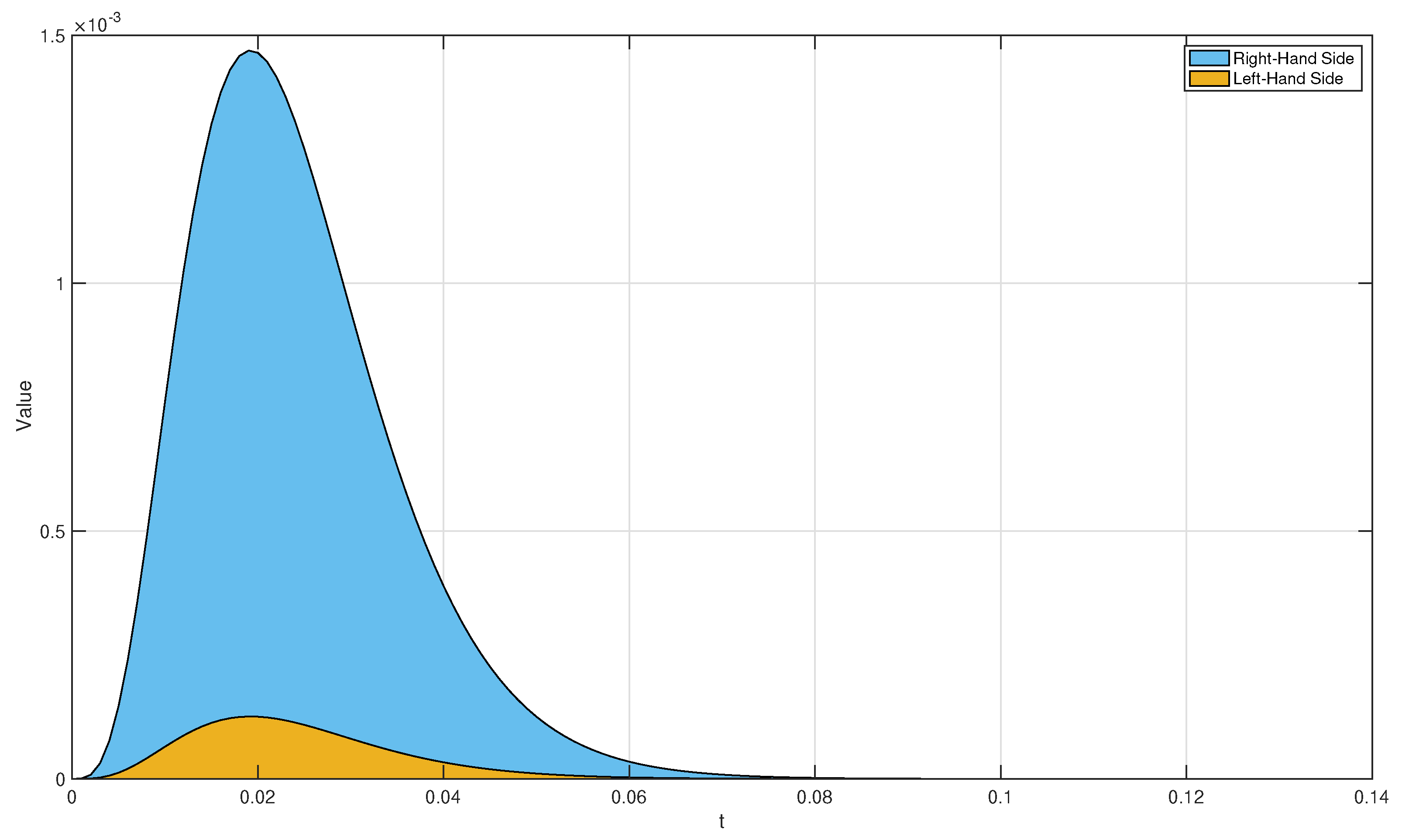
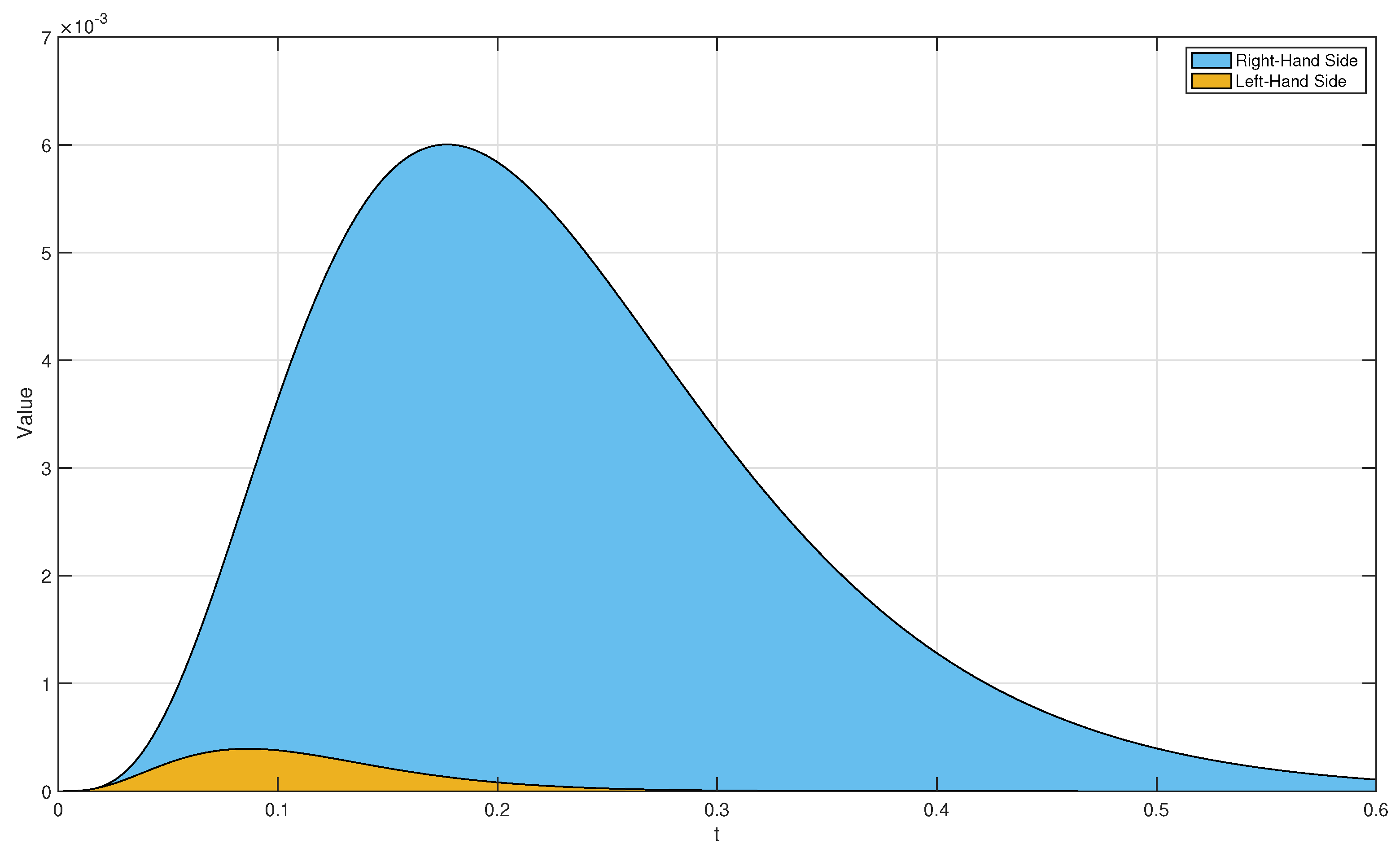
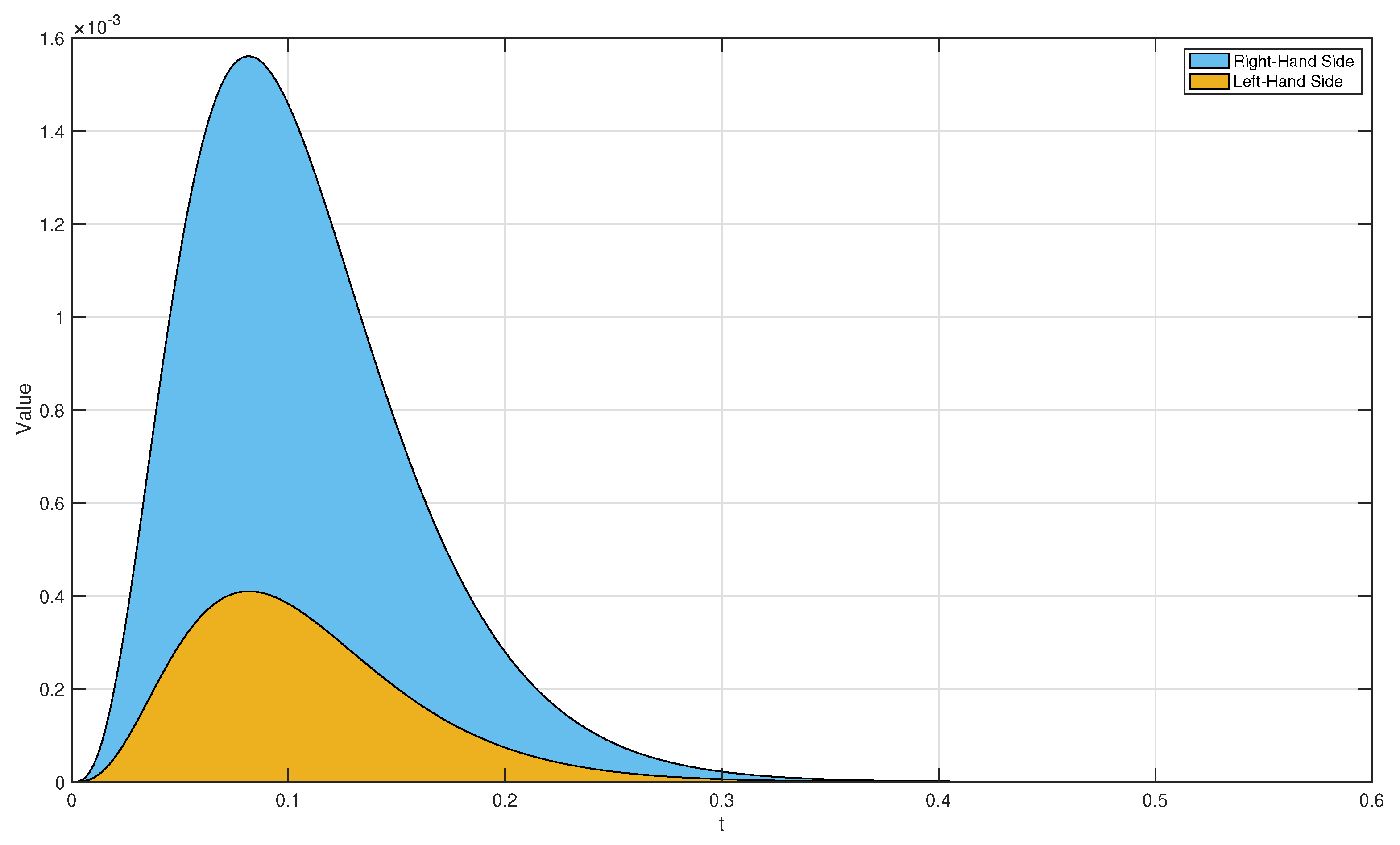
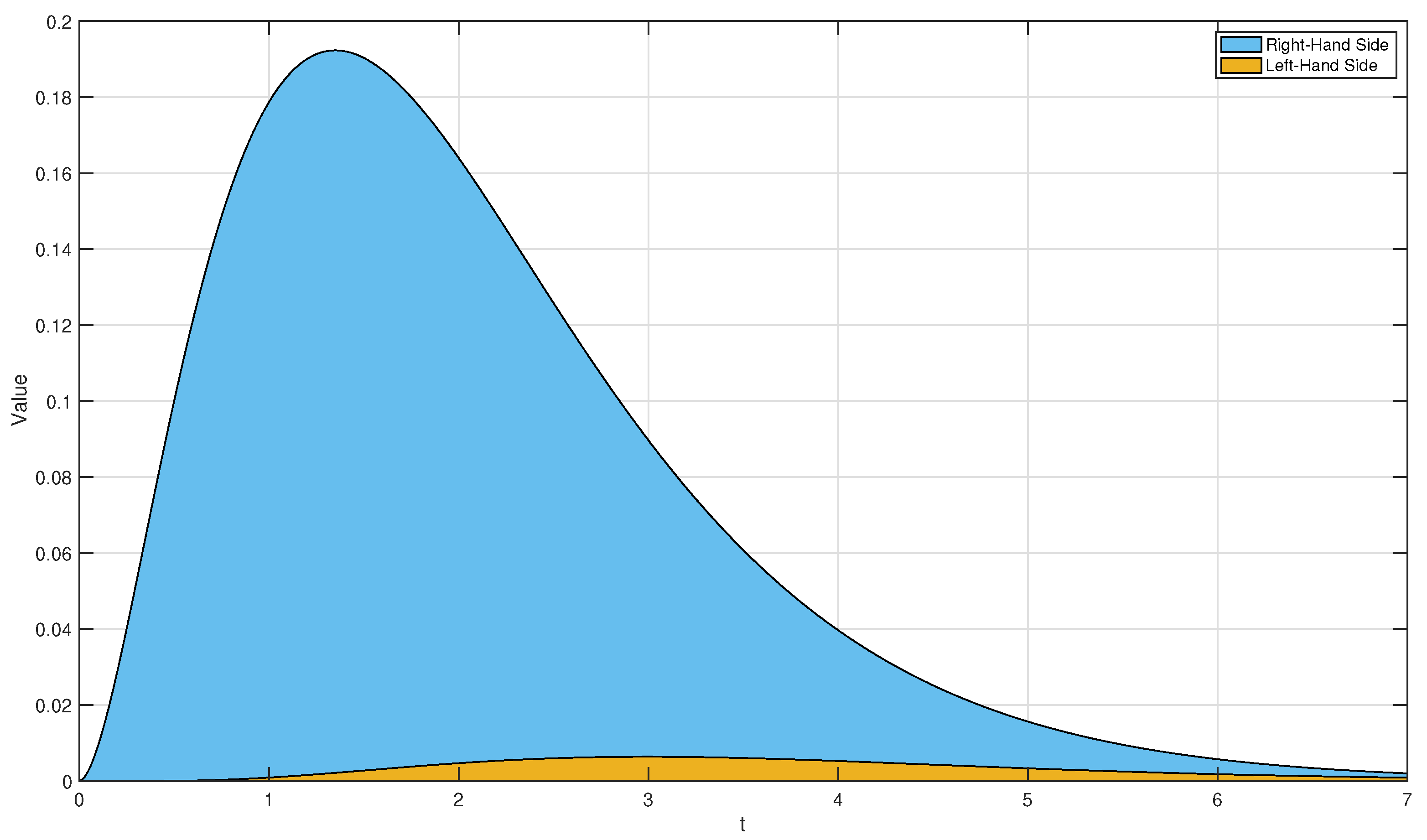
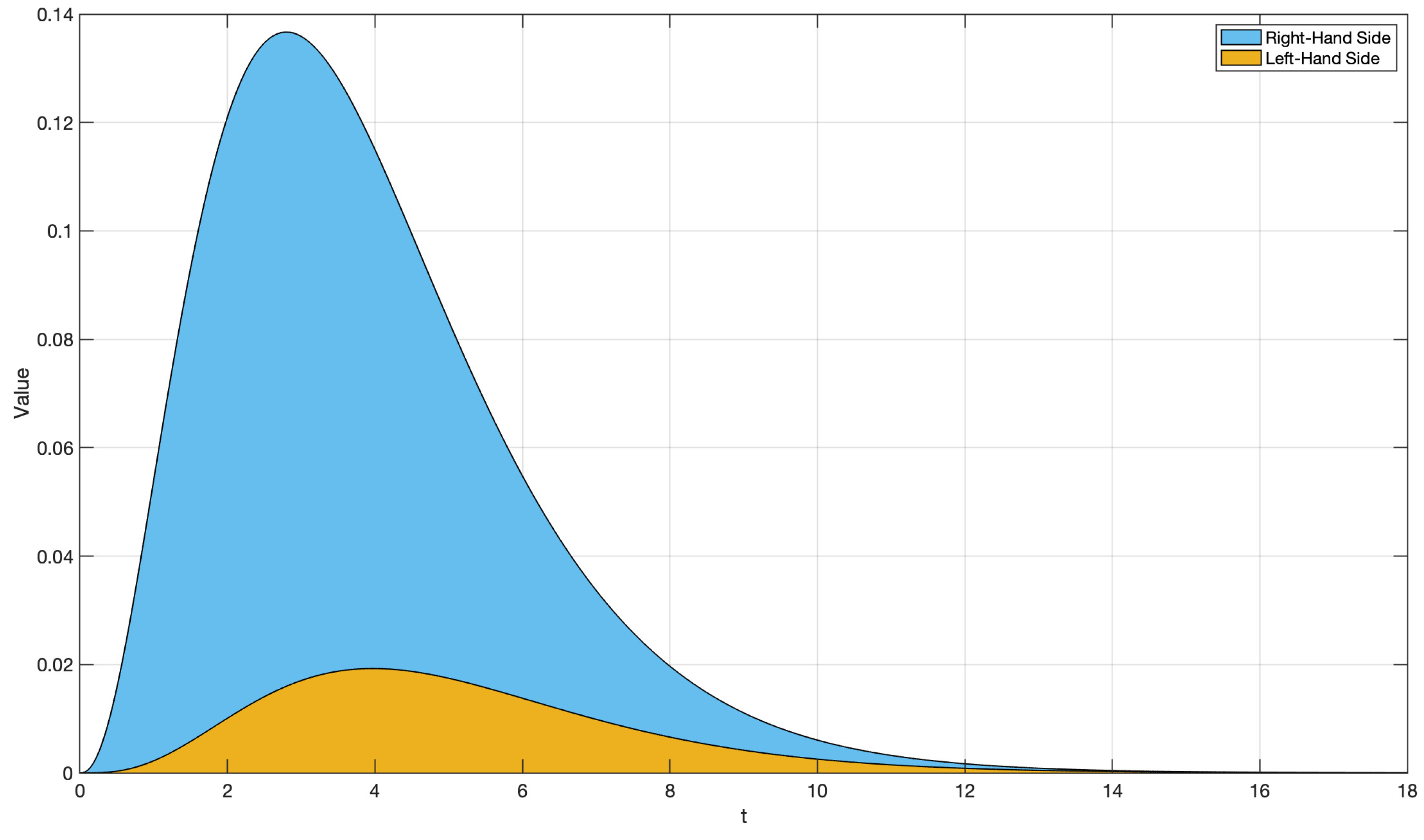
- The proportional of order : From Definition 4, we obtain thatClearly, if and , then (43) reduces to the classical expectation of
- (ii)
- The proportional of order : By Definition 9, one hasClearly, if and , then (44) reduces to the classical moment of order 2
- (iii)
- The proportional of order : By applying Theorem 1, we obtainBy direct computation with Definitions 3 and 4, we haveandClearly, if and then (48) reduces to the classical varience of
- (iv)
- The proportional of order :By Definition 9 and binomial expression,This implies that
5. Conclusions
Author Contributions
Funding
Institutional Review Board Statement
Informed Consent Statement
Data Availability Statement
Acknowledgments
Conflicts of Interest
Abbreviations
| FC | Fractional calculus |
| RL | Riemann–Liouville |
| Continuous random variable | |
| Probability density function | |
| Fractional expectation | |
| Fractional variance | |
| Fractional moment |
References
- Pachpatte, B.G. Mathematical Inequalities; Elsevier: Amsterdam, The Netherlands, 2005. [Google Scholar]
- Cerone, P.; Dragomir, S.S. Mathematical Inequalities; CRC Press: New York, NY, USA, 2011. [Google Scholar]
- Guessab, A.; Schmeisser, G. Convexity results and sharp error estimates in approximate multivariate integration. Math. Comput. 2004, 73, 1365–1384. [Google Scholar] [CrossRef] [Scilit]
- Azar, S.A. Jensen’s Inequality in Finance. Int. Adv. Econ. Res. 2008, 14, 433–440. [Google Scholar] [CrossRef] [Scilit]
- Guessab, A. Direct and converse results for generalized multivariate Jensen type inequalities. J. Nonlinear Convex Anal. 2012, 13, 777–797. [Google Scholar]
- Sudsutad, W.; Ntouyas, S.K.; Tariboon, J. Quantum integral inequalities for convex functions. J. Math. Inequal. 2015, 9, 781–793. [Google Scholar] [CrossRef] [Scilit]
- Masjed-Jamei, M.; Omey, E.; Dragomir, S.S. A main class of integral inequalities with applications. Math. Model. Anal. 2016, 21, 569–584. [Google Scholar] [CrossRef] [Scilit]
- Zhao, T.H.; Wang, M.K.; Chu, Y.M. A sharp double inequality involving generalized complete elliptic integral of the first kind. AIMS Math. 2020, 5, 4512–4528. [Google Scholar] [CrossRef] [Scilit]
- Sun, M.B.; Chu, Y.M. Inequalities for the generalized weighted mean values of g-convex functions with applications. RACSAM 2020, 114, 172. [Google Scholar] [CrossRef] [Scilit]
- Khan, M.A.; Pečarić, J.; Chu, Y.M. Refinements of Jensen’s and McShane’s inequalities with applications. AIMS Math. 2020, 5, 4931–4945. [Google Scholar] [CrossRef] [Scilit]
- Sudsutad, W.; Ntouyas, S.K.; Tariboon, J. Fractional integral inequalities via Hadamard’s fractional integral. Abstr. Appl. Anal. 2014, 2014, 563096. [Google Scholar] [CrossRef] [Scilit]
- Tariboon, J.; Sudsutad, W.; Ntouyas, S.K. Some new Riemann-Liouville fractional integral inequalities. Int. J. Math. Math. Sci. 2014, 2014, 869434. [Google Scholar] [CrossRef] [Scilit]
- Sudsutad, W.; Ntouyas, S.K.; Tariboon, J. Integral inequalities via fractional quantum calculus. J. Inequal. Appl. 2016, 2016, 81. [Google Scholar] [CrossRef] [Scilit]
- Kacar, E.; Kacar, Z.; Yildirim, H. Integral inequalities for Riemann-Liouville fractional integrals of a function with respect to another function. Iran. J. Math. Sci. Inform. 2018, 13, 1–13. [Google Scholar]
- Alzabut, J.; Abdeljawad, T.; Jarad, F.; Sudsutad, W. A Gronwall inequality via the generalized proportional fractional derivative with applications. J. Inequal. Appl. 2019, 2019, 101. [Google Scholar] [CrossRef] [Scilit]
- Abdeljawad, T.; Jarad, F.; Mallak, S.; Alzabut, J. Lyapunov type inequalities via fractional proportional derivatives and application on the free zero disc of Kilbas-Saigo generalized Mittag-Leffler functions. Eur. Phys. J. Plus 2019, 134, 247. [Google Scholar] [CrossRef] [Scilit]
- Alzabut, J.; Sudsutad, W.; Kayar, Z.; Baghani, H. A new Gronwall-Bellman inequality in frame of generalized proportional fractional derivative. Mathematics 2019, 7, 747. [Google Scholar] [CrossRef] [Scilit]
- Xu, L.; Chu, Y.M.; Rashid, S.; El-Deeb, A.A.; Nisar, K.S. On new unified bounds for a family of functions with fractional q-calculus theory. J. Funct. Spaces 2020, 2020, 4984612. [Google Scholar]
- Abdeljawad, T.; Rashid, S.; Hammouch, Z.; Chu, Y.M. Some new local fractional inequalities associated with generalized (s, m)-convex functions and applications. Adv. Differ. Equ. 2020, 2020, 406. [Google Scholar] [CrossRef] [Scilit]
- Guo, S.Y.; Chu, Y.M.; Farid, G.; Mehmood, S.; Nazeer, W. Fractional Hadamard and Fejér-Hadamard inequaities associated with exponentially (s, m)-convex functions. J. Funct. Spaces 2020, 2020, 2410385. [Google Scholar]
- Rashid, S.; Noor, M.A.; Noor, K.I.; Chu, Y.M. Ostrowski type inequalities in the sense of generalized K-fractional integral operator for exponentially convex functions. AIMS Math. 2020, 5, 2629–2645. [Google Scholar] [CrossRef] [Scilit]
- Khurshid, Y.; Khan, M.A.; Chu, Y.M. Conformable integral version of Hermite-Hadamard-Fejér inequalities via η-convex functions. AIMS Math. 2020, 5, 5106–5120. [Google Scholar] [CrossRef] [Scilit]
- Rashid, S.; Khalid, A.; Rahman, G.; Nisar, K.S.; Chu, Y.M. On new modifications governed by quantum Hahn’s integral operator pertaining to fractional calculus. J. Funct. Spaces 2020, 2020, 8262860. [Google Scholar] [CrossRef] [Scilit]
- Rashid, S.; Jarad, F.; Chu, Y.M. A note on reverse Minkowski inequality via generalized proportional fractional integral operator with respect to another function. Math. Probl. Eng. 2020, 2020, 7630260. [Google Scholar] [CrossRef] [Scilit]
- Kilbas, A.A.; Srivastava, H.M.; Trujillo, J.J. Theory and Applications of Fractional Differential Equations; Elsevier: Amsterdam, The Netherlands, 2006. [Google Scholar]
- Katugampola, U.N. New approach to generalized fractional integral. Appl. Math. Comput. 2011, 218, 860–865. [Google Scholar] [CrossRef] [Scilit]
- Abdeljawad, T. On conformable fractional calculus. J. Comput. Appl. Math. 2015, 279, 57–66. [Google Scholar] [CrossRef] [Scilit]
- Jarad, F.; Uǧurlu, E.; Abdeljawad, T.; Baleanu, D. On a new class of fractional operators. Adv. Differ. Equ. 2017, 2017, 247. [Google Scholar] [CrossRef] [Scilit]
- Khan, T.U.; Khan, M.A. Generalized conformable fractional operators. J. Comput. Appl. Math. 2019, 346, 378–389. [Google Scholar] [CrossRef] [Scilit]
- Jarad, F.; Alqudah, M.A.; Abdeljawad, T. On more generalized form of proportional fractional operators. Open Math. 2020, 18, 167–176. [Google Scholar] [CrossRef] [Scilit]
- Jarad, F.; Abdeljawad, T.; Rashid, S.; Hammouch, Z. More properties of the proportional fractional integrals and derivatives of a function with respect to another function. Adv. Differ. Equ. 2020, 2020, 303. [Google Scholar] [CrossRef] [Scilit]
- Barnett, N.S.; Dragomir, S.S. Some inequalities for random variables whose probability density functions are bounded using a pre-Grüss inequality. Kyungpook Math. J. 2020, 40, 299–311. [Google Scholar]
- Barnett, N.S.; Cerone, P.; Dargomir, S.S.; Roumeliotis, J. Some inequalities for the expectation and variance of a random variable whose PDF is n-time differentiable. J. Inequal. Pure Appl. Math. 2000, 2, 1–18. [Google Scholar]
- Dahmani, Z. Fractional integral inequalities for continous random variables. Malaya J. Mat. 2014, 2, 172–179. [Google Scholar]
- Akkurt, A.; Kaçar, Z.; Yildirim, H. Generalized fractional integral inequalities for continuous random variables. J. Prob. Stat. 2015, 2015, 958980. [Google Scholar] [CrossRef] [Scilit]
- Dahmani, Z. New applications of fractional calculus on probabilistic random variables. Acta Math. Univ. Comen. 2017, LXXXVI, 299–307. [Google Scholar]
- Dahmani, Z.; Khameli, A.; Bezziou, M.; Sarikaya, M.Z. Some estimations on continuous random variables involving fractional calculus. Int. J. Anal. Appl. 2017, 15, 8–17. [Google Scholar]
- Dahmani, Z.; Bouziane, A.E.; Houas, M.; Sarikaya, M.Z. New w-weighted concepts for continuous random variables with applications. Note di Mat. 2017, 37, 23–40. [Google Scholar]
- Khellaf, O.M.; Chinchane, V.L. Continuous random variables with Hadamard fractional integral. Tamkang J. Math. 2019, 50, 103–109. [Google Scholar]
- Chen, S.B.; Rashid, S.; Noor, M.A.; Ashraf, R.; Chu, Y.M. A new approach on fractional calculus and probability density function. AIMS Math. 2020, 5, 7041–7054. [Google Scholar] [CrossRef] [Scilit]
- Houas, M. Some estimations on continuous random variables for (k, s)-fractional integral operators. Moroc. J. Pure Appl. Anal. 2020, 6, 143–154. [Google Scholar] [CrossRef] [Scilit]
- Houas, M. Some inequalities for k-fractional continuous random variables. J. Adv. Res. Dyn. Control Syst. 2015, 7, 43–50. [Google Scholar]
- Tomar, M.; Maden, S.; Set, E. (k, s)-Riemann-Liouville fractional integral inequalities for continuous random variables. Arab. J. Math. 2017, 6, 55–63. [Google Scholar] [CrossRef] [Scilit]
- Houas, M.; Dahmani, Z.; Sarikaya, M.Z. New integral inequalities for (r, α)-fractional moments of continuous random variables. Mathematica 2018, 60, 166–176. [Google Scholar] [CrossRef] [Scilit]
- Sarikaya, M.Z.; Dahmani, Z.; Kiris, M.E.; Ahmad, F. (k, s)-Riemann-Liouville fractional integral and applications. Hacet. J. Math. Stat. 2016, 45, 77–89. [Google Scholar] [CrossRef] [Scilit]
- Bounoua, M.D.; Dahmani, Z.; Bekkouche, Z. Further results and applications on continuous random variables. Malaya J. Mat. 2019, 7, 429–435. [Google Scholar] [CrossRef] [Scilit]
- Abdelnebi, A.; Dahmani, Z.; Sarikaya, M.Z. New classes of fractional integral inequalities and some recent results on random variables. Malaya J. Mat. 2020, 8, 738–743. [Google Scholar] [CrossRef] [Scilit]
- Cerone, P.; Dargomir, S.S. On some inequalities for the expectation and variance. Korean J. Comput. Appl. Math. 2001, 8, 357–380. [Google Scholar] [CrossRef] [Scilit]
- Kumar, P. Inequalities involving moments of a continuous random variable defined over a finite interval. Comput. Math. Appl. 2004, 48, 257–273. [Google Scholar] [CrossRef] [Scilit]
- Dahmani, Z.; Tabharit, L. On weighted Gruss type inequalities via fractional integrals. J. Adv. Res. Pure Math. 2010, 2, 31–38. [Google Scholar] [CrossRef] [Scilit]
- Nápoles, V.J.E. Generalized fractional Hilfer integral and derivative. Contrib. Math. 2020, 2, 55–60. [Google Scholar]
- Atangana, A. Fractal-fractional differentiation and integration: Connecting fractal calculus and fractional calculus to predict complex system. Chaos Solitons Fractals 2017, 102, 396–406. [Google Scholar] [CrossRef] [Scilit]


Publisher’s Note: MDPI stays neutral with regard to jurisdictional claims in published maps and institutional affiliations. |
© 2022 by the authors. Licensee MDPI, Basel, Switzerland. This article is an open access article distributed under the terms and conditions of the Creative Commons Attribution (CC BY) license (https://creativecommons.org/licenses/by/4.0/).
Share and Cite
Sudsutad, W.; Jarasthitikulchai, N.; Thaiprayoon, C.; Kongson, J.; Alzabut, J. Novel Generalized Proportional Fractional Integral Inequalities on Probabilistic Random Variables and Their Applications. Mathematics 2022, 10, 573. https://doi.org/10.3390/math10040573
Sudsutad W, Jarasthitikulchai N, Thaiprayoon C, Kongson J, Alzabut J. Novel Generalized Proportional Fractional Integral Inequalities on Probabilistic Random Variables and Their Applications. Mathematics. 2022; 10(4):573. https://doi.org/10.3390/math10040573
Chicago/Turabian StyleSudsutad, Weerawat, Nantapat Jarasthitikulchai, Chatthai Thaiprayoon, Jutarat Kongson, and Jehad Alzabut. 2022. "Novel Generalized Proportional Fractional Integral Inequalities on Probabilistic Random Variables and Their Applications" Mathematics 10, no. 4: 573. https://doi.org/10.3390/math10040573
APA StyleSudsutad, W., Jarasthitikulchai, N., Thaiprayoon, C., Kongson, J., & Alzabut, J. (2022). Novel Generalized Proportional Fractional Integral Inequalities on Probabilistic Random Variables and Their Applications. Mathematics, 10(4), 573. https://doi.org/10.3390/math10040573