


Abstract
We work with a perturbed fractional differential equation with discontinuous right-hand sides where a discontinuity function crosses a discontinuity boundary transversally. The corresponding Poincaré map in a neighbourhood of a periodic orbit of an unperturbed equation is found. Then, bifurcations of periodic boundary solutions are analysed together with a concrete example.
Keywords:
fractional differential equation; periodic boundary condition; discontinuous system; Poincaré map; bifurcations MSC:
26A33; 34A08
1. Introduction
Many applications of fractional calculus and for discontinuous systems can be found in biophysics, quantum mechanics, group theory, robotics or economics. The main reason for the applications of fractional calculus is that fractional-order models have more degrees of freedom and are more flexible than the integer-order ones. On the other hand, discontinuous systems model phenomena with non-smooth forces or dry frictions. As basic sources are books such as [1,2,3,4,5,6], various analytical and numerical methods are applied as they are demonstrated in [7,8,9,10,11]. Moreover, the theory and applications of fractional systems are rapidly developing, supported by many recent papers and Special Issues such as [12,13,14,15,16], involving stability, asymptotic periodicity, synchronization, memory effect and several other important and interesting behaviours of fractional models.
We work with a perturbed fractional differential equation with globally Lipschitz right-hand sides and which change their forms, i.e., they are discontinuous and transversally cross a discontinuity boundary. We are looking for a solution of a perturbed system with a periodic boundary condition in a neighbourhood of a periodic orbit of an unperturbed system. That means a solution of an unperturbed equation is periodic. We consider Caputo fractional derivatives of an order less than one. Our approach is based on the well-known method of a Poincaré map constructed near an investigated periodic orbit widely applied in dynamical systems as either smooth or non-smooth [17,18]. Since our studied problem has a integral-differential structure due of using together integer and Caputo fractional derivatives, the extension of Poincaré method is not elementary, but rather technical. We also believe that it will have a good reason to continue in this study.
The paper is organised as follows. In Section 2, we introduce our problem and prove the existence of a global solution. In Section 3, we show the existence of a Poincaré map in a neighbourhood of a periodic orbit of an unperturbed equation, which allows a bifurcation analysis of periodic boundary solutions given in Section 4. Section 5 demonstrates our method on a concrete example, and it discusses a possible scenario of qualitative behaviour of our example problem. Section 6 summarises our achievements and proposes our future task.
2. Existence of Solutions
Let us consider the following equation:
where , , are small parameters, and function g is defined by
We suppose that functions and h are globally Lipschitz continuous functions on , and g transversally crosses the discontinuity boundary , i.e., .
We say that is a solution of the Equation (1) if it is continuous, piecewise and satisfies (1). The Equation (1) is equivalent to the following system:
where the second equation can be rewritten to the form
Initial conditions are as follows:
We work with .
Theorem 1.
The solution of the system (2) with fixed exists on , and it is expressed as
Proof.
The existence of a solution is shown by using the Banach fixed point theorem on a Banach space with a norm
where is specified below and is a norm on . When , we use the same norm .
Consider as a functional , where
We show that there is a unique point x such that for . We now verify that F is contractive on X for a suitable :
for and . Multiplying (3) by , we get:
The mapping is contractive if
Next, we compute
First, the integral in (5) is evaluated as follows:
Now, we first use substitution , then .
Thus, integral (6) is bounded by
Now we use Lipschitz continuity of functions and h. Let be a Lipschitz constant of function , where .
This shows that is contractive if (4) holds along with
a map has a unique fixed point. The proof is completed. □
3. Poincaré Map
The solution varies depending on . If is non-negative, we work with , otherwise we work with . We will therefore look for times and where is equal to zero, where changes to and vice versa.
Let us discuss a case, where parameters and are equal to 0. System (2) will then be system of ordinary differential equations.
For -periodic solution of system (9) is
fulfilled. The fixed -periodic solution of system (9) will be denoted by . The initial condition can be written as
The solution can be written in the terms of and :
The function is of class in all its variables.
Let us suppose the existence of and that and . At these points, function changes its form from to and vice versa. We work with , therefore will be , which means that will be of the following form:
It can be seen that can be identified as a function that
In the case where parameters and are not equal to 0, we obtain for
Similarly, for
where can be seen as a function , that
If and are not equal to 0, we obtain for
Similarly, for interval
First, let us look at the solution for ==0. The solution can be written in the following way:
It can be easily seen, that
where the last equation is result from T-periodicity.
The solution for and not equal to 0 can be written as , and on corresponding intervals , and , where these solutions are from (11)–(13).
It can be seen, that derivatives of function with respect to t are non-zero for and
The solution can be written similarly:
Let us recall , a solution to an unperturbed Equation (1), i.e., for . therefore indicates solutions (14) and (15). Now, we will look for a T-periodic boundary solution of system (2) near , which means that in system (2) we take and as small, close to 0. To reduce the number of variables, take and in the form and , while will be taken small close to 0, and and can be any. For simplicity, we will rename the variables and to and .
The system (2) can be written in the form
that , and . Now we define Poincaré map. We choose and .
is, similarly to and , function of variables and , that defines as . determines the time, when solution meets its initial value, which can be seen in Figure 1 The Poincaré map is defined as
where denotes the solution of (16) with right-hand side and the solution of (16) with right-hand side. To find periodic boundary solution we solve the equation
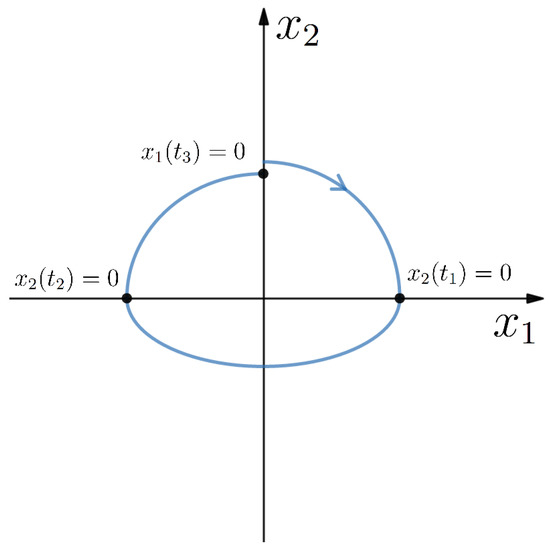
Figure 1.
Graphical representation of the behaviour of the solution at times , and .
Differentiating the Equation (11) with respect to at the point we obtain
In this case, we have , which gives us on the right-hand side. Differentiating the Equation (11) with respect to at the point , we have
Denote the first point, where changes to as . can be obtained by differentiating (11) at with respect to as
Similarly, by differentiating with respect to , we can express as
Now, we take time , which gives us on the right-hand side. Differentiating (12) with respect to at the point , we obtain
Differentiating (12) with respect to and at the point , we obtain
For function changes to . Denote by the point, when the change happens. Differentiating (12) at with respect to and , respectively, we have:
Now, take , and on the right-hand side of the equation is function . Differentiating (13) with respect to and at the point , respectively, we have:
4. Bifurcation Analysis
Poincaré map fulfils:
where . Denote by the point, for which the periodic orbit exists for . Then, we consider
for In our particular case, the function Q equals , where is the point, where
Let . It is easy to see that solves
hence
By differentiating the equation with respect to at the point , two options can occur:
or
In the first option, we obtain a isolated periodic boundary orbit, which means that the equation has a unique solution that fulfils
In the second option, the bifurcation may occur. Let us look at the special, degenerated, case of the second option:
In this case, we obtain several solutions, the one-parameter system of periodic solutions of the unperturbed system. Assume that (30) is fulfilled. Using Hadamard’s Lemma express in the form:
The equation
is obtained. After multiplying the equation by and giving , we have:
According to the roots of Equation (31), the existence of periodic boundary orbits can be discussed. If Equation (31) has a unique non-degenerated solution for , we obtain a local unique periodic boundary solution.
If the equation has no solution, a periodic boundary orbit does not exist. If the equation has several solutions, we obtain several periodic boundary orbits. In our particular case of Equation (1), can be found by differentiating (13) with respect to . We use the notation and , as introduced earlier in this chapter. For :
Since , can be expressed by differentiating with respect to .
5. Example of the Specific Equation
In further research, we will solve the equation, where the degenerated case (30) occurs. Using methods described in a previous chapter, we will solve specific equations in the form of (1). Let us solve an Equation (1) in unperturbed form.
Equation (35) is equivalent to the system
Let the function be such that there exists a periodic solution.
It is obvious that the periodic solution of system (36) exists.
Figure 2 shows that the solution of the system (36) is periodic. For positive , therefore, the solutions above the axis are circles. The solutions under the axis are ellipses, and the reason is that . We can look for the times and , in which the function changes from to and vice versa. The solution of the system (36) for equals
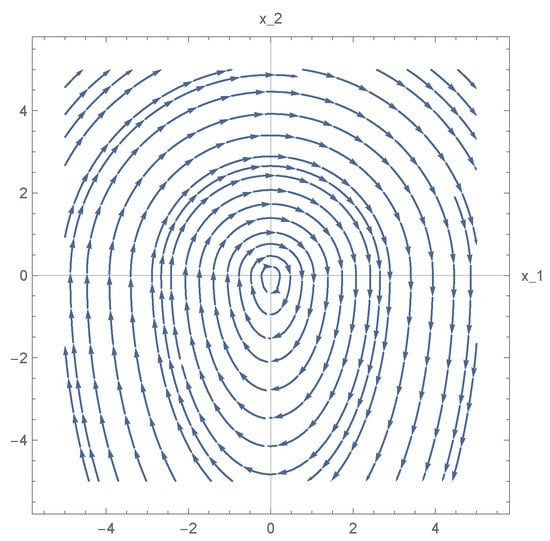
Figure 2.
Local phase portrait of system (36).
is the first time in which the solution Because the time changes for different values of and , we take the initial conditions as we used in the previous chapter, namely . In this case, the solution will be in the form of:
Time will be the time when It is obvious that . The system has on the interval initial conditions a Therefore, the solution is in the form
Hence, the time , in which the function changes to , is Let us look for a T-periodic solution, which means, that the solutions and . The solution for equals
Therefore, . Using the method described in the previous chapter, it is possible to find a Poincaré map for a perturbed equation
where is determined by the relation (37) and can be chosen as x, so . Solution x can be written as
In this case, we can express as
where , and are the first, second and third intersection points, respectively.
,
,
,
Times and satisfy following equations:
To use (34) for our specific equation, we have to find functions and . Function was defined (20), (24) and (28) on intervals [0,],[,] and [], respectively. Knowing that (2) (symbol symbolizes the time derivative), we can formulate ODE system to find functions and on each interval using functions (38), (39) and (40) as and .
On interval [0,] = [0,], we have
with initial conditions which, using a variation of parameters method, give the solution in the form:
where and . Similarly, the ODE system on the second interval []:
Its initial conditions can be calculated from Equation (45) at . The solution on interval [] using a variation of parameters method is in the form:
where ,
and .
On the last interval [] is the ODE system in the form
with initial conditions equal to (48) at time The solution on interval [] is in the form:
where ,
and . We do not express analytical solutions (45), (48) and (51) in another form, because the given formulas lead to hypergeometric functions. For specific parameter choices, it is possible to find a numerical solution, but we do not go for details. We focus in this paper on the analytical theory of the Poincaré mapping method rather than its numerical investigation, which is interesting but postponed to another of our studies based on [19,20,21,22].
On the other hand, to understand the dynamics of (41), we first consider its limit case for (see [23]), so we have
We see on Figure 3, Figure 4 and Figure 5 different dynamics depending on h. The perturbation on Figure 3 keeps the symmetry along the origin. It seems that the origin is a global attractor. The perturbation on Figure 4 breaks the symmetry along the origin. The perturbation on Figure 5 keeps the symmetry along the origin, but it is nonlinear, and the dynamics are more interesting and complex.
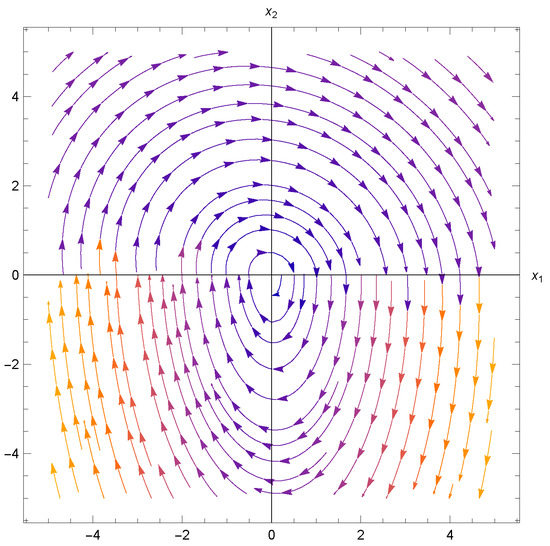
Figure 3.
Local phase portrait of (52) for , and .
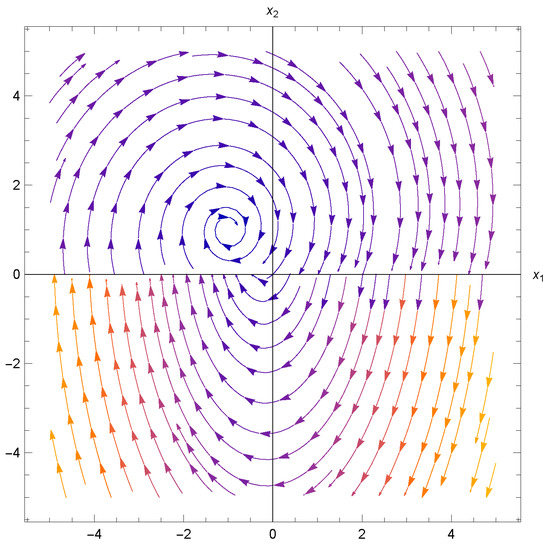
Figure 4.
Local phase portrait of (52) for , , and .
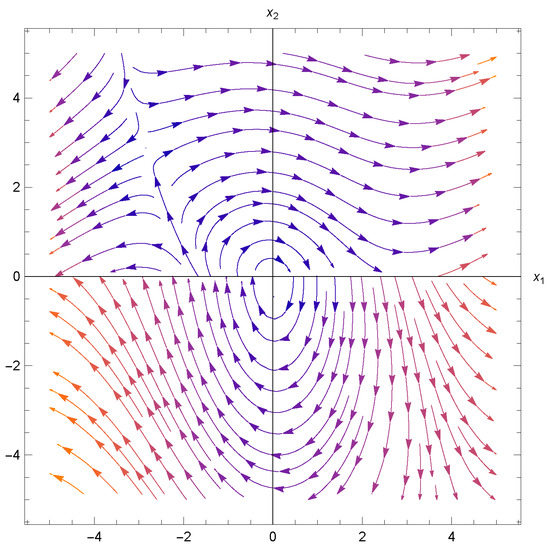
Figure 5.
Local phase portrait of (52) for , and .
Next, we consider a limit case of (41) for , so we have
(53) is no longer an ODE. For instance, if and , we obtain
The solutions of (54) seem to be repelled by Figure 6. Summarizing, the study of qualitative property of (41) is challenging by varying .
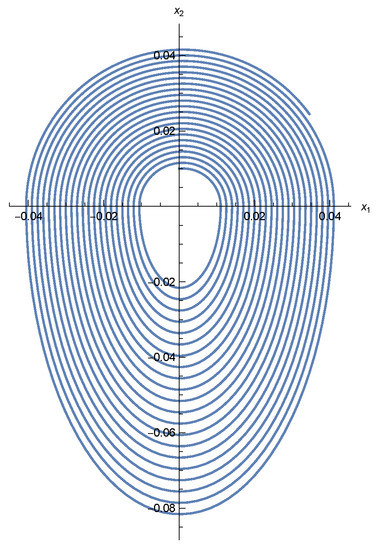
Figure 6.
Solution of (54) for and , .
6. Conclusions
We work with a fractional differential equation with a discontinuous right-hand side, which is equivalent to the system (2). Suppose that functions are globally Lipschitz continuous, which change their form according to the sign of and transversally cross the discontinuity boundary.
We look for a periodic boundary solution of the system in a neighbourhood of the periodic orbit of an unperturbed system. That means the solution of the unperturbed equation is periodic.
We have shown the existence of the solution of the studied equation and found the corresponding Poincaré map in a neighbourhood of the periodic orbit of the unperturbed equation. We also present a bifurcation analysis of periodic boundary solutions.
We demonstrate how to apply our found formula to a concrete problem.
In the forthcoming work, we intend to generalize this theory to higher dimensions. Some of possible directions are outlined above.
Author Contributions
Writing—original draft, I.E. and M.F.; Writing—review and editing, I.E. and M.F. All authors have read and agreed to the published version of the manuscript.
Funding
This research is partially supported by the Slovak Research and Development Agency under the contract No. APVV-18-0308 and by the Slovak Grant Agency VEGA No. 1/0358/20.
Institutional Review Board Statement
Not applicable.
Informed Consent Statement
Not applicable.
Data Availability Statement
Not applicable.
Conflicts of Interest
The authors declare no conflict of interest.
References
- Di Bernardo, M. Piecewise-Smooth Dynamical Systems: Theory and Applications; Springer: London, UK, 2008. [Google Scholar]
- Kilbas, A.A.; Srivastava, H.M.; Trujillo, J.J. Theory and Applications of Fractional Differential Equations; Elsevier Science: Amsterdam, The Netherlands, 2006. [Google Scholar]
- Miller, K.S.; Ross, B. An Introduction to the Fractional Calculus and Differential Equations; John Wiley & Sons, Inc.: New York, NY, USA, 1993. [Google Scholar]
- Olejnik, P.; Awrejcewicz, J.; Fečkan, M. Modeling, Analysis and Control of Dynamical Systems: With Friction and Impacts; World Scientific Series on Nonlinear Science Series A: Volume 92; World Scientific Publishing Co. Pte. Ltd.: Singapore, 2018. [Google Scholar]
- Podlubny, I. Fractional Differential Equations. An Introduction to Fractional Derivatives, Fractional Differential Equations, Some Methods of Their Solution and Some of Their Applications; Academic Press: San Diego, CA, USA, 1999. [Google Scholar]
- Samko, S.; Kilbas, A.A.; Marichev, O. Fractional Integrals and Derivatives, Theory and Applications; Gordon and Breach Science Publishers: Amsterdam, The Netherlands, 1993. [Google Scholar]
- Kexue, L.; Jigen, P. Laplace transform and fractional differential equations. Appl. Math. Lett. 2011, 24, 2019–2023. [Google Scholar] [CrossRef]
- Diethelm, K. Monotonicity of functions and sign changes of their Caputo derivatives. Fract. Calc. Appl. Anal. 2016, 19, 561–566. [Google Scholar] [CrossRef]
- Evans, R.M.; Katugampola, U.N.; Edwards, D.A. Applications of fractional calculus in solving Abel-type integral equations: Surface–volume reaction problem. Comput. Math. Appl. 2017, 73, 1346–1362. [Google Scholar] [CrossRef]
- Podlubny, I. The Laplace Transform Method for Linear Differential Equations of the Fractional Order; Ústav Experimentálnej Fyziky SAV: Košice, Slovakia, 1994. [Google Scholar]
- Fečkan, M.; Pospíšil, M. On the bifurcation of periodic orbits in discontinuous systems. Commun. Math. Anal. 2010, 8, 87–108. [Google Scholar]
- Fečkan, M.; Sathiyaraj, T.; Wang, J.R. Synchronization of butterfly fractional order chaotic system. Mathematics 2020, 8, 446. [Google Scholar] [CrossRef]
- Fečkan, M.; Danca, M.-F. Stability, Periodicity, and Related Problems in Fractional-Order Systems. Mathematics 2022, 10, 2040. [Google Scholar] [CrossRef]
- Tarasov, V.E. General fractional vector calculus. Mathematics 2021, 9, 2816. [Google Scholar] [CrossRef]
- Tarasov, V.E. Exact solutions of Bernoulli and logistic fractional differential equations with power law coefficients. Mathematics 2020, 8, 2231. [Google Scholar] [CrossRef]
- Tarasov, V.E. Mathematical Economics: Application of Fractional Calculus. Mathematics 2020, 8, 660. [Google Scholar] [CrossRef]
- Fečkan, M.; Pospíšil, M. Poincaré-Andronov-Melnikov Analysis for Non-Smooth Systems; Elsevier: Amsterdam, The Netherlands, 2016. [Google Scholar]
- Guckenheimer, J.; Holmes, P. Nonlinear Oscillations, Dynamical Systems and Bifurcations of Vector Fields; Springer: New York, NY, USA, 1983. [Google Scholar]
- Fečkan, M.; Kelemen, S. Discretization of Poincaré map. Electron. J. Qual. Theory Differ. Equ. 2013, 60, 1–33. [Google Scholar] [CrossRef]
- Fečkan, M. Note on a Poincaré map. Math. Slovaca 1991, 41, 83–87. [Google Scholar]
- Cek, M.K.; Marek, M. Computational Methods in Bifurcation Theory and Dissipative Structures; Springer: New York, NY, USA, 1983. [Google Scholar]
- Henon, M. On the numerical computation of Poincaré maps. Phys. Nonlinear Phenom. 1982, 5, 412–414. [Google Scholar] [CrossRef]
- Fečkan, M.; Pospíšil, M.; Wang, J.R. Note on weakly fractional differential equations. Adv. Differ. Equ. 2019, 2019, 143. [Google Scholar] [CrossRef]
Publisher’s Note: MDPI stays neutral with regard to jurisdictional claims in published maps and institutional affiliations. |
© 2022 by the authors. Licensee MDPI, Basel, Switzerland. This article is an open access article distributed under the terms and conditions of the Creative Commons Attribution (CC BY) license (https://creativecommons.org/licenses/by/4.0/).