


Abstract
Given an n-element point set in the plane, in how many ways can it be peeled off until no point remains? Only one extreme point can be removed at a time. The answer obviously depends on the point set. If the points are in convex position, there are exactly ways, which is the maximum number of ways for n points. But what is the minimum number?
MSC:
52C05; 52C45; 11B83
1. Introduction
Given n points on a line, in how many ways can they be removed, when we are only allowed to remove from one end? We can remove from either end until one point remains, when we have exactly one choice. Consequently, there are two choices at each step except the last one, thus options.
A set of points in the plane is said to be in a general position if no three of them are collinear. Let P be a set of n points in the plane in general position, labeled by . Consider removing points one by one until no point remains, under the provision that exactly one extreme point (i.e., a convex hull vertex) is removed in the current step. If the points are in a convex position, there are exactly options, which is clearly the maximum number of ways to remove n points. What is the minimum number?
A peeling sequence for P is any permutation of that can be obtained by writing the labels of the points removed one by one. We are interested in the minimum number of such permutations that can be obtained, over all point sets of size n.
Definitions.
Given an n-element point set P in a general position of the plane, let count the number of peeling sequences for P and denote the minimum of over all n-element point sets P in the general position. It should be clear that is an increasing function of n.
Our results.
To begin, we determine the values of for the first few small values of n. Trivially, we have , and .
Proposition 1.
The following exact values can be observed.
We then establish the following bounds (all logarithms are in base 2).
Theorem 1.
Every n-element point set in a general position admits peeling sequences. On the other hand, there are sets with only peeling sequences. Equivalently, the following inequalities are in effect: and .
It will be evident from the proof of Theorem 1 that is a multiple of 6 for every and that satisfies the following recurrence:
Let . Then, obviously, and .
Related work.
The concept of “peeling” a convex hull has been associated to dynamic convex hull algorithms and convex hull determination [1]. For a planar point set P, the convex layers of P are the convex polygons obtained by iterating the following procedure: computing its convex hull and removing its vertices from P [2]. The process of the peeling a point set has been shown to be very useful for obtaining robust estimators in statistics [2,3]. A common estimator of a (unidimensional) sample is its arithmetic mean; however, this estimator can be severely affected by outliers. A method that performs better is is to discard the highest and lowest -fraction of the data and take the mean of the remainder. This is the -trimmed mean. The median is the special case . The higher-dimensional analog of trimming, called “peeling” by Tukey, consists of successively removing extreme points of the convex hull of the data until a certain fixed fraction of the points remains.
A quadratic algorithm for peeling (i.e., for convex layer decomposition) was initially proposed by Shamos [4]. A faster algorithm, running in , is due to Overmars and Van Leeuwen [1]. Finally, an optimal algorithm, running in time, was obtained by Chazelle [2]. In the area of dynamic convex hull algorithms, the latest developments are due to Chan [5]. Computing the convex layers and studying their structure in a random setting have been studied by Dalal [6]. Har-Peled and Lidický [7] have studied the number of steps needed for peeling the integer grid with n points (with, say, ); note that is not in a general position, but the peeling process can be executed on any point set.
It should be noted that while in the discussion above, all the extreme points in a layer are removed in parallel (i.e., at the same time), in our study—of the function —the extreme points are removed sequentially one by one.
2. Preliminaries
Observation 1.
Let P be any n-element point set. Then, .
Proof.
By definition, any peeling sequence for P is a permutation of , and the upper bound is implied. □
Proof of Proposition 1.
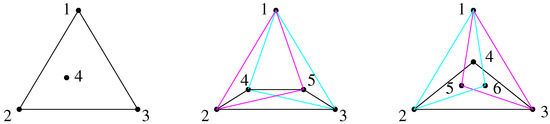
Let h denote the size of the convex hull of P. The case is clear: there are permutations, and each of them is a valid peeling sequence. The remaining cases are illustrated in Figure 1.
Figure 1.
Illustration for .
Let now . If the points are in convex position, there are permutations. If the points are not in convex position, let 4 be the interior point. Then, any permutation that starts with 4 is invalid; however, all remaining permutations are valid.
Let now . If , there are at least permutations. The case yields the smallest number, , of permutations; indeed, removing one of the extreme points yields a convex quadrilateral, while the other two removals can result in a triangle with a point inside.
Finally, let . If , there are at least permutations. The case yields the smallest number: permutations; indeed, removing each of the extreme points may yield the minimizer for discussed above. □
3. Proof of Theorem 1
Lower bound.
Let P be any n-element point set in general position, where . By the assumption, has at least three extreme vertices, and the removal of each yields a set of points in a general position. Any two peeling sequences resulting from the removal of two different extreme vertices are clearly different. As such, satisfies the recurrence . Consequently, . By Proposition 1, we also have for every .
Upper bound.
Here, we prove the upper bound in Theorem 1. Our construction is remotely reminiscent of that in [8] in that it uses long, slightly concave chains of points (vs. long slightly concave chains of unit disks). The long chains of disks in [8] have the effect that the construction is hard to dismantle, and a significant segment of the initial moves are in a certain sense wasted. Similarly, here, the long concave chains of points are very restrictive with respect to the points that can be removed in an initial phase of the removal procedure.
Consider a regular k-gon K with vertex set . Replace each side of the k-gon by a circular arc of very large radius R centered in the exterior of K that is incident to the two endpoints of the side. Distribute evenly new points on each arc, where a is a positive integer. Denote by P the resulting set of points; see Figure 2. Note that has exactly k extreme points. The key property of the constructed point set P with respect to repeated deletion of points is that this situation persists (apart from a factor of 2) as long as about points remain. This is made precise in the following.
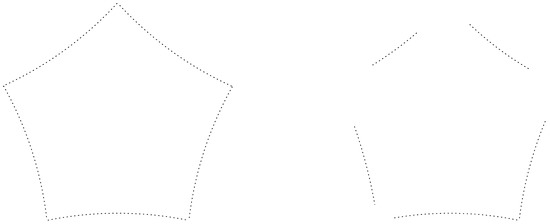
Figure 2.
Illustration for ; the figure is not to scale. Left: the point set resembles a slightly deflated pentagon. Right: after peeling off some of the points.
Lemma 1.
Let be a subset of points that remains after removing points from P (i.e., peeling P according to the rules for that many steps). If , then has at most extreme points.
Proof.
Let C be any fixed chain in P and let . Observe that consists of a contiguous subchain of the points in C. It suffices to show that contributes at most two extreme points in . This is clear if , so assume that . Each concave chain has initially points. Since , contains points from at least two different initial concave chains, by construction (recall that R is very large), has an extreme vertex that does not belong to C and exactly two extreme vertices in . In either case, contributes at most two extreme points in , as claimed. □
We return to the upper bound proof. It remains to estimate the number of resulting peeling sequences and set a suitable value for k to minimize the bound. Divide any peeling sequence (of length n) into two subsequences: a prefix subsequence of length and a suffix subsequence of length . By Lemma 1, the number of prefix subsequences is bounded from above by . By Observation 1, the number of suffix subsequences corresponding to a fixed prefix subsequence is bounded from above by . Consequently, the total number of peeling sequences is bounded from above by the product rule:
Using a trivial estimate for the factorial and taking logarithms yields
Setting
balances the two terms and further yields . This completes the proof of Theorem 1. □
A second proof of the upper bound.
Here we give another construction with a shorter proof. For every , Erdős and Szekeres [9] constructed sets with points in general position containing no subset of size in convex position. Let P be such a set. That is, the largest convex subset of P has at most k points. This implies that once we start peeling P, the convex hull of the current set has never more than k vertices, and so the number of choices at each step is at most k. Consequently, the total number of peeling sequences is bounded from above by (this bound can be somewhat reduced due to fewer choices at the end of the process). Taking logarithms as before yields .
4. Concluding Remarks
Observe that the convex layer decomposition of a point set P (mentioned in Section 1) yields a set of peeling sequences naturally derived from it: remove the points from one layer, one by one, before moving to the next layer. Indeed, this is so, since any point of the layer under removal is still extreme at that step. In general, if there are m layers and their sizes are counting from outside, where , , and , then there are peeling sequences given by the convex layer decomposition.
Apart from the case of points in convex position, the set of peeling sequences corresponding to layer by layer removal of the points is a strict subset of the set of peeling sequences of P. It is worth noting that this subset can be much smaller than the whole set. For example, consider a point set with layers, where each layer is a triangle (and so the point set is the vertex set of nested triangles). Then there are peeling sequences given by the convex layer decomposition, whereas the total number of peeling sequences is by Theorem 1.
Our estimates on the growth rate of are rather loose; indeed, even after taking logarithms of the lower and upper bounds, there is still a gap. According to the bounds we have obtained, it is perfectly possible that grows faster than any exponential:
Problem 1.
Is there a constant such that ?
Another interesting problem is to improve the trivial lower bound in Theorem 1 (say, increase the base by 1):
Problem 2.
Prove (or disprove) that .
Funding
This research received no external funding.
Institutional Review Board Statement
Not applicable.
Informed Consent Statement
Not applicable.
Data Availability Statement
Not applicable.
Conflicts of Interest
The authors declare no conflict of interest.
References
- Overmars, M.H.; van Leeuwen, J. Maintenance of configurations in the plane. J. Comput. Syst. Sci. 1981, 23, 166–204. [Google Scholar] [CrossRef]
- Chazelle, B. On the convex layers of a planar set. IEEE Trans. Inf. Theory 1985, 31, 509–517. [Google Scholar] [CrossRef]
- Shamos, M.I. Geometry and statistics: Problems at the interface. In Recent Results and New Directions in Algorithms and Complexity; Traub, J.F., Ed.; Academic Press: New York, NY, USA, 1976; pp. 251–280. [Google Scholar]
- Shamos, M.I. Problems in Computational Geometry. Ph.D. Thesis, Yale University, New Haven, CT, USA, 1978. [Google Scholar]
- Chan, T.M. Dynamic planar convex hull operations in near-logarithmic amortized time. J. ACM 2001, 48, 1–12. [Google Scholar] [CrossRef]
- Dalal, K. Counting the onion. Random Struct. Algorithms 2004, 24, 155–165. [Google Scholar] [CrossRef]
- Har-Peled, S.; Lidický, B. Peeling the grid. Siam J. Discret. Math. 2013, 27, 650–655. [Google Scholar] [CrossRef]
- Bereg, S.; Dumitrescu, A.; Pach, J. Sliding disks in the plane. Int. J. Comput. Geom. Appl. 2008, 15, 373–387. [Google Scholar] [CrossRef]
- Erdős, P.; Szekeres, G. On some extremum problems in elementary geometry. Ann. Univ. Sci. Bp. 1960, 3–4, 53–62. [Google Scholar]
Publisher’s Note: MDPI stays neutral with regard to jurisdictional claims in published maps and institutional affiliations. |
© 2022 by the author. Licensee MDPI, Basel, Switzerland. This article is an open access article distributed under the terms and conditions of the Creative Commons Attribution (CC BY) license (https://creativecommons.org/licenses/by/4.0/).