1. Introduction
Let
C be a nonempty, closed, and geodesic convex subset of a Hadamard manifold
M. Assume that
is a nonexpansive mapping, which means that
for every
, where
stands for a Riemannian distance function. In this research, we consider the following fixed point problem:
denotes the set of fixed points of the mapping
g. Many problems, such as convex feasibility problems, convex optimization problems, monotone variational inequalities, and image restorations, can be cast in the light of fixed point problems for nonexpansive mappings, which leads to a wide range of specific applications (see [
1,
2,
3,
4] and references therein).
To estimate fixed points, there is a significant amount of literature on fixed point iteration approaches. Most of the research has focused on the case when g is a self-mapping defined on a convex subset C of a normed linear space, and here are some of the most famous variations:
- 1.
The Picard algorithm [
5] is defined by
- 2.
The Mann algorithm [
6] is defined by
where
is a sequence in
.
- 3.
The Ishikawa algorithm [
7] is defined by
where
and
are sequences in
. One can see that the Ishikawa algorithm is a two-step Mann algorithm.
Assuming
g is a contraction mapping, the sequence
generated by Picard’s iteration (
2) converges strongly to a unique fixed point. The Picard method may not converge if the mapping
g is nonexpansive. On the other hand, the sequence
produced by Mann’s iteration (
3) converges weakly to a fixed point of the nonexpansive mapping
g. Subsequently, numerous scholars have investigated the Mann method and the Ishikawa algorithm to estimate fixed points of nonexpansive mapping. Observe, for instance [
8,
9,
10,
11,
12,
13,
14,
15].
Both Sahu et al. [
9] and Thakur et al. [
10] published their findings in 2016, proposing the same iterative approach for approximating fixed points of nonexpansive mappings in uniformly convex Banach spaces:
where
, and
are sequences in
. The authors [
9,
10] showed that the iterative scheme (
5) converges to fixed points of contractive mappings faster than various existing iterative schemes. Recently, the iterative method (
5) has been an attractive process and has been extensively studied in many directions; see, e.g., Refs. [
12,
16,
17,
18]. In particular, Padcharoen and Sukprasert [
12] improved and extended the iterative scheme (
5) for finding common fixed points of two nonexpansive mappings
, which is defined by the following:
where
, and
are sequences in
. The authors of [
12] proved that the sequence
achieved by (
6) converges weakly to common fixed points. Moreover, they applied the proposed iteration to solve common solutions of accretive operators, convex constrained least square problems, convex minimization problems, and signal processing in Banach spaces.
In recent years, many scholars have turned their attention to nonlinear problems in nonlinear systems such as Hadamard manifolds and CAT(0) spaces [
19,
20,
21,
22,
23,
24,
25,
26]. Nonlinear problems naturally extend from linear spaces to Riemannian manifolds, which provides a range of advantages. For instance, non-convex problems can be transformed as convex problems by introducing an appropriate Riemannian metric, and constrained optimization problems can be approached in the same manner as unconstrained problems. In addition to this, Hadamard manifolds are suitable frameworks for the development of effective methods for the solution of realistic problems [
27,
28,
29,
30].
In 2010, Li et al. [
11] investigated the fixed point problem (
1) in the context of Hadamard manifolds. The Mann and Halpern methods were also extended from Euclidean spaces to Hadamard manifolds. Recently, S-iterative techniques for approximating common fixed points of two nonexpansive mappings in the setting of Hadamard manifolds were recently presented by Sahu et al. [
13].
Algorithm 1 (S-iterative algorithm rank 2). Givenare nonexpansive mappings andis defined bywhere,
are sequences inand exp is an exponential mapping. Algorithm 2 (S-iterative algorithm rank 3). Givenare nonexpansive mappings andis defined bywhereandare sequences in. It was shown by the authors [
13] that any sequence produced by the suggested two algorithms converges to the common fixed points of nonexpansive maps. In addition, they provide numerical examples to support their assertions.
The goal of this paper is to provide a formal introduction to the iterative process (
6) in terms of exponential mappings on Hadamard manifolds, building on the foundation laid in [
11,
12]. Under certain conditions, we establish the convergence theorem of our proposed method for common fixed points of two nonexpansive mappings. We provide some numerical examples to indicate how successful the proposed method is, and we compare it with some of the other methods that are already in use. In addition to this, we illustrate how the proposed method can be utilized to solve inclusion and convex feasibility problems in Hadamard manifolds.
The remainder of this paper is organized as follows: In
Section 2, we present basic concepts and fundamental results in Riemannian geometry. In
Section 3, we propose an iterative algorithm for finding common fixed points of nonexpansive mappings in Hadamard manifolds. We establish the convergence results of the proposed algorithm. In
Section 4, we present some numerical experiments to demonstrate applications of the results in the present paper.
Section 5 consists of applications to inclusion problems and convex feasibility problems in Hadamard manifolds. Finally,
Section 6 provides a concise overview of the paper.
2. Preliminaries
In this section, we review the necessary terminology, concepts, properties, and results from Riemannian geometry that will be used in the rest of the paper. Readers may find references to it in a variety of textbooks that serve as introduction to Riemannian geometry. Some examples are [
31,
32,
33].
Let us assume that M is a connected manifold with finite dimensions. The tangent bundle of M is defined by , where is the tangent space of M at p and denotes the zero section of Every manifold M is a Riemannian manifold if and only if it is endowed with a Riemannian metric with the corresponding norm denoted by If there is no doubt, the subscript p is omitted. Determine the length of the piecewise smooth curve by using the formula where is the tangent vector at in the tangent space . A Riemannian distance, indicated by , is the shortest path between any two points p and q.
Let ∇ be a Levi–Civita connection associated with the Riemannian manifold M. A smooth vector field V along a smooth curve is said to be parallel ⟺. If is parallel to itself, we call it a geodesic, and in this case is a constant. The curve is considered to be normalized when the value of . If the length of a geodesic that joins two points p and q in M is equal to the distance between those two points, then we refer to that geodesic as a minimizing geodesic.
If the geodesics of a Riemannian manifold can be determined for any value of , then the manifold is said to be complete. The Hopf–Rinow theorem states that if M is complete, then any two points in M can be connected via a minimizing geodesic. In addition to this, because is a complete metric space, any bounded closed subset is a compact subset.
Let M be a complete Riemannian manifold and . The exponential map is given by , where is the geodesic starting at the point p with velocity u (i.e., and ). Then, for each real number t, we have and . Note that exponential map is differentiable on for each . This implies that the exponential map has an inverse . We also have .
A complete simply connected Riemannian manifold of non-positive sectional curvature is named a Hadamard manifold. The remainder of the article will proceed on the assumption that
M is a Hadamard manifold with finite dimensions. The exponential mapping
is a diffeomorphism for
. Any two points
have a unique minimizing normalized geodesic connecting them ([
31] Theorem 4.1).
A geodesic triangle of a Riemannian manifold M is a set consisting of three points , and , and three minimizing geodesics joining these points.
Proposition 1 ([
31]
).Let be a geodesic triangle. ThenandMoreover, if θ is the angle at , then we have Readers can refer to [
34] for further information on the relation between geodesic triangles on Riemannian manifolds and triangles on
.
Lemma 1 ([
34]
).Let be a geodesic triangle in M. Then, there exists a triangle for such that , indices taken modulo 3; it is unique up to an isometry of . The triangle in Lemma 1 is said to be a comparison triangle for . The points , , are called comparison points to the points respectively.
Lemma 2. Let be a geodesic triangle in M and be its comparison triangle.
- (i)
Let (respectively, ) be the angles of (respectively, ) at the vertices (respectively, , , ). Then - (ii)
Let q be a point on the geodesic joining to and its comparison point in the interval . If and , then .
Several convex analysis concepts and results have been extended in the setting of manifolds. We present some of these that will be used throughout the rest of the paper.
Let
M be an Hadamard manifold. A set
is called geodesic convex if for any two points
p and
q in
C, the geodesic joining
p to
q is contained in
C; that is, if
is a geodesic such that
and
, then
and
. A real valued function
is called geodesic convex if for any geodesic
the composition function
is convex; that is,
Proposition 2 ([
31]
).Let the distance function be . Then, is a geodesic convex function with respect to the Riemannian metric product; that is, the following inequality holds for any pair of geodesics and . In particular, for each , the function is a geodesic convex.
Let us conclude this section with the following results, which are essential to proving our convergence theorem.
Definition 1 ([
20]
).Assume that is a sequence in M and that C is a nonempty subset of M. If and , then is Fejér monotone with respect to C. Lemma 3 ([
20]
).Let C be a nonempty subset of M and be a sequence in M, such that is a Fejér monotone with respect to C. Then, the following holds: - (i)
For every , converges;
- (ii)
is bounded;
- (iii)
Assume that any cluster point of belongs to C, then converges to a point in C.
3. Main Results
Unless otherwise stated, the rest of this article will refer to C in terms of a nonempty, closed, and geodesic convex subset of a Hadamard manifold Given two mappings g and h from C to C, we say that g and h have at least one fixed point. The common fixed points between mappings g and h are denoted . An iterative approach for finding common fixed points of two nonexpansive mappings g and h is described below.
Algorithm 3. Letare mappings, andbe an initial point. Givenand calculatebywhereandare real positive sequences in. Following this, we are going to prove that Algorithm 3 satisfies the conditions required to achieve the convergence theorem.
Theorem 1. Let C be a nonempty, closed and geodesic convex subset of a Hadamard manifold M, and are nonexpansive mappings such that . Suppose that and are real positive sequences satisfying and . Let and is defined by Algorithm 3. Then converges to a common fixed point of g and h.
Proof. Because is a complete metric space and , it is sufficient to show by Lemma 3 that is Fejér monotone with respect to and the cluster point of belongs to .
Fix
, let
and
be geodesic connecting
to
,
be geodesic connecting
to
and
be geodesic connecting
to
. Hence, (
11), (
12) and (
13) can be written as
and
, respectively. By applying the geodesic convexity of the Riemannian distance, we have arrived at the conclusion that
and
As a result,
is a Fejér monotone with respect to
. Lemma 3 (ii) states that
is bounded. Therefore, there is a subsequence
of
that converges to a cluster point
p. Following this, we will prove that
Fix
and for
. Let
be a geodesic triangle with vertices
,
and
, and
be the corresponding comparison triangle. Then, we obtain
and
Let
be the comparison point of
. Using (ii) of Lemma 2 together with the expressions (
14) and (
15),
which implies that
Based on the fact that
, so
Summing up (18) from
to
, we obtain
Letting
, we have
Hence,
Now, let
be a geodesic triangle with vertices
,
and
, and
be the corresponding comparison triangle. Then, we obtain
Let
be the comparison point of
. Using (ii) of Lemma 2 and (
14), then
Adding (
20) into (
17) and using (
14), we get
Note that
. Summing up (21) form
to
, we obtain
Taking
, yields
Therefore,
Moreover, let
represent a geodesic triangle with vertices
,
and
, and
be the corresponding comparison triangle. Then, we get
Let
be the comparison point of
. Using (ii) of Lemma 2, then
Combining (23) and (
17), and using (
15), yields
Note that
. Taking the sum of (24) from
to
, we get
Letting
, we have
This indicates that
With the help of the geodesic convexity of the Riemannian distance,
Taking
into the last inequality and applying (25), we get
Because
g is nonexpansive, then
In view of (25) and (26), we deduce that
Recall (12) that
, we get
Letting
to the above inequality and using (22), so
Now,
By taking
into (29). Then, by combining (
19), (26), (27) and (28),
Consider,
and
By letting
, we are able to show that
and
. This proves that
. According to Lemma 3 (iii), the sequence
generated by Algorithm 3 converges to a common fixed point of
g and
h. As a result, the proof has been completed. □
5. Applications
5.1. Inclusion Problems
Let be the set of all multivalued vector fields such that , and denote the domain of A defined by . Suppose that is a multivalued vector. A point is called a singularity of A such that . The set of all singularities of A is assigned by
Next, we recall concept of monotonicity for a multivalued vector field on Hadamard manifolds.
Definition 2 ([
38]
).A vector field is said to be - (i)
monotone if and - (ii)
maximal monotone if it is monotone and and , the condition
Li et al. [
21] provided a definition for the resolvent of a multivalued vector field as well as a firmly nonexpansive mapping on Hadamard manifolds.
Definition 3 ([
21]
).Given and let the multivalued vector field , the resolvent related to A of order λ is a multivalued map defined by Remark 2 ([
21]
).Assume that According to the definition of the resolvent, then the range of the resolvent is contained the domain of A and Definition 4 ([
21]
).A mapping is said to be firmly nonexpansive if for any two points , the function defined byis nonincreasing. According to the concept of firmly nonexpansive mappings, it is straightforward to deduce that all firmly nonexpansive mappings are nonexpansive. By the way, the monotonicity and the expansiveness are closely related to one another.
Theorem 2 ([
21]
).Let a vector field . Then, the multivalued vector field A is monotone ⟺ is single-valued and firmly nonexpansive, . Let
be a geodesic convex function. We know that the subdifferential
at
x is closed and geodesic convex [
33] and is defined as
The following lemma states that the subdifferential
is maximal monotone vector field.
Lemma 4 ([
39]
).Let be a proper lower semicontinuous geodesic convex function and Then, the subdifferential of g is a maximal monotone vector field. Clearly,
where
stands for the set of minimizers.
Here we consider an inclusion problem in the setting of Hadamard manifolds. Then the problem is to find
such that
where
.
represents the solution set of the inclusion problem (32). In light of Remark 2, the challenge of finding singularities of
A is transformed into the problem of finding fixed points of the mapping
.
Next, we apply Algorithm 3 to find a common singularity of two multivalued monotone vector fields.
Theorem 3. Let be multivalued monotone vector fields such that . Assume that and are real positive sequences satisfying and . Let and is defined bywhere . Then, converges to an element in Proof. Set and . Form Theorem 2, g and h are single-valued and firmly nonexpansive mappings. Hence, they are nonexpansive mappings with and . From the hypothesis, Therefore, according to Theorem 1, we get the desired result. □
Now, we discuss a numerical experiment which support Theorem 3.
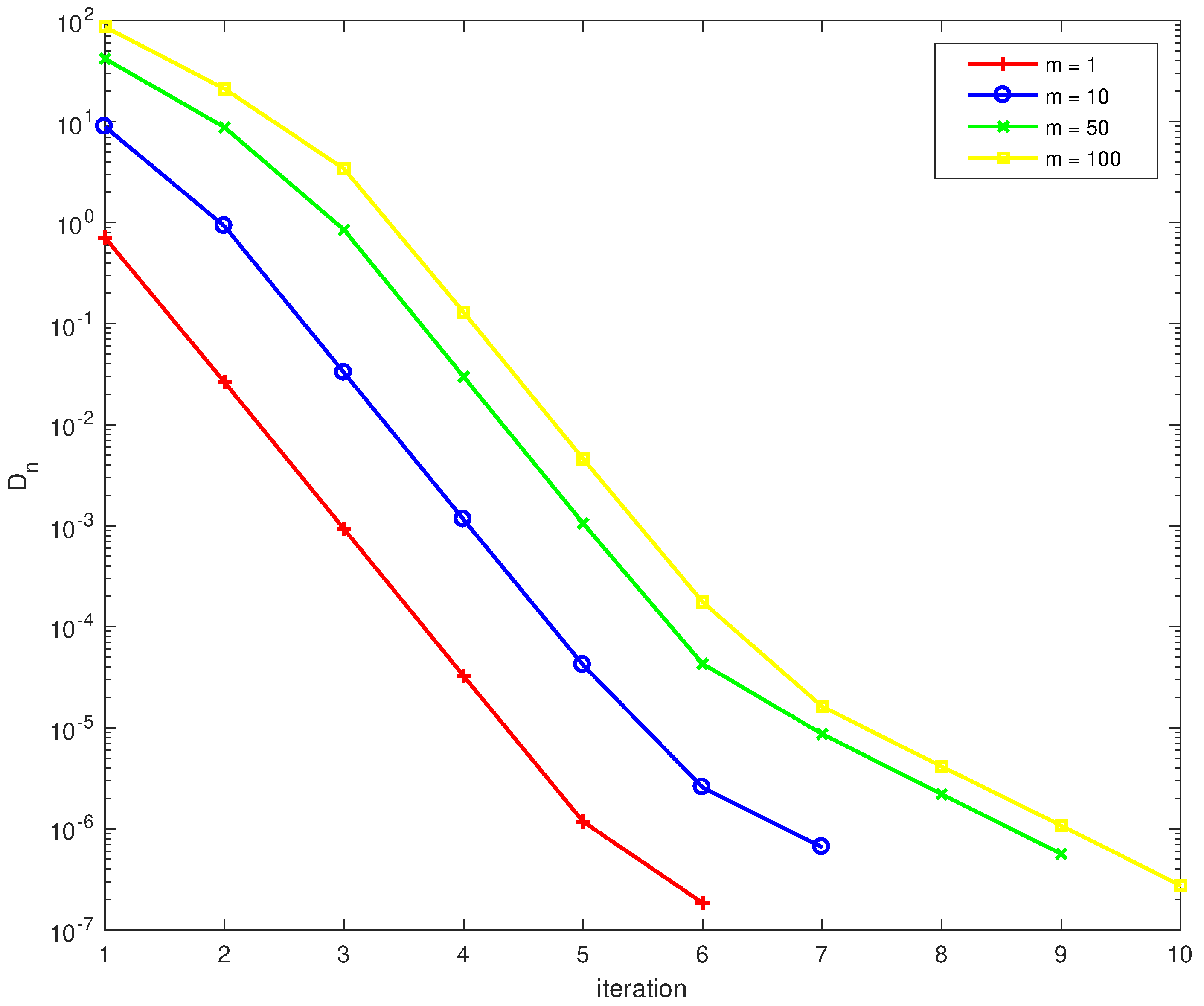
Example 3. Let and . As [28], let be the Riemannian manifold with the Riemannian metric defined by and , where is a diagonal metrix defined by Tangent space at , denoted by . The Riemannian distance is defined byThus, is a Hadamard manifold. The exponential map on is given byfor and The inverse of the exponential map is assigned by Let be a mapping defined bywhere satisfy and for . The minimizer of g is , where for . Ferreira et al. [19] showed that g is a geodesic convex function in . Taking and , for , we obtain 1 as the minimizer of the mapping g. Let be a mapping defined byIt is easy to see that h is geodesic convex function, and 1 is the minimizer. From (31), we haveandThe subdifferential and are maxiaml monotone vector fields, as shown by Lemma 4. Thus, we instead the multivalued monotone vector fields A and B by and , respectively. In addition to it, we haveandDue to the fact that the minimizer of both g and h is 1, it is possible for us to observe that . Choose , , and let . We take into account of the various of numbers for dimension m. Denoted as the stopping criterion. The initial values are randomly generated in MATLAB. Both Table 3 and Figure 3 include the numerical results that we obtained. Remark 3. - (i)
Numerical experiments, as shown in Table 3, demonstrate that the proposed Algorithm (33) with different dimensional sizes converges to a common singularity of maximal monotone multivalued vector fields. Our method is efficient and simple to implement for solving the inclusion problem (32). Furthermore, the number of iterations required by Algorithm (33) is unaffected by the dimension selection; in fact, the number of iterations required by the proposed method is only slightly affected by the dimension leaping change. - (ii)
The functions g and h in the Example 3 are nonconvex functions in the Euclidean sense. Therefore, the iterative method [12] can’t be applied to solve the problem (32).
5.2. Convex Feasibility Problems
Suppose that
C is a nonempty, closed and geodesic convex subset of
M. The projection operator
is defined by
. We know that the projection operator
is single-valued and firmly nonexpansive [
21].
Let and are nonempty, closed and geodesic convex subsets of M such that . Since with and with are nonexpansive mappings. Therefore, . This means that finding an element in is analogous to finding a point in the intersection of two nonempty, closed and geodesic convex subsets of Hadamard manifolds.
Next, we apply Algorithm 3 to find a point in the intersection of two nonempty, closed, and geodesic convex subsets of Hadamard manifolds.
Theorem 4. Let and are nonempty, closed, and geodesic convex subset of M such that . Assume that and are real positive sequences satisfying and . Let and is defined byThen, converges to an element in Proof. Set and . Then, g and h are nonexpansive mappings with and . From the hypothesis, Therefore, according to Theorem 1, we get the desired result. □
Now, we discuss a numerical experiment which support Theorem 4.
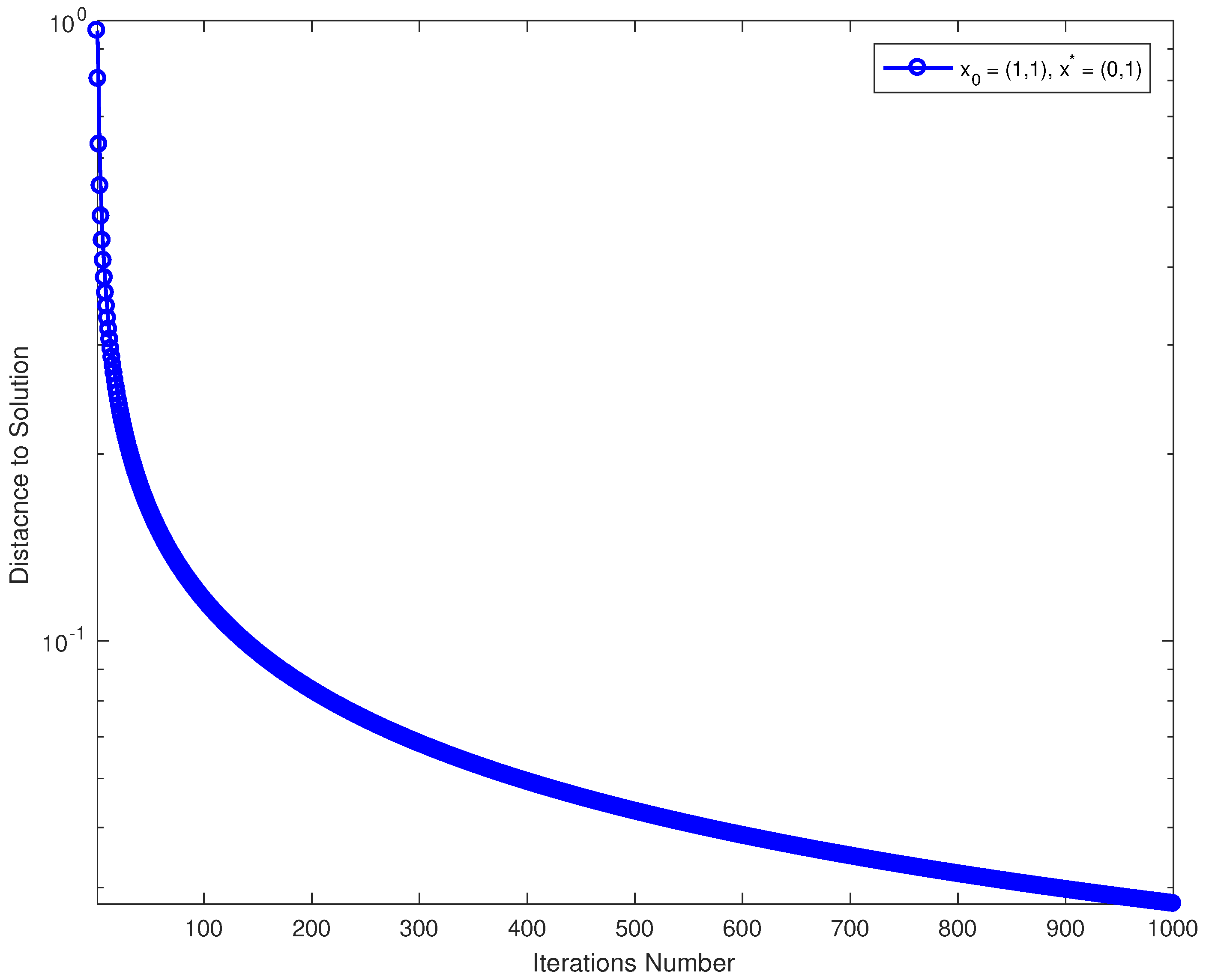
Example 4. Let be the Poincaré plane endowed with the Riemannian metric defined byThe sectional curvature of is equal to , and the geodesics of the Poincaré plane are the semilines and the semicircles or admit the following natural parameterizations:see e.g., [33]. Furthermore, consider two points and in . Then, the Riemannian distance between y and z is defined bywhereTo get the expression of , we consider a smooth geodesic curve φ joining y to z defined bywhere and are respectively defined byandBy the Riemannian metric endowed on (c.f. (35)), one checks thatsee [32] (p. 7). Therefore, by elementary calculus, we get It follows from [40] [Example 5.1], that we must let be closed convex subsets of defined asandFrom [33] (p. 301), and are convex because that is level set convex function defined byand is a geodesic of , receptively. Moreover ,and Choose and the initial point with . The computational results of Algorithm (34) are presented in Table 4 and Figure 4.