1. Introduction
Let
E be a fuzzy number space and
is a space of fuzzy number
, which has the property that the function
is continuous with respect to Hausdorff metric (in short, H-continuous) on
, where
for
is
-level set of
. From now on, we will introduce and investigate a brand-new fuzzy fractional partial differential coupled projection neural network system as follows
for all
and
, where
is a fuzzy projection operator (see [
1]),
is a continuous real-valued function defined on
J and
represents the set of all fuzzy numbers defined on
with H-continuous,
is a Caputo generalized Hukuhara type (in short,
-type) derivative operator with the fractional order
for
, and
and
are continuous. It is worth noting that
and
in (
1) assume the presence of Hukuhara difference (in short, H-difference) and
-type difference.
Clearly, if the right-hand side of the first equation in (
1) is generalized to a nonlinear function
,
for any
and all
, then the system (
1) is extended to the following new coupled system of fuzzy fractional order partial differential equation (in short, FFPDC): For each
and
,
where
J,
,
,
, and
and
for
are the same as in (
1).
Remark 1. When for all and each , the form (2) reduces to the fuzzy fractional coupled partial differential equations considered by Zhang et al. [2]. Further, one can easily see that the right side of the first equation for (1) or (2) is a function of and , which widen the scope of solvable problems comparing with [2] and other corresponding work in the literatures. In particular, as a special case of the FFPDC (2), the coupled projection neural network system (1) depends on fuzzy projection operator, which can be applied to solve some concerned fuzzy optimization problems [1]. Thus, (1) and (2) are fire-new and worth studying. The research of the above forms (
1) and (
2) is firstly motivated by an increasing interest in partial differential equations (in short, PDEs) and their applications. In fact, PDEs have a wide range of applications in the fields of engineering, biology and so on, and are considered as one of the most ideal methods to solve practical problems. For some related details, one can refer to [
2,
3,
4,
5,
6,
7,
8,
9] and the references therein.
Since theory of fractional differential equations (in short, FDEs) derived from the ideas of Leibnitz and Euler (see [
10]), can better describe the genetic characteristics of various substances and processes, FDEs have been shown to be a valuable modelling tool in the fields of mechanics and physics, electrochemistry and hydrodynamic flow modelling [
11]. Thus, fractional PDEs fully describe real world problems in theory [
4]. Further, as an excellent tool, fractional PDEs are employed to describe complex phenomena in electromagnetic waves, diffusion equations and other fields [
10].
It is well known that fuzzy analysis theory, as an extension of extreme value theory [
12], has flourished in the past 30 years. The dynamic representations of models related to natural events are often losing important information. The fuzzy numbers with the basic attributes of membership functions around clear data can well avoid such problems during transmission [
8]. In deed, Zadeh [
13] pointed out that the interpretability and simplicity of fuzzy systems make the modelling close to natural language. In 2017, Wang et al. [
14] pointed out that fuzzy set theory is a powerful tool for modelling uncertainty and dealing with subjective information in mathematical models. Humaira et al. [
15] established fixed-point results of multivalued mappings with least upper bound property under contractive condition in complex-valued fuzzy metric spaces, which opened the door for the study of ideal-type shrinkage in complex-valued fuzzy metric spaces. With its unique convenience, flexibility and simplicity in describing uncertain features [
7], fuzzy set theory creates unique opportunities for optimal control research [
16].
In addition, practical engineering problems such as optimal control systems can be transformed into constrained optimization problems, which in turn can be changed into projection neural networks, that is to solve equations in essence. In recent decades, many neural networks have been utilized to solve optimization problems have been studied intensively and extensively [
1]. In 2016, Eshaghnezhad et al. [
17] discussed the following nonlinear projection equation:
where
is a continuous vector function,
is a closed convex set,
,
, and projection map
is defined by
Here, the projection method due to projection operators, helps us establish the equivalence between variational inequalities and fixed point problems. Based on the concepts of projection, classical projection equations are equivalent to optimality conditions of the variational inequalities and the optimization problems. In other words, solving a variational inequality system is equivalent to solving the equilibrium point of projection neural network. Hence, the concept of fuzzy projection can be generalized and applied to solve fuzzy optimization problems [
1].
By the combination of fuzzy method with FDEs, a more accurate and precise proof of natural event complex system in applied science has been obtained (see [
8]). In fact, there is always inconsistency between the actual physical process and the measured physical process, which leads to uncertainty of data sets. In dealing with dynamic systems containing uncertain phenomena, such as epidemiology, economics and finance, the fuzzy PDEs proposed by Buckley and Feuring [
18] in 1999 are better choices than deterministic PDEs [
9].
Since concept of the H-difference has an important drawback, the use of classical Hukuhara derivative in fuzzy differential equations has been criticized [
19]. Stefanini and Bede [
20] pointed out that a set or a fuzzy differential equation may have only solutions with increasing length of their support, and uncertainty increases with time, then the solution of a set or a fuzzy differential equation is irreversibility under uncertainty and the diameter of natural fuzzy solution of the classical Hukuhara differentiability decreases monotonically. Therefore, based on the above shortcomings of the H-difference, they first proposed the
-type difference concept for studying the interval differential equations modeled by dynamic systems, whose functions diameter length do not monotonically increase monotonically with time. As Bede and Stefanini [
19] indicated again, the conditions for existence of H-difference between two fuzzy numbers are very strict, but the
-type difference exists under conditions with few restrictions, and the interval of the
-type difference is always present.
In the other direction, the relationship arising from the interaction and influence of two or more kinds of things is called “coupling”. Generally speaking, a single differential equation cannot model a complex system or process, and so coupled systems containing FDEs have attracted intense attention. See, for example, [
2,
4,
5,
21,
22].
Since most fractional differential equations do not have exact analytical solutions, approximate numerical solutions must be obtained by numerical techniques [
23]. The development of direct methods for constructing mathematical problems is an important branch of mathematics [
24]. However, traditional numerical methods such as finite difference and finite element exist some problems, for example, difficulty in grid generation and large amount of calculation. Thereupon, Aslefallah and Shivanian [
23,
24], and Aslefallah et al. [
25,
26] adopted meshless methods such as radial basis functions, spectral meshless radial point interpolation and singular boundary method to simulate numerical problems. In recent years, this meshless technique, which does not need to divide the grid domain and boundary, has been widely developed, and has attracted extensive attention in both mathematics and engineering fields. For some related details, one can refer to [
23,
24,
25,
26] and the references therein. By means of Buckley-Feuring strategy and fuzzing deterministic solutions, a
-weak solution of (
2) for
and ‡ is obtained. These solutions are the exact analytical solutions of (
2). Therefore, the solution method in this paper is different from the meshless technique.
On the other hand, it is easy to see that there are many relevant classical results of existence and uniqueness of solutions for differential equations, which are based on Lipschitz condition. In 2017, based on Banach fixed point theorem and the Lipschitz condition of function on the right-hand side of the equation, Long et al. [
3] established the first result on the existence of two kinds of
-weak solutions of the fuzzy fractional partial differential equations. And then, using Banach fixed point theorem and on the strength of the work from [
3,
22], under the Lipschitz condition, Zhang et al. [
2] proved the existence and uniqueness of two kinds of
-weak solutions of the coupled system of the form (
2) with a particular
for every
and any
. But in reality, for most functions, the Lipschitz condition is relatively strong and is often difficult to satisfy (see [
27,
28]). Thus, by virtue of the nonlinear alternative of the Schauder type for fuzzy-valued continuous functions without the Lipschitz condition, Long et al. [
3] also obtained the second result on the existence of two kinds of
-weak solutions for the special coupled system. Hence, in order to enhance the practicability and utility of the functions in the absence of Lipschitz condition, it is necessary to explore existence of solutions for the systems (
1) and (
2).
Inspired by the previous work of predecessors such as Long et al. [
3], Zhang et al. [
2] and other pioneers, in this paper, in order to obtain existence of two kinds of
-weak solutions for (
1) without Lipschitz conditions, it is of great value to explore (
2). Moreover, a numerical example is given and illustrated main results presented in this paper.
2. Preliminaries
In this section, we present the notions of fractional integral and fractional Caputo
-type derivative of fuzzy value multivariable functions, as well as some concepts of relative compactness in fuzzy number spaces. Some of them were detailed further in previous papers [
2,
3,
29,
30].
Throughout this paper, denote E by the space of fuzzy numbers , which satisfies properties as follows: (a) is normal, i.e., ; (b) is fuzzy convex, namely, for all and any ; (c) is upper semi-continuous on ; (d) , called the support of , is compactly supported, where is the closure of the sets.
It is easy to see that the Hausdorff metric
can be extended to the supremum metric
on
E by mean
where
for any
. And in
, it follows from (
3) that the supremum metric
is considered by
here
J is the same as in (
1). Thus,
and
are complete metric spaces (see [
3,
31]).
For all
,
, by [
32], one can see that
, where
is H-difference of fuzzy numbers
and
, and then (i)
; (ii)
for any
; (iii) if
exists, then
In this paper, we assume that the H-difference always exists and for
, define
as a space of fuzzy numbers
with H-continuous. According to [
29,
31,
33], fuzzy number spaces
E and
are semilinear spaces having the cancellation property. i.e., for any
, where
S is a semilinear space, if
, then
. Furthermore, it is proved that fuzzy numbers spaces
E and
with metric
are complete metric semilinear spaces. Hence, the fuzzy-valued continuous functions space
is complete metric semilinear space, which is a Banach semilinear space with the cancellation property. At the same time, we point out that
represents the Lebesgue integrable space of fuzzy valued continuous functions.
For each positive real number
r,
denotes the closed sphere in
, here the metric
is defined by (
4) and
for all
, where
if
, and otherwise
.
In the sequel, we present some lemmas and definitions which are needed to solve (
1) and (
2).
Lemma 1 ([
3]).
For all , one has the following presentations:- (i)
.
- (ii)
If and exist, then .
- (iii)
If exists then exists and .
- (iv)
If and exist then exists and .
- (v)
If exists then exists and .
Remark 2. The conclusions of Lemma 1 (ii)–(v) are based on the existence of H-difference, which will be used to obtain our main results.
Definition 1 ([
20]).
For any , a fuzzy valued mapping is called -type differentiable of the -order with respect to x at whenever the function ω is -type differentiable of the order i () at provided that -type differentiable has no change, if there exists an element such that for all sufficiently close to 0, , exists andowns, where denotes the -type difference ([34]) of , which is the fuzzy number ζ if it exists such thatUnder this circumstance, is said to be the n-order -type derivative of w at with respect to x, assume that the limit in the left side exists.
The higher fuzzy -type partial derivative of w with respect to y is defined similarly. If , (6) degenerates towhich represents the first partial derivative of ω at with respect to x. Definition 2 ([
2]).
Let , , for and . Then the mixed Riemann-Liouville fractional integral of orders θ for fuzzy-valued multivariable function is defined by Definition 3. If for any , there exist such that for all and with , , and , then the mappings and are called jointly continuous at point and , respectively.
For all
, let
here
,
,
and
are given functions such that
and
exist in several. Then we call
where
and
are alone defined by (
9) and (
10).
For , denote by the sets of all the functions , which have the partial -type derivatives up to order k and j with respect to x and y in j, respectively.
Definition 4 ([
2]).
Let , and . Then the Caputo -type derivative of order θ with respect to x and y for the function ω is defined bywhich the expression on the right hand side is well-defined, where .Particularly, it is necessary for us to distinguish two cases homologizing to and in (7), for any , ζ is - (i)
-Caputo -type differentiable of order θ with respect to x and y if as a -type derivative in type 1 (i.e., in (2)) at and denotes . - (ii)
-Caputo -type differentiable of order θ with respect to when is a -type derivative in type 2 (i.e., in (2)) at . One can denote it by .
Afterwards, we give some important concepts of relative compactness in the fuzzy number space .
Definition 5 ([
30]).
A subset , is equicontinuous at if for all , there exists such that implies for all and . We say that S is equicontinuous if S is equicontinuous at every . Definition 6 ([
30]).
For all , S is a subset of , if there exists a compact set such that , then S is said to be compact-supported. Definition 7 ([
30]).
A subset is called level-equicontinuous at , if for all , there exists such that means for each . Further, S is said to be level-equicontinuous on if S is level-equicontinuous at every . Definition 8. For any two fuzzy number spaces and with H-continuous, the continuous function defined on is said to be compact, if for any bounded subset , is relatively compact in , i.e., (the closure of )is a compact subset in .
Lemma 2 ([
30], Theorem 4.5).
S is a compact supported subset on , if and only if S is a relatively compact subset of and S is level-equicontinuous on . We note that this result presented in Lemma 2 states that when S is relatively compact in , S is compact-supported and level-equicontinuous on . Conversely, if S is compact-supported in and level-equicontinuous on , S is relatively compact in .
Lemma 3. Let and be the same as in (
9)
and (
10)
, let the functions and be jointly continuous according to Definition 3, and let the functions and be fuzzy value. Then (2) is equivalent to the following nonlinear fractional Volterra integro-differential coupled system: For any ,or Proof. The proving process of the equivalence is similar to the proof of ([
2], Lemma 3), and so it is omitted. □
3. Main Results
In this section, employing fire-new proof method, which is different from those already published work, that is, using Schauder fixed point in Banach semilinear spaces, without Lipschitz conditions for the functions
and
, we present existence of
-weak solutions and
-weak solutions for the more general coupled system (
2).
Lemma 4. Suppose that there exists a positive real number κ such that (i) and are compact operators; (ii) . Then there exist and such that an operator defined asfor all is continuous, where , , are respectively decided by Proof. For each
,
,
Since
and
are compact operators,
and
are bounded by Definition 8. Setting
then for all
,
, there exist constants
such that
and
because
is a polynomial with positive powers for any
and all
. Let
, and
, and denote
. Thus, one can get
and
First of all, we show that
is a mapping from the set
to itself, i.e.,
. In fact, it follows from (
17) that for all
,
By Lemma 1 (i), we have
Since
, one knows that
, which implies with substituting (
18) into (
20) that
By the same token, it is easy to see that
Combining (
21), (
22) with (
19), we get
and so
.
The next proof is that the mapping
is continuous. It can be known from Lemma 1 (i) that
Because
is a compact operator,
is continuous. Hence,
is continuous. Similarly,
which intends that the operator
is also continuous. Making
tends to
in
, then from (
23), (
24) and (
17), it follows that
. This completes the proof. □
Lemma 5. If all the assumptions in Lemma 4 are true, ψ and φ are compact-supported, then is relatively compact in .
Proof. The proof is divided into two steps as follows.
Step 1: To begin with, it is proved that
is equicontinuous in
. Considering
make
,
and
. To simplify the expression, let
,
,
and
. Since
and
one obtains
by virtue of Lemma 1 (i), which implies that
This deduces from the continucity of
that
In the same way, we acquire that when
,
is known based on the continuity of
. Further, by (
4), (
17), (
25) and (
26), now one knows that
. This suggests that
is equicontinuous on
.
Step 2: The following proof is to show that is relatively compact on . According to Lemma 2, we only need to prove that the following two conditions are satisfied: () is level-equicontinuous; () is a compact-supported subset of .
(i) Give evidence of the condition (
). In fact, for every fixed pair of
,
. If
, then there exists
which makes for any
,
Since
and
are compact operators,
is relatively compact on
and so is
in
, here
, and one can see from Lemma 2 that
and
are level-equicontinuous. Thus, for any
, there exists
such that for all
and each
,
and
when
. Since
and
are valid, it can be known from (
27) and (
28) that for each small
, there exists
such that
when
, exists, that is,
is level-equicontinuous over
.
(ii) Demonstrate the condition (). Since , are relatively compact, it can be seen from Lemma 2 that and are compact supports and level-equicontinuous on . According to Definition 6, there exists and , the compact subset of such that is true for any , is true for all .
Given that
have compact supports, then from Definition 6,
,
are valid for any
by the existence of
,
, the compact subsets of
. Thus, one has
And because is bounded on , there exists a compact subset such that , which indicates that is a compact-supported.
Similarly, hold, then there exists such that . This shows that is compact-supported.
From (
15), it follows that
and
is a compact-supported set.
To sum up, is relatively compact on . Therefore, is relatively compact on according to the Ascoli-Arzelá theorem. □
Lemma 6 ([
35], Theorem 3.4) Schauder fixed point theorem for semilinear spaces).
Let S be a nonempty, bounded, closed and convex subset of a Banach semilinear space with cancellation property, and h is a compact operator from S to itself. Then h has at least one fixed point on S. Remark 3. From Lemmas 4 and 5, we can obtain that is a relatively compact operator. Thus, applying Lemma 6 on Banach semilinear space but not based on Banach fixed point theorem in the product spaces of all fuzzy-valued continuous functions, which is the key to obtain the existence of -weak solution on .
Theorem 1. Assume that there exists such that (i) and are compact operators; (ii) and ψ, φ are compact-supported. Then there exist and such that (2) has at least a -weak solution on , where . Proof. Define an operator
by the same as (
15) and two operators
and
as in (
16). One can easily see that the operators
and
are well-defined and so is
. By Lemma 4, we know that
is a continuous operator. By means of the Ascoli-Arzelá theorem, it follows form Lemma 5 that
is relatively compact in
. Thus,
is a compact operator by Definition 8. Hence, it is known from Lemma 6 that
has at least one fixed point in
, which is a
-weak solution of (
2). □
Remark 4. The proposed proof in Theorem 1 is completely different from Theorem 1 in [2]. Indeed, there is no Lipschitz conditions to the functions and in Theorem 1, and we apply Lemmas 4–6 and Ascoli-Arzelá Theorem in Banach semilinear space to obtain the existence of -weak solutions to (2). But the existence result of -weak solutions in ([2], Theorem 1) has to be premised on the Lipschitz conditions. Next, we shall present existence of the
-weak solution for (
2) under the following hypotheses:
Remark 5. By [2], it is easy to see that it is not easy to solve the existence of (‡)-weak solution for (2) under H-difference and the case corresponding to of (7). However, the hypotheses()and()solve this problem well. Lemma 7. Suppose that () and () are satisfied, and there is a positive real number κ such that (i) and are compact operators; (ii) . Then there exist and such that an operator decided by is a continuous operator from to itself, where , , are separately defined byfor each . Proof. Since the hypotheses (
) and (
) are true for any
and all
,
, one has
Thus, one can clearly know that the proof is similar to Lemma 4 and so it is omitted. □
By the similar proof to Lemma 5, we have the following results.
Lemma 8. Under the premise that all the assumptions in Lemma 7 are true, ψ and φ are compact-supported, then is relatively compact on .
Theorem 2. Let all the conditions in Theorem 1 satisfy. In addition, suppose that () and () meet. Then there exist and such that (2) has at least a -weak solution on , where is the same as in Lemma 7. Proof. The proving process of this theorem is exactly similar to that of Theorem 1, thus, it is omitted. □
Remark 6. Inspired by the work in the second aspect of [3], in the absence of the Lipschitz conditions, Lemmas 6–8 and Ascoli-Arzelá Theorem in Banach semilinear space are applied. Therefore, the proof for the existence of -weak solutions in this paper is totally different from that of ([2], Theorem 2). 4. A Numerical Example and Applications
This section presents a numerical example to verify that Theorems 1 and 2 hold. Then some applications of Theorems 1 and 2 to projection neural network systems are given.
Example 1. We now consider the following coupled system of fuzzy fractional PDEs: For each and ,where and are fuzzy functions and A is a fuzzy number. It is easy to check that the functions
,
in (
29) are compact operators.
From (
9) and (
10),
and
can be lightly obtained.
Letting triangle fuzzy function
, then from [
21], one knows that
and
hold. According to Definition 6,
Let , . Then are obviously compact sets and so we know that and have compact-supported sets. Taking , and , then , are obtained and , are established.
(Case I) When
, with the aid of Buckley-Feuring strategy and fuzzifying the deterministic solution, it follows from (
13), Definition 4.1 of [
6] and [
3] that the following BF solution of (
29) is obtained:
Combining with the conclusions that
and
have compact-supported sets and
, it can be concluded from Theorem 1 that (
29) has a
-weak solution in
as follows
(Case II) When
, according to Lemma 1 (iii)–(v) and (
14), using the same strategy as (Case I), we get the BF solution of (
29) as
The continuity of the extended principle shows that the level sets of fuzzy solutions of (
29) are
and
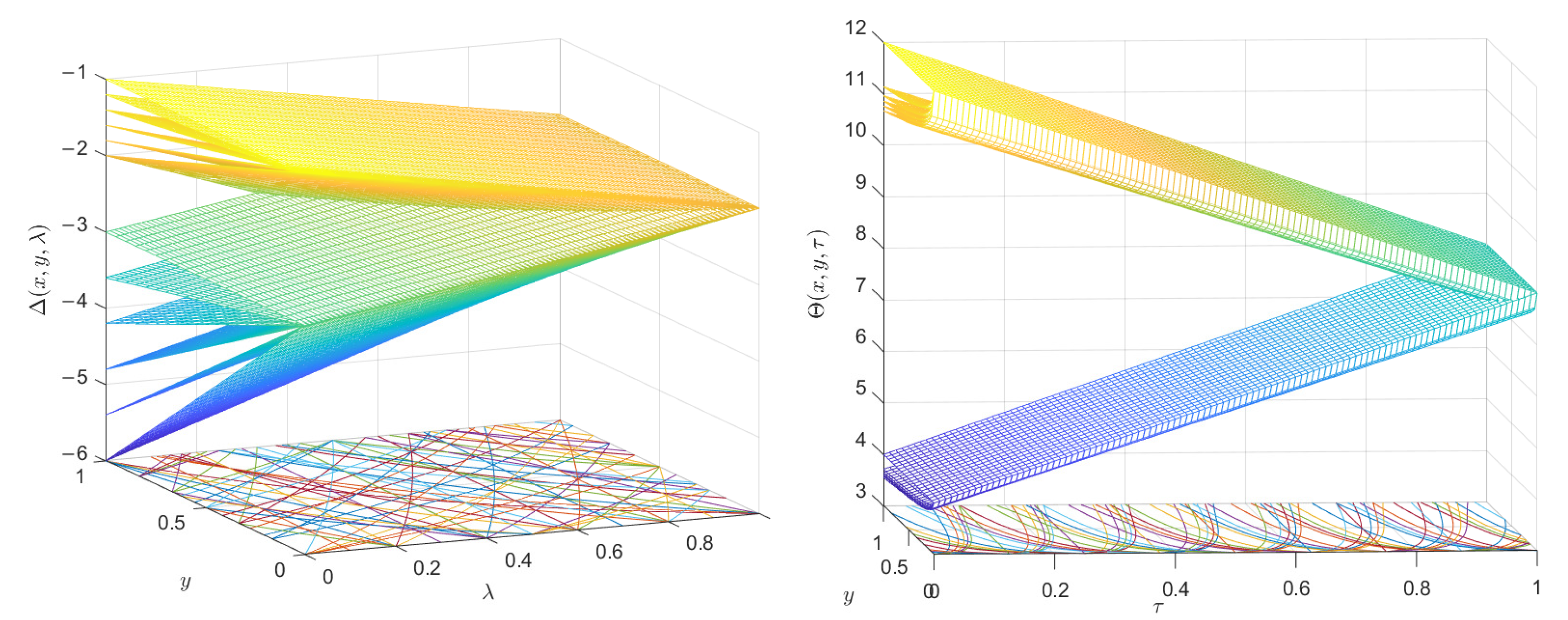
The simulation of the level sets of
and
for the fuzzy solutions are shown in
Figure 1. The left and right pictures of
Figure 1 represent the six level sets of fuzzy solutions
and
when six constant values of
x are fixed, respectively. That is, each group of corresponding surfaces represent a
or
level set, and the distance between each group of corresponding faces represent the fuzzy solution
and
. By observing (
30) and (
31), it can be found that the changes of the level sets of
and
with
x and
or
when
y is fixed to six constant values are exactly the same as in
Figure 1. The curves of
and
planes in the two pictures of
Figure 1 represent contour lines of
and
, respectively.
Moreover, we need to make sure that () and () are true.
For simplicity, take
. Since
we have
and based on (
5), one gets
furthermore,
It is known from ([
32], Proposition 21) (a) that there exists H-difference
Similar to the previous calculation method, we can obtain
and
It is shown that H-difference exists.
Analogously, based on (
32) and (
33), we have
and then we can get
It follows that
exists via (b) of ([
32], Proposition 21). So using the same calculation method, we find
and then one establishes
The above procedure demonstrates existence of H-difference
. So far, these validate the assumptions of (
) and (
) in Theorem 2. Because of
and
have compact-supported sets, and
, it can be known from Theorem 2 that on
, (
29) exists a
-weak solution
In the following, we shall give some applications of Theorems 1 and 2 to the projection neural network system (
1). It is concluded that there exists at least one
-weak solution or
-weak solution for fuzzy fractional coupled partial differential systems with projection operators under some suitable conditions.
To begin with, similar to [
1], we define the concept of fuzzy projection for fuzzy functions on fuzzy sets.
Definition 9. For any fuzzy function , its projection on is defined aswhich is a fuzzy mapping from to , where represents the set of all fuzzy numbers with H-continuous defined on and ρ is defined by (4). Remark 7. Because of and , we know from (1) that in Definition 9 can only be included in . It is easy to see that
in (
1) is a special case of
in (
2). Then, based on Definition 9, we can directly obtain two existence results of
-weak solutions of (
1) for
as follows.
Theorem 3. For any positive real number κ, suppose that
- (i)
is a relatively compact subset of the fuzzy set , where , and is a nonempty closed and convex subset of ;
- (ii)
is a compact mapping;
- (iii)
, and are compact-supported.
Then there exist and such that (1) has at least one -weak solution defined on , where . In order to show the existence theorem of
-weak solution for (
1) more specifically and intuitively, now we rewrite the hypotheses (
) and (
) to (
) and (
), the obtained two assumptions that guarantee the existence of the
-weak solution for (
1):
Theorem 4. If all the assumptions in Theorem 3 are satisfied, and () and () are also assumed to be true, then there exist and such that (1) has at least one -weak solution on . Remark 8. Theorems 3 and 4 are based on Definition 9. For projection operator , if is relatively compact on , then is a compact operator according to Definition 8. Further, the conclusions of Theorems 3 and 4 can be obtained from Theorems 1 and 2, respectively.