1. Introduction
Impulsive differential equations are used in mathematical models of many processes in economical sciences, medicine, physics and biology [
1,
2,
3,
4]. Various concepts which can be considered as the basis of our approach are presented in [
5,
6]. Their development for the positivity of Green’s function for the initial value and periodic problems for first-order functional differential equations can be found in [
7] (see also [
8] in this context) and for nonlocal problems in [
9]. For second-order impulsive equations, results on the positivity of the solutions of one- and two-point boundary value problems can be found in [
10,
11,
12,
13,
14,
15,
16,
17].
In this paper, we consider the following delay differential equation
with impulses of the first derivative at the points
where
f,
:
are from the space
of essentially bounded functions and
:
is a measurable function for
,
m and
n are natural numbers and
is a real positive number for
.
Let
be a space of functions
x:
such that their derivative
is absolutely continuous on every interval
,
,
; we also assume that there exist the finite limits
and condition (
3) is satisfied at points
. As a solution
x, we understand a function
satisfying (
1)–(
3).
In this paper, we study the case of
for
and
for
which naturally appears in the use of control in the process of a plane’s takeoff based on the feedback control of the height. The autopilot control can be of the form
. It is the so-called “slow” control. The direct (“fast”) control is implemented by a pilot, which can be modeled by impulses. It is important to have a sufficiently long length of time interval on which the solution, starting with the initial condition
, is increasing, i.e., a semi-nonoscillation interval (focal interval in another terminology) of the homogeneous equation
In this paper, estimates of the semi-nonoscillation interval are obtained. Our approach to study the negativity of Green’s functions is based on the nonoscillation properties of solutions. We define the so-called semi-nonoscillation interval in [
12] as an interval where a nontrivial solution of the homogeneous equation having a zero of its derivative does not have a zero itself. It is clear that the semi-nonoscillation interval is a corresponding development of the known definition of the focal interval. It is important to estimate the solution
of problem (
1)–(
3) with the boundary conditions
by corresponding test functions
and
satisfying the differential inequalities
for
This is the problem of the negativity of Green’s function
The sign-constancy of the Green’s function of one-point and two-point boundary value problems for impulsive functional differential equations of the second order was studied in [
7,
9,
10,
11,
12,
18,
19].
We study problems with two-point boundary value conditions. The results on the negativity of Green’s function for impulsive two-point problems for Equations (
1)–(
3) in the case of
and the case of
for
were obtained in [
11,
18,
20]. Those results assumed, in explicit or implicit forms, a corresponding smallness of the interval
As an example of such results, we can note the following (see Corollary
in [
20]):
If andthen the Green’s function of a two-point boundary value problem, i.e., for problem (1)–(3) with boundary condition (8) defined below, satisfies the inequality for .
We see that in the case of Equation (
1) without impulses in its derivatives (i.e.,
in (
1)), we get the classical Vallee–Poussin inequality
for the unique solvability of the two-point problem and negativity of its Green’s function
. It is known that inequality (
6) cannot been improved in a general case. The appearance of impulses, i.e., the case of
, disproves this inequality.
Our development is in the study of the case of
. We demonstrate that the impulses in the derivative of this sort can improve the estimates. The estimates of nonoscillation and focal intervals can be essentially increased. For example, for a nonimpulsive ordinary differential equation
where
p is a positive constant, the function
is a nontrivial solution which has focal interval
and nonoscillation interval
. In all sufficient conditions known to us, the impulses disprove the tests of nonoscillation, semi-nonoscillation and negativity of Green’s functions. In contrast with it, in the following, in the examples of
Section 5, we see that impulses in the derivative (in the case when
) increase the focal and nonoscillation intervals of the solution to impulsive equations. Our approach first demonstrates that adding impulses of the derivative could “improve” the so-called non-oscillation properties of solutions and consequently to increase the distances between adjacent zeros of the derivative, adjacent zeros of the solution and the zones of Green’s function negativity. This allows us essentially to improve the exactness of the intervals, where the test functions
and
estimate the solution. It is important for building a control strategy in applications.
3. Formulation of Main Results
Consider the auxiliary problem
Let us define the operator
, where
is a space of essentially bounded functions
, by the equality
where
is the Green’s function of problem (
17). We assume that
for
.
Theorem 1. Let for , . Then, the following assertions are equivalent:
- (1)
There exists a function such thatwhere the differential operator £ is defined by (1). - (2)
The spectral radius of the operator is less than one.
- (3)
The problem (1)–(3) with boundary condition (9) is uniquely solvable and its Green’s function satisfies the inequality for ×.
Remark 1. The following assertion can be also considered:
- (4)
Let for , and there exists a function such thatwhere the differential operator £ is defined by (1).
If we compare assertions (1) and , it is clear that we assume in instead of the condition of strict negativity of .
It can be proven that assertions (2) and (3) follow from assertion (4).
It is clear now that the choice of the function
in the condition of Theorem 1 allows us to obtain tests of the negativity of the Green’s function
of the problem (
1)–(
3) with boundary condition (
9).
Remark 2. The assertion (1)=>(3) can be considered as an analog of the Vallee–Poussin theorem about the differential inequality for second-order impulsive equations.
Remark 3. In a general case the process of construction of the test function is complicated. The calculations made below, before the proof of Theorem 4, explain how the test function can be constructed and how the explicit conditions guaranteeing the condition can be obtained. Of course, these conditions are more complicated than condition (5) and include restrictions on the smallness of the distance between adjacent points of impulses. We propose a new idea to choose
, using a solution of the ordinary impulsive differential equation
Let us define the function:
The influence of the fact that
is a semi-nonoscillation interval on the negativity of the Green’s function of problem (
1)–(
3) with boundary condition (
9) can be explained by the next assertion.
Theorem 2. If for , and is a semi-nonoscillation interval of the solution of (21)–(23), (9), then the Green’s function of problem (1)–(3) with boundary condition (9) is negative for The clear relation between the negativity of Green’s function and the negativity of the Green’s functions of problems with the boundary conditions for every can be done by the following assertion.
Theorem 3. If the Green’s function of the problem consisting of Equations (1)–(3) and boundary conditions for every is negative for , and is a semi-nonoscillation interval of the solution of (21)–(23), then the Green’s function of problem (1)–(3), (8) is nonpositive for . We propose the following test for the negativity of Green’s functions. Consider the equation
where
and
p is a positive constant.
Theorem 4. Let p be positive and the distance between two adjacent points of impulses satisfy the inequalitieswhere Then, is a semi-nonoscillation interval of the solution of Equation (25) and the Green’s functions of the impulsive problemsandwith impulses defined by (3) are negative for ×. 4. Proofs
Proof of Theorem 1.
(1)=>(2)
In (1) we have the function
satisfying the inequality
The function
can be written in the form
where
is the Green’s function of (
17) and
is a solution of
It follows from (
17) that the condition
implies that
for
. Substituting the presentation of solution (
30) into (
29), we get
where
.
Let us denote
and rewrite (
32) in the form
It is clear that
. Thus, from [
21] (p. 86) we can conclude that the spectral radius
of the operator
K is less than one.
(2)=>(3)
Consider the problem consisting of the equation
with impulses (
3) and boundary condition (
9).
Assume that is nonpositive for .
After the substitution
we have
If the spectral radius of the positive operator is less than one, then there exists a bounded operator … which is positive. This implies that is nonpositive for every nonpositive .
According to representation (
14), we have
and on the other hand,
It is clear now that for ×.
(3)=>(1)
In order to prove this, we set in the assertion (1).
This completes the proof of Theorem 1. □
The proof of the assertion in Remark 1 is obvious. It can be made by repeating the proof of the implication (1)=>(2). Note that and for .
Proof of Theorem 2.
Let us take the solution
of Equations (
1)–(
3) satisfying the initial conditions
as a function
in the assertion
of Theorem 1. This function
is positive and its derivative
is positive in every one of the intervals
, since
is a semi-nonoscillation interval of the solution of Equations (
1)–(
3), and its second derivative
is negative since
The reference to Remark 1 completes the proof. □
Proof of Theorem 3.
Let us assume, on the contrary, that the Green’s function
of problem (
1)–(
3) with boundary condition (
8) changes its sign on the interval
. Then, for a corresponding
the solution
of (
1)–(
3) with boundary condition (
8) changes it sign at some point
.
It follows from our assumption that there exists a point
such that the solution
satisfies the boundary value problem consisting of Equations (
1)–(
3) and boundary conditions
. Its Green’s function is negative for
×
.
This implies that for , and we have a contradiction with the assumption about the change of sign of the solution . □
Consider the ordinary differential equation of second order with constant positive
p and the impulses
with the initial conditions
Let us construct its solution and this is the basis of the proof of Theorem 4 which is given below.
On the interval
, we have
where
. Let us assume that
. On the next interval
, we search for a solution of the form
Taking into account that
has to be continuous but
has an impulse at the point
, we come to the equalities
Using (
45) and (
46), we obtain
and
Assuming
one can derive that
Thus, on the interval
we have:
Then, we obtain at the point
and consequently
Using (
55) and (
56), we obtain
and
Assuming
one can derive that
Eventually, such iterations lead us to the following inequality
Proof of Theorem 4.
Let us set the solution of ordinary Equation (
41) constructed above instead of
in assertion (1) of Theorem 1. The function
increases and this allows us to write
since
.
It is clear now that this function satisfies the assertion of Theorem 1 from which all the assertions of Theorem 4 follow. □
5. Computation Results
In this section, we construct the function
in condition (1) of Theorem 1 as a solution of the ordinary impulsive differential equation
where
p is a real positive constant,
and
are points at which the derivative
has impulses. If we assume that
, then the solution of (
63) on the interval
can be written in the form
Let us assume, for simplicity, that the distances between impulses are equal to each other (i.e.,
, where
is the distance between the points of impulses). The following equalities are fulfilled at the points
:
Denoting
,
, we obtain the formula for finding the amplitudes
:
From (
65) and (
66), we obtain
The program based on this algorithm (we took
and the maximal amplitude of
was
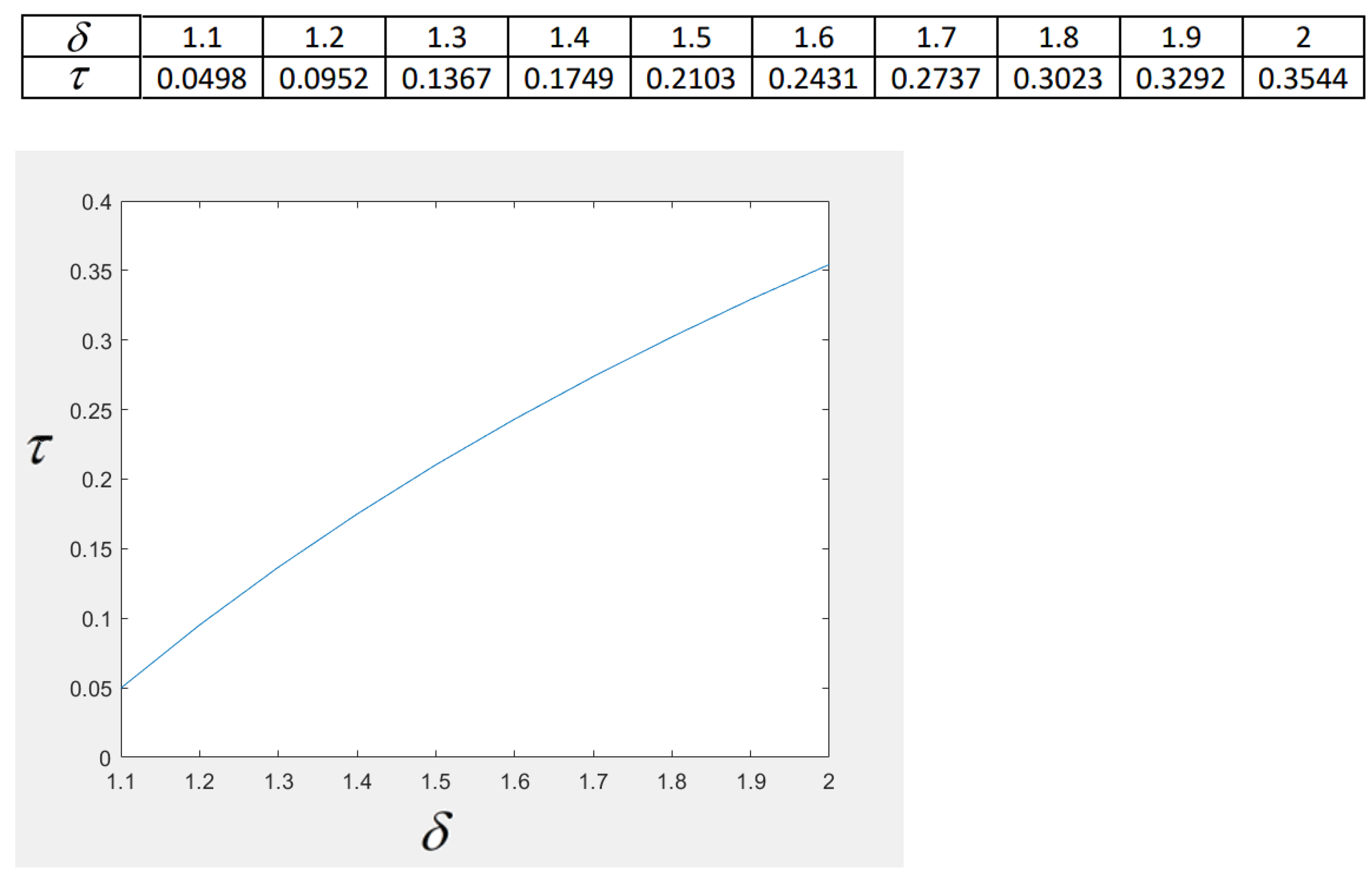
10,500) gives the connection between impulse constant of the derivative
and the maximal possible distance
between every two adjacent points of impulses, which provides the required amplitude
. The maximal amplitude
describes in the application the cruising altitude of the plane after completing the takeoff process (see
Figure 1).
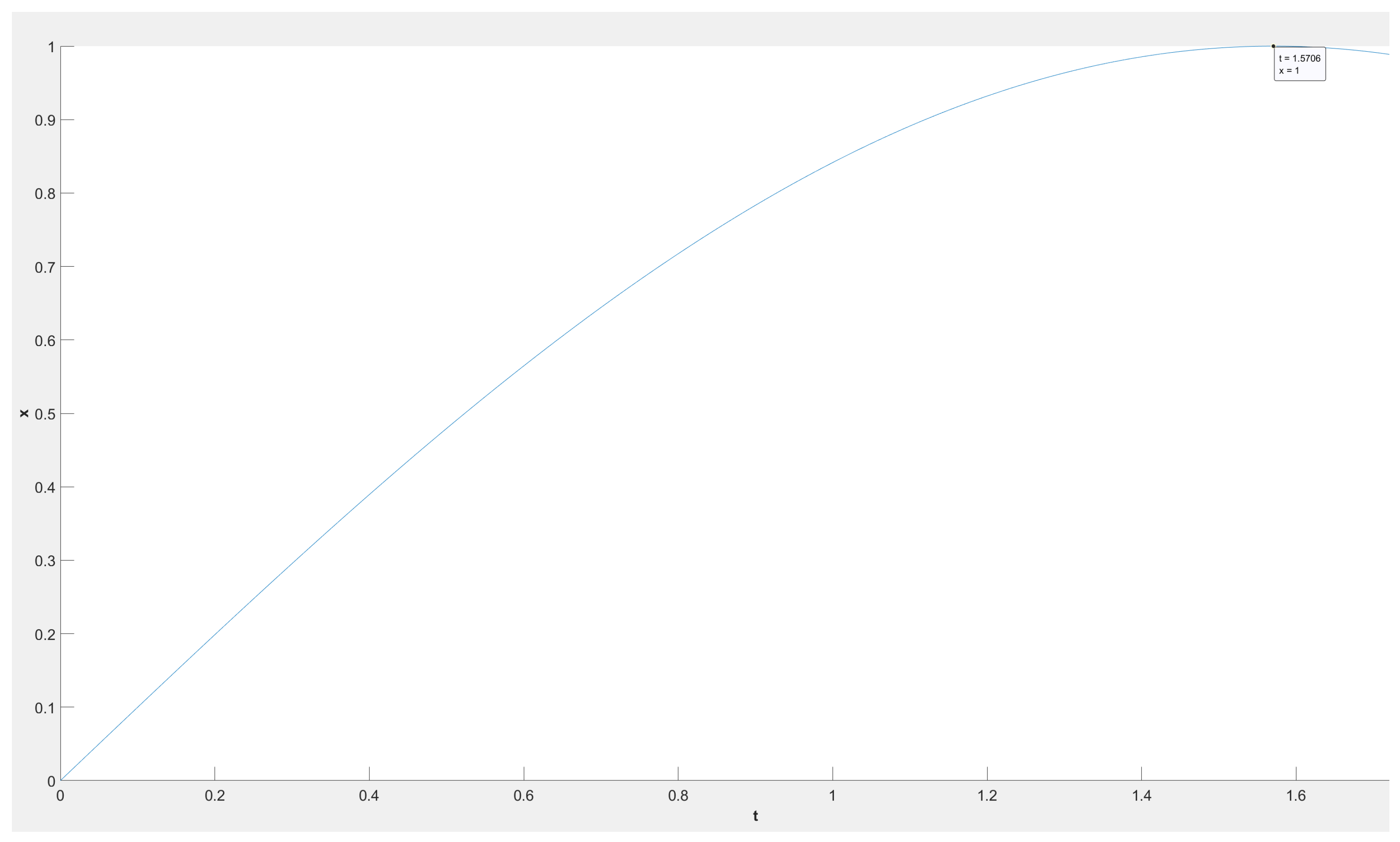
We see that in the nonimpulsive case (
Figure 2), the length of the interval where the function
stays positive and increasing is
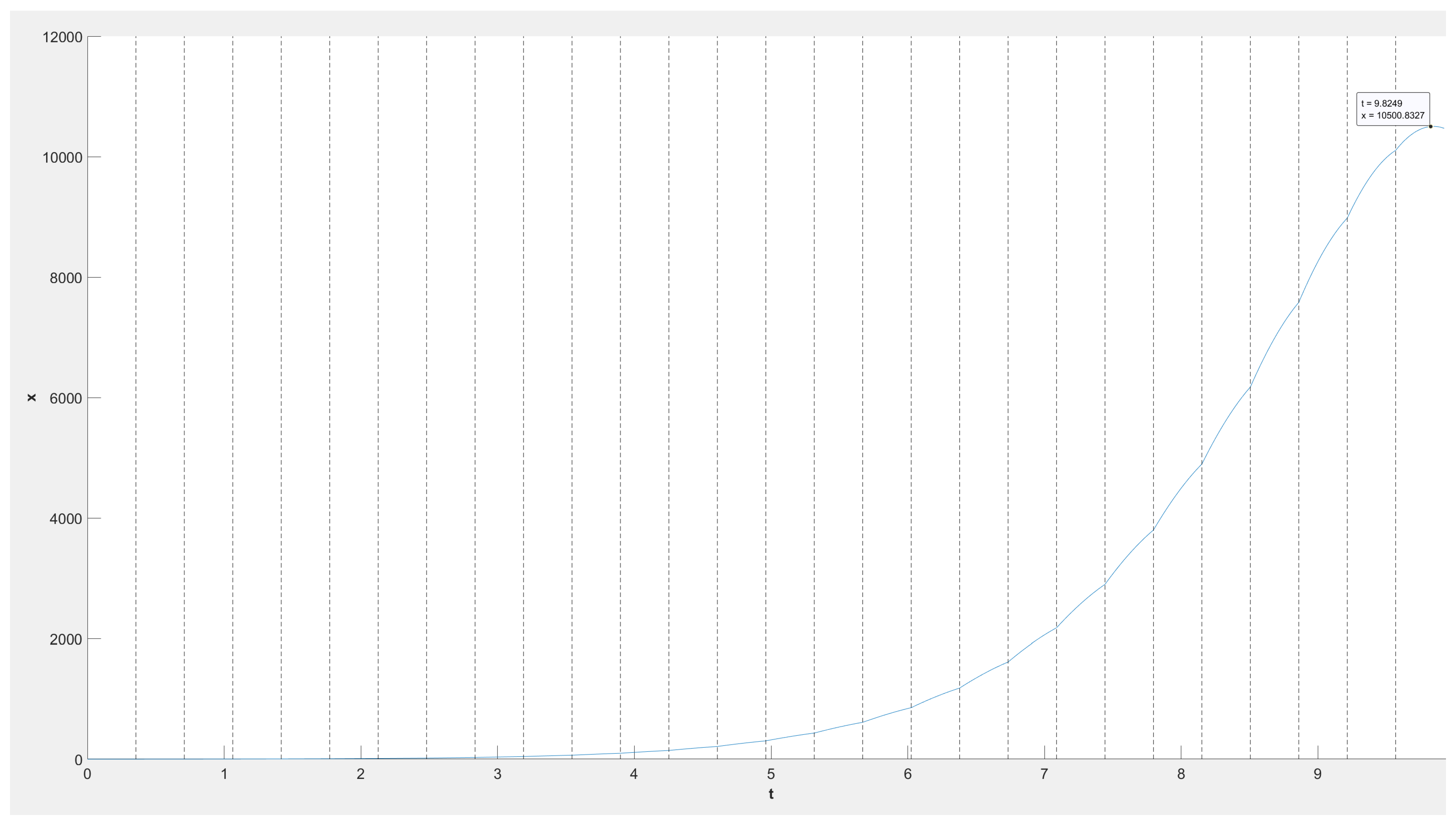
, while in the impulsive case (
Figure 3), the length of this interval is more than
(≈3.12
).
Thus, it is possible to enlarge the interval where solution is positive, using the impulses of the derivative . In the application of a plane’s takeoff, the cruising altitude and limited takeoff angle are given. Then, the problem of the enlargement of the interval, on which the solution is increasing, becomes important. We proposed an approach to this enlargement using impulses in the derivative of .