1. Introduction
Integro-differential equations (IDEs) are studied in physics, biology, and engineering applications, as well as in advanced integral equations literature. Applications of the IDEs in electromagnetic theory, dispersive waves, and ocean circulations are enormous [
1,
2,
3,
4,
5,
6]. The addressed paper considers the highly oscillatory singular FIDEs of the following kind:
along with the initial condition:
The given highly oscillatory kernel function
possesses weak and Cauchy singularities, i.e.,
.
are smooth functions on
, whereas
is the unknown function that needs to be determined. The FIDEs having weak or strong singularities are considered in [
7]. To gain analytical approximation, the author used the power series expansion technique. However, for the convergence of the method, the author applied a ratio test and proved that the proposed method gives exact solutions if the solutions of the equations are finite-degree polynomials. Otherwise, by increasing the number of polynomials, better accuracies are obtained.
For a FIDE of the kind
a reproducing kernel method is introduced in [
8], where the kernel function in the equation is a weakly singular kernel. The method converts the weakly singular kernel into a logarithmic kernel to a Kalman kernel. Furthermore, a smooth transformation helps to remove the weak singularity of the Kalman kernel. The authors claimed that the reproducing kernel method is not restricted by the order of the equation.
A quadrature formula is applied to discretize the FIDEs. Based on the behavior of the exact solution, the special graded grid points are used for piecewise polynomial collocation method [
9]. Smooth parts of the integrands are approximated by the piecewise polynomial interpolation, whereas the singular parts are integrated exactly. By the same authors in [
10], two approaches, an integral equation reformation and discrete Galerkin method, are used to find the approximations for the solutions and derivatives of the nth order weakly singular FIDEs. The approximations to the solutions are piecewise polynomial functions. In another research work, the Taylor series expansion along with the Galerkin method is considered for FIDEs with Cauchy singularity. The Legendre polynomials are used as basis to approximate the solution of the FIDEs [
11]. The traditional piecewise homotopy perturbation method is extended for FIDEs with weak singular kernels. The accuracy and calculation speed with the Gauss quadrature rule and piecewise low-order interpolation is significantly improved in [
12].
For an FIDE
with weak singular or other non-smooth kernels, the regularity properties of the solutions are briefly studied by the author in [
13]. These obtained results are further used in the analysis to solve such problems by piecewise polynomial collocation method. As compared to highly oscillatory Volterra integral equations, Fredholm integral equations with high oscillations have received less attention by researchers. Nevertheless, there is still a gap to be filled to propose the approximate methods to obtain the numerical solutions of highly oscillatory FIDEs along with the singular kernel functions. The purpose of this paper is to represent an efficient algorithm for such highly oscillatory singular FIDEs and try to fill this gap. The main novelty is the simplicity and accuracy of the proposed method. This research work aims at introducing an approximation method for a highly oscillatory Fredholm integro-differential equation. The general form of the integral term in Equation (
1) with highly oscillatory function, weak singularities and Cauchy singularity in
is defined as
,
,
.
Along with weak and Cauchy singularities, the highly oscillatory FIDE (
1) is impossible to solve by the classical methods discussed above. To overcome such adversity, an approximated method following the steps of the Clenshaw–Curtis rule is presented, which interpolates the unknown function with an interpolation polynomial
of degree
N. In the integral term, the interpolation polynomial extended to a sum of Chebyshev series of the first kind is rewritten in the form of truncated Taylor series expansion for
. The pivotal point of this method is that efficient results with higher accuracy rates can be achieved for smaller values of
N and
m, where
m defines the degree of the Taylor series expansion of the Chebyshev polynomial. With the evaluation of the highly oscillatory singular integral, a system of linear equations is constructed for Equation (
1) by using the equally spaced points as the collocation points. This system is eventually solved to obtain the unknown coefficients for the unknown function
.
The rest of this paper is organized as follows:
Section 2 illustrates the methodology of a newly proposed method briefly, and obtains a system of linear equations.
Section 3 gives an idea of error estimation. The efficiency and accuracy of the method is demonstrated in
Section 4 by some numerical examples.
2. Methodology
A function
can be approximated by its interpolation polynomial
of degree
N at Chebyshev points of the second kind,
. We rewrite the interpolation polynomial in terms of the Chebyshev series as [
14]:
where
is the Chebyshev polynomial of the first kind of degree
n, double prime denotes a sum whose first and last term are halved and
are the coefficients which can be efficiently computed by FFT [
15,
16], defined as
Equation (
5) can further be written in the matrix form as follows:
Furthermore, the derivative of a function
in terms of Chebyshev series and matrix form is defined as [
17]
where the matrix
for odd and even values of
N is defined, respectively, as:
By considering the Equation (
5) for integral
in (
1), it transforms into the following:
where
are called the modified moments and defined as:
The following subsection appertains the Clenshaw–Curtis method with truncated Taylor series to evaluate the moments accurately.
2.1. Computation of the Moments
For moments
, we transform these moments into a singular and non-singular integrals by applying some basic steps as follows:
For the Cauchy singular integral
, an explicit calculation has been performed in [
16] as
where
is the exponential integral, and
is the sign function. On the other hand, by applying the truncated Taylor series expansion for
in non-singular integral, we obtain
where
To calculate the moments
, a simple recurrence relation is illustrated by integrating by parts
with the initial value
, where
m denotes the derivatives of the relative terms.
2.2. Computation of the Moments
For the moments
, by following the initial necessary steps as above, we obtain
In addition, by applying the truncated Taylor series expansion for the left integral, it becomes
where
clearly possesses some weak singularities as well as high oscillation and cannot be calculated easily without any numerical method. The following theorem presents the steepest descent method to evaluate this integral significantly accurately.
Theorem 1. Suppose that a function is analytic in the half-strip of the complex plane and , and satisfies thatfor M and constants, the integral can be evaluated as Proof. The integrand
is analytic in the half-strip of the complex plane:
and
; then, based on the Cauchy’s theorem, we obtain
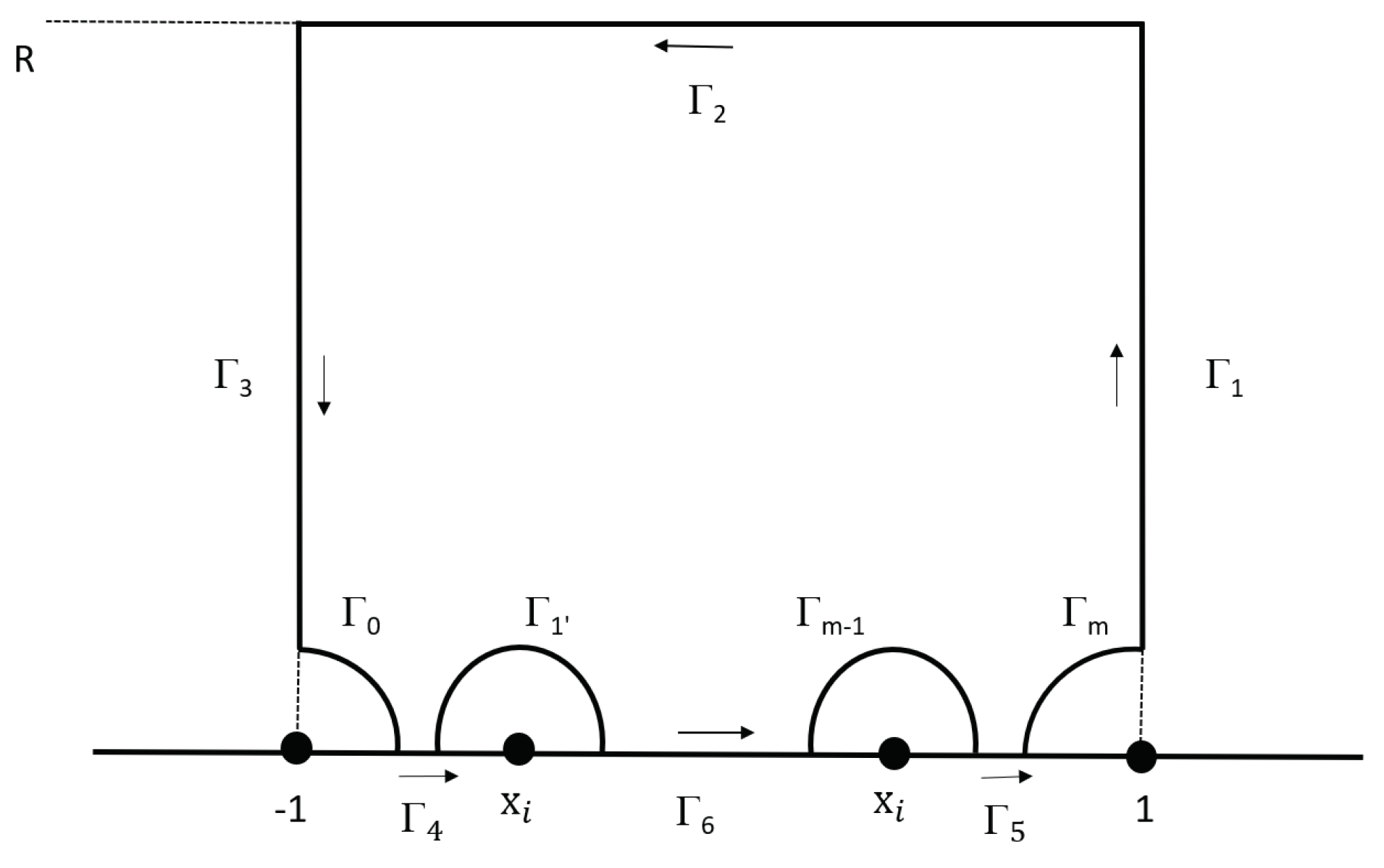
where paths of the integration are taken in counterclockwise direction and shown in the
Figure 1.
Since
, where
R is a large number, then
For
, by taking
and
,
then
By Equations (
19) and (
18), we yield
Similarly, for all integration paths
For
, Equation (
17) implies
□
For the calculation of integrals involving weight functions
and
, the generalized Gauss–Laguerre quadrature rule can be used to approximate these integrals. For this purpose, let
and
be the zeros and weight functions of generalized Gauss–Laguerre quadrature rule, respectively, then these integrals are written as
The above theorem is proved for a highly oscillatory weakly singular integral which has an analytic function; however, this can be extended to the integral of our choice.
The integral
in Equation (
13) is also explicitly calculated by steepest descent method in [
18,
19].
With the successful evaluation of the moments
, the Equation (
1) is transformed after some necessary substitutions as
Furthermore, to obtain the unknown coefficients
in Equation (
22), we can apply collocation method for equally spaced points
as
where
For unknown coefficient vector
, the Equation (
23) is obtained in matrix form
where
is an
matrix and corresponds to a system of linear equations that can be solved to obtain the unknown coefficients
. Similarly for the initial conditions (
2), we obtain
Consequently, by replacing the rows of
with the rows of Equation (
25), the new obtained system of equations
is solved for the unknown coefficients
. Once the unknown coefficients are derived, these can be substituted in the Equation (
5) to obtain the unknown function
. It should be noted that the matrix
of the linear system of equations
(
24) can be ill-conditioned, which indicates that increasing the parameter
N does not guarantee the greater accuracy of the approximated solution. To avoid such adversity, small values of
N are taken as the proposed method, giving more accurate results for smaller
N. The value of the
N in numerical examples is taken as
. The increment in the
N values gives no such improvement in the accuracy.
5. Conclusions
In this paper, we have given a really simple but efficient method to solve the highly oscillatory singular FIDEs. For a small number of equally spaced points as collocation points, the proposed method provides efficient higher accuracy. We do not need to take the higher degree Taylor series expansion of the Chebyshev polynomial, as even for we obtain satisfactory approximation to the exact values. However, for weak singularities, the values of m and N are taken to be identical. All the exact values of the integrals are calculated in Mathematica11 software, whereas the code for the proposed method is developed in MatlabR2018a.