Design of Space Efficient Electric Vehicle Charging Infrastructure Integration Impact on Power Grid Network

Abstract
1. Introduction
2. Related Works
2.1. Smart Grid Network
2.2. EV Charging Stations
3. Overview of Charging Stations
3.1. Electric Vehicle Charging Infrastructure in India
- Home Charging: Home chargers commonly use a 230 V/15 A single-phase socket with a maximum output capacity of 2.5 kW. Home charging is clearly an AC (Alternating Current) charging method. The amount of electricity used is factored into the home-metering system. The time it takes to charge an electric vehicle is determined by the charging rate and the quantity of charge necessary (which is determined by the battery’s usable capacity). Electric scooters can be charged in 2–3 h and electric cars in 6–7 h using home charging.
- Public Charging: Public charging means charging the electric vehicle outside the home. For example charging the vehicle either in the supermarket, cinema hall, retail parks, etc.
- Battery Swapping: The electric vehicles swap their drained batteries with fully recharged batteries. The Battery Swapping concept decouples battery charging from vehicle use, which benefits both the swapping station operator and the power system. No rapid charging is necessary, and electrical grid management is straightforward [11].
3.2. Types of Chargers
- Type 1 AC Charger: This is the most basic EV charger, which is used by some entry-level electric vehicles. It may charge a vehicle slowly using an AC outlet or a home charging system. It has a charging power of up to 220 volts and a maximum current of 16 amps. It can handle up to 3 kW of single-phase input electricity. When using these types of chargers, the vehicle must convert AC electricity to DC, which is a time-consuming procedure.
- Type 2 Charger: The Type 2 Charger can charge at a quicker rate and works with both AC and DC charging methods. These chargers are designed to work with three-phase power systems. In European charging stations, it’s fairly frequent. With a 400 volt AC supply, it can handle input power ranging from 7.4 kW to 43 kW. These chargers are also commonly installed in EV owners’ houses for faster charging periods because they are compatible with vehicles that use CCS connections.
- CCS or Combined Charging System: With new-generation electric vehicles, a combination charging system plug, often known as a CCS type plug (or CCS Type 2), is becoming more widespread. These charging systems are capable of offering DC fast-charging for cars from commercial charging stations as well as standard charging from home charging stations. For DC rapid charging, the plug contains two additional contact points. Input power for most DC fast chargers is 50 kW, however, this type of socket can handle charge power of up to 350 kW.
- CHAdeMo Charger: It was developed by Nissan, Tokyo Electric Power Company (TEPCO), Mitsubishi, Subaru, and Toyota and was first deployed in Japan [34]. This was one of the first fast-charging systems to be created, and it is now used in over 70 nations across the world. It can handle up to 50 kW of DC fast charging [35]. Newer automobiles, on the other hand, are converting to the CCS system since it is more versatile.
- GB/T Charger Under the Bharat DC 001 standard, the Indian Government suggested the GB/T type charger for EVs. These chargers, which were erected by the government’s Energy Efficiency Services Limited (EESL), are capable of DC fast-charging with a 10–15 kW output for low-power EVs. On the other hand, this sort of connector can handle capacities of up to 230 kW.
4. Proposed Space Efficient Multi-Level Charging Station Infrastructure Method
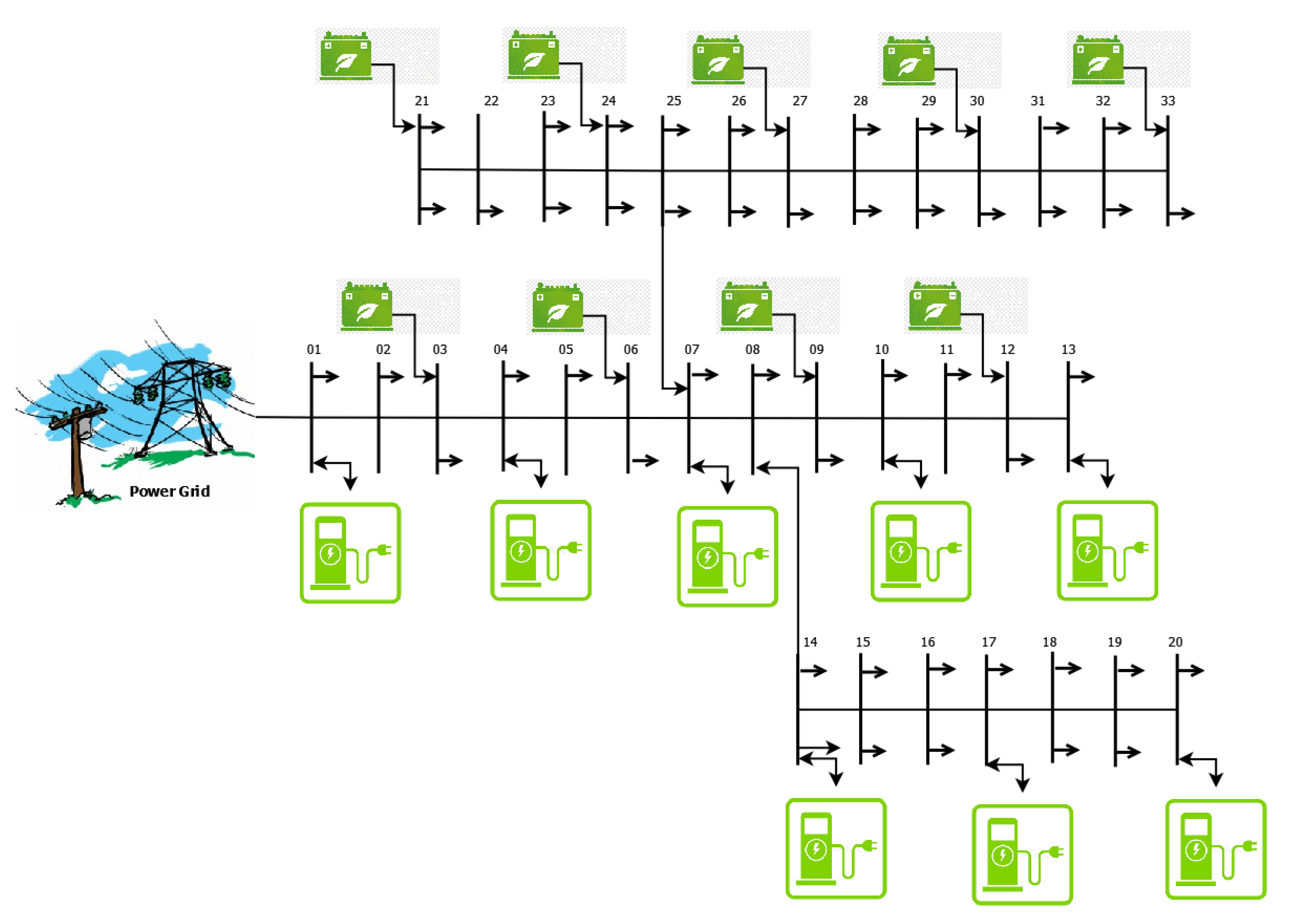
Implementation of an EV Charging Station with 33-Bus Distribution Network
- Each bus is connected to the agent, and this agent, in turn, connects to the charging station. Therefore, the agent analysis its respective bus and shares the information with the charging station.
- Every EV/EV battery connected to the station has 40% of the initial state of charge (SoC).
- Every EV has the same battery parameters.
- Each charging station is equipped with similar chargers in order to linearize the distributed observations.
- The simulation assumes a charging station to be operating at 100% capacity in order to make distinct observations.
- Residential/Industrial loads are always connected and running at full power.
- A single three-phase power source powers the entirety of the grid.
Observations and Inferences from IEEE 33-Bus Distribution Network
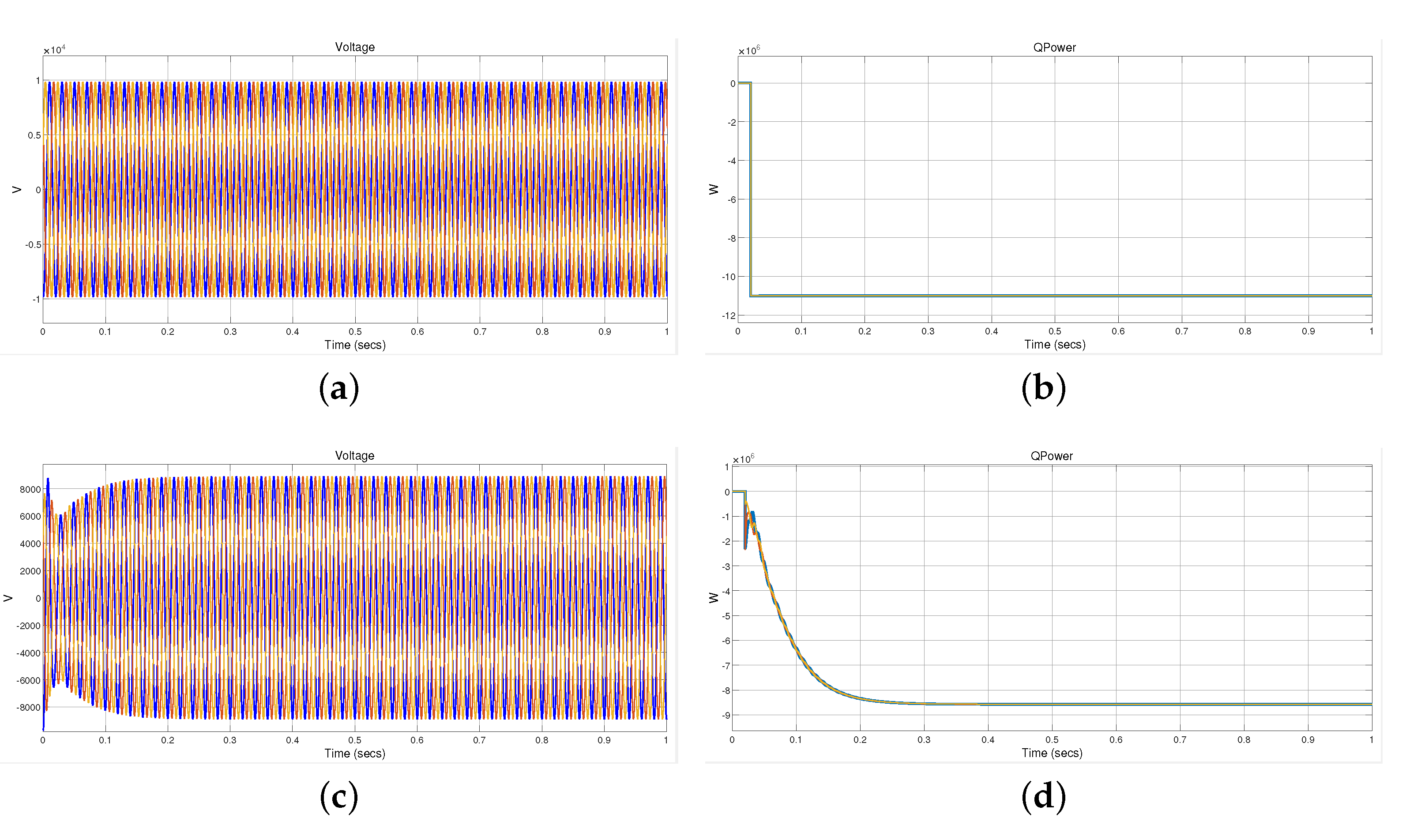
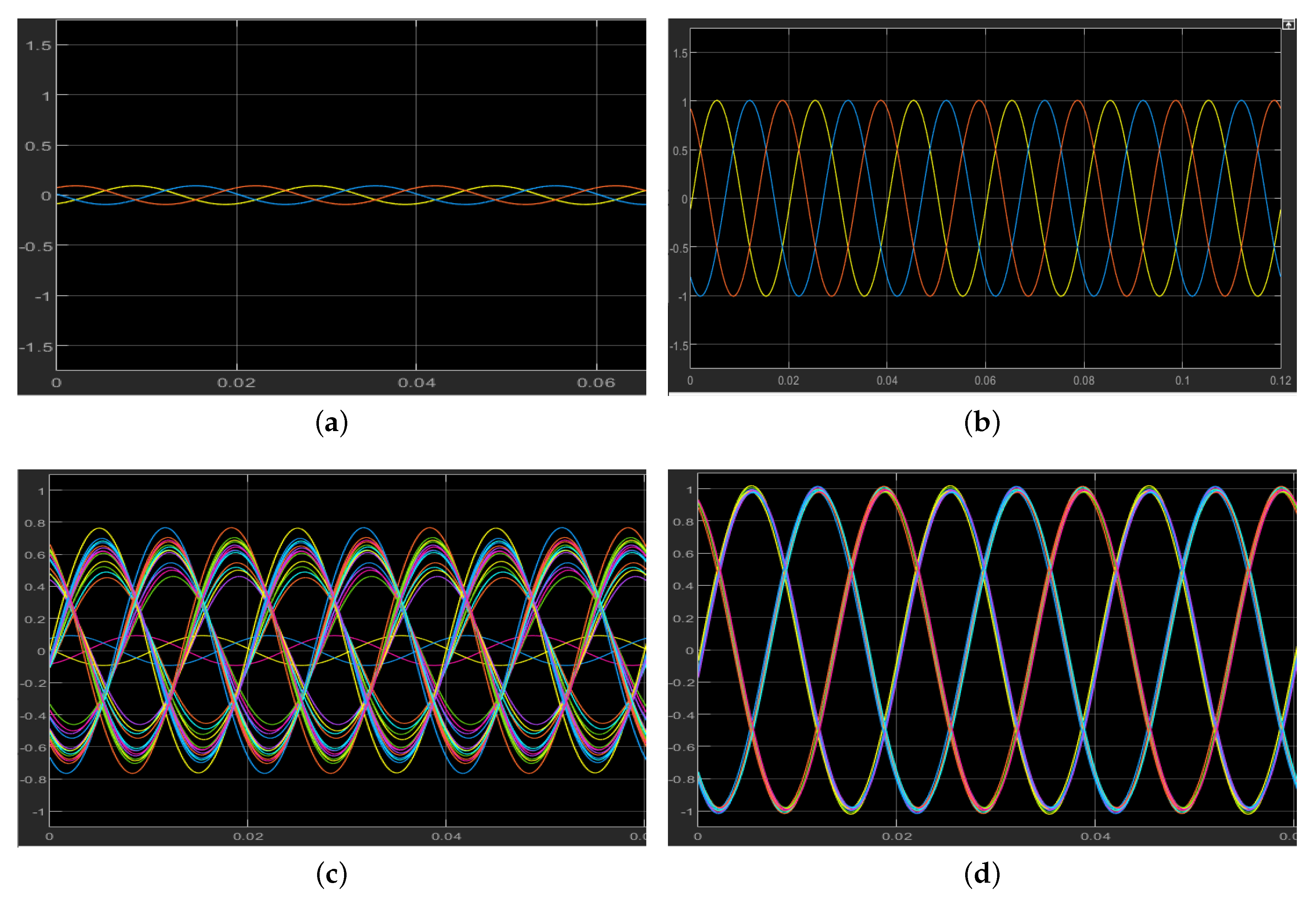
- Utility grid simulation is conducted with only residential/industrial loads and the charging station kept off. For this scenario, we have observed a stable 3-phase voltage of 9.7 kV as shown in Figure 4a in the grid.Figure 4b shows the reactive power of 11 MW in the system. It is absorbed by harmonic filters and some residential/industrial loads.
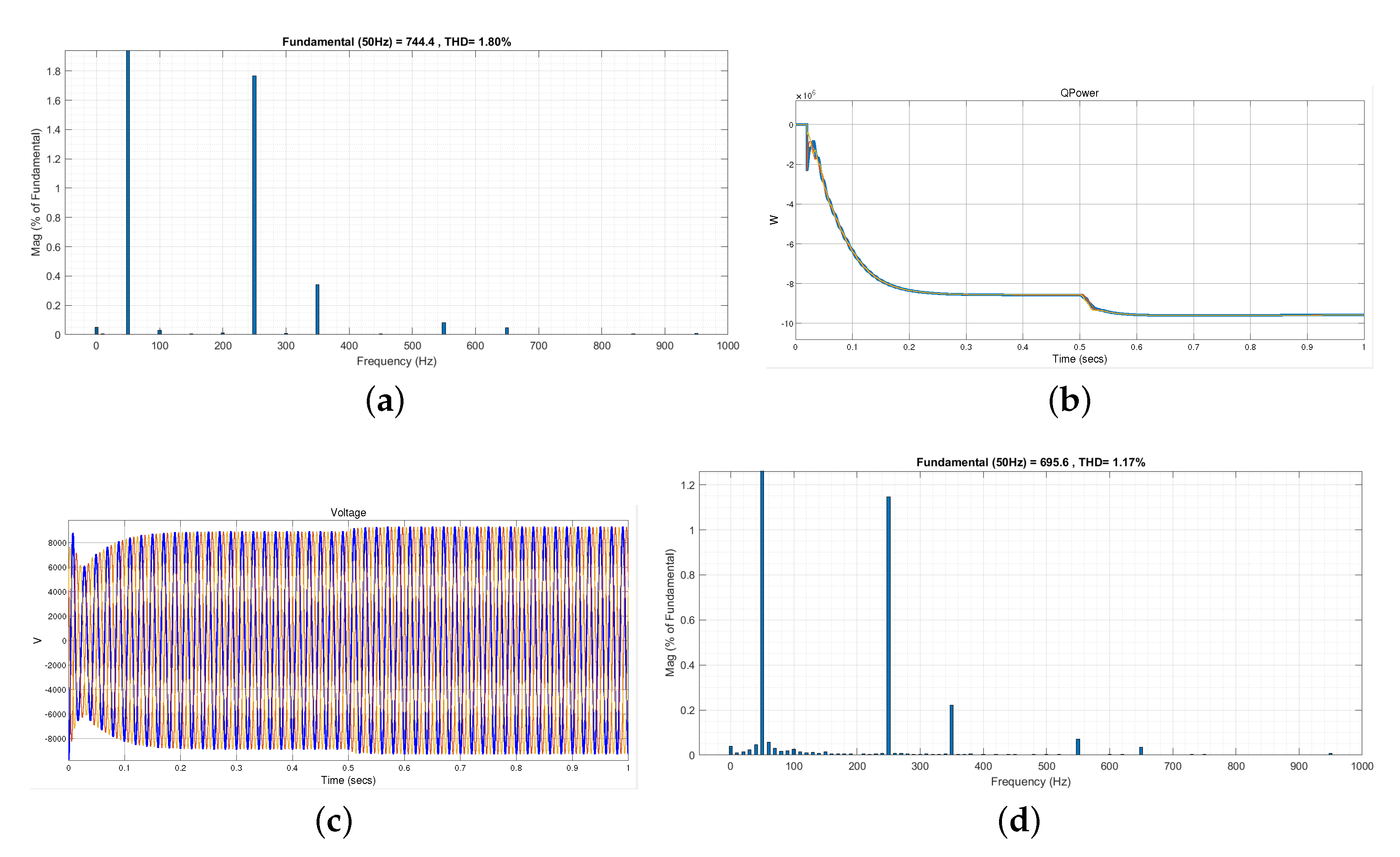
- When all CSs are operated at total capacity and no DC Fast Chargers are operated, there is a voltage drop to 8.88 kV as shown in Figure 4c along with the injection of reactive power as shown in Figure 4d in the system which scaled up to −8.5 MW.Total Harmonic Distortion (THD) has been observed that is 1.8% as shown in Figure 5a using the Powergui FFT analysis tool.
- When the simulated charging station’s power draw crossed the 50% capacity threshold, the charger switched to energy stored in battery banks by enabling DCFCs at half time of simulation, and there is a significant drop of reactive power to −9.6 MW has been observed as shown in Figure 5b and a considerable increase in voltage of 9.25 kV has been observed as shown in Figure 5c. This increased the grid’s power quality significantly. A substantial decline in THD that is, 1.17%. This decline is due to the disconnection of chargers at the instance of time as shown in Figure 5d.
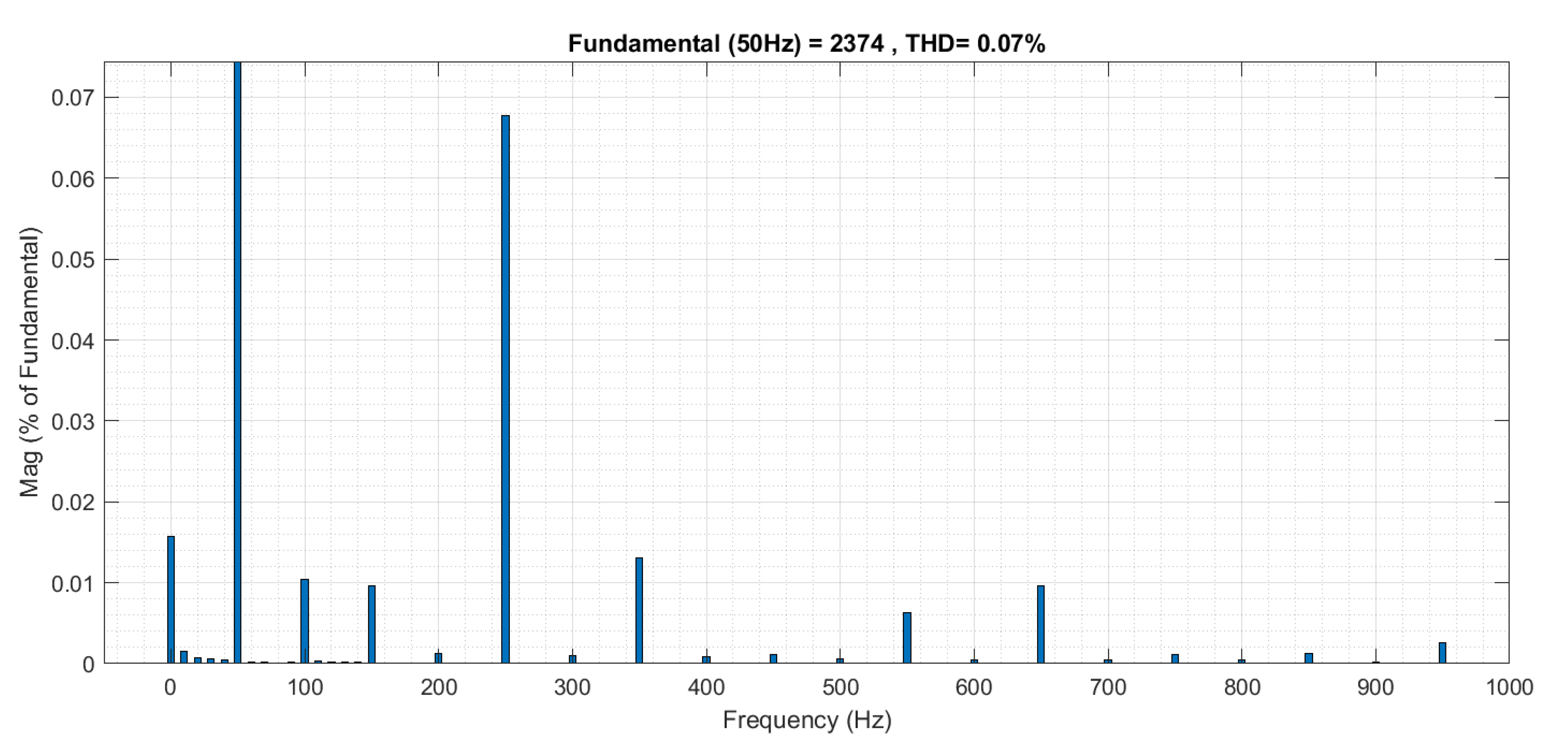
- To reduce harmonics, we developed two advanced doubly-tuned passive harmonics filters in the grid. These filters consist of a circuit formed by inductance, capacitance, and resistances. The intended design was shown to observe an optimal amount of reactive power from the grid which decreases the harmonics distortion. By using this, we observed a drop to 0.07% in THD as shown in Figure 6 as compared to 1.8% THD without a filter. This falls within the range of acceptable limits of both THD and reactive power as shown in Figure 5a.
5. Cost Analysis of Multi-Level Charging Station Infrastructure
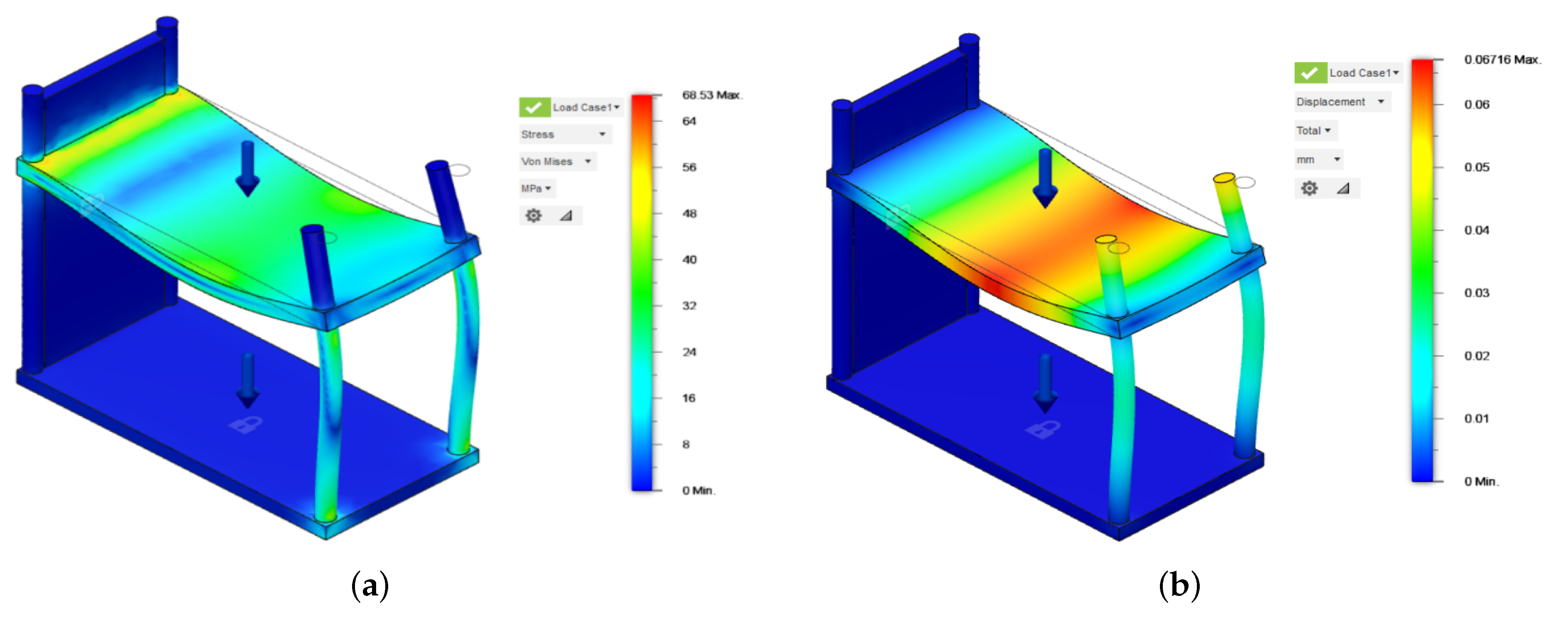
6. Stress Analysis of the Designed Structure of Multi-Level Charging Station Infrastructre
7. Multi-Level EV Charging Station Infrastructure Model
7.1. Analytical Model
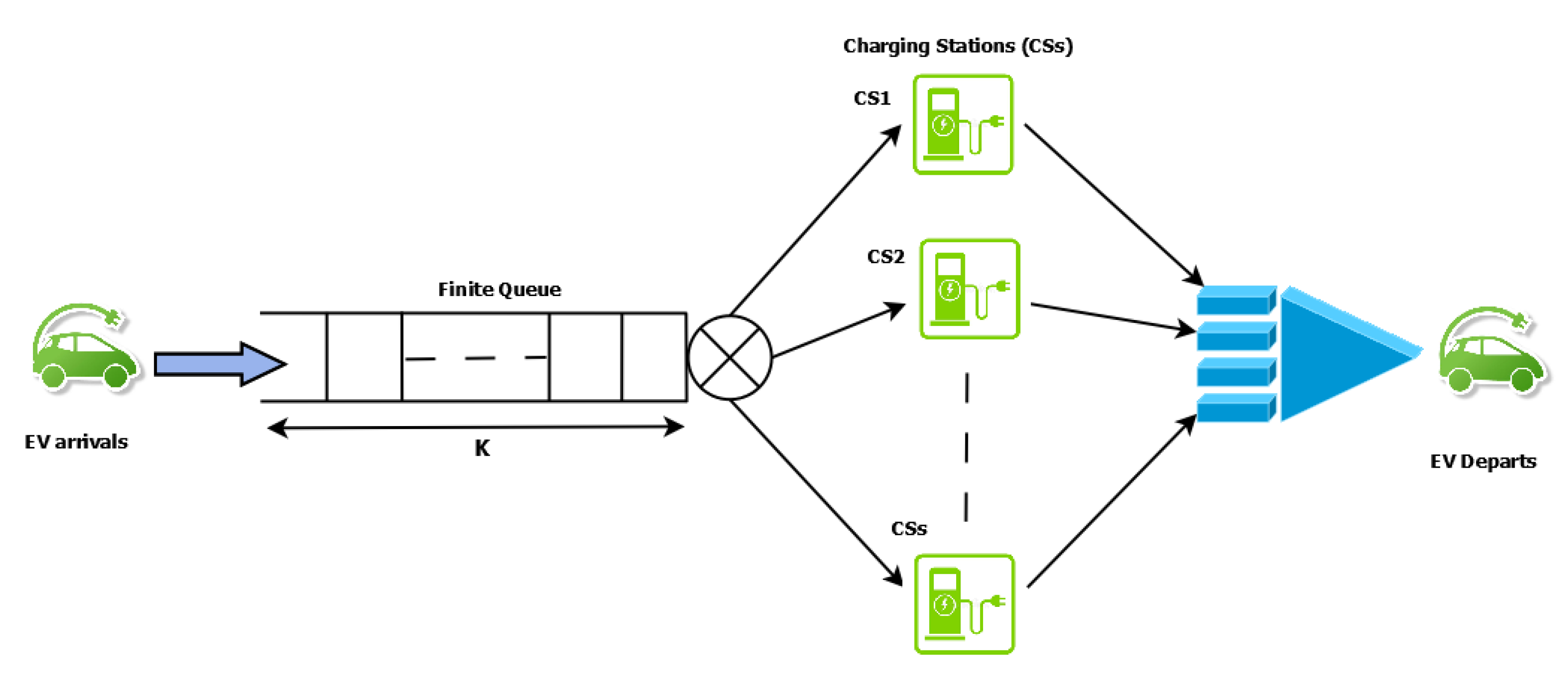
- Arrival rate (): .
- Service rate ():
7.2. Optimization Model
7.3. GA for Multi-Level Charging Station Infrastructure
- Initialization of population: We have randomly generated the initial population. Here, binary coding is employed, that is 1 means the point is selected to develop the charging station, otherwise 0.
- Estimation of each individual fitness metric. During each scheme performance evaluation, extra work needs to be taken in order to complete the solution, that is all the charging station’s charging demand points should be allocated to the potential station to end the evaluation process.
- Estimating the next generation. For generating qualified offspring, especially the designed crossover and mutation operators are employed.
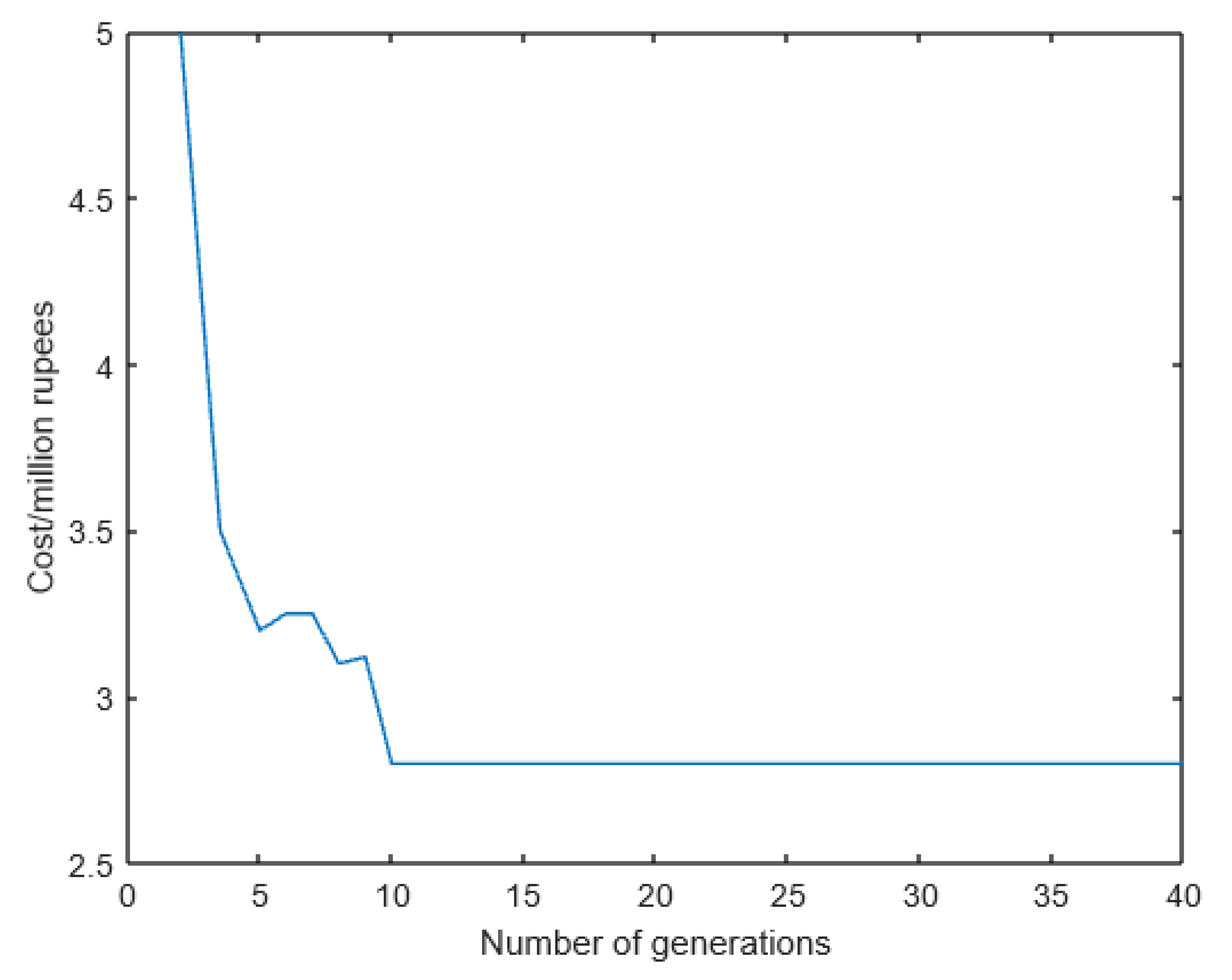
- Convergence: There are two convergences, either the generated the best fitness out of 50 generations or the limit has reached, the developed algorithm will produce the best individual of that generation as the final output.
8. Simulation and Results Analysis
9. Conclusions
Author Contributions
Funding
Institutional Review Board Statement
Informed Consent Statement
Data Availability Statement
Acknowledgments
Conflicts of Interest
Abbreviations
| EV | Electric Vehicle |
| SG | Smart Grid |
| AMI | Advanced Metering Infrastructure |
| DMS | Distributed Management System |
| PLC | Power Line Communication |
| UWB | Ultra-Wide Band |
| UIC | Universal Inductive Charger |
| MAS | Multi-Agent System |
References
- Colak, I.; Sagiroglu, S.; Fulli, G.; Yesilbudak, M.; Covrig, C.F. A survey on the critical issues in smart grid technologies. Renew. Sustain. Energy Rev. 2016, 54, 396–405. [Google Scholar] [CrossRef]
- Sagiroglu, S.; Terzi, R.; Canbay, Y.; Colak, I. Big data issues in smart grid systems. In Proceedings of the 2016 IEEE International Conference on Renewable Energy Research and Applications (ICRERA), Birmingham, UK, 20–23 November 2016; pp. 1007–1012. [Google Scholar]
- Shadare, A.E.; Sadiku, M.N.; Musa, S.M. BElectromagnetic compatibility issues in critical smart grid infrastructure. IEEE Electromagn. Compat. Mag. 2017, 6, 63–70. [Google Scholar] [CrossRef]
- Young, J.R. Smart Grid Technology in the Developing World, 2017, Honors Projects 68. Available online: https://digitalcommons.spu.edu/honorsprojects/68 (accessed on 25 July 2022).
- Ellis, M. Smart grid: The components and integrating communication. In Proceedings of the 2012 IEEE Green Technologies Conference, Tulsa, OK, USA, 19–20 April 2012; pp. 1–6. [Google Scholar]
- Hu, J.; Saleem, A.; You, S.; Nordström, L.; Lind, M.; Østergaard, J. A multi-agent system for distribution grid congestion management with electric vehicles. Eng. Appl. Artif. Intell. 2015, 38, 45–58. [Google Scholar] [CrossRef]
- Vallejo, D.; Albusac, J.; Glez-Morcillo, C.; Castro-Schez, J.J.; Jiménez, L. A multi-agent approach to intelligent monitoring in smart grids. Int. J. Syst. Sci. 2014, 45, 756–777. [Google Scholar] [CrossRef]
- Bonaiuto, V.; Sargeni, F. A Matlab Simulink model for the study of smart grid—Grid-integrated vehicles interactions. In Proceedings of the 2017 IEEE 3rd International Forum on Research and Technologies for Society and Industry (RTSI), Modena, Italy, 11–13 September 2017; pp. 1–6. [Google Scholar]
- Falvo, M.C.; Foiadelli, F.E.D.E.R.I.C.A. Preliminary analysis for the design of an energy-efficient and environmental sustainable integrated mobility system. In Proceedings of the IEEE PES General Meeting, Minneapolis, MN, USA, 25–29 July 2017; pp. 1–7. [Google Scholar]
- Roscia, M.; Longo, M.; Lazaroiu, G.C. Smart City by multi-agent systems. In Proceedings of the 2013 International Conference on Renewable Energy Research and Applications (ICRERA), Madrid, Spain, 20–23 October 2018; pp. 371–376. [Google Scholar]
- Marra, F.; Sacchetti, D.; Træholt, C.; Larsen, E. Electric vehicle requirements for operation in smart grids. In Proceedings of the 2nd IEEE PES International Conference and Exhibition on Innovative Smart Grid Technologies, Manchester, UK, 5–7 December 2011; pp. 1–7. [Google Scholar]
- Vermesan, O.; Blystad, L.C.; Hank, P.; Bahr, R.; John, R.; Moscatelli, A. Smart, connected and mobile: Architecting future electric mobility ecosystems. In Proceedings of the 2013 Design, Automation & Test in Europe Conference & Exhibition (DATE), Grenoble, France, 18–22 March 2018; pp. 1740–1744. [Google Scholar]
- Lin, S.Y.; Chen, J.F. Distributed optimal power flow for smart grid transmission system with renewable energy sources. Energy 2013, 56, 184–192. [Google Scholar] [CrossRef]
- Li, Z.; Wang, J.; Sun, H.; Guo, Q. Transmission contingency analysis based on integrated transmission and distribution power flow in smart grid. IEEE Trans. Power Syst. 2015, 30, 3356–3367. [Google Scholar] [CrossRef]
- Yang, Q.; Li, D.; Yu, W.; Liu, Y.; An, D.; Yang, X.; Lin, J. Toward data integrity attacks against optimal power flow in smart grid. IEEE Internet Things J. 2017, 4, 1726–1738. [Google Scholar] [CrossRef]
- Liu, G.; Liu, K.; Shi, D.; Zhu, W.; Wang, Z.; Chen, X. Graph computation and its applications in smart grid. In Proceedings of the 2017 IEEE International Congress on Big Data (BigData Congress), Honolulu, HI, USA, 25–30 June 2017; pp. 507–510. [Google Scholar]
- Owerko, D.; Gama, F.; Ribeiro, A. Optimal power flow using graph neural networks. In Proceedings of the ICASSP 2020–2020 IEEE International Conference on Acoustics, Speech and Signal Processing (ICASSP), Barcelona, Spain, 4–8 May 2020; pp. 5930–5934. [Google Scholar]
- Sureshkumar, K.; Ponnusamy, V. Hybrid renewable energy systems for power flow management in smart grid using an efficient hybrid technique. Trans. Inst. Meas. Control 2020, 42, 2068–2087. [Google Scholar] [CrossRef]
- Vogt, M.; Marten, F.; Braun, M. A survey and statistical analysis of smart grid co-simulations. Appl. Energy 2018, 222, 67–78. [Google Scholar] [CrossRef]
- Mohagheghi, E.; Alramlawi, M.; Gabash, A.; Li, P. A survey of real-time optimal power flow. Energies 2018, 11, 3142. [Google Scholar] [CrossRef]
- Sureshkumar, K.; Ponnusamy, V. Power flow management in micro grid through renewable energy sources using a hybrid modified dragonfly algorithm with bat search algorithm. Energy 2019, 181, 1166–1178. [Google Scholar] [CrossRef]
- Montoya, O.D.; Garrido, V.M.; Gil-González, W.; Grisales-Noreña, L.F. Power flow analysis in DC grids: Two alternative numerical methods. IEEE Trans. Circuits Syst. II Express Briefs 2019, 66, 1865–1869. [Google Scholar] [CrossRef]
- Ustun, T.S.; Aoto, Y. Analysis of smart inverter’s impact on the distribution network operation. IEEE Access 2019, 7, 9790–9804. [Google Scholar] [CrossRef]
- Ni, Z.; Paul, S. A multistage game in smart grid security: A reinforcement learning solution. IEEE Trans. Neural Netw. Learn. Syst. 2019, 30, 2684–2695. [Google Scholar] [CrossRef]
- Pohl, O.; Rewald, F.; Dalhues, S.; Jörke, P.; Rehtanz, C.; Wietfeld, C.; Kubis, A.; Tamgue, R.K.; Kirsten, D. Advancements in distributed power flow control. In Proceedings of the 2018 53rd International Universities Power Engineering Conference (UPEC), Glasgow, UK, 4–7 September 2018; pp. 1–6. [Google Scholar]
- Hossain, E.; Khan, I.; Un-Noor, F.; Sikander, S.S.; Sunny, M.S.H. Application of big data and machine learning in smart grid, and associated security concerns: A review. IEEE Access 2019, 7, 13960–13988. [Google Scholar] [CrossRef]
- Kongjeen, Y.; Bhumkittipich, K. Impact of plug-in electric vehicles integrated into power distribution system based on voltage-dependent power flow analysis. Energies 2018, 11, 1571. [Google Scholar] [CrossRef]
- Kappagantu, R.; Daniel, S.A. Challenges and issues of smart grid implementation: A case of Indian scenario. J. Electr. Syst. Inf. Technol. 2018, 5, 453–467. [Google Scholar] [CrossRef]
- Faheem, M.; Shah, S.B.H.; Butt, R.A.; Raza, B.; Anwar, M.; Ashraf, M.W.; Ngadi, M.A.; Gungor, V.C. Smart grid communication and information technologies in the perspective of Industry 4.0: Opportunities and challenges. Comput. Sci. Rev. 2018, 30, 1–30. [Google Scholar] [CrossRef]
- Abdel-Nasser, M.; Mahmoud, K.; Kashef, H. A novel smart grid state estimation method based on neural networks. IJIMAI 2018, 5, 92–100. [Google Scholar] [CrossRef]
- Gupta, S.; Kazi, F.; Wagh, S.; Singh, N. Analysis and prediction of vulnerability in smart power transmission system: A geometrical approach. Int. J. Electr. Power Energy Syst. 2018, 94, 77–87. [Google Scholar] [CrossRef]
- Artale, G.; Cataliotti, A.; Cosentino, V.; Di Cara, D.; Fiorelli, R.; Guaiana, S.; Panzavecchia, N.; Tinè, G. A new low cost power line communication solution for smart grid monitoring and management. IEEE Instrum. Meas. Mag. 2018, 21, 29–33. [Google Scholar] [CrossRef]
- Agundis-Tinajero, G.; Segundo-Ramírez, J.; Visairo-Cruz, N.; Savaghebi, M.; Guerrero, J.M.; Barocio, E. Power flow modeling of islanded AC microgrids with hierarchical control. Int. J. Electr. Power Energy Syst. 2019, 105, 28–36. [Google Scholar] [CrossRef]
- Lei, X.; Yang, Z.; Yu, J.; Zhao, J.; Gao, Q.; Yu, H. Data-driven optimal power flow: A physics-informed machine learning approach. IEEE Trans. Power Syst. 2020, 36, 346–354. [Google Scholar] [CrossRef]
- Muhammad, Y.; Khan, R.; Raja, M.A.Z.; Ullah, F.; Chaudhary, N.I.; He, Y. Design of fractional swarm intelligent computing with entropy evolution for optimal power flow problems. IEEE Access 2020, 8, 111401–111419. [Google Scholar] [CrossRef]





| Paper ID | Approach | SG Ecosystem, Network Power Distribution | V2G, MAS | Power Flow Monitoring | Integration of Micro-Grids | Optimization Techniques |
|---|---|---|---|---|---|---|
| [11,18,19,20,21] | Distributed Power flow network model with energy management systems for EV Infrastructure | ✓ | ✓ | × | × | × |
| [5,8,16,22,23,24,25,26] | Power Flow in microgrids in SG Network | ✓ | ✓ | ✓ | × | × |
| [27,28,29,30] | Cyber Physical Protection in SG Network | ✓ | ✓ | ✓ | × | ✓ |
| [6,13,14,21,31,32,33] | Efficient Management Algorithms and optimised power flow mechanism | ✓ | × | ✓ | ✓ | × |
| Proposed Work | A comprehensive power flow analysis of the SG Network Infrastructure | ✓ | ✓ | ✓ | ✓ | × |
| Parameters | On-Board Charging Station | Off-Board Charging Station | Fast Charging Station | Wireless Charging Station | Smart Charging Station | Battery Swapping Station | Multi-Level Charging Station |
|---|---|---|---|---|---|---|---|
| Energy transfer (in kW) | Less | High | Different ports for multiple levels | Bi-directional | Depends upon the distance between coils | Bidirectional | Bidirectional, Safe and High |
| Level of battery heating issue | Low | Very high | Medium | Medium | Low | Low | Very low |
| Battery weight on EV | Added | Removed | Removed | Removed | Moderate | Constant | Removed |
| Battery charging time | More | Depends on the controller of EV | Depends on the controller of EV | Depends on user control | Depends on power transmission coils | More | No delay |
| Flexibility | Anywhere charge | No flexibility | Anywhere charge | Anywhere charge | More flexible | More flexible | No flexibility |
| Cost and complexity | Low cost and complexity | High cost and complexity | High cost and low complexity | High cost and complexity | High cost and medium complexity | Medicum cost and high complexity | Low cost and low complexity |
| Type of Charger | Number of Chargers in PCS | Power Output | Approx. Cost in Indian Rupees | Number of EVs That Can Be Charged Simulataneously | Maximum Power Sold to EVs per Day (24 h/day) kWh |
|---|---|---|---|---|---|
| CCS | 1 | 50 kW | 72,500 | 1 | 1200 |
| CHAdeMO | 1 | 50 kW | 72,500 | 1 | 1200 |
| Type 2 AC | 1 | 22 kW | 12,500 | 1 | 528 |
| Bharat DC-001 | 1 | 15 kW | 24,000 | 1 | 360 |
| Bharat AC-001 | 1 | 9.9 kW | 7000 | 3 | 237.6 |
| Swap station | - | - | - | - | 360 |
| New electricity connection (2SO KVA), Transformer, Cabling, Panels, Breakers, and Energy meter | - | - | 75,000 | - | - |
| Civil works (Flooring, painting, Boards, Branding, Shed/covers, etc. | - | - | 750,000 | - | - |
| EVSE Management Software-integration with chargers and payment gateway | - | - | 40,000 | - | - |
| CCTV Camera Setup | - | - | 30,000 | - | - |
| Total CAPEX | - | - | 2,955,000 | - | 3885.6 |
| Type of Service | Cost in Indian Rupees |
|---|---|
| Technician’s charges | 150,000 for 6 months |
| Site maintenance staff | 180,000 per year |
| Land lease rental (50,000 per month) | 600,000 per year |
| Advertising (3000 per month) | 36,000 per year |
| Total cost | 972,000 + EVSE software fees for 1st year. 822,000 + EVSE software fees for 2nd year |
| Type of Charging Station | Safety | Traffic | Waiting Time | Cost | Complexity |
|---|---|---|---|---|---|
| On-board charging station | Less | High | More | Low | Low |
| Off-board charging station | Medium | High | More | High | High |
| Battery swapping station | Less | Low | Medium | Medium | High |
| Multi-level charging station | High | Low | Low | Low | Low |
Publisher’s Note: MDPI stays neutral with regard to jurisdictional claims in published maps and institutional affiliations. |
© 2022 by the authors. Licensee MDPI, Basel, Switzerland. This article is an open access article distributed under the terms and conditions of the Creative Commons Attribution (CC BY) license (https://creativecommons.org/licenses/by/4.0/).
Share and Cite
Chavhan, S.; Zeebaree, S.R.M.; Alkhayyat, A.; Kumar, S. Design of Space Efficient Electric Vehicle Charging Infrastructure Integration Impact on Power Grid Network. Mathematics 2022, 10, 3450. https://doi.org/10.3390/math10193450
Chavhan S, Zeebaree SRM, Alkhayyat A, Kumar S. Design of Space Efficient Electric Vehicle Charging Infrastructure Integration Impact on Power Grid Network. Mathematics. 2022; 10(19):3450. https://doi.org/10.3390/math10193450
Chicago/Turabian StyleChavhan, Suresh, Subhi R. M. Zeebaree, Ahmed Alkhayyat, and Sachin Kumar. 2022. "Design of Space Efficient Electric Vehicle Charging Infrastructure Integration Impact on Power Grid Network" Mathematics 10, no. 19: 3450. https://doi.org/10.3390/math10193450
APA StyleChavhan, S., Zeebaree, S. R. M., Alkhayyat, A., & Kumar, S. (2022). Design of Space Efficient Electric Vehicle Charging Infrastructure Integration Impact on Power Grid Network. Mathematics, 10(19), 3450. https://doi.org/10.3390/math10193450