


Abstract
The complemented triangulation graph of a graph G, denoted by , is defined as the graph obtained from G by adding, for each edge of G, a new vertex whose neighbours are the vertices of G other than u and v. In this paper, we first obtain the A-spectra, the L-spectra, and the Q-spectra of the complemented triangulation graphs of regular graphs. By using the results, we construct infinitely many pairs of A-cospectral graphs, L-cospectral graphs, and Q-cospectral graphs. We also obtain the number of spanning trees and the Kirchhoff index of the complemented triangulation graphs of regular graphs.
MSC:
05C50
1. Introduction
All graphs considered in this paper are undirected and simple. Let be a graph with vertex set and edge set . The adjacency matrix of G, denoted by , is the matrix whose -entry is 1 if and are adjacent in G and 0 otherwise. We denote by the degree of in G and define as the diagonal matrix with diagonal entries . The Laplacian matrix of G and the signless Laplacian matrix of G are defined as and , respectively. Given an matrix M, we denote by
or, simply, , the characteristic polynomial of M, where denotes the identity matrix of size n. In particular, for a graph G, we call (respectively, , ) the adjacency (respectively, Laplacian, signless Laplacian) characteristic polynomial of G, and we call its roots the adjacency (respectively, Laplacian, signless Laplacian) eigenvalues of G. The collection of eigenvalues of together with their multiplicities are called the A-spectrum of G. Two graphs are said to be A-cospectral if they have the same A-spectrum. Similar terminology will be used for and . So, we obtain the definitions of the L-spectrum, Q-spectrum, L-cospectral graphs, and Q-cospectral graphs. It is known that graph spectra store numerous units of structural information about a graph; see [1,2,3] and the references therein.
Formulating the characteristic polynomials of graphs, as well as calculating the spectra of graphs, is a fundamental and very meaningful work in spectral graph theory. Up until now, the spectra of several graphs have been investigated. For examples, see [1,2,3,4,5,6,7,8,9,10]. It is known that the characteristic polynomials of graphs and the spectra of graphs can enable us to construct infinitely many pairs of A-cospectral (respectively, L-cospectral, Q-cospectral) graphs [7,9,10], as well as to investigate many other properties of graphs, such as the number of spanning trees [1,3], the Kirchhoff index [1,3,11,12,13], and so on.
In this paper, we investigate the spectra of complemented triangulation graphs of regular graphs, whose definition is given in Definition 1. Our motivation for defining the complemented triangulation graph comes from [14], where the so-called Q-complemented graph was introduced and the adjacency characteristic polynomial of the Q-complemented graph of a graph was computed.
Definition 1.
The complemented triangulation graph of a graph G, denoted by , is defined as the graph obtained from G by adding, for each edge of G, a new vertex whose neighbours are the vertices of G other than u and v.
Let denote the cycle on n vertices. Figure 1 depicts the complemented triangulation graph of .
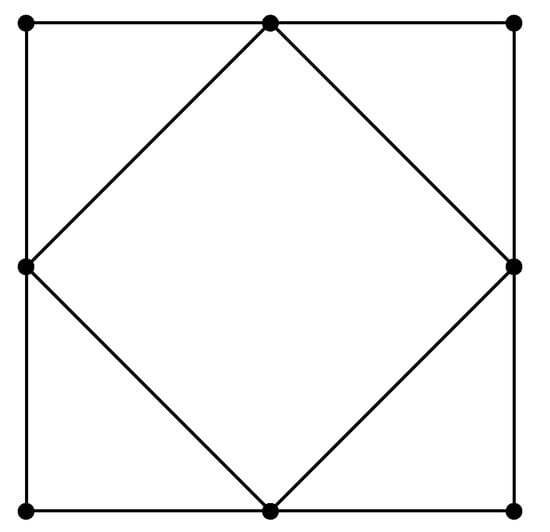
Figure 1.
An example of a complemented triangulation graph.
In our work, we first obtain the A-spectra, the L-spectra, and the Q-spectra of complemented triangulation graphs of regular graphs. By using the results, we construct infinitely many pairs of A-cospectral graphs, L-cospectral graphs, and Q-cospectral graphs. We also obtain the number of spanning trees and the Kirchhoff index of the complemented triangulation graphs of regular graphs.
2. Spectra of Complemented Triangulation Graphs
Before proceeding to the presentation of the main results of this section, we need to state some basic results that will be used frequently later.
Let G be a graph with the vertex set and the edge set . The (vertex–edge) incidence matrix of G, denoted by , is an matrix with entry if the vertex is incident the edge , and otherwise. It is well known [3] that, if G is an r-regular graph, then
where represents the transpose of .
The M-coronal of an matrix M is defined [4,15] as the sum of the entries of the matrix , that is,
where denotes the column vector of dimension n with all of the components equal to one. It is known [4] (Proposition 2) that, if M is an matrix with each row sum equal to a constant t, then
In particular, since, for any graph G with n vertices, each row sum of is equal to 0, we have
Lemma 1
(see [10]). Let A be an real matrix, α a real number, and the matrix with all entries equal to one. Then,
Lemma 2
(see [16]). Let , , , and be, respectively, , , , and matrices, where and are invertible. Then,
where and are called the Schur complements of and , respectively.
2.1. A-Spectra of Complemented Triangulation Graphs
Theorem 1.
Let G be an r-regular connected graph with n vertices, m edges, and . Suppose that are the adjacency eigenvalues of G. Then, the adjacency eigenvalues of are stated as follows:
- (a)
- 0, repeated times;
- (b)
- (c)
- for .
Proof.
Note that the adjacency matrix of is given by
where denotes the matrix with all entries equal to one. Then, the adjacency characteristic polynomial of is given by
where
is the Schur complement of obtained by Lemma 2. Note (1) that Then, we have
By Lemma 1 and (2), we have
Then, the required result follows from . This completes the proof. □
Example 1.
Let be the graph shown in Figure 1. Note that the adjacency eigenvalues of are and . By Theorem 1, the adjacency eigenvalues of are , , , , and 0.
2.2. L-Spectra of Complemented Triangulation Graphs
Theorem 2.
Let G be an r-regular connected graph with n vertices, m edges, and . Suppose that are the Laplacian eigenvalues of G. Then, the Laplacian eigenvalues of are stated as follows:
- (a)
- ;
- (b)
- , repeated times;
- (c)
- wherefor ;
- (d)
- 0.
Proof.
Note that the Laplacian matrix of is given by
where denotes the matrix with all entries equal to one. Thus, the Laplacian characteristic polynomial of is given by
where
is the Schur complement of obtained by Lemma 2. Note (1) that Then, we have
By Lemma 1 and (3), we have
Then, the required result follows from and the fact that . This completes the proof. □
Example 2.
Let be the graph shown in Figure 1. Note that the Laplacian eigenvalues of are and . By Theorem 2, the Laplacian eigenvalues of are 6, 4, 2, , , and 0.
2.3. Q-Spectra of Complemented Triangulation Graphs
Theorem 3.
Let G be an r-regular connected graph with n vertices, m edges, and . Suppose that are the signless Laplacian eigenvalues of G. Then, the signless Laplacian eigenvalues of are stated as follows:
- (a)
- , repeated times;
- (b)
- (c)
- wherefor .
Proof.
Note that the signless Laplacian matrix of is given by
where denotes the identity matrix of size n, and denotes the matrix with all entries equal to one. Thus, the signless Laplacian characteristic polynomial of is given by
where
is the Schur complement of obtained by Lemma 2. Note (1) that Then, we have
By Lemma 1 and (2), we have
Then, the required result follows from and the fact that . This completes the proof. □
Example 3.
Let be the graph shown in Figure 1. Note that the signless Laplacian eigenvalues of are and . By Theorem 3, the signless Laplacian eigenvalues of are , , , 4, and 0.
3. Consequences
3.1. Constructing Cospectral Graphs
It is known that, by using graph operations, we can construct many infinite families of pairs of A-cospectral (respectively, L-cospectral, Q-cospectral) graphs. For example, see [7,9,15]. Here, we use complemented triangulation graphs to construct infinitely many pairs of A-cospectral (respectively, L-cospectral, Q-cospectral) graphs. The following constructions follow from Theorems 1–3. Recall that two graphs are said to be A-cospectral (respectively, L-cospectral, Q-cospectral) if they have the same A-spectrum (respectively, L-spectrum, Q-spectrum).
Corollary 1.
- (a)
- If and are A-cospectral regular graphs, then and are A-cospectral graphs.
- (b)
- If and are L-cospectral regular graphs, then and are L-cospectral graphs.
- (c)
- If and are Q-cospectral regular graphs, then and are Q-cospectral graphs.
Example 4.
Let and be the two graphs given in [17] (Figure 2). It is known that and are A-cospectral (respectively, L-cospectral, Q-cospectral) graphs. By Corollary 1, and are A-cospectral (respectively, L-cospectral, Q-cospectral) graphs.
3.2. The Number of Spanning Trees
A spanning tree of a graph G is a subgraph that is a tree that includes all of the vertices of G [2]. Let denote the number of spanning trees of G. It is known [2] that, if G is a connected graph on n vertices with the Laplacian spectrum , then
Here, we give the number of the spanning trees of for an r-regular graph G.
Corollary 2.
Let G be an r-regular graph on n vertices and m edges. Suppose that are the Laplacian eigenvalues of G. Then,
Proof.
By Theorem 2, we define
where
for . One can easily verify that
Therefore, is obtained by the definition of the number of spanning trees of a graph. □
Example 5.
Let be the graph shown in Figure 1. Note that the Laplacian eigenvalues of are and . By Corollary 2,
3.3. The Kirchhoff Index
The Kirchhoff index of a graph G, denoted by , is defined as the sum of the resistance distances between all pairs of vertices [18,19]. At almost exactly the same time, Gutman et al. [20] and Zhu et al. [21] proved that the Kirchhoff index of a connected graph G with vertices can be expressed as
where are the non-zero Laplacian eigenvalues of G. By Theorem 2, we obtain the Kirchhoff index of for an r-regular graph G.
Corollary 3.
Let G be an r-regular graph on n vertices and m edges. Suppose that are the Laplacian eigenvalues of G. Then,
Proof.
By Theorem 2, we define
where
for . One can easily verify that
Thus, is obtained by the definition of the Kirchhoff index of a graph. □
Example 6.
Let be the graph shown in Figure 1. Note that the Laplacian eigenvalues of are and . By Corollary 3,
4. Conclusions
Computing the spectra of graphs is an important and interesting work in spectral graph theory. In this paper, we determined the spectra of complemented triangulation graphs of regular graphs. As applications, we constructed infinitely many pairs of cospectral graphs. We also calculated the number of spanning trees and the Kirchhoff index of complemented triangulation graphs. We are sure that the methods used in this paper can also be applied to other graphs, and any attempts on other graphs should be welcome.
Author Contributions
Writing—original draft preparation, J.W. (Jia Wei); writing—review and editing, J.W. (Jing Wang). All authors have read and agreed to the published version of the manuscript.
Funding
This research was supported by the Project of Institutions of Higher Learning Innovation Ability Enhancement of Gansu Province (Nos. 2019A-158, 2021A-175).
Institutional Review Board Statement
Not applicable.
Informed Consent Statement
Not applicable.
Data Availability Statement
Not applicable.
Acknowledgments
The authors greatly appreciate the anonymous referees’ comments and suggestions.
Conflicts of Interest
The authors declare no conflict of interest.
References
- Brouwer, A.E.; Haemers, W.H. Spectra of Graphs; Springer: New York, NY, USA, 2012. [Google Scholar]
- Cvetković, D.M.; Doob, M.; Sachs, H. Spectra of Graphs—Theory and Applications, 3rd ed.; Johann Ambrosius Barth: Heidelberg, Germany, 1995. [Google Scholar]
- Cvetković, D.M.; Rowlinson, P.; Simić, H. An Introduction to the Theory of Graph Spectra; Cambridge University Press: Cambridge, UK, 2010. [Google Scholar]
- Cui, S.-Y.; Tian, G.-X. The spectrum and the signless Laplacian spectrum of coronae. Linear Algebra Appl. 2012, 437, 1692–1703. [Google Scholar] [CrossRef]
- Hou, Y.; Shiu, W.-C. The spectrum of the edge corona of two graphs. Electron. J. Linear Algebra 2010, 20, 586–594. [Google Scholar] [CrossRef]
- Lan, J.; Zhou, B. Spectra of graph operations based on R-graph. Linear Multilinear Algebra 2015, 63, 1401–1422. [Google Scholar] [CrossRef]
- Liu, X.; Lu, P. Spectra of subdivision-vertex and subdivision-edge neighbourhood coronae. Linear Algebra Appl. 2013, 438, 3547–3559. [Google Scholar] [CrossRef]
- Liu, X.; Wang, Q. Laplacian state transfer in total graphs. Discrete Math. 2021, 344, 112139. [Google Scholar] [CrossRef]
- Liu, X.; Zhou, S. Spectra of the neighbourhood corona of two graphs. Linear Multilinear Algebra 2014, 62, 1205–1219. [Google Scholar] [CrossRef]
- Liu, X.; Zhang, Z. Spectra of subdivision-vertex join and subdivision-edge join of two graphs. Bull. Malays. Math. Sci. Soc. 2019, 42, 15–31. [Google Scholar] [CrossRef]
- Liu, J.-B.; Bao, Y.; Zheng, W.-T.; Hayat, S. Network coherence analysis on a family of nested weighted n-polygon networks. Fractals 2021, 29, 2150260. [Google Scholar] [CrossRef]
- Liu, J.-B.; Pan, X.F. Minimizing Kirchhoffindex among graphs with a given vertex bipartiteness. Appl. Math. Comput. 2016, 291, 84–88. [Google Scholar] [CrossRef]
- Liu, J.-B.; Pan, X.F.; Yu, L.; Li, D. Complete characterization of bicyclic graphs with minimal Kirchhoff index. Discrete Appl. Math. 2016, 200, 95–107. [Google Scholar] [CrossRef]
- Rajkumar, R.; Gayathri, M. Spectra of (H1,H2)-merged subdivision graph of a graph. Indagat. Math. 2019, 30, 1061–1076. [Google Scholar] [CrossRef]
- McLeman, C.; McNicholas, E. Spectra of coronae. Linear Algebra Appl. 2011, 435, 998–1007. [Google Scholar] [CrossRef]
- Zhang, F. The Schur Complement and Its Applications; Springer: New York, NY, USA, 2005. [Google Scholar]
- van Dam, E.R.; Haemers, W.H. Which graphs are determined by their spectrum? Linear Algebra Appl. 2003, 373, 241–272. [Google Scholar] [CrossRef]
- Bonchev, D.; Balaban, A.T.; Liu, X.; Klein, D.J. Molecular cyclicity and centricity of polycyclic graphs. I. Cyclicity based on resistance distances or reciprocal distances. Internat. J. Quant. Chem. 1994, 50, 1–20. [Google Scholar] [CrossRef]
- Klein, D.J.; Randić, M. Resistance distance. J. Math. Chem. 1993, 12, 81–95. [Google Scholar] [CrossRef]
- Gutman, I.; Mohar, B. The quasi-Wiener and the Kirchhoff indices coincide. J. Chen. Inf. Comput. Sci. 1996, 36, 982–985. [Google Scholar] [CrossRef]
- Zhu, H.-Y.; Klein, D.J.; Lukovits, I. Extensions of the Wiener number. J. Chem. Inf. Comput. Sci. 1996, 36, 420–428. [Google Scholar] [CrossRef]
Publisher’s Note: MDPI stays neutral with regard to jurisdictional claims in published maps and institutional affiliations. |
© 2022 by the authors. Licensee MDPI, Basel, Switzerland. This article is an open access article distributed under the terms and conditions of the Creative Commons Attribution (CC BY) license (https://creativecommons.org/licenses/by/4.0/).