


Abstract
One of the open problems in the numerical analysis of solutions to high-dimensional nonlinear integral equations with memory kernel and proportional delay is how to preserve the high-order accuracy for nonsmooth solutions. It is well-known that the solutions to these equations display a typical weak singularity at the initial time, which causes challenges in developing high-order and efficient numerical algorithms. The key idea of the proposed approach is to adopt a smoothing transformation for the multivariate spectral collocation method to circumvent the curse of singularity at the beginning of time. Therefore, the singularity of the approximate solution can be tailored to that of the exact one, resulting in high-order spectral collocation algorithms. Moreover, we provide a framework for studying the rate of convergence of the proposed algorithm. Finally, we give a numerical test example to show that the approach can preserve the nonsmooth solution to the underlying problems.
Keywords:
spectral algorithm; multidimensional integral equations; memory kernels; nonsmooth solution MSC:
35K55; 65M06; 35K57; 35K15
1. Introduction
In this paper, we consider the following nonlinear multi-dimensional Volterra–Fredholm integral equation with memory kernel and proportional delay:
where , , with are given functions and is the proportional delay.
Non-linear integral equations with weakly singular kernels have recently attracted the attention of researchers due to their applications to the solution of some general problems of fluid mechanics. Such problems are converted to the solution of a non-linear integral equation with a memory kernel, linked to a large number of studies of an applied character; see ([1,2,3,4], Section 7.8). The Volterra integral equation with proportional delay is an important type of Volterra integral equation [5,6]. It arises frequently in the modelling of many applied science problems, including bioscience modeling, ecological competition systems, and population growth. The book [7], with various physical and engineering applications, is one of the most recent contributions to this area. The analysis of Volterra functional integral equations with proportional delays dates back to Volterra’s work ([8], pp. 92–101). Fox et al. [9] were the first to address the approximate solution to the so-called pantograph equations.
Because explicit solutions to even linear weakly singular Volterra–Fredholm integral equations are difficult to acquire, robust numerical methods are required in order to discretize the model equations [10,11,12,13,14,15]. A series of numerical methods for approximating the solutions of Volterra–Fredholm integral equations and other singular problems have been developed, including Runge–Kutta methods, Nyström methods, piecewise polynomial collocation methods, and the finite element method [16,17,18,19,20,21,22,23,24,25,26,27,28]. Some numerical approaches to Volterra–Fredholm integral equations with various delays have recently been developed. Brunner and his colleagues [29] have conducted a lot of ground-breaking work in this area. They mostly used geometric meshes to solve the Volterra–Fredholm integral equations with proportional delay. Xie et al. [30] analyzed the existence, uniqueness, and regularity aspects of solutions to general Volterra functional integral equations with vanishing delay. Wang and Sheng [31] proposed and analyzed a high-order multistep Gauss–Legendre spectral collocation approach for second-kind nonlinear Volterra integral equations with regular kernel and vanishing variable delays.
Near the boundary domain of integration, the solution to nonlinear Volterra–Fredholm integral equations with weakly singular kernels is often nonsmooth (its derivatives are unbounded). If one wants to achieve a high-order rate of convergence in a numerical approach for these equations, one should take into consideration, in some way, the nonsmooth behavior of the exact solution. Traditionally, the theory, application, and implementation of spectral approaches for the solution of nonlinear integral equations have been focused on problems with a certain amount of inherent regularity in the solutions. When the solutions are smooth, spectral methods provide exponential rates of convergence accuracy with a relatively small number of unknowns [32,33]. In contrast, finite element methods and finite difference methods provide only algebraic rates of convergence. However, spectral accuracy is not possible when the approximated solutions have lower regularities, as is the case when, for example, a weakly singular kernel exists in Volterra–Fredholm integral equations. There are relatively few papers on spectral methods for the nonsmooth solution to integral equations. Allaei et al. [11] developed a Jacobi spectral collocation method for weakly singular nonlinear Volterra integral equations with nonsmooth solutions. Zaky et al. [34,35,36,37,38] studied the convergence analysis of the collocation spectral method for general classes of nonlinear fractional differential and related integral equations with limited regular solutions. Zhang et al. [39] proposed a spectral element approach based on the shifted Muntz–Jacobi functions and shifted Legendre polynomials for the numerical solution to nonlinear weakly singular Volterra integral equations. Li et al. [40] considered the second kind of Volterra integral equations with weakly singular kernels and nonsmooth solutions and constructed a spectral approach based on Legendre and Chebyshev polynomial approximations. Wang et al. [41] developed and analyzed an -version discontinuous Galerkin time-stepping method for linear weakly singular Volterra integral equations. They demonstrated that utilizing geometrically refined time steps can achieve high-order rates of convergence for solutions with start-up singularities. Mokhtary et al. [42] constructed a well-conditioned Jacobi–Galerkin spectral technique for the numerical solution of weakly singular Volterra–Hammerstein integral equations with proportional delay. On the other hand, many authors constructed non-polynomial singular functions as basis functions of spectral techniques to approximate the nonsmooth solutions of many problems, which can accurately capture the singularities of the solutions [43,44,45,46,47,48,49,50,51].
One of the open problems in the numerical analysis of solutions to these equations is how to obtain high-order accuracy for nonsmooth solutions. It is well-known that the solutions to these problems exhibit singularities, which causes challenges in developing high-order and efficient spectral methods. Moreover, the spectral techniques of Galerkin or Petrov–Galerkin type formulations are inefficient in handling nonlinear problems. In contrast, the spectral techniques of the collocation type do not suffer from such limitations and are especially well suited for nonlinear fractional integral equations. The singular behavior of the exact solution can be properly considered in collocation methods by utilizing polynomial splines on specific nonuniform grids that are suitably graded to compensate for the general boundary singularities of the exact solution’s derivatives. However, in the application, the usage of strongly graded grids may cause serious technical challenges, since such grids can produce significant round-off errors in computations, resulting in unstable numerical outputs. To overcome the issues associated with the use of strongly graded grids, a variable change is frequently used to enhance the smoothness of the solutions, resulting in milder or disappearing singularities of the derivatives of the exact solution (see, for instance [52,53]). In the present work, we adopt a transformed spectral scheme to solve nonlinear high-dimensional weakly singular integral equations with proportional delay and nonsmooth solutions. The modified spectral approach is built on multivariate Jacobi polynomials and adopted smoothing transformations to circumvent the curse of singularity at the beginning of time. Furthermore, we investigate the convergence, existence, and uniqueness of approximation solutions.
The rest of the paper is structured as follows. In Section 2, we present the essential properties of multivariate Jacobi polynomials as well as several relevant lemmas for the convergence analysis. In Section 3, we develop the spectral collocation approach for the integral Equation (1). In Section 4, we study the convergence analysis of the spectral collocation method. In Section 5, we investigate the existence of the approximate solution. In Section 6, we present a numerical example to demonstrate the accuracy and the efficiency of the numerical scheme. Conclusions and remarks are considered in Section 7.
2. Multivariate Jacobi Polynomials
Throughout the paper, the notations and denote the set of all positive integers and real numbers, respectively, and . Let be the space of all algebraic polynomials of degree at most N in .
For , the lowercase boldface letters are used to denote vectors and m-dimensional multi-indexes, e.g., and . In addition, let be the kth unit vector in and . We identify the following component-wise operations for a scalar :
We also employ the following patterns:
We denote
Let and . Given a multivariate function , the -th partial (mixed) derivative is denoted by
Now, let us start by recalling some properties of the Jacobi polynomials in one dimension (cf. [54]). Let be the Jacobi weight function defined in . The set of Jacobi polynomials, denoted by , forms a complete orthogonal system in ,
where
and is Kronecker Delta symbol. The m-dimensional multivariate Jacobi polynomial and Jacobi weight function are defined, respectively, as
we also have
Let be the Jacobi–Gauss nodes, , and their related weights in for the one-dimensional case, and be its associated interpolation operator in direction. The m-dimensional multivariate weights and nodes in are given by
The multidimensional Gauss–Jacobi quadrature formula satisfies
Hence
For any , the Gauss–Jacobi interpolation operator is determined uniquely by
For the sake of technical notation, we assume that the collocation points in each direction are the same (i.e., points). Accordingly,
For the sake of convergence analysis, we introduce the space for with the semi-norm and norm
where for , the index sets
Lemma 1
(see [55], Theorem 8.6). For , and with ,
where c is a positive constant independent of , and v.
3. Construction of the Scheme
Generally, the singularities of the kernel function in (1) may cause a nonsmooth solution. The goal of this section is to recover the low-regularity property of the solution by a smoothing transformation.
Using the change of variable in Equation (1), where are suitable positive integers, and letting , , we obtain the corresponding equation to (1) as follows
This equation still has a weakly singular kernel, but its solution is smooth. It can be rewritten as
where
In order to compute the integral terms using the Gauss–Jacobi quadrature formula, Equation (17) can be reformulated as
where
The starting point of the Jacobi collocation spectral method is to approximate the solution (19) by a finite sum
We now provide a detailed implementation procedure. Setting
we obtain
Moreover
where
We obtain following system of algebraic equations by comparing the expansion coefficients of (28)
This nonlinear system can be solved by an iterative process (e.g., the Newton–Raphson iteration method or the successive substitution method). The full system (29) is solved using the Mathematica built-in function FindRoot with zero initial approximation.
4. Convergence Analysis
In this section, we investigate the convergence of the scheme (22) in the function space , which confirms the practicability of the algorithm theoretically. We will drop the superscript if .
Let be the Jacobi–Gauss nodes in and . The mapped Jacobi–Gauss interpolation operator is defined by
Hence,
and
Accordingly, we can easily derive the following results
Let us denote the identity operator in m dimensions by . Then, for any , we have
For convenience, we denote . Clearly
Lemma 2.
The following inequality holds:
where
Proof.
The desired result can be obtained directly from the above. □
Theorem 1.
Let be the exact solution of the Equation (19) and be its approximate solution. Assume that , and F and G fulfill the Lipschitz condition w with the Lipschitz constant . Then, we have the estimate:
Proof.
Making use of Lemma 1, we obtain
We next estimate the term . Using the Jacobi–Gauss integration Formula (9), we have
Using the Cauchy–Schwarz inequality yields, we obtain that
for any and . Let . We note that is a convex function of . Accordingly, by using Jensen’s inequality for all
The previous inequality yields
Hence, for any and , it is clear that
An estimate for the term can be obtained by using the Jacobi–Gauss integration Formula (9) to give
Using the Cauchy–Schwarz inequality and (33), we further obtain
Using the Lipschitz condition, we deduce that
Moreover, by using the triangle inequality, we obtain that
We further obtain the following result from (35)
We can estimate the following term using (35) and Theorem 1
We now estimate the last term
By using the Cauchy–Schwarz inequality, we deduce that
Using the Lipschitz condition, we deduce that
Moreover, by using the triangle inequality, we obtain that
We further obtain from Theorem 1 the following result
5. Existence and Uniqueness of the Approximate Solution
Consider the following iteration process :
Let . Then, we have
where
We now estimate the term By the Jacobi–Gauss integration Formula (9), we have
Using the Cauchy-Schwarz inequality and (33), we further obtain
Using the Lipschitz condition, we deduce that
It remains to estimate the term . By the Cauchy–Schwarz inequality, we have
Using the Lipschitz condition, we obtain that
with
6. Numerical Test Example
In this section, we test the proposed algorithm on a test problem and show the efficiency of the present method.
Consider the following Volterra–Fredholm nonlinear integral equation with proportional delay:
where
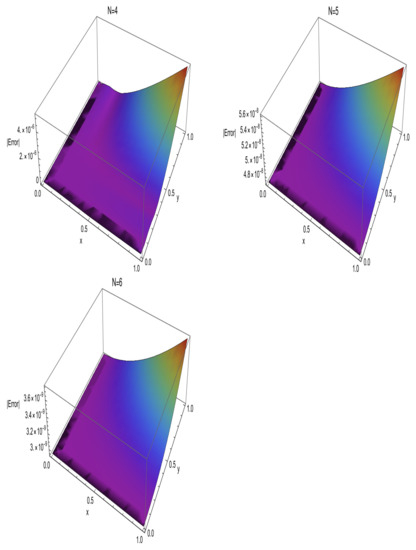
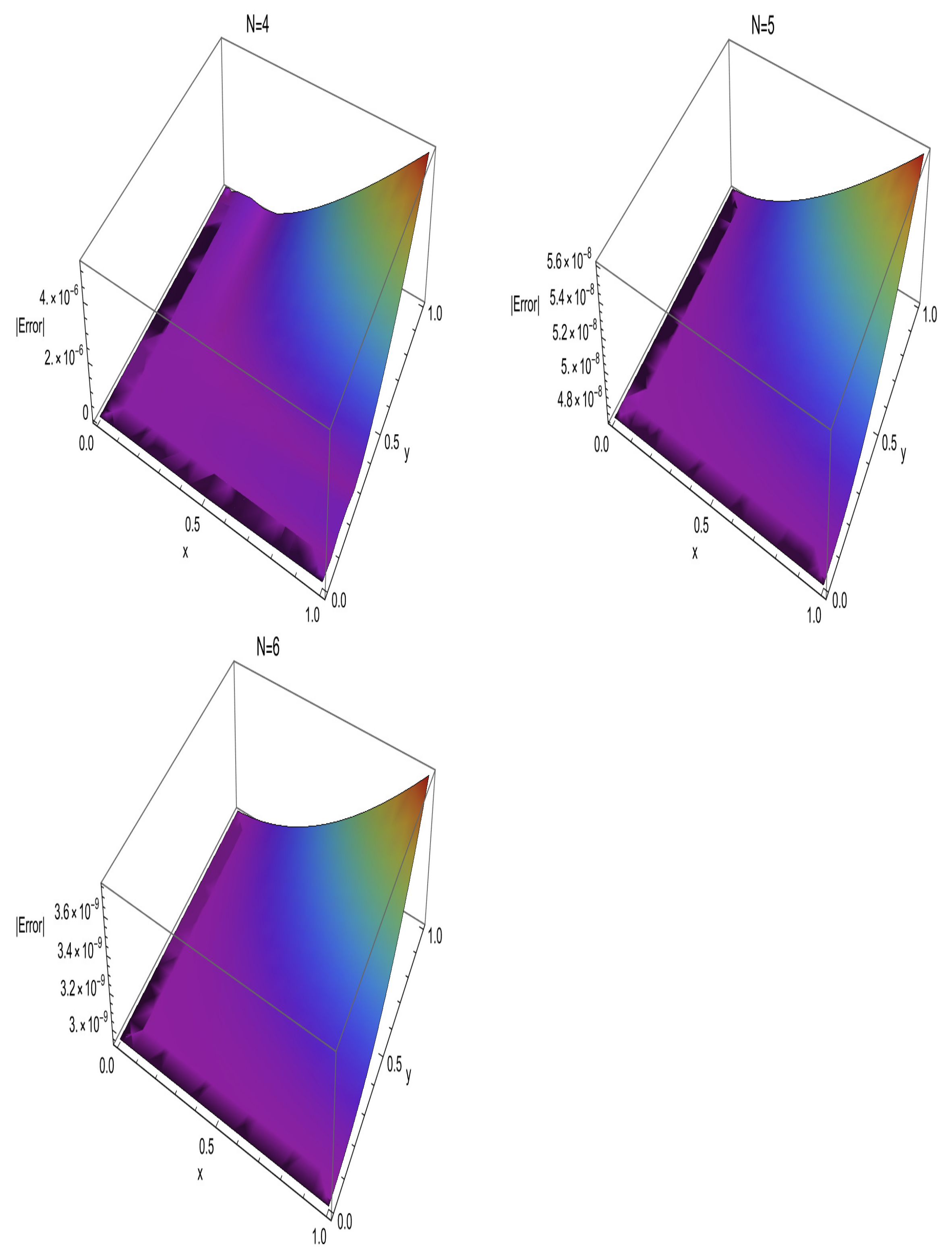
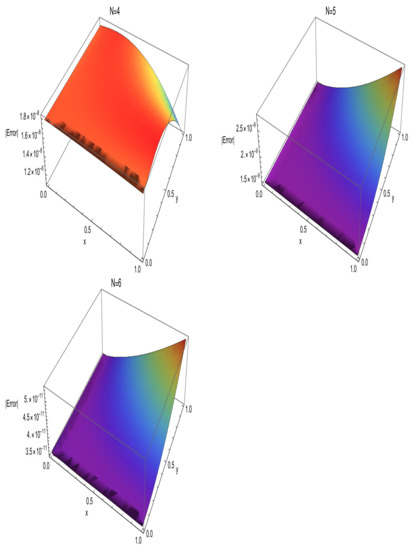
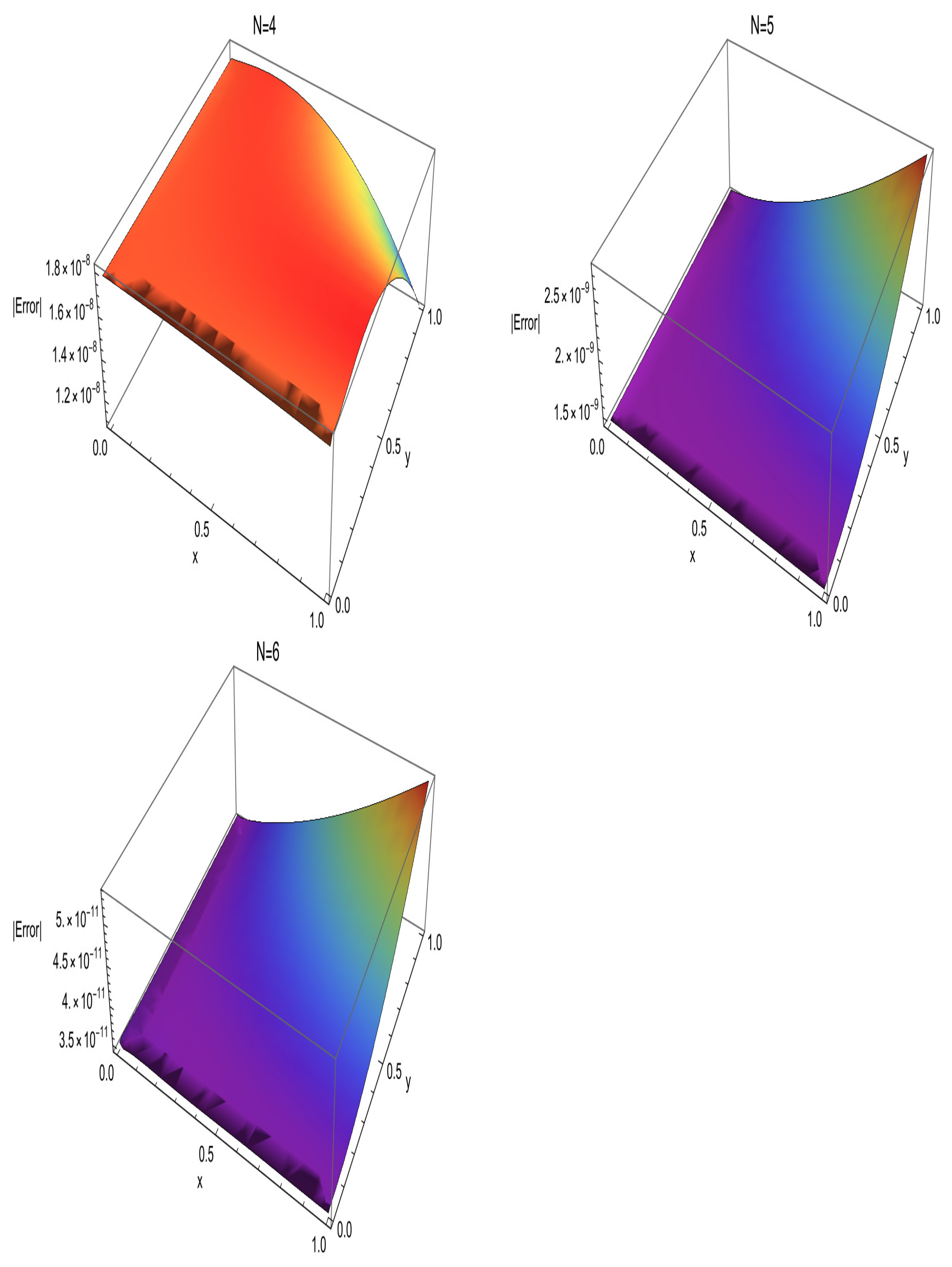
The analytical solution of (59) is . In Figure 1 and Figure 2, the absolute errors are displayed for various choices of , and N in . The weighted function is .
Figure 1.
The absolute errors with .
Figure 2.
The absolute errors with .
7. Concluding Remarks
We have adopted a regularized spectral scheme to solve nonlinear high-dimensional weakly singular integral equations with proportional delay and nonsmooth solutions. The transformed spectral method has been constructed based on multivariate Jacobi polynomials and some smoothing transformations, hence inheriting the advantages of the spectral collocation methods even for nonsmooth solutions. Furthermore, we studied the convergence, the existence, and the uniqueness of the approximate solutions. This scheme has various advantages, which are listed below:
- The numerical results shown in the figures demonstrate that the provided technique is accurate and efficient, producing acceptable results for nonsmooth solutions.
- With a modest number of points and base functions considered in the examples, our technique produced satisfactory results. With a minimal number of computations, this approach yields an accurate numerical result.
An extension of the work to different types of singular initial and boundary-value problems of integer or fractional orders [56,57,58,59] is of high concern in works in the near future.
Author Contributions
Conceptualization, A.Z.A. and M.A.Z.; methodology, M.A.Z., A.S.H. and I.H.; software, M.A.Z.; validation, I.H. and M.A.Z.; formal analysis, M.A.Z. and A.Z.A.; writing—original draft preparation, A.Z.A., M.A.Z., A.S.H., I.H. and A.A.; writing review and editing, A.Z.A., M.A.Z., A.S.H., I.H. and A.A. All authors have read and agreed to the published version of the manuscript.
Funding
M. A. Zaky and A. Aldraiweesh extend their appreciation to Distinguished Scientist Fellowship Program (DSFP) at King Saud University (Saudi Arabia).
Institutional Review Board Statement
Not applicable.
Informed Consent Statement
Not applicable.
Data Availability Statement
Not applicable.
Conflicts of Interest
The authors declare no potential conflicst of interest with respect to the research, authorship, and/or publication of this article.
References
- Brunner, H. Collocation Methods for Volterra Integral and Related Functional Differential Equations; Cambridge University Press: Cambridge, UK, 2004; Volume 15. [Google Scholar]
- Abbaszadeh, M.; Dehghan, M. A finite-difference procedure to solve weakly singular integro partial differential equation with space-time fractional derivatives. Eng. Comput. 2021, 37, 2173–2182. [Google Scholar] [CrossRef] [Scilit]
- Hosseinzadeh, H.; Dehghan, M.; Sedaghatjoo, Z. The stability study of numerical solution of Fredholm integral equations of the first kind with emphasis on its application in boundary elements method. Appl. Numer. Math. 2020, 158, 134–151. [Google Scholar] [CrossRef] [Scilit]
- Assari, P.; Dehghan, M. A Meshless Discrete Galerkin Method Based on the Free Shape Parameter Radial Basis Functions for Solving Hammerstein Integral Equations. Numer. Math. Theory Methods Appl. 2018, 11, 540–568. [Google Scholar]
- Brunner, H.; Hu, Q. Optimal superconvergence orders of iterated collocation solutions for Volterra integral equations with vanishing delays. SIAM J. Numer. Anal. 2005, 43, 1934–1949. [Google Scholar] [CrossRef] [Scilit]
- Li, D.; Zhang, C. Long time numerical behaviors of fractional pantograph equations. Math. Comput. Simul. 2020, 172, 244–257. [Google Scholar] [CrossRef] [Scilit]
- Ladopoulos, E.G. Singular Integral Equations: Linear and Non-Linear Theory and Its Applications in Science and Engineering; Springer: Berlin/Heidelberg, Germany, 2000. [Google Scholar]
- Volterra, V. Leçons sur les Équations Intégrales et les Équations Intégro-Différentielles; Gauthier-Villars: Paris, France, 1913; Volume 15. [Google Scholar]
- Fox, L.; Mayers, D.F.; Ockendon, J.R.; Tayler, A.B. On a functional differential equation. IMA J. Appl. Math. 1971, 8, 271–307. [Google Scholar] [CrossRef] [Scilit]
- Chen, Y.; Tang, T. Convergence analysis of the Jacobi spectral-collocation methods for Volterra integral equations with a weakly singular kernel. Math. Comput. 2010, 79, 147–167. [Google Scholar] [CrossRef] [Scilit]
- Allaei, S.S.; Diogo, T.; Rebelo, M. The jacobi collocation method for a class of nonlinear Volterra integral equations with weakly singular kernel. J. Sci. Comput. 2016, 69, 673–695. [Google Scholar] [CrossRef] [Scilit]
- Kolk, M.; Pedas, A. Numerical solution of Volterra integral equations with weakly singular kernels which may have a boundary singularity. Math. Model. Anal. 2009, 14, 79–89. [Google Scholar] [CrossRef] [Scilit]
- De Bonis, M.; Laurita, C.; Sagaria, V. A numerical method for linear Volterra integral equations on infinite intervals and its application to the resolution of metastatic tumor growth models. Appl. Numer. Math. 2022, 172, 475–496. [Google Scholar] [CrossRef] [Scilit]
- Assari, P.; Dehghan, M. The numerical solution of two-dimensional logarithmic integral equations on normal domains using radial basis functions with polynomial precision. Eng. Comput. 2017, 33, 853–870. [Google Scholar] [CrossRef] [Scilit]
- Assari, P.; Dehghan, M. The approximate solution of nonlinear Volterra integral equations of the second kind using radial basis functions. Appl. Numer. Math. 2018, 131, 140–157. [Google Scholar] [CrossRef] [Scilit]
- Chen, C.; Thomée, V.; Wahlbin, L.B. Finite element approximation of a parabolic integro-differential equation with a weakly singular kernel. Math. Comput. 1992, 58, 587–602. [Google Scholar] [CrossRef]
- Fermo, L.; Occorsio, D. Weakly singular linear Volterra integral equations: A Nystrom method in weighted spaces of continuous functions. J. Comput. Appl. Math. 2021, 406, 114001. [Google Scholar] [CrossRef] [Scilit]
- Abo-Gabal, H.; Zaky, M.A.; Doha, E.H. Fractional Romanovski–Jacobi tau method for time-fractional partial differential equations with nonsmooth solutions. Appl. Numer. Math. 2022, 182, 214–234. [Google Scholar] [CrossRef] [Scilit]
- Vermiglio, R. On the stability of Runge-Kutta methods for delay integral equations. Numer. Math. 1992, 61, 561–577. [Google Scholar] [CrossRef] [Scilit]
- Ezz-Eldien, S.; Wang, Y.; Abdelkawy, M.; Zaky, M.; Aldraiweesh, A.; Machado, J.T. Chebyshev spectral methods for multi-order fractional neutral pantograph equations. Nonlinear Dyn. 2020, 100, 3785–3797. [Google Scholar] [CrossRef] [Scilit]
- Diogo, T.; Lima, P. Superconvergence of collocation methods for a class of weakly singular Volterra integral equations. J. Comput. Appl. Math. 2008, 218, 307–316. [Google Scholar] [CrossRef] [Scilit]
- Yao, G.; Tao, D.; Zhang, C. A hybrid spectral method for the nonlinear Volterra integral equations with weakly singular kernel and vanishing delays. Appl. Math. Comput. 2022, 417, 126780. [Google Scholar] [CrossRef] [Scilit]
- Zhou, Y.; Stynes, M. Block boundary value methods for solving linear neutral Volterra integro-differential equations with weakly singular kernels. J. Comput. Appl. Math. 2022, 401, 113747. [Google Scholar] [CrossRef] [Scilit]
- Liu, H.; Huang, J.; He, X. Bivariate barycentric rational interpolation method for two dimensional fractional Volterra integral equations. J. Comput. Appl. Math. 2021, 389, 113339. [Google Scholar] [CrossRef] [Scilit]
- Rufai, M.A.; Ramos, H. Numerical solution for singular boundary value problems using a pair of hybrid Nyström techniques. Axioms 2021, 10, 202. [Google Scholar] [CrossRef] [Scilit]
- Ramos, H.; Rufai, M.A. An adaptive pair of one-step hybrid block Nyström methods for singular initial-value problems of Lane–Emden–Fowler type. Math. Comput. Simul. 2022, 193, 497–508. [Google Scholar] [CrossRef] [Scilit]
- Nikan, O.; Avazzadeh, Z.; Machado, J.T. Numerical study of the nonlinear anomalous reaction–subdiffusion process arising in the electroanalytical chemistry. J. Comput. Sci. 2021, 53, 101394. [Google Scholar] [CrossRef] [Scilit]
- Nikan, O.; Avazzadeh, Z. Numerical simulation of fractional evolution model arising in viscoelastic mechanics. Appl. Numer. Math. 2021, 169, 303–320. [Google Scholar] [CrossRef] [Scilit]
- Brunner, H.; Hu, Q.; Lin, Q. Geometric meshes in collocation methods for Volterra integral equations with proportional delays. IMA J. Numer. Anal. 2001, 21, 783–798. [Google Scholar] [CrossRef] [Scilit]
- Xie, H.; Zhang, R.; Brunner, H. Collocation methods for general Volterra functional integral equations with vanishing delays. SIAM J. Sci. Comput. 2011, 33, 3303–3332. [Google Scholar] [CrossRef] [Scilit]
- Zhong-Qing, W.; Chang-Tao, S. An hp-spectral collocation method for nonlinear Volterra integral equations with vanishing variable delays. Math. Comput. 2016, 85, 635–666. [Google Scholar] [CrossRef] [Scilit]
- Dehghan, M.; Shafieeabyaneh, N.; Abbaszadeh, M. Numerical and theoretical discussions for solving nonlinear generalized Benjamin–Bona–Mahony–Burgers equation based on the Legendre spectral element method. Numer. Methods Partial Differ. Equ. 2021, 37, 360–382. [Google Scholar] [CrossRef] [Scilit]
- Dehghan, M.; Abbaszadeh, M. A Legendre spectral element method (SEM) based on the modified bases for solving neutral delay distributed-order fractional damped diffusion-wave equation. Math. Methods Appl. Sci. 2018, 41, 3476–3494. [Google Scholar] [CrossRef] [Scilit]
- Elkot, N.A.; Zaky, M.A.; Doha, E.H.; Ameen, I.G. On the rate of convergence of the Legendre spectral collocation method for multi-dimensional nonlinear Volterra–Fredholm integral equations. Commun. Theor. Phys. 2021, 73, 025002. [Google Scholar] [CrossRef] [Scilit]
- Zaky, M.A.; Ameen, I.G.; Elkot, N.A.; Doha, E.H. A unified spectral collocation method for nonlinear systems of multi-dimensional integral equations with convergence analysis. Appl. Numer. Math. 2021, 161, 27–45. [Google Scholar] [CrossRef] [Scilit]
- Ameen, I.G.; Elkot, N.A.; Zaky, M.A.; Hendy, A.S.; Doha, E.H. A pseudo-spectral scheme for systems of two-point boundary value problems with left and right sided fractional derivatives and related integral equations. CMES-Comput. Model. Eng. Sci. 2021, 128, 21–41. [Google Scholar]
- Zaky, M.A. An accurate spectral collocation method for nonlinear systems of fractional differential equations and related integral equations with nonsmooth solutions. Appl. Numer. Math. 2020, 154, 205–222. [Google Scholar] [CrossRef] [Scilit]
- Zaky, M.A.; Ameen, I.G. A priori error estimates of a Jacobi spectral method for nonlinear systems of fractional boundary value problems and related Volterra-Fredholm integral equations with smooth solutions. Numer. Algorithms 2020, 84, 63–89. [Google Scholar] [CrossRef] [Scilit]
- Zhang, C.; Liu, Z.; Chen, S.; Tao, D. New spectral element method for Volterra integral equations with weakly singular kernel. J. Comput. Appl. Math. 2022, 404, 113902. [Google Scholar] [CrossRef] [Scilit]
- Li, X.; Tang, T.; Xu, C. Numerical solutions for weakly singular Volterra integral equations using Chebyshev and Legendre pseudo-spectral Galerkin methods. J. Sci. Comput. 2016, 67, 43–64. [Google Scholar] [CrossRef] [Scilit]
- Wang, L.; Tian, H.; Yi, L. An hp-version of the discontinuous Galerkin time-stepping method for Volterra integral equations with weakly singular kernels. Appl. Numer. Math. 2021, 161, 218–232. [Google Scholar] [CrossRef] [Scilit]
- Mokhtary, P.; Moghaddam, B.P.; Lopes, A.M.; Machado, J.T. A computational approach for the non-smooth solution of non-linear weakly singular Volterra integral equation with proportional delay. Numer. Algorithms 2020, 83, 987–1006. [Google Scholar] [CrossRef] [Scilit]
- Brunner, H. Nonpolynomial spline collocation for Volterra equations with weakly singular kernels. SIAM J. Numer. Anal. 1983, 20, 1106–1119. [Google Scholar] [CrossRef] [Scilit]
- Bhrawy, A.H.; Zaky, M.A. Shifted fractional-order Jacobi orthogonal functions: Application to a system of fractional differential equations. Appl. Math. Model. 2016, 40, 832–845. [Google Scholar] [CrossRef] [Scilit]
- Cai, H.; Chen, Y. A fractional order collocation method for second kind Volterra integral equations with weakly singular kernels. J. Sci. Comput. 2018, 75, 970–992. [Google Scholar] [CrossRef] [Scilit]
- Cai, H. A fractional spectral collocation for solving second kind nonlinear Volterra integral equations with weakly singular kernels. J. Sci. Comput. 2019, 80, 1529–1548. [Google Scholar] [CrossRef] [Scilit]
- Zaky, M.A.; Doha, E.H.; Machado, J.A.T. A spectral framework for fractional variational problems based on fractional Jacobi functions. Appl. Numer. Math. 2018, 132, 51–72. [Google Scholar] [CrossRef] [Scilit]
- Shen, J.; Wang, Y. Muntz–Galerkin methods and applications to mixed dirichlet–Neumann boundary value problems. SIAM J. Sci. Comput. 2016, 38, A2357–A2381. [Google Scholar] [CrossRef] [Scilit]
- Hou, D.; Hasan, M.T.; Xu, C. Müntz spectral methods for the time-fractional diffusion equation. Comput. Methods Appl. Math. 2018, 18, 43–62. [Google Scholar] [CrossRef] [Scilit]
- Khosravian-Arab, H.; Dehghan, M.; Eslahchi, M. Fractional spectral and pseudo-spectral methods in unbounded domains: Theory and applications. J. Comput. Phys. 2017, 338, 527–566. [Google Scholar] [CrossRef] [Scilit]
- Khosravian-Arab, H.; Dehghan, M.; Eslahchi, M. Fractional Sturm–Liouville boundary value problems in unbounded domains: Theory and applications. J. Comput. Phys. 2015, 299, 526–560. [Google Scholar] [CrossRef] [Scilit]
- Ameen, I.G.; Zaky, M.A.; Doha, E.H. Singularity preserving spectral collocation method for nonlinear systems of fractional differential equations with the right-sided Caputo fractional derivative. J. Comput. Appl. Math. 2021, 392, 113468. [Google Scholar] [CrossRef] [Scilit]
- Zaky, M.A. Existence, uniqueness and numerical analysis of solutions of tempered fractional boundary value problems. Appl. Numer. Math. 2019, 145, 429–457. [Google Scholar] [CrossRef] [Scilit]
- Shen, J.; Wang, L.L. Sparse spectral approximations of high-dimensional problems based on hyperbolic cross. SIAM J. Numer. Anal. 2010, 48, 1087–1109. [Google Scholar] [CrossRef] [Scilit]
- Shen, J.; Tang, T.; Wang, L.L. Spectral Methods: Algorithms, Analysis and Applications; Springer Science & Business Media: Berlin, Germany, 2011; Volume 41. [Google Scholar]
- Rufai, M.A.; Ramos, H. Numerical integration of third-order singular boundary-value problems of Emden–Fowler type using hybrid block techniques. Commun. Nonlinear Sci. Numer. Simul. 2022, 105, 106069. [Google Scholar] [CrossRef] [Scilit]
- Rufai, M.A.; Ramos, H. Numerical solution of second-order singular problems arising in astrophysics by combining a pair of one-step hybrid block Nyström methods. Astrophys. Space Sci. 2020, 365, 1–13. [Google Scholar] [CrossRef] [Scilit]
- Van Bockstal, K.; Zaky, M.A.; Hendy, A.S. On the existence and uniqueness of solutions to a nonlinear variable order time-fractional reaction–diffusion equation with delay. Commun. Nonlinear Sci. Numer. Simul. 2022, 115, 106755. [Google Scholar] [CrossRef] [Scilit]
- Zaky, M.A.; Hendy, A.S.; Suragan, D. Logarithmic Jacobi collocation method for Caputo–Hadamard fractional differential equations. Appl. Numer. Math. 2022, 181, 326–346. [Google Scholar] [CrossRef] [Scilit]
Publisher’s Note: MDPI stays neutral with regard to jurisdictional claims in published maps and institutional affiliations. |
© 2022 by the authors. Licensee MDPI, Basel, Switzerland. This article is an open access article distributed under the terms and conditions of the Creative Commons Attribution (CC BY) license (https://creativecommons.org/licenses/by/4.0/).