


Abstract
This article introduces a new projection method via shifted Legendre polynomials and an efficient procedure for solving a system of integro-differential equations of the Cauchy type. The proposed computational process solves two systems of linear equations. We demonstrate the existence of the solution to the approximate problem and conduct an error analysis. Numerical tests provide theoretical results.
Keywords:
Cauchy type; projection approach; integro-differential system; shifted Legendre polynomials MSC:
45E05; 45F15; 45F05; 47G20
1. Introduction
Numerous scientific domains, including hydrodynamics, biology, electromagnetism, and elasticity rely heavily on operator equations theory. Integro-differential and integral equations of Cauchy type are a subset of these equations.
Much research has recently been conducted on using ordinary differential, integro-differential, and integral equations in mathematical physics (see [1,2,3,4,5,6,7,8,9]). An essential class of these problems is singular integro-differential equations with boundary conditions (cf. [10,11,12,13,14,15,16]).
The authors of [17] investigated a category of integro-differential equations with variable-order. They suggested a new approach based on fifth-order shifted Chebyshev polynomials. In [18], the superconvergence error estimate for integro-differential equations of semilinear parabolic type without time-step constraints is generated by spatial discretization with a bilinear element and temporal discretization with a modeled backward Euler formula.
Projection approximation methods are fundamental to approximation theory and have a variety of uses, including the solution of integro-differential and integral equations. The authors of [19] focused on several finite rank approximations with bounded, limited rank projections. For solving second-kind singular Fredholm integral equations with weak singularities, the authors employed a projection approximation in [20]. A projection approximation for solving integro-differential problems of Cauchy type using first-order airfoil polynomials is investigated in [21].
Recently, the authors of [22] demonstrated how to solve fuzzy integro-differential equations with weak singularities via airfoil polynomials. In [23], Mennouni introduced a novel projection approach based on Legendre polynomials for examining integro-differential equations with a Cauchy type on .
Several results for solving compact operator equations using the Galerkin and Kulkarni methods have been established over the last two decades. These two methods are used in [24] to approach the solution of the following bounded equation:
The author considered an approximate equation of the form:
To begin, the author regarded the approximate operator as a Galerkin one:
for some sequence of bounded projections .
Secondly, he employed Kulkarni’s approximation as follows:
This work presents a new projection method for solving the following system of Cauchy integro-differential equations on
We will turn the problem into a system of two separate equations that looks like this:
Unlike previously, we use the shifted Legendre polynomial and introduce an approximation system of the form:
The results from the introduced computational technique were used to solve two systems of linear equations. We show that the approximation equation has a solution, and we conduct an error analysis. Numerical examples illustrate the theories.
Other sections of this study are described as follows: The system of logarithmic integro-differential equations is covered in the next section. Section 3 discusses some key aspects of shifted Legendre polynomials and the development of the method. Section 6 improves the convergence of the approximate solution and estimates the error analysis. Section 5 explores some numerical tests.
2. Cauchy-Type Systems of Singular Integro-Differential Equations
Let be the space of complex-valued Lebesgue square integrable functions on . The goal of this paper is to introduce a new projection method that uses shifted Legendre polynomials to solve Cauchy-type systems of singular integro-differential equations in .
Consider the following Cauchy-type system of singular integro-differential equations:
Both integrals denote the main value of Cauchy:
We follow [25] in letting
Lemma 1.
Problem (1) can be expressed in the form:
Proof.
We note that
System (2) can be rewritten in operator form as follows:
where is the Cauchy integral operator
and is the differential operator
with domain
Following [23], the operator is bounded from into itself.
It is well known that the operator is invertible, and its inverse is the following Voletrra integral operator
Moreover, is compact.
3. Shifted Legendre Polynomials and Development of the Method
The well-known Legendre polynomials represented on are described by the following recurrence
The first Legendre polynomials are given below.
Let the shifted Legendre polynomials be denoted by , . We recall that
Let
denote the corresponding normalized sequence. Let be the chain of bounded finite rank orthogonal projections described by
Denote by the corresponding norm on . Thus,
Let represent the space covered by the first n-shifted Legendre polynomials. It is obvious that . The approximate solution solves the following system:
We note that . Thus, the system
is approximated by
We assume that and 1 are not eigenvalues of . Thus, both operators and are invertible.
We recall that is compact, and
This implies that
Writing
We obtain the unknowns and by solving the two separate linear systems
As a result, two separate linear systems are produced:
where, for and ,
4. Convergence Analysis
We will now show how the current method converges. To that end, consider to be the classical Sobolev space for some , and to be its norm.
Remark that
Also,
We recall that there exists such that
Because is compact, according to [23], the operators and exist for n large enough and are uniformly bounded with respect to n.
Theorem 1.
Assume thatfor some. Then, there existsuch that
and
Proof.
In fact,
As in [23], we have
Further,
However,
and
Since , we get and .
Moreover, we have
Hence,
and
Thus,
and
The desired result follows. □
5. Numerical Example
We establish some numerical tests in this section to highlight the theoretical results described above. In these numerical tests, the Maple programming language was used.
Through this example, we consider the integro-differential system (1), which has the exact solution as follows:
In this instance, we obtain
The way of connecting errors for this example is shown in Table 1.

Table 1.
Example 1.
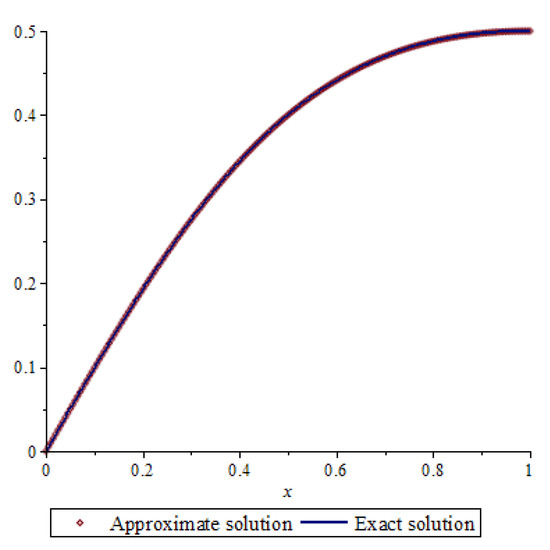
Figure 1.
The approach solution for .
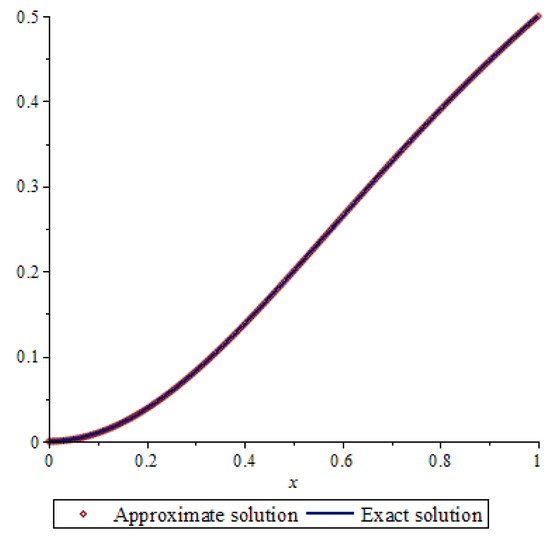
Figure 2.
The approach solution for .
Allow us to illustrate our method by providing some examples of approximate solutions. For instance, when , the approximate solutions are as follows:
The reported results show that the stated method is extremely accurate in analyzing this example, as seen in Figure 3 and Figure 4. Observe that the first 18 terms were examined for the performance of the described procedure.
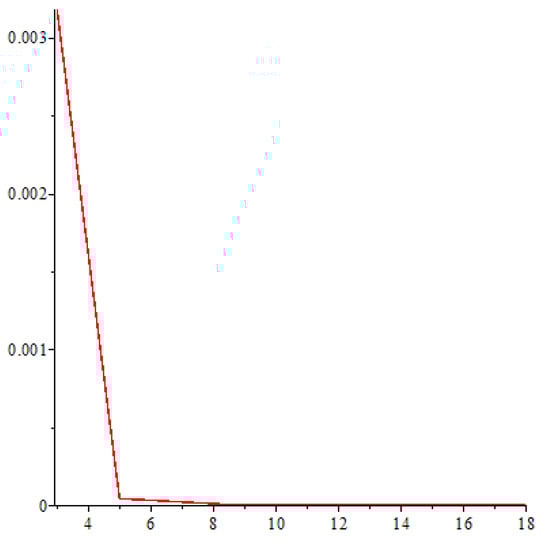
Figure 3.
Presentation of with .
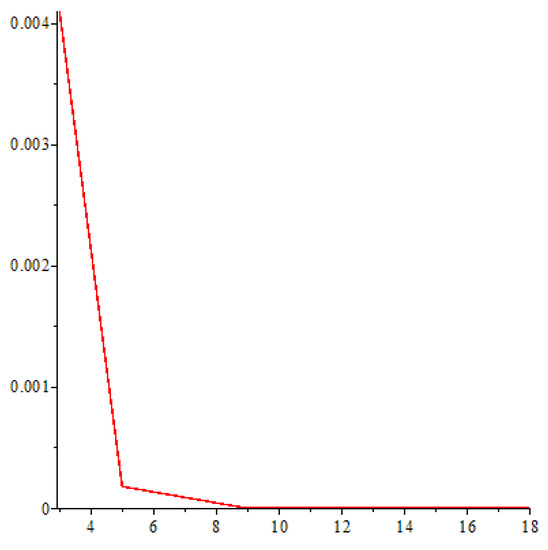
Figure 4.
Presentation of with .
6. Conclusions
Many works have been published on the numerical solution of integro-differential equations using various approximation procedures. The application of projection methods to the Cauchy singular integro-differential system is extended in this paper. A series of orthogonal finite-rank Legendre polynomial projections build the modified projection method. In the Sobolev space, we demonstrated the convergence of the approach solution to the exact one. Numerical experiments demonstrate the utility of our method. Other classes of integro-differential and integral systems can be studied and solved using this method.
Author Contributions
Conceptualization, S.A. and A.M.; Methodology, S.A. and A.M.; Investigation, S.A. and A.M.; Resources, S.A. and A.M.; Data curation, S.A. and A.M.; Writing—original draft preparation, S.A. and A.M.; Writing—review and editing, S.A. and A.M.; Supervision, S.A. and A.M.; Funding acquisition, S.A. All authors have read and agreed to the published version of the manuscript.
Funding
The research of the first author was funded by Taif University Researchers Supporting project number (TURSP-2020/320), Taif University, Taif, Saudi Arabia.
Institutional Review Board Statement
Not applicable.
Informed Consent Statement
Not applicable.
Data Availability Statement
Not applicable.
Acknowledgments
The authors would like to thank the reviewers and the editor for their insightful comments and suggestions, which significantly improved the original manuscript.
Conflicts of Interest
The authors declare no conflict of interest.
References
- Atkinson, K. The Numerical Solution of Integral Equations of the Second Kind; Cambridge University Press: Cambridge, UK, 1997. [Google Scholar]
- Atkinson, K.E.; Han, W. Theoretical Numerical Analysis: A Functional Analysis Framework, 3rd ed.; Springer: New York, NY, USA, 2009. [Google Scholar]
- Grzymkowski, R.; Pleszczyński, M. Application of the Taylor Transformation to the Systems of Ordinary Differential Equations. In Information and Software Technologies; Damaševičius, R., Vasiljevienė, G., Eds.; ICIST 2018. Communications in Computer and Information Science; Springer: Cham, Switzerland, 2018; Volume 920. [Google Scholar] [CrossRef]
- Hetmaniok, E.; Pleszczyński, M. Comparison of the Selected Methods Used for Solving the Ordinary Differential Equations and Their Systems. Mathematics 2022, 10, 306. [Google Scholar] [CrossRef]
- Hetmaniok, E.; Pleszczyński, M.; Khan, Y. Solving the Integral Differential Equations with Delayed Argument by Using the DTM Method. Sensors 2022, 22, 4124. [Google Scholar] [CrossRef] [PubMed]
- Kukushkin, M.V. Riemann-Liouville operator in weighted Lp spaces via the Jacobi series expansion. Axioms 2019, 8, 75. [Google Scholar] [CrossRef]
- Kukushkin, M.V. On Smoothness of the Solution to the Abel Equation in Terms of the Jacobi Series Coefficients. Axioms 2020, 9, 81. [Google Scholar] [CrossRef]
- Kukushkin, M.V. On Solvability of the Sonin-Abel Equation in the Weighted Lebesgue Space. Fractal Fract. 2021, 5, 77. [Google Scholar] [CrossRef]
- Muskhelishvili, N.I. Singular Integral Equations: Boundary Problems of Function Theory and Their Application to Mathematical Physics; Dover Books on Mathematics; Dover Publications: Mineola, NY, USA, 1953. [Google Scholar]
- Parts, I.; Pedas, A.; Tamme, E. Piecewise polynomial collocation for Fredholm integro-differential equations with weakly singular kernels. SIAM J. Numer. Anal. 2005, 43, 1897–1911. [Google Scholar] [CrossRef]
- Pedas, A.; Tamme, E. Spline collocation method for integro-differential equations with weakly singular kernels. J. Comput. Appl. Math. 2006, 197, 253–269. [Google Scholar] [CrossRef][Green Version]
- Pedas, A.; Tamme, E. Discrete Galerkin method for Fredholm integro-differential equations with weakly singular kernels. J. Comput. Appl. Math. 2008, 213, 111–126. [Google Scholar] [CrossRef][Green Version]
- Pedas, A.; Tamme, E. Product integration for weakly singular integro-differential equations. Math. Model. Anal. 2011, 16, 153–172. [Google Scholar] [CrossRef]
- Dauylbayev, M.K.; Uaissov, A.B. Asymptotic behavior of the solutions of boundary-value problems for singularly perturbed integro-differential Equations. Ukr. Math. J. 2020, 71, 1677–1691. [Google Scholar] [CrossRef]
- Dauylbayev, M.K.; Uaissov, A.B. Integral boundary-value problem with initial jumps for a singularly perturbed system of integro-differential equations. Chaos Solitons 2020, 141, 110328. [Google Scholar] [CrossRef]
- Assanova, A.T.; Nurmukanbet, S.N. A solvability of a problem for a Fredholm integro-differential equation with weakly singular kernel. Lobachevskii J. Math. 2022, 43, 182–191. [Google Scholar] [CrossRef]
- Jafari, H.; Nemati, S.; Ganji, R.M. Operational matrices based on the shifted fifth-kind Chebyshev polynomials for solving nonlinear variable order integro-differential equations. Adv. Differ. Equ. 2021, 2021, 435. [Google Scholar] [CrossRef] [PubMed]
- Yang, H. Huaijun Yang Superconvergence analysis of Galerkin method for semilinear parabolic integro-differential equation. Appl. Math. Lett. 2022, 128, 107872. [Google Scholar] [CrossRef]
- Ahues, M.; Largillier, A.; Limaye, B.V. Spectral Computations for Bounded Operators; CRC: Boca Raton, FL, USA, 2001. [Google Scholar]
- Ahues, M.; Amosove, A.; Largillier, A.; Titaud, O. Lp Error Estimates for Projection Approximations. Appl. Math. Lett. 2005, 18, 381–386. [Google Scholar] [CrossRef]
- Mennouni, A. Airfoil polynomials for solving integro-differential equations with logarithmic kernel. Appl. Math. Comput. 2012, 218, 11947–11951. [Google Scholar]
- Araour, M.; Mennouni, A. A New Procedures for Solving Two Classes of Fuzzy Singular Integro-Differential Equations: Airfoil Collocation Methods. Int. J. Appl. Comput. Math. 2022, 8, 1–23. [Google Scholar] [CrossRef]
- Mennouni, A. A projection method for solving Cauchy singular integro-differential equations. Appl. Math. Lett. 2012, 25, 986–989. [Google Scholar] [CrossRef]
- Mennouni, A. Two projection methods for skew-hermitian operator equations. Math. Comput. Model. 2012, 55, 1649–1654. [Google Scholar] [CrossRef]
- Mennouni, A. A new efficient strategy for solving the system of Cauchy integral equations via two projection methods. Transylv. J. Math. Mech. 2022, 14, 63–71. [Google Scholar]
Publisher’s Note: MDPI stays neutral with regard to jurisdictional claims in published maps and institutional affiliations. |
© 2022 by the authors. Licensee MDPI, Basel, Switzerland. This article is an open access article distributed under the terms and conditions of the Creative Commons Attribution (CC BY) license (https://creativecommons.org/licenses/by/4.0/).