


Abstract
In the theory of wavelet frames, the known Daubechies wavelet bases have been generalized to compactly supported (Daubechies-like) wavelet frames, while the known bandlimited Meyer wavelet bases have not been generalized to date. In this study, we will generalize known Meyer wavelet basis into non-separable Meyer-like wavelet frames. By using a characteristic function to mask the Fourier transform of the one-dimensional Meyer scaling function with a width parameter, we can produce a family of Meyer-like frame scaling functions and associated Meyer-like wavelet frames. After that, by inserting a real-valued function into the width parameter of a one-dimensional Meyer-like frame scaling function, we propose a novel approach to construct non-separable Meyer-like frame scaling functions with unique circular symmetry. Finally, we construct the corresponding non-separable Meyer-like wavelet frames.
MSC:
42C
1. Introduction
Wavelet analysis has become a common tool for data compression, feature extraction and denoising [1,2]. An orthonormal basis for , which is generated by dyadic dilations and integer translates of one or several functions, is called a wavelet basis for [3,4]. The decomposition of data by using wavelet bases can reveal the increment in information from a coarser approximation to a higher resolution approximation. Inspired by it, Mallat [1] proposed the concept of multiresolution analysis.
Let be a sequence of subspaces of such that
- (i)
- ;
- (ii)
- if and only if ;
- (iii)
- there exists a such that is an orthonormal basis for .
Then is called a multiresolution analysis (MRA), and is called a scaling function.
The Meyer wavelet is among the first wavelets in the history of wavelet theory [3]. Its construction is based on the Meyer scaling function whose Fourier transform is
where
The corresponding Meyer wavelet is defined by its Fourier transform:
The dyadic dilations and integer translates of the Meyer wavelet can form a wavelet basis for . In the high dimension, the tensor product of the Meyer scaling function and Meyer wavelet can generate a separable Meyer wavelet basis for [5].
Frames are an overcomplete version of bases [5,6]. Let be a sequence in . If there exists such that
where and are the inner product and the norm, respectively, then is called a frame for with bounds A and B [1,6].
Wavelet frames are a generalization of both wavelet bases and frames [6]. Let be such that their dyadic dilations and integer translates
consists of a frame for . Then such a frame is called a wavelet frame, and the family is called a wavelet frame generator [6,7,8]. Compared with wavelet bases, wavelet frames can provide redundant representations of data, leading to better performances in time-frequency analysis, feature extraction, data compression and compressed sensing [7].
Until now, the known Daubechies wavelet bases have been generalized to compactly supported (Daubechies-like) wavelet frames [9,10,11], while the known bandlimited Meyer wavelet bases have not been generalized to date. In this study, we will generalize known Meyer wavelet bases into non-separable Meyer-like wavelet frames.
2. Construction of Wavelet Frames
In order to construct wavelet frames, the classic MRA is extended to the frame MRA [8,12] when the condition (iii) in MRA is replaced by
where is the characteristic function on Q. In this case, is called a frame MRA for , is called a frame scaling function, and Q is called the spectrum of frame scaling function. When , the frame scaling function in frame MRA is just a scaling function in MRA [8,12].
By the bi-scale equation of frame MRA, there exists a -periodic function such that
is called the filter of frame MRA [8,12]. Conversely, we have
Proposition 1
([6,13,14]). If a function φ satisfies
- (i)
- and is continuous at ;
- (ii)
- ;
- (iii)
- there exists a -periodic function such that ,then φ is a frame scaling function for .
The following unitary extension principle [9] can be used to construct wavelet frames from frame MRAs.
Proposition 2
([9]). For a given frame MRA with filter and spectrum Q. Let be -periodic bounded functions and define the matrix
where the set consists of the vertices of the cube . Let be such that
If , then is a wavelet frame generator for .
3. One-Dimensional Meyer-like Wavelet Frames
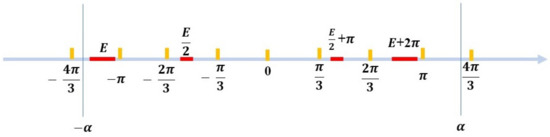
Figure 1.
The point set F.
Let be a function whose Fourier transform is
where
Then we have
Theorem 1.
For , is a frame scaling function in .
Proof.
For , By Equations (1) and (2), we have
When , we have and . Again by Equation (3), we obtain
For , we have . Again, by , we deduce
Again, by Equation (1), when , we have . Furthermore
For , we have and . Noticing that , we can deduce that
Since the length of the interval is and is -periodic, by Equations (4) and (5), we have
where is the characteristic function of and . Furthermore,
Define
and then we extend into a -periodic function on .
Now we will prove that
When , we have and , and so . From this, we know that when , Equation (9) holds.
When , we have , and so . Moreover, by Equation (7) and , it follows that . Therefore, when , Equation (9) holds.
When , we have . By Equation (3) and noticing that , , we obtain for . Therefore, when , Equation (9) holds.
By Equations (6) and (10), noticing that and is continuous at , using Proposition 1, we know that is a frame scaling function in . □
Below we begin to construct wavelet frame generators associated with the frame scaling function . By Equation (8), it follows that
Furthermore, we have
Therefore, the matrix
satisfies
Let
It is clear that M is a -periodic point set, i.e., . We divide M into two -periodic point sets as follows
By Equations (11), (13) and (14), we have
Define , and as
Now we compute :
For ,
It means that
and
where
When and , we have . Again by Equation (13), we deduce that
When and , we have and . From this and Equations (1) and (17), we obtain
When and , we have and . From this and Equations (1) and (17), we obtain
Summarizing the above results, we have
Similarly, by Equations (6) and (16), for , we have
For , we have
By Equations (12), (14) and (15), the matrix
satisfies
Again by Equation (16) and Proposition 2, we have
Theorem 2.
For , the system is a wavelet frame generator in , where , , and are stated in Equations (18)–(20).
Remark 1.
Since is just the known Meyer wavelet masked by some characteristic function, and and are just the Meyer scaling function masked by some characteristic function, the system is called a Meyer-like wavelet frame generator.
4. Non-Separable Meyer-like Frame Scaling Functions
Let be a real-valued function satisfying the conditions:
where b is a constant. In this section, we always take and . Based on as stated in (1), we define a bivariate function such that its Fourier transform satisfies
Define two curvilinear quadrangles G and as
and define .
Theorem 3.
(i) is a non-separable frame scaling function in
(ii) is circularly symmetric and .
Remark 2.
In Theorem 3, by inserting a real-valued function into the width parameter of the one-dimensional Meyer-like frame scaling function, we give a novel approach to construct non-separable Meyer-like frame scaling functions in the two-dimensional case. At present, only separable frame scaling functions are circularly symmetric, the Meyer-like frame scaling function in Theorem 3 is the first non-separable frame scaling function with circular symmetry.
Proof.
By Equation (22), it is clear that is non-separable and circularly symmetric (i.e., ). Since , it follows that .
Now, we will prove that
Since and is periodic, we only need to prove that .
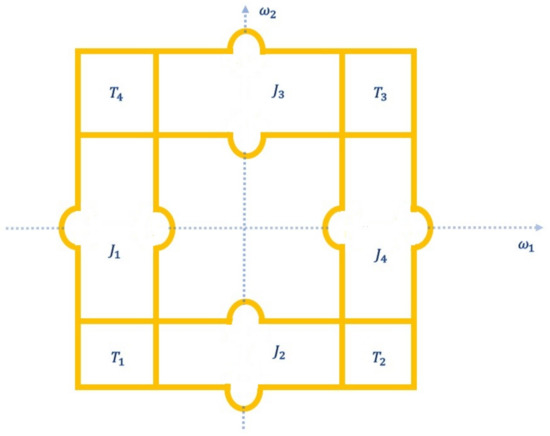
Since is a region bounded by four curves in the -plane:
we can divide into eight domains (Figure 2):
Figure 2.
Divide into eight domains: and .
For , we have
(a) Let . Then and , and so
Similarly, we have . By , we have . Again by Equation (7), we have
(b) Let .
For , when , we have . This implies that
Since , we have and , and then . Hence,
From , we know that . By (3.5), we know that
Similarly, we have .
(c) Let .
For , we have . Furthermore,
From , we have . Again by Equation (21), we have . Similarly, we have . Therefore,
By Equation (5), we have . Similarly, we have .
Combining (a)–(c) and Equation (24), we obtain . Since and is periodic, it follows that
Since , we have
Furthermore,
Let
Then
From this and Equation (26), noticing that and is continuous at , by Proposition 1, we that is a frame scaling function of . □
5. Non-Separable Meyer-like Wavelet Frames
In this section, we construct the wavelet frame corresponding to the frame scaling function . Define
By Equations (28) and (29), we have
Adding the above four formulas together, we have
Define . By Theorem 3(ii) and Equation (26), we have
where is the characteristic function of . Again by Equation (32), we have
It means that the inner product of first and second columns of the matrix are orthogonal. Similarly, all columns of are mutually orthogonal. Again by Equation (33), we have
where
Let
It is clear that K is a -periodic point set. We divide K into four -periodic point sets as follows
Define a matrix
where . Therefore, by Equations (34)–(36), we have
For , we define as
By Proposition 2, we have the following theorem:
Theorem 4.
The system is a non-separable wavelet frame generator for .
Finally, we give the representation of the frame generator in Theorem 4. By Equation (29), we have
Again, noticing that , we
Similarly, we have
Example 1.
Let be the cubic spline:
It is well-known that and . Let
By Equation (1), we define a bivariate function such that its Fourier transform satisfies
By Theorem 3, we know that φ is a non-separable frame scaling function. Again by Equation (37) and Theorem 4, it is clear that the system is a non-separable wavelet frame generator for .
6. Conclusions
In this study, we generalized the known Meyer wavelet basis into non-separable Meyer-like wavelet frames. By using a characteristic function to mask the Fourier transform of the one-dimensional Meyer scaling function with width parameter, we can produce a family of Meyer-like frame scaling functions. Compared with the Meyer scaling function, the Meyer-like frame scaling function’s spectrum is not . After that, we construct the corresponding Meyer-like wavelet frame generator, which consists of three functions: The Fourier transform of the first function is just that of the known Meyer wavelet masked by some characteristic function; the Fourier transform of the second and third functions are just that of the Meyer scaling function masked by some characteristic function.
Separable Meyer-like wavelet frames can be constructed directly through the tensor product of one-dimensional Meyer-like wavelet frames. For the non-separable case, by inserting a real-valued function into the width parameter of the one-dimensional Meyer-like frame scaling function, we propose a novel approach to construct non-separable Meyer-like frame scaling functions. At present, only separable frame scaling functions are circularly symmetric, and our Meyer-like frame scaling function is the first non-separable frame scaling function with circular symmetry. Moreover, we construct the corresponding non-separable Meyer-like wavelet frame generator, which consists of seven functions.
Funding
This research was partially supported by European Commissions Horizon 2020 Framework Program No 861584 and Taishan Distinguished Professor Fund.
Institutional Review Board Statement
Not applicable.
Informed Consent Statement
Not applicable.
Data Availability Statement
Not applicable.
Conflicts of Interest
The author declares no conflict of interest.
References
- Mallat, S. A Wavelet Tour of Signal Processing; Academic Press: San Diego, CA, USA, 2008. [Google Scholar]
- Li, T. Time Series with Mixed Spectra; Chapman and Hall/CRC: Boca Raton, FL, USA, 2019. [Google Scholar]
- Meyer, Y. Ondelettes et Operateurs; Hermann: Hermann, MO, USA, 1990. [Google Scholar]
- Walter, G.G. Wavelet and Other Orthogonal Systems with Applications; CRC Press: Boca Raton, FL, USA, 2018. [Google Scholar]
- Hernandez, E.; Weiss, G. A First Course on Wavelets; CRC Press: Boca Raton, FL, USA, 1996. [Google Scholar]
- Christensen, O. An Introduction to Frames and Riesz Bases; Birkhauser: Boston, MA, USA, 2003. [Google Scholar]
- Zhang, Z.; Jorgenson, P.E.T. Frame Theory in Data Science; Springer: Berlin/Heidelberg, Germany, 2022; in press. [Google Scholar]
- Benedetto, J.J.; Li, S. The theory of multiresolution analysis frames and applications to filter banks. Appl. Comp. Harmonic Anal. 1998, 5, 389–427. [Google Scholar] [CrossRef] [Green Version]
- Daubechies, I.; Han, B.; Ron, A.; Shen, Z. Framelets: MRA-based Constructions of Wavelet Frames. Appl. Comput. Harmon. Anal. 2003, 14, 1–46. [Google Scholar] [CrossRef] [Green Version]
- Antolin, A.S.; Zalik, R.A. Compactly supported Parseval framelets with symmetry associated to E(2)d(Z) matrices. Appl. Math. Comput. 2018, 325, 179–190. [Google Scholar]
- Atreas, N.; Karantzas, N.; Papadakis, M.; Stavropoulos, T. On the design of multi-dimensional compactly supported Parseval framelets with directional characteristics. Linear Algebra Appl. 2019, 582, 1–36. [Google Scholar] [CrossRef] [Green Version]
- Mu, L.; Zhang, Z.; Zhang, P. On the Higher-dimensional Wavelet Frames. Appl. Comput. Harmon. Anal. 2004, 16, 1. [Google Scholar]
- Zhang, Z. Characterization of Frequency Domains of Bandlimited Frame Multiresolution Analysis. Mathematics 2021, 9, 1050. [Google Scholar] [CrossRef]
- Zhang, Z. Frequency domain of Weakly Translation Invariant Frame MRAs. Int. J. Wavelets Multiresolut. Inf. Process. 2022, 2150059. [Google Scholar] [CrossRef]
Publisher’s Note: MDPI stays neutral with regard to jurisdictional claims in published maps and institutional affiliations. |
© 2022 by the author. Licensee MDPI, Basel, Switzerland. This article is an open access article distributed under the terms and conditions of the Creative Commons Attribution (CC BY) license (https://creativecommons.org/licenses/by/4.0/).