


Abstract
In this article, we present the fuzzy Adomian decomposition method (ADM) and fuzzy modified Laplace decomposition method (MLDM) to obtain the solutions of fuzzy fractional Navier–Stokes equations in a tube under fuzzy fractional derivatives. We have looked at the turbulent flow of a viscous fluid in a tube, where the velocity field is a function of only one spatial coordinate, in addition to time being one of the dependent variables. Furthermore, we investigate the fuzzy Elzaki transform, and the fuzzy Elzaki decomposition method (EDM) applied to solving fuzzy linear-nonlinear Schrodinger differential equations. The proposed method worked perfectly without any need for linearization or discretization. Finally, we compared the fuzzy reduced differential transform method (RDTM) and fuzzy homotopy perturbation method (HPM) to solving fuzzy heat-like and wave-like equations with variable coefficients. The RDTM and HPM solutions are simpler than other already existing methods. Several examples are provided to illustrate the methods that have been offered. The results obtained using the scheme presented here agree well with the analytical solutions and the numerical results presented elsewhere. These studies are important in the context of the development of the theory of fuzzy partial differential equations.
Keywords:
fuzzy fractional derivatives; ADM; MLDM; EDM; RDTM; HPM; fuzzy Schrodinger equations; fuzzy heat-like and wave-like equations; fuzzy fractional Navier–Stokes equations MSC:
35R13; 03E72; 35R11
1. Introduction
The fuzzy differential equations, often known as FDEs, are an important tool for expanding the number of system models used in physics, engineering, biology, and other scientific fields; see [1,2,3,4,5]. The concept of FDEs was first presented by Kandel and Byatt [6] in 1978. The fuzzy FDEs and fuzzy Cauchy problems have been extensively investigated by Seikkala [7], Kaleva [8,9], Kloeden [10], Ouyang and Wu [11], and other researchers; Jowers et al. [12], Bede et al. [13], Chen et al. [14], Ding et al. [15], and Song and Wu [16,17]. Bede et al. [18] presented and investigated the notion of strongly generalized differentiability of fuzzy-valued functions, which broadened the class of differentiable fuzzy-valued functions [19].
Fractional calculus and fractional differential equations naturally arise in a number of fields, such as diffusion processes, viscoelasticity, electrochemistry, rheology, etc. Fractional calculus is usually used to replace the time derivative in a given evolution equation with a fractional derivative. For a general overview and applications of fractional differential equations in signal processing, as well as in the complex dynamic in biological tissues, the readers are referred to [20,21,22,23,24,25,26,27,28] and the references therein.
The ADM [29,30,31] generates a quick convergent series which may approach the exact solution. Recently, Wazwaz [32,33], Yan [34], and Zhu [35,36] demonstrated the ADM’s efficacy in solving various nonlinear equations via solitary construction. Furthermore, see [37,38,39,40,41].
The Laplace ADM is an efficient analytical techniques for solving linear-nonlinear equations [42,43,44,45]. This method is devoid of any small or large parameters and has advantages over other approximation techniques such as perturbation [46,47,48].
Elzaki invented the Elzaki transform (ET) from the classical Fourier integral in [49,50], and it is used to facilitate the solution of ordinary and partial differential equations (PDEs) in the time domain. Elzaki Transform is a mathematical method for solving differential equations, similar to Fourier Transform, Laplace Transform, and Sumudu Transform. Lately, this method has been considered by various researchers; see [51,52,53,54].
In electric circuit analysis, Zhou [55] developed DTM and solved engineering models principally. It is an iterative procedure that generates an analytic way out in the form of a polynomial using Taylor series expansions. This approach is addressed thoroughly in [56,57,58].
Keskin et al. devised the reduced DTM [59,60] and fractional reduced DTM (FRDTM) [61] to overcome the complex calculation flaw of DTM. These approaches have proven to be trustworthy semi-analytical methods, and have been used to estimate numerical solutions to PDEs and fractional order PDEs. RDTM and FRDTM have significant applications [40,57,62].
The HPM was developed by He [63] and used the homotopy in topology for nonlinear problems [64]. Various other authors have discussed the HPM. Altaie et al. [65] used the HPM to develop an approximate analytical solution for the fuzzy PDEs. Ates et al. [66] studied the application of the HPM to two-point boundary-value problems with a fractional-order derivative of the Caputo type. Sakar et al. [67] discussed the HPM applied to solve fractional PDEs with proportional delays. Jameel et al. [68] presented the application of HPM to solving one-dimensional heat-like and wave-like equations in a fuzzy environment. Osman et al. [40] investigated the comparison of fuzzy HPM and other methods to get the solutions of a fuzzy -dimensional Burgers’ equation.
In this paper, we establish the comparison of fuzzy ADM and fuzzy modified LDM to get the solutions of fuzzy time-fractional Navier–Stokes equations in a tube. The nonlinear fuzzy time-fractional Navier–Stokes equations have no general solutions. Relatively, few circumstances can solve the problem exactly, assuming/given a simple fluid condition and flow pattern. We consider the unsteady flow of a viscous fluid in a tube where the velocity field is a function of just one space coordinate. Moreover, we studied the fuzzy EDM to give the exact solution for the fuzzy linear and nonlinear Schrodinger differential equations. The Schrodinger equations are often used in several more areas of physics and engineering science, such as optics, plasma physics, quantum mechanics, and others. Finally, we study the fuzzy RDTM and fuzzy HPM to solve fuzzy heat-like and wave-like equations with variable coefficients. These techniques are flexible and can solve the underlined problems without having to calculate complicated Adomian polynomials or make unrealistic assumptions about nonlinear behavior.
This work is organized as follows: In Section 2, we review some fundamental definitions, and the theorems that will be used are presented. In Section 3, we propose fuzzy fractional Navier–Stokes equations utilizing fuzzy ADM and modified LDM. In Section 4, we investigate the fuzzy EDM for solving the fuzzy linear-nonlinear Schrodinger differential equation. In Section 5, we apply the fuzzy RDTM and HPM to deduce the solutions of fuzzy heat-like and wave-like equations. Finally, conclusions are given in Section 6.
2. Basic Concepts
In this section, the most fundamental notations utilized in this article are presented as follows:
The set of all real numbers is denoted by the letter , and the set of all fuzzy numbers that are contained within is denoted by the letter A fuzzy number is a mapping that possesses the following qualities [18]:
- 1.
- is normal, i.e., there exists with
- 2.
- stands for a convex fuzzy set (i.e.,
- 3.
- is semicontinuous on ;
- 4.
- is the support of the in addition, its closure cl is compact.
The -level set of a fuzzy number denoted by is given as:
Definition 1
([69]). For arbitrary fuzzy numbers , the quantity is the distance between and , and the following properties also hold:
- 1.
- is a complete metric space,
- 2.
- 3.
- ,
- 4.
- 5.
- 6.
- with .
Now, we state the definition of the Hukuhara difference from [20]. Let . A Hukuhara difference is defined by the set such that . The H-difference is unique, but it does not always exist (a necessary condition for to exist is that contains a translate ).
Definition 2
([20]). The gH-difference between two fuzzy numbers is defined by the following setting:
In terms of the -level, we get and, if the H-difference exists, then ; the conditions for the existence of are
It is simple to demonstrate that both (i) and (ii) are true if and only if is a crisp number. It is probable that the gH-difference between two fuzzy numbers does not exist. To remedy this flaw, a new distinction between fuzzy numbers is developed [20].
Definition 3
([18]). Let and . We say that is a strongly generalized Hukuhara differentiability (or GH-differentiability for short) on , if there exists an element such that
- (i)
- for all sufficiently small, and the limits (in the metric D)or
- (ii)
- for all sufficiently small, and the limitsor
- (iii)
- for all sufficiently small, and the limitsor
- (iv)
- for all sufficiently small, and the limits
Definition 4
([20]). Let us assume that is a function and that for each . Then,
(1) If is gH-differentiable in the first form (i), then and are differentiable functions and
(2) If is gH-differentiable in the second form (ii), then and are differentiable functions and
Definition 5
([70]). A fuzzy-valued function of two variables is a rule that assigns to every ordered pair of real numbers, , in a set , a unique fuzzy number denoted by . The set is the domain of and its range is the set of values that takes on that is . The parametric representation of the fuzzy-valued function is expressed by , for any and .
Theorem 1
([71]). Suppose that is a fuzzy-valued function on represented by σ-level set . For any fixed , assume and are Riemann integrable on for every , and assume there are two positive functions and such that and for every . Then, is improper fuzzy Riemann integrable on and the improper fuuzy Riemann integral is a fuzzy number. Furthermore, we obtain
Fuzzy Fractional Calculus
We denote as a space of all fuzzy-valued functions which are continuous on . In addition, we denote the space of all Lebesgue integrable fuzzy-valued functions on the bounded interval by , refs. [71].
Definition 6
([71]). Let . The fuzzy Riemann–Liouville integral of fuzzy-valued function f is defined as:
Suppose that the σ-level representation of fuzzy-valued function f as , for , then we can indicate the fuzzy Riemann–Liouville integral of fuzzy-valued function f based on the lower and upper functions as follows:
Definition 7
([71]). Suppose that , and the fuzzy Riemann–Liouville integral of fuzzy-valued function f is defined as:
where and
Definition 8.
The Mittag–Leffler function with is expressed as follows:
Definition 9
([71,72]). Let be a fuzzy-valued function and . Then, is said to be Caputo’s gH-differentiable at ψ when
Note that later we indicate using
Theorem 2
([72]). Suppose that and Then,
- (i)
- if is (i)-differentiable fuzzy-valued function, then
- (ii)
- if is (ii)-differentiable fuzzy-valued function, then
4. Fuzzy Linear and Nonlinear Schrodinger Equations
In this section, we propose some theorems of fuzzy Elzaki transform and fuzzy EDM for solving linear-nonlinear Schrodinger differential equations.
- Consider the following fuzzy linear Schrodinger equation:with the initial condition
- Consider the fuzzy nonlinear Schrodinger equation as:with the initial conditionandwith the initial condition
where is a constant and is a complex fuzzy-valued function. Equation (79) discusses the time evolution of a free particle.
4.1. Elzaki Transform
We present the fuzzy Elzaki transform of the fuzzy-valued functions belonging to a class , where , where is denoted by and defined by the setting:
Here are some Elzaki transform properties:
4.2. Fuzzy Elzaki Adomian Decomposition Method
The nonlinear Schrodinger differential equation is represented by the fuzzy complex valued function of the form
with the initial condition
and boundary condition
We obtain by combining the differentiation property of the fuzzy Elzaki transform with the initial condition
and
The following step is to substitute an infinite series for the arbitrary fuzzy-valued function .
and substitute by the series
The Adomian polynomials are determined by the following formula:
Applying the general solution of (86), we compare both sides of (107) and (108) and take the inverse Elzaki transform
and
where is the prescribed initial condition, and
are the Adomian polynomials. The solution is
4.3. Convergence Analysis
We consider the following fuzzy convergence analysis of fuzzy EADM for the general fuzzy nonlinear partial differential equations given by
The 2nd order operator is shown by , the linear operator of order less than is denoted by , the nonlinear operator is , and the source term is denoted by
Theorem 5.
Proof.
Define the sequence , where we have
and we prove that is the Cauchy sequence in the Hilbert space, then
On the other hand, for we obtain
Hence,
and i.e., is a Cauchy sequence in a Hilbert space, for , the proof complies. □
Corollary 1.
converges to the exact solution , if
4.4. Examples
In this part, we investigate the fuzzy EDM for solving the fuzzy linear-nonlinear Schrodinger differential equation.
4.4.1. The Fuzzy Linear Schrodinger Equation
Here are two examples of the fuzzy linear Schrodinger differential equation.
Example 3.
We take into account the fuzzy linear Schrodinger differential equation with
with the initial condition
where are constants, for
Adopting the infinite series solution of the unknown fuzzy-valued function and comparing both sides of (122) and (123) in the manner indicated above, we obtain
and
components are provided by
and
Thus, we can obtain the exact solution as:
Example 4.
We take into account the fuzzy linear Schrodinger differential equation with
with the initial condition
where
The first few components of are
and
Thus, when using the above iterations, we can obtain the exact solution as:
4.4.2. The Fuzzy Nonlinear Schrodinger Equation
In this part, we show two examples of the fuzzy nonlinear Schrodinger differential equation.
Example 5.
We take into account the fuzzy nonlinear Schrodinger differential equation with and as:
with the initial condition
where
Applying the fuzzy Elzaki transform to (134) with the initial condition (135), we obtain
and
where and are the Adomian polynomials to be determined from the nonlinear term
where and are the conjugate of , and few terms using the formulas in (103) and (104), we obtain
and
The few components are
and
Thus, we can obtain the exact solution as:
Example 6.
Consider the fuzzy nonlinear Schrodinger differential equation with and
with the initial condition
where
According to (144) and the initial condition, (145) yields
and
where and are the Adomian polynomials to be determined from the nonlinear term given in Equations (140) and (141). Consequently, we express the few components as:
and
Thus, we can obtain the exact solution as follows:
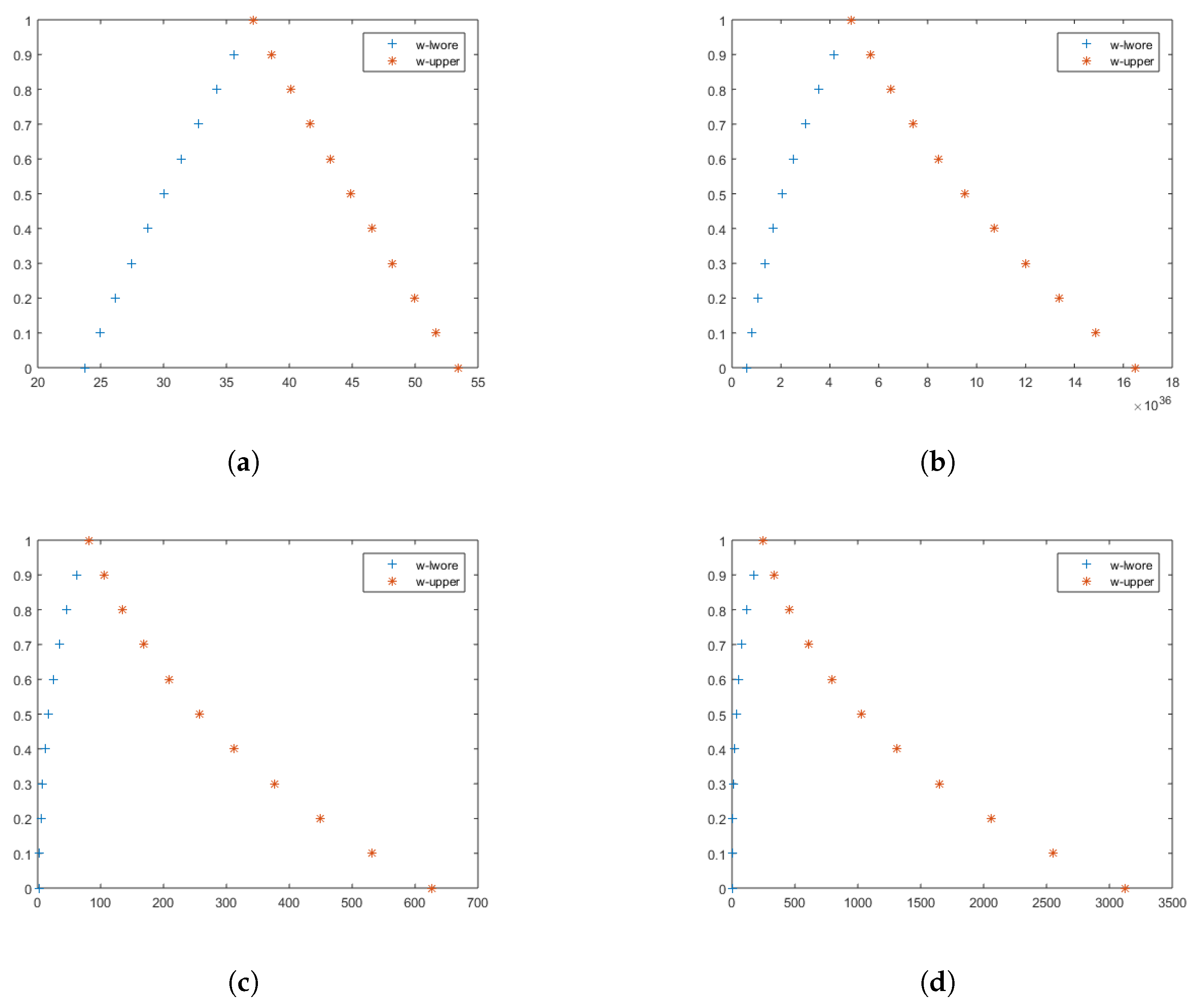
In the preceding instances, Figure 1 demonstrates that the left-hand functions of the -level set of (w lower) are always increasing functions of and the right-hand functions of the -level set of (w upper) are always decreasing functions of .
Figure 1.
Ex (4.1) Ex (4.2) Ex (4.3) Ex (4.4) .
5. Fuzzy Heat-Like and Wave-like Equations with Variable Coefficients
In this section, we apply the fuzzy RDTM and HPM to obtain the fuzzy solutions of heat-like and wave-like equations with variable coefficients as follows:
- Consider the fuzzy heat-like equation of the formwith the initial condition
- Consider the fuzzy wave-like equation of the formwith the initial condition
5.1. The Fuzzy Reduced Differential Transform Method
We consider the fuzzy-valued function of two variables . Based on the properties theory of one-dimensional DTM, the fuzzy-valued function can be represented as:
where is called t-dimensional spectrum fuzzy-valued function of
Definition 10.
If a fuzzy-valued function is analytic and differentiated continuously with respect to time t and space ψ in the domain of interest, then let
where the t-dimensional spectrum fuzzy-valued function is the transformed function.
Definition 11.
The fuzzy differential inverse transform of is defined as:
Next, using the aforementioned definitions, we can find that the concept of fuzzy RDTM is derived from the expansion of the power series. To illustrate the basic concepts of fuzzy RDTM, we consider the following fuzzy nonlinear PDE written in the operator form
with the initial condition
where is a linear operator which has fuzzy partial derivatives, is a fuzzy nonlinear operator and is an fuzzy inhomogeneous term. Applying the fuzzy RDTM, we obtain
where , and are the fuzzy transformations of the fuzzy-valued functions and , respectively. According to the initial condition (163), we obtain
From (167) into (164) and by straightforward iterative calculation, we obtain the following values. Moreover, the fuzzy inverse transformation of the set of values gives the n-terms approximation solution as:
Thus, the exact solution of the problem is given by
Next, the basic mathematical operations performed by RDTM proposed in [60,61] as follows:
- 1.
- If , then
- 2.
- If , then
- 3.
- If , then , where is a constant.
- 4.
- If , then
- 5.
- If , then
- 6.
- If , then
- 7.
- If , then
- 8.
- If , then
5.2. The Fuzzy Homotopy Perturbation Method
Consider the fuzzy nonlinear differential equation as:
where , we define:
- 1.
- a fuzzy differential operator, which means and are differential operator,
- 2.
- and , for any
under the boundary condition
where stand for boundary operator and stand for boundary of the domain . The fuzzy operator can be divided into two parts and , where is a linear operator while is a nonlinear operator. Moreover, Equation (172) can be rewritten as follows:
By the fuzzy homotopy technique, we construct a homotopy:
and
where and is an embedding parameter, is the initial approximation to (172), which satisfies the boundary conditions. According to (176) and (177), we have
and
and the changing process of p from zero to unity is just that from to . In topology, this is called deformation, and are called Homotopy. The Homotopy parameter p is used as an expanding parameter by the fuzzy HPM to obtain
Finally, on setting p = 1, this results in the formal solution
5.2.1. Fuzzy Heat-like Equations
Using the fuzzy HPM, construct the homotopy which satisfies
and the initial approximation Suppose that the solution to (184) and (185) can be represented as:
Assume , and solving the above equations results in the approximate solution
5.2.2. Inhomogeneous Fuzzy Heat-like Equations
Here, the parametric form of the inhomogeneous fuzzy heat-like equation is investigated:
Applying the fuzzy HPM, we construct the homotopy which satisfies
and the initial approximation
5.2.3. Fuzzy Wave-like Equations
Applying the fuzzy HPM, we construct the homotopy , which satisfies
and the initial approximation . Assume that the solution to (199) and (200) as
Assume ,
The convergence analysis theory of the fuzzy HPM; see (Osman et al. [40]).
5.3. Examples
In this part, we present the exact solutions to the fuzzy heat-like and wave-like equations with variable coefficients discussed by Osman et al. [39] to assess the efficiency of the fuzzy RDTM and HPM.
Example 7.
Consider the following one-dimensional fuzzy heat-like equation with variable coefficients in the form [39]
subject to the initial condition
Above , fuzzy number is defined by
and
Case [A]. Fuzzy reduced differential transform method
Applying the fuzzy inverse transformation of the set of values gives n-terms approximation solutions as
Thus, we can obtain the exact solution as:
Case [B]. Fuzzy Homotopy perturbation method
Using the fuzzy HPM, we can construct the homotopy which satisfies
and the initial approximation where (n = 1,2,3,…). Let the solution of (207) be represented as follows:
By choosing and the solving the mentioned equations, we get power of p as
Therefore, the exact solution of (207) is obtained as:
Example 8.
Consider the two-dimensional fuzzy heat-like equation with variable coefficients in the form [39]
with the initial condition
where
Case [A]. Fuzzy reduced differential transform method
According to the fuzzy inverse transformation of the set of values, gives n-terms approximation solutions as:
Thus, the exact solution can be obtained as:
Case [B]. Fuzzy Homotopy perturbation method
Therefore, the exact solution can be represented as:
Example 9.
Consider the three-dimensional inhomogeneous fuzzy heat-like equation with variable coefficients [39]
with the initial condition
where
Case [A]. Fuzzy reduced differential transform method
According to the fuzzy inverse transformation of the set of values, gives n-terms approximation solutions as:
The exact solution can be obtained as:
Case [B]. Fuzzy Homotopy perturbation method
Substituting (218), (240) and (239), with equating the terms of the same power of p, it follows that
and
Therefore, the exact solution is given as:
Example 10.
Consider the one-dimensional fuzzy wave-like equation with variable coefficients as [39]
subject to the initial conditions
where n = 1,2,3,…
Case [A]. Fuzzy reduced differential transform method
Applying the fuzzy inverse transformation of the set of values gives n-terms approximation solutions as:
The exact solution is given as:
Case [B]. Fuzzy Homotopy perturbation method
Suppose the solution of (241) can be represented as:
Thus, the exact solution can be obtained as:
Example 11.
Consider the two-dimensional fuzzy wave-like equation with variable coefficients as [39]
with the initial conditions
where
Case [A]. Fuzzy reduced differential transform method
Applying the fuzzy inverse transformation of the set of values gives n-terms approximation solutions as:
The exact solution can be represented as:
Case [B]. Fuzzy Homotopy perturbation method
we have
and
Hence, the exact solution of (252) is given as:
Example 12.
Consider the three-dimensional fuzzy wave-like equation with variable coefficients in the form [39]
subject to the initial conditions
where
Case [A]. Fuzzy reduced differential transform method
Using the fuzzy inverse transformation of the set of values gives n-terms approximation solutions as:
The exact solution can be obtained as:
Case [B]. Fuzzy Homotopy perturbation method
Using the above equations and the initial approximation we have
and
Thus, we can obtain the exact solution as follows:
This section figures are the same as Figure 1 and 2 in Osman et al. [39]; we proposed these to clarify the solutions.
5.4. Discussion
The comparison between fuzzy RDTM and HPM with the fuzzy ADM, and VIM in [39] shows that, although the results of these methods when applied to the fuzzy heat-like and wave-like equations are the same, fuzzy RDTM, like fuzzy HPM, does not require specific algorithms and complex calculations such as fuzzy ADM or construction of correction functionals using general Lagrange multipliers in the fuzzy variational iteration method. Therefore, the fuzzy RDTM and HPM are more readily implemented and promising approaches to solving fuzzy partial differential equations with variable coefficients.
6. Conclusions
In this article, we successfully compared the fuzzy Adomian decomposition method (ADM) and fuzzy modified Laplace decomposition method (LDM) to obtain fuzzy fractional Navier–Stokes equations in a tube under fuzzy fractional derivative. The analytical results were expressed as a power series with easily calculated terms. Furthermore, we investigated the fuzzy Elzaki decomposition method (EDM) applied to solving fuzzy linear-nonlinear Schrodinger differential equations. For all four numerical problems investigated, the technique works wonderfully since the solutions found yield outstanding exact solutions. Finally, we proposed the comparison of the fuzzy reduced differential transform method (RDTM) and fuzzy homotopy perturbation method (HPM) to solving fuzzy heat-like and wave-like equations with variable coefficients. The results demonstrate that the methods are efficient and reliable, and a comparison of the approaches to other analytical methods accessible in the literature reveals that, while the results are similar, RDTM and HPM are more convenient and efficient. All these results demonstrate that the methods are powerful mathematical tools for solving fuzzy linear and nonlinear partial differential equations.
Author Contributions
Conceptualization, M.O. and Y.X.; Validation, M.O., Y.X., and A.H.; writing—original draft, M.O.; Writing—review and editing, M.O. and O.A.O.; Funding acquisition M.O. All authors have read and agreed to the published version of the manuscript.
Funding
The research was supported by Zhejiang Normal University Research Fund under Grant ZC304022909.
Acknowledgments
The authors are grateful to the editor and anonymous reviewers for their helpful, valuable comments and suggestions in the improvement of this manuscript.
Conflicts of Interest
The authors declare no conflict of interest.
References
- Araour, M.; Mennouni, A. A New Procedures for Solving Two Classes of Fuzzy Singular Integro-Differential Equations: Airfoil Collocation Methods. Int. J. Appl. Comput. Math. 2022, 8, 35. [Google Scholar] [CrossRef]
- Casasnovas, J.; Rossell, F. Averaging fuzzy biopolymers. Fuzzy Sets Syst. 2005, 105, 139–158. [Google Scholar] [CrossRef] [Green Version]
- Guo, M.; Xue, X.; Li, R. Impulsive functional differential inclusions and fuzzy population models. Fuzzy Sets Syst. 2003, 138, 601–615. [Google Scholar] [CrossRef]
- Naschie, M.S.E. From experimental quantum optics to quantum gravity via a fuzzy Khler manifold. Chaos Solitons Fractals 2005, 25, 969–977. [Google Scholar] [CrossRef]
- Oberguggenberger, M.; Pittschmann, S. Differential equations with fuzzy parameters. Math. Mod. Syst. 1999, 5, 181–202. [Google Scholar]
- Kandel, A.; Byatt, W.J. Fuzzy differential equations. In Proceedings of the International Conference on Cybernetics and Society, Tokyo, Japan; 1978. [Google Scholar]
- Seikkala, S. On the fuzzy initial value problem. Fuzzy Sets Syst. 1987, 24, 319–330. [Google Scholar] [CrossRef]
- Kaleva, O. Fuzzy differential equations. Fuzzy Sets Syst. 1987, 24, 301–317. [Google Scholar] [CrossRef]
- Kaleva, O. The Cauchy problem for fuzzy differential equations. Fuzzy Sets Syst. 1990, 35, 389–396. [Google Scholar] [CrossRef]
- Kloeden, P.E. Remarks on Peano-like theorems for fuzzy differential equations. Fuzzy Sets Syst. 1991, 44, 161–163. [Google Scholar] [CrossRef]
- Ouyang, H.; Wu, Y. On fuzzy differential equations. Fuzzy Sets Syst. 1989, 32, 321–325. [Google Scholar]
- Jowers, L.J.; Buckley, J.J.; Reilly, K.D. Simulating continuous fuzzy systems. Inf. Sci. 2007, 177, 436–448. [Google Scholar] [CrossRef]
- Bede, B.; Rudas, I.J.; Bencsik, A.L. First order linear fuzzy differential equations under generalized differentiability. Inf. Sci. 2007, 177, 1648–1662. [Google Scholar] [CrossRef]
- Chen, M.H.; Wu, C.X.; Xue, X.P.; Liu, G.Q. On fuzzy boundary value problems. Inf. Sci. 2008, 178, 1877–1892. [Google Scholar] [CrossRef]
- Ding, Z.; Ma, M.; Kandel, A. Existence of the solutions of fuzzy differential equations with parameters. Inf. Sci. 1997, 99, 205–217. [Google Scholar] [CrossRef]
- Song, S.J.; Wu, C.X. Existence and uniqueness of solutions to Cauchy problem of fuzzy differential equations. Fuzzy Sets Syst. 2000, 110, 55–67. [Google Scholar] [CrossRef]
- Wu, C.X.; Song, S.J. Existence theorem to the Cauchy problem of fuzzy differential equations under compactness-type conditions. Inf. Sci. 1998, 108, 123–134. [Google Scholar]
- Bede, B.; Gal, S.G. Generalizations of the differentiability of fuzzy-number-valued functions with applications to fuzzy differential equations. Fuzzy Sets Syst. 2005, 151, 581–599. [Google Scholar] [CrossRef]
- Puri, M.L.; Ralescu, D.A. Differentials of fuzzy functions. J. Math. Anal. Appl. 1983, 91, C552–C558. [Google Scholar] [CrossRef] [Green Version]
- Bede, B.; Stefanini, L. Generalized differentiability of fuzzy-valued functions. Fuzzy Setes Syst. 2013, 230, 119–141. [Google Scholar] [CrossRef] [Green Version]
- Kumar, A.; Malik, M.; Sajid, M.; Baleanu, D. Existence of local and global solutions to fractional order fuzzy delay differential equation with non-instantaneous impulses. AIMS Math. 2022, 7, C2348–C2369. [Google Scholar] [CrossRef]
- Lakshmikantham, V.; Leela, S. A Krasnoselskii-Krein-type uniqueness result for fractional differential equations. Nonlinear Anal. Theory Methods Appl. 2009, 71, 3421–3424. [Google Scholar] [CrossRef]
- Lakshmikantham, V. Theory of fractional functional differential equations, Nonlinear Analysis: Theory. Methods Appl. 2008, 69, 3337–3343. [Google Scholar]
- Magin, R. Fractional calculus models of complex dynamics in biological tissues. Comput. Math. Appl. 2010, 59, 1586–1593. [Google Scholar] [CrossRef] [Green Version]
- Magin, R.; Ortigueira, M.; Podlubny, I.; Trujillo, J.J. On the fractional signals and systems. Signal Process. 2011, 91, 350–371. [Google Scholar] [CrossRef]
- Merala, F.C.; Roystona, T.J.; Magin, R. Fractional calculus in viscoelasticity: An exbperimental study. Commun. Nonlinear Sci. Numer. Simul. 2010, 15, 939–945. [Google Scholar] [CrossRef]
- Mazandarani, M.; Pariz, N.; Kamyad, A.V. Granular differentiability of fuzzy-number-valued functions. IEEE Trans. Fuzzy Syst. 2018, 26, 310–323. [Google Scholar] [CrossRef]
- Samko, S.G.; Kilbas, A.A.; Marichev, O.I. Fractional Integrals and Derivatives: Theory and Applications; Gordon and Breach Science Publishers: Basel, Switzerland, 1993. [Google Scholar]
- Adomian, G. Nonlinear Stochastic Operator Equations; Academic Press: San Diego, CA, USA, 1986. [Google Scholar]
- Adomian, G. A review of the decomposition method in applied mathematics. J. Math. Anal. Appl. 1988, 135, 501–544. [Google Scholar] [CrossRef] [Green Version]
- Adomian, G. Solving Frontier Problems of Physics: The Decomposition Method; Kluwer Academic Publishers: Boston, MA, USA, 1994. [Google Scholar]
- Wazwaz, A.M. Exact Special solutions with solitary patterns for the nonlinear dispersive K(m,n) equations. Chaos Solitons Fractals 2002, 13, 161–170. [Google Scholar] [CrossRef]
- Wazwaz, A.M. Construction of soliton solutions and periodic solutions of the Boussinesq equation by the modified decomposition method. Chaos Solitons Fractals 2001, 12, 1549–1556. [Google Scholar] [CrossRef]
- Yan, Z.Y. New families of solitons with compact support for Boussinesq-like B(m,n) equations with fully nonlinear dispersion. Chaos Solitons Fractals 2002, 14, 1151–1158. [Google Scholar] [CrossRef]
- Zhu, Y.G. Exact special solutions with solitary patterns for Boussinesq-like B(m,n) equations with fully nonlinear dispersion. Chaos Solitons Fractals 2004, 22, 213–220. [Google Scholar] [CrossRef]
- Zhu, Y.; Chang, Q.; Wu, S. Exact solitary-wave solutions with compact support for the modified KdV equation. Chaos Solitons Fractals 2005, 24, 365–369. [Google Scholar] [CrossRef]
- Bhattia, S.; Zahida, M.; Alib, R.; Sarwara, A.; Wahabc, H.A. Blade coating analysis of a viscoelastic Carreau fluid using Adomian decomposition method. Math. Comput. Simul. 2021, 190, 659–677. [Google Scholar] [CrossRef]
- Georgieva, A.; Pavlova, A. Fuzzy Sawi Decomposition Method for Solving Nonlinear Partial Fuzzy Differential Equations. Symmetry 2021, 13, 1580. [Google Scholar] [CrossRef]
- Osman, M.; Gong, Z.T.; Mustafa, A.M. Comparison of fuzzy Adomian decomposition method with fuzzy VIM for solving fuzzy heat-like and wave-like equations with variable coefficients. Adv. Diff. Equ. 2020, 2020, 372. [Google Scholar] [CrossRef]
- Osman, M.; Gong, Z.T.; Mustafa, A.M.; Yong, H. Solving fuzzy (1+n)-dimensional Burgers’ equation. Adv. Diff. Equ. 2021, 2021, 219. [Google Scholar] [CrossRef]
- Paul, G.C.; Khatun, S.; Nuruzzaman, M.; Kumar, D.; Ali, M.E.; Bilkis, F.; Barman, M.C. Solving protoplanetary structure equations using Adomian decomposition method. Heliyon 2021, 7, e08213. [Google Scholar] [CrossRef]
- Elcin, Y. (Aghadjanov), Numerical solution of Duffing equation by the Laplace decomposition algorithm. Appl. Math. Comput. 2006, 177, 572–580. [Google Scholar]
- Hamoud, A.; Ghadle, K. Modified Laplace decomposition method for fractional Volterra-Fredholm integro-differential equations. J. Math. Model. 2018, 6, 91–104. [Google Scholar]
- Khuri, S.A. A Laplace decomposition algorithm applied to class of nonlinear differential equations. J. Math. Appl. 2001, 1, 141–155. [Google Scholar] [CrossRef]
- Khuri, S.A. A new approach to Bratu’s problem. Appl. Math. Comput. 2004, 147, 131–136. [Google Scholar] [CrossRef]
- Baleanu, D.; Aydogn, S.M.; Mohammadi, H.; Rezapour, S. On modelling of epidemic childhood diseases with the Caputo-Fabrizio derivative by using the Laplace Adomian decomposition method. Alex. Eng. J. 2020, 59, 3029–3039. [Google Scholar] [CrossRef]
- Farman, M.; Saleem, M.U.; Ahmad, A.; Ahmad, M.O. Analysis and numerical solution of SEIR epidemic model of measles with non-integer time fractional derivatives by using Laplace Adomian Decomposition Method. Ain Shams Eng. 2018, 9, 3391–3397. [Google Scholar] [CrossRef]
- Mohammed, O.H.; Salim, H.A. Computational methods based laplace decomposition for solving nonlinear system of fractional order differential equations. Alex. Eng. J. 2018, 57, 3549–3557. [Google Scholar] [CrossRef]
- Elzaki, T.M. The new integral transform “Elzaki Transform”. Glob. J. Pure Appl. Math. 2011, 7, 57–64. [Google Scholar]
- Elzaki, T.M.; Ezaki, S.M. Application of new transform “Elzaki Transform”, to partial differential equations. Glob. J. Pure Appl. Math. 2011, 7, 65–70. [Google Scholar]
- Elzaki1, T.M.; Mousa, A. On the convergence of triple Elzaki transform. SN Appl. Sci. 2019, 1, 275. [Google Scholar] [CrossRef] [Green Version]
- Khan, H.; Khan, A.; Kumam, P.; Baleanu, D.; Arif, M. An approximate analytical solution of the Navier–Stokes equations within Caputo operator and Elzaki transform decomposition method. Adv. Differ. Equ. 2020, 2020, 622. [Google Scholar]
- Nuruddeen, R.I. Elzaki decomposition method and its application in solving linear and nonlinear Schrodinger equations. Sohag J. Math. 2017, 4, 1–5. [Google Scholar] [CrossRef]
- Varsoliwala, A.C.; Singh, T.R. Mathematical modelling of atmospheric internal waves phenomenon and its solution by Elzaki Adomian Decomposition Method. J. Ocean. Eng. Sci. 2022, 7, 203–212. [Google Scholar] [CrossRef]
- Zhou, J.K. Differential Transformation and Its Application for Electrical Circuits; Huazhong University Press: Wuhan, China, 1986. [Google Scholar]
- Kanth, A.R.; Aruna, K. Differential transform method for solving linear and nonlinear systems of partial differential equations. Phys. Lett. A 2008, 372, 6896–6898. [Google Scholar] [CrossRef]
- Yu, J.; Jing, J.; Sun, Y.; Wu, S. (n+1)-dimensional reduced differential transform method for solving partial differential equations. Appl. Math. Comput. 2016, 273, 697–705. [Google Scholar] [CrossRef]
- Zou, L.; Wang, Z.; Zong, Z. Generalized differential transform method to differential-difference equation. Phy. Lett. A 2009, 373, 4142–4151. [Google Scholar] [CrossRef]
- Abazari, R.; Ganji, M. Extended two-dimensional dtm and its application on nonlinear pdes with proportional delay. Int. J. Compu. Math. 2011, 88, 1749–1762. [Google Scholar] [CrossRef]
- Keskin, Y.; Oturan, G. Reduced differential transform method for partial differential equations. Int. J. Nonlinear Sci. Numer. Simul. 2009, 10, 741–749. [Google Scholar] [CrossRef]
- Keskin, Y.; Oturan, G. Reduced differential transform method: A new approach to fractional partial differential equations. Nonlinear Sci. Lett. A 2010, 1, 61–72. [Google Scholar]
- Arshad, M.; Wang, D.L.J. (N+1)-dimensional fractional reduced differential transform method for fractional order partial differential equations. Commun. Nonlinear Sci. Numer. Simul. 2017, 48, 509–519. [Google Scholar] [CrossRef]
- He, J.H. Homotopy perturbation technique, Comput. Mehods. Comput. Methods Appl. Mech. Eng. 1999, 178, 257–262. [Google Scholar] [CrossRef]
- He, J.H. A coupling method of Homotopy technique and a perturbation technique for nonlinear problems. Int. J. Non-Linear Mech. 2000, 35, 7–43. [Google Scholar] [CrossRef]
- Altaie, S.A.; Jameel, A.F.; Saaban, A. Homotopy perturbation method approximate analytical solution of fuzzy partial differential equation. IAENG Int. J. Appl. Math. 2019, 49, 22–28. [Google Scholar]
- Ates, I.; Zegeling, P.A. A homotopy perturbation method for fractional-order advection-diffusion-reaction boundary-value problems. Appl. Math. Model. 2017, 47, 425–441. [Google Scholar] [CrossRef]
- Sakar, M.G.; Uludag, F.; Erdogan, F. Numerical solution of time-fractional nonlinear PDEs with proportional delyas by homotopy perturbation method. Appli. Math. Mode. 2016, 40, 6639–6649. [Google Scholar] [CrossRef]
- Jameel, A.F.; Altaie, A.S.J.; Aljabbari, S.G.A.; AlZubaidi, A.; Man, N.H. Double Parametric Fuzzy Numbers Approximate Scheme for Solving One-Dimensional Fuzzy Heat-Like and Wave-Like Equations. Mathematics 2020, 8, 1737. [Google Scholar] [CrossRef]
- Wu, C.V.; Gong, Z.T. On Henstock integral of fuzzy-number-valued functions (1). Fuzzy Sets Syst. 2001, 120, 523–532. [Google Scholar] [CrossRef]
- Allahviranloo, T.; Gouyandeha, Z.; Armanda, A.; Hasanoglub, A. On fuzzy solutions for heat equation based on generalized Hukuhara differentiability. Fuzzy Sets Syst. 2015, 265, 1–23. [Google Scholar] [CrossRef]
- Salahshour, S.; Allahviranloo, T.; Abbasbandy, S. Solving fuzzy fractional differential equations by fuzzy Laplace transforms. Commun. Nonlinear Sci. Numer. Simul. 2012, 17, 1372–1381. [Google Scholar] [CrossRef]
- Rivaz, A.; Fard, O.S.; Bidgoli, T.A. Solving fuzzy fractional differential equations by generalized differential transform method. SeMA J. 2016, 73, 149–170. [Google Scholar] [CrossRef]
Publisher’s Note: MDPI stays neutral with regard to jurisdictional claims in published maps and institutional affiliations. |
© 2022 by the authors. Licensee MDPI, Basel, Switzerland. This article is an open access article distributed under the terms and conditions of the Creative Commons Attribution (CC BY) license (https://creativecommons.org/licenses/by/4.0/).