


Abstract
This paper focuses on the tracking control problem for a family of fractional-order systems with unknown drift functions and unknown time delays. By employing fuzzy logic systems (FLSs), the unknown functions are approximated and compensated. Meanwhile, with the help of a hyperbolic tangent function and a sign function, the adverse effects of time-varying delays and FLSs approximation error are mitigated simultaneously. It should be stressed that the proposed method eliminates the assumption that the time delay is bounded by a known function. The stability analysis shows that the tracking error can converge to a small neighborhood of the origin. Finally, simulation is conducted to confirm the effectiveness of the presented control strategy.
Keywords:
fractional-order systems; fuzzy logic systems; time delays; unknown nonlinear functions; hyperbolic tangent function MSC:
93C10
1. Introduction
Fractional-order systems are able to describe the phenomenon of viscoelastic structures and heat conduction more precisely than integer-order systems [1,2,3,4], and thus, research on the control problem of fractional-order systems is significant and has received increasing attention. For example, in paper [5], the synchronization problem for incommensurate fractional-order chaotic systems was addressed by utilizing the comparison principle, linear matrix inequalities (LMIs), and linear feedback control technique. In paper [6], the convergence of a Lyapunov candidate function to zero when time tends to infinity was studied. The proposed method provides the theoretical foundations for its potential applications in secure communication and control processing. In paper [7], the problem of approximate controllability of infinite-dimensional degenerate fractional-order systems in the sectorial case was studied. This work gives the necessary and sufficient conditions for such problems, which are less restrictive compared with the existing methods.
In addition, in practical engineering, various crimes would occur in controlled plants. Unknown dynamics is one of the main factors, which brings difficulty in designing controllers and limits the system performance severely. Thus, the design of approximators or estimations has received attention in recent decades. Examples include the sliding mode observer [8,9,10,11], extended state observer [12], robust observer [13,14,15], and FLS-based approximators [16,17,18]. It should be noted that the fuzzy-based approximator serves as a tool to approximate any continuous dynamics and is widely utilized to cope with the unknown dynamics in the existing literature. For example, in [19], a novel fuzzy observer-based control strategy was investigated to solve the periodic tracking control problem for a class of nonlinear systems. In [16], multi-input single-output nonstrict-feedback nonlinear systems in the presence of unmeasured states and actuator failures were considered; by employing FLSs, the issue caused by unknown nonlinear functions was handled. In [20], an integrated fuzzy-observer-based fault detection method was proposed for a family of general nonlinear industrial processes such that the real-time fault detection is achieved. In [21], FLSs were integrated with the dwell time approach such that a fault-tolerant controller is designed which can overcome the control problem for switched nonlinear systems with unknown nonlinearities, unmeasured states, sensor and actuator faults, simultaneously. Similar results can be found in references [22,23]. It can be found from the existing results that the FLSs technique is efficient in solving nonlinear dynamics.
On the other hand, time delays, which are caused by the limitation of the mechanical mechanism itself, or the measurement ability of sensors, also usually appear in practical plants such as those for aircraft, steel manufacturing, heat exchanges, mining processes, etc. Therefore, many strategies have been presented to solve the problem caused by time delays [24,25,26,27,28,29]. In [24,25], the Lyapunov–Krasovskii functional [26], which has been widely used in analyzing the stability and designing the control scheme for nonlinear systems with time-delay, was used to cope with the control problem for linear systems with time delays. In paper [27], an output feedback control strategy was presented for a class of commensurate fractional-order nonlinear systems in the presence of time-varying delays and input saturation. To cope with the time-varying delays, some assumptions are given and neuro-fuzzy network systems (NFNSs) are designed. In paper [28], a guaranteed cost-control scheme was proposed for a class of uncertain fractional-order delayed linear systems with norm-bounded, time-varying parametric uncertainty. The proposed approach can achieve the robust stability of the closed-loop system and an upper bound of the specified linear integral–quadratic cost function for all delays. In paper [29], a control method for networked fractional-order multi-agent systems with time-varying delays was presented. To deal with the time-varying delays and switching topologies, two sampled-data-based containment control protocols are proposed. In [30], a compensation method was developed for both linear and nonlinear systems when there exists state-dependent input delay. In [31], the Lyapunov–Razumikhin function, which is a more popular method to analysis the stability of time-delay systems, was combined with a back-stepping technique to overcome the control problem for nonlinear systems with a arbitrary large delay in the input.
In this paper, we investigated a novel tracking control strategy for a class of nonlinear commensurate fractional-order systems when there are unknown nonlinearities and time delays. FLSs were utilized to handle the issue caused by unknown nonlinear dynamics occurring in the systems. Furthermore, inspired by the strategy proposed in [32], a novel method to design adaptive parameters is proposed to deal with the unknown time delays and FLSs approximation error. It should be noted that the developed method can further reduce the tracking error compared with the methods presented in [33] due to the fact that a sign function is introduced. Meanwhile, the chattering phenomena caused by sign functions is successfully overcome. The main superiorities of this paper are outlined as follows:
- (1)
- The assumption that the unknown time delay is bounded by a known function or constant is eliminated.
- (2)
- The proposed method is able to further reduce the output tracking error due to the fact that a sign function is introduced. Meanwhile, the chattering behavior caused by the sign function is successfully alleviated.
- (3)
- A control strategy is presented for a class of nonlinear commensurate fractional-order systems with unknown time delays and unknown nonlinear functions.
The rest of the paper is composed of five sections. In Section 2, some preliminaries which are used to develop the control method and the description of the controlled system are given. Section 3 presents the proposed novel output tracking control strategy and the stability analysis. Section 4 shows the simulation results to demonstrate the feasibility and efficiency of the developed strategy. Finally, Section 5 gives the conclusions of this paper.
2. Preliminaries and System Description
2.1. Preliminaries
This subsection gives some definitions and lemmas which are required when designing the controller.
Definition 1 ((Gamma function)
[34]). The well-known Gamma function is defined by the following integral form
where α is a positive constant.
Definition 2 ((Caputo’s fractional derivative)
[34]). The Caputo’s fractional derivative of order for a continuous function , with is defined as
where , is the nth-order derivative of function , represents the Gamma function.
Definition 3 ((Caputo’s fractional integral)
[34]). The Caputo’s fractional integral of order for a continuous function , is defined as the following form
Lemma 1
([35]). For two real vectors of the same dimension x and y, Young’s inequality shows that there exists a constant β such that the following inequality holds
Lemma 2
([32]). For a function , the following inequality holds for any
with .
Lemma 3
([36]). Let , be a smoothing function. Then, we have
where P is a positive definite matrix.
Lemma 4
([37]). For a continuous function with , where Ω is a compact set, there exists an FLS and an arbitrary positive constant such that the following inequality holds
where represents the input vector, is the output of FLSs. denotes the weight vector, represents the basis function vector which is given by
where denotes fuzzy membership functions with respect to fuzzy sets , , where N denotes the number of inference rules. Generally, Gaussian function is chosen to design , i.e.,
with parameters and being the center and width of the Gaussian function.
2.2. System Description
Consider the following commensurate fractional-order nonlinear systems with time-varying delays described as follows
where , represents the measurable state vector, denotes the unknown nonlinear drift function, represents the control input, while y denotes the output of the controlled system.
Assumption 1.
The desired signal and its α order Caputo’s fractional derivative are assumed to be smooth and bounded.
Assumption 2.
The unknown time delay function , is assumed to be bounded. It should be stressed that the boundary of time delay is not required to be known.
Remark 1.
Generally, the unknown nonlinear time-delay function is supposed to be bounded by a known function [33,38] such that the time delay term can be separated and compensated by using using Lyapunov–Krasovskii functional. However, we relax this assumption via the presented novel control scheme. The boundary of the unknown time-delay function is not required to be known. For the reason that the boundary of the unknown time-delay function is usually difficult to be known in practical plants, the assumption in this paper is more practical.
The control objective of this work is to design a fuzzy-based control strategy for a family of nonlinear commensurate fractional-order systems with unknown drift functions and time delays such that the system output tracks the desired signal within a small neighborhood of the origin.
3. Control Design and Stability Analysis
In this section, the control design process and stability analysis for the fractional-order nonlinear system (10) will be detailed.
Define tracking errors as follows
where , denotes the virtual control input.
Step 1: Let , where is the virtual control input which is designed by resorting to the following Lyapunov function candidate
where , and are positive constants, denotes the approximation error between and its approximation , represents the approximation error between and its approximation , and the variable will be specified afterward.
Take the derivative of , which yields
By recalling Equations (10)–(12), the inequality (14) can be further expressed as
Remark 2.
In existing results, the problem of “explosion of complexity” is generally dealt with by utilizing dynamic surface or filter techniques. However, in this work, the Caputo’s fractional derivative of order α for the desired signal and the unknown drift function are regarded as a compound nonlinear term and denoted by . By employing Lemma 4, can be approximated by using FLSs and expressed as , where is the ideal weight vector of FLSs, and denotes the input vector. Similarly, we regard and as a compound nonlinear term . FLSs are used to approximate and compensate it.
Remark 3.
Since the unknown time-delay function consists of the unknown variable , which makes it is difficult to be directly approximated and compensated. The widely used method is to assume that it is bounded by a known function, then the time-delay function can be compensated via a Lyapunov–Krasovskii functional constructed by using the known function. However, in this paper, a hyperbolic tangent function and a sign function are utilized to deal with the time-delay function. This method does not require the known boundary of the unknown time-delay function, which relaxes the restriction.
Then, inequality (15) can be rewritten as
Design the virtual control input as follows
where is a positive constant, which should be designed.
By substituting (17) into (16),
Lemma 4 shows that is bounded by a small positive constant. Meanwhile, we have that is bounded from assumption 1. Hence, it is reasonable to assume that there exists a positive constant such that the following equation holds
Subsequently, one can obtain
By using Lemma 2, we have
Design the updating laws of adaptive weight and adaptive parameter as follows
Then, Equation (21) can be rewritten as follows
Remark 4.
Generally, when applying Lemma 4 to deal with the unknown function, such as in [33,38], one of the items included in the virtual control input would be designed as . Then, there would be a positive term on the right side of inequality (24), which would lead to a larger tracking error. However, this issue is overcome in this paper; as shown in inequality (24), when we construct the virtual control input by designing one term as , the positive term can be eliminated.
It should be stressed that although the tracking error can be further reduced by designing virtual control input and adaptive parameters as Equations (17), (22) and (23), the chattering would occur since the sign function is introduced. To handle this problem, we redesign virtual control input and adaptive parameters , as follows.
where parameter r is a positive constant, which should be designed. Then, inequality (24) can be rewritten as follows
When , the term . The Equation (28) can be finally written as
When , the term . Let , which can be arbitrarily small by tuning positive parameter . Then, the Equation (28) can finally be written as
Step i, : Let , where denotes the virtual control input which will be designed by using the Lyapunov function candidate defined as follows
where , and are positive constants which should be designed, denotes the approximation error between and its approximation , represents the approximation error between and its approximation ; the variable will be specified afterward.
Taking the derivative of yields
By recalling Equations (10) and (12), we have
It should be noted that the Caputo’s fractional derivative of order for the desired signal and the unknown drift function are regarded as a compound nonlinear term and denoted by . According to Lemma 4, can be approximated by using FLSs and expressed as , where is the ideal weight vector of FLSs, and denotes the input vector.
Then, inequality (33) is given as
Design the virtual control input as follows
Substituting (35) into (34) yields
According to Lemma 4, we know that is a small positive constant. Meanwhile, Assumption 1 shows that is bounded. Hence, it is reasonable to assume that there exists a positive constant such that the following inequality holds
Subsequently, one can obtain
By using Lemma 2, we have
Design the updating laws of adaptive weight and adaptive parameter as follows
Thus, Equation (39) can be expressed as
When , the term . Then, Equation (42) can finally be written as
When , the term . Let , which can be arbitrarily small by tuning positive parameter . Then, Equation (42) can finally be written as
Step : Let , where is the virtual control input which will be designed afterward. Choose the following Lyapunov function candidate
where , and are positive constants which should be designed, denotes the approximation error between and its approximation , represents the approximation error between and its approximation , and the variable will be specified afterward.
Taking the derivative of yields
By recalling Equations (10) and (12), we have
It should be noted that the Caputo’s fractional derivative of order for the desired signal and the unknown drift function are regarded as a compound nonlinear term and denoted by . According to Lemma 4, can be approximated by using FLSs and expressed as , where is the ideal weight vector of FLSs, and denotes the input vector.
Then, inequality (47) can be rewritten as
Design the virtual control input as follows
Substituting (49) into (48) yields
According to Lemma 4, we known that is a small positive constant. Meanwhile, Assumption 1 shows that is bounded. Thus, there exists a positive constant such that the following inequality holds
Subsequently, one can obtain
By using Lemma 2, we have
Design the updating laws of adaptive weight and adaptive parameter as follows
Then, Equation (53) can be rewritten as follows
When , the term . The Equation (56) can finally be written as
When , the term . Let , which can be arbitrarily small by tuning positive parameter . Then, Equation (56) can finally be written as
Step n: This step will design the control input u by using the following Lyapunov function candidate
where , and are positive constants which should be designed, denotes the approximation error between and its approximation , represents the approximation error between and its approximation , the variable will be specific afterward.
Taking the derivative of yields
By recalling Equations (10) and (12), we have
It should be noted that in order to facilitate the calculation, the Caputo’s fractional derivative of order for the desired signal and the unknown drift function are regarded as a compound nonlinear term and denoted by . According to Lemma 4, can be approximated by using FLSs and expressed as , where is the ideal weight vector of FLSs, and denotes the input vector.
Then, inequality (61) can be rewritten as
Design the virtual control input u as follows
Substituting (63) into (62) yields
Lemma 4 shows that is a small positive constant. Meanwhile, Assumption 1 shows that is bounded. Hence, it is reasonable to assume that there exists a positive constant such that the following equation holds
Subsequently, one can obtain
By utilizing Lemma 2, we have
Design the updating laws of adaptive weight and adaptive parameter as follows
Then, Equation (67) can be rewritten as follows
When , the term . The Equation (70) can finally be written as
When , the term . Let , which can be arbitrarily small by tuning positive parameter . Then, Equation (70) can finally be written as
Therefore, satisfies the following inequality
with , , when , . In this case, the derivative of Lyapunov function is negative. According to Layapunov stability theory, the system output tracking error can converge to zero. Otherwise, the output tracking error can eventually converge to a compact .
Remark 5.
Noted that the unknown function is approximated and dealt with by using Fuzzy Logic Systems (FLSs). It can be seen from Lemma 4 that the inputs of FLSs are the variables of unknown function and thus, the proposed method can also be used to cope with the control problem of the system (10) in the presence of unknown state-dependent disturbance. In this instance, the unknown state-dependent disturbance and unknown function can be viewed as a lump unknown function associated with the system states, and FLS can be utilized to deal with it.
4. Simulation Results
Consider the following system described as
Remark 6.

The nonlinear fractional-order system used in this simulation section is a dimensionless equation, which is also used in some existing works [39,40]. Thus, the process of ‘dimensionlessization’ and physical dimensions of the controller parameters shown in Table 1 are not given in our work.
Table 1.
Control parameters.
In this section, three cases are performed on the system (74) to verify the effectiveness and advantages of the proposed control strategy.
Case 1: The aim of this case is to verify the effectiveness of the presented method. To compare the tracking performance, three evaluation indices, i.e., the integral of the squared error (ISE), the integral absolute error (IAE) and the integral of time multiplied absolute error (ITAE) are used to count the influence of parameters on control performance. Their definitions are given by
where 0 s and 10 s.
The designed controller parameters are designed as Table 1. Simulation results are shown in Figure 1, Figure 2 and Figure 3. Furthermore, keep parameters unchanged except for designing the value of r as 0, , , and 1. The simulation results are shown in Figure 4, Figure 5 and Figure 6, and the tracking error performance indices by using different values of r are shown in Table 2.
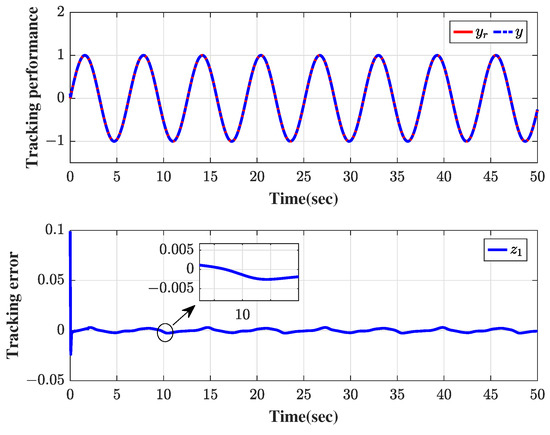
Figure 1.
Tracking performance and tracking error.
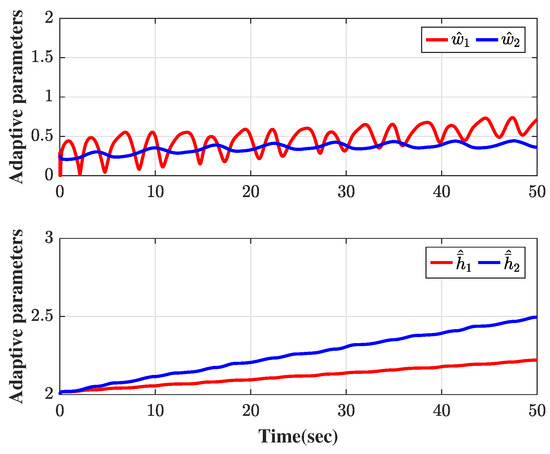
Figure 2.
Evolution of adaptive parameters.
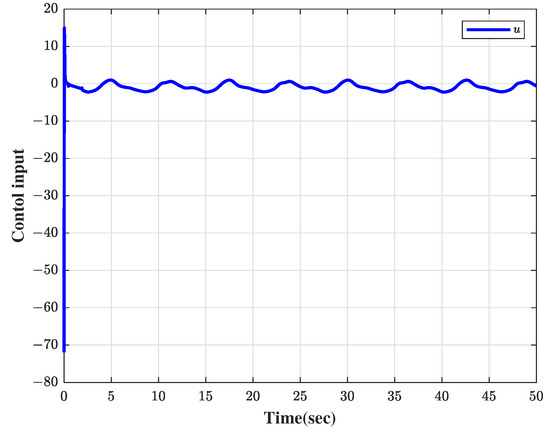
Figure 3.
Control input.
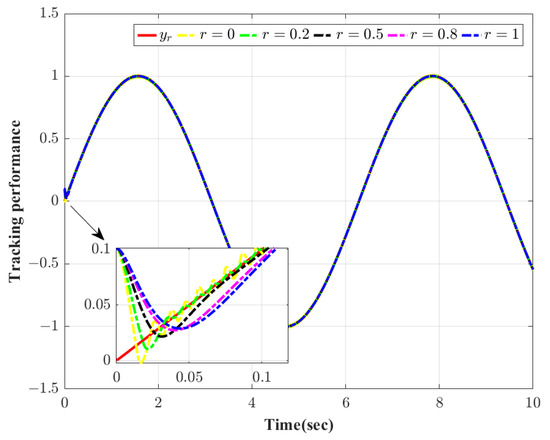
Figure 4.
Tracking performance.
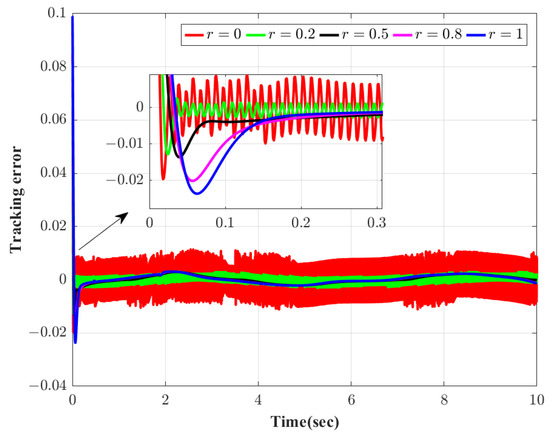
Figure 5.
Tracking errors.
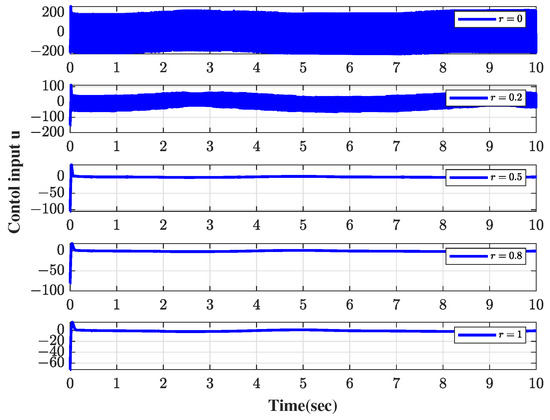
Figure 6.
Control inputs.
Table 2.
Tracking error performance indices by using different control parameters.
Specifically, the first case is designing the control parameters as in Table 1. We can see from Figure 1 that the tracking error can converge to a very small neighborhood of the origin. It can be seen from Figure 2 that the norm of FLSs adaptive weight vector can tend to be stable over time. However, the value of and increase over time since they relate to absolute value of error; they can be stable when the tracking error is zero. Figure 3 shows the evolution of the control input.
Then, we design the control parameters shown in Table 1 and keep them unchanged, only tuning the value of parameter r. Figure 4, Figure 5 and Figure 6 compare the effects of different r on the tracking performance. Specifically, Figure 4 and Figure 5 show the output tracking performance and the output tracking errors by using the proposed control method with different parameter r. It should be stressed that represents that the term which is used to alleviate the chattering is eliminated. Figure 4 and Figure 5 show that the proposed control method can largely reduce the chatting caused by the sign function; the larger value of r results in smaller chattering but at the expense of larger tracking error. Figure 6 shows the control input under different r, and it can be found that the larger value of r, the smaller the chattering; it is even potentially eliminated.
In addition, Figure 7 shows the trajectories of system output y and its desired signal , in which time delays 1–3 are given as follows
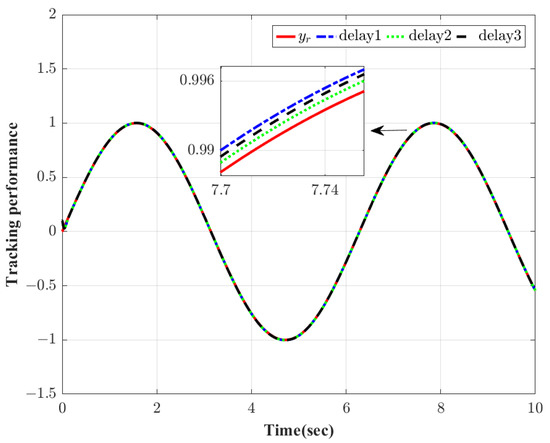
Figure 7.
Tracking performance.
It can be found from Figure 7 that the proposed method can guarantee that the system output tracks its desired signal quickly even in the case that the system with unknown function related to different time-varying delays.
Case 2: The objective of this case is to test robustness of the proposed method to state-dependent disturbance. Noted that the control design process is same as what was given in Section III, since the unknown disturbance as be regarded as one part of lumped unknown function F which can be dealt with by using the FLS technique. When disturbance is considered, the system (74) is written as follows
where
The the simulation results are shown in Figure 8. Specifically, in the first subplot of Figure 8, the desired reference trajectory is shown in red solid line, the system output y is shown in blue solid line, while the evolution is drawn in a black solid line. The tracking error is given in the second subplot of Figure 8. It can be found that although the amplitude of the disturbance is large, there is a fluctuation when the disturbance occurs at time t = 8 s. Afterwards, the tracking error decreases quickly and has remained in a limited range since then, which illustrates that the proposed control strategy is robust to the state-dependent disturbance.
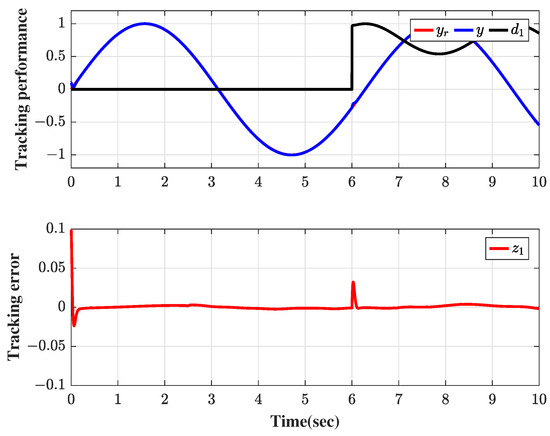
Figure 8.
Tracking performance and tracking error.
Case 3: The aim of this case is to show the effectiveness of the proposed method when compared with the existing strategies, i.e., PID technique and the method proposed in the paper [41]. The reason why the PID technique is selected as a comparison is that it is effective and widely used in engineering, while the other is employed because it handles a control problem that is similar to our study. Specifically, the authors in the paper [41] proposed an adaptive neural network control strategy for a fractional-order system with unknown parameter uncertainties and time delays. The backstepping approach is combined with a model reference technique to ensure the orderly decay of the desired error trajectory, NNs are used to cope with unknown uncertainties, the command filter technique is used to solve the explosion of complexity issues in backstepping, and the Lyapunov–Krasovskii function is designed to deal with time delays.
The controller parameters of our method in this case are same as those of Case 1. The controller parameters of the PID technique are , and . Controller parameters of proposed method in [41] are , , , , , , , , , , . The first subgraph of Figure 9 shows the trajectories of system output y by using different control methods and their desired signal , while the second subgraph depicts the corresponding tracking errors. The tracking error performance indices obtained by using different control strategies are shown in Table 3. It can be found that all these three methods can achieve perfect control performance. In particular, the proposed method and control method presented in [41] can achieve better control performance and smaller tracking errors than the PID technique. The method in [41] can obtain a better transient performance, while the values of IAE and IATE obtained by using the proposed method are smaller.
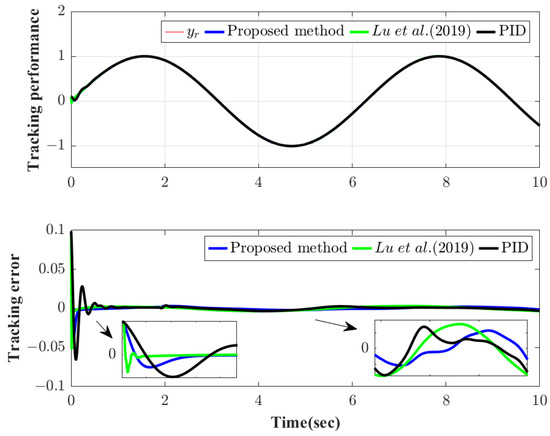
Figure 9.
Tracking performance and tracking error (Noted that Lu et al. (2019) represents the reference [41]).
Table 3.
Tracking error performance indices by using proposed method, PID and method presented in [41].
5. Conclusions
For a class of commensurate fractional-order nonlinear systems with unknown time-varying delays and unknown drift functions, a fuzzy-based tracking approach was developed in this study. The proposed control mechanism does not require knowledge of the time delay boundary. Meanwhile, with the addition of a sign function and a compensation term, the tracking error can be reduced even further and the chattering phenomena can be alleviated. The stability analysis and simulation results show that the presented control method is effective. External time-varying disturbances, however, might degrade control performance in applications. As a result, in the future, on the basis of the proposed method, we would like to focus on the control problem for nonlinear fractional-order systems in the presence of external time-varying disturbances.
Author Contributions
Formal analysis, Y.W.; Writing—original draft, J.Y.; Writing—review & editing, T.W. and X.Y. All authors have read and agreed to the published version of the manuscript.
Funding
This work was supported by the National Natural Science Foundation of China under Grant 61803122 and Grant 61773143, in part by the 111 Project under Grant B16014, in part by the Special Project of Heilongjiang Postdoctoral Science Foundation under Grant LBH-TZ2011.
Institutional Review Board Statement
Not applicable.
Informed Consent Statement
Not applicable.
Conflicts of Interest
The authors declare no conflict of interest.
References
- Marir, S.; Chadli, M.; Bouagada, D. New admissibility conditions for singular linear continuous-time fractional-order systems. J. Frankl. Inst. 2017, 354, 752–766. [Google Scholar] [CrossRef]
- Efe, M.Ö. Fractional order systems in industrial automation a survey. IEEE Trans. Ind. Inform. 2011, 7, 582–591. [Google Scholar] [CrossRef]
- Mujumdar, A.; Tamhane, B.; Kurode, S. Observer-based sliding mode control for a class of noncommensurate fractional-order systems. IEE/ASME Trans. Mechatron. 2015, 20, 2504–2512. [Google Scholar] [CrossRef]
- David, S.A.; de Sousa, R.V.; Valentim, C.A., Jr.; Tabile, R.A.; Machado, J.A.T. Fractional PID controller in an active image stabilization system for mitigating vibration effects in agricultural tractors. Comput. Electron. Agric. 2016, 131, 1–9. [Google Scholar] [CrossRef]
- Qi, F.; Qu, J.; Chai, Y.; Chen, L.; Lopes, A.M. Synchronization of incommensurate fractional-order chaotic systems based on linear feedback control. Fractal Fract. 2022, 6, 221. [Google Scholar] [CrossRef]
- Pahnehkolaei, S.M.A.; Alfi, A.; Machado, J.T. Dynamic stability analysis of fractional order leaky integrator echo state neural networks. Commun. Nonlinear Sci. Numer. Simul. 2017, 47, 328–337. [Google Scholar] [CrossRef]
- Baleanu, D.; Fedorov, V.E.; Gordievskikh, D.M.; Taş, K. Approximate controllability of infinite-dimensional degenerate fractional order systems in the sectorial case. Mathematics 2019, 7, 735. [Google Scholar] [CrossRef] [Green Version]
- Basin, M.V.; Rodríguez-Ramírez, P.C. Sliding mode controller design for stochastic polynomial systems with unmeasured states. IEEE Trans. Ind. Electron. 2013, 61, 387–396. [Google Scholar] [CrossRef]
- Davila, J.; Fridman, L.; Levant, A. Second-order sliding-mode observer for mechanical systems. IEEE Trans. Autom. Control. 2005, 50, 1785–1789. [Google Scholar] [CrossRef]
- Xiao, B.; Yin, S.; Gao, H. Reconfigurable tolerant control of uncertain mechanical systems with actuator faults: A sliding mode observer-based approach. IEEE Trans. Control. Syst. Technol. 2017, 26, 1249–1258. [Google Scholar] [CrossRef]
- Chalanga, A.; Kamal, S.; Fridman, L.M.; Bandyopadhyay, B.; Moreno, J.A. Implementation of super-twisting control: Super-twisting and higher order sliding-mode observer-based approaches. IEEE Trans. Ind. Electron. 2016, 63, 3677–3685. [Google Scholar] [CrossRef]
- Liu, J.; Vazquez, S.; Wu, L.; Marquez, A.; Gao, H.; Franquelo, L.G. Extended state observer-based sliding-mode control for three-phase power converters. IEEE Trans. Ind. Electron. 2016, 64, 22–31. [Google Scholar] [CrossRef] [Green Version]
- Kommuri, S.K.; Defoort, M.; Karimi, H.R.; Veluvolu, K.C. A robust observer-based sensor fault-tolerant control for PMSM in electric vehicles. IEEE Trans. Ind. Electron. 2016, 63, 7671–7681. [Google Scholar] [CrossRef]
- Wang, Z.; Ho, D.W.; Dong, H.; Gao, H. Robust H∞ finite-horizon Control for a Class of stochastic nonlinear time-varying systems subject to sensor and actuator saturations. IEEE Trans. Autom. Control 2010, 55, 1716–1722. [Google Scholar] [CrossRef]
- Dong, H.; Wang, Z.; Ding, S.X.; Gao, H. Finite-horizon estimation of randomly occurring faults for a class of nonlinear time-varying systems. Automatica 2014, 50, 3182–3189. [Google Scholar] [CrossRef] [Green Version]
- Wang, L.; Basin, M.V.; Li, H.; Lu, R. Observer-based composite adaptive fuzzy control for nonstrict-feedback systems with actuator failures. IEEE Trans. Fuzzy Syst. 2017, 26, 2336–2347. [Google Scholar] [CrossRef]
- Qiu, J.; Sun, K.; Wang, T.; Gao, H. Observer-based fuzzy adaptive event-triggered control for pure-feedback nonlinear systems with prescribed performance. IEEE Trans. Fuzzy Syst. 2019, 27, 2152–2162. [Google Scholar] [CrossRef]
- Li, Y.; Sun, K.; Tong, S. Observer-based adaptive fuzzy fault-tolerant optimal control for SISO nonlinear systems. IEEE Trans. Cybern. 2018, 49, 649–661. [Google Scholar] [CrossRef]
- Zhang, C.; Hu, J.; Qiu, J.; Yang, W.; Sun, H.; Chen, Q. A novel fuzzy observer-based steering control approach for path tracking in autonomous vehicles. IEEE Trans. Fuzzy Syst. 2018, 27, 278–290. [Google Scholar] [CrossRef]
- Li, L.; Ding, S.X.; Qiu, J.; Yang, Y.; Xu, D. Fuzzy observer-based fault detection design approach for nonlinear processes. IEEE Trans. Syst. Man Cybern. Syst. 2016, 47, 1941–1952. [Google Scholar] [CrossRef]
- Fu, S.; Qiu, J.; Chen, L.; Mou, S. Adaptive fuzzy observer design for a class of switched nonlinear systems with actuator and sensor faults. IEEE Trans. Fuzzy Syst. 2018, 26, 3730–3742. [Google Scholar] [CrossRef]
- Xie, X.; Yue, D.; Park, J.H.; Li, H. Relaxed fuzzy observer design of discrete-time nonlinear systems via two effective technical measures. IEEE Trans. Fuzzy Syst. 2018, 26, 2833–2845. [Google Scholar] [CrossRef]
- Liu, Y.; Gong, M.; Liu, L.; Tong, S.; Chen, C.P. Fuzzy observer constraint based on adaptive control for uncertain nonlinear MIMO systems with time-varying state constraints. IEEE Trans. Cybern. 2019, 51, 1380–1389. [Google Scholar] [CrossRef]
- Bliman, P.A. Lyapunov equation for the stability of linear delay systems of retarded and neutral type. IEEE Trans. Autom. Control. 2002, 47, 327–335. [Google Scholar] [CrossRef]
- Wei, Y.; Qiu, J.; Lam, H.K. A novel approach to reliable output feedback control of fuzzy-affine systems with time delays and sensor faults. IEEE Trans. Fuzzy Syst. 2016, 25, 1808–1823. [Google Scholar] [CrossRef] [Green Version]
- Krasovskii, N.N. Stability of Motion; Stanford University Press: Stanford, CA, USA, 1963. [Google Scholar]
- Song, S.; Park, J.H.; Zhang, B.; Song, X. Adaptive hybrid fuzzy output feedback control for fractional-order nonlinear systems with time-varying delays and input saturation. Appl. Math. Comput. 2020, 364, 124662. [Google Scholar] [CrossRef]
- Qi, F.; Chai, Y.; Chen, L.; Tenreiro Machado, J.A. Delay-dependent and order-dependent guaranteed cost control for uncertain fractional-order delayed linear systems. Mathematics 2020, 9, 41. [Google Scholar] [CrossRef]
- Liu, H.; Xie, G.; Gao, Y. Containment control of fractional-order multi-agent systems with time-varying delays. J. Frankl. Inst. 2019, 356, 9992–10014. [Google Scholar] [CrossRef]
- Bekiaris-Liberis, N.; Krstic, M. Compensation of state-dependent input delay for nonlinear systems. IEEE Trans. Autom. Control. 2012, 58, 275–289. [Google Scholar] [CrossRef]
- Mazenc, F.; Bliman, P.A. Backstepping design for time-delay nonlinear systems. IEEE Trans. Autom. Control. 2006, 51, 149–154. [Google Scholar] [CrossRef] [Green Version]
- Polycarpou, M.M.; Ioannou, P.A. A robust adaptive nonlinear control design. In Proceedings of the American Control Conference, San Francisco, CA, USA, 2–4 June 1993; pp. 1365–1369. [Google Scholar]
- Yang, X.; Zheng, X.; Gao, H. SGD-based adaptive NN control design for uncertain nonlinear systems. IEEE Trans. Neural Netw. Learn. Syst. 2018, 29, 5071–5083. [Google Scholar] [CrossRef] [PubMed]
- Podlubny, I. Fractional Differential Equations: An Introduction to Fractional Derivatives, Fractional Differential Equations, to Methods of Their Solution and Some of Their Applications; Elsevier: New York, NY, USA, 1998. [Google Scholar]
- Ando, T. Matrix young inequalities. In Operator Theory in Function Spaces and Banach Lattices; Birkhäuse: Basel, Switzerland, 1995; Volume 75, pp. 33–38. [Google Scholar]
- Li, Y.; Chen, Y.Q.; Podlubny, I. Mittag CLeffler stability of fractional order nonlinear dynamic systems. Automatica 2009, 45, 1965–1969. [Google Scholar] [CrossRef]
- Sugeno, M.; Takagi, T. Fuzzy identification of systems and its applications to modelling and control. Readings Fuzzy Sets Intell. Syst. 1993, 15, 387–403. [Google Scholar]
- Tong, S.C.; Li, Y.M.; Zhang, H. Adaptive neural network decentralized backstepping output-feedback control for nonlinear large-scale systems with time delays. IEEE Trans. Neural Netw. 2011, 22, 1073–1086. [Google Scholar] [CrossRef] [PubMed]
- Liu, H.; Pan, Y.; Li, S.; Chen, Y. Adaptive fuzzy backstepping control of fractional-order nonlinear systems. IEEE Trans. Syst. Man, Cybern. Syst. 2017, 47, 2209–2217. [Google Scholar] [CrossRef]
- Ma, Z.; Ma, H. Adaptive fuzzy backstepping dynamic surface control of strict-feedback fractional-order uncertain nonlinear systems. IEEE Trans. Fuzzy Syst. 2019, 28, 122–133. [Google Scholar] [CrossRef]
- Lu, S.; Wang, X.; Li, Y. Adaptive neural network control for fractional-order PMSM with time delay based on command filtered backstepping. AIP Adv. 2019, 9, 055105. [Google Scholar] [CrossRef] [Green Version]
Publisher’s Note: MDPI stays neutral with regard to jurisdictional claims in published maps and institutional affiliations. |
© 2022 by the authors. Licensee MDPI, Basel, Switzerland. This article is an open access article distributed under the terms and conditions of the Creative Commons Attribution (CC BY) license (https://creativecommons.org/licenses/by/4.0/).