1. Introduction
A gyrostat
is a mechanical system made up of a rigid body
, called the platform, and other bodies
, called the rotors, connected to the platform in such a way that the motion of the rotors does not modify the distribution of mass of the gyrostat
. Due to this double spinning, the platform, on the one hand, and the rotors, on the other, the gyrostat is also known under the name of a dual-spin body, especially in astrodynamics, where these artifacts are widely used in spacecraft dynamics in order to stabilize their rotations; see, e.g., [
1,
2,
3,
4,
5].
In the absence of external torques, this problem is an extension of the free rigid body motion. It seems (see [
6]) that Zhukovskii [
7] was the first to consider the gyrostat problem and, soon after, Volterra [
8] used this model to represent the Earth’s rotational motion, assuming that, in the interior of the Earth, there was a cavity filled with an inviscid, homogeneous fluid. Moreover, he obtained the solution in terms of elliptic functions. Although it is known that the problem is integrable, much work has been dedicated to it, because it depends on several parameters, such as the principal moments of inertia and the gyrostatic moments, and there is a rich choreography of bifurcations; see, for instance, [
9,
10,
11,
12,
13,
14,
15,
16,
17,
18], to quote only a few references. As expected, scientists have moved a step forward by adding some complexity to the problem, by considering generalized models to be of interest in practical applications, mainly in the field of astrodynamics. In this way, most of the works are devoted to the consideration of external torques or inner perturbations. For instance, some authors assume elasticity or periodic time dependence of the moments of inertia [
4,
5], while other authors focus on the attitude dynamics of a gyrostat rotating and moving on a circular orbit [
15,
19,
20], or under the action of a uniform gravity field [
21,
22,
23,
24,
25,
26,
27,
28,
29].
The paper that we present here is related to the latter problem, and it is an extension of the work previously presented by the authors [
26,
27]. We consider the rotation of a tri-axial gyrostat under a uniform gravity field. We assume that there are two rotors, one along the direction of a principal axis of inertia, where we assume the center of mass lies (
z-axis), and another one along another principal axis of inertia (
x-axis). In particular, we are interested in the existence of stable permanent rotations. When the rotors are at relative rest with respect to the platform, many works are devoted to studying the stability of particular motions, such as Staude’s permanent rotations [
30,
31], planar motions [
32,
33], pendulum-like motions [
34,
35] or regular precessions [
16,
36], to mention a few. However, the action of the rotors plays an important role in the stabilization of the motion of a heavy gyrostat and it is a key point in obtaining stable solutions, mainly for its practical applications [
15,
18,
24,
37,
38].
Different approaches can be followed to derive conditions on the stability of permanent rotations. The classical approach uses Lyapunov functions [
17,
21,
22] but it is also possible to obtain insight by analyzing the invariant manifolds and their bifurcations [
39]. In the case treated in this work, we use the Energy-Casimir method [
40,
41], as a complementary approach to derive sufficient stability conditions for the existence of stable permanent rotations. This method has been used successfully in previous works [
23,
26,
27,
42,
43]. In this way, from the equations of motion—see, e.g., [
6]—we focus on two families of equilibria; we denote
and
, which constitute a generalization of those obtained in [
27] and potentially cover any orientation of the gyrostat in the space. The family
proves to be stable if
is the largest moment of inertia or if
and the angular velocity of rotation
is small enough or, equivalently, if the gyrostatic moment
is great enough. In cases not covered by the above conditions—that is to say, when
is the largest principal moment of inertia or
—we can obtain stable rotations by switching
and
, i.e., by turning on the gyrostatic moment
and
off.
In respect to the other family of equilibria, , we find that it is a limit case of the other one and stability is also obtained if is small enough, although it can be extended for every value of . Hence, in the case here considered, given a rotation axis, the action of the rotors leads to stable permanent rotations provided that the center of mass is lying on the vertical axis, which is the most frequent practical case.
The paper is organized as follows. In
Section 2, we consider the equations of the motion and discuss the equilibrium solutions.
Section 3 is devoted to the stability analysis, where the main results about sufficient and necessary conditions of stability are presented. Finally, conclusions are given in
Section 4.
2. Equations of Motion and Equilibrium Solutions
We consider an asymmetric heavy gyrostat with two rotors, whose axes are aligned with the principal axes of the platform, in a uniform gravity field. It is assumed that the mass distribution of the gyrostat is not modified by the relative motion of the rotors and that the whole gyrostat rotates with a fixed point O, which may be different from the center of mass G.
We use two orthonormal reference frames centered at the fixed point
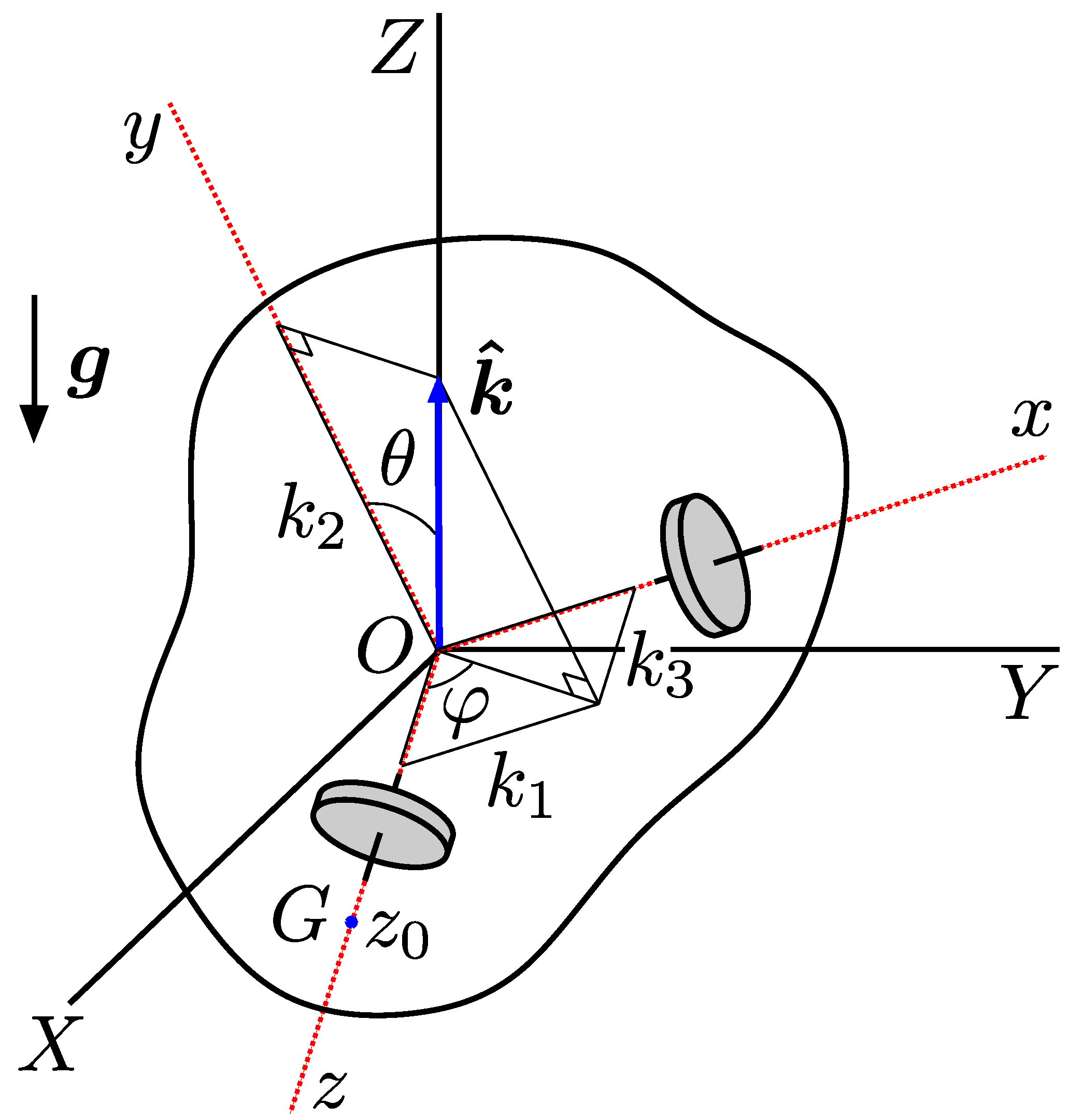
O (see
Figure 1). On the one hand, we use the space or inertial reference frame
, fixed in the space, with the direction of the
Z-axis opposite to the acceleration
g of the gravity field. On the other hand, we use the body frame
, fixed with the gyrostat, so that the axes coincide with the principal axes of inertia of the gyrostat. The relative attitude between these two reference frames results from three consecutive rotations involving three angles, such as the Euler angles. Note that, as we study the permanent rotations of the gyrostat, we only need two of these angles to define the orientation of the rotating gyrostat in the inertial fixed frame
. Let
be the inertia tensor in the body frame
and
the angular velocity of the gyrostat expressed in the body frame. Then, the angular momentum of the gyrostat, considered as a rigid body, is given by
. Results about the stability of permanent rotations under the action of only one rotor are given in [
26,
27]. The combination of these two cases, a rotor acting on the
z axis and another rotor on one of the other principal axes of inertia, will be considered here. In this sense, we take
in the vector
, the angular momentum of the rotors in the body frame. The vector
is the unitary vector in the direction of the fixed
Z axis, expressed in the body frame
. This vector can be expressed as
where the angles
and
give us the orientation of the gyrostat with respect to the inertial reference frame
(see
Figure 1). If
are the coordinates of the center of mass
G in the body frame, the equations of motion result to be (see, e.g., [
6,
44])
Under these hypotheses, permanent rotations appear as the equilibrium points of Equation (
2) and we have the following result.
Theorem 1. There are two families of equilibrium points. The first one is given by those points of the formwhere and such that The second one is defined by points of the formwhere , and such that Proof. In terms of the angles
and
, introduced in (
1), the components of the angular momentum can be written as
where
is the modulus of the angular velocity. Now, it is easy to verify that, under this parameterization, the last three equations of system (
2) vanish. Thus, we have to check when the three first equations vanish, which is found to be
Discarding the case , there are two kinds of solutions: those verifying and those that do not.
If
, the first and the third equations (
6) vanish. Thus, provided that
,
, and then all the equations are satisfied if and only if
If
, the third equation in (
6) vanishes if
By substitution of
in the second equation, the first two equations vanish at the same time if the condition
holds. □
Remark 1. This result is very similar to Theorem 1 in [27], but replacing by . Moreover, the family is a limit case of the family . However, the two conditions (4) do not need to be satisfied at the same time, but only the linear combination (3). It is worth noting that
and
give rise to equilibrium solutions with the gyrostat oriented along any direction of the space, provided that the corresponding gyrostatic moments verify appropriate conditions, as they are (
3) or (
4). Our next step will be to determine under which conditions they are stable.
3. Stability Analysis
Let us consider the stability of the solutions in Theorem 1. It is known that (
2) is a Lie–Poisson system (see [
6,
23]). The associated Hamiltonian function is given by
while the corresponding Poisson bracket is defined as
Moreover, there are two Casimir functions:
being
the component of the total angular momentum
along the fixed
Z axis. These two Casimir functions are used to define the augmented Hamiltonian given by
where
and
are suitable parameters such that the equilibrium positions are critical points of
.
Under these considerations, in order to establish sufficient stability conditions, we will make use of the classical Energy-Casimir method [
43,
45] and, more precisely, of a generalized result given by Ortega and Ratiu [
41], which reads as
Theorem 2 (Generalized Energy-Casimir method)
. Let be a Poisson system, and be an equilibrium of the Hamiltonian vector field . If there is a set of conserved quantities for whichandis definite for , then m is stable. If , m is always stable. Let us proceed to the application of this result. To begin with, we need to identify the space
W, which is defined from Equations (
9) and (
10) as
Taking into account the parameterization (
1), (
5), we obtain
Solving the system
, and identifying the six vectors of the canonic basis in
,
with
, we find that
W is generated by the following four vectors
provided
. Now, let us consider a vector
v in
W, expressed as
where
,
. Thus, the quadratic form
in the variables
is obtained from
. In this way, we obtain
where
3.1. Stability of the Equilibrium
We first focus on the equilibrium in order to give both sufficient and necessary conditions of stability. In this way, for the sufficient conditions, we obtain the following result.
Theorem 3. If , the equilibrium is stable if is the largest moment of inertia, or if and Proof. First of all, it is deduced that
is a critical point of the augmented Hamiltonian (
11) if
Substituting this value into Equation (
13), the corresponding reduced Hessian matrix is positive definite if all the principal minors are positive. In this case, if we denote the minors by
(
), we have
where
Taking into account that and are positive (), we only need to verify whether and are positive. On the one hand, it is clear that if is the largest moment of inertia, both and are positive, as well as and . As a consequence, is stable.
On the other hand, if is not the largest moment of inertia, we distinguish two cases, depending on the sign of .
Case 1.. In this case, as
is not the largest moment of inertia, it must be
and the sign of
and
can be either positive or negative. To have stability, both of them must be positive. However,
and, if
is positive, also
is positive. Thus, it is enough to check when
. By considering
as a second-degree polynomial in
, it is easy to verify that it has two real roots given by
Taking into account that the coefficient of is positive, is positive if , and the theorem is proven.
Case 2.. In this case, if
, both
and
are positive and, as a consequence,
, and nothing can be said about the stability. On the contrary, if
, we have
and
cannot be positive if
is negative. Thus,
and
cannot be positive at the same time and, again, nothing can be said about the stability. □
Remark 2. In the case , the equations of motion (2) reduce to Then, we have an equilibrium solution if and . In this way, we recover a particular case of the equilibrium , mentioned in [26], where it is established that there is stability if is the largest moment of inertia, or if andin agreement with the result stated in Theorem 3. It is worth noting that the last condition, (19), is no more than a limiting case of Theorem 3. Indeed, when , the roots given by Equation (18) tend to the limit valueand stability is achieved if . Taking into account the relation between and ω, we obtain the condition (19). Nonetheless, if we proceed from the very beginning, computing the principal minors of the reduced Hessian matrix in when , we arrive at From here, it follows that, if and , all the principal minors are positive. In this way, we recover again the conditions of stability of Theorem 3, which are the same as given in [26]. To complete the analysis of the sufficient stability conditions for the equilibrium , we are left with the case . In this way, we have the following result.
Theorem 4. If , the equilibrium is stable if is the largest moment of inertia, or if and ω satisfies the inequality Proof. In this case, the equilibrium
is a critical point of the augmented Hamiltonian if Equation (
15) is satisfied. Moreover, we have permanent rotations when the gyrostatic moments are given by
Now, we follow the steps for the application of Theorem 2, taking into account that
. We only consider the case
, as the case
is analogous. It can be seen that if
(the case
has been already considered in Remark 2), the reduced space
W is generated by the vectors
Now, the Hessian matrix for the augmented Hamiltonian in the reduced space
is given by
where
By means of the Sylvester criterion, the matrix is positive definite if the principal minors are all positive. For them, we obtain
where
It is clear that, if
is the largest moment of inertia, all the principal minors are positive and the equilibrium is stable. On the contrary, if
is not the largest moment of inertia and
, it follows that
and
if
, or equivalently, if the inequality of the hypothesis of the theorem holds. Since
and
, it follows that
and then
. Therefore, the equilibrium point is stable if (
21) is satisfied, as stated in the theorem.
In the case
, as is the case in Theorem 3,
and
cannot be positive at the same time. On the one hand, if
,
and consequently
. On the other hand, if
, it must be
. However,
and, then,
, as well as
, is negative. □
Remark 3. We note that Theorem 4 is also a limit case of Theorem 3. Indeed, if , taking into account that , condition (14) reduces to . Remark 4. For the three situations not covered by Theorems 3 and 4, namely is the largest moment of inertia, and , we can also obtain stable rotations by acting on the gyrostatic moment. Indeed, the result is analogous by considering the parameterization As a consequence, it is enough to replace by and interchange and .
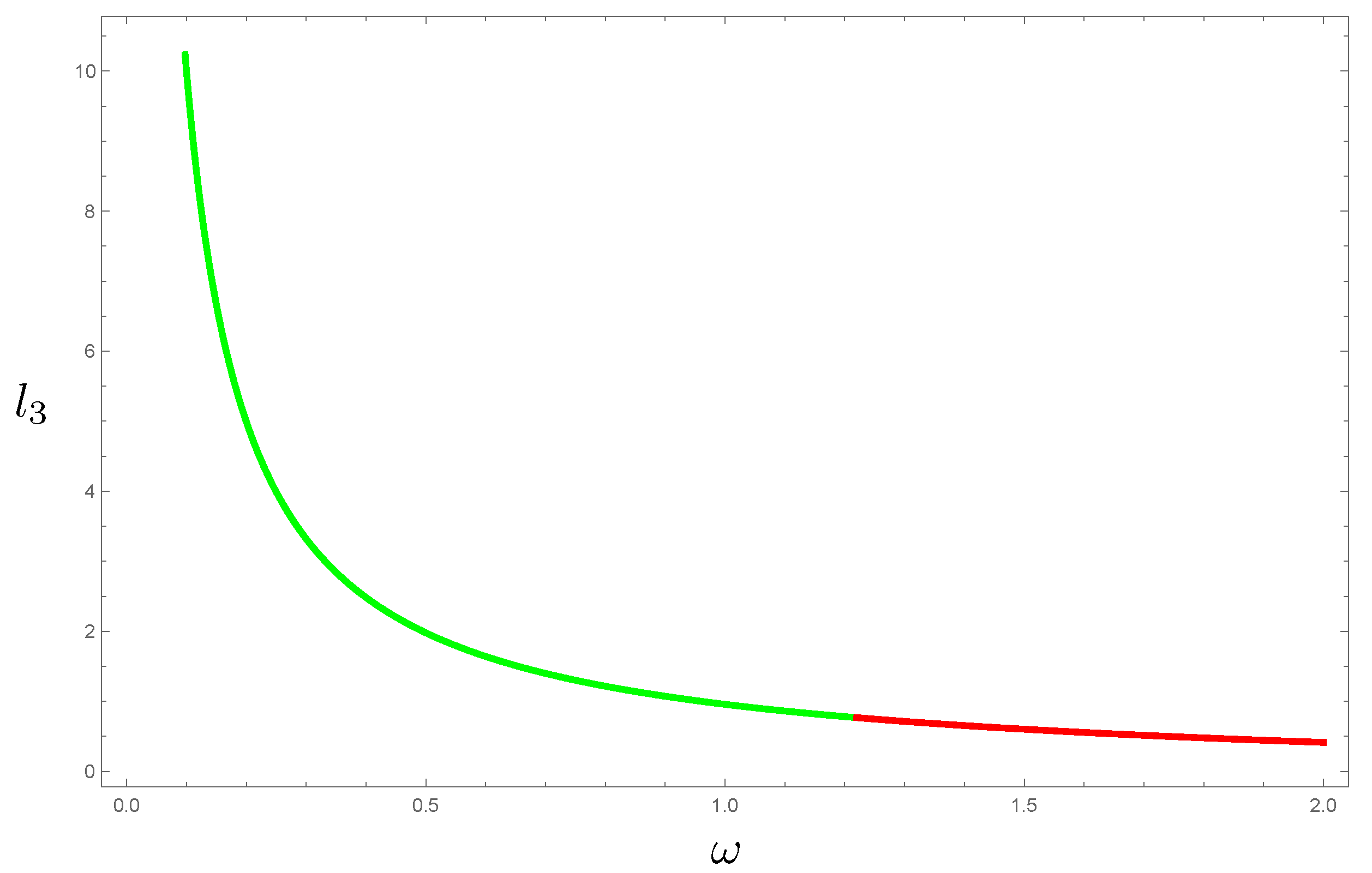
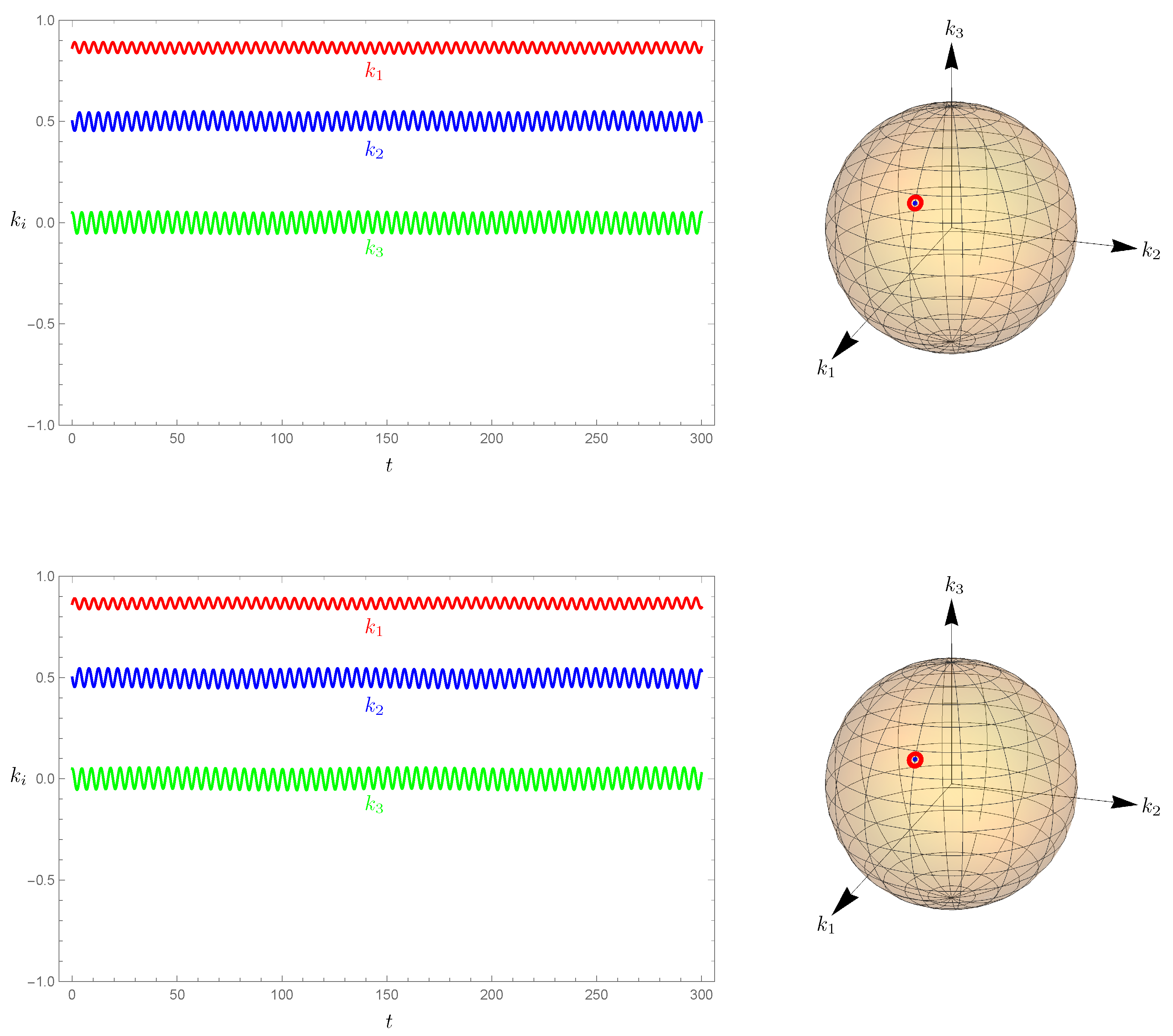
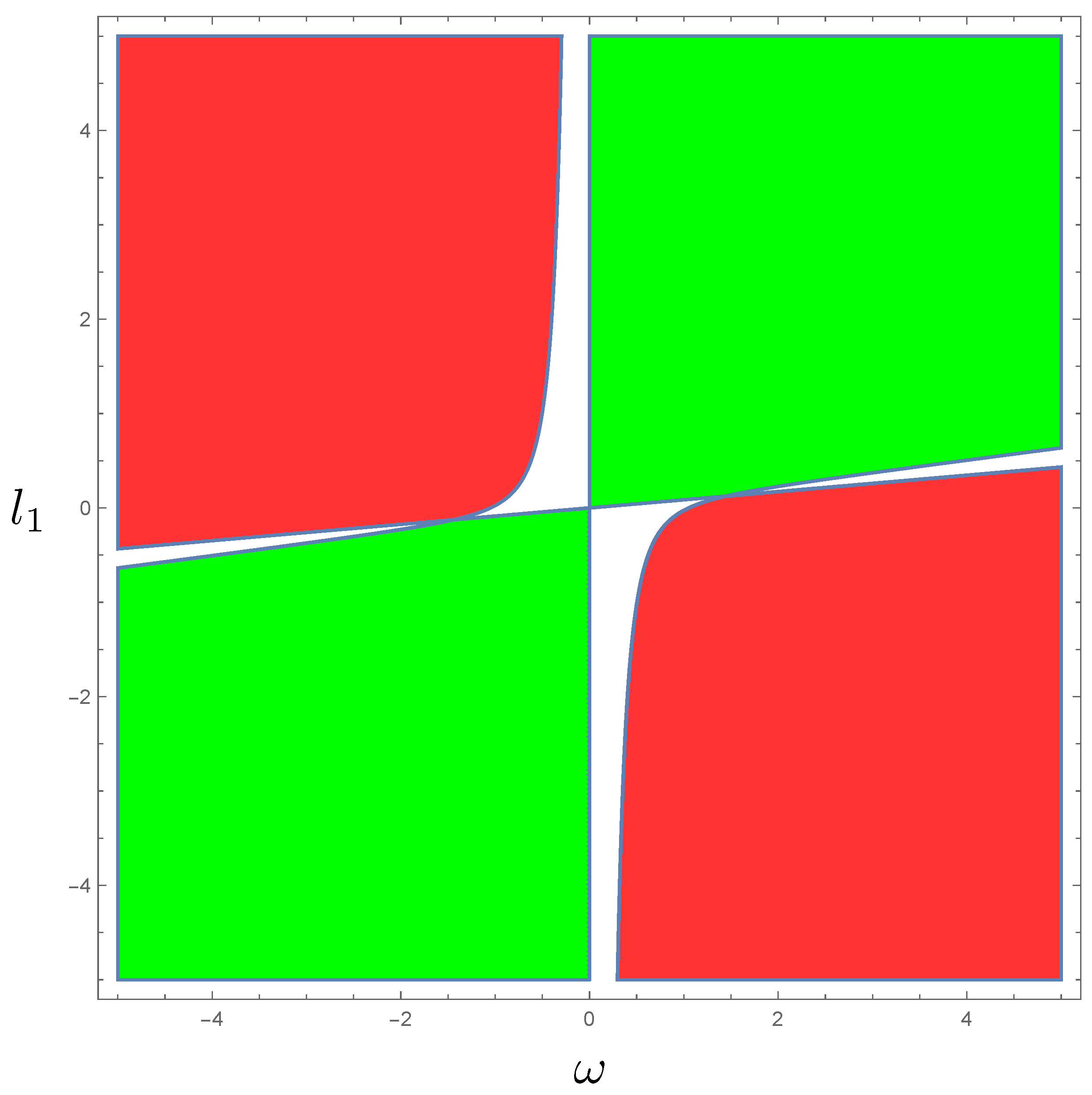
Remark 5. It follows from Theorem 4 that, if , there exist stable permanent rotations if is small enough. The same conclusion is obtained from Theorem 3, introducing the relation between and ω, given by the second constraint in (4), into (14). Indeed, we can derive stability curves for each orientation, once the moments of inertia and the position of the center of mass are fixed. In this way, Equation (4) determines in the plane ω– a curve of equilibria, with a stable part where sufficient conditions, given by Equation (14), are satisfied. This curve is depicted in Figure 2 for a test example with , , , and a given orientation . The green part of the curve corresponds to stable rotations and the red one to the part where sufficient conditions are not satisfied. Figure 3 shows the evolution of a trajectory close to the equilibrium point, when the starting orientation is . In the upper panel, we observe the stable character of the equilibrium position when is chosen in the green part of the curve, whereas the lower one shows the unstable character when is on the red part. This behavior suggests that sufficient and necessary conditions can be the same. However, necessary conditions are readily derived by analyzing the associated linear system.
Theorem 5. If the equilibrium is stable and , then , where is given by (16). Analogously, if , is stable if , where is given by (20) if and by (24) if . Proof. Stability of
implies spectral stability, so that the real part of the eigenvalues associated with the linear system at
cannot be greater than 0. It can be seen that the eigenvalues are the roots of a polynomial equation of the form
where
, in the case
. If (
26) does not have roots with a positive real part, it must be
and, consequently,
. The case
is proven in the same way. □
As a consequence, sufficient and necessary conditions are the same when is the largest moment of inertia or . For the remaining cases, further investigation is needed. However, taking into account Remark 4, by acting on the gyrostatic moment in these situations, we obtain a coincidence between necessary and sufficient conditions.
3.2. Stability of the Equilibrium
From the results in the previous subsection, we conclude that two rotors are enough to have stable permanent rotations around an axis oriented in any direction, regardless of the values of the moments of inertia, if the center of mass lies on one of the principal axes and one of the rotors is aligned with the same axis. The only possible exception is the family
, which is a limit case of
when
. Unfortunately, previous results cannot be applied because some of the principal minors are singular for
. This is the reason that it must be considered separately, using the condition (
3). In this way, we arrive at the following result.
Theorem 6. The equilibrium is stable if
and,
and,
and,
where and are the maximum and minimum, respectively, ofand is the maximum of Proof. First of all,
is a critical point of the augmented Hamiltonian if
Substituting these values into Equation (
13), we obtain that the principal minors of the reduced Hessian matrix are given by
where
We note that , and are positive, and the sufficient stability conditions reduce to and . Let us assume that ; then, both and must be greater than zero. It is easy to verify that under the hypothesis of item 1 in the theorem. Indeed, it is enough to solve in terms of .
A similar situation appears if . In this case, both and must be negative, which immediately follows from the conditions of item 2.
We are left with the case
, which corresponds to the two equilibrium positions
where the plus sign stands for
and the minus sign for
. They appear if the existence condition
is verified. Moreover, they are critical points of the augmented Hamiltonian when
The space
W is now generated by the vectors
and the corresponding reduced Hessian matrix reads as
From here, the principal minors are given by
We note that all the minors are positive if satisfies the conditions in item 3. Thus, by the Sylvester criterion, the reduced Hessian matrix is positive definite and the equilibrium position is stable. □
To finish the stability analysis, we provide necessary stability conditions for the family of equilibria , which arise from the spectral stability of the associated linear system.
Theorem 7. If is stable, then , where is given by (28) if and by (30) if . Proof. We proceed as in Theorem 5. In this way, the characteristic polynomial associated with the equilibrium
has also the form
For the case
, we obtain
, where
is given by (
28). A necessary condition to have spectral stability is
, which implies
. In the case
, we obtain
, with
as in (
30) and, again, spectral stability implies
. □
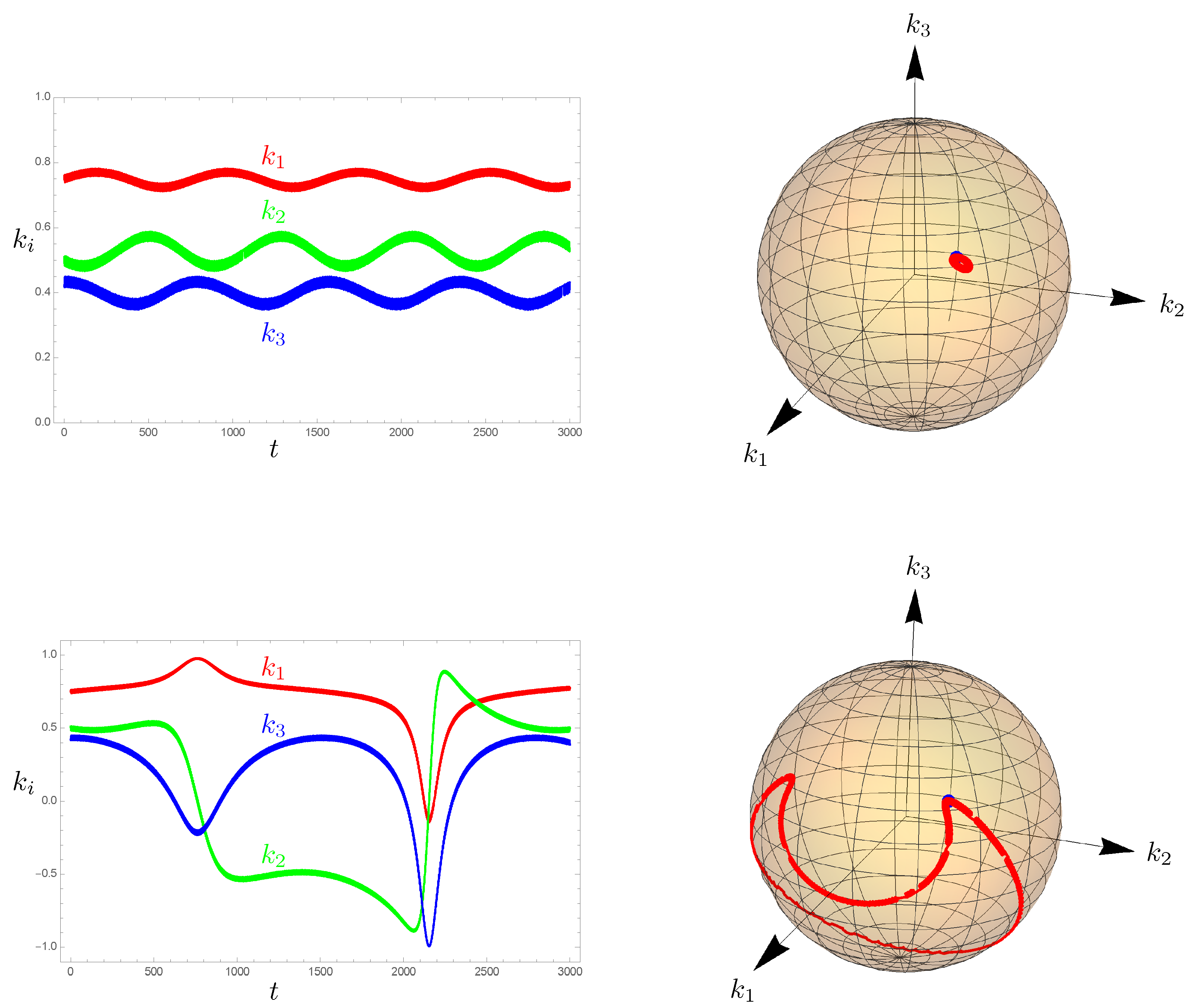
Remark 6. Note that, in the case , sufficient and necessary stability conditions are the same. However, it seems that necessary conditions are enough to have stable rotations. As an example, we take the case of a gyrostat with , , , and . Figure 4 shows, in the plane ω–, the regions where the necessary stability conditions are satisfied, and the green color represents the region where the sufficient stability conditions are also satisfied. Besides the expected symmetry with respect to the origin, the green and red regions have in common the points . Let us take and two values of , one inside the green region () and another one inside the red one (). Figure 5 shows the time evolution of the vector , when the initial condition is slightly deviated from the equilibrium position. The upper panel corresponds to the case , inside the green area, and the lower one to the case , inside the red area. There is no significant difference between the two time histories, which constitutes evidence that necessary stability conditions are, probably, sufficient ones. Remark 7. It is worth noting that when the conditions (4) vanish. Thus, the stability boundary corresponds to the bifurcation of the family into the family. Remark 8. We stress that all the above results are also valid for a more general case. Indeed, by adding to the three first equations of the differential system (2) with circular gyroscopic forces M with componentswhere is an arbitrary function, we obtain the same equilibrium solutions reported in Theorem 1. Furthermore, as proven in [46], (7), (9) and (10) remain as first integrals and the stability results are also valid for this generalized system.