


Turning the Page: Pre-Class AI-Generated Podcasts Improve Student Outcomes in Ecology and Environmental Biology


Abstract
1. Introduction
2. Materials and Methods
2.1. Course Context and Participants
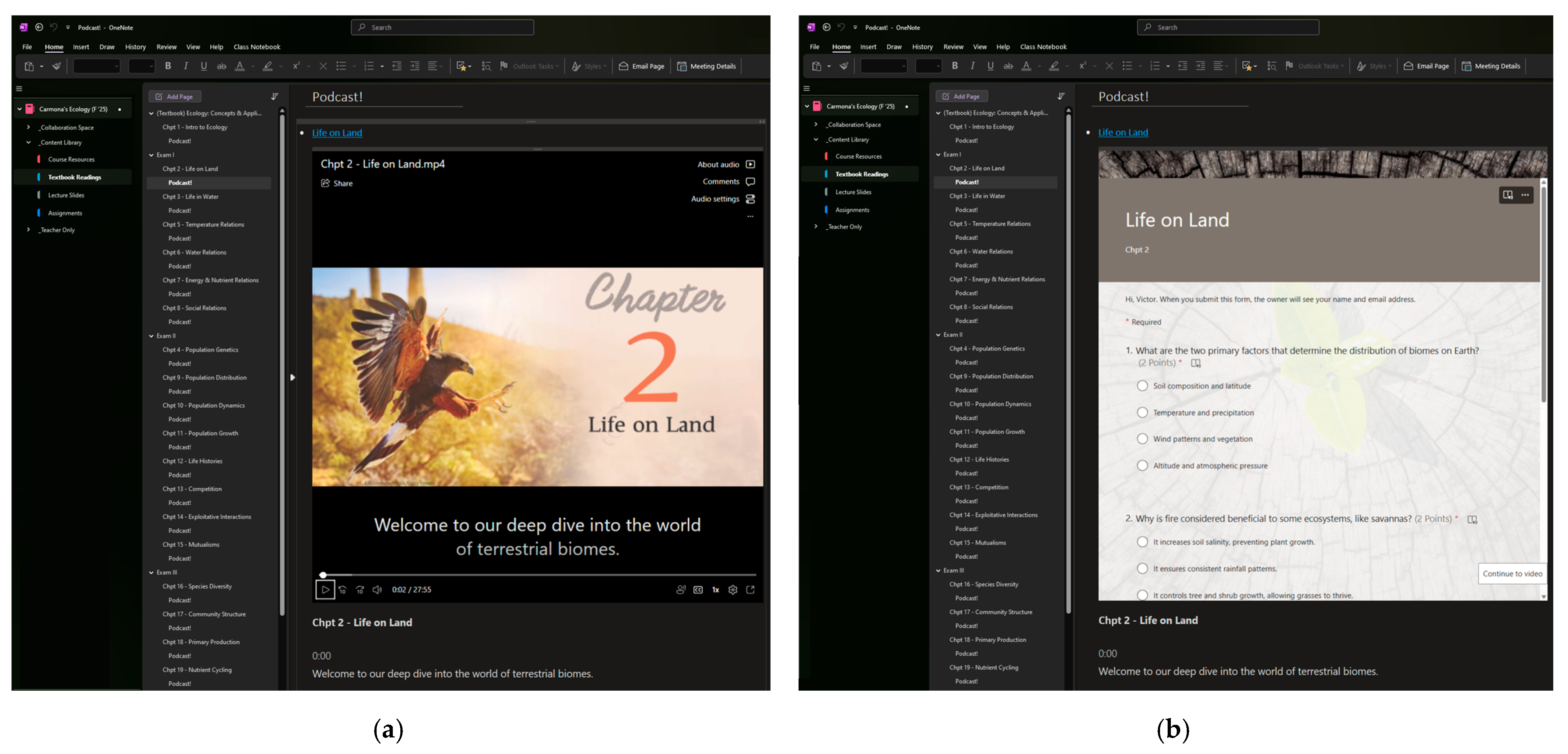
2.2. Intervention Design: AI-Generated Podcasts
2.3. Course Structure and Alignment
2.4. Pre- and Post-Intervention Surveys
2.5. Data Analysis
3. Results
3.1. Pre-Course Survey Responses
3.2. Post-Course Survey Responses
3.3. Correlations with Course Performance
3.4. Instructor Observations of In-Class Engagement
4. Discussion
5. Conclusions
Author Contributions
Funding
Institutional Review Board Statement
Informed Consent Statement
Data Availability Statement
Acknowledgments
Conflicts of Interest
Correction Statement
Abbreviations
| ChatGPT | Chat Generative Pre-trained Transformer |
| COVID-19 | Coronavirus disease 2019 |
| GenAI | Generative Artificial Intelligence |
| NotebookLM | Notebook Language Model |
| Portable Document Format | |
| STEM | Science, Technology, Engineering, and Mathematics |
| WAV | Waveform Audio File Format |
| VR | Virtual Reality |
Appendix A
Student Survey Instrument: Pre- and Post-Course Survey on Learning Preferences and Podcast Use

| Pre-Course Survey | Post-Course Survey |
|---|---|
| Exploring Your Learning Preferences Welcome! This short survey is part of a research initiative designed to better understand how students engage with course materials and learning tools in STEM education—including newer approaches like using podcasts to support preparation and comprehension. Your responses will help us tailor resources to your learning preferences and improve how we support students in this course. The survey takes approximately 5–10 min to complete. All responses are anonymous and confidential. Your feedback is appreciated and will contribute to making STEM learning more effective, inclusive, and responsive to diverse student needs. | Reflecting on Your Learning Preferences Thank you for being part of this course. This short survey is part of an ongoing research initiative exploring how students engage with STEM course materials and learning tools—including the podcasts you’ve been using to support preparation and comprehension. Now that you’ve had a chance to interact with these resources throughout the semester, we’d like to hear your reflections. Your responses will help us better understand how these tools supported your learning and how we can improve them for future students. The survey takes approximately 5–10 min to complete. All responses are anonymous and confidential. Your input is important and will contribute to making STEM learning more effective, inclusive, and responsive to student needs. |
☐ Often ☐ Sometimes ☐ Rarely ☐ Never |
☐ Often ☐ Sometimes ☐ Rarely ☐ Never |
☐ Somewhat confident ☐ Neutral ☐ Not very confident ☐ Not at all confident |
☐ Somewhat confident ☐ Neutral ☐ Not very confident ☐ Not at all confident |
☐ Somewhat engaging ☐ Neutral ☐ Somewhat disengaging ☐ Very disengaging |
☐ Somewhat engaging ☐ Neutral ☐ Somewhat disengaging ☐ Very disengaging |
☐ Difficulty understanding the material ☐ Lack of motivation ☐ Other |
☐ Difficulty understanding the material ☐ Lack of motivation ☐ Other |
|
|
☐ Yes, occasionally ☐ No, but I am interested ☐ No, and I am not interested |
☐ While doing other tasks ☐ Before bedtime ☐ While studying ☐ I did not listen to them |
☐ Reviewing lecture slides or notes ☐ Watching videos ☐ Discussing with peers ☐ I do not prepare before lectures |
☐ Somewhat effective ☐ Neutral ☐ Not very effective ☐ Not at all effective |
☐ Somewhat effective ☐ Neutral ☐ Not very effective ☐ Not at all effective |
☐ Yes, somewhat ☐ Neutral ☐ No, not really ☐ No, not at all |
☐ Sometimes ☐ Rarely ☐ No, I understand most concepts before lecture |
☐ Slightly more engaging ☐ About the same ☐ Slightly less engaging ☐ Much less engaging |
☐ Somewhat likely ☐ Neutral ☐ Unlikely ☐ Very unlikely |
☐ Somewhat likely ☐ Neutral ☐ Unlikely ☐ Very unlikely |
☐ Watching videos ☐ Listening to audio resources ☐ Group discussions ☐ Hands-on activities |
☐ In some cases ☐ No preference ☐ Not really ☐ Definitely not |
☐ Somewhat confident ☐ Neutral ☐ Not very confident ☐ Not at all confident |
☐ Yes, somewhat ☐ Neutral ☐ No, not really ☐ No, not at all |
☐ Lack of support ☐ Lack of interest ☐ Time commitment ☐ Other |
☐ Yes, somewhat ☐ Neutral ☐ No, not really ☐ No, not at all |
|
☐ No change ☐ My confidence has decreased |
☐ Somewhat likely ☐ Neutral ☐ Somewhat unlikely ☐ Very unlikely |
☐ Maybe ☐ No ☐ Not sure |
☐ Faculty office hours ☐ Online learning resources ☐ Mentorship programs ☐ None of the above |
|
☐ Often ☐ Sometimes ☐ Rarely ☐ Never | |
☐ Somewhat interested ☐ Neutral ☐ Not very interested ☐ Not at all interested | |
☐ Yes, somewhat ☐ Neutral ☐ No, probably not ☐ No, definitely not | |
☐ Somewhat likely ☐ Neutral ☐ Unlikely ☐ Very unlikely | |
☐ While doing other tasks ☐ Before bedtime ☐ While studying ☐ I wouldn’t listen to them |
References
- Abbas, M., Jam, F. A., & Khan, T. I. (2024). Is it harmful or helpful? Examining the causes and consequences of generative AI usage among university students. International Journal of Educational Technology in Higher Education, 21(1), 10. [Google Scholar] [CrossRef] [Scilit]
- Armstrong, K. E., Goodboy, A. K., & Shin, M. (2022). Pandemic pedagogy and emergency remote instruction: Transitioning scheduled in-person courses to online diminishes effective teaching and student learning outcomes. Southern Communication Journal, 87(1), 56–69. [Google Scholar] [CrossRef] [Scilit]
- Bassett, K., Olbricht, G. R., & Shannon, K. B. (2020). Student preclass preparation by both reading the textbook and watching videos online improves exam performance in a partially flipped course. CBE—Life Sciences Education, 19(3), ar32. [Google Scholar] [CrossRef] [Scilit]
- Bone, J. K., Bu, F., Sonke, J. K., & Fancourt, D. (2025). The decline in reading for pleasure over 20 years of the American Time Use Survey. iScience, 28(9), 113288. [Google Scholar] [CrossRef] [Scilit]
- Carmona-Galindo, V. D., Velado-Cano, M. A., & Groat-Carmona, A. M. (2025). The ecology of climate change: Using virtual reality to share, experience, and cultivate local and global perspectives. Education Sciences, 15(3), 290. [Google Scholar] [CrossRef] [Scilit]
- Clinton-Lisell, V. (2026). Comparing quizzes and social annotation for pre-class reading accountability. Teaching of Psychology, 53(1), 18–23. [Google Scholar] [CrossRef] [Scilit]
- Denny, P., Gulwani, S., Heffernan, N. T., Käser, T., Moore, S., Rafferty, A. N., & Singla, A. (2024). Generative AI for education (GAIED): Advances, opportunities, and challenges. arXiv preprint, arXiv:2402.01580. [Google Scholar] [CrossRef] [Scilit]
- Desmedt, C. P., Budts, W., De Vos, M., & Moons, P. (2025). Artificial intelligence-generated podcasts open new doors to make science accessible: A mixed-method evaluation of quality and the potential for science communication. European Journal of Cardiovascular Nursing, 24(6), 885–895. [Google Scholar] [CrossRef] [Scilit]
- Dhulia, M. (2025, August 4). AI, but verify: Navigating future of learning. The Times of India. Available online: https://www.timesofindia.indiatimes.com/city/delhi/ai-but-verify-navigating-future-of-learning/articleshow/123080374.cms (accessed on 25 August 2025).
- Dhuliawala, S., Komeili, M., Xu, J., Raileanu, R., Li, X., Celikyilmaz, A., & Weston, J. (2023). Chain-of-verification reduces hallucination in large language models. arXiv preprint, arXiv:2309.11495. [Google Scholar]
- Do, T. D., Shafqat, U. B., Ling, E., & Sarda, N. (2025, April 26–May 1). PAIGE: Examining learning outcomes and experiences with personalized AI-generated educational podcasts. 2025 CHI Conference on Human Factors in Computing Systems, Yokohama, Japan. [Google Scholar]
- Dunbar-Wallis, A., Katcher, J., Moore, W., & Corwin, L. (2024). Bee the CURE: Increasing student science self-efficacy, science identity, and predictors of scientific civic engagement in a community college CURE. CBE—Life Sciences Education, 23, ar46. [Google Scholar] [CrossRef] [Scilit]
- Dunlosky, J., Rawson, K. A., Marsh, E. J., Nathan, M. J., & Willingham, D. T. (2013). Improving students’ learning with effective learning techniques: Promising directions from cognitive and educational psychology. Psychological Science in the Public Interest, 14(1), 4–58. [Google Scholar] [CrossRef] [Scilit]
- Enríquez, I. G., Cutuli, M. S., & Cáceres, O. I. M. (2023). Enhancing collaborative learning in higher education through podcast production: An experiential approach with anthropology and tourism students. Education Sciences, 13(9), 898. [Google Scholar] [CrossRef] [Scilit]
- Fan, L., Deng, K., & Liu, F. (2025). Educational impacts of generative artificial intelligence on learning and performance of engineering students in China. Scientific Reports, 15(1), 26521. [Google Scholar] [CrossRef] [Scilit]
- Fiorella, L., & Mayer, R. E. (2015). Learning as a generative activity. Cambridge University Press. [Google Scholar]
- Freeman, S., Eddy, S. L., McDonough, M., Smith, M. K., Okoroafor, N., Jordt, H., & Wenderoth, M. P. (2014). Active learning increases student performance in science, engineering, and mathematics. Proceedings of the National Academy of Sciences USA, 111(23), 8410–8415. [Google Scholar] [CrossRef] [Scilit]
- García-Peñalvo, F. J. (2021). Avoiding the dark side of digital transformation in teaching. An institutional reference framework for eLearning in higher education. Sustainability, 13(4), 2023. [Google Scholar] [CrossRef] [Scilit]
- Giannakos, M., Azevedo, R., Brusilovsky, P., Cukurova, M., Dimitriadis, Y., Hernandez-Leo, D., Järvelä, S., Mavrikis, M., & Rienties, B. (2025). The promise and challenges of generative AI in education. Behaviour & Information Technology, 44(11), 2518–2544. [Google Scholar]
- Güven, Ç., Alishahi, A., Brighton, H., Nápoles, G., Olier, J. S., Šafář, M., Postma, E., Shterionov, D., De Sisto, M., & Vanmassenhove, E. (2025). AI in support of diversity and inclusion. arXiv preprint, arXiv:2501.09534. [Google Scholar] [CrossRef] [Scilit]
- Holmes, W. (2020). Artificial intelligence in education. In Encyclopedia of education and information technologies (pp. 88–103). Springer. [Google Scholar]
- James, P. (2018). The biology of urban environments (5th ed.). Oxford University Press. [Google Scholar]
- Jia, S., Bit, S., Searls, E., Lauber, M. V., Fan, P., Wang, W. M., Claus, L. A., Jasodanand, V. H., Veerapaneni, D., & Au, R. (2025). PodGPT: An audio-augmented large language model for research and education. npj Biomedical Innovations, 2(1), 26. [Google Scholar] [CrossRef] [Scilit] [PubMed]
- Kasneci, E., Seßler, K., Küchemann, S., Bannert, M., Dementieva, D., Fischer, F., Gasser, U., Groh, G., Günnemann, S., & Hüllermeier, E. (2023). ChatGPT for good? On opportunities and challenges of large language models for education. Learning and Individual Differences, 103, 102274. [Google Scholar] [CrossRef] [Scilit]
- Katsamakas, E., Pavlov, O. V., & Saklad, R. (2024). Artificial intelligence and the transformation of higher education institutions: A systems approach. Sustainability, 16(14), 6118. [Google Scholar] [CrossRef] [Scilit]
- Kerssens, N., & Van Dijck, J. (2022). Governed by edtech? Valuing pedagogical autonomy in a platform society. Harvard Educational Review, 92(2), 284–303. [Google Scholar] [CrossRef] [Scilit]
- Kinzie, J. (2023). Tracking student (Dis) engagement through the pandemic: What colleges & universities can do to foster an engagement reset. Journal of Postsecondary Student Success, 2(2), 1–14. [Google Scholar] [CrossRef] [Scilit]
- Kleimola, R., Hirsto, L., & Ruokamo, H. (2025). Promoting higher education students’ self-regulated learning through learning analytics: A qualitative study. Education and Information Technologies, 30(4), 4959–4986. [Google Scholar] [CrossRef] [Scilit]
- Kraal, E., Sirrakos, G., Guertin, L., Epstein, A., & Simmens, G. (2022). Impact of student produced audio narrative (SPAN) assignments on students’ perceptions and attitudes toward science in introductory geoscience courses. Journal of Geoscience education, 70(2), 208–222. [Google Scholar] [CrossRef] [Scilit]
- Lucas, K. L., & Vandergon, T. L. (2024). Science identity in undergraduates: A comparison of first-year biology majors, senior biology majors, and non-STEM majors. Education Sciences, 14(6), 624. [Google Scholar] [CrossRef] [Scilit]
- Mayer, R. E. (2002). Multimedia learning. In Psychology of learning and motivation (Vol. 41, pp. 85–139). Elsevier. [Google Scholar]
- McClanahan, E. B., & McClanahan, L. L. (2002). Active learning in a non-majors biology class: Lessons learned. College Teaching, 50(3), 92–96. [Google Scholar] [CrossRef] [Scilit]
- McMurtrie, B. (2024). Is this the end of reading? The Chronicle of Higher Education. Available online: https://www.chronicle.com/article/is-this-the-end-of-reading (accessed on 25 August 2025).
- Meyer, A., Rose, D. H., & Gordon, D. (2014). Universal design for learning: Theory and practice. CAST, Inc. [Google Scholar]
- Michel-Villarreal, R., Vilalta-Perdomo, E., Salinas-Navarro, D. E., Thierry-Aguilera, R., & Gerardou, F. S. (2023). Challenges and opportunities of generative AI for higher education as explained by ChatGPT. Education Sciences, 13(9), 856. [Google Scholar] [CrossRef] [Scilit]
- Miller, D., Deshler, J., McEldowney, T., Stewart, J., Fuller, E., Pascal, M., & Michaluk, L. (2021). Supporting student success and persistence in STEM with active learning approaches in emerging scholars classrooms. Frontiers in Education, 6, 667918. [Google Scholar] [CrossRef] [Scilit]
- Mizrachi, D., & Salaz, A. M. (2022). Reading format attitudes in the time of COVID. The Journal of Academic Librarianship, 48(4), 102552. [Google Scholar] [CrossRef] [Scilit]
- Möller, M., Nirmal, G., Fabietti, D., Stierstorfer, Q., Zakhvatkin, M., Sommerfeld, H., & Schütt, S. (2024). Revolutionising distance learning: A comparative study of learning progress with AI-driven tutoring. arXiv preprint, arXiv:2403.14642. [Google Scholar] [CrossRef] [Scilit]
- Nicholls, K. (2025). The latest awful ed-tech buzzword: “Learnings”. The Chronicle of Higher Education. Available online: https://www.chronicle.com/article/the-rise-of-a-new-ed-tech-buzzword (accessed on 25 August 2025).
- Nixon, N., Lin, Y., & Snow, L. (2024). Catalyzing equity in STEM teams: Harnessing generative AI for inclusion and diversity. Policy Insights from the Behavioral and Brain Sciences, 11(1), 85–92. [Google Scholar] [CrossRef] [Scilit] [PubMed]
- Nyman, F. (2024). “You’re not learning skills—you’re just realizing what you can do”: A preliminary study of self-regulation in higher education. Frontiers in Education, 9, 1418297. [Google Scholar] [CrossRef] [Scilit]
- O’Bannon, B. W., Lubke, J. K., Beard, J. L., & Britt, V. G. (2011). Using podcasts to replace lecture: Effects on student achievement. Computers & Education, 57(3), 1885–1892. [Google Scholar] [CrossRef] [Scilit]
- Panadero, E. (2017). A review of self-regulated learning: Six models and four directions for research. Frontiers in Psychology, 8, 422. [Google Scholar] [CrossRef] [Scilit]
- Pfeifer, M. A., Zajic, C., Isaacs, J. M., Erickson, O. A., & Dolan, E. L. (2024). Beyond performance, competence, and recognition: Forging a science researcher identity in the context of research training. International Journal of STEM Education, 11(1), 19. [Google Scholar] [CrossRef] [Scilit]
- Pilotti, M., El Alaoui, K., Khan, R., & Abdelsalam, H. (2023). “Do I need to read to do well?”: A post-pandemic case study of the reading habits and academic attainment of STEM and non-STEM students. Discover Education, 2(1), 34. [Google Scholar] [CrossRef] [Scilit]
- Qian, Y. (2025). Pedagogical applications of generative AI in higher education: A systematic review of the field. TechTrends, 69, 1105–1120. [Google Scholar] [CrossRef] [Scilit]
- Ravšelj, D., Keržič, D., Tomaževič, N., Umek, L., Brezovar, N., A. Iahad, N., Abdulla, A. A., Akopyan, A., Aldana Segura, M. W., & AlHumaid, J. (2025). Higher education students’ perceptions of ChatGPT: A global study of early reactions. PLoS ONE, 20(2), e0315011. [Google Scholar] [CrossRef] [Scilit]
- Rime, J., Pike, C., & Collins, T. (2022). What is a podcast? Considering innovations in podcasting through the six-tensions framework. Convergence, 28(5), 1260–1282. [Google Scholar] [CrossRef] [Scilit]
- Selwyn, N. (2019). Should robots replace teachers?: AI and the future of education. John Wiley & Sons. [Google Scholar]
- Sher, A., & Molles, M. (2022). Ecology: Concepts and applications (9th ed.). McGraw Hill. [Google Scholar]
- Shortlidge, E. E., Gray, M. J., Estes, S., & Goodwin, E. C. (2024). The value of support: STEM intervention programs impact student persistence and belonging. CBE—Life Sciences Education, 23(2), ar23. [Google Scholar] [CrossRef] [Scilit]
- Symeou, L., Louca, L., Kavadella, A., Mackay, J., Danidou, Y., & Raffay, V. (2025). Development of evidence-based guidelines for the integration of generative AI in university education through a multidisciplinary, consensus-based approach. European Journal of Dental Education, 29(2), 285–303. [Google Scholar] [CrossRef] [Scilit] [PubMed]
- Tanner, K. D. (2012). Promoting student metacognition. CBE—Life Sciences Education, 11(2), 113–120. [Google Scholar] [CrossRef] [Scilit]
- Theobald, E. J., Hill, M. J., Tran, E., Agrawal, S., Arroyo, E. N., Behling, S., Chambwe, N., Cintrón, D. L., Cooper, J. D., & Dunster, G. (2020). Active learning narrows achievement gaps for underrepresented students in undergraduate science, technology, engineering, and math. Proceedings of the National Academy of Sciences USA, 117(12), 6476–6483. [Google Scholar] [CrossRef] [Scilit]
- Thornton, L., Rose-Wiles, L. M., & Shea, G. (2024). Will print books survive? Print book circulation and in-house use at a mid-sized academic library. The Journal of Academic Librarianship, 50(6), 102979. [Google Scholar] [CrossRef] [Scilit]
- TIBCO statistica. (2017). (Version 13.3). TIBCO Software Inc.
- Valdivieso, T., & González, O. (2025). Generative AI tools in salvadoran higher education: Balancing equity, ethics, and knowledge management in the global south. Education Sciences, 15(2), 214. [Google Scholar] [CrossRef] [Scilit]
- Wakefield, A., Pike, R., & Amici-Dargan, S. (2023). Learner-generated podcasts: An authentic and enjoyable assessment for students working in pairs. Assessment & Evaluation in Higher Education, 48(7), 1025–1037. [Google Scholar]
- Wang, J., & Fan, W. (2025). The effect of ChatGPT on students’ learning performance, learning perception, and higher-order thinking: Insights from a meta-analysis. Humanities and Social Sciences Communications, 12(1), 1–21. [Google Scholar] [CrossRef] [Scilit]
- Whitcomb, K. M., Cwik, S., & Singh, C. (2021). Not all disadvantages are equal: Racial/ethnic minority students have largest disadvantage among demographic groups in both STEM and non-STEM GPA. Aera Open, 7, 23328584211059823. [Google Scholar] [CrossRef] [Scilit]
| Dimension | Survey Indicator | Ecology | Environmental Biology |
|---|---|---|---|
| Podcast Use Frequency | Students reporting podcast use “Often” or “Always” | 69.2% of respondents; 46.2% “Always” | 69.2% of respondents; 34.8% “Always” |
| Perceived Comprehension | Podcasts improved understanding of course material | >80% agreement | >80% agreement |
| Preparedness for Lecture | Reported increased preparedness after podcast use | Majority agreement | Majority agreement |
| Confidence with Content | Self-reported confidence post-intervention | Primarily “Somewhat confident”; none “Very confident” | Shift toward higher confidence; 21.7% “Very confident” |
| Engagement Level | Podcasts rated as engaging | More variable; 30.8% “Somewhat engaging” | Predominantly “Very engaging” |
| Perceived Effectiveness | Podcasts effective for understanding biology concepts | Primarily “Somewhat” or “Very effective” | Primarily “Somewhat” or “Very effective” |
| Learning Modality Preference | Audio format supported learning | Preferred as a supplement | Preferred as a supplement |
| Replacement of Textbook | Support for replacing textbook reading with podcasts | Largely unsupported | Largely unsupported |
| STEM Confidence & Anxiety | Changes in STEM confidence or anxiety | Moderate increase in confidence | Greater reduction in anxiety and improved access |
Disclaimer/Publisher’s Note: The statements, opinions and data contained in all publications are solely those of the individual author(s) and contributor(s) and not of MDPI and/or the editor(s). MDPI and/or the editor(s) disclaim responsibility for any injury to people or property resulting from any ideas, methods, instructions or products referred to in the content. |
© 2026 by the authors. Licensee MDPI, Basel, Switzerland. This article is an open access article distributed under the terms and conditions of the Creative Commons Attribution (CC BY) license.
Share and Cite
Díaz, L.; Carmona-Galindo, V.D. Turning the Page: Pre-Class AI-Generated Podcasts Improve Student Outcomes in Ecology and Environmental Biology. Educ. Sci. 2026, 16, 168. https://doi.org/10.3390/educsci16010168
Díaz L, Carmona-Galindo VD. Turning the Page: Pre-Class AI-Generated Podcasts Improve Student Outcomes in Ecology and Environmental Biology. Education Sciences. 2026; 16(1):168. https://doi.org/10.3390/educsci16010168
Chicago/Turabian StyleDíaz, Laura, and Víctor D. Carmona-Galindo. 2026. "Turning the Page: Pre-Class AI-Generated Podcasts Improve Student Outcomes in Ecology and Environmental Biology" Education Sciences 16, no. 1: 168. https://doi.org/10.3390/educsci16010168
APA StyleDíaz, L., & Carmona-Galindo, V. D. (2026). Turning the Page: Pre-Class AI-Generated Podcasts Improve Student Outcomes in Ecology and Environmental Biology. Education Sciences, 16(1), 168. https://doi.org/10.3390/educsci16010168

