During their interactions with the Cooking Rocks simulation and our questioning, students identified the parts of the system (Component 1) and the relationships between the materials and the processes (Component 2). As they interacted with the Bob’s Life and George’s Life simulations, the students used what they had learned about Components 1 and 2 to reason about the system as a whole (Component 3) in different hypothetical situations.
4.1. Component 1—Identifying the Parts of the System
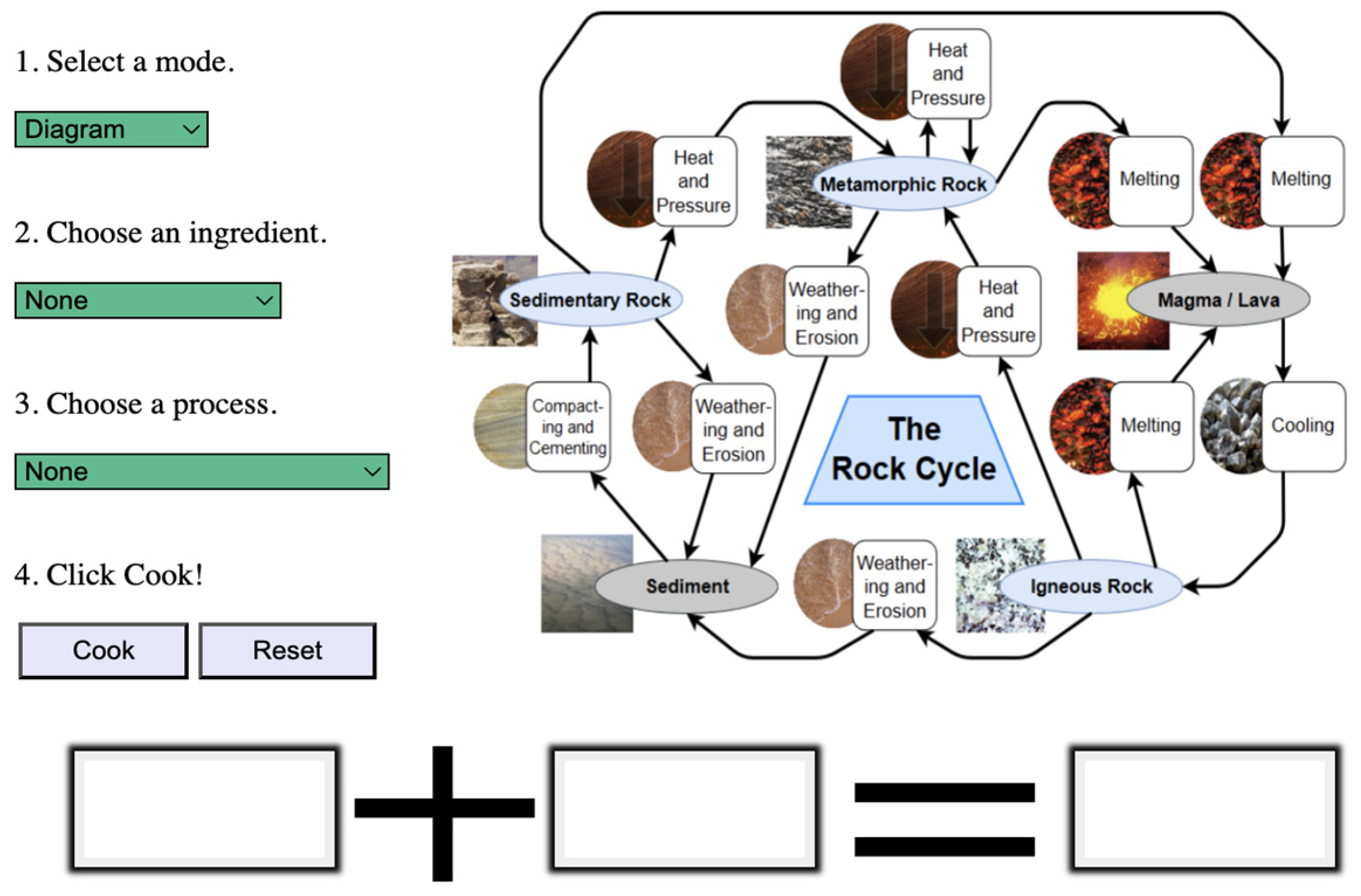
As mentioned earlier, students were given a few minutes to freely explore the Cooking Rocks simulation and then were asked questions about what they notice and what they can control in the simulation. These questions prompted the students to articulate the variables they were working with, and all students identified the materials and processes of the system. For instance, James stated that he can control “which rocks and which process it will go through” and that the ingredient list showed “types of rocks.” Similarly, when asked what he can use to make rocks, Daniel used the simulation to point out the drop-down list of ingredients and the processes. Another student, Arianna, listed all five ingredients (“Igneous rock, sedimentary rock, metamorphic rock, sediment, magma/lava”) and mentioned specific processes, such as heat and pressure and compacting. In their responses, four students (Laura, Michael, Noelle, and James) also distinguished between rocks and non-rocks. For example, Laura described that she could control “the processes and the ingredients to make a rock or sediment or magma” showing a distinction between rocks and other materials. When asked how she would explain the simulation to someone else, Laura provided a detailed description:
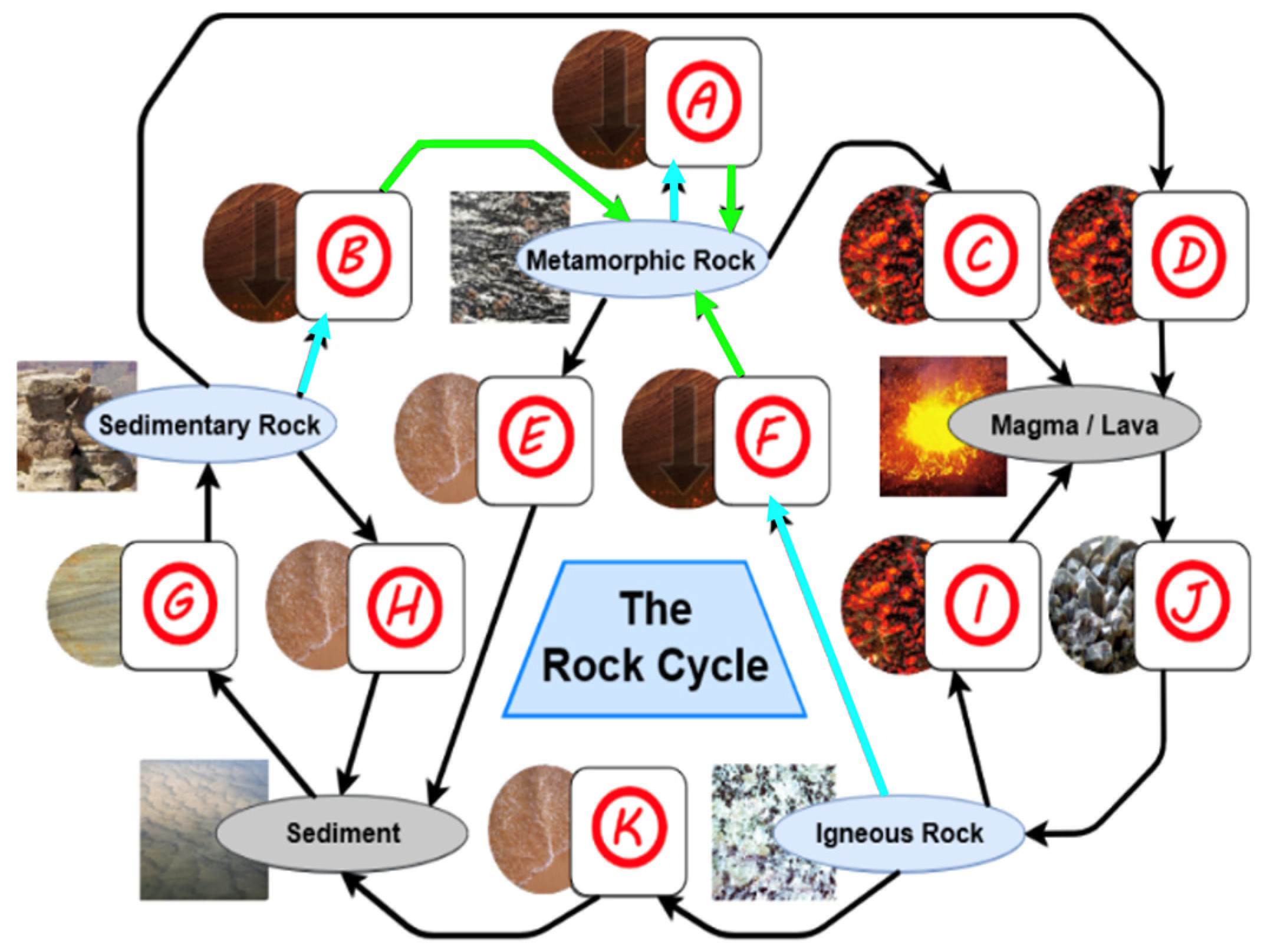
So, the simulation, you have to choose an ingredient, you have to choose out of igneous rock, sedimentary rock, metamorphic rock, sediment and magma/lava. And you have to choose a process, you have to choose weathering and erosion, compacting and cementing, heat and pressure, melting and cooling. And then when you choose either one of those and you press Select and you Cook it, it gives you a process. It either, if you, if your process makes sense it gives you like a result, if it doesn’t it puts an X through it. And if it’s a process, it highlights it in this diagram and the diagrams are labeled with big red letters to show sort of like paths through the rock cycle.
Like Laura, other students identified how they could use parts of the system that they had identified in the simulation. As they used the simulation, they noticed relationships and patterns in the combinations of materials and processes. For instance, James summarized that he could, “see what would happen to different types of rocks when it goes through different types of processes.” Similarly, Noelle noted that “each rock has a different process to become other things” and “that some types of processes only work for a specific type of rock and don’t work for others. So they don’t work for all the rocks, they only work for some of them.” These statements show that the students were beginning to think beyond the individual materials and processes to how they work together.
Students also began giving explanations about why some recipes were valid or not and these provided further insights into their conceptualizations of materials in terms of their location and physical properties. For instance, Arianna said that she usually sees sediment “on land, like at beaches.” In describing melting with an input of magma/lava, she reasoned about the difference in location for lava and magma, “Obviously it doesn’t do anything. […] Magma is just like the cool version, the underground version actually of lava, and lava is above ground but they’re both already melted.” In exploring the same process, students also discussed the materials’ temperature. For example, James explained that magma/lava “is already heated”, Noelle stated that “magma already has heat in it”, and Michael elaborated that “because magma is already heat[sic] and if you just add to it just makes more like hotter magma and lava.” In their explanations, we observed that they often used temperature as both a physical property of a material and a process that might transform that material. For instance, in trying to melt an input of metamorphic rock, Noelle connected the increase in heat to the transformation of a rock to hot magma, stating “Because you’re putting heat on the rock so then it will turn into magma because magma is really hot.” Likewise, while experimenting with recipes and cooling, students provided explanations of why cooling was the only process that worked with magma/lava by connecting it to temperature. James, for example, stated that this happens “because magma and lava is hot.” Likewise, Michael explained, “You can’t cool any type of rock except for magma. […] ‘Cause if you cool any type of rock it won’t really make an effect on anything except for the temperature.”
Additionally, students distinguished between solid and non-solid materials. For instance, Michael stated that “magma and lava is a liquid kind of” while James argued that sediment is “not a full rock, it’s like, it’s not like solid.” Noelle also reasoned similarly in explaining why magma did not work with weathering and erosion, stating “Because magma is kind of like a liquid. It’s not a solid. […] It’s not a solid rock and all the other ones are solid.” She later attributed sediment and magma as “not working” with certain processes while cooking “cause they’re not like a rock.” Similarly, Daniel identified that magma/lava and cooling would “turn into igneous rock” arguing that, “you can’t really cool something that isn’t melted. When you cool something that is melted, it forms into a rock.”
Students also discussed the difference between sediment and rocks, with James stating that sediment “is not like a full rock” and Laura explaining that it is “tiny pieces of the rock.” It was evident in their explanations, that they began connecting specific processes with the form of specific output materials, such as the process of weathering and erosion breaks down the rocks into sediment which is a broken down material consisting of tiny pieces. To exemplify, Daniel explained that “weathering and erosion, it slowly breaks down the metamorphic rock for certain tiny pieces and you call those tiny pieces sediment.” As Noelle tried sediment with weathering & erosion, she stated that “when you weather and erode sediment it’s already sediment so it’s not going to turn into sediment so it’s already like broken down.”
Additionally, students began making connections between the form of input materials and specific processes, such as arguing that the process of compacting and cementing brought together the little pieces of sediment into a compacted and cemented rock. For example, when asked why Noelle thought compacting & cementing worked for sediment, she explained, “Because sediment it’s not together so when you compact cement, […] it will get together.” Noelle and James similarly explained that sediment worked with compacting & cementing because it was a material that had not been compacted & cemented (brought “together”) yet. Laura stated, “When you compact sediment and it’s like pressure when it’s compacting it over like millions of years it turns into sedimentary rock.” Daniel used the simulation to cook metamorphic rock and compacting & cementing he explained, “the metamorphic rock is kind of already compacted. […] The metamorphic rock is already compacted and it’s cemented already. When asked which rock was most interesting to him, Daniel drew upon his trials in the simulation and stated,
Sedimentary rock […] because it’s kind of cool that it’s formed out sometimes little tiny pieces that because they will come back together it’s just a little tiny piece. […] It has to be compact for sedimentary rock to form.
During students’ experimentations, their explanations illustrate that they identified that materials can be transformed and began connecting the materials’ transformations (input and output materials) with specific processes. The next section describes how students developed these connections between materials and processes into various forms of relationships.
4.2. Component 2—Identifying Relationships Among the Parts of the System
As students continued to explore the simulation and experiment with different recipes, they constructed relationships between the processes and materials they identified. Our analysis illustrated three different types of relationships for each process: particular, partial, and holistic. We characterize
particular relationships as the relationships that depict the interconnectedness between a single input and a single process with a specific output, such as
metamorphic rock + melting → magma & lava. We identify
holistic relationships as the relationships that depict a web of connections between input(s), process(es), and output(s). For example,
any rock + melting → magma & lava.
Table 3 presents an overview of the six students’ constructions of holistic relationships for each rock cycle process. Gray shaded cells illustrate that the student showed evidence of constructing the relationship. White cells illustrate that we do not have enough evidence from that student to make a claim that they constructed the relationship at that time (Note: At times our evidence was limited by data collection factors such as unintelligible audio and blocked screens on the video recordings). Finally, we define
partial relationships as the relationships that are missing input(s) or output(s) in their web of connections. For example,
compacting & cementing → sedimentary rock.
The following subsections delve deeper into each process by providing examples of how students’ constructed and reorganized particular, partial, and holistic relationships. We also highlight the diverse ways students engaged in exploration and how our questioning supported their constructions and reorganizations of relationships.
4.2.1. Melting
Table 4 presents the relationships that students explored and constructed about melting. Students who cooked the particular relationships with the simulation are represented with an S in the table. The students who verbally expressed the relationship are represented by shaded cells. As
Table 1 shows, all students explored almost all five ingredients with the melting process and determined which ones produced valid recipes and which did not. In the following paragraphs, we provide examples to describe how students began with particular relationships and, through experimentation, were able to notice patterns and reorganize their thinking to more holistic relationships.
For example, as James and Noelle were exploring the simulation they both cooked sedimentary + melting → magma/lava. When asked what happened, James described the particular relationship, “The sedimentary rock got melted so it turned into magma/lava.” Similarly, Noelle pointed to the recipe and stated, “when you melt it usually turns into magma.” James was then asked if he also noticed that when rocks melted they turned into magma/lava, and he said, “yes.” Then they were both prompted to use the simulation to explore different recipes to prove if any rock melting would create magma/lava. As she cooked the three rocks, Noelle stated, “Yeah this one [igneous] did and sedimentary did. And metamorphic.” In addition, James tried magma/lava, which provided an opportunity to ask the students why that material did not work. James stated, “Because it’s already melted”.
Later in the DE, Noelle was again asked what happened with melting and explained that melting “turns into magma. […] Because you’re putting heat on the rock so then it will turn into magma because magma is really hot.” She was then asked, “So if I put heat into any rock will it turn into magma?” Noelle replied, “I think, yes. I think except for the magma, because it’s already magma. And for the sediment. Maybe, I don’t know about the sediment. I know for sedimentary rocks, metamorphic and igneous, it will turn into magma.” She was then prompted to try the ones she was not sure about. Noelle tried magma/lava and sediment and explained “this[magma/lava] is already magma […] So it’s already heated. And sediment. It doesn’t work for sediment.” Finally, when asked why they did not work, Noelle stated, “‘Cause they’re not a rock.” As seen in this example, the researcher’s questions and prompts helped Noelle to validate her existing holistic relationship any rock + melting → magma/lava by excluding magma/lava and sediment as additional materials that did not work and providing explanations of why only rocks were included.
Similarly to Noelle and James, Laura and Daniel used the simulation to create various recipes to construct the same holistic relationship. However, in Arianna’s and Michael’s statements the rock vs. non-rock distinction was rather blurred. For instance, Arianna stated, “all the rocks, except magma and lava when you melt them they all become magma and lava.” Her statement illustrates the relationship any rock (except magma/lava) + melting → magma/lava, without distinguishing magma/lava from rocks. In a similar manner, when Michael was asked about what happens with melting, he stated and demonstrated using the simulation that “if you melt any type of rock, [cooked metamorphic + melting → magma] it always becomes magma and lava because magma and lava is…melted rock.” Then he cooked sediment + melting → X, stating, “oh wait, except for sediment.” While his statement illustrates the holistic relationship of any rock (except sediment) + melting → magma/lava, we do not have evidence of him distinguishing sediment from rocks. During the experiment the researchers did not notice this lack of distinction in their meanings, so no follow up questions were asked to help clarify their thinking.
4.2.2. Cooling
Table 5 illustrates which of the materials each student cooked in a recipe with cooling and the verbal statements that they made. Similarly to melting, the students experimented with the simulation and all six of them constructed the particular relationship
magma/lava + cooling → igneous rock. Next, students considered both this relationship and the non-relationships they noticed to reorganize their thinking to more holistic relationships. We observed two distinct holistic relationships emerging in students’ thinking, which we describe below, highlighting the role our questioning might have played in their construction.
To begin with, one student (Arianna) was asked questions intended to help her examine one material with multiple processes (e.g., “[this material] has to undergo what process?”). Through these, she identified cooling as the only process that worked with magma/lava and eliminated other processes to construct the relationship magma/lava + only cooling → igneous rock. For example, after identifying the particular relationship magma/lava + cooling → igneous rock, she identified that “Magma and lava is not a rock. So it can’t weather or erode.” She was then asked what the only process that worked was and answered, “Cooling.” In contrast, three students (Michael, Laura, Daniel) identified magma/lava as the only material that worked with cooling and eliminated other materials to construct the relationship only magma/lava + cooling → igneous rock. For example, when asked what can be cooled, Laura identified that “you can cool magma and lava, you can’t cool sediments or metamorphic rock, sedimentary, igneous,” leaving magma/lava as the only ingredient which can be cooled. We noticed that two of those students (Laura and Daniel) were asked questions that were focused on the materials (e.g., “what material can be cooled?”) rather than the process, which might have led to the specific type of the holistic relationship.
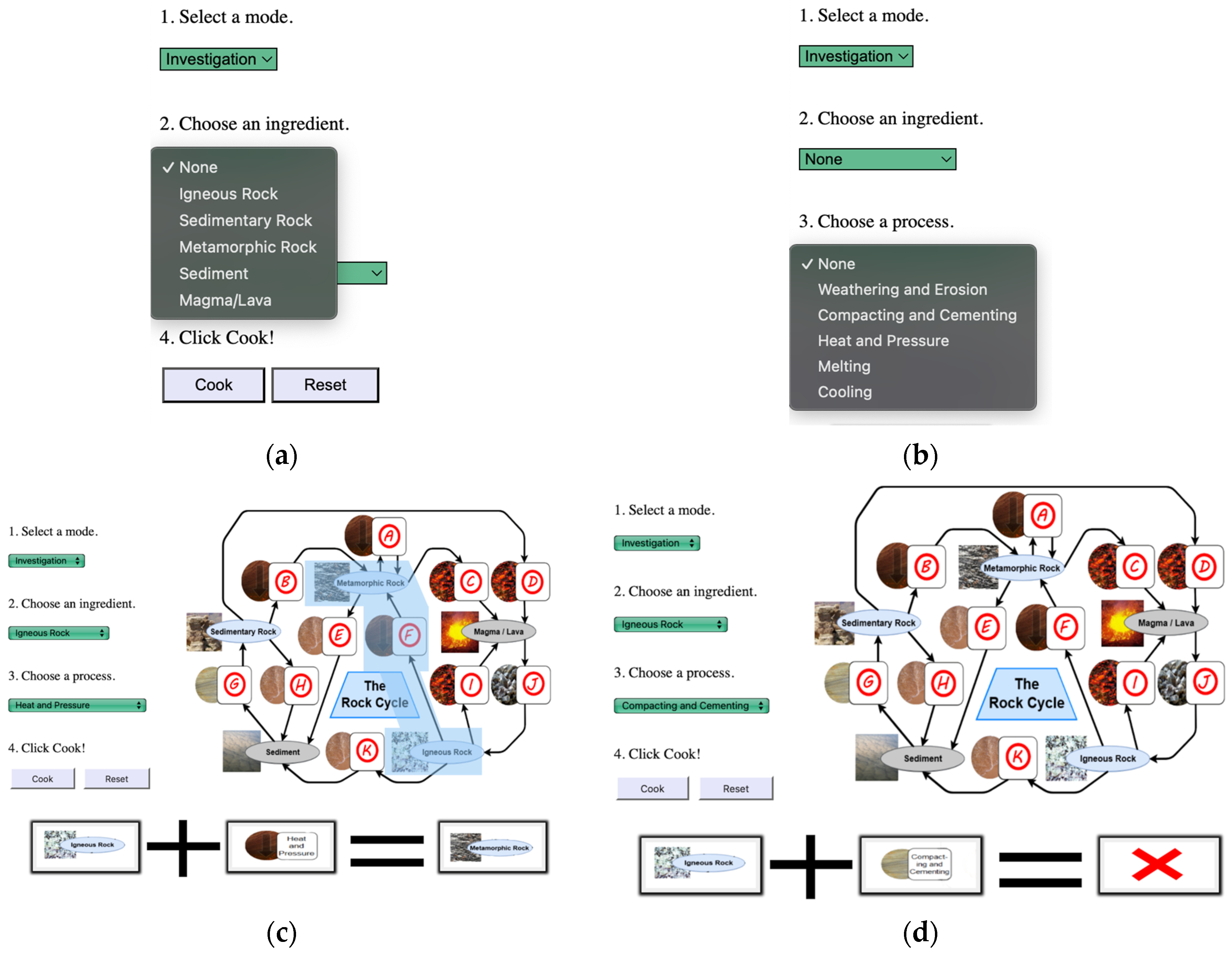
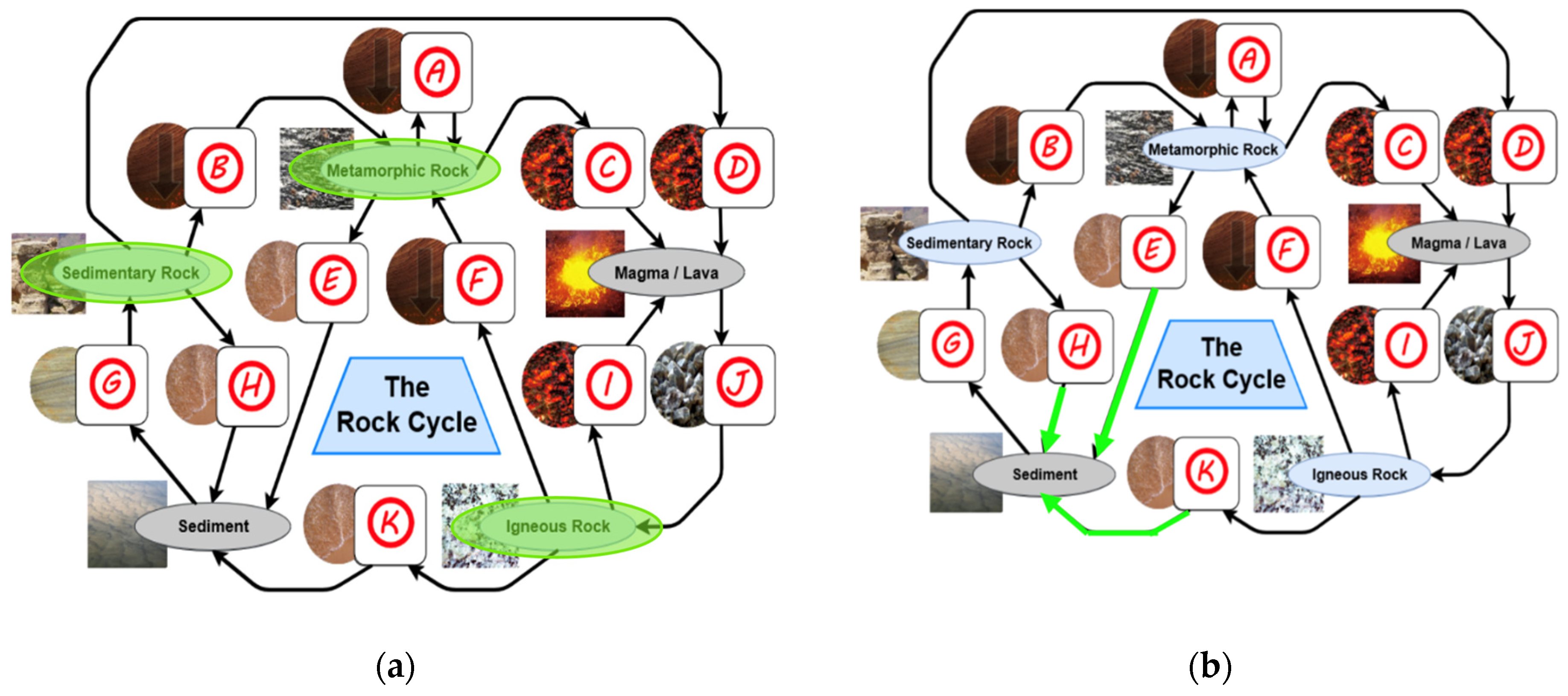
Two students (James and Noelle) constructed both of these holistic relationships, with Noelle making a distinct transition from one to the other. For instance, after experimenting with the simulation, Noelle was asked what processes would work with magma/lava. She cooked magma/lava + heat & pressure → X and explained that it was “Cooling. […] ‘Cause if you put heat and pressure [pointed to equation she just tried on the simulation] it’s already heated, so if you put melting it’s already heated but cooling like it can cool to form something else.” When asked what this cooling produces, she replied with “igneous rock” while tracing the path on her computer screen with her finger (
Figure 7a). She was then asked if cooling only works for magma/lava. Noelle cooked metamorphic with cooling, and explained “I think it only works for magma and lava because when I tried the other ones it just does that” pointing to the X in the simulation (
Figure 7b). Noelle’s example demonstrates a transition from examining one material with multiple processes to considering multiple materials for one process after being asked questions focusing on both processes and the materials, respectively.
4.2.3. Weathering and Erosion
Table 6 illustrates which of the materials each student cooked in a recipe with weathering and erosion and the verbal statements that they made. While experimenting with the simulation, four out of six students (Daniel, Michael, Noelle, and Laura) verbally constructed the holistic relationship
any rock + weathering & erosion → sediment, one student (Arianna) constructed a single non-relationship, and one student (James) tested recipes but we do not have evidence of him expressing the relationships in words. We discuss the four students’ constructions and reorganizations below.
All four students who constructed a holistic relationship were supported by probing questions that focused on input materials (e.g., “is it [that relationship] true for every rock?”, “for which [inputs] does it work?”, “What are those rocks that have to experience weathering and erosion”) and questions that focused on processes/outputs (e.g., “So when do we get sediment?”, “how do you make sediment?”, “Do you know how sediments form?”). To begin with, following her initial exploration, Laura was asked, “how is this going?”, and she replied, “I wanted to try [to] see, if any other process can turn into sediments, because so far it’s just been weathering and erosion.” She then stated,
I realized that every single time we selected ingredients and then choose a process and we cook it, it always, the answer is always weathering and erosion because you can’t compact it, and it will turn it to sediment. Nor is cooling or melting. And heat and pressure like turns it though [inaudible].
A few minutes later, Laura was asked if she noticed any patterns, to which she responded, “I noticed that all of the rocks, if you choose weathering and erosion, they turn into sediment.” When asked about “all of them” she stated “Igneous, sedimentary, and metamorphic. If you choose all of them.” She was then asked about the other materials and she responded by explaining that “sediment can’t really erode more” and that “magma and lava aren’t rocks, they’re material made to use rocks.” At the end of the cooking rocks lesson, she confidently stated that “if any type of rock weathers and erodes away it can turn into sediments.” Her explanation of both the process that produces sediment and materials that did and did not work led her to reorganize her thinking to the holistic relationship, any rock + weathering & erosion → sediment. Even though Noelle and Michael’s reorganizations were led by an exploration of materials first, and then an exploration of processes, they still constructed the holistic relationship any rock + weathering & erosion → sediment.
Daniel differed from the other students in that he verbally connected three relationships of weathering and erosion depicted in the diagram to his prior explorations with the different recipes. When he was asked how sediment was formed he pointed to the three rocks in the diagram (
Figure 8a) stating “For every rock, sedimentary rock, metamorphic rock, igneous rock […] they all have to experience weathering and erosion to create sediment” and pointed to sediment. When later in the DE he was asked again about how sediment forms he pointed on the arrows as illustrated in
Figure 8b emphasized that “It’s shown on the diagram. The arrows pointed.” Daniel’s reasoning illustrates that the combination of actively engaging with the recipes and also having the rock cycle diagram visible on screen may have supported students in making connections between their experimentations and the different possible paths that involve a specific process.
4.2.4. Compacting and Cementing
Table 7 illustrates which of the materials each student cooked in a recipe with compacting and cementing and the verbal statements that they made. All six students identified that sediment was the only material that could be compacted and cemented and that it turns into sedimentary rock, constructing several different holistic relationships, including
only sediment + compacting & cementing → sedimentary rock,
only sediment + only compacting & cementing → sedimentary rock, and
only (sediment + compacting & cementing → sedimentary rock). While engaging with the simulation, students systematically explored different recipes using two distinct approaches. We describe these approaches below and discuss how these might have been influenced by our questioning.
The first approach was evident in four students’ work. James, Noelle, Michael, and Laura started exploring different input materials with compacting and cementing as a fixed process. All four students’ simulation explorations were supported by questions about the different input materials (e.g., “what do you compact and cement”, “which [material] do you think would work here [with compacting and cementing]?”) and constructed the holistic relationship only sediment + compacting & cementing → sedimentary rock.
Contrastingly, Daniel used a different approach by testing recipes of a single material with different processes. For example, he was asked, “Do you notice if you use metamorphic rock with a different process, can you try each one and then see how it goes?” As he tested processes with metamorphic rock, he noted that it did not work “because the metamorphic rock is kind of already compacted.” Recall that Daniel described sedimentary rock as his favorite rock that is created by bringing together and compacting little pieces of sediment (see
Section 4.1). Later he was asked, “Did you master how sedimentary rock forms?” Daniel noted that “sedimentary rock forms from sediment that is compact. […] No, there isn’t any other way.” By considering which processes worked with specific input materials and which processes produced specific output materials, respectively, he was able to reorganize his thinking to the holistic relationship
only (sediment + compacting & cementing → sedimentary rock).
Arianna’s case differed because she transitioned between these two approaches (varying the materials versus varying the process) and this transition supported a reorganization of a different holistic relationship. Similarly to the first group of students, Arianna started exploring multiple materials with compacting and cementing. When asked what she noticed about the simulation, Arianna stated, “For compacting and cementing, you can only do it with sediment. None of the others. […] because when I select different types of […] ingredients they don’t compact or cement.” As she spoke, she systematically used the simulation by trying different materials to show that only sediment can be compacted & cemented. Later, when she was asked questions prompting her to think about which processes work with a single material (e.g., “So what’s the only process that can go with it?”), she shifted to cooking all processes with sediment, and stated, “For sediment, there’s only one process, compacting and cementing, that works for it.” These statements illustrate partial relationships that she has constructed between the input material and the process,
only Sediment + Compacting & Cementing, and
Sediment + only Compacting & Cementing respectively. She then connected these to the output material, stating,
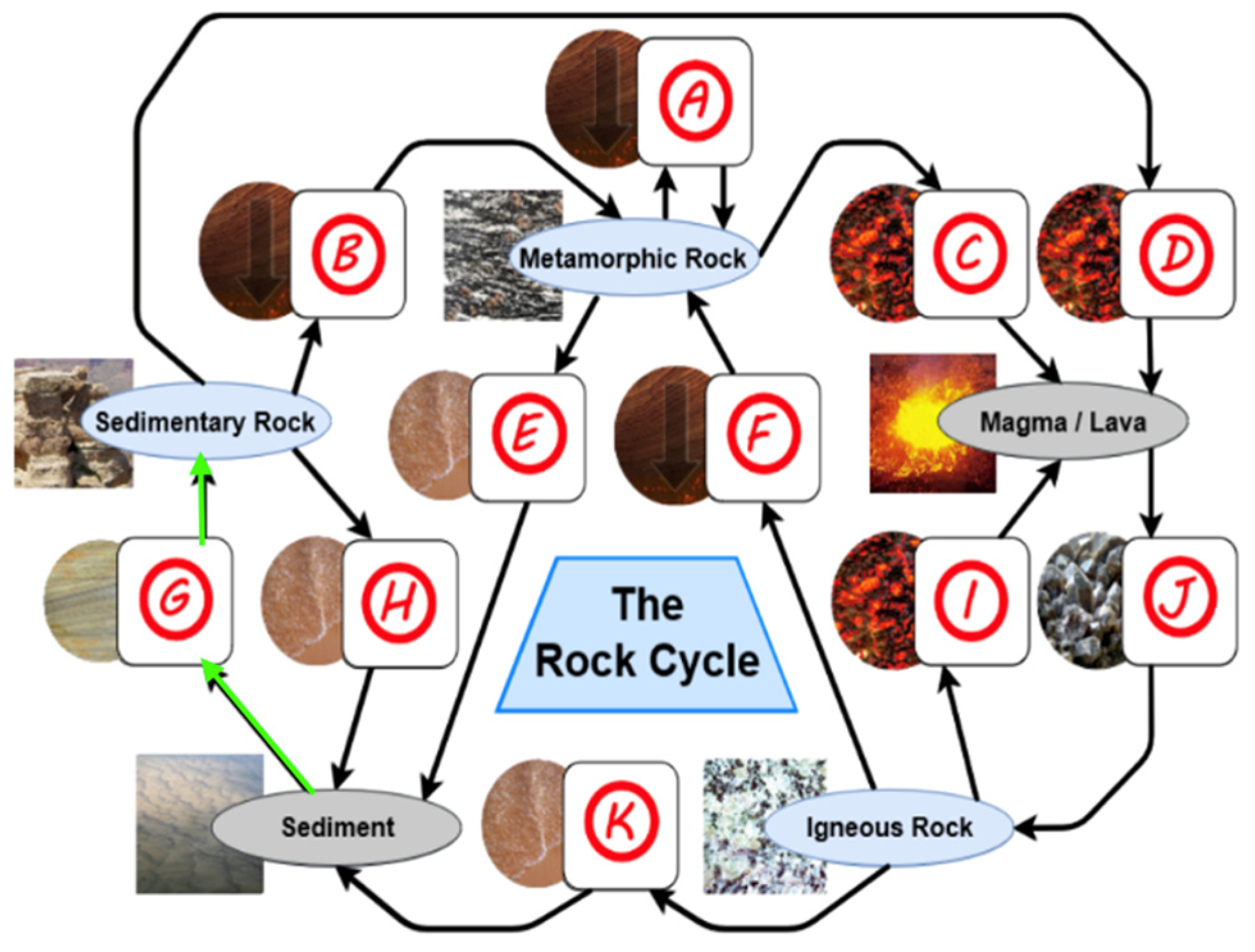
I think the only process there is for sediment is like, cause the only process like I think of equals sedimentary, cause that’s what sedimentary rocks are made out of […] from the arrows it seems [the only process for sediment is] compaction and cementing [pointing to the arrows around G (compacting & cementing)].
This demonstrated that Arianna constructed the relationship
only sediment + only compacting & cementing → sedimentary rock. This also showed that she was able to link her relationship to the depiction in the diagram, as seen in
Figure 9.
4.2.5. Heat and Pressure
Table 8 illustrates which of the materials each student cooked in a recipe with heat and pressure and the verbal statements that they made. We have evidence of five students (Arianna, Michael, Noelle, James, and Laura) verbally expressing relationships about heat and pressure. Three students (Noelle, James, and Michael) constructed the holistic relationship
any rock + heat & pressure → metamorphic rock while two students (Laura and Arianna) only constructed particular and/or partial relationships.
To elaborate, James initially cooked just metamorphic rock with heat and pressure and noted that “metamorphic rock is going through heat & pressure and then it turns into metamorphic rock.” This illustrated the construction of a particular relationship metamorphic rock + heat & pressure → metamorphic rock. James then systematically tested the three rocks with heat and pressure. James was asked if he noticed anything interesting, to which he replied “any rock you add heat and pressure to, it turns into a metamorphic rock,” revealing a reorganization to the holistic relationship any rock + heat & pressure → metamorphic rock. He was then asked what materials did not work with heat & pressure. James tested both sediment and magma/lava with heat and pressure using the simulation, and confirmed “Sediment and magma.”
Three other students (Michael, Noelle, Laura) explored the simulation similarly by testing different materials with heat and pressure. They were also supported by questions focused on those materials (e.g., “Any type of rock [works with heat and pressure]?”, “Does [heat and pressure] work for all the rocks?”). Through this experimentation, Michael and Noelle were able to reorganize their thinking to the holistic relationship any rock + heat & pressure → metamorphic rock. We do not have evidence of Laura constructing this holistic relationship.
Arianna’s case helped us identify the kind of questioning and exploration that can and cannot support students as they explore a single process with multiple input materials. Similar to the other students, Arianna started with a systematic exploration of multiple materials as input for heat and pressure. However, she was not asked to articulate any relationships during this free exploration. She then moved to an exploration of multiple processes with each material, after which she was asked the question, “Can you tell me or any friend that hasn’t seen this simulation, how metamorphic rock forms?” and she stated, “I think from what I remember, heat and pressure,” illustrating the partial relationship heat & pressure → metamorphic rock. She then cooked igneous rock with heat & pressure and elaborated, “Yeah, heat and pressure with most rock” reorganizing her relationship to most rocks + heat & pressure → metamorphic rock.
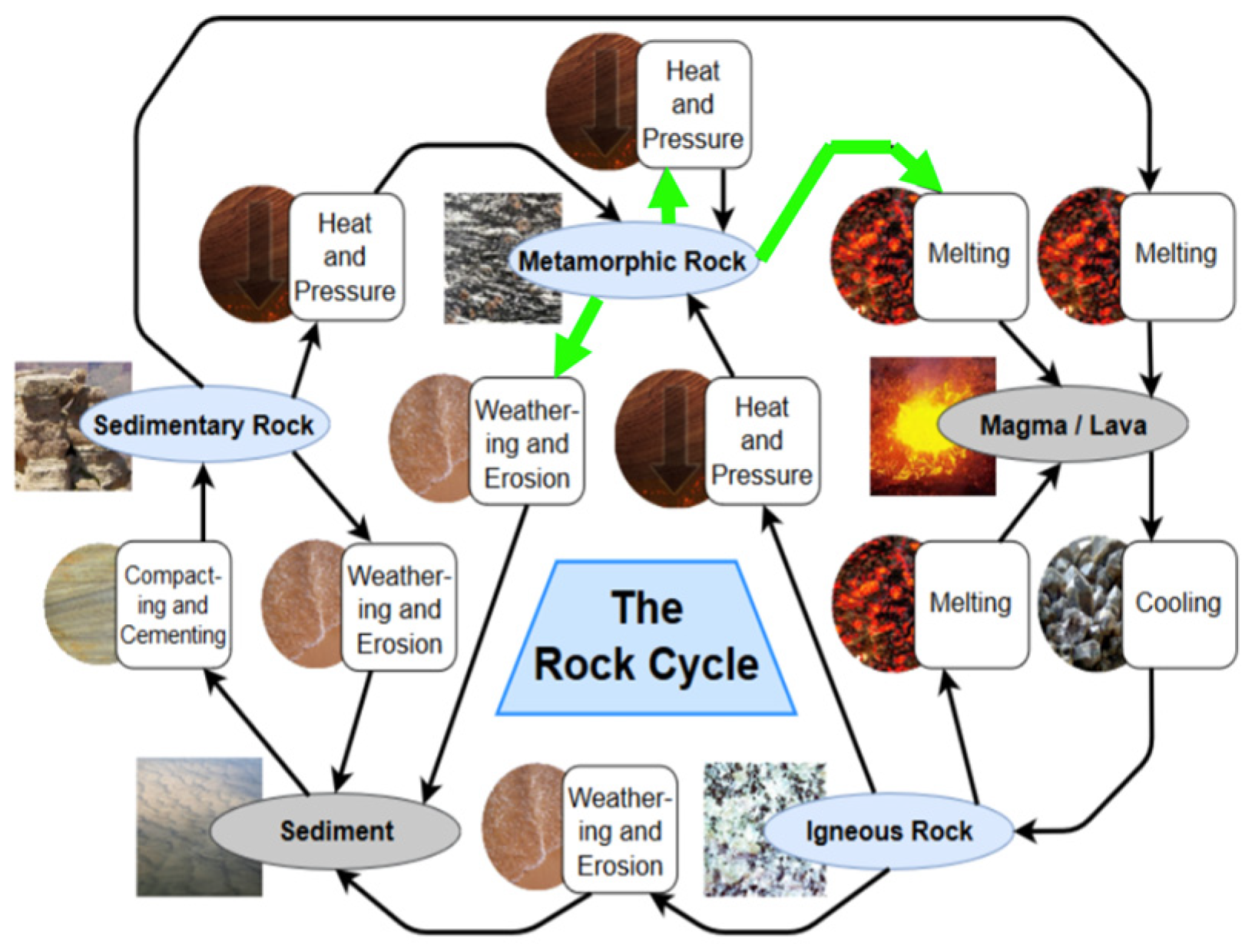
The researcher then decided to direct her attention to the arrows of the diagram pointing to the arrows around metamorphic rock on the simulation in
Figure 10, “do these arrows help you find what the sources of metamorphic rock are?” Arianna did not mention any materials stating, “it’s only heat and pressure looking at the arrows.” The partial relationship might have been the result of looking only at the green arrows in
Figure 10 only and disregarding the arrows that begin from the input sources (in blue). It is possible that having two sets of arrows for each relationship (one pointing to the process and one pointing to the output) might encourage partial relationships.
She was then asked about other rocks working with heat & pressure, aiming to direct her attention to the various materials that can be used as inputs. Arianna responded, “Heat and pressure I’ve only seen igneous for now. But I haven’t tried sedimentary rock. [Combined sedimentary rock + heat & pressure], Metamorphic rock.” She was then prompted to try sediment as input and this ended up shifting the conversation to weathering and erosion. As a result, we do not have evidence of Arianna articulating a more holistic relationship about heat and pressure. Arianna’s case showed how multiple approaches can and should be taken to probe students’ thinking further.
4.3. Component 3—The System as a Whole
During the Cooking Rocks exploration, students started illustrating traces of conceptualizing the system as a whole by beginning to chain multiple processes together. For example, Daniel argued that, “you can’t really cool something that isn’t melted. When you cool something that is melted, it forms into a rock.” This explanation acknowledged that a material that was melted could then be cooled to form a rock, illustrating a loose chain of processes and materials. During the two simulations that followed (Bob’s Life and the George’s Life), students’ conceptualization of the rock cycle as both a cyclic process and a chain of processes and materials was more evident.
Table 9 presents a summary of which students we observed demonstrating evidence of these sub-components. As the table illustrates, we have evidence from five students (except Arianna) describing the chain of processes and materials and from five students (except Michael) discussing the cyclic nature of the rock cycle. The following sections will describe examples from each simulation exploration that illustrate the nature of how students reasoned about these sub-components and the system as a whole.
4.3.1. Bob’s Life
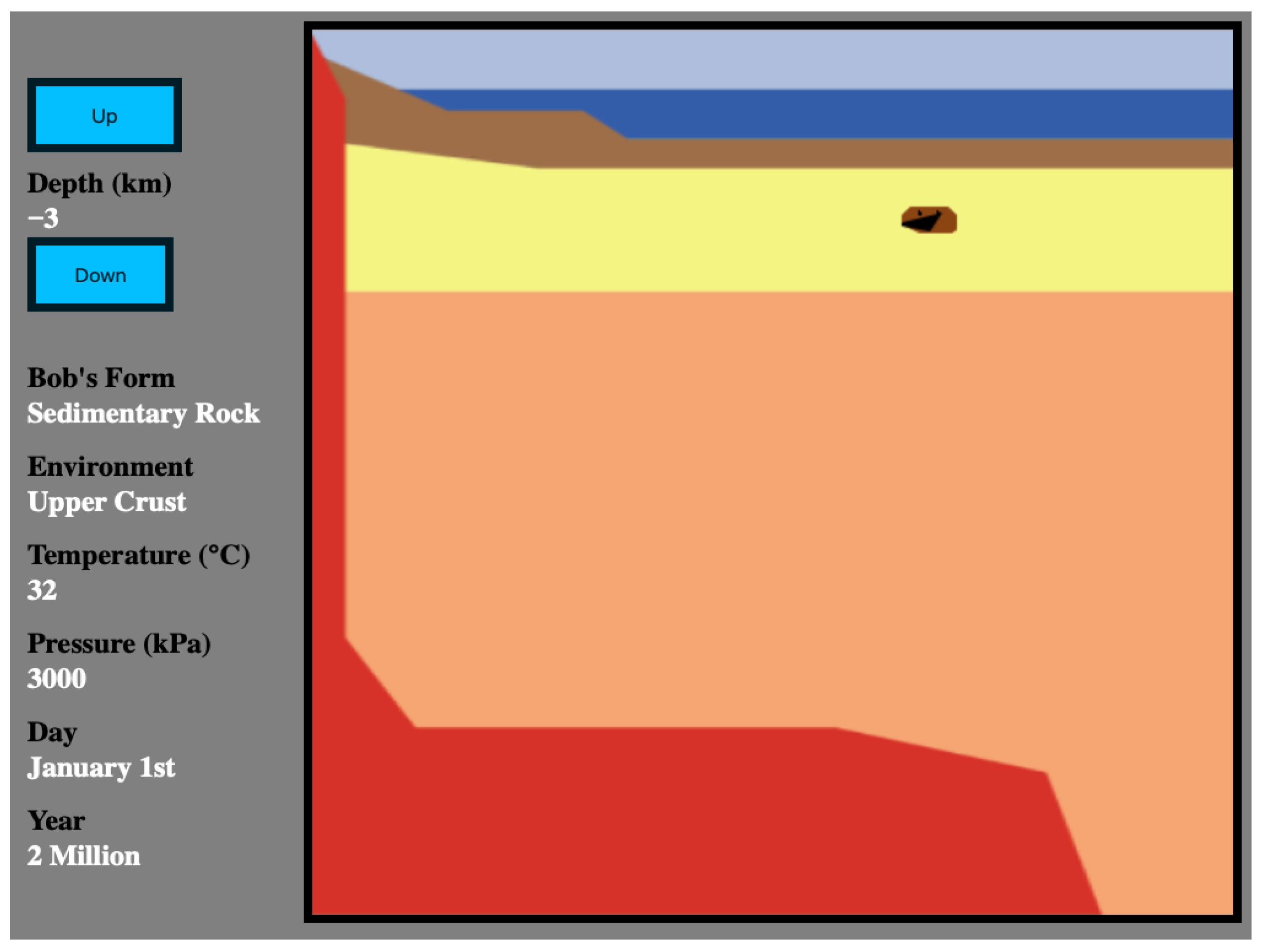
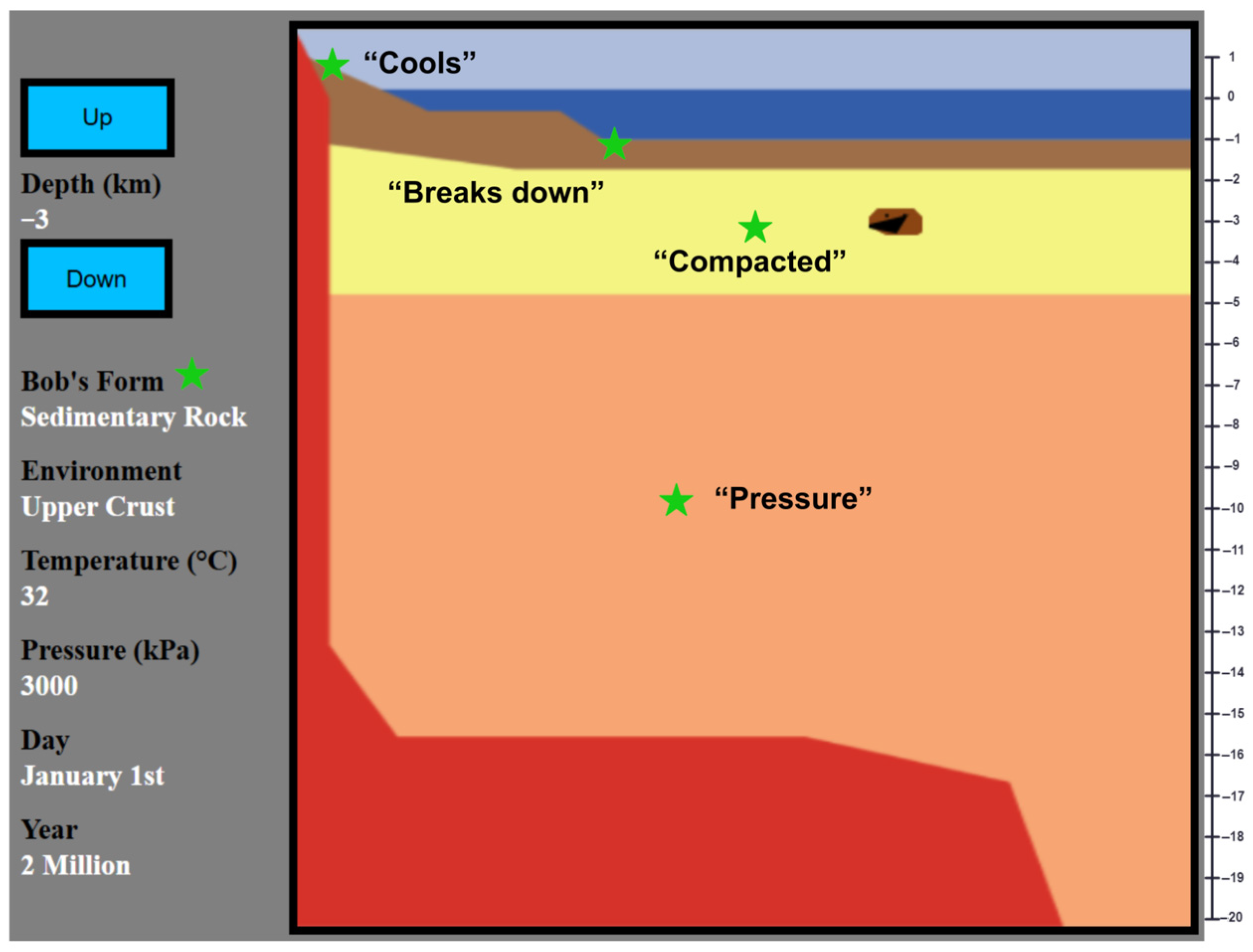
In the Bob’s Life simulation, students were asked to move Bob through the cross-section of his environment in the Canary Islands and observe what happens as he moves through a single continuous sub-cycle through the rock cycle. This illustration of a continuous path supported five students (all except Michael) to discuss the cyclic nature of the sub-cycle in this simulation. For example, Arianna stated that “he’s getting recycled” and “it just restarts once it goes into the conduit pipe.” Daniel also acknowledged that “it’s a cycle” and “this whole cycle restarts again.” Noelle stated, “It restarts. […] because the cycle keeps going” as she motions with her finger in a circular motion over the simulation. These explanations were elicited when students were exploring or explaining what happens to Bob when he reaches the magma chamber and then subsequently travels through the conduit pipe to erupt from the volcano.
When they were asked what they noticed or how they would explain the simulation to someone else, two students (Laura and James) also identified a chain of materials and/or processes. For instance, Laura explained and gestured to the simulation (
Figure 11):
The lower you get, like the deeper you get, his form changes [pointed to Bob’s form on the left of the simulation] from like it gets to the coast line [pointed to the water] it changes sediment then sedimentary rock, and then, so it cools from here [pointed to the Surface/Sea Level area where Bob would be if he was at 0 km] and turns into igneous, it has, then it breaks down to sediment [pointed to Below Shoreline area] and turns into sedimentary rock [pointed to Upper Crust area, which is where Bob currently was] because it gets compacted and then the, the pressure increases so then it turns into metamorphic for most of it [pointed to Lower Crust area], once it reaches the lava it turns back into magma. […] It turns back into magma and it goes back up into lava [used finger to trace path up to the surface].
Figure 11.
Recreation of Laura’s gestures to the approximate locations where the processes work to change Bob’s form.
Figure 11.
Recreation of Laura’s gestures to the approximate locations where the processes work to change Bob’s form.
Laura identified that Bob’s form was changing and connected the materials and processes together in the hypothetical situation of Bob. The rock cycle processes were not shown in this simulation, yet she mentioned cooling, compacting, and pressure, in addition to rocks “break[ing] down” as a way to describe weathering and erosion. This shows that Laura used the relationships she constructed between the materials and processes from the Cooking Rocks simulation as she explored this simulation. We also interpret Laura’s recognition that Bob would turn “back into” magma to signify a conception of a repeating sub-cycle. [Please note: Laura appears to have described the magma chamber (the large red area at the bottom of the simulation) as “reaching the lava”.] In contrast to Laura, James described the chain of materials without the connecting processes as he moved Bob,
I would say that over time a rock goes down into the, starting at sea level and then it goes down. Which [Bob] turns into sediment and then once it goes into the ground it turns into sedimentary rock and then once it goes down far enough it turns into metamorphic rock and then when it goes like, when it goes really far down it turns into magma and then once it goes deep, really, really far down it, it restarts the cycle.
As Bob moved further down in the environment, James noted that the cycle would “restart” demonstrating an understanding of the endless cycling of matter in the rock cycle. Laura and James were the only two students who explicitly connected two or more transformations of material in this simulation, illustrating the potential for this simulation to support students in connecting what they learned in the Cooking Rocks simulation to the context of this hypothetical situation. While both Laura’s and James’ responses were elicited by general questions, more specific questioning about connecting the processes and materials in the context of this simulation may have supported other students to verbally express a chain of processes and/or materials.
4.3.2. George’s Life
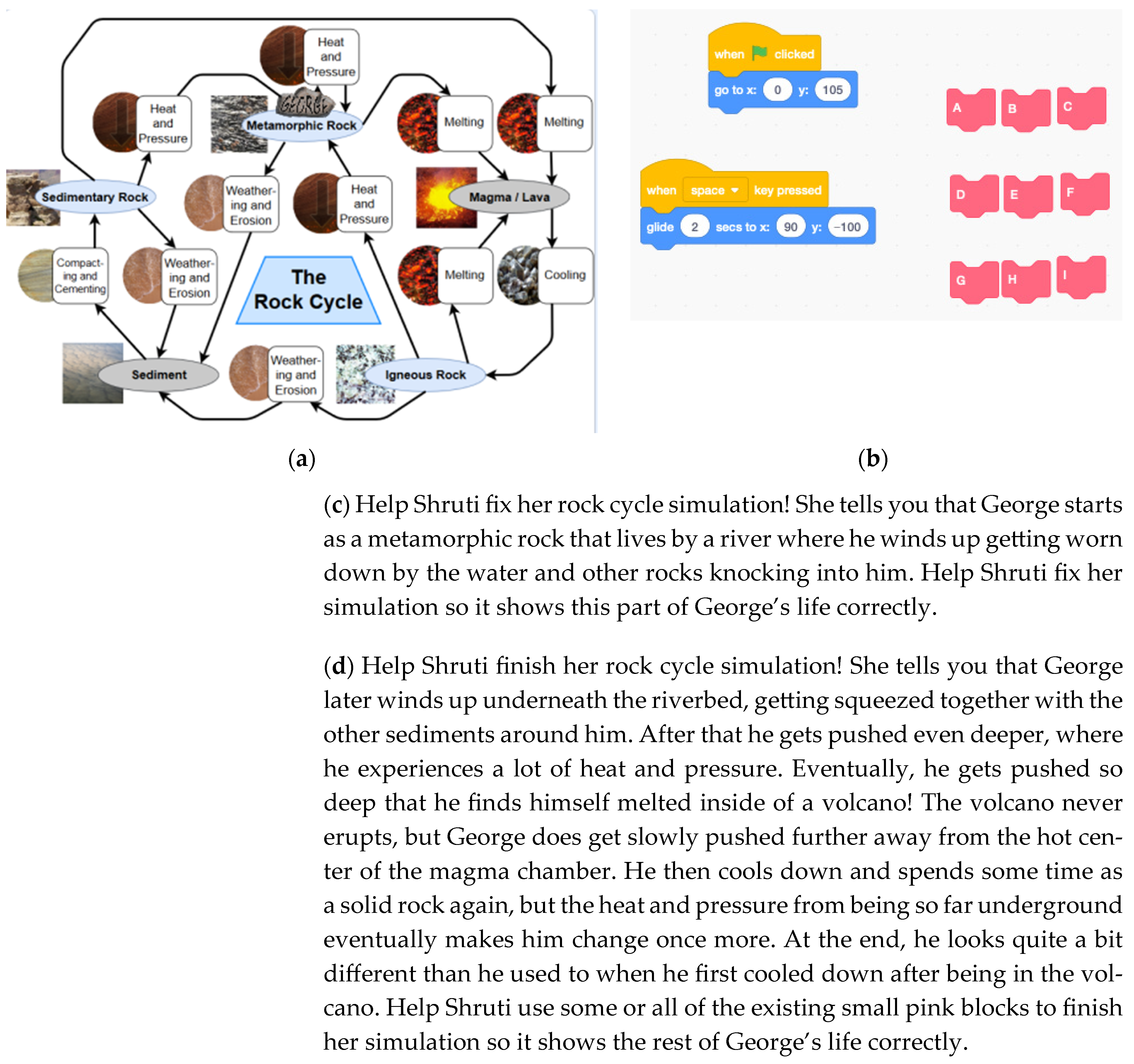
In the George’s Life activity on Scratch, George was incorrectly programmed to move around the rock cycle diagram providing an opportunity for students to take a more holistic view of the rock cycle (see the
Section 3.2.3). First, students were asked to state what they noticed in the simulation and to identify the mistake in George’s movement. Five students (Laura, Daniel, Arianna, Michael, and Noelle) mentioned the incorrect movement of George in the simulation from metamorphic to igneous through heat and pressure. For example, Laura responded, “It’s saying that the metamorphic goes straight to igneous.”
Next, the students were asked to identify the correct path that Goerge should travel to match the story and five students (Michael, Noelle, Daniel, Laura, and James) described the correct path. We noticed that students drew from their prior explorations with Cooking Rocks to make sense of this new hypothetical situation. Michael, for instance, explained that, “if it [metamorphic rock]’s getting worn down by the water and other rocks knocking into him, it would have to go to weathering and erosion and end up as sediment.” Noelle explicitly mentioned the Cooking Rocks simulation and the holistic relationship she constructed for weathering and erosion:
Well, on the first thing, like Cooking Rocks, every time I put weather and erosion to any rock it turned into sediment [pointed to sediment on the diagram]. So that’s why I think metamorphic rock [pointed to metamorphic rock on diagram] when you go through weather and erosion [pointed to Weather and Erosion] it also turns into sediment [pointed to Sediment].
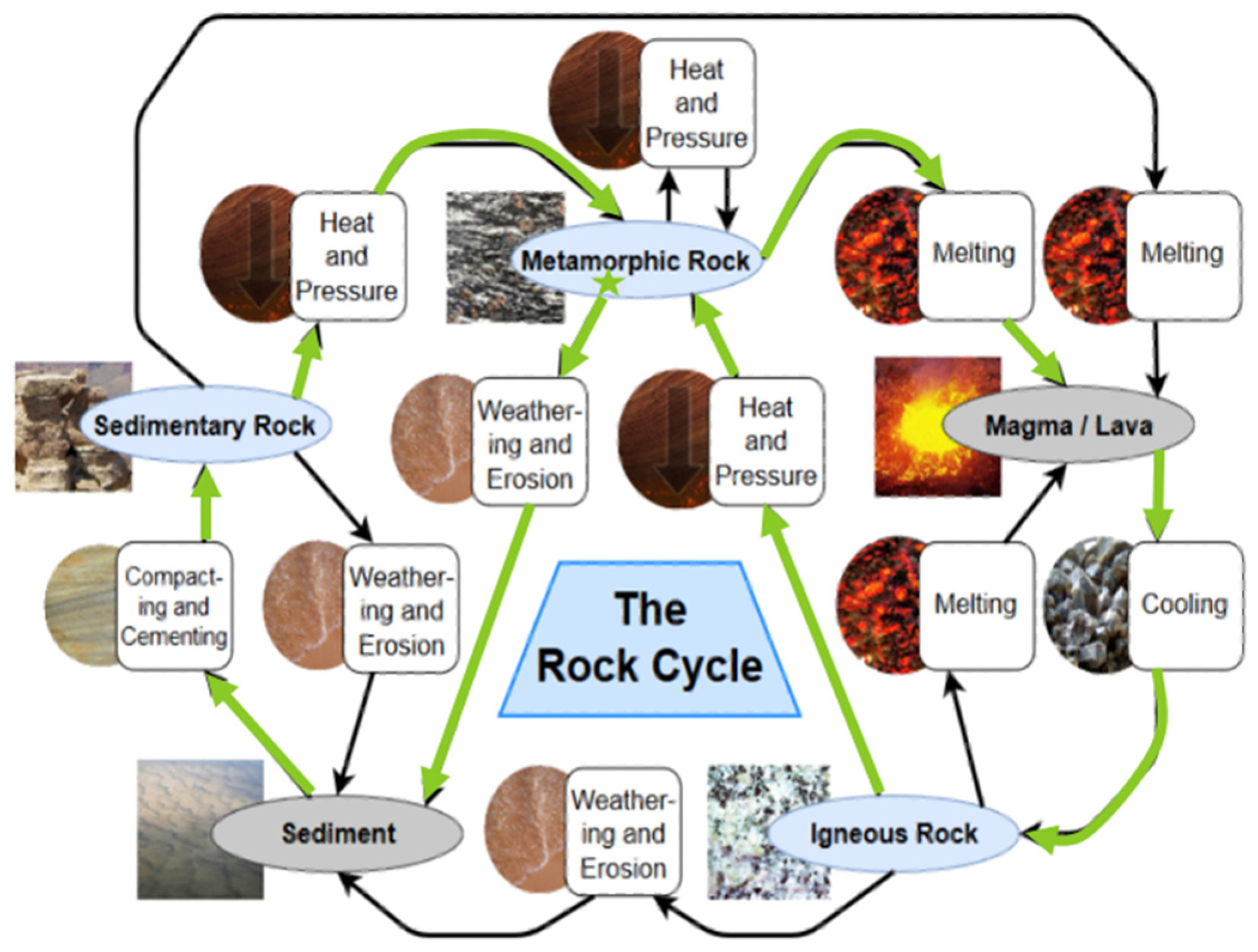
The students then worked to debug George’s path through the cycle to match the story. Two students (Laura and Michael) were able to successfully program George to move through the chain described by the story. For instance, when Laura was asked to describe the path she had programmed, she pointed to locations on the diagram stating (
Figure 12),
It’s just that it goes to metamorphic, and then goes to weathering, sediment, compacting and then to sedimentary. I think it went through heat and pressure to metamorphic and then melting, magma, cooling, igneous, heat and pressure ending at metamorphic.
Laura’s description of the path repeatedly passing through metamorphic rock illustrated the cyclic nature of the rock cycle and movement through two connected loops forming sub-cycles. We noticed that asking students to explain their paths provided an insight into their construction of chains of processes and materials and the sub-cycles.
Figure 12.
Recreation of Laura’s chain of processes and materials through the Rock Cycle starting at the star and following the green arrows.
Figure 12.
Recreation of Laura’s chain of processes and materials through the Rock Cycle starting at the star and following the green arrows.
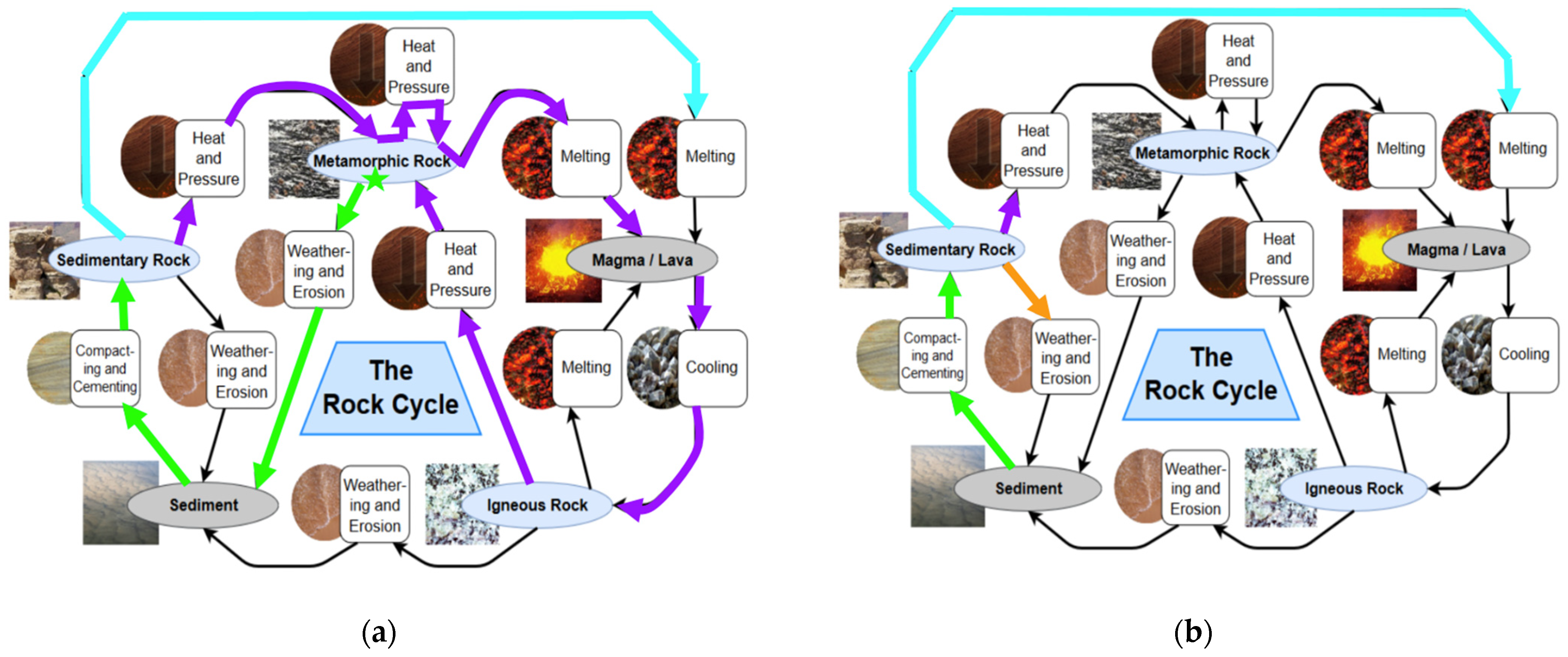
Noelle and James’ exploration was slightly different as they identified and programmed multiple possible chains for George’s movement through the cycle, which were not always aligned with the hypothetical situation of the story. For example, when Noelle was asked about how she would fix the cycle to match the story, she explained and traced the chain with her mouse (
Figure 13a),
It goes down to weather and erosion, then turn[s] into sediment. And then it will go through compacting and sedimenting. And then turns into sedimentary rock. Then, goes to melting. Can it also go here? [pointed to heat and pressure coming from sedimentary rock. Researcher nodded head yes] So I’ll just do that way. [She continued tracing the path with the mouse starting from sedimentary rock—purple arrows] And then it goes through heat and pressure. And then it turns back to metamorphic rock. […] And then metamorphic rock, heat and pressure again. And then it goes back to it, metamorphic rock. Then through melting it turns into magma. And then when the magma cools, it turns into igneous rock. And then um over.
Figure 13.
(a) Recreation of Noelle’s description and tracing of how she would fix George’s path and (b) Arrows representing the multiple chains that Noelle had discussed.
Figure 13.
(a) Recreation of Noelle’s description and tracing of how she would fix George’s path and (b) Arrows representing the multiple chains that Noelle had discussed.
As Noelle considered the path that Goerge should take, she considered multiple pathways, illustrated by blue and purple arrows diverging from sedimentary rock in
Figure 13a. Noelle also included a detour in the middle of the purple chain (from metamorphic rock to heat and pressure to metamorphic rock) that did not match the story. By saying that George goes “back to” metamorphic, passes through heat and pressure “again”, or stating that it continues “over” again, we interpret Noelle to be showing evidence that a single material (metamorphic rock) can serve as a connecting point for multiple sub-cycles. Noelle was then asked how many ways there are through the cycle. She pointed to the diagram (
Figure 13b) and stated,
From here [pointed to Sediment] you can go this way [pointed to Compacting and Cementing to Sedimentary Rock] and then this way [pointed from Sedimentary Rock to Melting—blue arrow], or that way [pointed from Sedimentary Rock to Heat and Pressure to Metamorphic—purple arrow] And then, can you go this way too [pointed from Sedimentary to Weathering and Erosion—orange arrow]? [Interviewer nods head] And then that way so, from here [pointed to Sedimentary], there’s three ways you can go.
Noelle’s explanation demonstrated how an output to a process could become an input. It also illustrated that some input materials could lead to multiple different chains. However, Noelle relied on support from the researcher for confirmation that George could move through different pathways.
In contrast, James was more confident than Noelle in identifying the multiple pathways independently. When asked about the different ways that George could move through the cycle, he pointed to the processes from metamorphic rock (
Figure 14) and stated, “He can go through heat and pressure, weathering and erosion, or melting.”
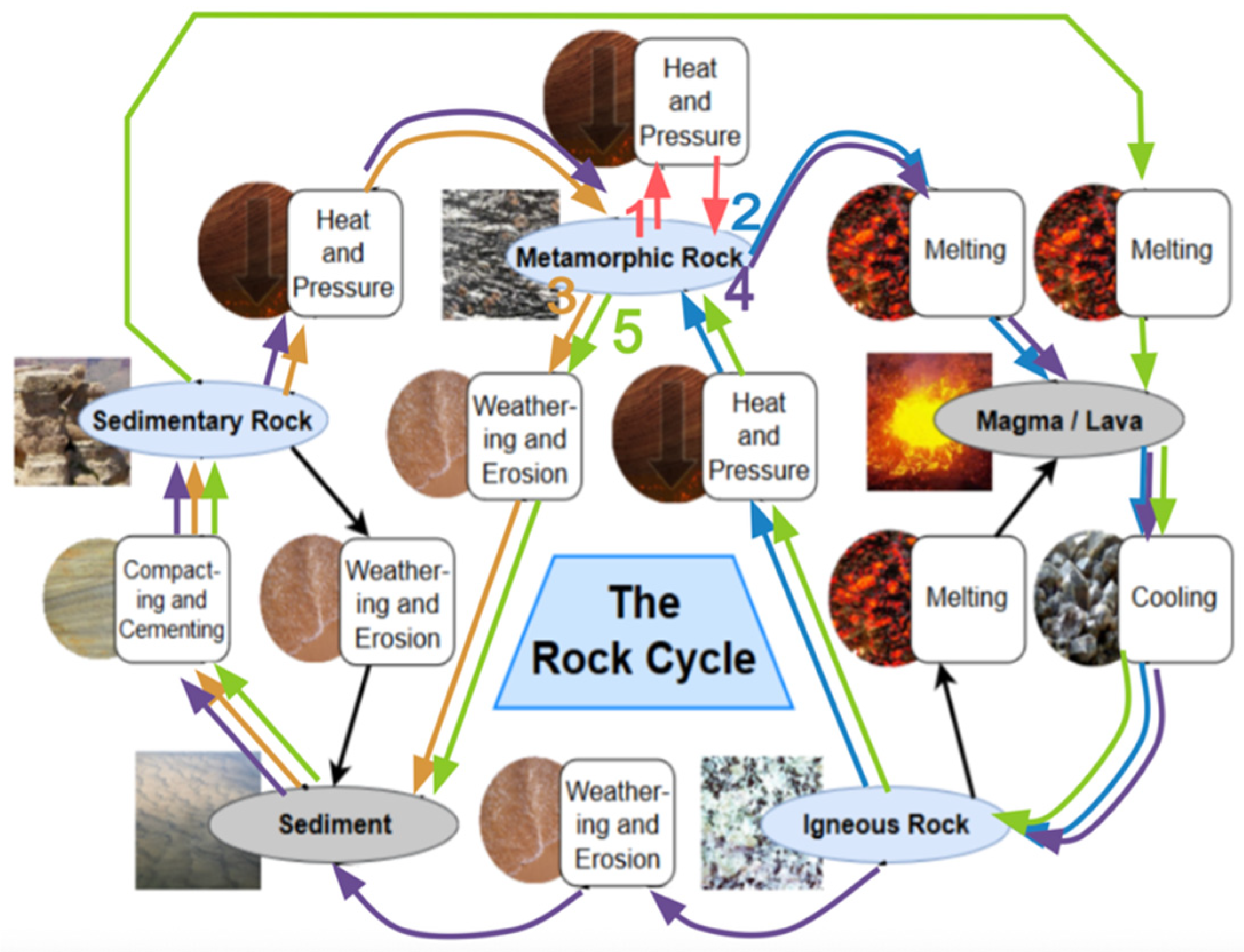
Then James was asked about the number of cycles that he saw in the simulation and he mentioned that there were multiple pathways through the cycle from a single input material. James listed five different paths starting from metamorphic rock that could be traveled by George as illustrated in
Figure 15. James explained the sub-cycles as he used his mouse to drag George through each path,
[1] He goes from heat and pressure and then he goes back to metamorphic rock. [2] Then melts turned into magma and lava. Then he cools then turns into igneous rock. And then with heat and pressure, he turned into metamorphic rock. That’s two [paths] and [3] then he goes to, goes through weathering and erosion, turns into sediment, compacts and cements, turns into sedimentary rock and with heat and pressure, he turns into metamorphic rock. [4] And then once he melts he turns into magma and cools. He turns into igneous rock, and he weathers and erodes and then cement, sediment and he turns into sediment, then he compacts and cements, turning into sedimentary rock, and then adds heat and pressure and metamorphic rock. [5] Then when he goes through weathering and eroding, he goes to sediment and then he compacts and cements and turns into sedimentary rock, and then goes all the way around and melts. Turn into the magma, cools, igneous and then heat and pressure into metamorphic rock.
Figure 15.
Recreation of the five paths through the Rock Cycle identified by James. Each color represents a different numbered path.
Figure 15.
Recreation of the five paths through the Rock Cycle identified by James. Each color represents a different numbered path.
James explained each of these cycles as sub-cycles by connecting them together at metamorphic rock, which he had previously identified had multiple processes it could go through. This illustrated the cyclic nature of the individual sub-cycles. However, he identified more than three sub-cycles, illustrating that he also noticed other divergences of multiple processes coming from input materials subsequently in the chain. For example, sub-cycle 3 and sub-cycle 5 diverged at sedimentary rock undergoing different processes. While Laura and Noelle also described George moving through connected sub-cycles in the context of the story, James’ identification of multiple pathways went beyond the hypothetical situation and illustrated how George could move through the multiple sub-cycles in a continuous manner.