


Abstract
Higher education continues to encounter the challenge of redesigning writing pedagogy beyond the rapid adoption of emerging technologies. This challenge is particularly evident in English writing courses, which play a role in developing students’ writing and research skills in universities across the United Arab Emirates (UAE). While generative artificial intelligence (GenAI) tools offer practical affordances for writing instruction, their growing use has also raised concerns about academic integrity, authenticity, and critical engagement. Although early discourse has focused on the risks and potential of GenAI, there remains a clear dearth of frameworks to guide instructors in designing meaningful and engaging writing assignments. This paper introduces Ai-RACE, an adaptable pedagogical framework for designing purposeful and innovative writing tasks. Grounded in classroom-based insights, principles of writing pedagogy, constructivist and multimodal learning theories, Ai-RACE conceptualises assignment design around five interconnected components: AI integration, Relevance, Authenticity, the 4Cs, and Engagement. Employing a design-focused qualitative approach, the study uses instructional practices and student reflections to examine the implementation of Ai-RACE in writing contexts. Although situated within a specific institutional context, the study offers transferable guidelines for designing writing assignments across international higher education settings. By positioning Ai-RACE as a design heuristic, the study demonstrates its potential in supporting engagement, critical thinking, writing skills and ethical use of AI, and highlights the importance of rethinking writing pedagogy and the professional development in AI- influenced contexts.
1. Introduction
Writing remains a foundational component of academic and professional contexts, supporting the development of critical thinking and communication skills. The emergence of Artificial Intelligence (AI) applications, particularly generative AI (GenAI), has attracted over one hundred million users in a short period, introducing new challenges and opportunities for writing education (Perkins et al., 2024b; Milmo, 2023). Tools such as OpenAI’s ChatGPT, Microsoft’s Copilot, and Google’s Gemini can generate text, revise drafts, and provide instant feedback at low cost, making them popular among students (Perkins et al., 2024a). These tools are also associated with personalised forms of learning support (Dakakni & Safa, 2023).
However, the accessibility of GenAI has raised concerns about academic integrity, critical thinking, creativity, and overreliance on AI-generated content (Baule, 2024; Kamalov et al., 2023). Educators’ responses have been polarised, ranging from restrictive approaches that limit AI use to more pragmatic approaches that incorporate AI into instruction while preserving a focus on process-oriented learning and ethical standards (Nicolas, 2023; Olejnik, 2023). GenAI is also viewed as an opportunity to rethink approaches to writing pedagogy and to encourage critical engagement with AI-generated outputs.
In higher education institutions across the United Arab Emirates (UAE), English writing courses are a requirement for undergraduate students (El-Soussi, 2021). These courses aim to develop students’ competence in academic writing genres, critical reflection, and research writing. These courses focus on structured argumentation and information synthesis, skills that are increasingly challenged by AI-generated content (Marzuki et al., 2023). As universities emphasise digital proficiency, writing instructors also support students in developing digital literacy, defined as “the ability to use and understand current digital technologies and anticipate future digital technologies” (Hamilton, 2019, p. 3; Spante et al., 2018). They also focus on AI literacy, a set of competencies that enables individuals to critically evaluate, communicate, and collaborate effectively with AI technologies (Long & Magerko, 2020, p. 2). Therefore, it is crucial to support students in using AI critically, responsibly, and competently (Ou et al., 2024).
Several frameworks have been proposed to guide instructors and institutions in the use of AI. However, many of these frameworks emphasise AI’s impact on student learning behaviours or policy-level responses, providing limited guidance for assignment design. Addressing this gap, this design-informed study introduces the framework comprising five components: AI-Integration, Relevance, Authenticity, the 4Cs, and Engagement (Ai-RACE, pronounced “I-race”), to support the design of writing assignments in higher education. Classroom implementation is used to demonstrate how the framework’s design principles can be applied in practice.
Ai-RACE is intended to support instructors in designing student-centred, process-based, multimodal writing that meets expectations for the ethical and responsible AI use. Although situated within a specific institutional context, the study offers transferable guidelines to inform the design of writing assignments across international higher education settings. In response to the ubiquity of GenAI in HE and the need for pedagogically grounded approaches to writing instruction, this study is guided by the following research question:
How can the Ai-RACE framework inform the design of writing assignments to support student engagement, critical thinking, perceived development of writing skills, and ethical AI use in writing?
2. Literature Review
2.1. Teaching Writing in Higher Education
Academic writing is widely recognised as cognitively demanding, requiring students to synthesise sources, adopt a critical approach, and develop a clear academic voice, compounded by a concern for audience and accuracy (Lavelle & Bushrow, 2007; Lin & Morrison, 2021). Hulleman and Barron (2013) further confirm that, “The sacrifices that one has to make to engage in the activity, and the negative aspects of the experience (such as anxiety and fatigue) can prevent a student from wanting to continue to engage” (p. 11). This emotional complexity often leads some students to disengage from the writing process or to resort to unethical practices, such as plagiarism or hiring shadow writers (El-Soussi, 2021; Hamza et al., 2022).
However, students who resort to plagiarism miss the essence of writing as a meaningful, interactive, and collaborative process. Writing is a dynamic, iterative and reflective process that fosters critical engagement, revision, and continuous refinement of ideas. It is inherently social and rhetorical, shaped by previous experiences, interactions, and constant practice, not innate ability and requires reflection and metacognition to develop and progress (Adler-Kassner & Wardle, 2015, pp. 17–19). Investigating meaningful writing experiences, Eodice et al. (2017) surveyed more than 700 seniors at three universities and identified key themes driving memorable writing experiences, rather than particular classes or teachers. These themes included learning for transfer, student agency, choice and engagement, through interaction with peers, instructors and real-world applications (Eodice et al., 2017). These interconnected themes enhance critical thinking by enabling exploration, revision, and refinement of ideas, affirming the interactive nature of writing.
2.2. AI in Writing
In higher education, artificial intelligence (AI) increasingly influences students’ academic performance and daily lives (Chen et al., 2020; Chu et al., 2022; Yusuf et al., 2024b), particularly in writing courses. AI-powered writing tools provide immediate feedback on formatting, grammar, and punctuation, and are associated with improvements in writing (Chang et al., 2021; Farhi et al., 2023; Holmes & Tuomi, 2022; R. Lam & Moorhouse, 2022; Liu et al., 2021; Marzuki et al., 2023; Nazari et al., 2021; Stöhr et al., 2024; Zawacki-Richter et al., 2019). However, research also highlights limitations, including inconsistent feedback quality (Z. Wang, 2022; Su & Yang, 2023), stylistic simplification (Escalante et al., 2023), and the risk of biased or inaccurate content (Cui, 2025; Lingard, 2023).
Concerns have been raised regarding academic integrity, AI-assisted plagiarism, and over-reliance on AI tools, which may impact independent learning, critical analysis, and problem-solving skills (Fleckenstein et al., 2024; Liebrenz et al., 2023; R. Jiang, 2022; Tlili et al., 2023; Yusuf et al., 2024b; Cui, 2025). Studies suggest that students may lack the critical and digital literacy skills needed to effectively use AI feedback (Chen et al., 2020; C. Wang et al., 2024) and that excessive reliance on AI can reduce opportunities for trial-and-error learning and peer interaction (C. Wang et al., 2024).
As writing instructors, the authors believe that GenAI cannot, and should not, replace the social, interactive, and cognitive nature of writing as a process. Writing pedagogy must continue to prioritise rhetorical awareness, critical thinking, and authentic voice development (Adler-Kassner & Wardle, 2015; Eodice et al., 2017). GenAI can support parts of the process, offering new ways to teach, assess, and engage students (Perkins et al., 2024a); however, it cannot replicate the cognitive and interactive experiences required to develop rhetorical awareness, critical thinking, and an authentic voice through writing activities. All elements of the writing process remain human experiences that instructors support (Olejnik, 2023).
As Bedington et al. (2024) stated, “writing has always adapted and evolved with the emergence of new technologies. Due to developments in artificial intelligence, we are in the midst of a moment of change—one that impacts how we write, what we write, and the networks and assemblages in which we write and teach” (p. 1). GenAI represents the latest shift, requiring instructors to reconsider how they support student learning.
2.3. Constructivist Learning and Multimodality
Constructivist learning theories position learners as active agents who construct knowledge by reflecting on experience and interaction within meaningful contexts (Pardjono, 2016; Bond, 2012). This perspective is particularly relevant to writing pedagogy, where iterative practice, feedback and real-world applications are essential (Rahimi & Fathi, 2022; Tuncel & Bahtiyar, 2015).
Social Constructivism emphasises the importance of collaboration and scaffolding, where learning co-constructs knowledge within the Zone of Proximal Development (ZPD) (Vygotsky, 1978). This model promotes the progressive development of students’ skills through carefully designed challenges supported by instructor and peer input, leading to the development of higher-order thinking skills. Piaget’s cognitive constructivism (Piaget, 2001) reinforces this perspective by asserting that learning is an adaptive process involving assimilation and accommodation rather than passive reception of information. Similarly, Tynjala (1999) emphasises the value of constructivist learning environments in bridging theory and practice through reflective and experiential learning.
In writing pedagogy, these principles translate into assignments that integrate theoretical knowledge with practical applications and require students to critically evaluate AI outputs and engage in an iterative process of reflection and revision. Such environments support critical thinking, creativity, self-regulation, and adaptability, competencies relevant for navigating the challenges presented by GenAI (Guo et al., 2024).
Additionally, grounded in constructivism (Dewey, 1986; Piaget, 2001), multimodal writing prioritises “learning by making” and aligns with the New London Group’s (1996) theory of multiliteracies, positioning literacy as a multimodal and socially situated act that integrates linguistic, visual, and digital forms. By composing across modes, students move beyond the constraints of the traditional written page to make strategic rhetorical choices tailored to specific audiences and purposes (Lafond & Macias, 2018; Haimes-Korn & Hansen, 2018). Such iterative, process-based tasks emphasise knowledge construction over single-product performance, thereby fostering learner agency, inclusivity, and participation in real-world writing communities (Behizadeh, 2019; Evans, 2024; Quinlan et al., 2025). Ultimately, this approach promotes ethical AI integration by centering human creativity and rhetorical decision-making over automated content generation (Baskara, 2023; Khlaif et al., 2025).
2.4. Existing AI-Related Frameworks
Research on AI in education has led to the development of frameworks that guide instructors and institutions in addressing AI literacy, ethics, assessment, and tool affordances in higher education (e.g., Kolade et al., 2024; Perkins et al., 2024a; Rowland, 2023). Examples include the AI Literacy Framework (Ruiz et al., 2024), UNESCO’s AI competency framework (UNESCO, 2025) and models focusing on functional, critical, and ethical AI literacy (Ng et al., 2021).
Other frameworks, such as IDEE (Su & Yang, 2023), propose guidelines for the use of ChatGPT and other generative AI in education. The IDEE framework consists of four stages: Identify, Determine, Ensure, and Evaluate, offering a structured approach to AI integration in education. Similarly, Rowland (2023) introduces two frameworks for integrating GenAI into academic writing. More recent models, such as Shanto et al.’s (2024) AI-CRITIQUE and Yusuf et al.’s (2024a) five-phase framework, have introduced structured approaches to enhance critical thinking through the evaluation of AI-generated content.
Other frameworks address writing pedagogy within AI-assisted writing environments. For example, the Artificial Intelligence Assessment Scale (AIAS) provides a structured framework for evaluating the ethical and pedagogical appropriateness of AI integration in assessments (Perkins et al., 2024a). While AIAS ensures that AI tools are used responsibly and fairly, it does not directly address the pedagogical design of writing assignments, specifically, how instructors can redesign assignments to foster deeper engagement, originality, and critical thinking.
Furthermore, the CARE framework (Pflugfelder & Reeves, 2024) emphasises ethical and contextual use of AI in technical writing classrooms. In the context of research writing, Pigg’s (2024) embodied practice framework examines how students interact with AI tools throughout the research process.
These frameworks focus on how AI affects student learning behaviours, assessment, and tool use, but offer limited guidance on how instructors can redesign assignments and implement direct strategies. Ai-RACE addresses a gap in the literature by emphasising assignment design as a pedagogical intervention, restructuring writing tasks to support critical thinking and active learning, promote originality, reduce overreliance on generative AI, and integrate AI use within ethical and pedagogical boundaries.
This study recognises that writing pedagogy and student engagement with AI are shaped by institutional and cultural contexts. Research in higher education demonstrates that students’ approaches to writing and technology use are influenced by language backgrounds, institutional expectations, and educational contexts, in which writing practices and digital engagement are linked to local academic cultures (Kamalov et al., 2023; Khlaif et al., 2025). In higher education institutions in the UAE, where English writing courses are compulsory and the student population is diverse, studies have shown that these conditions, especially in multilingual education contexts, influence how students approach writing tasks and use AI tools, particularly with respect to motivation, value of writing, and academic integrity (El-Soussi, 2021; Perkins et al., 2024a). Ai-RACE offers a design-focused framework that provides a structured approach to supporting instructors in creating meaningful, student-centred writing experiences and adapting its principles to their own disciplinary and institutional environments.
Building on the theoretical and pedagogical perspectives outlined in the literature, the following sections describe the methodological approach used to develop the Ai-RACE framework and examine its pedagogical value through classroom implementation.
3. Methodology
3.1. Research Design
This study adopted a design-informed, exploratory, and qualitative approach to classroom-based research. Its primary analytical focus is the conceptual design and pedagogical logic of the Ai-RACE framework as a design heuristic, focusing on its development to meet the challenges of the use of AI in writing. Student reflections are used as a supplementary data source to support the interpretation of how these design principles are reflected during implementation and to validate how the design heuristics guide the creation of writing assignments in higher education.
Positioned within an interpretivist paradigm, the study recognises that teaching and learning are socially constructed through the lived experiences and interpretations of participants (Cohen et al., 2018; Creswell & Creswell, 2023). Consequently, the objective is not to produce universal generalisations, but to generate context-rich, transferable design insights into how the Ai-RACE framework can inform pedagogical practice in AI-influenced writing environments.
3.2. Researcher Positionality and Ethical Considerations
The course instructor also served as one of the researchers in the study, which may introduce bias. To address this risk, reflexive journaling was employed throughout the implementation, data collection and analysis to critically examine assumptions and interpretations. This insider perspective facilitated rapport and empathy but also required reflexivity to minimise research bias.
Ethical approval for the study was obtained from the university’s Institutional Review Board (IRB) [Approval# 45 CFR 46.104(d)(2)]. The study was conducted in accordance with their guidelines and regulations. Participation in the research component was voluntary, and written informed consent forms (to participate and to publish) were obtained from all participants. Students were informed that they could withdraw at any time without penalty and that their reflections would not affect assessment outcomes. The reflections are available from the corresponding author on reasonable request.
3.3. Instructional Context and Participants
The study was conducted in a first-year academic writing course at a private university in the United Arab Emirates (UAE). The course is a compulsory component of undergraduate programs across disciplines. It aims to develop students’ academic writing, reading, and critical thinking skills, including idea generation, genre-based writing, contextualised grammar instruction, and digital literacy, through genre-based assignments such as narrative, expository, and reflective writing. A total of 45 undergraduate students enrolled in two sections of the course, joining from various disciplines, including business, engineering, media studies, sciences, and arts. The Ai-RACE framework was implemented in a major course assignment, a multimodal process paragraph project designed to integrate authentic, collaborative, and reflective elements.
3.4. Assignment Design
The assignment, a multimodal process paragraph, was designed using the Ai-RACE framework. It was implemented over four weeks, comprising biweekly 75-min sessions. This structure utilized a blended approach, with foundational tasks conducted in class to facilitate peer collaboration, while others were completed independently as home-based work. The design prioritised process writing, multimodality, peer interaction, and responsible use of AI. The assignment design is described in detail in Section 4.2.
3.5. Role of Student Reflections as Supplementary Evidence
Data were drawn from students’ written reflections completed as the final step of the assignment. The reflective task invited students to comment on their learning experiences, perceptions of writing development, use of AI tools, and overall challenges and benefits of the assignment.
Student reflections were used as a supplementary data source to examine how the design principles of Ai-RACE were evident in the implementation of the assignment. In this design-informed study, reflections were not treated as evidence of learning outcomes but rather as indicators of the framework’s affordances and limitations.
3.6. Data Analysis of Students’ Reflections
Students’ reflections were analysed using thematic analysis, consistent with the study’s design-informed focus (Braun & Clarke, 2006). The analysis involved iterative reading of the reflections to identify recurring ideas related to engagement, creativity, the writing process, and AI use. Relevant segments were coded and grouped into categories, following a deductive thematic approach in which student reflections were mapped against the core components of the Ai-RACE framework. This method enabled a direct analytical link between the pedagogical design, the framework, and the students’ experiences during implementation. Through iterative comparison across reflections, recurring patterns were synthesised into design-relevant themes that highlighted the framework’s affordances and constraints. The five Ai-RACE components, AI-integration, relevance, authenticity, the 4Cs (Critical Thinking, Communication, Collaboration, and Creativity), and engagement, served as primary coding categories to evaluate the framework’s effectiveness in practice. This deductive “top-down” mapping enabled an examination of how the framework’s design heuristics were reflected in students’ writing experiences. Reliability was enhanced through peer debriefing: two colleagues independently reviewed a subset of transcripts and codes, and discrepancies were discussed until consensus was reached.
4. Ai-RACE Framework: Components and Applications
4.1. Design Rationale and Components of Ai-RACE
In recent semesters, instructors have observed an increasing reliance on generative AI tools, such as ChatGPT, among students, raising concerns related to academic integrity, originality, voice, and engagement. These classroom-based observations necessitated rethinking the design of writing assignments to move beyond mere detection toward a more proactive pedagogical response. By synthesising these contextual insights with a review of literature on multimodal writing, constructivist learning, and AI in writing pedagogy (Cheng, 2024; Marzuki et al., 2023; Tynjala, 1999), the Ai-RACE framework was conceptualised. This framework serves as a design heuristic intended to rethink assignment structures, fostering creativity and critical inquiry while guiding students toward the ethical and strategic integration of AI tools.
Ai-RACE offers a comprehensive approach for writing instructors to reimagine and restructure their writing assignments. Ai-RACE promotes engagement, critical thinking, reflection, communication, learner agency, iterative practice, and collaboration, essential elements in writing pedagogy as highlighted in earlier studies (Adler-Kassner & Wardle, 2015; Eodice et al., 2017). From a constructivist perspective, learning is understood as an active process in which students construct knowledge through experience, collaboration, questioning, and reflection, rather than passively receiving information (Saudelli et al., 2021). Similarly, research on authenticity in learning demonstrates that active participation in authentic tasks promotes deeper understanding, autonomy, motivation, and critical thinking (Behizadeh, 2019; Koh et al., 2019; Tuncel & Bahtiyar, 2015). For instance, writing for an authentic audience intensifies student engagement and purpose, transforming conventional assignments into transformative experiences that mirror professional practice (Behizadeh, 2019). The integration of these theoretical foundations informs Ai-RACE as a structured and adaptable framework for designing writing assignments and creating meaningful learning experiences. By prioritising active participation, collaborative learning and critical engagement, the framework addresses the challenges posed by GenAI tools and prepares students for the demands of academic and professional writing.
The framework, grounded in the principles of constructivist learning theories and writing pedagogy, was conceptualised with five main components (see Figure 1):
Figure 1.
Ai-Race Framework.
- AI-Integration: Designing assignments that either minimise AI misuse and/or incorporate AI tools effectively and ethically.
- Relevance: Ensuring assignments connect to students’ interests, academic goals, and real-world applications.
- Authenticity: Designing tasks that mirror professional and real-world contexts.
- The 4Cs: Promoting active collaboration, communication, creativity, and critical thinking through interactive and multimodal tasks.
- Engagement: Using digital tools, meaningful tasks, and collaborative projects to maintain student motivation and participation.
4.2. Application of Ai-RACE in Assignment Design
The assignment, a multimodal process paragraph, was designed using the Ai-RACE framework. Each stage of the assignment was intentionally aligned with one or more components of the framework. Digital tools, such as Google Docs, Padlet, Flipgrid, and Grammarly, were carefully chosen to align with the framework’s components, learning outcomes, and accessibility, minimising technical barriers to participation. The following section describes the steps in sufficient detail to enable adaptation across comparable academic writing contexts.
- Step 1: Introducing the Process Paragraph Genre (in class)
- The first step introduced the process paragraph genre and its conventions through direct instruction, discussion, and analysis of model texts. This stage focused on helping students understand key elements, including organisational structure, lexical choices, content development, audience awareness, and the techniques and purposes of process paragraphs.
- Sample process paragraphs, including some generated by AI, were presented and analysed to further illustrate relevant content, efficient organisation and proper language use.
- During the analysis stage, students first independently analysed the sample texts, identifying their structure, content, elaboration, and lexical features. Then they used AI tools to compare and supplement their observations. The activity concluded with small-group discussions, during which students reflected on how AI-assisted analysis validated their interpretations or prompted a re-evaluation of their understanding of effective paragraph writing.
- Step 2: Practising the Writing Process Paragraphs in Groups (in class)
- Following the genre introduction, students collaborated in groups to draft their own process paragraphs on a specific subject in class. They were also encouraged to use generative AI tools, such as Gemini and ChatGPT, to generate topic ideas.
- Using Google Docs, each group applied the conventions discussed in the first step to create a well-organised, logical, and coherent process paragraph.
- Groups presented their finished paragraphs to the class. Peers and the teacher shared feedback and reflection to discuss lessons learned, areas for improvement, and strengths. This collaborative process reinforced writing principles, promoted peer learning, and fostered metacognitive awareness of the writing process.
- Step 3: Prewriting Video Recording Assignment (done as homework)
- As a prewriting task, students were asked to create a three-minute video using Flipgrid (before its discontinuation) demonstrating an on-campus process that promotes sustainable practices. They explored the campus and engaged in conversations with other students, faculty, and staff about sustainability, which informed the content of their videos.
- Students recorded and posted their videos on Flipgrid as part of a digital awareness campaign. Some students chose to record themselves or other students performing the process in real time, while others, who were more camera-shy, used AI-generated avatars to present their work and maintain on-screen anonymity. Students were required to critically audit AI-generated content for hallucinations, systemic biases, and intellectual property risks. Students were expected to review and respond to each other’s videos.
- Step 4: Transferring Video Content into a Written Process Paragraph (in class)
- In the final step, students returned to class prepared to write the process paragraph assignment. The instructor randomly selected one student’s video and instructed them to write a process paragraph based on that video. To ensure genuine, spontaneous writing and to avoid AI-generated content, students were not informed in advance of the tasks for this step of the assignment.
- Students watched the recorded video in class while wearing headphones, then composed their process paragraphs based on the visual content. This step encouraged students to produce original content by requiring them to write in controlled conditions.
- The instructor reviewed students’ first drafts, graded them, and offered targeted feedback.
- Final drafts were revised and submitted in the following session. At this stage, students had the opportunity to improve their grades up to 5 marks by addressing the instructor’s feedback. They were permitted to use AI grammar checkers, such as Grammarly or Wordtune, only for linguistic revision, not for content generation.
- Step 5: Reflective Writing Task (outside class)
- After completing the final draft of the process paragraph and videos, students engaged in a short reflective activity. In this step, students were asked to evaluate their learning experience throughout the assignment.
5. Findings and Discussion
The discussion centers on the Ai-RACE design components. Student reflections are woven throughout this analysis as illustrative evidence that supports the design rationale, particularly the bridge between constructivist learning theory and practical multimodal production. The findings address the research question by examining how the design principles of Ai-RACE were reflected in the structure and implementation of the writing assignment and by validating that these heuristics fostered engagement, critical thinking, and a sense of ethical agency, as evidenced by students’ reflections.
The framework comprises five components: AI Integration, Relevance, Authenticity, the 4 Cs, and Engagement. Each component served as a design principle to guide instructors in structuring writing tasks. Student reflections were analysed and mapped to these components to identify recurring and design-relevant patterns, with many of the reflections aligning with multiple components of the framework. Student reflections and responses mostly affirm the framework’s value and pedagogical impact. The interconnectedness enhances the potential of the Ai-RACE framework, underscoring its capacity to support a multifaceted, integrated approach to writing instruction.
Although overall experiences were positive, several reflections also pointed to challenges related to working in groups, managing time across task stages, handling new tasks, and maintaining consistent energy throughout the assignment process. These observations highlight the importance of scaffolding and clear guidance when implementing innovative assignments.
This section is organised thematically according to the framework’s components.
5.1. AI-Integration
Effective AI integration in writing instruction requires an approach that balances designing tasks that discourage unethical AI use (AI-proof) with those that encourage the ethical and practical use of AI tools (AI-friendly). The assignment was designed to combine the two concepts. The AI-proof element was established by incorporating several steps into the assignment. To ensure that students submit their own work, assignments should include checkpoints at which students must submit parts of the assignment, such as the outline, the introduction, the first draft, or any part, emphasising that writing is a process (Praphan & Praphan, 2023). The pedagogical design navigated the tension between AI resistance and AI integration. ‘AI-proof’ was structurally reinforced by requiring students to synthesise peer-generated video content in a controlled setting. The assignment incorporated intentional AI-friendly heuristics. By utilising AI for data analysis and avatar creation, the assignment moved beyond tool-use toward a sophisticated human-AI co-compositional model.
The requirement to audit AI-generated content for hallucinations, biases, and intellectual property risks functioned as a catalyst for ethical agency, as students demonstrated the ability to make nuanced, personal decisions when navigating the ethical pitfalls inherent in AI-assisted multimodal production (N. Kim et al., 2025). Consistent with research emphasising the iterative process more than the outcome, Ai-RACE prioritises students’ ability to critically assess and revise AI-generated content (Lubbe et al., 2025).
Analysis of student reflections suggested that multimodal tasks served as the primary sources of idea development, reinforcing originality, the purposeful use of AI, and the role of authentic and collaborative design in writing. One student noted, “There was no need to use AI while writing the draft, as I could provide what I needed on my own based on the video. My video and my friend’s helped me with ideas.”
Reflections also revealed selective and appropriate use of AI tools throughout various stages of the writing process. For example, tools like Grammarly were considered helpful during the editing stage. One student reflected, “I used Grammarly for correcting any grammar mistakes and removing redundant words and phrases.” AI-integration functioned as a design-regulated affordance, supporting clarity and accuracy without affecting student authorship. This finding is consistent with earlier research highlighting the positive effects of AI tools in providing feedback to students (e.g., Chang et al., 2021; Farhi et al., 2023; Holmes & Tuomi, 2022).
Reflections also highlighted the importance of acknowledging the responsible use of AI as a means of accommodating diverse student needs. For instance, one student mentioned, “I chose to use AI for my video because I am not comfortable recording myself speaking to a camera.” This response reflects how the framework’s emphasis on agency empowered students to make design choices within the assignment’s scope. These observations illustrate how Ai-RACE informed assignment design by specifying when, how, and why AI tools could be used, and reinforcing the focus on process writing practices.
Ai-RACE recognises the twofold nature of AI in education as a challenge to academic integrity and a tool for supporting critical engagement. Given the increasing use of AI tools, educators must stay current with technological advancements to support students’ development of digital and critical thinking skills while maintaining the academic integrity of the writing process (Perkins et al., 2024a). In this context, Ai-RACE offers instructors the flexibility to integrate AI into writing assignments as a design principle, emphasising the intentional, ethical, and purposeful use of AI, depending on the nature of the assignment and the stages of the writing process. As Cummings et al. (2024) argue, “It is this component or stage definition that allows for a successful integration with generative AI technology” (p. 3). From a design perspective, instructors must clearly communicate the objectives and expectations for using AI in writing tasks to support students in building confidence in their writing process and in using AI responsibly and selectively.
5.2. Relevance
Relevance is an important component of the framework, ensuring that assignments are aligned with students’ academic and personal interests. This assignment focuses on sustainability, a critical global concern that is highly relevant to students’ lives, and links classroom material to the university’s sustainability initiatives. This design choice positioned the writing tasks within a broader social and institutional context and supported active learning. From a design perspective, this approach aligns with research suggesting that relevance enhances engagement as “relevance has to be the red thread permeating activities” (Dörnyei & Ushioda, 2011). Assignment topics are relevant when aligned with students’ ages, majors, concerns, interests, needs, current circumstances, environment, context, and culture.
The assignment aimed to foster active learning by allowing students to choose sustainable practices aligned with their personal interests, fostering intrinsic motivation and a stronger sense of ownership over their writing. Students explored the significance of sustainable practices, including sustainable fashion and waste management. Reflections affirmed that researching these topics helped students connect course content to real-world issues and to their own world and future concerns. Several students described the task as meaningful. One student reflected, “Researching about the topic (sustainability) for the video was really interesting and helped me when writing my paragraph.” Other students commented, “It was my first time to learn about sustainability; I learned a lot of useful information”.
These observations mirror concerns raised in the literature on writing pedagogy that “any mismatch between classroom tasks and their immediate necessity raises doubts in students’ minds and makes them less attached to the writing class” (Saha, 2017, p. 54). Hidi and Boscolo (2006) further argue that some teachers’ instructional approaches to writing, and their disconnectedness from other disciplines, have made it difficult for students to view writing as a communicative tool or an exciting activity rather than an academic task. As such, the design of assignments plays a critical role in student engagement and autonomy, with relevance promoting a liberating and confidence-boosting effect (Lo & Hyland, 2007, p. 232).
5.3. Authenticity
Ai-RACE incorporates authenticity by designing writing tasks that mirror real-world complexity, contexts, purpose, and audience. Within this framework, authenticity functions as a design principle, shaping how the tasks are framed and implemented. Authenticity refers to tasks that require students to apply the same competencies, knowledge, skills, and attitudes necessary in real-life professional contexts (Gulikers et al., 2004, p. 69).
The assignment exemplified this principle by involving students in organising a real-life event, the Sustainability Awareness Event, and creating a video intended for an authentic audience beyond the classroom, as recommended by earlier literature (Foulger & Jimenez-Silva, 2007; Henry et al., 2017). Following the video creation, students wrote a process paragraph based on their peers’ video that showcased sustainable practices, encouraging critical analysis and communicating authentic content across multimedia platforms. One student remarked, “Using real-life online campaigns and videos enhanced my learning experience.” This feedback highlights the value of authenticity as a means to deepen engagement.
This design approach positioned writing as a communicative act situated within a social context. The multimodal nature of these tasks requires students to translate their interpretations across various rhetorical contexts and for multiple audience types. El-Soussi (2021) suggests that instructors should ensure that students do not view writing tasks as products, but as authentic, purposeful communications and means of contributing to a community, so that students value the writing task and engage with the process. Similarly, DeNigris et al. (2020) confirm that introducing students to authentic research tasks encourages them to review their work and informs their academic experience or career choices (p. 481).
Students’ engagement with authentic audiences and topics of interest has been shown to compensate for the low grades they receive on inaccuracies in grammar and structure (Lo & Hyland, 2007). Incorporating authenticity through purposeful, real-world tasks or contexts can positively impact students’ learning, engagement, motivation, and skill development (Gulikers et al., 2004; Wargo, 2019).
5.4. The 4 Cs: Collaboration, Communication, Creativity, Critical Thinking
Ai-RACE incorporates the 4Cs in assignment design to develop students’ skills for academic and professional success. “21st-century skills” are highlighted as essential for success in a volatile, uncertain, complex, and ambiguous workplace. Early frameworks, such as the Partnership for 21st Century Skills (P21) and the World Economic Forum (Thornhill-Miller et al., 2023), introduced the “4Cs”, creativity, critical thinking, communication, and collaboration, as key components of future-focused education, crucial for advancing educational standards, curriculum design, professional development, and learning environments. The assignment design encouraged collaboration through group activities, creativity in video production, critical thinking in evaluating peer and AI-generated content, and communication in both written and visual formats. Using the framework, these elements were integrated through a multimodal approach rather than being treated as isolated activities.
The assignment required students to examine a sustainability topic, break it down into actionable steps, produce a video, write a process paragraph, and discuss the importance of the chosen sustainable practice. This approach encouraged evaluation and synthesis by combining structured academic writing with visual storytelling, thereby promoting both divergent and convergent thinking (Fischer et al., 2020). The assignment incorporated hands-on activities designed to promote writing skills and oral communication competence, demonstrating the affordances of multimodal task designs in engaging students cognitively and linguistically (Y. Kim et al., 2023; Lai, 2024).
Research suggests that multimodal composition enables students to engage with new material and knowledge in a more sensory-rich way than conventional writing, sparking their intellectual curiosity (L. Jiang & Luk, 2016). As one student said, “It was my first time to learn about sustainable practices, and I want to be more sustainable.” Critical thinking was evident in tasks that required analysing written work and videos, as well as in providing constructive feedback—student reflections referencing these activities indicate the practical application of the design principles.
By encouraging peer feedback and collective effort through shared platforms such as Flipgrid, the assignment design cultivates community and enables students to learn from one another while developing their writing skills (Haley, 2022; Huisman et al., 2018). One student wrote, “Feedback on Flipgrid helped me to feel part of a community”. Research suggests that students who engage in cooperative multimodal writing tasks outperform their peers in several aspects, including text length, lexical variety, and perceived communicative efficacy (Vandommele et al., 2017).
The 4Cs play a significant role in enhancing students’ writing performance. Integrating these elements into writing practices helps students develop a deeper analytical mindset, which is essential for effective writing (Singh et al., 2017). Dewey (1933) argued that thinking is prompted by problems, questions, ambiguity, confusion, or doubt, leading students to reflect on their thought processes. Developing critical thinking and problem-solving skills remains essential in this digital age (Adawati, 2014).
5.5. Engagement
Engagement is central to the Ai-RACE framework and was particularly evident in students’ responses. Within the framework, engagement was achieved by designing tasks that allowed students to select a topic of interest and present it creatively through video and writing. The design emphasised a sense of ownership, expression, and purpose. Student reflections described the assignment using terms such as “happy,” “interesting,” “perfect,” and “useful,” revealing their emotional connection to it. One participant also confirmed, “I can see my development in writing after this assignment and learned a lot of useful and interesting information.” These affective descriptors illustrate how students experienced the opportunities provided by the task design.
This sense of ownership was shaped by students’ contributions to a meaningful, shared project connected to the university community, positioning engagement as purpose-driven. Such active meaning-making and knowledge construction are in consonance with the principles of cognitive constructivism (Piaget, 2001).
Ai-RACE ensures that engagement is central to assignment design, with mistakes as a natural component of the learning process. Consistent with the literature, this design principle acknowledges the importance of engagement for sustained participation in writing tasks, including engagement with authentic audiences (Foulger & Jimenez-Silva, 2007), risk-taking, novel ideas, uncertainty, and surprise (S. Lam & Law, 2007; Sucuoglu, 2017). Research also shows that collaborative and project-based writing tasks increase students’ engagement by providing opportunities for autonomy and for interpersonal and intrapersonal communication (El-Soussi, 2021). As Kathpalia and Heah (2011) affirm, “the social dimension shows that writing is not a lonely, individualistic activity, but involves other participants” (p. 21), a principle that informed the assignment’s design.
Table 1 summarises excerpts from student reflections mapped to the five Ai-RACE components. These excerpts are included to illustrate how engagement- related design elements were experienced during implementation.
Table 1.
Student Reflections mapped to Ai-RACE components.
The analysis illustrates how the Ai-RACE framework informed the design of the writing assignment through the integration of AI integration, Relevance, Authenticity, the 4Cs, and Engagement. Across the assignment stages, these components shaped task structure, guiding responsible use of AI while positioning writing as a socially situated, process-focused practice. Student reflections, used as supplementary evidence, provided insight into how the design principles were experienced during implementation.
6. Implications and Recommendations
The classroom implementation of the Ai-RACE framework illustrates its relevance as a design-focused approach to rethinking writing assignments. Analysis of the assignment design, supported by student reflections, suggests that the multimodal assignment, which moves beyond traditional writing tasks, can influence how students perceive writing as an authentic and meaningful activity. The practical contribution of Ai-RACE is evident in how its components align with patterns identified in student reflections. This framing positions Ai-RACE as a design heuristic that informs assignment design decisions in response to the pedagogical challenges introduced by GenAI.
These design considerations reinforce the need to revisit writing pedagogy in response to technological advances and the demands of an AI-influenced academic environment. From a pedagogical perspective, the framework prioritises critical and creative engagement over rote content delivery. The assignment design demonstrates how structured opportunities for autonomous writing, using digital and AI tools, may be integrated at appropriate stages of the writing process.
Assignments can be designed to encourage the development of skills such as critical thinking, creativity, and collaboration while promoting the ethical and responsible use of GenAI tools. Ai-RACE addresses this need by providing a structured model that helps instructors align writing tasks with these priorities. The framework is developed to guide assignment design, providing a foundation for future research and educational practice.
The implementation of Ai-RACE also highlights the importance of ongoing professional development programmes to help educators adopt AI-informed strategies. Professional learning opportunities centred on assessment redesign, AI literacy, and ethical considerations can support instructors in making well-informed design choices as AI is widely adopted.
This section concludes with practical recommendations for instructors seeking to redesign writing assignments. Table 2 outlines the components of the Ai-RACE and corresponding design strategies that can be adapted across different classroom contexts.
Table 2.
Ai-RACE and Practical Strategies.
7. Limitations and Future Research Directions
This study provides insights into the application of the Ai-RACE framework, yet several limitations should be acknowledged. The first limitation is in the research’s limited scope. The implementation of the Ai-RACE was examined within a single institutional context and course with 45 students, which may limit the design’s generalisability. However, in alignment with the interpretivist paradigm, the goal was not universal generalisation but analytical transferability, offering a “design blueprint” that other educators can adapt and test in their own classroom environments.
The second limitation is related to methodological focus and data sources. The primary objective of this research was to explore the initial design and implementation of the Ai-RACE framework. Consequently, the data relied on qualitative accounts of student experiences. While the reflections provided rich descriptions of the writing process, the study lacks the longitudinal or quantitative data necessary to measure long-term skill acquisition. To further validate the framework, future studies should adopt mixed-methods approaches. Integrating quantitative metrics alongside qualitative reflections would provide a more robust validation of the framework’s impact on student performance.
Future research could examine the application of Ai-RACE across diverse disciplinary and institutional contexts. Such studies could validate its flexibility and responsiveness and assess the long-term impact on students’ writing skills and ethical decision-making. Specific areas for future investigation include:
- How the framework supports students’ academic and career readiness
- The development of assessment strategies that align with the framework’s principles.
- The role of Ai-RACE in student creativity and innovation across disciplines provides deeper insights into its scalability.
8. Conclusions
This study presents the Ai-RACE framework for redesigning writing assignments in higher education contexts. As AI technologies continue to shape educational practices, transforming how students learn, teachers educate, and institutions function (Kamalov et al., 2023), there is a growing need to explore new approaches to instruction and assessment. The components of Ai-RACE—AI-Integration, Relevance, Authenticity, the 4Cs, and Engagement inform the design of assignments aligned with constructivist and multimodal principles, emphasising writing as a process and a socially situated activity. By applying these elements, educators can design learning experiences that support students in developing essential skills for success in an AI-driven world.
As educators and institutions adapt to the realities of AI integration, frameworks such as Ai-RACE offer conceptual and practical guidance for assignment design. Such frameworks can be adapted and refined across different institutional contexts, helping to establish writing as a means for reflection, communication, and critical thinking. Through this approach, assignment design can address the ethical and practical considerations of an AI-driven world. As generative AI continue to shape higher education practices, the pedagogical challenge shifts from controlling the use of AI to designing writing tasks in response to it. Ai-RACE addresses this shift by adopting a design-based perspective that maintains writing as a reflective and process- driven practice.
Author Contributions
Conceptualization, A.E.-S. and D.Y.; methodology, A.E.-S. and D.Y.; validation, A.E.-S. and D.Y.; formal analysis, A.E.-S. and D.Y.; resources, A.E.-S. and D.Y.; data curation, A.E.-S. and D.Y.; writing—original draft preparation, A.E.-S. and D.Y.; writing—review and editing, A.E.-S. and D.Y.; visualization, A.E.-S. and D.Y. All authors have read and agreed to the published version of the manuscript.
Funding
This research received no external funding.
Institutional Review Board Statement
The study was conducted in accordance with the Declaration of Helsinki, and approved by the Institutional Review Board of American University of Sharjah (protocol code: 24-083; date of approval: 10 June 2024).
Informed Consent Statement
Informed consent was obtained from all subjects involved in the study.
Data Availability Statement
The data presented in the study are available on request from the corresponding author.
Conflicts of Interest
The authors declare no conflicts of interest. This paper represents the opinions of the authors and does not mean to represent the position or opinions of their institutions.
Abbreviations
The following abbreviations are used in this manuscript:
| GenAI | Generative Artificial Intelligence |
| AI | Artificial Intelligence |
| UAE | United Arab Emirates |
References
- Adawati, H. S. (2014). Exploring teachers’ experiences on integration of higher order thinking skills (HOTS) in the teaching of science [Master’s thesis, Universiti Malaysia Sarawak, UNIMAS]. [Google Scholar]
- Adler-Kassner, L., & Wardle, E. (2015). Naming what we know: Threshold concepts of writing studies. Utah State University Press. [Google Scholar] [CrossRef] [Scilit]
- Baskara, A. (2023). Integrating ChatGPT into EFL writing instruction: Benefits and challenges. Studies in English Language and Education, 10(3), 1208–1226. [Google Scholar] [CrossRef] [Scilit]
- Baule, S. (2024, April 11). Should instructors disclose their own use of AI in teaching? (Opinion). Inside Higher EdHigher Education News, Events and Jobs. Available online: https://www.insidehighered.com/opinion/career-advice/2024/04/11/should-instructors-disclose-their-own-use-ai-teaching-opinion (accessed on 2 June 2024).
- Bedington, A., Halcomb, E. F., McKee, H. A., Sargent, T., & Smith, A. (2024). Writing with generative AI and human-machine teaming: Insights and recommendations from faculty and students. Computers & Composition/Computers and Composition, 71, 102833. [Google Scholar] [CrossRef] [Scilit]
- Behizadeh, N. (2019). Aiming for authenticity: Successes and struggles of an attempt to increase authenticity in writing. Journal of Adolescent & Adult Literacy, 62(4), 411–419. [Google Scholar] [CrossRef] [Scilit]
- Bond, T. G. (2012). Piaget’s learning theory. In Encyclopedia of the sciences of learning (pp. 2634–2636). Springer eBooks. Springer. [Google Scholar] [CrossRef] [Scilit]
- Braun, V., & Clarke, V. (2006). Using thematic analysis in psychology. Qualitative Research in Psychology, 3(2), 77–101. [Google Scholar] [CrossRef] [Scilit]
- Campillo-Ferrer, J. M., Miralles-Martínez, P., & Sánchez-Ibáñez, R. (2021). The effectiveness of using edublogs as an instructional and motivating tool in the context of higher education. Humanities and Social Sciences Communications, 8(1), 175. [Google Scholar] [CrossRef] [Scilit]
- Chang, T. S., Li, Y., Huang, H. W., & Whitfield, B. (2021, March 9–11). Exploring EFL students’ writing performance and their acceptance of AI-based automated writing feedback. 2021 2nd International Conference on Education Development and Studies (pp. 31–35), Hilo, HI, USA. [Google Scholar]
- Chen, L., Chen, P., & Lin, Z. (2020). Artificial intelligence in education: A review. IEEE Access, 8, 75264–75278. [Google Scholar] [CrossRef] [Scilit]
- Cheng, C. H. (2024). Using AI-generative tools in tertiary education: Reflections on their effectiveness in improving tertiary students’ English writing abilities. Online Learning, 28(3), 33–54. [Google Scholar] [CrossRef] [Scilit]
- Cho, S. (2015). Writing teacher views on teacher feedback: A shift from grammar corrector to motivator. The Journal of Asia TEFL, 12(3), 33–59. [Google Scholar] [CrossRef] [Scilit]
- Chu, H. C., Hwang, G. H., Tu, Y. F., & Yang, K. H. (2022). Roles and research trends of artificial intelligence in higher education: A systematic review of the top 50 most-cited articles. Australasian Journal of Educational Technology, 38(3), 22–42. [Google Scholar]
- Cohen, L., Manion, L., & Morrison, K. (2018). Research methods in education (8th ed., Vol. 1). Routledge. [Google Scholar]
- Creswell, J. W., & Creswell, J. D. (2023). Research design: Qualitative, quantitative and mixed methods approaches. Sage Publications Ltd. [Google Scholar]
- Cui, Y. (2025). What influences college students using AI for academic writing?—A quantitative analysis based on HISAM and TRI theory. Computers and Education Artificial Intelligence, 8, 100391. [Google Scholar] [CrossRef] [Scilit]
- Cummings, R. E., Monroe, S. M., & Watkins, M. (2024). Generative AI in first-year writing: An early analysis of affordances, limitations, and a framework for the future. Computers & Composition, 71, 102827. [Google Scholar] [CrossRef] [Scilit]
- Dakakni, D., & Safa, N. (2023). Artificial intelligence in the L2 classroom: Implications and challenges on ethics and equity in higher education: A 21st-century Pandora’s box. Computers and Education Artificial Intelligence, 5, 100179. [Google Scholar] [CrossRef] [Scilit]
- DeNigris, D., Stanislaus, S., & Sheets, K. (2020). Why your students should publish in undergraduate journals: Benefits of engaging students in the research process. In T. M. Ober, E. Che, J. E. Brodsky, C. Raffaele, & P. J. Brooks (Eds.), How we teach now: The GSTA guide to transformative teaching (pp. 470–486). Society for the Teaching of Psychology. Available online: http://teachpsych.org/ebooks/howweteachnow-transformative (accessed on 20 September 2024).
- Dewey, J. (1933). How we think: A restatement of the relation of reflective thinking to the educative process. D. C. Heath and Company. [Google Scholar]
- Dewey, J. (1986, September). Experience and education. In The educational forum (Vol. 50, No. 3, pp. 241–252). Taylor & Francis Group. [Google Scholar]
- Dörnyei, Z., & Ushioda, E. (2011). Teaching and researching motivation (2nd ed.). Pearson. [Google Scholar]
- El-Soussi, A. (2021). Teachers’ perspectives on motivational challenges and strategies in L2 writing classes at higher education institutions in the UAE. The Journal of AsiaTEFL, 18(1), 57–75. [Google Scholar] [CrossRef] [Scilit]
- Eodice, M., Geller, E., & Lerner, N. (2017). The meaningful writing project: Learning, teaching and writing in higher education. Utah State University Press. [Google Scholar] [CrossRef] [Scilit]
- Escalante, J., Pack, A., & Barrett, A. (2023). AI-generated feedback on writing: Insights into efficacy and ENL student preference. International Journal of Educational Technology in Higher Education, 20(1). [Google Scholar] [CrossRef] [Scilit]
- Evans, A. (2024). Cultivating student voices: Multimodal composing in the community college. In M. Dennihy, & Z. Perel Katz (Eds.), Teaching community college and historically underserved students. Palgrave Macmillan. [Google Scholar] [CrossRef] [Scilit]
- Farhi, F., Jeljeli, R., Aburezeq, I., Dweikat, F. F., Al-Shami, S. A., & Slamene, R. (2023). Analyzing the students’ views, concerns, and perceived ethics about chat GPT usage. Computers and Education Artificial Intelligence, 5, 100180. [Google Scholar] [CrossRef] [Scilit]
- Fischer, D., Selm, H., Sundermann, A., & Storksdieck, M. (2020). Storytelling for sustainability. In Storytelling for sustainability in higher education (pp. 38–51). Routledge eBooks. Routledge. [Google Scholar] [CrossRef] [Scilit]
- Fleckenstein, J., Meyer, J., Jansen, T., Keller, S. D., Köller, O., & Möller, J. (2024). Do teachers spot AI? Evaluating the detectability of AI-generated texts among student essays. Computers and Education: Artificial Intelligence, 6, 100209. [Google Scholar] [CrossRef] [Scilit]
- Foulger, T. S., & Jimenez-Silva, M. (2007). Enhancing the writing development of English language learners: Teacher perceptions of common technology in project-based learning. Journal of Research in Childhood Education, 22(2), 109–124. [Google Scholar] [CrossRef] [Scilit]
- Gulikers, J. T., Bastiaens, T. J., & Kirschner, P. A. (2004). A five-dimensional framework for authentic assessment. Educational Technology Research and Development, 52(3), 67–86. [Google Scholar] [CrossRef] [Scilit]
- Guo, H., Yi, W., & Liu, K. (2024, April 28–30). Enhancing constructivist learning: The role of generative AI in personalised learning experiences. 26th International Conference on Enterprise Information Systems (ICEIS 2024) (Vol. 1, pp. 767–770), Angers, France. [Google Scholar]
- Haimes-Korn, K., & Hansen, K. (2018). Transforming curriculum: Re-seeing rhetoric through a multimodal lens. In Designing and implementing multimodal curricula and programs (pp. 35–54). Routledge. [Google Scholar] [CrossRef] [Scilit]
- Haley, T. (2022). When students critique each other’s work, learning happens. Harvard Business Publishing Education. Available online: https://hbsp.harvard.edu/inspiring-minds/when-students-critique-each-others-work-learning-happens (accessed on 20 September 2024).
- Hamilton, S. (2019). Reflection(s) in/on digital writing’s hybrid pedagogy, 2010–2017. Computers and Composition, 52, 158–174. [Google Scholar] [CrossRef] [Scilit]
- Hamza, M. A., Al Assadi, F. R., Khojah, A. A., AlHanaki, R. M., Alotaibi, N. T., Kheimi, R. M., Salem, A. H., & Marar, S. D. (2022). Contract cheating and ghostwriting among university students in health specialties. Journal of Empirical Research on Human Research Ethics, 17(5), 536–544. [Google Scholar] [CrossRef] [Scilit]
- Han, S. (2023). The contribution of blog-based writing instruction to enhancing writing performance and writing motivation of Chinese EFL learners. Frontiers in Psychology, 13, 1069585. [Google Scholar] [CrossRef] [Scilit]
- Henry, A., Korp, H., Sundqvist, P., & Thorsen, C. (2017). Motivational strategies and the reframing of English: Activity design and challenges for teachers in contexts of extensive extramural encounters. TESOL Quarterly, 52(2), 247–273. [Google Scholar] [CrossRef] [Scilit]
- Hidi, S., & Boscolo, P. (2006). Motivation and writing. In C. A. MacArthur, S. Graham, & J. Fitzgerald (Eds.), Handbook of writing research (pp. 144–157). Guilford. [Google Scholar]
- Holmes, W., & Tuomi, I. (2022). State of the art and practice in AI in education. European Journal of Education, 57(4), 542–570. [Google Scholar] [CrossRef] [Scilit]
- Huisman, B., Saab, N., van den Broek, P., & van Driel, J. (2018). The impact of formative peer feedback on higher education students’ academic writing: A meta-analysis. Assessment & Evaluation in Higher Education, 44(6), 863–880. [Google Scholar] [CrossRef] [Scilit]
- Hulleman, C., & Barron, K. E. (2013, April 27–May 1). Teacher perceptions of student motivational challenges and best strategies to enhance motivation. Annual Conference of the American Educational Research Association (pp. 1–29), Washington, DC, USA. [Google Scholar]
- Jiang, L., & Luk, J. (2016). Multimodal composing as a learning activity in English classrooms: Inquiring into the sources of its motivational capacity. System, 59, 1–11. [Google Scholar] [CrossRef] [Scilit]
- Jiang, R. (2022). How does artificial intelligence empower EFL teaching and learning nowadays? A review on artificial intelligence in the EFL context. Frontiers in Psychology, 13, 1049401. [Google Scholar] [CrossRef] [Scilit] [PubMed]
- Kamalov, F., Calonge, D. S., & Gurrib, I. (2023). New era of artificial intelligence in education: Towards a sustainable multifaceted revolution. Sustainability, 15(16), 12451. [Google Scholar] [CrossRef] [Scilit]
- Kathpalia, S., & Heah, C. (2011). Affective and social factors in a project-based writing course. I-Manager’s Journal on English Language Teaching, 1(1), 20–30. [Google Scholar] [CrossRef] [Scilit]
- Khlaif, Z. N., Alkouk, W. A., Salama, N., & Abu Eideh, B. (2025). Redesigning assessments for AI-enhanced learning: A framework for educators in the generative AI era. Education Sciences, 15(2), 174. [Google Scholar] [CrossRef] [Scilit]
- Kim, N., Lee, V., Mecham, S., & De Costa, P. I. (2025). Problematizing and addressing equity issues in multiliteracies and the use of generative AI: Why critical ethical literacy matters. Pedagogies an International Journal, 20(1), 1–14. [Google Scholar] [CrossRef] [Scilit]
- Kim, Y., Belcher, D., & Peyton, C. (2023). Comparing monomodal traditional writing and digital multimodal composing in EAP classrooms: Linguistic performance and writing development. Journal of English for Academic Purposes, 64, 101247. [Google Scholar] [CrossRef] [Scilit]
- Koh, K., Delanoy, N., Thomas, C., Bene, R., Chapman, O., Turner, J., Danysk, G., & Hone, G. (2019). The role of authentic assessment tasks in problem-based learning. Papers on Postsecondary Learning and Teaching, 3, 17–24. [Google Scholar] [CrossRef] [Scilit]
- Kolade, O., Owoseni, A., & Egbetokun, A. (2024). Is AI changing learning and assessment as we know it? Evidence from a ChatGPT experiment and a conceptual framework. Heliyon, 10(4), e25953. [Google Scholar] [CrossRef] [Scilit]
- Kousloglou, M., Petridou, E., Molohidis, A., & Hatzikraniotis, E. (2023). Assessing students’ awareness of 4Cs skills after mobile-technology-supported inquiry-based learning. Sustainability, 15(8), 6725. [Google Scholar] [CrossRef] [Scilit]
- Lafond, B., & Macias, K. (2018). Modes of meaning, modes of engagement: Pragmatic intersections of adaptation theory and multimodal composition. In The Routledge handbook of digital writing and rhetoric (pp. 371–379). Routledge. [Google Scholar]
- Lai, C. (2024). Examining the impact of multimodal task design on English oral communicative competence in fourth-grade content-language integrated social studies: A quasi-experimental study. Asian-Pacific Journal of Second and Foreign Language Education, 9(1), 64. [Google Scholar] [CrossRef] [Scilit]
- Lam, R., & Moorhouse, B. L. (2022). Using digital portfolios to develop students’ writing: A practical guide for language teachers (1st ed.). Routledge. [Google Scholar] [CrossRef] [Scilit]
- Lam, S., & Law, Y. (2007). The roles of instructional practices and motivation in writing performance. The Journal of Experimental Education, 75(2), 145–164. [Google Scholar] [CrossRef] [Scilit]
- Lavelle, E., & Bushrow, K. (2007). Writing approaches of graduate students. Educational Psychology, 27(6), 807–822. [Google Scholar] [CrossRef] [Scilit]
- Liebrenz, M., Schleifer, R., Buadze, A., Bhugra, D., & Smith, A. (2023). Generating scholarly content with ChatGPT: Ethical challenges for medical publishing. The Lancet Digital Health, 5(3), e105–e106. [Google Scholar] [CrossRef] [Scilit] [PubMed]
- Lin, L. H., & Morrison, B. (2021). Challenges in academic writing: Perspectives of engineering faculty and L2 postgraduate research students. English for Specific Purposes, 63, 59–70. [Google Scholar] [CrossRef] [Scilit]
- Lingard, L. (2023). Writing with ChatGPT: An Illustration of its Capacity, Limitations & Implications for Academic Writers. Perspectives on Medical Education, 12(1), 261–270. [Google Scholar] [CrossRef] [Scilit]
- Liu, C., Hou, J., Tu, Y., Wang, Y., & Hwang, G. (2021). Incorporating a reflective thinking promoting mechanism into artificial intelligence-supported English writing environments. Interactive Learning Environments, 31(9), 5614–5632. [Google Scholar] [CrossRef] [Scilit]
- Lo, J., & Hyland, F. (2007). Enhancing students’ engagement and motivation in writing: The case of primary students in Hong Kong. Journal of Second Language Writing, 16(4), 219–237. [Google Scholar] [CrossRef] [Scilit]
- Long, D., & Magerko, B. (2020, April 25–30). What is AI literacy? Competencies and design considerations. 2020 CHI Conference on Human Factors in Computing Systems (pp. 1–16), Honolulu, HI, USA. [Google Scholar] [CrossRef] [Scilit]
- Lubbe, A., Marais, E., & Kruger, D. (2025). Cultivating independent thinkers: The triad of artificial intelligence, Bloom’s taxonomy and critical thinking in assessment pedagogy. Education and Information Technologies, 30, 17589–17622. [Google Scholar] [CrossRef] [Scilit]
- Marzuki, Widiati, U., Rusdin, D., Darwin, & Indrawati, I. (2023). The impact of AI writing tools on the content and organization of students’ writing: EFL teachers’ perspective. Cogent Education, 10(2), 2236469. [Google Scholar] [CrossRef] [Scilit]
- Milmo, D. (2023, February 2). ChatGPT reaches 100 million users two months after launch. The Guardian. Available online: https://www.theguardian.com/technology/2023/feb/02/chatgpt-100-million-users-open-ai-fastest-growing-app (accessed on 12 June 2024).
- Nazari, N., Shabbir, M. S., & Setiawan, R. (2021). Application of artificial intelligence powered digital writing assistant in higher education: Randomized controlled trial. Heliyon, 7(5), e07014. [Google Scholar] [CrossRef] [Scilit]
- New London Group. (1996). A pedagogy of multiliteracies: Designing social futures. Harvard Educational Review, 66(1), 60–92. [Google Scholar] [CrossRef] [Scilit]
- Ng, D. T. K., Leung, J. K. L., Chu, S. K. W., & Qiao, M. S. (2021). Conceptualizing AI literacy: An exploratory review. Computers and Education Artificial Intelligence, 2, 100041. [Google Scholar] [CrossRef] [Scilit]
- Nicolas, M. (2023, November 14). Eliminate the required first-year writing course (opinion). Inside Higher Ed. Available online: https://www.insidehighered.com/opinion/views/2023/11/14/eliminate-required-first-year-writing-course-opinion (accessed on 10 July 2024).
- Olejnik, M. (2023, December 8). AI won’t replace writing instruction (opinion). Inside Higher Ed. Available online: https://www.insidehighered.com/opinion/views/2023/12/08/ai-wont-replace-writing-instruction-opinion (accessed on 10 July 2024).
- Ou, A. W., Khuder, B., Franzetti, S., & Negretti, R. (2024). Conceptualising and cultivating Critical GAI Literacy in doctoral academic writing. Journal of Second Language Writing, 66, 101156. [Google Scholar] [CrossRef] [Scilit]
- Pardjono, P. (2016). Active learning: The dewey, piaget, vygotsky, and constructivist theory perspectives. Jurnal Ilmu Pendidikan (Jakarta), 9(3), 163–178. [Google Scholar]
- Perkins, M., Furze, L., Roe, J., & MacVaugh, J. (2024a). The artificial intelligence assessment scale (AIAS): A framework for ethical integration of generative AI in educational assessment. Journal of University Teaching and Learning Practice, 21(6). [Google Scholar] [CrossRef] [Scilit]
- Perkins, M., Roe, J., Vu, B. H., Postma, D., Hickerson, D., McGaughran, J., & Khuat, H. Q. (2024b). GenAI detection tools, adversarial techniques and implications for inclusivity in higher education. arXiv, arXiv:2403.19148. [Google Scholar] [CrossRef] [Scilit]
- Pflugfelder, E. H., & Reeves, J. (2024). Surveillance work in (and) teaching technical writing with AI. Journal of Technical Writing and Communication, 54(4), 419–438. [Google Scholar] [CrossRef] [Scilit]
- Piaget, J. (2001). The psychology of intelligence. Routledge. [Google Scholar]
- Pigg, S. (2024). Research writing with ChatGPT: A descriptive embodied practice framework. Computers & Composition/Computers and Composition, 71, 102830. [Google Scholar] [CrossRef] [Scilit]
- Praphan, P. W., & Praphan, K. (2023). AI technologies in the ESL/EFL writing classroom: The villain or the champion? Journal of Second Language Writing, 62, 101072. [Google Scholar] [CrossRef] [Scilit]
- Quinlan, K. M., Sellei, G., & Fiorucci, W. (2025). Educationally authentic assessment: Reframing authentic assessment in relation to students’ meaningful engagement. Teaching in Higher Education, 30(3), 717–734. [Google Scholar] [CrossRef] [Scilit]
- Rahimi, M., & Fathi, J. (2022). Exploring the impact of wiki-mediated collaborative writing on EFL students’ writing performance, writing self-regulation, and writing self-efficacy: A mixed methods study. Computer Assisted Language Learning, 35(9), 2627–2674. [Google Scholar] [CrossRef] [Scilit]
- Rowland, D. R. (2023). Two frameworks to guide discussions around levels of acceptable use of generative AI in student academic research and writing. Journal of Academic Language and Learning, 17(1), T31–T69. [Google Scholar]
- Ruiz, P., Mills, K., Lee, K., Coenraad, M., Fusco, J., Roschelle, J., & Weisgrau, J. (2024). AI Literacy: A framework to understand, evaluate, and use emerging technology. Digital Promise. [Google Scholar] [CrossRef] [Scilit]
- Saha, S. (2017). EFL students’ ‘Unmotivation’ toward writing classroom: Bangladeshi University teachers’ narrative reflections. BELTA Journal, 1(1), 46–63. [Google Scholar] [CrossRef] [Scilit]
- Saudelli, M. G., Kleiv, R., Davies, J., Jungmark, M., & Mueller, R. (2021). PhET Simulations in undergraduate physics. Brock Education Journal, 31(1). [Google Scholar] [CrossRef] [Scilit]
- Shanto, S. S., Ahmed, Z., & Jony, A. I. (2024). Enriching learning process with generative AI: A proposed framework to cultivate critical thinking in higher education using ChatGPT. Tuijin Jishu/Journal of Propulsion Technology, 45(1), 3019–3029. [Google Scholar]
- Singh, R. K. A., Singh, C. K. S., Mostafa, N. A., & Singh, T. S. M. (2017). A review of research on the use of higher order thinking skills to teach writing. International Journal of English Linguistics, 8(1), 86. [Google Scholar] [CrossRef] [Scilit]
- Spante, M., Hashemi, S. S., Lundin, M., & Algers, A. (2018). Digital competence and digital literacy in higher education research: Systematic review of concept use. Cogent Education, 5(1), 1519143. [Google Scholar] [CrossRef] [Scilit]
- Stöhr, C., Ou, A. W., & Malmström, H. (2024). Perceptions and usage of AI chatbots among students in higher education across genders, academic levels and fields of study. Computers and Education: Artificial Intelligence, 7, 100259. [Google Scholar] [CrossRef] [Scilit]
- Su, J., & Yang, W. (2023). Unlocking the power of ChatGPT: A framework for applying generative AI in education. ECNU Review of Education, 6(3), 355–366. [Google Scholar] [CrossRef] [Scilit]
- Sucuoglu, E. (2017). Analysis of motivational strategies used by English language teachers teaching at secondary schools. Procedia—Social and Behavioral Sciences, 120, 189–195. [Google Scholar] [CrossRef] [Scilit]
- Thornhill-Miller, B., Camarda, A., Mercier, M., Burkhardt, J. M., Morisseau, T., Bourgeois-Bougrine, S., Vinchon, F., El Hayek, S., Augereau-Landais, M., Mourey, F., Feybesse, C., Sundquist, D., & Lubart, T. (2023). Creativity, critical thinking, communication, and collaboration: Assessment, certification, and promotion of 21st-century skills for the future of work and education. Journal of Intelligence, 11(3), 54. [Google Scholar] [CrossRef] [Scilit] [PubMed]
- Tlili, A., Shehata, B., Adarkwah, M. A., Bozkurt, A., Hickey, D. T., Huang, R., & Agyemang, B. (2023). What if the devil is my guardian angel? ChatGPT as a case study in the use of chatbots in education. Smart Learning Environments, 10(1), 15. [Google Scholar] [CrossRef] [Scilit]
- Tuncel, İ., & Bahtiyar, A. (2015). A case study on constructivist learning environment in content knowledge courses in science teaching. Procedia, Social and Behavioral Sciences, 174, 3178–3185. [Google Scholar] [CrossRef] [Scilit]
- Tynjala, P. (1999). Towards expert knowledge? A comparison between a constructivist and a traditional learning environment in the university. International Journal of Educational Research, 31(5), 357–442. [Google Scholar] [CrossRef] [Scilit]
- UNESCO. (2025, February 20). What you need to know about UNESCO’s new AI competency Frameworks for students and teachers. UNESCO. Available online: https://www.unesco.org/en/articles/what-you-need-know-about-unescos-new-ai-competency-frameworks-students-and-teachers (accessed on 25 April 2025).
- Vandommele, G., Van den Branden, K., Van Gorp, K., & De Maeyer, S. (2017). In-school and out-of-school multimodal writing as an L2 writing resource for beginning learners of Dutch. Journal of Second Language Writing, 36, 23–36. [Google Scholar] [CrossRef] [Scilit]
- Vygotsky, L. S. (1978). Mind in society: The development of higher psychological processes. Harvard University Press. [Google Scholar]
- Wang, C., Li, Z., & Bonk, C. (2024). Understanding self-directed learning in AI-Assisted writing: A mixed methods study of postsecondary learners. Computers and Education Artificial Intelligence, 6, 100247. [Google Scholar] [CrossRef] [Scilit]
- Wang, Z. (2022). Computer-assisted EFL writing and evaluations based on artificial intelligence: A case from a college reading and writing course. Library HiTech, 40, 80–97. [Google Scholar] [CrossRef] [Scilit]
- Wargo, K. (2019). A conceptual framework for authentic writing assignments: Academic and everyday meet. Journal of Adolescent & Adult Literacy, 63(5), 539–547. [Google Scholar] [CrossRef] [Scilit]
- Yusuf, A., Bello, S., Pervin, N., & Tukur, A. K. (2024a). Implementing a proposed framework for enhancing critical thinking skills in synthesizing AI-generated texts. Thinking Skills and Creativity, 53, 101619. [Google Scholar] [CrossRef] [Scilit]
- Yusuf, A., Pervin, N., & Román-González, M. (2024b). Generative AI and the future of higher education: A threat to academic integrity or reformation? Evidence from multicultural perspectives. International Journal of Educational Technology in Higher Education, 21(1), 21. [Google Scholar] [CrossRef] [Scilit]
- Zawacki-Richter, O., Marín, V. I., Bond, M., & Gouverneur, F. (2019). Systematic review of research on artificial intelligence applications in higher education–where are the educators? International Journal of Educational Technology in Higher Education, 16(1), 39. [Google Scholar] [CrossRef] [Scilit]
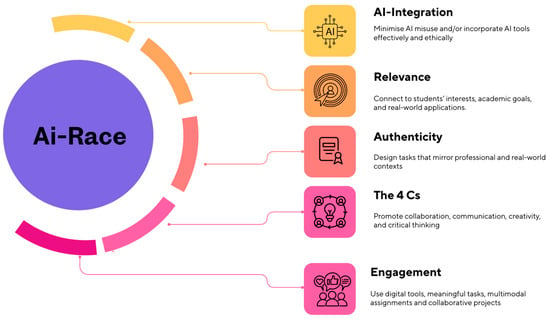

Disclaimer/Publisher’s Note: The statements, opinions and data contained in all publications are solely those of the individual author(s) and contributor(s) and not of MDPI and/or the editor(s). MDPI and/or the editor(s) disclaim responsibility for any injury to people or property resulting from any ideas, methods, instructions or products referred to in the content. |
© 2026 by the authors. Licensee MDPI, Basel, Switzerland. This article is an open access article distributed under the terms and conditions of the Creative Commons Attribution (CC BY) license.