


Business Simulation Games for the Development of Decision Making: Systematic Review


Abstract
1. Introduction
2. Materials and Methods
2.1. Design
2.2. Screening Strategy and Selection of Scientific Articles
2.3. Data Selection
2.4. Methodological Assessment
3. Results
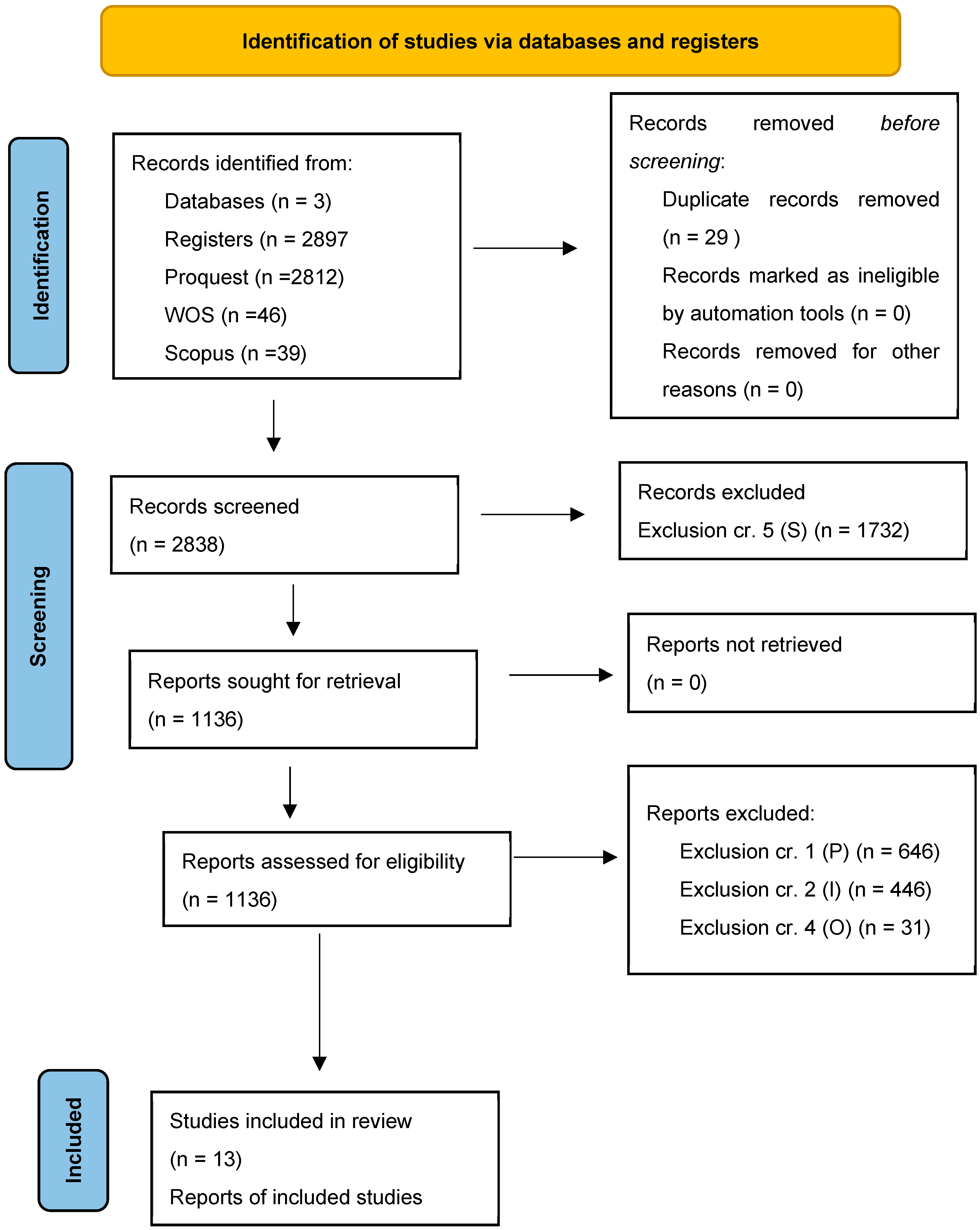
3.1. Identification and Selection of Studies
3.2. Methodological Quality
3.3. Article Analysis
4. Discussion
5. Conclusions
Supplementary Materials
Author Contributions
Funding
Conflicts of Interest
References
- Abt, C. C. (1970). Serious games. The Viking Press. [Google Scholar]
- Alamri, H., Lowell, V., Watson, W., & Watson, S. L. (2020). Using personalized learning as an instructional approach to motivate learners in online higher education: Learner self-determination and intrinsic motivation. Journal of Research on Technology in Education, 52(3), 322–352. [Google Scholar] [CrossRef] [Scilit]
- Bach, M. P., Ćurlin, T., Stjepić, A. M., & Meško, M. (2023). Quo vadis business simulation games in the 21st century? Information, 14(3), 178. [Google Scholar] [CrossRef] [Scilit]
- Beranič, T., & Heričko, M. (2022). The impact of serious games in economic and business education: A case of ERP business simulation. Sustainability, 14(2), 683. [Google Scholar] [CrossRef] [Scilit]
- Brandl, L. C., & Schrader, A. (2024). Serious games in higher education in the transforming process to education 4.0—Systematized review. Education Sciences, 14(3), 281. [Google Scholar] [CrossRef] [Scilit]
- Chen, J., Tang, L., Tian, H., Ou, R., Wang, J., & Chen, Q. (2022). The effect of mobile business simulation games in entrepreneurship education: A quasi-experiment. Library Hi Tech, 41, 1333–1356. [Google Scholar] [CrossRef] [Scilit]
- Chen, H.-M., & Wei, K.-W. (2017). Application of Serious Game Model on Simulation Training for Decision Makings of Project Management. Proceedings of Engineering and Technology Innovation, 5, 25–30. Available online: https://ojs.imeti.org/index.php/PETI/article/view/933 (accessed on 9 December 2024).
- Coffey, B., & Anderson, S. (2006). The students’ view of a business simulation: Perceived value of the learning experience. Journal of Strategic Management Education, 3(1), 151–168. [Google Scholar]
- De La Torre, R., Onggo, B. S., Corlu, C. G., Nogal, M., & Juan, A. A. (2021). The role of simulation and serious games in teaching concepts on circular economy and sustainable energy. Energies, 14(4), 1138. [Google Scholar] [CrossRef] [Scilit]
- Endress, T., Pussep, A., & Schief, M. (2023). Digital serious game to engage business students in active lectures: A pilot study. Journal of International Education in Business, 16(1), 115–128. [Google Scholar] [CrossRef] [Scilit]
- Faisal, N., Chadhar, M., Goriss-Hunter, A., & Stranieri, A. (2022). Business simulation games in higher education: A systematic review of empirical research. Human Behavior and Emerging Technologies, 2022, 1578791. [Google Scholar] [CrossRef] [Scilit]
- Faria, A. J., Hutchinson, D., Wellington, W. J., & Gold, S. (2009). Developments in business gaming: A review of the past 40 years. Simulation & Gaming, 40(4), 464–487. [Google Scholar] [CrossRef] [Scilit]
- Ferreira, C. P., González-González, C. S., & Adamatti, D. F. (2021). Business simulation games analysis supported by human-computer interfaces: A systematic review. Sensors, 21(14), 4810. [Google Scholar] [CrossRef] [Scilit] [PubMed]
- Gatti, L., Ulrich, M., & Seele, P. (2019). Education for sustainable development through business simulation games: An exploratory study of sustainability gamification and its effects on students’ learning outcomes. Journal of Cleaner Production, 207, 667–678. [Google Scholar] [CrossRef] [Scilit]
- Goosen, R., & Steenkamp, G. (2023). Activating accounting students’ decision-making skills through a reflective self-assessment workshop on learning styles. The International Journal of Management Education, 21(3), 100858. [Google Scholar] [CrossRef] [Scilit]
- Grijalvo, M., Segura, A., & Núñez, Y. (2022). Computer-based business games in higher education: A proposal of a gamified learning framework. Technological Forecasting and Social Change, 178, 121597. [Google Scholar] [CrossRef] [Scilit]
- Haleem, A., Javaid, M., Qadri, M. A., & Suman, R. (2022). Understanding the role of digital technologies in education: A review. Sustainable Operations and Computers, 3, 275–285. [Google Scholar] [CrossRef] [Scilit]
- Hallo, L., & Nguyen, T. (2021). Holistic view of intuition and analysis in leadership decision-making and problem-solving. Administrative Sciences, 12(1), 4. [Google Scholar] [CrossRef] [Scilit]
- Hernández-Lara, A. B., & Serradell-López, E. (2018). Student interactions in online discussion forums: Their perception on learning with business simulation games. Behaviour & Information Technology, 37(4), 419–429. [Google Scholar] [CrossRef] [Scilit]
- Hernández-Lara, A. B., Serradell-Lopez, E., & Fitó-Bertran, À. (2018). Do business games foster skills? A cross-cultural study from learners’ views. Intangible Capital, 14(2), 315. [Google Scholar] [CrossRef] [Scilit]
- Hofstede, G. J., De Caluwé, L., & Peters, V. (2010). Why simulation games work-in search of the active substance: A synthesis. Simulation & Gaming, 41(6), 824–843. [Google Scholar] [CrossRef] [Scilit]
- Huang, Y.-M., Silitonga, L. M., Murti, A. T., & Wu, T.-T. (2023). Learner engagement in a business simulation game: Impact on higher-order thinking skills. Journal of Educational Computing Research, 61(1), 96–126. [Google Scholar] [CrossRef] [Scilit]
- Huang, Y.-M., Silitonga, L. M., & Wu, T.-T. (2022). Applying a business simulation game in a flipped classroom to enhance engagement, learning achievement, and higher-order thinking skills. Computers & Education, 183, 104494. [Google Scholar] [CrossRef] [Scilit]
- Jääskä, E., Lehtinen, J., Kujala, J., & Kauppila, O. (2022). Game-based learning and students’ motivation in project management education. Project Leadership and Society, 3, 100055. [Google Scholar] [CrossRef] [Scilit]
- Laamarti, F., Eid, M., & El Saddik, A. (2014). An overview of serious games. International Journal of Computer Games Technology, 2014, 358152. [Google Scholar] [CrossRef] [Scilit]
- Lopes, M. C., Fialho, F. A. P., Cunha, C. J. C. A., & Niveiros, S. I. (2013). Business games for leadership development: A systematic review. Simulation & Gaming, 44(4), 523–543. [Google Scholar] [CrossRef] [Scilit]
- Mannino, M. V., Khojah, M., & Gregg, D. G. (2021). Emerge2Maturity: A simulation game for data warehouse maturity concepts. Journal of Information Systems Education, 32, 77. [Google Scholar]
- McChlery, S., & Visser, S. (2009). A comparative analysis of the learning styles of accounting students in the United Kingdom and South Africa. Research in Post-Compulsory Education, 14(3), 299–315. [Google Scholar] [CrossRef] [Scilit]
- McKone, K., & Bozewicz, J. (2003). The ism simulation: Teaching integrated management concepts. Journal of Management Education, 27(4), 497–515. [Google Scholar] [CrossRef] [Scilit]
- Michael, D. R., & Chen, S. L. (2005). Serious games: Games that educate, train, and inform. Thomson Course Technology. [Google Scholar]
- Moher, D., Shamseer, L., Clarke, M., Ghersi, D., Liberati, A., Petticrew, M., Shekelle, P., & Stewart, L. A. (2015). Preferred reporting items for systematic review and meta-analysis protocols (PRISMA-P) 2015 statement. Systematic Reviews, 4(1), 1. [Google Scholar] [CrossRef]
- Mustata, I. C., Alexe, C. G., & Alexe, C. M. (2017). Developing competencies with the general management II business simulation game. International Journal of Simulation Modelling, 16(3), 412–421. [Google Scholar] [CrossRef] [Scilit]
- O’Reilly, M., Caulfield, B., Ward, T., Johnston, W., & Doherty, C. (2018). Wearable inertial sensor systems for lower limb exercise detection and evaluation: A systematic review. Sports Medicine, 48(5), 1221–1246. [Google Scholar] [CrossRef] [Scilit] [PubMed]
- Pacheco-Velázquez, E. A., Vázquez-Parra, J. C., Cruz-Sandoval, M., Salinas-Navarro, D. E., & Carlos-Arroyo, M. (2023). Business decision-making and complex thinking: A bibliometric study. Administrative Sciences, 13(3), 80. [Google Scholar] [CrossRef] [Scilit]
- Page, M. J., McKenzie, J. E., Bossuyt, P. M., Boutron, I., Hoffmann, T. C., Mulrow, C. D., Shamseer, L., Tetzlaff, J. M., Akl, E. A., Brennan, S. E., Chou, R., Glanville, J., Grimshaw, J. M., Hróbjartsson, A., Lalu, M. M., Li, T., Loder, E. W., Mayo-Wilson, E., McDonald, S., … Moher, D. (2021). The PRISMA 2020 statement: An updated guideline for reporting systematic reviews. BMJ, 372, n71. [Google Scholar] [CrossRef] [Scilit] [PubMed]
- Pando-Garcia, J., Periañez-Cañadillas, I., & Charterina, J. (2016). Business simulation games with and without supervision: An analysis based on the TAM model. Journal of Business Research, 69(5), 1731–1736. [Google Scholar] [CrossRef] [Scilit]
- Peterková, J., Repaská, Z., & Prachařová, L. (2022). Best practice of using digital business simulation games in business education. Sustainability, 14(15), 8987. [Google Scholar] [CrossRef] [Scilit]
- Sakata, D., Akiyama, Y., Kaneko, M., & Kumagai, S. (2014). Education system to learn the skills of management decision-making by using business simulator with speech recognition technology. Industrial Engineering and Management Systems, 13(3), 267–277. [Google Scholar] [CrossRef] [Scilit]
- Seethamraju, R. (2011). Enhancing student learning of enterprise integration and business process orientation through an erp business simulation game. Journal of Information Systems Education, 22, 19. [Google Scholar]
- Silitonga, L. M., Dharmawan, B., Murti, A. T., & Wu, T.-T. (2024). Promoting entrepreneurial intentions and competencies through business simulation games. Journal of Educational Computing Research, 62(3), 725–755. [Google Scholar] [CrossRef] [Scilit]
- Simon, H. A. (1997). Administrative behavior: A study of decision-making processes in administrative organizations (4th ed.). Free Press. [Google Scholar]
- Sultanova, O., & Sadullayev, S. (2024). Application of modern technologies in education of students. Science and Innovation, 3, 431–433. [Google Scholar] [CrossRef]
- Tsiligiris, V., & Bowyer, D. (2021). Exploring the impact of 4IR on skills and personal qualities for future accountants: A proposed conceptual framework for university accounting education. Accounting Education, 30(6), 621–649. [Google Scholar] [CrossRef] [Scilit]
- Vélez, A., Alonso, R. K., & Rico-González, M. (2023). Business simulation games for the development of intrinsic motivation-boosting sustainability: Systematic review. Sustainability, 15(21), 15483. [Google Scholar] [CrossRef] [Scilit]
- Yalabik, B., Howard, M., & Roden, S. (2012). The innovation game: Lessons in strategy and managing operations. International Journal of Operations & Production Management, 32(12), 1441–1459. [Google Scholar] [CrossRef] [Scilit]
- Zöbeley, B., Minner, S., & Kilger, C. (2011). Incentive alignment at the manufacturing–marketing interface: Design and validation of a management game. Logistics Research, 3(2–3), 89–100. [Google Scholar] [CrossRef] [Scilit]

| Criterion | Inclusion Criteria | Exclusion Criteria |
|---|---|---|
| 1. Population | Students receiving university education | Students who do not receive university education |
| 2. Intervention | Business Simulation Games (BSGs) intended to promote Decision Making (DM) | Programs that are not BSGs or that are not intended to promote DM |
| 3. Comparison | Inapplicable | Inapplicable |
| 4. Outcomes | Programs that provide information on DM outcomes from BSGs | Programs that do not provide information on DM outcomes from BSGs |
| 5.Study design | Only original, full-text articles in either English or Spanish | Written in a language other than English or Spanish. A few examples of non-original article types are book chapters, reviews, letters to the editor, abstracts from conferences, and protocol proposals. |
| Reference | 1 | 2 | 3 | 4 | 5 | 6 | 7 | 8 | 9 | 10 | Q |
|---|---|---|---|---|---|---|---|---|---|---|---|
| Chen and Wei (2017) | 1 | 1 | 1 | 1 | 1 | 1 | 1 | 1 | 1 | 0 | 9 |
| Endress et al. (2023) | 1 | 1 | 1 | 1 | 1 | 1 | 1 | 1 | 1 | 0 | 9 |
| Grijalvo et al. (2022) | 1 | 1 | 1 | 1 | 1 | 1 | 1 | 1 | 1 | 1 | 10 |
| Hernández-Lara and Serradell-López (2018) | 1 | 1 | 1 | 1 | 1 | 1 | 1 | 1 | 1 | 1 | 10 |
| Hernández-Lara et al. (2018) | 1 | 1 | 1 | 1 | 1 | 1 | 1 | 1 | 1 | 1 | 10 |
| Jääskä et al. (2022) | 1 | 1 | 1 | 1 | 1 | 1 | 1 | 1 | 1 | 1 | 10 |
| Mannino et al. (2021) | 1 | 1 | 0 | 1 | 1 | 1 | 1 | 0 | 1 | 0 | 7 |
| McKone and Bozewicz (2003) | 1 | 1 | 1 | 1 | 1 | 1 | 1 | 0 | 1 | 0 | 8 |
| Mustata et al. (2017) | 1 | 1 | 1 | 1 | 1 | 1 | 1 | 1 | 1 | 1 | 10 |
| Sakata et al. (2014) | 1 | 1 | 1 | 1 | 1 | 1 | 1 | 1 | 1 | 0 | 9 |
| Seethamraju (2011) | 1 | 1 | 1 | 1 | 1 | 1 | 1 | 1 | 1 | 0 | 9 |
| Yalabik et al. (2012) | 1 | 1 | 1 | 1 | 1 | 1 | 1 | 1 | 1 | 0 | 9 |
| Zöbeley et al. (2011) | 1 | 1 | 1 | 1 | 1 | 1 | 1 | 0 | 1 | 1 | 9 |
| Study | Aim | Country | Sample Size | Area | Measurement Methods | Results | Conclusion |
|---|---|---|---|---|---|---|---|
| Chen and Wei (2017) | Examine the use of Business Simulation Game (BSG) training in project management Decision Making (DM). | Taiwan. | 50. | Project planning and control. | Survey. | After playing the BSG, students perform better in DM, simulation, interactivity, interest, learning efficiency, and immersion. | In comparison to alternative training modalities, the suggested BSG guarantees superior performance in terms of cost and safety calculations. |
| Endress et al. (2023) | Examine a combined strategy that encourages engagement and interaction in the virtual classroom. | Thailand. | 21. | MBA and PhD students. | Survey. | The students expressed a high degree of perceived learning accomplishment (enhanced enjoyment and DM). Additionally, all of the students were really involved in the game, and the interactive nature of the learning mode allowed for strong student collaboration and bonding. | A more limited scope simulation game can help promote engagement and involvement in lectures. With a basic game that has few choice variables and little training, one can benefit from the major advantages of simulation-based learning. |
| Grijalvo et al. (2022) | Determine the background and circumstances that facilitate the incorporation of business simulators into official educational settings. | Spain. | 346. | Industrial Engineering. | Survey. | The data support the favorable opinion of the students as a means of enhancing these abilities, which include “DM”, “information analysis”, and “strategic capacity”. | It is not simple to use BSGs. Teachers must devote a significant amount of time to teaching even with the most advanced simulations. |
| Hernández-Lara and Serradell-López (2018) | Provide further evidence of how Business Simulation Games help students learn, taking into account the interactions that students have in online discussion boards. | Spain. | 182. | Management. | Observation of online discussion forums. | The majority of students cited dealing with uncertainty, reaching agreements, teamwork, DM, and information processing as the most pertinent learning outcomes of the game. | Teachers ought to provide more assistance to students in managing risks and uncertainty. This assistance could come in the form of instruction on the inclusion and evaluation of various scenarios, mathematical tools for estimation and prediction, DM strategies for uncertain situations, etc. |
| Hernández-Lara et al. (2018) | Examine to what degree students consider BSGs to be an e-learning tool for management education. | Spain, Ireland, Portugal, Italy, and Germany. | 120. | Management. | Questionnaire including some items that have already been published in the literature. | Information and DM were the most highly regarded generic skills. | Students from many nations and cultural backgrounds provided evaluations and DM that were both highly favorable and similar. |
| Jääskä et al. (2022) | Give new perspectives on the effective design and implementation of a computer game-based learning approach for teaching sustainability management in projects. | Finland. | 15. | Project management. | Survey. | The use of this BSG enhances improved DM and intrinsic motivation. | Key issues covered in the game include the significance of decision making during the project design phase, the engagement of internal and external stakeholders in the decision-making processes, and the comprehension of how decisions made during the project affect the sustainability of the project product. |
| Mannino et al. (2021) | Address deficiencies in the training provided on managing the development of data warehouses. | United States. | N.R. | Data Warehouse. | Survey. | The use of the BSG improves students’ DM skills. | Players must play multiple times to see the effect and get the most out of the game. The length of the game and the complex nature of the writing can discourage players from playing, but additional text and phases may improve the likelihood of a better learning experience. |
| McKone and Bozewicz (2003) | Present a business challenge from a holistic standpoint to demonstrate to students how different disciplines collaborate, display complementary knowledge, and interact to enhance DM. | United States. | 150. | General management. | Questionnaire. | The use of the BSG improves student learning, including students’ integrated DM skills. | This BSG has proven to be very beneficial in the classroom because it is (a) simple to use; (b) engaging and educational for students; (c) a tangible representation of a simplified service organization with intricate DM; and (d) an excellent tool for demonstrating an integrated approach to service management. |
| Mustata et al. (2017) | Determine whether components of the GM2 BSG can help participants achieve the necessary management-related skills and personal attributes. | Romania. | 88. | General management. | Online survey. | Promotes DM and other skills such as analytical thinking, strategic thinking or teamwork. | Analytical thinking, strategic thinking, teamwork, goal-setting, opportunity recognition, problem-solving, DM, proactive thinking, communication, intuitive thinking, responsibility, time management, argumentation, conflict management, courage, and self-esteem were the 17 out of 21 desired competencies that were thought to have clearly shown positive development. |
| Sakata et al. (2014) | Analyze whether using a BSG with speech recognition technology improves management DM skills compared to traditional teaching. | Japan. | 31. | General management. | Questionnaire. | The effectiveness of the intervention is confirmed, since it promotes students’ DM skills. | Using speech recognition technology, the speech recognition assistance system BizVocie retrieves student speech during game play and transcribes it into text. Using BizLator, teachers may determine the boundaries of their pupils’ understanding, enabling them to educate more effectively. |
| Seethamraju (2011) | Examine how BSGs affects DM, skill development, and the efficacy of learning. | Australia. | 50. | Business and Information Technology. | Questionnaire. | This game has a big impact on the pupils’ DM skills. Their process orientation and integrative skills significantly improved as a result of the game, which also aided in deep learning. | The following factors have made the BSG’s implementation difficult: the game’s quick speed, particularly in the beginning; insufficient accounting and finance knowledge; inexperience; poor teamwork, communication, and collaboration; the complexity of the BSG; and a general lack of business experience and knowledge. |
| Yalabik et al. (2012) | Examine the effects of decisions made regarding product-portfolio management, capacity management, and capability accumulation. | United Kingdom and India. | 250. | New product development. | Questionnaire. | The strategic and operational DM abilities necessary for successful new product development and innovation strategy are enhanced by this BSG. | A number of features were taken into consideration when designing the game in order to enhance the learning process: involving human opponents; actions that impact one another and the environment; a focus on winning and competition; a recurring cycle of making decisions and experiencing outcomes; and the ability to hope for improvement and “doing better next time”. |
| Zöbeley et al. (2011) | Examine how each person’s conduct under distributed DM might be enhanced to align with the overarching goals of the organization. | Germany. | 80. | Supply chain. | Observation. | The intervention improves students’ DM skills. | Coordinated bonus plans, information sharing, and communication improve overall performance and reduce conflict amongst the functional domains involved in the game. |
| Study | Background/Traits | Type of Business Simulation Game (BSG) | Key Elements of Implementation | Impact/Benefits |
|---|---|---|---|---|
| Chen and Wei (2017) | Students take on the role of a project manager, making choices about how to handle accidents and distribute resources as the virtual construction project moves forward. | Computer BSG using integrations of MySQL for project data management and Microsoft Project for project schedule. | Based on project data, real-time simulation is used to obtain the results of the decisions made. Students are then provided with interactive, visible responses that help them comprehend the consequences of their actions. | Decision-based simulation can offer accurate and realistic outcomes of their choices in this training mode. |
| Endress et al. (2023) | The BSG (LingoLearn) aims to introduce a language-learning app to the market. The students have to decide if they wish to enter the market and, if so, what approach they will use. | Computer BSG using a survey tool (PollEverywhere) to enter the decisions. Also, an Excel-based backend was used to administer the calculation, and the students were shown the results as slides and reports in PDF format. | Active learning strategies like problem-based learning and collaborative learning are incorporated into the general design of the simulation. The students’ assignment was to debate the problem in groups, come to a consensus, and then submit their answers to an online questionnaire. | For the pupils, the hands-on group decision making (DM) and problem-solving activity seems to be a really beneficial educational opportunity. Together with a group environment, an integrated simulation of business results gives students frequent feedback and promotes analysis and critical thinking. |
| Grijalvo et al. (2022) | Students operated a company in a competitive industry in the games Gestionet and Global Management Challenge (GMC), trying to optimize the return on their investment. They compete with organizations that operate in the same market and sell the same products. | Computer online BSG using (1) the business game website, where each team’s score in the market may be viewed; (2) the instructional platform, where debriefings need to be posted; (3) online tools like Teams and Zoom were added for clarifying doubts at the group and individual levels. | The MDE Framework in gamification was used. In addition to providing a collaborative, group-driven learning environment, instructors often plan tutoring sessions and provide material from past competitions, including reports or videos. | Both BSGs used promote DM. Regarding the acquired competencies, DM varies depending on the simulator used; in Gestionet, it is viewed as a team task, whereas in the GMC simulator, information analysis is emphasized as a first step towards individual DM, which ultimately leads to team DM. |
| Hernández-Lara and Serradell-López (2018) | This BSG (Cesim Global Challenge) simulates a multinational mobile telecommunications firm and integrates several functional areas and focuses on strategic management, international business, global operations, and business policy. | Computer online BSG. | By using online forums, instructors can get deeper viewpoints, more helpful and less biased data, and superior knowledge to supplement the information they receive from students. | The BSG encourages DM. However, even if students have a specific strategic goal in mind when making decisions, this information does not often show up in their communication style. They appear to use a more short-term strategy, making decisions for each round based on rivals’ financial circumstances from the previous round without any explicit long-term planning or objectives. |
| Hernández-Lara et al. (2018) | This BSG (Cesim Global Challenge) simulates a multinational mobile telecommunications firm and integrates several functional areas and focuses on strategic management, international business, global operations, and business policy. | Computer online BSG. | Whenever an issue arose within or between the students’ teams, the students promptly sought the instructor’s assistance and intervention. Consequently, even though the BSG might expose students to conflictual situations, they did not view it as a particularly suitable tool for improving their conflict management skills. | According to the students, the BSG’s most valued generic skills were DM, leadership, and information processing. Students who have been exposed to experiential learning are more likely to value and gain from this type of tool, as well as to recognize its greater practical utility for management training. |
| Jääskä et al. (2022) | Project Business Game is a simulation on sustainability. A challenging project task network, subcontractors, materials, and project personnel are all included in the PBG simulation model. | Computer online BSG. | Enough time should be dedicated to teaching the pupils the BSG mechanics in order to guarantee a successful learning experience. You should also spend time explaining DM theoretical concepts. Students can learn from narrative case descriptions and meaningful stories. | The BSG used improves DM capabilities. With a circular economy project example integrated into the BSG, students demonstrated a comprehension of how the produced BSG replicated the real-life phenomenon of managing project budgets, resources, stakeholders, and uncertainty. |
| Mannino et al. (2021) | The BSG (Emerge2Maturity) uses common elements across enterprises to break down data warehouse growth into DM steps. | Computer BSG. | To promote DM, the BSG employs two models: the Capability Assessment Model for choices about data and the Configuration Model for transition among DM phases. Debriefing discussions are also important. | DM talents are enhanced by the BSG. Students consider how realistic BSG components are, particularly the characteristics of data sources, cost-benefit analysis, the influence of outside events, and the learning impact on data warehouse development. |
| McKone and Bozewicz (2003) | ISM Simulation is a non-technological BSG that simulates the management of an airline company in a classroom. | It is a board game that uses a computer to assist in certain parts of the game. | It is crucial to allow for the minimum of thirty minutes for debriefing after ISM Simulation. While the debriefing session enables the facilitator to highlight important learning points and connect the lessons to the course aims, the improvement/DM sessions have given students a chance to talk about their decisions and the results. | The BSG promotes DM. It is crucial to integrate decisions both inside and outside of the simulated company. The connections between strategy and short- and long-term success or failure are highlighted by charting the relationship between strategic decisions and financial results for “winner” and “loser” teams. |
| Mustata et al. (2017) | In the GM2 BSG, you have to manage a company by making decisions on all the different functional areas of the company. | Computer BSG. | It is important to have clear instructions from the BSG. In order to design their choices, the participants receive a handbook that gives them a general understanding of how each of these sections operates. | Students benefit from such experiences for DM because they gain real-world experience and develop critical skills without the danger of losing a lot of money in the real world. |
| Sakata et al. (2014) | In the BSG, Bizlator, every enterprise was an automobile that operated in the Japanese market. To teach students about the state of the Japanese market today and how events like natural disasters impact decisions about management, we simulated changes in market circumstances in a way that matched the headlines. | Computer online BSG. | BizVoice, a voice recognition assistance program was suggested to give teachers more insightful feedback on things like pupils’ comprehension levels. There are some important activities like presentations and debates. Interactive lessons using the BSG are mixed with conventional lecture-based lessons. | The BSG involves developing and assessing a curriculum that would enhance students’ DM abilities and enable active participation. It was successful in producing a more realistic management atmosphere. |
| Seethamraju (2011) | In ERPSim, each group runs a firm in the team-based game that serves as the intervention. By sending and receiving orders, delivering their products, deciding on pricing strategies, managing credit, utilizing business analytics, reporting in consecutive quarters, and finishing cash-to-cash cycles, each team engages with clients and suppliers. | Computer online BSG using SAP software. | Given the complexity of SAP software, the preparation phase for SAP in general, and for the game itself, is very important. Debriefings and group presentations are important. | The strategy seems to have been successful in providing enhanced DM and group-working skills and process orientation without becoming bogged down with the complexity of the SAP software. |
| Yalabik et al. (2012) | In the Innovation Game, participants are tasked with establishing alignment by beginning with operational capabilities, moving on to operational decisions, and concluding with market dynamics and rival strategies. By enabling players to invest in more advanced technical capabilities (such as reduced R&D lead times and costs), the innovation game simulates these dynamics. | Board game. | It is evident how important clear instructions are, and it is crucial to have a well-organized reflection phase at the conclusion of a simulation. Using the facilitator’s meticulously arranged data, participants must actively analyze what just occurred. | Benefits were particularly obtained in relation to the improvement of DM abilities (with regard to capacity and portfolio management); the cultivation of an awareness of how dynamic environments affect innovation; experiential learning through instructor feedback and reflective thinking; and the influence of other participants’ (firms’) decisions on their innovation strategy. |
| Zöbeley et al. (2011) | The BSG is based on an industrial scenario from the food sector, and attempts to raise general system awareness. It enables the recognition of the interdependencies between time-sensitive demand, order acceptance, and due date determination under capacity restrictions and significant changeover delays by adopting a process-oriented bird’s-eye view of the business. | Board game. | To enable strong delivery of the essential learning, a comparatively low degree of complexity was selected for the BSG design. This involved giving up some reality, by maintaining exogenous demand. | By raising system awareness, properly aligning incentive systems, and improving cross-functional communication protocols, individual behavior under dispersed DM can be improved to meet overall corporate objectives. |
Disclaimer/Publisher’s Note: The statements, opinions and data contained in all publications are solely those of the individual author(s) and contributor(s) and not of MDPI and/or the editor(s). MDPI and/or the editor(s) disclaim responsibility for any injury to people or property resulting from any ideas, methods, instructions or products referred to in the content. |
© 2025 by the authors. Licensee MDPI, Basel, Switzerland. This article is an open access article distributed under the terms and conditions of the Creative Commons Attribution (CC BY) license (https://creativecommons.org/licenses/by/4.0/).
Share and Cite
Velez, A.; Alonso, R.K. Business Simulation Games for the Development of Decision Making: Systematic Review. Educ. Sci. 2025, 15, 168. https://doi.org/10.3390/educsci15020168
Velez A, Alonso RK. Business Simulation Games for the Development of Decision Making: Systematic Review. Education Sciences. 2025; 15(2):168. https://doi.org/10.3390/educsci15020168
Chicago/Turabian StyleVelez, Alexander, and Rebeca Kerstin Alonso. 2025. "Business Simulation Games for the Development of Decision Making: Systematic Review" Education Sciences 15, no. 2: 168. https://doi.org/10.3390/educsci15020168
APA StyleVelez, A., & Alonso, R. K. (2025). Business Simulation Games for the Development of Decision Making: Systematic Review. Education Sciences, 15(2), 168. https://doi.org/10.3390/educsci15020168

