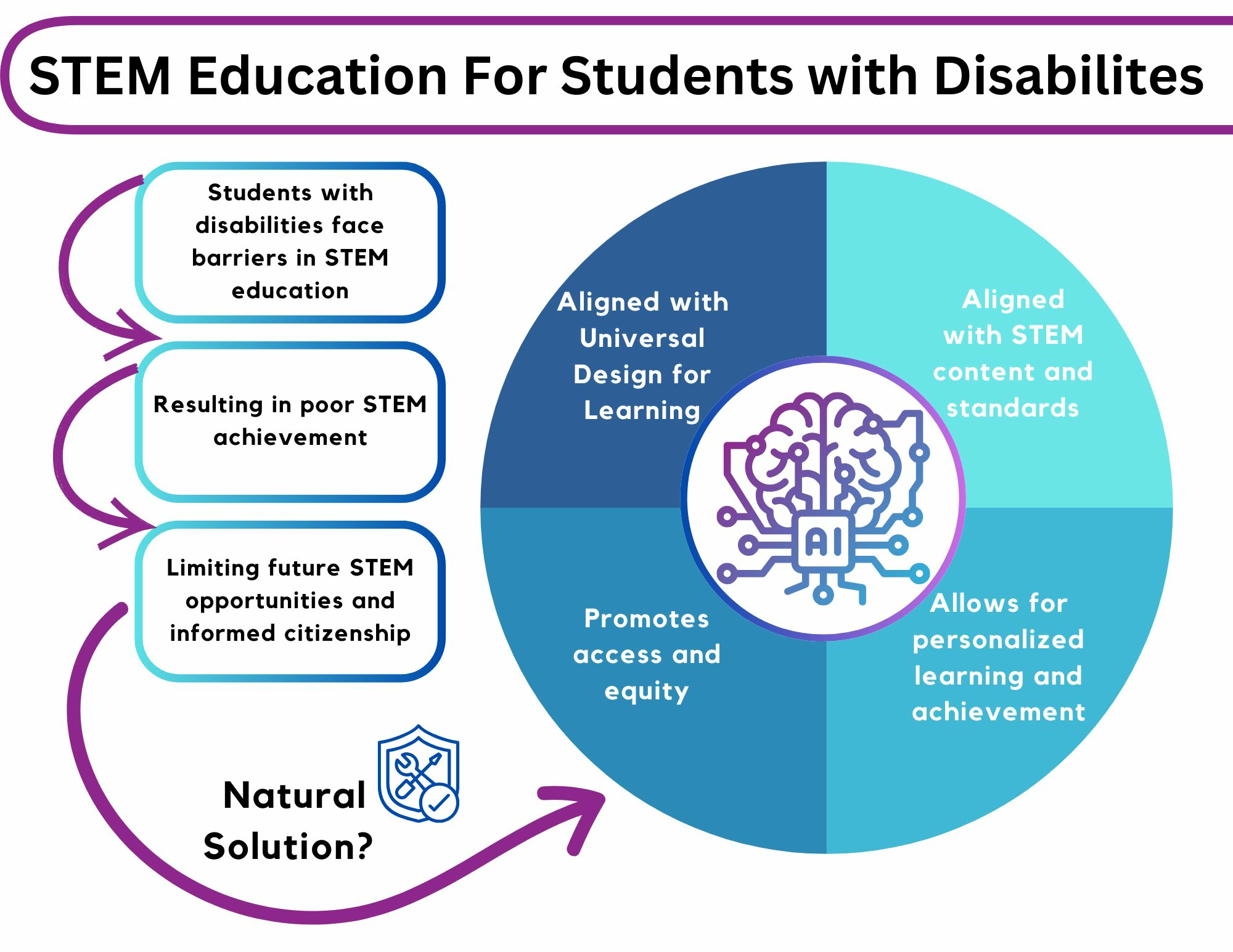
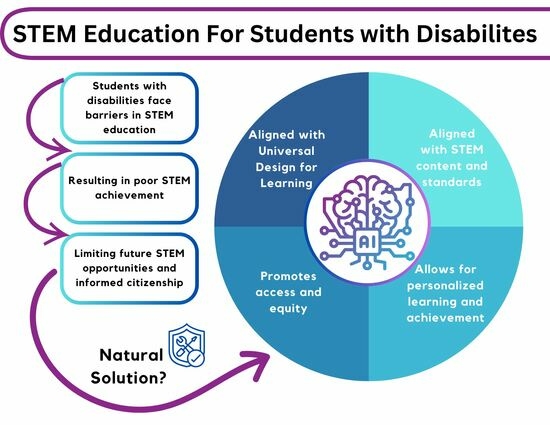
Artificial Intelligence: An Untapped Opportunity for Equity and Access in STEM Education


Abstract
1. Introduction
1.1. The Unfortunate Reality of STEM Education for Individuals with Disabilities
Barriers to STEM Content
1.2. Artificial Intelligence: What It Is and Its Not-So-New History
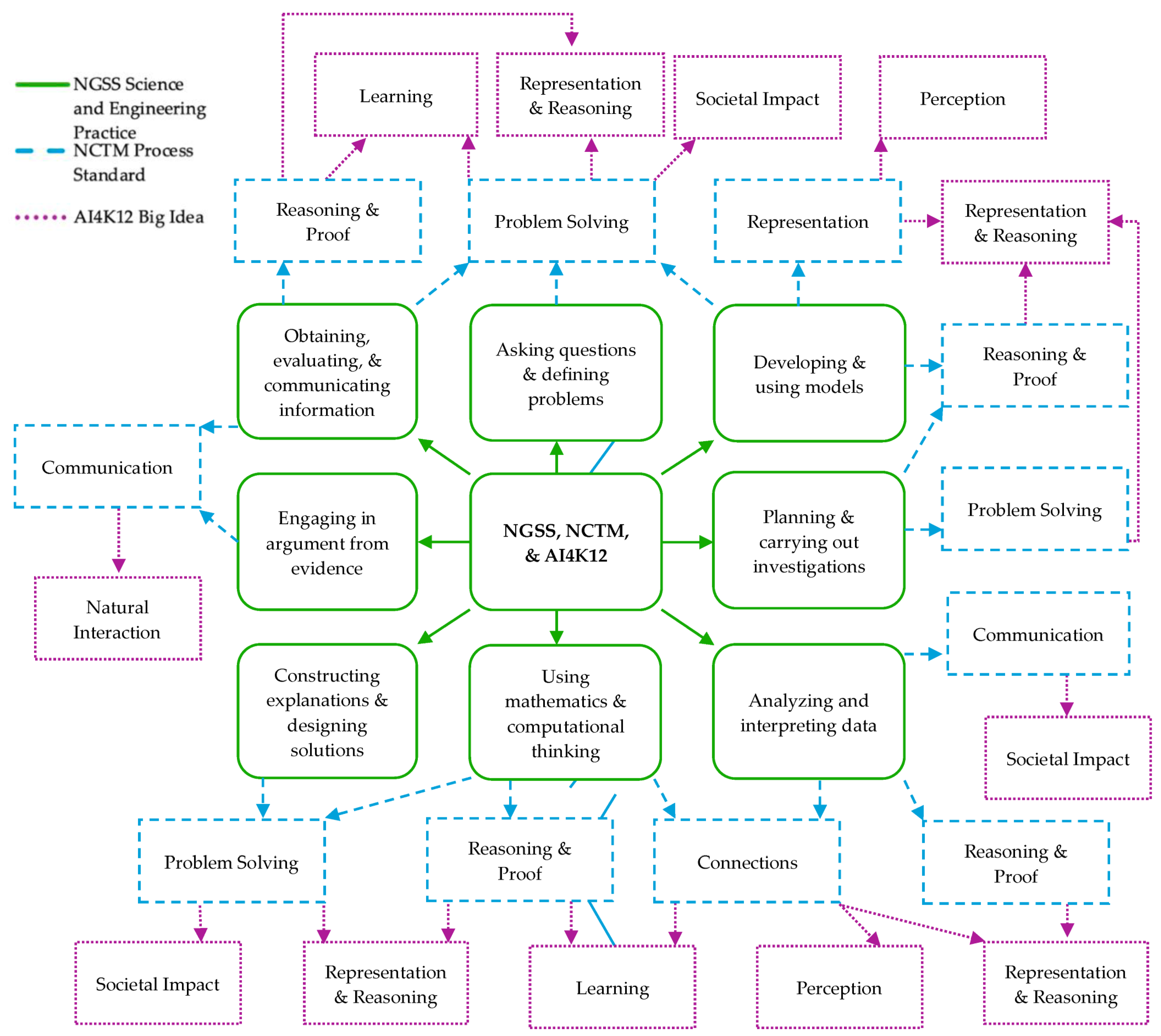
1.3. Alignment of AI to STEM Practices and Standards
Ongoing Emphasis on Access and Equity
2. Methodology

| Citation | Topic | Article Type | Number of Articles Reviewed | Types of Articles Reviewed |
|---|---|---|---|---|
| Ahmad et al. (2020) | AI and Education | Bibliometric analysis and systematic review | N = 3246 | Articles from top venues from 2014 to 2020 |
| Dai and Ke (2022) | AI and Education | Systematic mapping review and thematic synthesis | N = 59 | Peer-reviewed journal articles, book chapters, and conference proceedings. Years not specified |
| Kavitha and Joshith (2024) | AI and Education | Bibliometric analysis | N = 324 | Articles from 2003 to 2023 in Scopus |
| Misra et al. (2023) | AI and Education | Thematic review | N = 280 | Articles from 1976 to 2023 |
| Paek and Kim (2021) | AI and Education | Bibliometric analysis | N = 5035 | Articles from 2001 to 2021 |
| Yousuf and Wahid (2021) | AI and Education | Review study | Not specified | Not specified |
| Zhai et al. (2021) | AI and Education | Systematic review | N = 142 | Research articles, review papers, interview papers, and book reviews from 2010 to 2020 |
| Chng et al. (2023) | AI and STEM | Literature review | N = 82 | Empirical articles. Years not specified |
| Ouyang et al. (2023) | AI and STEM | Systematic review | N = 17 | Empirical research articles from January 2011 to April 2023 |
| Xu and Ouyang (2022) | AI and STEM | Systematic review | N = 63 | Empirical articles from 2011 to 2021 |
| Hwang and Tu (2021) | AI and Mathematics | Bibliometric analysis and systematic review | N = 43 | Publications from 1996 to 2020 |
| Mohamed et al. (2022) | AI and Mathematics | Systematic review | N = 20 | Articles from 2017 to 2021 in indexed journals |
| Jia et al. (2024) | AI and Science | Systematic review | N = 76 | Studies from 2013 to 2023 |
| Barua et al. (2022) | AI and Students with disabilities | Systematic review | N = 26 | Peer-reviewed articles from 2011 to 2021 |
| Bhatti et al. (2024) | AI and Students with disabilities | Systematic review | N = 16 | Journal articles and conference proceedings from 2015 to 2022 |
| Hopcan et al. (2022) | AI and Students with disabilities | Systematic review | N = 29 | Studies between 2008 and 2020 |
| Kharbat et al. (2021) | AI and Students with disabilities | Systematic review | N = 105 | Peer-reviewed articles published between January 2000 and 2020 |
| Pierrès et al. (2024) | AI and Students with disabilities | Systematic review | N = 72 | Articles from 2018 to 2022 |
| Rice and Dunn (2023) | AI and Students with disabilities | Systematic review | N = 18 | Publications from 2009 to 2022 |
| Zdravkova et al. (2022) | AI and Students with disabilities | Narrative literature review | Not stated | Articles from 2012 to 2022 |
| Bray et al. (2024) | UDL and Technology | Systematic review | N = 15 | Peer-reviewed publications. Years not specified |
| Citation | Topic | Article Type | Population Focus |
|---|---|---|---|
| Gawande et al. (2020) | AI and Education | Research article | Higher education |
| Ivanović et al. (2022) | AI and Education | Book chapter | All levels |
| How and Hung (2019) | AI and STEM/STEAM | Application article | K-12 STEAM settings |
| Ogunkunle and Qu (2020) | AI and STEM | Research article | Students in STEM subjects |
| Vasconcelos and Santos (2023) | AI and STEM | Research article | Students in simulated STEM learning experience |
| Yelamarthi et al. (2024) | AI and engineering | Position article | Students in engineering education |
| McMahon and Walker (2019) | AI and UDL | Practitioner article | Not specified |
| Saborío-Taylor and Rojas-Ramírez (2024) | AI and UDL | Practitioner article | Not specified |
| Almufareh et al. (2024) | AI and Students with disabilities | Conceptual paper | Individuals with disabilities |
| Ivanović et al. (2019) | AI and Students with disabilities | Position article | Students with disabilities in virtual enviornments |
| Lamb et al. (2023) | AI and Students with disabilities | Opinion paper | Students with disabilities |
| Marino et al. (2023) | AI and Students with disabilities | Position article | Students receiving special education in K-12 settings |
| Rai et al. (2023) | AI and Students with disabilities | Research article | Students with learning disabilities |
| Center for Innovation, Design, and Digital Learning (2024) | AI and all learners | Report | All learners, early childhood–higher education |
| Hyatt and Owenz (2024) | AI, UDL, and Students with disabilities | Research article | Graduate students with disabilities |
| Shukla et al. (2016) | AI, STEM, and Students with disabilities | Research article | Individuals with profound and multiple learning disabilities |
| Hughes et al. (2022) | AI, STEM, UDL, and Students with disabilities | Research article | Elementary students with autism spectrum disorder |
3. Results: Current Educational Trends of Artificial Intelligence
3.1. Artificial Intelligence Within STEM Education
3.2. Artificial Intelligence for Students with Disabilities
3.2.1. Providing Universal Design Through AI
3.2.2. Providing Personalization Through Artificial Intelligence
3.2.3. Technological Advancements and Inclusivity
3.2.4. Artificial Intelligence as Assistive Technology
3.3. Artificial Intelligence for Students with Disabilities in STEM Education
4. Precautions for AI Implementation and Research
Closed vs. Open Bot: Information Source and Transparency
5. Conclusions
6. Implications and a Call for Research
6.1. Implications for Practice
6.2. Implications for Technology Developers
6.3. Future Research Directions and Their Implications
Funding
Data Availability Statement
Conflicts of Interest
References
- Ahmad, K., Qadir, J., Al-Fuqaha, A., Iqbal, W., Elhassan, A., Benhaddou, D., & Ayyash, M. (2020). Artificial intelligence in education: A comprehensive review. Preprint, 1–42. [Google Scholar] [CrossRef]
- AI4K12. (2020). Big ideas poster. Available online: https://ai4k12.org/resources/big-ideas-poster/ (accessed on 24 July 2024).
- AI4K12. (2024). Artificial intelligence (AI) for K-12 initiative (AI4K12). Available online: https://ai4k12.org/ (accessed on 24 July 2024).
- Ali, S., Abuhmed, T., El-Sappagh, S., Muhammad, K., Alonso-Moral, J. M., Confalonieri, R., Guidotti, R., Del Ser, J., Diaz-Rodriguez, N., & Herrera, F. (2023). Explainable artificial intelligence (XAI): What we know and what is left to attain trustworthy artificial intelligence. Information Fusion, 99, 101805. [Google Scholar] [CrossRef]
- Almufareh, M. F., Kausar, S., Humayun, M., & Tehsin, S. (2024). A conceptual model for inclusive technology: Advancing disability inclusion through artificial intelligence. Journal of Disability Research, 3(1), 1–11. [Google Scholar] [CrossRef]
- Al Omoush, M., & Mehigan, T. (2023). Personalised presentation of mathematics for visually impaired or dyslexic students: Challenges and benefits. Ubiquity Proceedings, 3(1), 409–415. [Google Scholar] [CrossRef]
- Amaral, M. (2020). Wheelchair access and inclusion barriers on campus: Exploring Universal Design models in higher education. In Accessibility and Diversity in Education: Breakthroughs in Research and Practice (pp. 509–534). IGI Global. [Google Scholar] [CrossRef]
- Ampadu, Y. (2023). Handling big data in education: A review of educational data mining techniques for specific educational problems. AI, Computer Science and Robotics Technology, 2023(2), 1–16. [Google Scholar] [CrossRef]
- Baker, R. S., & Hawn, A. (2022). Algorithmic bias in education. International Journal of Artificial Intelligence in Education, 32(4), 1052–1092. [Google Scholar] [CrossRef]
- Barnes, E., & Hutson, J. (2024). Navigating the ethical terrain of AI in higher education: Strategies for mitigating bias and promoting fairness. Forum for Education Studies, 2(2), 1229. [Google Scholar] [CrossRef]
- Barua, P. D., Vicnesh, J., Gururajan, R., Oh, S. L., Palmer, E., Azizan, M. M., Kadri, N. A., & Acharya, U. R. (2022). Artificial intelligence enabled personalised assistive tools to enhance education of children with neurodevelopmental disorders—A review. International Journal of Environmental Research and Public Health, 19(3), 1192. [Google Scholar] [CrossRef]
- Basham, J. D., & Marino, M. T. (2013). Understanding STEM education and supporting students through Universal Design for Learning. Teaching Exceptional Children, 45(4), 8–15. [Google Scholar] [CrossRef]
- Basham, J. D., Marino, M. T., Hunt, C. L., & Han, K. (2020). Considering STEM for learners with disabilities and other diverse needs. In C. C. Johnson, M. J. Mohr-Schroeder, T. J. Moore, & L. D. English (Eds.), Handbook of Research on STEM Education (1st ed., pp. 128–137). Routledge. [Google Scholar]
- Bastien, F., Koop, R., Small, T. A., Giasson, T., & Jansen, H. (2020). The role of online technologies and digital skills in the political participation of citizens with disabilities. Journal of Information Technology & Politics, 17(3), 218–231. [Google Scholar] [CrossRef]
- Beyene, W. M., Mekonnen, A. T., & Giannoumis, G. A. (2023). Inclusion, access, and accessibility of educational resources in higher education institutions: Exploring the ethiopian context. International Journal of Inclusive Education, 27(1), 18–34. [Google Scholar] [CrossRef]
- Bhatti, I., Mohi-U-din, S. F., Hayat, Y., & Tariq, M. (2024). Artificial intelligence applications for students with learning disabilities: A systematic review. European Journal of Science, Innovation and Technology, 4(2), 2. [Google Scholar]
- Bray, A., Devitt, A., Banks, J., Sanchez Fuentes, S., Sandoval, M., Riviou, K., Byrne, D., Flood, M., Reale, J., & Terrenzio, S. (2024). What next for Universal Design for Learning? A systematic literature review of technology in UDL implementations at second level. British Journal of Educational Technology, 55(1), 113–138. [Google Scholar] [CrossRef]
- Caccavale, F., Caccavale, C. L., Gernaey, K., & Krühne, U. (2022). To be fAIr: Ethical and fair application of artificial intelligence in virtual laboratories. In SEFI 50th Annual Conference of The European Society for Engineering Education: Towards a new future in engineering education, new scenarios that European alliances of tech universities open up (pp. 1022–1030). Universitat Politècnica de Catalunya. [Google Scholar] [CrossRef]
- CAST. (2018). UDL: The UDL guidelines version 2.2. Available online: http://udlguidelines.cast.org/ (accessed on 24 July 2024).
- Center for Innovation, Design, and Digital Learning. (2024). Inclusive intelligence: The impact of ai on education for all learners (pp. 1–99). Available online: https://ciddl.org/wp-content/uploads/2024/04/InclusiveIntelligence_a11y_navadded.pdf (accessed on 18 October 2024).
- Chng, E., Tan, A. L., & Tan, S. C. (2023). Examining the use of emerging technologies in schools: A review of artificial intelligence and immersive technologies in STEM education. Journal for STEM Education Research, 6(3), 385–407. [Google Scholar] [CrossRef]
- Copeland, B. J., & Proudfoot, D. (2007). Artificial intelligence: History, foundations, and philosophical issues. In Philosophy of psychology and cognitive science (pp. 429–482). North-Holland. [Google Scholar] [CrossRef]
- Crevier, D. (1993). AI: The tumultuous history of the search for artificial intelligence. Basic Book. Available online: https://research.ebsco.com/linkprocessor/plink?id=a8db9061-709f-3e7a-b47a-a7e07b3033d6 (accessed on 24 July 2024).
- Dai, C.-P., & Ke, F. (2022). Educational applications of artificial intelligence in simulation-based learning: A systematic mapping review. Computers and Education: Artificial Intelligence, 3, 100087. [Google Scholar] [CrossRef]
- Demirbilek, M., & Talan, T. (2022). Integrating assistive robotics in STEM education to empower people with disabilities. In Designing, constructing, and programming robots for learning (pp. 179–200). IGI Global. [Google Scholar] [CrossRef]
- Dieker, L., Hines, R., Wilkins, I., Hughes, C., Hawkins Scott, K., Smith, S., Ingraham, K., Ali, K., Zaugg, T., & Shah, S. (2024). Using an artificial intelligence (AI) agent to support teacher instruction and student learning. Journal of Special Education Preparation, 4(2), 78–88. [Google Scholar] [CrossRef]
- Doabler, C. T., Therrien, W. J., Longhi, M. A., Roberts, G., Hess, K. E., Maddox, S. A., Uy, J., Lovette, G. E., Fall, A.-M., Kimmel, G. L., Benson, S., VanUitert, V. J., Emily Wilson, S., Powell, S. R., Sampson, V., & Toprac, P. (2021). Efficacy of a second-grade science program: Increasing science outcomes for all students. Remedial and Special Education, 42(3), 140–154. [Google Scholar] [CrossRef]
- Dobransky, K., & Hargittai, E. (2006). The disability divide in internet access and use. Information, Communication & Society, 9(3), 313–334. [Google Scholar] [CrossRef]
- Educating All Learners Alliance & New America. (2024). Prioritizing students with disabilities in ai policy (pp. 1–15). Policy Brief. Available online: https://drive.google.com/file/d/1iaY6s466mlvzo-9SmcuKbohxVF1Pc274/view?usp=sharing&usp=embed_facebook (accessed on 18 October 2024).
- Executive Office of the President. (2020). Progress report on the federal implementation of the STEM education strategic plan. Available online: https://trumpwhitehouse.archives.gov/wp-content/uploads/2017/12/Progress-Report-Federal-Implementation-STEM-Education-Strategic-Plan-Dec-2020.pdf (accessed on 27 July 2024).
- Federal Communications Commission. (2021). Fourteenth broadband deployment report (FCC 21-18; Broadband Progress Reports, pp. 1–209). Federal Communications Commission. Available online: https://www.fcc.gov/reports-research/reports/broadband-progress-reports/fourteenth-broadband-deployment-report (accessed on 23 December 2024).
- Ferrini-Mundy, J. (2000). Principles and standards for school mathematics: A guide for mathematicians. Notices of the American Mathematical Society, 47(8), 868–876. [Google Scholar]
- Fichten, C. S., Asuncion, J. V., Barile, M., Fossey, M., & de Simone, C. (2000). Access to educational and instructional computer technologies for post-secondary students with disabilities: Lessons from three empirical studies. Journal of Educational Media, 25(3), 179–201. [Google Scholar] [CrossRef]
- Friedensen, R., Lauterbach, A., Kimball, E., & Mwangi, C. G. (2021). Students with high-incidence disabilities in STEM: Barriers encountered in postsecondary learning environments. Journal of Postsecondary Education and Disability, 34(1), 77–90. [Google Scholar]
- Gawande, V., Badi, H., & Al Makharoumi, K. (2020). An empirical study on emerging rrends in artificial intelligence and its impact on higher education. International Journal of Computer Applications, 175, 43–47. [Google Scholar] [CrossRef]
- Google LLC. (2019). Lookout—Accessibility app (Version 12/5/2024) [Computer software]. Available online: https://play.google.com/store/apps/details?id=com.google.android.apps.accessibility.reveal&hl=en_US (accessed on 22 December 2024).
- Grodzinsky, F. S. (1997). Computer access for students with disabilities: An adaptive technology laboratory. SIGCSE Bulletin, 29(1), 292–295. [Google Scholar] [CrossRef]
- Groumpos, P. P. (2023). A critical historic overview of artificial intelligence: Issues, challenges, opportunities, and threats. Artificial Intelligence and Applications, 1(4), 4. [Google Scholar] [CrossRef]
- Gupta, S., Gupta, S. B., & Gupta, M. (2024). Importance of artificial intelligence in achieving sdgs in India. International Journal of Built Environment and Sustainability, 11(2), 1–26. [Google Scholar] [CrossRef]
- Hall, M., & Rathbun, A. (2020). Health and STEM career expectations and science literacy achievement of U.S. 15-year-old students: Stats in brief (NCES 2020-034; Stats in Brief, pp. 1–23). National Center for Education Statistics. Available online: https://nces.ed.gov/pubs2020/2020034.pdf (accessed on 26 December 2024).
- Hamet, P., & Tremblay, J. (2017). Artificial intelligence in medicine. Metabolism: Clinical & Experimental, 69, S36–S40. [Google Scholar] [CrossRef]
- Hassabis, D., Kumaran, D., Summerfield, C., & Botvinick, M. (2017). Neuroscience-inspired artificial intelligence. Neuron, 95(2), 245–258. [Google Scholar] [CrossRef]
- He, J., Baxter, S. L., Xu, J., Xu, J., Zhou, X., & Zhang, K. (2019). The practical implementation of artificial intelligence technologies in medicine. Nature Medicine, 25(1), 30. [Google Scholar] [CrossRef]
- Holman, K., & Kohnke, S. (2024). Melding mindsets: Isolated content, same destination, hidden opportunity. Constellations: Online STEM Teacher Education Journal, 1(1), 3. [Google Scholar]
- Holmes, W., Porayska-Pomsta, K., Holstein, K., Sutherland, E., Baker, T., Shum, S. B., Santos, O. C., Rodrigo, M. T., Cukurova, M., Bittencourt, I. I., & Koedinger, K. R. (2022). Ethics of AI in education: Towards a community-wide framework. International Journal of Artificial Intelligence in Education, 32(3), 504–526. [Google Scholar] [CrossRef]
- Hopcan, S., Polat, E., Ozturk, M. E., & Ozturk, L. (2022). Artificial intelligence in special education: A systematic review. Interactive Learning Environments, 31(10), 7335–7353. [Google Scholar] [CrossRef]
- How, M.-L., & Hung, W. L. D. (2019). Educing ai-thinking in science, technology, engineering, arts, and mathematics (steam) education. Education Sciences, 9(3), 184. [Google Scholar] [CrossRef]
- Hughes, C. E., Dieker, L. A., Glavey, E. M., Hines, R. A., Wilkins, I., Ingraham, K., Bukaty, C. A., Ali, K., Shah, S., Murphy, J., & Taylor, M. S. (2022). RAISE: Robotics & AI to improve STEM and social skills for elementary school students. Frontiers in Virtual Reality, 3. [Google Scholar] [CrossRef]
- Hughes, S., Pennington, J. L., & Makris, S. (2012). Translating autoethnography across the AERA standards: Toward understanding autoethnographic scholarship as empirical research. Educational Researcher, 41(6), 209–219. [Google Scholar] [CrossRef]
- Hulland, J. (2020). Conceptual review papers: Revisiting existing research to develop and refine theory. AMS Review, 10(1–2), 27–35. [Google Scholar] [CrossRef]
- Huong, X. V. (2024). The implications of artificial intelligence for educational systems: Challenges, opportunities, and transformative potential. The American Journal of Social Science and Education Innovations, 6(3), 101–111. [Google Scholar] [CrossRef]
- Hwang, G.-J., & Tu, Y.-F. (2021). Roles and research trends of artificial intelligence in mathematics education: A bibliometric mapping analysis and systematic review. Mathematics, 9(6), 584. [Google Scholar] [CrossRef]
- Hwang, G.-J., Xie, H., Wah, B. W., & Gašević, D. (2020). Vision, challenges, roles and research issues of artificial intelligence in education. Computers and Education: Artificial Intelligence, 1, 100001. [Google Scholar] [CrossRef]
- Hyatt, S. E., & Owenz, M. B. (2024). Using Universal Design for Learning and artificial intelligence to support students with disabilities. College Teaching, 1–8. [Google Scholar] [CrossRef]
- Ifenthaler, D., Majumdar, R., Gorissen, P., Judge, M., Mishra, S., Raffaghelli, J., & Shimada, A. (2024). Artificial intelligence in education: Implications for policymakers, researchers, and practitioners. Technology, Knowledge and Learning: Learning Mathematics, Science and the Arts in the Context of Digital Technologies, 29, 1693–1710. [Google Scholar] [CrossRef]
- Ivanović, M., Ganzha, M., Paprzycki, M., Bădică, C., Klašnja-Milićević, A., & Bădică, A. (2019). On measuring learning success of students with disabilities in virtual environments (Vol. 2508). Available online: https://research.ebsco.com/linkprocessor/plink?id=efc81286-f649-3149-b2ee-21ca4e4b3860 (accessed on 16 October 2024).
- Ivanović, M., Klašnja-Milićević, A., Paprzycki, M., Ganzha, M., Bădică, C., Bădică, A., & Jain, L. C. (2022). Current trends in AI-based educational processes—An overview. In Handbook on intelligent techniques in the educational process: Vol 1 recent advances and case studies (Vol. 29, pp. 1–15). Springer Nature. [Google Scholar]
- Izzo, M. V. (2012). Universal Design for Learning: Enhancing achievement of students with disabilities. Procedia Computer Science, 14, 343–350. [Google Scholar] [CrossRef][Green Version]
- Jia, F., Sun, D., & Looi, C. (2024). Artificial intelligence in science education (2013–2023): Research trends in ten years. Journal of Science Education and Technology, 33(1), 94–117. [Google Scholar] [CrossRef]
- Kanter, A. (2019). The right to inclusive education for students with disabilities under international human rights law. In G. de Beco, S. Quinlivan, & J. E. Lord (Eds.), The right to inclusive education for students with disabilities under international human rights law (pp. 15–57). Cambridge University Press. [Google Scholar] [CrossRef]
- Kaul, V., Enslin, S., & Gross, S. A. (2020). History of artificial intelligence in medicine. Gastrointestinal Endoscopy, 92(4), 807–812. [Google Scholar] [CrossRef]
- Kavitha, K., & Joshith, V. P. (2024). The transformative trajectory of artificial intelligence in education: The two decades of bibliometric retrospect. Journal of Educational Technology Systems, 52(3), 376–405, Supplemental Index. [Google Scholar] [CrossRef]
- Kharbat, F. F., Alshawabkeh, A., & Woolsey, M. L. (2021). Identifying gaps in using artificial intelligence to support students with intellectual disabilities from education and health perspectives. Aslib Journal of Information Management, 73(1), 101–128. [Google Scholar] [CrossRef]
- Kizilcec, R. F., & Lee, H. (2023). Algorithmic fairness in education (1st ed., pp. 174–202). Routledge. [Google Scholar] [CrossRef]
- Klimaitis, C. C., & Mullen, C. A. (2021a). Access and barriers to science, technology, engineering, and mathematics (STEM) education for K–12 students with disabilities and females (pp. 813–836). Springer International Publishing. [Google Scholar] [CrossRef]
- Klimaitis, C. C., & Mullen, C. A. (2021b). Including K-12 students with disabilities in STEM education and planning for inclusion. Educational Planning, 28(2), 27–43. [Google Scholar]
- Koch, K. (2017). Stay in the box! Embedded assistive technology improves access for students with disabilities. Education Sciences, 7(4), 82. [Google Scholar] [CrossRef]
- Kohnke, S. (2023). The effect of extended reality on the science achievement gap between students with and without disabilities. University of Central Florida. Available online: https://stars.library.ucf.edu/etd2020/1810 (accessed on 20 December 2024).
- Kolne, K., & Lindsay, S. (2020). A systematic review of programs and interventions for increasing the interest and participation of children and youth with disabilities in STEM education or careers. Journal of Occupational Science, 27(4), 525–546. [Google Scholar] [CrossRef]
- Lamb, R., Choi, I., & Owens, T. (2023). Artificial intelligence and sensor technologies the future of special education for students with intellectual and developmental disabilities. Journal of Intellectual & Developmental Disability, 11, 1–3. [Google Scholar] [CrossRef]
- Leddy, M. H. (2010). Technology to advance high school and undergraduate students with disabilities in science, technology, engineering, and mathematics. Journal of Special Education Technology, 25(3), 3–8. [Google Scholar] [CrossRef]
- Lunsford, S. K., & Bargerhuff, M. E. (2006). A project to make the laboratory more accessible to students with disabilities. Journal of Chemical Education, 83(3), 407. [Google Scholar] [CrossRef]
- Maass, K., Sorge, S., Romero-Ariza, M., Hesse, A., & Straser, O. (2022). Promoting active citizenship in mathematics and science teaching. International Journal of Science and Mathematics Education, 20(4), 727–746. [Google Scholar] [CrossRef] [PubMed]
- Mack, K., Sidik, N., Desai, A., McDonnell, E., Mehta, K., Zhang, C., & Mankoff, J. (2023, October 22–25). Maintaining the accessibility ecosystem: A multi-stakeholder analysis of accessibility in higher education. The 25th International ACM SIGACCESS Conference on Computers and Accessibility, New York, NY, USA. [Google Scholar] [CrossRef]
- Marino, M. T., Parsons, C., Brewer, J., & Vasquez, E. (2021). Students with disabilities in science/STEM. In L. M. Stroud, A. Roy, & K. S. Doyle (Eds.), Science laboratory safety manual (4th ed., pp. 351–353). National Safety Consultants, LLC. Available online: https://sites.google.com/site/nationalsafetyconsultantsllc (accessed on 20 December 2024).
- Marino, M. T., Vasquez, E., Dieker, L., Basham, J., & Blackorby, J. (2023). The future of artificial intelligence in special education technology. Journal of Special Education Technology, 38(3), 404–416. [Google Scholar] [CrossRef]
- Martiniello, N., Asuncion, J., Fichten, C., Jorgensen, M., Havel, A., Harvison, M., Legault, A., Lussier, A., & Vo, C. (2020). Artificial intelligence for students in postsecondary education: A world of opportunity. AI Matters, 6(3), 17–29. [Google Scholar] [CrossRef]
- Maslej, N., Fattorini, L., Perrault, R., Parli, V., Reuel, A., Brynjolfsson, E., Etchemendy, J., Ligett, K., Lyons, T., Manyika, J., Niebles, J. C., Shoham, Y., Wald, R., & Clark, J. (2024). Artificial intelligence index report 2024. arXiv. Available online: https://research.ebsco.com/linkprocessor/plink?id=e597febc-e43b-3cbd-b053-294b80bcff87 (accessed on 4 October 2024).
- Massala, K. (2023). Navigating bias and ensuring fairness: Equity unveiled in the ai-powered educational landscape. Apprendre et Enseigner Aujourd’hui, 13(1), 37–41. [Google Scholar] [CrossRef]
- McMahon, D. D., & Walker, Z. (2019). Leveraging emerging technology to design an inclusive future with Universal Design for Learning. CEPS Journal, 9(3), 75–93. [Google Scholar] [CrossRef]
- McNicholl, A., Casey, H., Desmond, D., & Gallagher, P. (2021). The impact of assistive technology use for students with disabilities in higher education: A systematic review. Disability and Rehabilitation: Assistive Technology, 16(2), 130–143. [Google Scholar] [CrossRef]
- McNicholl, A., Desmond, D., & Gallagher, P. (2023). Assistive technologies, educational engagement and psychosocial outcomes among students with disabilities in higher education. Disability and Rehabilitation: Assistive Technology, 18(1), 50–58. [Google Scholar] [CrossRef]
- Misra, V. P., Mishra, P. K., & Sharma, A. (2023, December 4–6). Artificial intelligence in education—Emerging trends, thematic analysis & application in lifelong learning. 2023 IEEE Asia-Pacific Conference on Computer Science and Data Engineering (CSDE), Nadi, Fiji. [Google Scholar] [CrossRef]
- MMD. (2021). Knewton personalizes learning with the power of AI. Digital innovation and transformation. Available online: https://d3.harvard.edu/platform-digit/submission/knewton-personalizes-learning-with-the-power-of-ai/ (accessed on 22 December 2024).
- Mohamed, M. Z. b., Hidayat, R., Suhaizi, N. N. b., Sabri, N. b. M., Mahmud, M. K. H. b., & Baharuddin, S. N. b. (2022). Artificial intelligence in mathematics education: A systematic literature review. International Electronic Journal of Mathematics Education, 17(3), 1–11. Available online: http://spot.lib.auburn.edu/login?url=https://search.ebscohost.com/login.aspx?direct=true&db=eric&AN=EJ1357707&site=eds-live&scope=site (accessed on 13 November 2024).
- Mosher, M., Dieker, L., & Hines, R. (2024). The Past, present, and future use of artificial intelligence in teacher education. Journal of Special Education Preparation, 4(2), 6–17. [Google Scholar] [CrossRef]
- Mrayhi, S., Koutheair Khribi, M., & Jemni, M. (2023, July 10–13). Ensuring inclusivity in MOOCs: The importance of UDL and digital accessibility. 2023 IEEE International Conference on Advanced Learning Technologies (ICALT) (pp. 44–46), Orem, UT, USA. [Google Scholar] [CrossRef]
- Nash, R., Conner, B., Fellows, K., Clemmensen, B., Gullickson, R., & Goldrup, S. (2022). Barriers in medical education: A scoping review of common themes for medical students with disabilities. Discover Education, 1(1), 4. [Google Scholar] [CrossRef]
- National Academies of Sciences, Engineering, and Medicine, Division of Behavioral and Social Sciences and Education, Board on Science Education, Committee on the Call to Action for Science Education, Honey, M., Schweingruber, H., Brenner, K., & Gonring, P. (2021). Call to action for science education: Building opportunity for the future. National Academies Press. [Google Scholar] [CrossRef]
- National Center for Education Statistics. (2022). NAEP mathematics: National student group scores and score gaps. U.S. Department of Education.
- National Center for Science and Engineering Statistics. (2023). Diversity and STEM: Women, minorities, and persons with disabilities (Special Report NSF 23-315). National Science Foundation. Available online: https://ncses.nsf.gov/wmpd (accessed on 16 July 2024).
- National Council of Teachers of Mathematics. (2000). Principles and standards for school mathematics. NCTM. [Google Scholar]
- National Research Council. (2012). A framework for k-12 science education: Practices, crosscutting concepts, and core ideas. National Academies Press. [Google Scholar] [CrossRef]
- NGSS Lead States. (2013). Next generation science standards: For states, by states. The National Academies Press. [Google Scholar] [CrossRef]
- Nilsen, P., Svedberg, P., Neher, M., Nair, M., Larsson, I., Petersson, L., & Nygren, J. (2023). A framework to guide implementation of AI in health care: Protocol for a cocreation research project. JMIR Research Protocols, 12, e50216. [Google Scholar] [CrossRef] [PubMed]
- Nixon, N., Lin, Y., & Snow, L. (2024). Catalyzing equity in STEM teams: Harnessing generative AI for inclusion and diversity. Policy Insights from the Behavioral and Brain Sciences, 11(1), 85–92. [Google Scholar] [CrossRef] [PubMed]
- Office of Special Education and Rehabilitative Services. (2024). 45th Annual report to congress on the implementation of the IDEA. US Department of Education. Available online: https://sites.ed.gov/idea/2023-individuals-with-disabilities-education-act-annual-report-to-congress/ (accessed on 15 July 2024).
- Ogunkunle, O., & Qu, Y. (2020, December 16–18). A data mining based optimization of selecting learning material in an intelligent tutoring system for advancing STEM education. 2020 International Conference on Computational Science and Computational Intelligence (CSCI) (pp. 904–909), Las Vegas, NV, USA. [Google Scholar] [CrossRef]
- Ouyang, F., Dinh, T. A., & Xu, W. (2023). A systematic review of ai-driven educational assessment in stem education. Journal for STEM Education Research, 6(3), 408–426. [Google Scholar] [CrossRef]
- Paek, S., & Kim, N. (2021). Analysis of worldwide research trends on the impact of artificial intelligence in education. Sustainability, 13(14), 7941. [Google Scholar] [CrossRef]
- Paul, S., Rafal, M., & Houtenville, A. (2020). Annual disabilities statistics compendium: 2020 (pp. 1–173). University of New Hampshire, Institute on Disability. Available online: https://disabilitycompendium.org/sites/default/files/user-uploads/Events/2021_release_year/Final%20Accessibility%20Compendium%202020%20PDF_2.1.2020reduced.pdf (accessed on 29 July 2024).
- Pierrès, O., Christen, M., Schmitt-Koopmann, F. M., & Darvishy, A. (2024). Could the use of AI in higher education hinder students with disabilities? A scoping review. IEEE Access, 12, 27810–27828. [Google Scholar] [CrossRef]
- Rai, H. L., Saluja, D. N., & Pimplapure, D. A. (2023). AI and learning disabilities: Ethical and social considerations in educational technology. Educational Administration Theory and Practices, 29, 726–733. [Google Scholar] [CrossRef]
- Reed, M. J., Lewis, T., & Lund-Lucas, E. (2006). Access to post-secondary education and services for students with learning disabilities: Student, alumni and parent perspectives from two Ontario universities. Higher Education Perspectives, 2(2). [Google Scholar]
- Rice, M. F., & Dunn, S. (2023). The use of artificial intelligence with students with identified disabilities: A systematic review with critique. Computers in the Schools, 40(4), 370–390. [Google Scholar] [CrossRef]
- Rodrigo, C., & Tabuenca, B. (2020). Learning ecologies in online students with disabilities. Comunicar, 28(62), 53. [Google Scholar] [CrossRef]
- Roshanaei, M., Olivares, H., & Lopez, R. R. (2023). Harnessing AI to foster equity in education: Opportunities, challenges, and emerging strategies. Journal of Intelligent Learning Systems and Applications, 15(4), 123–143. [Google Scholar] [CrossRef]
- Rostan, J., & Stark, B. (2023). Meet LUDIA, your AI-powered UDL partner. The International Educator (TIE Online). Available online: https://www.tieonline.com/article/3575/meet-ludia-your-ai-powered-udl-partner (accessed on 29 July 2024).
- Saborío-Taylor, S., & Rojas-Ramírez, F. (2024). Universal Design for Learning and artificial intelligence in the digital era: Fostering inclusion and autonomous learning. International Journal of Professional Development, Learners and Learning, 6(2), ep2408. [Google Scholar] [CrossRef] [PubMed]
- Sandoval-Gomez, A., Cosier, M., & Cardinal, D. N. (2020). Inclusion and the right to access to regular classes for students with disabilities. International Electronic Journal of Elementary Education, 12(3), 233–234. [Google Scholar] [CrossRef]
- Santos, S. M. A. V., Silva, C. G. d., Carvalho, I. E. d., Castilho, L. P. d., Meroto, M. B. d. N., Tavares, P. R., Pires, R. d. R., & Moniz, S. S. d. O. R. (2024). The art of personalization of education: Artificial intelligence on the stages of special education. Contribuciones a Las Ciencias Sociales, 17(2), e4971. [Google Scholar] [CrossRef]
- Sarasola Sánchez-Serrano, J. L., Jaén-Martínez, A., Montenegro-Rueda, M., & Fernández-Cerero, J. (2020). Impact of the information and communication technologies on students with disabilities. A systematic review 2009–2019. Sustainability, 12(20), 8603. [Google Scholar] [CrossRef]
- Saxena, A. K. (2024). AI in governance and policy making. International Journal of Science and Research (IJSR), 13(5), 1218–1223. [Google Scholar] [CrossRef]
- Scanlan, M. (2022). Reassessing the disability divide: Unequal access as the world is pushed online. Universal Access in the Information Society, 21(3), 725–735. [Google Scholar] [CrossRef]
- Shukla, J., Cristiano, J., Anguera, L., Vergés-Llahí, J., & Puig, D. (2016). A comparison of robot interaction with tactile gaming console stimulation in clinical applications. In L. P. Reis, A. P. Moreira, P. U. Lima, L. Montano, & V. Muñoz-Martinez (Eds.), Robot 2015: Second iberian robotics conference (pp. 435–445). Springer International Publishing. [Google Scholar]
- Slimi, Z., & Carballido, B. V. (2023). Navigating the ethical challenges of artificial intelligence in higher education: An analysis of seven global ai ethics policies. TEM Journal, 12(2), 590–602. [Google Scholar] [CrossRef]
- Song, Y., Weisberg, L. R., Zhang, S., Tian, X., Boyer, K. E., & Israel, M. (2024). A framework for inclusive AI learning design for diverse learners. Computers and Education: Artificial Intelligence, 6, 100212. [Google Scholar] [CrossRef]
- Southworth, J., Migliaccio, K., Glover, J., Glover, J., Reed, D., McCarty, C., Brendemuhl, J., & Thomas, A. (2023). Developing a model for ai across the curriculum: Transforming the higher education landscape via innovation in ai literacy. Computers and Education: Artificial Intelligence, 4, 100127. [Google Scholar] [CrossRef]
- Stark, B., & Rostan, J. (2023). Ludia, your AI-powered UDL partner. Available online: https://docs.google.com/presentation/d/e/2PACX-1vTVN6FUeeP4C9Sz49m4Ydqwbh_yH-CrtuayLb5VCaSJF_fy-roEe2uVZAGuiDccwy46qefJGRCBnNav/pub?start=false&loop=true&delayms=15000&usp=embed_facebook (accessed on 29 July 2024).
- Svedberg, P., Reed, J., Nilsen, P., Barlow, J., Macrae, C., & Nygren, J. (2022). Toward successful implementation of artificial intelligence in health care practice: Protocol for a research program. JMIR Research Protocols, 11(3), e34920. [Google Scholar] [CrossRef] [PubMed]
- Tanveer, M., Bhaumik, A., & Hassan, S. (2020). Academic policy regarding sustainability and artificial intelligence (AI). Sustainability, 12(22), 9435. [Google Scholar] [CrossRef]
- Therrien, W. J., Benson, S. K., Hughes, C. A., & Morris, J. R. (2017). Explicit instruction and Next Generation Science Standards aligned classrooms: A fit or a split? Learning Disabilities Research & Practice, 32(3), 149–154. [Google Scholar] [CrossRef]
- Thurston, L. P., Shuman, C., Middendorf, B. J., & Johnson, C. (2017). Postsecondary stem education for students with disabilities: Lessons learned from a decade of NSF funding. Journal of Postsecondary Education and Disability, 30(1), 49–60. [Google Scholar]
- Touretzky, D., Gardner-McCune, C., & Seehorn, D. (2023). Machine learning and the Five Big Ideas in AI. International Journal of Artificial Intelligence in Education, 33(2), 233–266, ERIC. [Google Scholar] [CrossRef]
- U.S. Department of Education. (2019). National assessment of educational progress (NAEP), 2019 science assessment. Institute of Education Sciences, National Center for Education Statistics. Available online: https://www.nationsreportcard.gov/ (accessed on 29 July 2024).
- Vasconcelos, M. A. R., & Santos, R. P. d. (2023). Enhancing STEM learning with ChatGPT and Bing Chat as objects-to-think-with: A case study. arXiv. ahead-of-print. [Google Scholar] [CrossRef]
- Vasquez, E., III, Basham, J. D., Jimenez, B., & Marino, M. T. (2024). Ethical considerations for educators leveraging artificial intelligence. In Inclusive intelligence: The impact of AI on education for all learners (pp. 92–99). Center for Innovation, Design, and Digital Learning. Available online: https://ciddl.org/wp-content/uploads/2024/04/InclusiveIntelligence_a11y_navadded.pdf (accessed on 29 July 2024).
- Weber, A. (2020, March 2–4). Ethics concerns in artificial intelligence use in education. 14th International Technology, Education and Development Conference (pp. 4539–4544), Valencia, Spain. [Google Scholar] [CrossRef]
- West, M., & Kregel, J. (1993). Beyond section 504: Satisfaction and empowerment of students with disabilities in higher education. Exceptional Children, 59(5), 456–467. [Google Scholar] [CrossRef]
- Wiencierz, C., & Lünich, M. (2022). Trust in open data applications through transparency. New Media and Society, 24(8), 1751–1770. [Google Scholar] [CrossRef]
- Xu, W., & Ouyang, F. (2022). The application of AI technologies in STEM education: A systematic review from 2011 to 2021. International Journal of STEM Education, 9, 59. [Google Scholar] [CrossRef]
- Yang, W. (2022). Artificial intelligence education for young children: Why, what, and how in curriculum design and implementation. Computers and Education: Artificial Intelligence, 3, 100061. [Google Scholar] [CrossRef]
- Yelamarthi, K., Dandu, R., Rao, M., Yanambaka, V. P., & Mahajan, S. (2024). Exploring the potential of generative AI in shaping engineering education: Opportunities and challenges. Journal of Engineering Education Transformations, 37(2), 439–445. [Google Scholar] [CrossRef]
- Yousuf, M., & Wahid, A. (2021, November 3–5). The role of artificial intelligence in Education: Current trends and future prospects. 2021 International Conference on Information Science and Communications Technologies (ICISCT) (pp. 1–7), Tashkent, Uzbekistan. [Google Scholar] [CrossRef]
- Zaugg, T. (2024). EL-education and learning in an inclusive environment [large language model] (Version 7/1/2024) [CustomGPT.ai]. Available online: https://app.customgpt.ai/projects/14678/ask-me-anything?embed=1&shareable_slug=233792c3a0deb7bcfac31baaab211673 (accessed on 4 October 2024).
- Zdravkova, K., Krasniqi, V., Dalipi, F., & Ferati, M. (2022). Cutting-edge communication and learning assistive technologies for disabled children: An artificial intelligence perspective. Frontiers in Artificial Intelligence, 5, 970430. [Google Scholar] [CrossRef] [PubMed]
- Zhai, X., Chu, X., Chai, C. S., Jong, M. S. Y., Istenic, A., Spector, M., Liu, J.-B., Yuan, J., & Li, Y. (2021). A review of artificial intelligence (AI) in education from 2010 to 2020. Complexity, 2021, 8812542. [Google Scholar] [CrossRef]
- Zorec, K., Desmond, D., Boland, T., McNicholl, A., O’Connor, A., Stafford, G., & Gallagher, P. (2024). A whole-campus approach to technology and inclusion of students with disabilities in higher education in Ireland. Disability & Society, 39(5), 1147–1172. [Google Scholar] [CrossRef]

| UDL Principle | Facilitating STEM Learning with AI | Alignment with Practices, Standards, and Guidelines |
|---|---|---|
| Multiple Means of Representation | AI supports diverse representations of STEM concepts through simulations, visualizations, and adaptive learning platforms (Vasconcelos & Santos, 2023; Xu & Ouyang, 2022). | NGSS and NCTM standards emphasize diverse representations and tools (e.g., models, simulations) and AI4K12 highlights the importance of representations for reasoning, aligning with UDL by supporting different learning styles. |
| Multiple Means of Action and Expression | AI enables students to demonstrate understanding through varied methods (e.g., coding, designing AI models, using digital tools) to solve STEM problems (Yang, 2022). | NGSS and NCTM standards encourage various methods for students to express their understanding (e.g., conducting investigations and problem solving) aligning with UDL and AI. |
| Multiple Means of Engagement | AI fosters engagement by providing real-world applications in STEM, personalized learning experiences, and interactive simulations (Xu & Ouyang, 2022; Yang, 2022). | NGSS and AI4K12 guidelines emphasize real-world applications and interdisciplinary learning, which align with UDL by engaging students in meaningful and relevant activities. |
| Input: Please help a high school chemistry teacher who wants to try to assess their students’ knowledge without the use of a formal test, written lab report, or worksheet but is unsure of the direction they want to take, please provide ideas. |
Output: Some UDL checkpoints that could be helpful in this situation include:
|
| Lesson Plan: Exploring Ecosystems with AI Grade Level: Middle School (6–8) Standards:
1. Introduction (10 minutes)
1. Multiple Means of Engagement:
|
Disclaimer/Publisher’s Note: The statements, opinions and data contained in all publications are solely those of the individual author(s) and contributor(s) and not of MDPI and/or the editor(s). MDPI and/or the editor(s) disclaim responsibility for any injury to people or property resulting from any ideas, methods, instructions or products referred to in the content. |
© 2025 by the authors. Licensee MDPI, Basel, Switzerland. This article is an open access article distributed under the terms and conditions of the Creative Commons Attribution (CC BY) license (https://creativecommons.org/licenses/by/4.0/).
Share and Cite
Kohnke, S.; Zaugg, T. Artificial Intelligence: An Untapped Opportunity for Equity and Access in STEM Education. Educ. Sci. 2025, 15, 68. https://doi.org/10.3390/educsci15010068
Kohnke S, Zaugg T. Artificial Intelligence: An Untapped Opportunity for Equity and Access in STEM Education. Education Sciences. 2025; 15(1):68. https://doi.org/10.3390/educsci15010068
Chicago/Turabian StyleKohnke, Shalece, and Tiffanie Zaugg. 2025. "Artificial Intelligence: An Untapped Opportunity for Equity and Access in STEM Education" Education Sciences 15, no. 1: 68. https://doi.org/10.3390/educsci15010068
APA StyleKohnke, S., & Zaugg, T. (2025). Artificial Intelligence: An Untapped Opportunity for Equity and Access in STEM Education. Education Sciences, 15(1), 68. https://doi.org/10.3390/educsci15010068