A Portable, Compact, and Fault-Tolerant Processor for Spaceflight Applications

 , , and
Abstract
1. Introduction
2. Related Work
3. The GRV Architecture Design
3.1. Pipeline
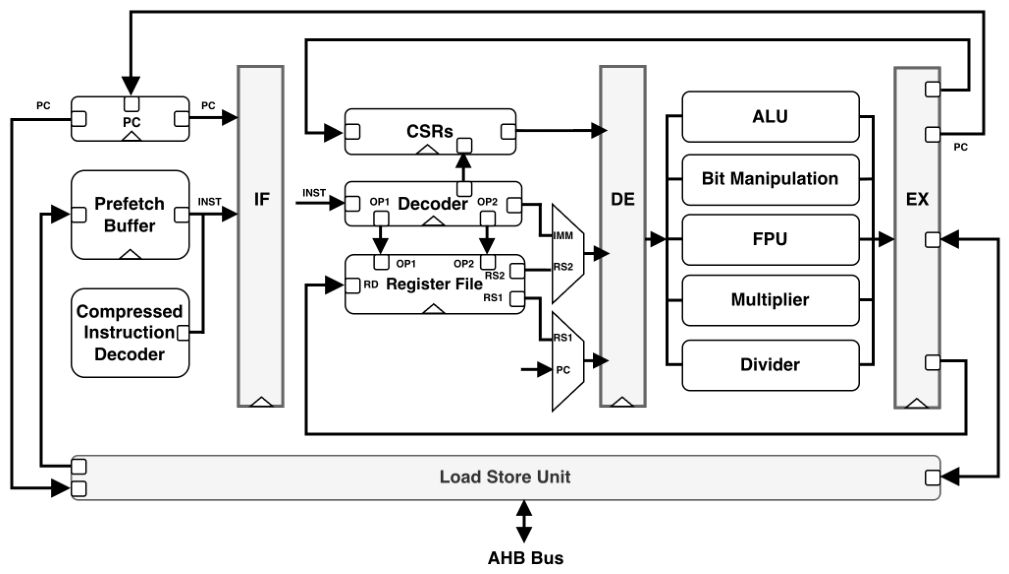
- (IF) Instruction Fetch. The design incorporates two Instruction Prefetch Buffers (IPBs) arranged in a ping-pong configuration, each capable of storing a configurable number of instructions, with a default capacity of four. Instructions are fetched from memory and loaded into the active IPB, becoming valid by the end of this stage before being latched in the subsequent stage. The pipeline temporarily stalls when a branch, jump, or trap occurs, halting operation until the IPB is replenished.
- (DE) Decode. This stage analyzes the fetched instruction, determining its type and operands. It identifies the operation to be performed, the number of operands, and the registers involved. Additionally, the necessary resources are allocated accordingly.
- (EX) Execute. Arithmetic Logic Unit (ALU) operations, along with logical and shift functions, are executed during this stage. Memory accesses, Floating Point calculations, Bit-Manipulation operations, and other extension instructions requiring more than one cycle to complete will cause the pipeline to stall until their execution is finished. The results of ALU, logical, shift, or memory operations are then written back to the register file.
3.2. System Bus
3.3. Memory Interface
3.4. Multiplier and Divider
3.5. Floating Point Unit
3.6. Debug Module
4. Error Detection and Fault Tolerance
4.1. Triple Modular Redundancy (TMR)
4.2. EDAC Protection
4.3. Processor Register File
5. System Validation
6. Results
6.1. Performance
6.2. Resource Utilization
7. Conclusions and Future Work
Author Contributions
Funding
Data Availability Statement
Conflicts of Interest
Abbreviations
| AHB | Advanced High-performance Bus |
| AI | Artificial Intelligence |
| ALU | Arithmetic Logic Unit |
| AMBA | Advanced Microcontroller Bus Architecture |
| APB | Advanced Peripheral Bus |
| BCH | Bose–Chaudhuri–Hocquenghem |
| COTS | Commercial Off The Shelf |
| CPU | Central Processing Unit |
| DE | Decode |
| DM | Debug Module |
| DPU | Data Processing Unit |
| EBR | Embedded Block RAM |
| EDAC | Error-Detection And Correction |
| ESA | European Space Agency |
| EX | Execute |
| FF | Flip-Flop |
| FPGA | Field Programmable Gate Array |
| FPU | Floating Point Unit |
| FSM | Finite State Machine |
| GRV | Goddard RISC-V |
| GSFC | Goddard Space Flight Center |
| GUI | Graphical User Interface |
| I2C | Inter-Integrated Circuit |
| IF | Instruction Fetch |
| IO | Input/Output |
| IP | Intellectual Property |
| IPB | Instruction Prefetch Buffer |
| ISA | Instruction Set Architecture |
| IU | Integer Unit |
| JTAG | Joint Test Action Group |
| LDSTU | Load Store Unit |
| ML | Machine Learning |
| MRAM | Magnetoresistive Random Access memory |
| MTBF | Mean Time Between Failures |
| NASA | National Aeronautics and Space Administration |
| OSVVM | Open-Source VHDL Verification Methodology |
| PROM | Programmable Read-Only Memory |
| PWM | Pulse Width Modulation |
| RISC | Reduced Instruction Set Computer |
| SET | Single Event Transient |
| SEU | Single-Event Upset |
| SOC | System On Chip |
| SPARC | Scalable Processor Architecture |
| SPI | Serial Peripheral Interface |
| SRAM | Static Random Access Memory |
| SDRAM | Synchronous Dynamic Random Access Memory |
| TCM | Tightly Coupled Memory |
| TMR | Triple Modular Redundancy |
| TRL | Technology Readiness Level |
| UART | Universal Asynchronous Receiver/Transmitter |
References
- Frontgrade Gaisler. LEON and NOEL-V SoC Architectures. Available online: https://download.gaisler.com/white_papers/Position-Paper-LEON-NOELV-SoC-Architectures-2022-02-22.pdf (accessed on 7 May 2026).
- Andersson, J. Development of a NOEL-V RISC-V SoC Targeting Space Applications. In Proceedings of the 2020 50th Annual IEEE/IFIP International Conference on Dependable Systems and Networks Workshops (DSN-W), Valencia, Spain, 29 June–2 July 2020; IEEE: Piscataway, NJ, USA, 2020; pp. 66–67. [Google Scholar] [CrossRef] [Scilit]
- NASA. High Performance Spaceflight Computing (HPSC) White Paper. Available online: https://www.nasa.gov/wp-content/uploads/2024/07/hpsc-white-paper-tmg-23jul2024.pdf?emrc=6a049985c5a0c (accessed on 7 May 2026).
- Habinc, S.; Gaisler, J. LEON3FT Processor with PCI, Ethernet and Reed-Solomon SDRAM protection. In Proceedings of the Military and Aerospace Programmable Logic Devices (MAPLD) Conference 2008, Annapolis, MD, USA, 15–18 September 2008; National Aeronautics and Space Administration: Moffett Field, CA, USA, 2008. Available online: https://nepp.nasa.gov/mapld_2008/presentations/t/01%20-%20Gaisler_Jiri_mapld08_pres_1.pdf (accessed on 7 May 2026).
- Green, C.; Haghani, N.; Hernandez-Pellerano, A.; Gheen, B.; Lanham, A.; Fraction, J. MUSTANG: A Workhorse for NASA Spaceflight Avionics. In Proceedings of the 2023 IEEE 9th International Conference on Space Mission Challenges for Information Technology (SMC-IT), Pasadena, CA, USA, 18–27 July 2023; IEEE: Piscataway, NJ, USA, 2023. [Google Scholar] [CrossRef] [Scilit]
- Flatley, T. SpaceCube: A family of reconfigurable hybrid on-board science data processors. In 2012 NASA/ESA Conference on Adaptive Hardware and Systems (AHS), Erlangen, Germany, 2012; IEEE: Piscataway, NJ, USA, 2012. [Google Scholar] [CrossRef] [Scilit]
- Asanovic, K.; Patterson, D.A. Instruction Sets Should Be Free: The Case for RISC-V; Technical Report No. UCB/EECS-2014-146; EECS Department, University of California: Berkeley, CA, USA, 2014; Available online: https://www2.eecs.berkeley.edu/Pubs/TechRpts/2014/EECS-2014-146.html (accessed on 7 May 2026).
- Waterman, A.; Lee, Y.; Patterson, D.; Asanovic, K. The RISC-V Instruction Set Manual, Volume I: Unprivileged ISA Version 2.0; University of California: Berkeley, CA, USA, 2016. [Google Scholar]
- Gaisler, J.; Catovic, E. Multi-Core Processor Based on LEON3-FT IP Core (LEON3-FT-MP). In DASIA 2006—Data Systems in Aerospace, Proceedings of the Conference Held 22–25 May, 2006 in Berlin, Germany; Ouwehand, L., Ed.; ESA SP-630; European Space Agency: Noordwijk, The Netherlands, 2006; Available online: https://articles.adsabs.harvard.edu/pdf/2006ESASP.630E..76G (accessed on 7 May 2026).
- Weigand, R.; Redant, S. LEONUMC—The LEON2 Fault Tolerant Processor in 0.18 μm Commercial UMC Technology. In Proceedings of the 2004 Microelectronics Presentation Days, Noordwijk, The Netherlands, 4–5 February 2004; European Space Agency: Noordwijk, The Netherlands, 2004; Available online: http://microelectronics.esa.int/mpd2004/leonumc-mpd2004.pdf (accessed on 7 May 2026).
- Holler, R.; Haselberger, D.; Ballek, D.; Rossler, P.; Krapfenbauer, M.; Linauer, M. Open-Source RISC-V Processor IP Cores for FPGAs—Overview and Evaluation. In Proceedings of the 2019 8th Mediterranean Conference on Embedded Computing (MECO), Budva, Montenegro, 10–14 June 2019; IEEE: Piscataway, NJ, USA, 2019; pp. 1–6. [Google Scholar] [CrossRef] [Scilit]
- Di Mascio, S.; Menicucci, A.; Gill, E.K.A.; Furano, G.; Monteleone, C. Leveraging the Openness and Modularity of RISC-V in Space. J. Aerosp. Inf. Syst. 2019, 16, 454–472. [Google Scholar] [CrossRef] [Scilit]
- Gupta, S.; Gala, N.; Madhusudan, G.; Veezhinathan, K. SHAKTI-F: A Fault Tolerant Microprocessor Architecture. In Proceedings of the 2015 IEEE 24th Asian Test Symposium (ATS), Mumbai, India, 22–25 November 2015; IEEE: Piscataway, NJ, USA, 2015; pp. 163–168. [Google Scholar] [CrossRef] [Scilit]
- Li, J.; Zhang, S.; Bao, C. DuckCore: A Fault-Tolerant Processor Core Architecture Based on the RISC-V ISA. Electronics 2022, 11, 122. [Google Scholar] [CrossRef] [Scilit]
- Santos, D.A.; Luza, L.M.; Zeferino, C.A.; Dilillo, L.; Melo, D.R. A Low-Cost Fault-Tolerant RISC-V Processor for Space Systems. In Proceedings of the 2020 15th Design & Technology of Integrated Systems in Nanoscale Era (DTIS), Marrakech, Morocco, 1–3 April 2020; IEEE: Piscataway, NJ, USA, 2020; pp. 1–5. [Google Scholar] [CrossRef] [Scilit]
- Sim, M.; Zhuang, Y. A Dual Lockstep Processor System-on-a-Chip for Fast Error Recovery in Safety-Critical Applications. In Proceedings of the IECON 2020, The 46th Annual Conference of the IEEE Industrial Electronics Society, Singapore, 18–21 October 2020; IEEE: Piscataway, NJ, USA, 2020; pp. 2231–2238. [Google Scholar] [CrossRef] [Scilit]
- Rogenmoser, M.; Wiese, P.; Forlin, B.E.; Gürkaynak, F.K.; Rech, P.; Menicucci, A.; Ottavi, M.; Benini, L. Trikarenos: Design and Experimental Characterization of a Fault-Tolerant 28-nm RISC-V-Based SoC. IEEE Trans. Nucl. Sci. 2025, 72, 2783–2792. [Google Scholar] [CrossRef] [Scilit]
- Böhmer, K.; Forlin, B.; Cazzaniga, C.; Rech, P.; Furano, G.; Alachiotis, N.; Ottavi, M. Neutron Radiation Tests of the NEORV32 RISC-V SoC on Flash-Based FPGAs. In Proceedings of the 36th IEEE International Symposium on Defect and Fault Tolerance in VLSI and Nanotechnology Systems (DFT), Juan-Les-Pins, France, 3–5 October 2023; IEEE: Piscataway, NJ, USA, 2023; pp. 1–6. [Google Scholar] [CrossRef] [Scilit]
- Cora, G.; De Sio, C.; Azimi, S.; Sterpone, L. Selective hardening of RISC-V soft-processors for space applications. Microelectron. Reliab. 2025, 167, 115667. [Google Scholar] [CrossRef] [Scilit]
- Barbirotta, M.; Cheikh, A.; Mastrandrea, A.; Menichelli, F.; Vigli, F.; Olivieri, M. A Fault Tolerant soft-core obtained from an Interleaved-Multi-Threading RISC-V microprocessor design. In Proceedings of the 34th IEEE International Symposium on Defect and Fault Tolerance in VLSI and Nanotechnology Systems (DFT), Athens, Greece, 6–8 October 2021; IEEE: Piscataway, NJ, USA, 2021; pp. 1–4. [Google Scholar] [CrossRef] [Scilit]
- Patankar, U.S.; Koer, A. Review of Basic Classes of Dividers Based on Division Algorithm. IEEE Access 2021, 9, 23035–23069. [Google Scholar] [CrossRef] [Scilit]
- IEEE Std 754-2019; IEEE Standard for Floating-Point Arithmetic. IEEE: Piscataway, NJ, USA, 2019. [CrossRef] [Scilit]
- Li, Y.; Chu, W. A new non-restoring square root algorithm and its VLSI implementations. In Proceedings of the International Conference on Computer Design, VLSI in Computers and Processors, Austin, TX, USA, 7–9 October 1996; IEEE: Piscataway, NJ, USA, 1996. [Google Scholar] [CrossRef] [Scilit]
- Gaisler, J. A portable and fault-tolerant microprocessor based on the SPARC v8 architecture. In Proceedings of the International Conference on Dependable Systems and Networks, Washington, DC, USA, 23–26 June 2002; IEEE: Piscataway, NJ, USA, 2002; pp. 409–415. [Google Scholar] [CrossRef] [Scilit]
- Berg, M.; LaBel, K. New Developments in Error Detection and Correction Strategies for Critical Applications. In Proceedings of the 2016 Single Event Effects (SEE) Symposium and Military and Aerospace Programmable Logic Devices (MAPLD) Workshop, San Diego, CA, USA, 23–26 May 2016; National Aeronautics and Space Administration: Moffett Field, CA, USA, 2016. Available online: https://ntrs.nasa.gov/citations/20160007971 (accessed on 7 May 2026).
- Berg, M.; Label, K. Verification of Triple Modular Redundancy Insertion for Reliable and Trusted Systems. In Proceedings of the GOMAC Tech 2016 Government Microcircuits Applications & Critical Technologies Conference, Orland, FL, USA, 14–17 March 2016; National Aeronautics and Space Administration: Moffett Field, CA, USA, 2016. Available online: https://ntrs.nasa.gov/api/citations/20160003521/downloads/20160003521.pdf (accessed on 7 May 2026).
- Berg, M.; Campola, M. FPGA Mitigation Strategies for Critical Applications. In Proceedings of the Radiation Effects on Components and Systems (RADECS) Conference, Gothenburg, Sweden, 16–21 September 2018; IEEE: Piscataway, NJ, USA, 2018. Available online: https://ntrs.nasa.gov/api/citations/20180006778/downloads/20180006778.pdf (accessed on 7 May 2026).
- Jansen, R. Microelectronics Radiation Mitigation. In Proceedings of the European Data Handling and Data Processing Conference for Space 2023, Juan Les Pins, France, 2–6 October 2023; European Space Agency: Paris, France, 2023; Available online: https://indico.esa.int/event/445/contributions/8603/attachments/5600/9131/EDHPC%20tutorial%20-%20Microelectronics%20Radiation%20Mitigation%20v4.pdf (accessed on 7 May 2026).
- Hsiao, M.Y. A Class of Optimal Minimum Odd-weight-column SEC-DED Codes. IBM J. Res. Dev. 1970, 14, 395–401. [Google Scholar] [CrossRef] [Scilit]
- RISCOF—The RISC-V Compatibility Framework. Available online: https://github.com/riscv-software-src/riscof (accessed on 7 May 2026).
- VUnit: A Test Framework for HDL. Available online: https://vunit.github.io/ (accessed on 7 May 2026).
- Asplund, L.; Kraigher, O. VUnit: A Unit Testing Framework for VHDL/SystemVerilog. In DVCon Europe 2014; Accellera Systems Initiative: Elk Grove, CA, USA, 2014. [Google Scholar]
- Open Source VHDL Verification Methodology (OSVVM). Available online: https://osvvm.org/ (accessed on 7 May 2026).
- Intelligent Coverage Driven, Modern Verification for VHDL Based Designs in Native VHDL with OSVVM. In Design and Verification Conference and Exhibition (DCON) 2015, India; Accellera Systems Initiative: San Jose, CA, USA, 2015; Available online: https://dvcon-proceedings.org/document/intelligent-coverage-driven-modern-verification-for-vhdl-based-designs-in-native-vhdl-with-osvvm-presentation/ (accessed on 7 May 2026).
- Gaisler, J. Fault-tolerant and radiation-hardened SPARC processors. In Proceedings of the Topical Workshop on Electronics for Particle Physics; CERN: Geneva, Switzerland, 2007; pp. 39–46. [Google Scholar] [CrossRef]
- CoreMark—CPU Benchmark. Available online: https://www.eembc.org/coremark/ (accessed on 7 May 2026).
- Bruno, A.; de Nolfo, G.A.; Daehn, M.; DuMonthier, J.; Legere, J.; Liceaga-Indart, I.; Messner, R.; Mitchell, J.G.; Ryan, J.M.; Suarez, G.; et al. The Lunar OutpOst Neutron Spectrometer (LOONS). In Proceedings of the 2022 IEEE Nuclear Science Symposium and Medical Imaging Conference (NSS/MIC), Milan, Italy, 5–12 November 2022; IEEE: Piscataway, NJ, USA, 2022; pp. 1–5. [Google Scholar] [CrossRef] [Scilit]
- de Nolfo, G.A.; Mitchell, J.G.; Suarez, G.; Ryan, J.M.; Bruno, A.; Dumonthier, J.; Legere, J.; Messner, R.; Tatoli, T.; Williams, L. Next-generation SOlar Neutron TRACking (SONTRAC) instrument. Nucl. Instrum. Methods Phys. Res. Sect. A Accel. Spectrometers Detect. Assoc. Equip. 2023, 1054, 168352. [Google Scholar] [CrossRef] [Scilit]



| Extension | Description |
|---|---|
| A | Atomic Instructions |
| C | Compressed Instructions |
| E | Embedded, 32-bit ISA with 16 registers |
| I | Integer, Base 32-bit ISA |
| M | Multiplication and Division |
| U | Less-privileged User-Mode |
| Zifencei | Stream Synchronization Instructions |
| Zfinx | Single-Precision Floating-Point in Integer Register |
| Zicntr | Base Counters |
| Zicond | Integer Conditional Operations |
| Zicsr | Control and Status Register Access Instructions |
| Zihpm | Hardware Performance Monitors |
| Zmmul | Integer Multiplication-only Instructions |
| Smppmp | Physical Memory Protection |
| Smcntrpmf | Counter Privilege Mode Filtering |
| Sdext | External Debug |
| Sdtrig | Trigger Module |
| Zba | Shifted-Add Bit-Manipulation |
| Zbb | Basic Bit-Manipulation |
| Zbc | Carry-Less Multiplication Instructions |
| Zbs | Single-Bit Instructions |
| Zbkb | Bit-Manipulation Instructions for Cryptography |
| Zbkc | Carry-Less Multiplication Instructions for Cryptography |
| Zbkx | Crossbar Permutation |
| Zknh | NIST Hash |
| Zkne | NIST AES Encryption |
| Zknd | NIST AES Decryption |
| Zksed | ShangMi Block Cypher |
| Zksh | ShangMi Hash |
| FPGA | Resource/Parameter | Utilization (GRV) | Utilization (GRV-FT) |
|---|---|---|---|
| Microchip RTProASIC3 RT3PE3000L | Core Cells | 27,002/75,624 (35.7%) | 54,036/75,624 (71%) |
| RAM4K9 | 6/112 (5%) | 12/112 (10%) | |
| Frequency | 32 MHz | 16 MHz | |
| Power (mW) | 76 | 116 | |
| Microchip RTG4 RT4G150 | 4LUTs | 4896/151,824 (3.22%) | 4896/151,824 (3.22%) |
| DFFs | 3216/151,824 (2.11%) | 3216/151,824 (2.11%) | |
| RAM64x18 | 1/240 (0.5%) | 2/240 (1%) | |
| RAM1K18 | 0/236 (0%) | 0/236 (0%) | |
| Frequency | 75 MHz | 75 MHz | |
| Power (mW) | 198 | 198 | |
| Lattice CertusPro-NX LFCPNX-100 | SLICE | 2512/79,872 (5%) | 2512/79,872 (5%) |
| LUT4S | 8369/79,872 (11%) | 8369/79,872 (11%) | |
| Registers | 4552/80,769 (6%) | 9140/80,769 (11.31%) | |
| EBR | 2/208 (1%) | 4/208 (2%) | |
| Frequency | 100 MHz | 50 MHz | |
| Power (mW) | 160 | 245 |
Disclaimer/Publisher’s Note: The statements, opinions and data contained in all publications are solely those of the individual author(s) and contributor(s) and not of MDPI and/or the editor(s). MDPI and/or the editor(s) disclaim responsibility for any injury to people or property resulting from any ideas, methods, instructions or products referred to in the content. |
© 2026 by the authors. Licensee MDPI, Basel, Switzerland. This article is an open access article distributed under the terms and conditions of the Creative Commons Attribution (CC BY) license.
Share and Cite
Guzman-Garcia, D.; Ridley, R.J.; Suarez, G.; Sheikh, S.I.; Daehn, M.C.; Dumonthier, J.J.; de Nolfo, G.A.; Mitchell, J.G. A Portable, Compact, and Fault-Tolerant Processor for Spaceflight Applications. Aerospace 2026, 13, 464. https://doi.org/10.3390/aerospace13050464
Guzman-Garcia D, Ridley RJ, Suarez G, Sheikh SI, Daehn MC, Dumonthier JJ, de Nolfo GA, Mitchell JG. A Portable, Compact, and Fault-Tolerant Processor for Spaceflight Applications. Aerospace. 2026; 13(5):464. https://doi.org/10.3390/aerospace13050464
Chicago/Turabian StyleGuzman-Garcia, David, Ryan J. Ridley, George Suarez, Salman I. Sheikh, Matthew C. Daehn, Jeffrey J. Dumonthier, Georgia A. de Nolfo, and John G. Mitchell. 2026. "A Portable, Compact, and Fault-Tolerant Processor for Spaceflight Applications" Aerospace 13, no. 5: 464. https://doi.org/10.3390/aerospace13050464
APA StyleGuzman-Garcia, D., Ridley, R. J., Suarez, G., Sheikh, S. I., Daehn, M. C., Dumonthier, J. J., de Nolfo, G. A., & Mitchell, J. G. (2026). A Portable, Compact, and Fault-Tolerant Processor for Spaceflight Applications. Aerospace, 13(5), 464. https://doi.org/10.3390/aerospace13050464