Article

Partitioned Topology Optimization of Aero-Engine Rear Cooling Plate Based on Multi-Feature K-Means Algorithm

1
AECC Hunan Aviation Powerplant Research Institute, Zhuzhou 412002, China
2
Research Institute of Aero-Engine, Beihang University, Beijing 100191, China
3
School of Aerospace Engineering, Xiamen University, Xiamen 361005, China
*
Author to whom correspondence should be addressed.
Aerospace 2026, 13(5), 394; https://doi.org/10.3390/aerospace13050394
Submission received: 14 February 2026 / Revised: 4 April 2026 / Accepted: 10 April 2026 / Published: 22 April 2026

Abstract

As a core load-bearing component, the aero-engine rear cooling plate requires its design to simultaneously meet strength requirements and lightweight indicators. The topology optimization method considering stress constraints is the core technical path to achieve this goal, but it suffers from insufficient control precision in key areas, easily leading to material redundancy. To address this issue, a partitioned topology optimization method based on the multi-feature K-means algorithm is proposed. First, by integrating multi-dimensional features including element stress, physical density, and spatial position, an innovative multi-feature K-means algorithm is employed to realize dynamic adaptive partitioning during the optimization process. Secondly, combined with the p-norm method for partitioned stress aggregation, a precise prediction and control method for partitioned stress is adopted to refine stress constraints. Thirdly, a topology optimization model of the rear cooling plate with multi-feature partitioned stress constraints is constructed, and the adjoint method is used to solve the stress sensitivities under centrifugal loads. Finally, the effectiveness of the proposed method is verified using the rear cooling plate model. The rear cooling plate is discretized with 0.5 mm 2D axisymmetric finite elements, the filter radius is 4 mm, and the Method of Moving Asymptotes (MMA) is employed for the solution. The mass fraction of the finally optimized rear cooling plate structure is 0.157, which is 13.7% lower than that obtained by the global stress constraint method and 11.3% lower than that obtained by the topology optimization method considering both the geometric partitioned stress constraints and global stress constraints. The proposed method provides a new approach for the lightweight design of the aero-engine rear cooling plate.

1. Introduction

As a key load-bearing sealing component of aero-engines, the rear cooling plate is usually designed as an annular structure with a large centroid radius. Located in the high-speed rotating turbine section of the engine, it undertakes core functions such as turbine disk positioning, bearing load transmission, and rotor system stability maintenance. Its structural performance, strength reliability, and lightweight performance directly affect the thrust-to-weight ratio, fuel consumption, and service life of the entire aero-engine. During long-term service, the rear cooling plate bears huge centrifugal loads and contact loads, which impose extremely high requirements on structural strength and material distribution [1]. However, traditional design methods rely heavily on empirical formulas, which easily lead to problems such as material redundancy and local stress concentration. Moreover, it is difficult to achieve a systematic balance between multiple mutually restrictive performance indicators, including bearing capacity and weight reduction targets. Therefore, under the development requirements of advanced aero-engines for high thrust-to-weight ratio and high efficiency [2,3,4], it is particularly urgent and necessary to introduce advanced optimization design methods to improve the structural performance of the rear cooling plate.
Optimization design methods mainly include shape optimization [5,6,7], size optimization [8,9], and topology optimization [10,11,12]. Shape optimization aims to adjust the geometric boundaries and profiles of structures to improve structural performance. Size optimization focuses on changing the sectional dimensions, thickness, and other size parameters of components. Both shape optimization and size optimization can only improve the layout and parameters on the basis of the fixed initial structural configuration and cannot break through the limitations of traditional structural forms. In contrast, topology optimization can intelligently optimize the material distribution in the design domain without relying on a given initial configuration, so as to obtain an innovative and optimal structural layout. Therefore, topology optimization has greater advantages in the lightweight and high-performance design of aero-engine components.
Topology optimization is an advanced design technology that optimizes the material distribution within the design domain to achieve expected structural performance [13]. Its main methods include the Solid Isotropic Material with Penalization (SIMP) method [14,15,16], the Evolutionary Structural Optimization Method (ESO) [17,18,19], the Level Set Method (LSM) [20,21,22], etc. Among them, the SIMP method has been widely used in the structural design of aero-engine components due to its simplicity and practicality [23]. William et al. [24] explored a design method combining SIMP-based topology optimization and lattice generation, and redesigned three components: jet engine brackets, aircraft bearing brackets, and optical instrument mounting structures. After optimization, the weight of the mounting structure is reduced by 81.8%, the weight of the jet engine bracket structure is reduced by 62.4%, and the weight of the aircraft bearing bracket structure is reduced by 52.5%. Okorie et al. [25] applied topology optimization technology to optimize the performance design of aerospace brackets and fabricated the components via additive manufacturing technology. Mechanical performance tests on the components demonstrated that the optimized design achieved a 20% weight reduction while maintaining the compressive displacement of the original component unchanged under the given load. Wang et al. [26] conducted a study on topology optimization for aero-engine turbine disks. By introducing a density distribution function with the radial thickness of the disk as the control parameter to regulate the material density distribution of each radial element in the design domain, the problem of closed hole generation in traditional topology optimization results was effectively avoided. Ultimately, an optimized design scheme for turbine disks with clear boundary contours and no internal holes was obtained. Boccini et al. [27] developed a design method combining topology optimization with lattice optimization to perform structural optimization on rotating machinery such as turbine disks, which effectively improved the resonance characteristics and dynamic operational performance of turbine disks. Meli et al. [28] carried out multi-objective topology optimization of the turbine disk, realizing the simultaneous reduction of natural frequency and structural weight. However, stress has not been considered in these studies. Given that the rear cooling plate of aero-engines operates in harsh service environments, it is essential to consider stress constraints in its topology optimization.
Stress-constrained topology optimization is mainly used to control the maximum structural stress under working loads. The most direct method to prevent excessive stress in structures is to limit the maximum stress at each element [29], which is referred to as the local stress constraint method. However, the local stress constraint method involves a large number of constraints, and when the number of constraints reaches a certain scale, the optimization solution will face enormous challenges [30]. Paris et al. [31] introduced the augmented Lagrangian method into the topology optimization problem with stress constraints. This method directly handles these constraints by adding local stress constraints to the objective function in the form of penalty terms. Compared with the traditional local stress constraint method, the augmented Lagrangian method enables more efficient solutions. Another approach is the global stress constraint method based on stress aggregation [32]. This method uses stress aggregation functions such as the Kreisselmeier–Steinhauser function [33,34,35] and the p-norm function to aggregate the responses of all elements, achieve a smooth approximation of the global maximum stress, and thereby establish a global maximum stress constraint. Liu et al. [36] adopted a topology optimization method considering stress constraints for the structural design of components fabricated via the Fused Deposition Modeling (FDM) process, and investigated the influence law of FDM process parameters on the actual strength of the optimized components. Han et al. [37], based on the alternative effective phase algorithm, proposed a solution method combining the nodal variable strategy and the material distribution-based clustering method, which effectively suppressed the checkerboard pattern in the topology optimization process, significantly improved the accuracy and stability of stress aggregation, and solved the problem of insufficient control of local stress states by traditional global stress constraints. Zhao et al. [38] proposed a collaborative topology optimization method for dual-scale hierarchical structures under stress constraints. Aiming at the problem of a huge number of stress constraints existing in the collaborative optimization process, a novel hierarchical aggregation strategy was adopted to reduce the number of stress constraints. Goo et al. [39] carried out topology optimization of thin plate structures considering bending stress constraints based on the p-norm function and verified the effectiveness through numerical examples. Ni et al. [40] proposed a topology design method for continuum structures with global stress constraints considering self-weight loads. This method adopts the improved p-norm method to aggregate the local stress constraints of all elements into a global stress constraint and simultaneously uses a rational approximation method for material properties to describe the material distribution, so as to overcome the parasitic effect at low densities. However, although the topology optimization method based on global stress constraints has excellent optimization efficiency, it cannot precisely control the local stress of the structure, resulting in material redundancy and underutilized lightweight potential.
The partitioned topology optimization method is developed by local stress constraint method and global stress constraint method [41]. This method imposes stress constraints only on partial domains of the structure on the basis of global stress constraints, achieving precise control of local stress while ensuring a reasonable computational cost. Xia et al. [42] proposed a level set-based method coupled with the Method of Moving Asymptotes (MMA) to solve the topology optimization problem with partitioned stress constraints, and adopted the problem, realizing structural topology optimization for minimum volume under stress constraints. This method exhibits higher stability during calculation and yields a more uniform structure in stress-concentrated regions compared with the global stress constraint method. Paris et al. [43] investigated the performance of the local stress constraint method, global stress constraint method and partitioned topology optimization method in stress-constrained topology optimization. Compared with the local stress constraint method, the computational requirements of the global stress constraint method and partitioned topology optimization method are reduced by an order of magnitude. On the other hand, at the cost of a slight increase in computational overhead, the partitioned topology optimization method retains the advantages of the global stress constraint method while significantly mitigating its drawback of insufficient precision in controlling local stress. However, the domain division of existing partitioned topology optimization methods is mostly based on a single index such as structural geometric features or initial stress distribution. Moreover, the divided domains remain fixed, making it difficult to adapt to the dynamic evolution of structural morphology and stress field during the iteration of topology optimization. This limits the lightweight potential of the topology optimization method to a certain extent.
Therefore, a partitioned stress-constrained topology optimization method based on the multi-feature K-means algorithm is innovatively proposed in this paper. The multi-feature K-means algorithm integrates three feature types, including element stress, physical density, and spatial position. It performs real-time and autonomous division of the design domain during the optimization iteration process. Subsequently, the p-norm function is employed to aggregate the stress of each partition, and the precise prediction and control method of partitioned stress is applied to improving the control precision of local stress. On this basis, a topology optimization model for the rear cooling plate is further established, and the stress sensitivity of each element of the rear cooling plate under centrifugal loads is derived based on the adjoint method. Ultimately, the effectiveness of the method proposed in this paper is verified on the rear cooling plate, which achieves better lightweight performance compared with conventional stress-constrained topology optimization methods. The proposed method enriches the partitioned topology optimization theory system of rotating load-bearing structures, provides new ideas and approaches for the lightweight and high-strength design of similar high-speed rotating components, and effectively supplements and expands the relevant research in the field of aero-engine components.
The main contents of this paper are as follows. Section 2 introduces the principle of the multi-feature K-means algorithm and partitioning method. Section 3 elaborates on the precise prediction and control method of partitioned stress. Section 4 focuses on the establishment of the topology optimization model for the rear cooling plate, along with the derivation of relevant sensitivity formulas and the formulation of the flow of our method. Section 5 applies the method proposed in this paper to the topology optimization of the rear cooling plate and verifies the effectiveness of the method through numerical results. Finally, a summary of the full paper is presented.

2. Partitioning Method Based on Multi-Feature K-Means Algorithm

Existing partitioned topology optimization methods mostly perform fixed division of the design domain based on element stress, geometric features, or other such criteria. These methods thus fail to dynamically adapt to the significant changes in material distribution and stress distribution during the topology optimization process. This results in the rationality and refinement level of the partitioning results being unsustainable throughout the iterations. A clustering algorithm is a type of algorithm that divides a set of objects into several subsets, such that the data within the same cluster share common characteristics while differing from the data in other clusters [44]. Common clustering algorithms include DBSCAN, hierarchical clustering, and the K-means algorithm [45]. However, DBSCAN and hierarchical clustering involve a large amount of computation and low efficiency, leading to slow convergence in iterative finite element analysis, which makes them unsuitable for dynamic partitioning in topology optimization. In contrast, the K-means algorithm has a clear and simple principle. Its core idea is to divide data points into k clusters by minimizing the sum of squared distances from each sample to the cluster center, so that samples within the same cluster have high similarity. The K-means algorithm can comprehensively integrate multiple physical characteristics of finite elements and adaptively divide the design domain into several sub-domains according to the real-time distribution of parameters such as stress during the iteration of topology optimization, so as to achieve accurate and efficient multi-feature partitioning. Based on the stress, physical density, and spatial position of structural elements, this paper uses the K-means algorithm to achieve multi-feature division of the design domain, so as to avoid the subjectivity and randomness of manual division. Meanwhile, it can maintain the dynamic adaptability of partitioning throughout the optimization process, thereby tapping into the lightweight potential of the structure more fully.

2.1. K-Means Algorithm

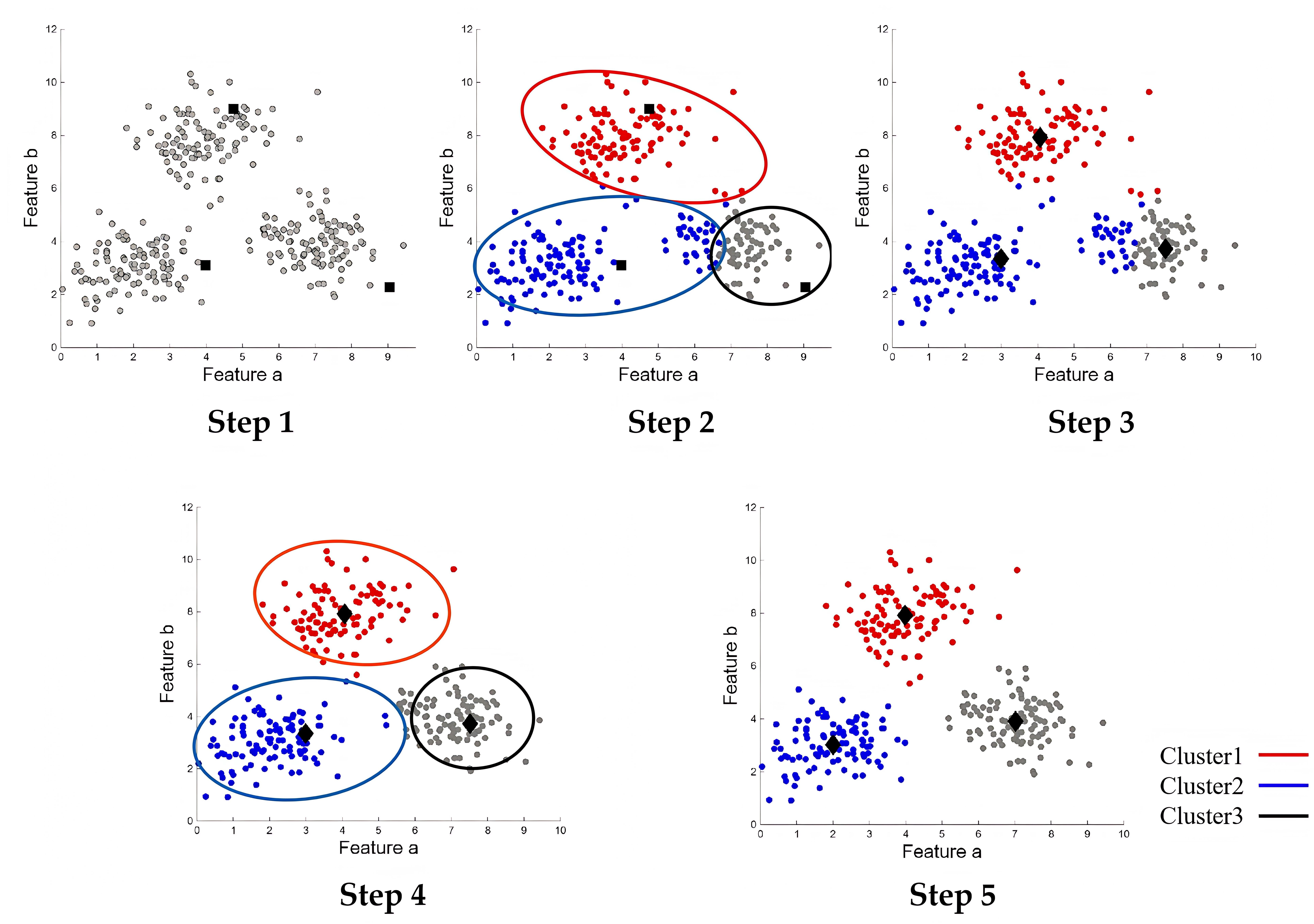
The K-means algorithm is a method that reasonably partitions n data points into k non-overlapping point sets. The operation process of this algorithm is illustrated in Figure 1, which can be divided into five steps:
First, construct a two-dimensional sample point set X containing n data points, where the point set takes feature a and feature b as coordinate dimensions. Randomly select k data points x 1 , x 2 x k from the point set X as the initial cluster centers (represented by black squares).
Second, assign each data point except the cluster centers to the nearest cluster center, thus forming k clusters X 1 , X 2 X k . At this point, let the j-th data point of the i-th cluster be denoted as x i j = ( a i j , b i j ) .
Then, calculate the mean point of all data points in each cluster (denoted by μ 1 , μ 2 μ k ) and take it as the new cluster center (represented by black diamonds), where μ k = ( a k , b k ) .
Next, the quality of the current clustering results is quantitatively evaluated. The K-means algorithm uses the within-cluster sum of squares (WCSS) to assess the quality of the current clustering results. The WCSS refers to the sum of geometric distances from all data points to their corresponding cluster centers, which represents the compactness of data point distribution within each cluster. The more compact the data points in a cluster are, the better the clustering effect will be, and the smaller the value of the WCSS will be. The mathematical expression of the WCSS is as follows.
  WCSS = i = 1 k j = 1 p d i j 2
where k denotes the number of clusters, p represents the total number of elements in the i-th point set, and d i j is the distance from the j-th data point of the i-th cluster to the corresponding cluster center. In this paper, the Euclidean distance is adopted for calculation, with the formula given as follows:
d i j = ( a i j a i ) 2 + ( b i j b i ) 2
Finally, with the goal of minimizing the WCSS, the iteration is repeated until the WCSS converges or meets the preset criteria.

2.2. Multi-Feature Partitioning Strategy

In this paper, the elements of the design domain are classified based on three metrics, namely, the von Mises stress σ of the design domain elements, physical density x ¯ , and the geometric distance l between the element centroid and the cluster center.
Adopting the von Mises stress as the classification index allows for a better differentiation of elements at different stress levels and the implementation of targeted stress control on them. Taking the element physical density as the classification index allows differentiation between high-density and low-density elements, thereby reducing the impact of low-density elements on the stress-constrained topology optimization process. Adopting the element geometric distance as the index ensures that the domain partitioning results are more spatially concentrated and rational.
Each element can be regarded as a data point in a three-dimensional coordinate system with stress σ , physical density x ¯ , and geometric distance l as the coordinate axes. Let the coordinate of the j-th element in the i-th cluster be denoted as σ i j , x ¯ i j , l i j . To avoid the impact of data scales on the clustering results, the values of σ i j , x ¯ i j , and l i j are all normalized using the z-score method [46]. The specific formula is given as follows:
The formula for the weighted distance vector d i j between the j-th element in cluster i and the cluster center is given as follows:
d i j = c 1 σ ¯ ij + c 2 x = ij + c 3 l ¯ ij
where c 1 , c 2 and c 3 are the weight parameters of the three features; σ ¯ i j , x ¯ ¯ i j and l ¯ i j represent the squared differences of the distances between the element and the cluster center in terms of stress, physical density, and spatial position, respectively. The formulas are given as follows:
σ ¯ ij = σ ij σ i 2
x = ij = x ¯ ij x ¯ i 2
l ¯ ij = ( r i j r i ) 2 + ( z i j z i ) 2 l i 2
where σ i , x ¯ i , l i denotes the cluster center of the i-th cluster. Let the geometric coordinate of this element be ( r i j , z i j ) and ( r i , z i ) be the geometric mean point of all data points in the i-th cluster. Let p represent the total number of elements in the i-th cluster. Then the calculation formulas for each coordinate parameter of the cluster center are given as follows:
σ i = 1 p j = 1 p σ ij
x ¯ i = 1 p j = 1 p x ¯ ij
l i = 0
r i = 1 p j = 1 p r ij
z i = 1 p j = 1 p z ij
Substituting Equations (4)–(6) into Equation (3), d i j can be obtained:
d i j = c 1 σ ij σ i 2 + c 2 x ¯ ij x ¯ i 2 + c 3 ( r i j r i ) 2 + ( z i j z i ) 2 l i 2

3. Precise Prediction and Control Method of Partitioned Stress

3.1. Precise Prediction Method for Partitioned Stress

In topology optimization, the presence of intermediate-density elements tends to induce spurious stress concentrations in numerical models. Moreover, the mismatch between the single stiffness matrix interpolation and structural grayscale can further interfere with stress calculations [47], which seriously impairs the effectiveness of stress constraints and the rationality of optimization results. To support the reliable implementation of dynamic domain partitioning and ensure the accuracy of stress constraints within each domain, a precise stress prediction method is proposed in this paper. The core ideas are as follows: (i) define the predicted density, and perform a strong mapping of the filtered density using the Heaviside function to significantly reduce the number of intermediate-density elements; (ii) introduce a transition factor to adaptively select the linear or nonlinear stiffness matrix calculation method according to the proportion of intermediate-density elements in the design domain. The calculation process of precise stress prediction is given as follows:
(1)
Based on the density filtering method, the design variable x e , m of sub-domain m is filtered to obtain the filtered density x ˜ e , m (See Appendix A.1 for details).
(2)
After the filtered density x ˜ e , m is mapped by the Heaviside function, the predicted density is obtained, which can be expressed as
x ˙ e , m = tanh 0.5 β H + tanh β H x ˜ e , m 0.5 2 tanh 0.5 β H
where the parameter β H controls the smoothness of the Heaviside function.
(3)
When the number of intermediate-density elements is small, using a linear penalty function to calculate the stiffness matrix can improve the accuracy of the stress field; conversely, a nonlinear penalty function yields better results. Therefore, a transition factor φ is introduced to control the calculation method of the stiffness matrix for the design domain elements. The definition of φ is given as follows:
φ = N b + N w N m
where N b is the number of elements in the sub-domain whose predicted density is greater than 0.9, N w is the number of elements in the sub-domain whose predicted density is less than 0.1, and N m is the total number of elements in the sub-domain. A transition threshold φ 0 is defined as follows:
When φ < φ 0 the nonlinear penalty method is selected.
E e , m = E min + x ˙ e , m 1 + 4 1 x ˙ e , m E max E min
When φ φ 0 the nonlinear penalty method is selected.
E e , m = E min + x ˙ e , m E max E min
Finally, the elastic moduli E e , m of each sub-domain are assembled to form the global predicted elastic modulus E H .
(4)
The equilibrium equation for calculating the nodal displacements of the elements is given as follows:
K u = f
where K is the global stiffness matrix calculated from the predicted density x ˙ e , m and predicted elastic modulus E H , and f is the equivalent load vector; u is the displacement vector of all nodes.
(5)
Perform a finite element analysis to calculate the predicted von Mises stress of the elements in the sub-domain. Adopt the linear stress penalty method to relax the element stress σ ˙ e , m V M . The expression of the linear stress penalty method adopted is given as follows:
σ ¯ ˙ e , m VM = ( E min + x ˙ e , m ( E max E min ) ) σ ˙ e , m VM
where σ ¯ ˙ e , m VM is the penalized von Mises stress.
(6)
Obtain the maximum value of the penalized von Mises stress for all elements in the sub-domain, which is defined as the predicted maximum stress σ P , m .
σ P , m = max σ ¯ ˙ e , m VM
The more accurate predicted maximum stress of the sub-domain can be obtained via the aforementioned method.

3.2. Partitioned Stress Precision Control Method

The partitioned stress precision control method constructs a relaxation coefficient based on the predicted maximum stress to modify and control the stress constraints of each sub-domain. The stress constraints for the sub-domains are given as follows:
c m σ ˜ max , m σ L , m
where c m denotes the relaxation coefficient, and its expression is as follows:
c m = σ ¯ P , m σ ˜ max , m
where σ ¯ P , m denotes the iterative predicted maximum stress and σ ˜ max , m represents the approximate maximum stress of the sub-domain, which is obtained by aggregating the stresses of the sub-domain using the p-norm method. The calculation formulas are as follows:
σ ˜ max , m = σ ¯ e , m VM P 1 P
where p denotes the norm factor. According to the relevant research by Kiyono et al. [48]. Its value is set to 6 in this paper; σ ¯ e V M represents the penalized stress of the element, which is calculated using the RAMP-like penalty method [49] (see Appendix A.2 for details). The formula is as follows:
σ ¯ e , m VM = E min + x ¯ e , m 1 + q s 1 x ¯ e , m E max E min σ e , m VM
where σ e , m VM denotes the von Mises stress of the element in the sub-domain, q s is the stress penalty factor, and x ¯ e , m represents the physical density of the element.
To avoid rapid oscillations caused by the high nonlinearity of stress constraints, the relaxation coefficient is updated every five iterations, which enhances the stability of the iteration process. The iterative maximum stress of the current iteration is calculated based on the predicted maximum stress of the current iteration and the maximum stress of the previous iteration. The update method for the iterative maximum stress can be expressed as follows:
Step 1:
σ ¯ P , m 1 = σ P , m 1
Step k:
σ ¯ P , m k + 1 = 0.4 σ P , m k + 1 + 0.6 σ ¯ P , m k

4. Topology Optimization Methods Based on Multi-Feature Partitioning

4.1. Topology Optimization Model

This paper mainly focuses on the mass minimization problem of the rear cooling plate under global stress constraints and partitioned stress constraints. Assuming that the current design domain consists of a total of n elements, which are divided into k sub-domains by the K-means algorithm, the final mathematical model for the topology optimization of the aero-engine rear cooling plate can be expressed as follows:
f i n d X = x 1 x e x n min M f = e = 1 N x ¯ e x e v e e = 1 N v e s . t . c σ ˜ max σ L 0             c m σ ˜ max , m σ L , m 0 m = 1 , 2 , , k             0 x e 1 , e = 1 , 2 , , n             K u = f
where M f denotes the mass fraction of the rear cooling plate; v e represents the element volume; x ¯ e stands for the element physical density (which is a function of the element density x e ); σ ˜ max is the maximum stress of the structure; σ ˜ max , m is the maximum stress of the m-th sub-domain; σ L is the allowable stress of the material; σ L , m is the maximum allowable stress of the m-th sub-domain; and c and c m denote the maximum stress relaxation coefficients for the global domain and the m-th sub-domain, respectively. K is the global stiffness matrix, u is the nodal displacement vector, and f is the equivalent nodal load vector.

4.2. Sensitivity Analysis

In this paper, the Method of Moving Asymptotes (MMA) [50] is adopted for iterative solution of the stress-constrained topology optimization problem. Therefore, it is necessary to solve the gradient information of the objective function and constraints to update the design variables.
The derivative of the objective function mass fraction M f with respect to the physical density of the e-th element is as follows:
M f x ¯ e = v e v e e = 1 , 2 , , n
In the process of solving the gradient information of constraints, calculating the derivative of the approximate maximum stress with respect to physical density using the direct method poses significant challenges. Therefore, the adjoint method is adopted for sensitivity analysis. Among them, the augmented form of the approximate maximum stress of the m-th sub-domain can be written as follows:
σ ˜ ^ max , m = σ ˜ max , m + λ m T K u - f
where λ m is an arbitrary adjoint vector.
The expression for the derivative of the augmented form of the approximate maximum stress in the m-th sub-domain with respect to physical density is as follows:
σ ˜ ^ max , m x ¯ e = σ ˜ max , m x ¯ e + σ ˜ max , m u T + λ m T K u x ¯ e + λ m T K x ¯ e u f x ¯ e
where the derivative of the global stiffness matrix K with respect to the physical density x ¯ e and the derivative of the equivalent load f with respect to the physical density x ¯ e are as follows:
K x ¯ e = G T A e B T E x ¯ e x ¯ e D 0 B 2 π r d r d z G     = 1 + q c 1 + q c 1 x ¯ e 2 E max E min G T A e B T D 0 B 2 π r d r d z G
f x ¯ e = G T A e N T b x ¯ e 2 π r d r d z = G T A e N T ρ 0 ω 2 0 2 π r d r d z
where A e denotes the cross-sectional area of the axisymmetric element, q c is the penalty factor, G is the transformation matrix between the element nodal degrees of freedom and the structural nodal degrees of freedom, ω represents the angular velocity of the aero-engine rear cooling plate, and ρ 0 is the material density. The expression of D 0 is as follows:
D 0 = 1 μ 1 + μ 1 2 μ 1 μ 1 μ μ 1 μ 0 μ 1 μ 1 μ 1 μ 0 μ 1 μ μ 1 μ 1 0 0 0 0 1 2 μ 2 1 μ
In Equation (30), the adjoint equation can be obtained by selecting an appropriate adjoint vector λ m :
σ ˜ max , m u + K T λ m = 0
Therefore, the calculation expression of the adjoint vector λ m is as follows:
λ m T = K 1 σ ˜ max , m u T
where the derivative σ ˜ max , m u of the approximate maximum stress with respect to the structural displacement vector can be decomposed into the derivative with respect to the structural displacement vector u e , m of elements in the current sub-domain and the derivative with respect to the structural displacement vector u e , n of elements in other sub-domains. The expression is as follows:
σ ˜ max , m u = σ ˜ max , m u e = σ ˜ max , m u e , m + σ ˜ max , m u e , n
Further derivation gives the expression for the derivative of the approximate maximum stress σ ˜ max , m with respect to the structural displacement vector u e , m of elements in the current sub-domain as follows:
σ ˜ max , m u e , m T = 1 P σ ¯ e , m V M P 1 P 1 P σ ¯ e , m V M P 1 ·   E min + x ¯ e , m 1 + q s 1 x ¯ e , m E max E min 1 σ e , m V M σ e , m T V D B
The derivative of the approximate maximum stress with respect to the structural displacement vector u e , n of elements in other sub-domains is as follows:
σ ˜ max , m u e , n = 0
Similarly, the derivative σ ˜ max , m x ¯ e of the approximate maximum stress in this sub-domain with respect to physical density can be decomposed into the derivative with respect to the physical density x ¯ e , m of elements in the current sub-domain and the derivative with respect to the physical density x ¯ e , n of elements in other sub-domains. The expression is as follows:
σ ˜ max , m x ¯ e = σ ˜ max , m x ¯ e , m + σ ˜ max , m x ¯ e , n
The expression for the derivative of the approximate maximum stress with respect to the physical density x ¯ e , m of elements in the current sub-domain is as follows:
σ ˜ max , m x ¯ e , m = 1 P σ ¯ e , m V M P 1 P 1 P σ ¯ e , m V M P 1 1 + q s 1 + q s 1 x ¯ e , m 2 E 0 E min σ e , m V M
And the derivative of the approximate maximum stress with respect to the physical density of elements in other sub-domains is as follows:
σ ˜ max , m x ¯ e , n = 0
The derivative of the approximate maximum stress σ ˜ ^ max , m with respect to the physical density x ¯ e is as follows:
σ ˜ ^ max , m x ¯ e , m = σ ˜ max , m x ¯ e , m + λ m T K x ¯ e u f x ¯ e σ ˜ ^ max , m x ¯ e , i = λ m T K x ¯ e u f x ¯ e
In addition, the derivative of the physical density x ¯ e with respect to the design variable x e is as follows:
x ¯ e x e = x ¯ e x ˜ e x ˜ e x e
Finally, according to the chain rule, the derivatives of the mass fraction M f and the approximate maximum stress σ ˜ max , m of the sub-domain with respect to the design variables x e can be easily obtained.

4.3. Algorithm Flow

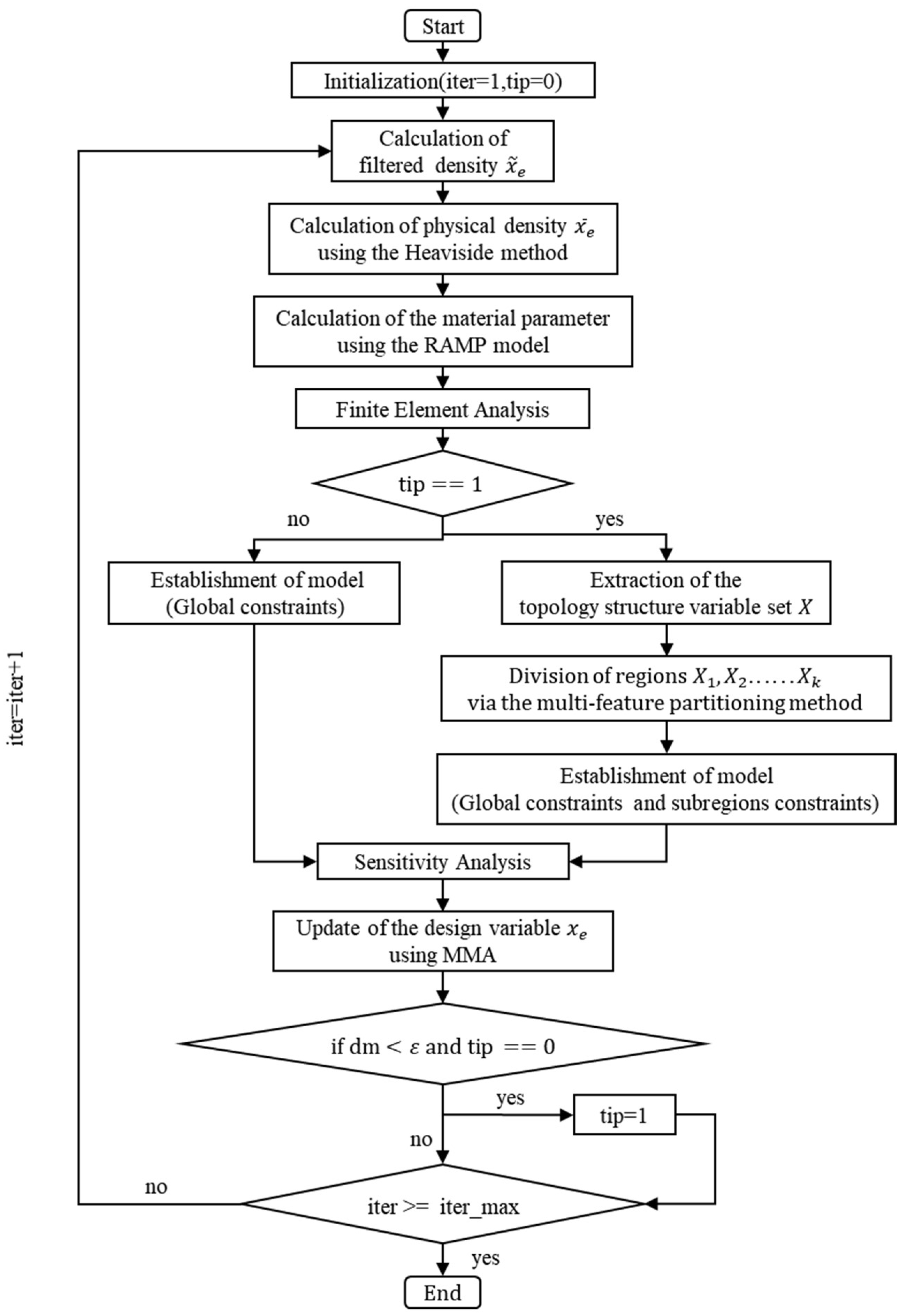
This section systematically integrates the topology optimization mathematical model, sensitivity analysis method, and multi-feature partitioning strategy constructed earlier, forming the final partitioned topology optimization method for the aero-engine rear cooling plate based on the multi-feature K-means algorithm, which is shown in Figure 2. The specific flow of this method is as follows:
(1)
Initialization: Discretize the initial model into finite elements, assign initial values to the elements density x e in the design domain, set the number of iterations iter to 1, create a parameter tip to determine whether to perform partitioning, and set its initial value to 0.
(2)
Density filtering: Filter the element design variables x e to obtain the element filtered density x ˜ e .
(3)
Density mapping: Project the filtered density x ˜ e using the Heaviside method to obtain the physical density x ¯ e .
(4)
Material interpolation: Calculate the material parameters using the RAMP model.
(5)
Finite element analysis: Calculate nodal displacements and other parameters.
(6)
Determine whether to perform partitioning: If tip = 1, construct the multi-feature partitioning topology optimization model; if tip = 0, construct the global maximum stress-constrained topology optimization model.
(7)
Construct the topology optimization model: If tip = 0, create a global maximum stress-constrained topology optimization model and establish global stress constraints; if tip = 1, create the multi-feature partitioning topology optimization model according to the following steps:
  • Extract the topological structure: Set the weight parameters of the K-means algorithm to [0.1, 0.9, 0], take density as the dominant classification criterion to distinguish the topological structure from the blank area, and obtain the topological structure variable set X .
  • Multi-feature partitioning: Set the weight parameters of the K-means algorithm to [0.55, 0.2, 0.25], take stress characteristics as the dominant factor, and consider element density and geometric position characteristics simultaneously to divide the topological structure into k sub-domains X 1 , X 2 X k .
  • Create the multi-feature partitioning topology optimization model: On the basis of global stress constraints, add stress constraint conditions for each sub-domain.
(8)
Sensitivity analysis: Calculate the derivative information of the mass fraction with respect to the design variables.
(9)
Optimization solution: Update the design variables using the MMA based on the solution results.
(10)
Determine whether the partitioning condition is satisfied: If the current mass fraction change rate d m meets the preset threshold ε , update the value of the parameter tip to 1. Starting from the next cycle, multi-feature partitioning topology optimization will be performed.
(11)
Determine whether the maximum iteration step has been reached: If the maximum iteration step is reached, terminate the optimization; otherwise, update the iteration step and proceed to the next iteration.

5. Results and Discussion

This section takes the axisymmetric model of the aero-engine rear cooling plate as an example to study the mass minimization problem under partitioned stress constraints. In Section 5.1, the axisymmetric model and boundary conditions of the aero-engine rear cooling plate are constructed; in Section 5.2, the influence of the number of partitions on the results of our method is studied, and the appropriate partition parameters are selected through comparison. Section 5.3 verifies the effectiveness of the proposed partitioned topology optimization method for the rear cooling plate based on the multi-feature K-means algorithm; then, in Section 5.4, the influences of allowable stress on the optimization results of the rear cooling plate are discussed.

5.1. Rear Cooling Plate Model and Optimization Settings

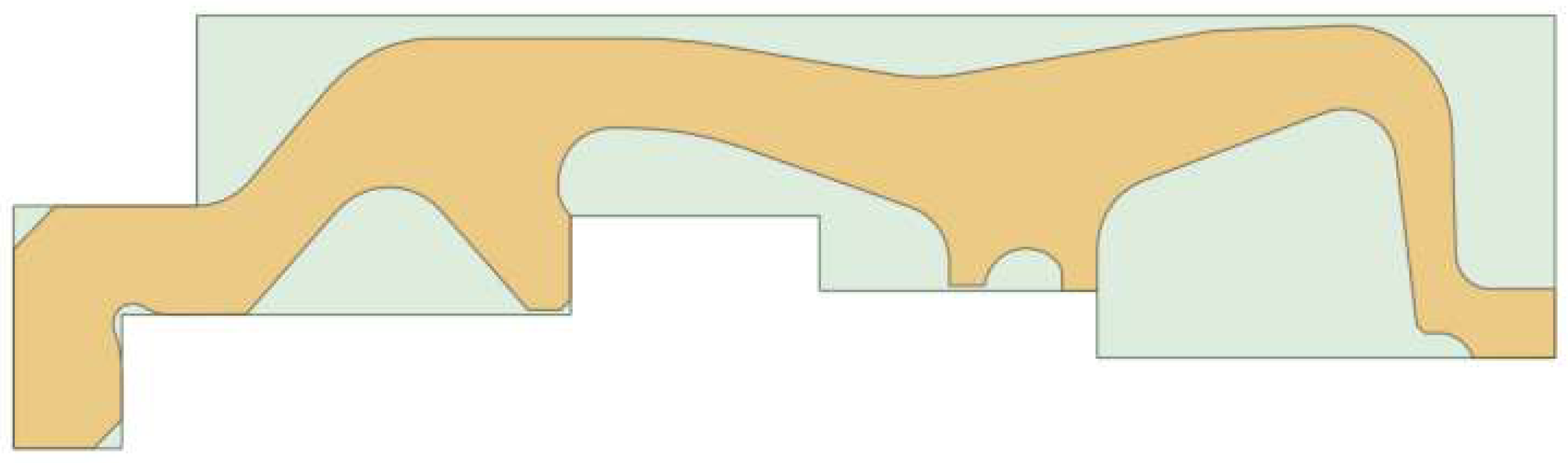
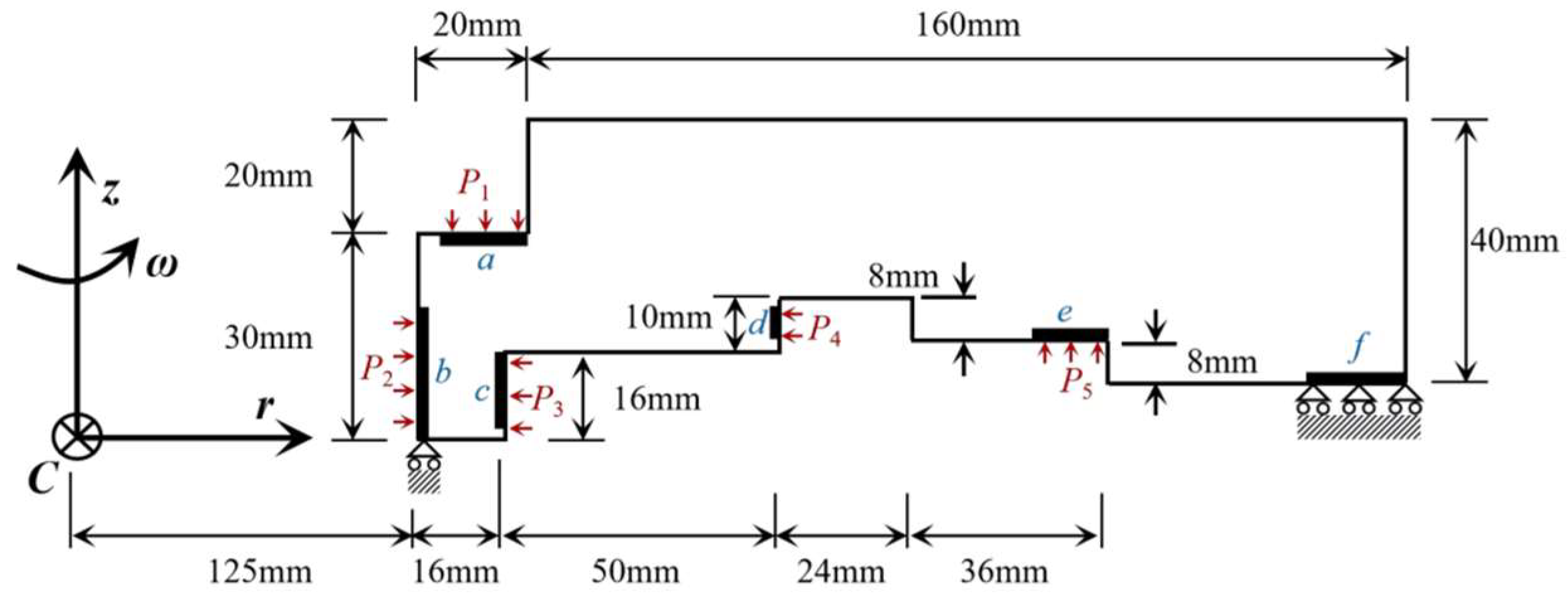
The core function of the aero-engine rear cooling plate structure is to achieve the axial positioning of the turbine disk. Its loads mainly include centrifugal loads generated by high-speed rotation, contact loads exerted by other components of the turbine system and interference fits. The rear cooling plate can be classified into bolted and boltless types according to the connection method. The boltless rear cooling plate can avoid problems such as stress concentration, complicated assembly, and insufficient structural reliability caused by bolted connections, and has been widely used in the current aero-engine engineering field. The original model of the rear cooling plate has a relatively complex geometric shape, making its analysis and design difficult and inefficient, and it is not suitable for direct application in topology optimization. During the design phase, this paper establishes a 2D axisymmetric model of the boltless rear cooling plate as shown in Figure 3 based on the original model to expand the design space and improve the optimization effect. For the model of the rear cooling plate, the material properties are set as follows: elastic modulus E = 2.1 × 10 5   MPa , density ρ = 8450   kg / m 3 , and Poisson’s ratio μ = 0.3 . The selected element type is a 4-node axisymmetric rectangular element with an element size of 0.5 mm. Figure 4 details the geometric dimension parameters and boundary conditions of the 2D axisymmetric model of the aero-engine rear cooling plate in the cylindrical coordinate system, where r and z represent the radial and axial directions of the rear cooling plate, respectively. Unless otherwise specified, all length units in this paper are in millimeters (mm). Contact loads P1, P2, P3, P4, P5 are applied at contact positions a, b, c, d, e, respectively, and axial displacement constraints are set at position f and the lower left area of the rear cooling plate as blade support locations. The blank area in the figure is the design domain, and the black area is the non-design domain. The area parameters of the non-design domain are shown in Table 1 and Table 2, listing the contact load parameters of the rear cooling plate. ω represents the rotational speed of the rear cooling plate, which is set to 10,000 r/min in this paper.
MMA is adopted for the optimization solution in this paper. The initial value of the design variable is set to 0.5, and the design variable movement limit in the MMA algorithm is configured as 0.05. With the progress of optimization iterations, the Heaviside parameter value in the physical density gradually increases from 4 to 16, while the Heaviside parameter value β H in the predicted density gradually rises from 4 to 20. In the maximum stress prediction method, the threshold value of the transition factor is set to 0.9, the minimum filter radius is set to 4 mm, and ε is set to 1.5 × 10⁻⁴. The maximum allowable stress of the rear cooling plate is 1000 MPa. The maximum number of iterations is set to 300.

5.2. Influence of the Number of Partitions

The results of K-means clustering are significantly affected by the predefined number of clusters k. As a fixed value determined in advance for the K-means algorithm, an excessively small k will force data that should be separated by distinct feature differences into the same cluster. This leads to overly generalized clustering results, making it difficult to fully reflect the true internal structure of the data. Conversely, an excessively large k may over-segment data that inherently belongs to the same cluster. This not only reduces the stability and interpretability of the clustering results but also significantly increases unnecessary computational costs, impairing algorithm efficiency. This section investigates the clustering results and topology optimization outcomes under different numbers of clusters k.
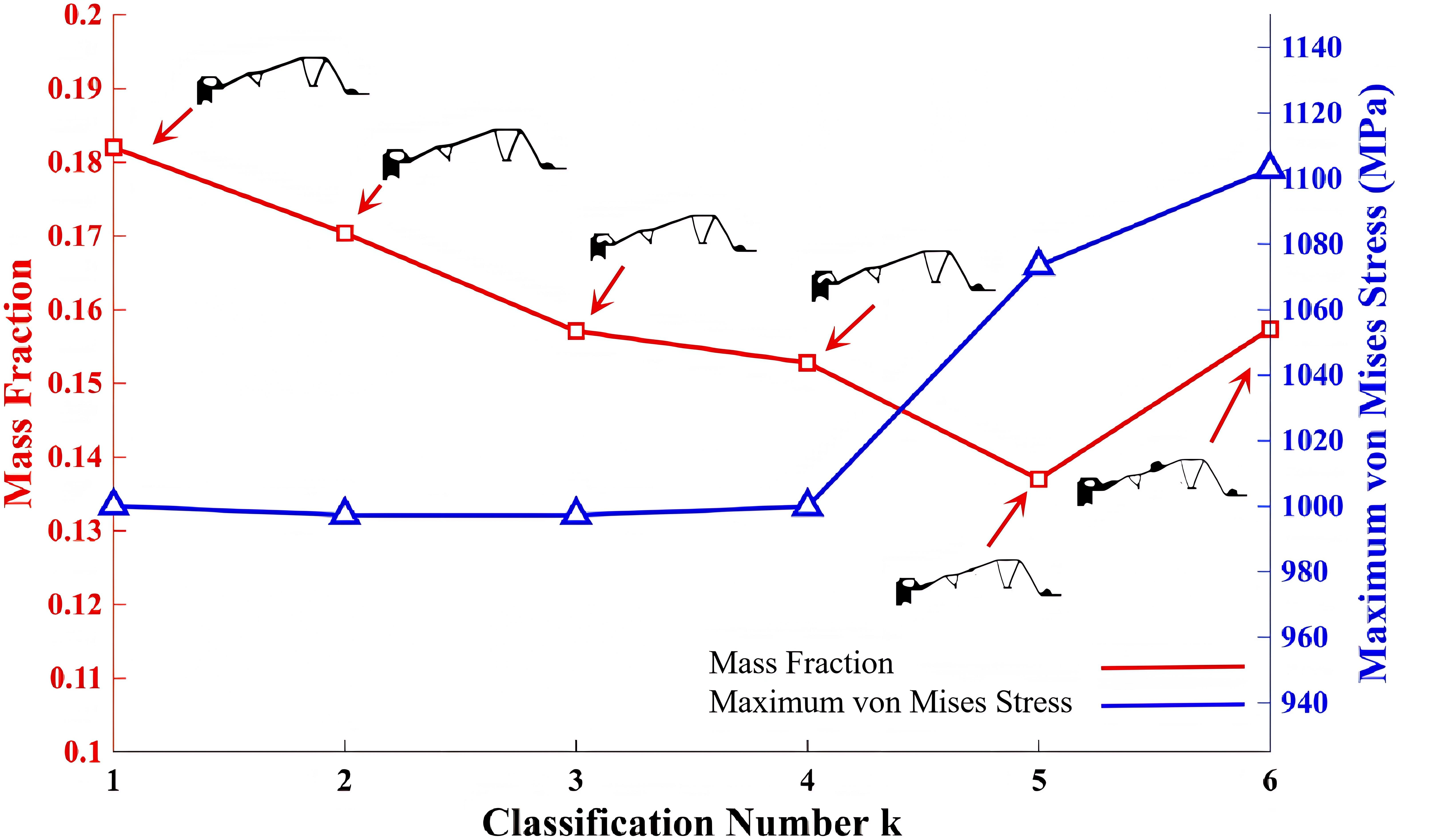
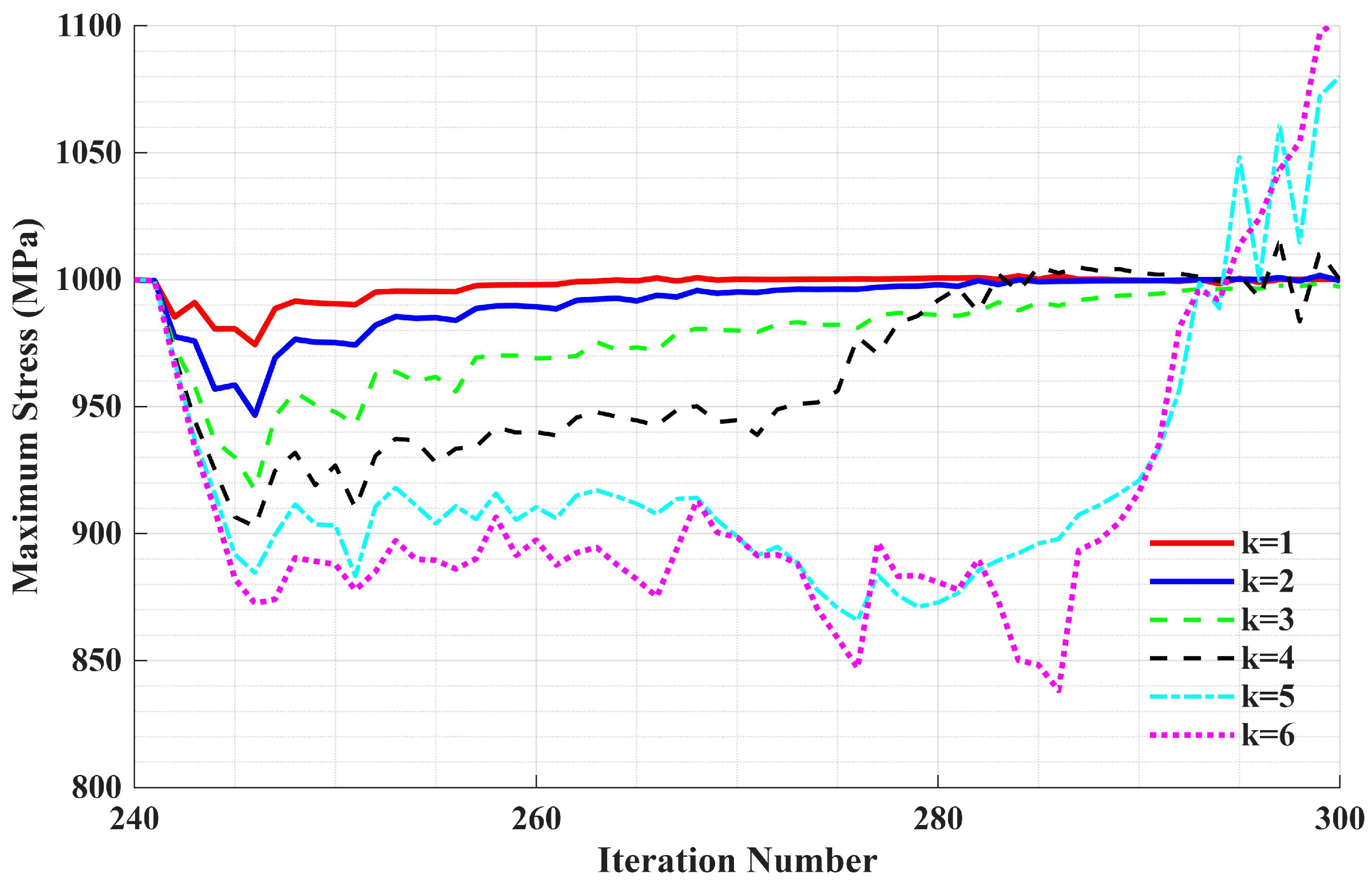
Figure 5 shows the optimized topological configurations, mass fractions, and maximum stress under different numbers of partitions. The mass fraction is defined as the ratio of the optimized structural mass to the total mass of the initial design domain under full material filling. The reference value is the total mass when the design domain is completely filled with solid material, which is considered to be 100%. When k = 2~4, the mass fraction of the optimized structure continuously decreases from 0.182 to 0.153, and the lightweight effect is significantly improved, while the maximum stress remains around 1000 MPa. However, when the k value is excessively large (k > 4), the mass fraction of the obtained topological structure increases instead. When k = 6, the mass fraction rises to 0.157, and the clarity of the topological boundaries is reduced. Figure 6 presents the maximum stress iteration curves under different numbers of partitions. It can be seen from the figure that when the k value is too large, deviations occur in the control of the maximum stress. The maximum stress of the structure gradually increases with the increase in the k value, reaching 1102.9 MPa at k = 6 with an error of 10.29%. Meanwhile, the convergence of the solution process deteriorates significantly, and both the stress fluctuation range and the number of iterative convergence steps increase substantially.
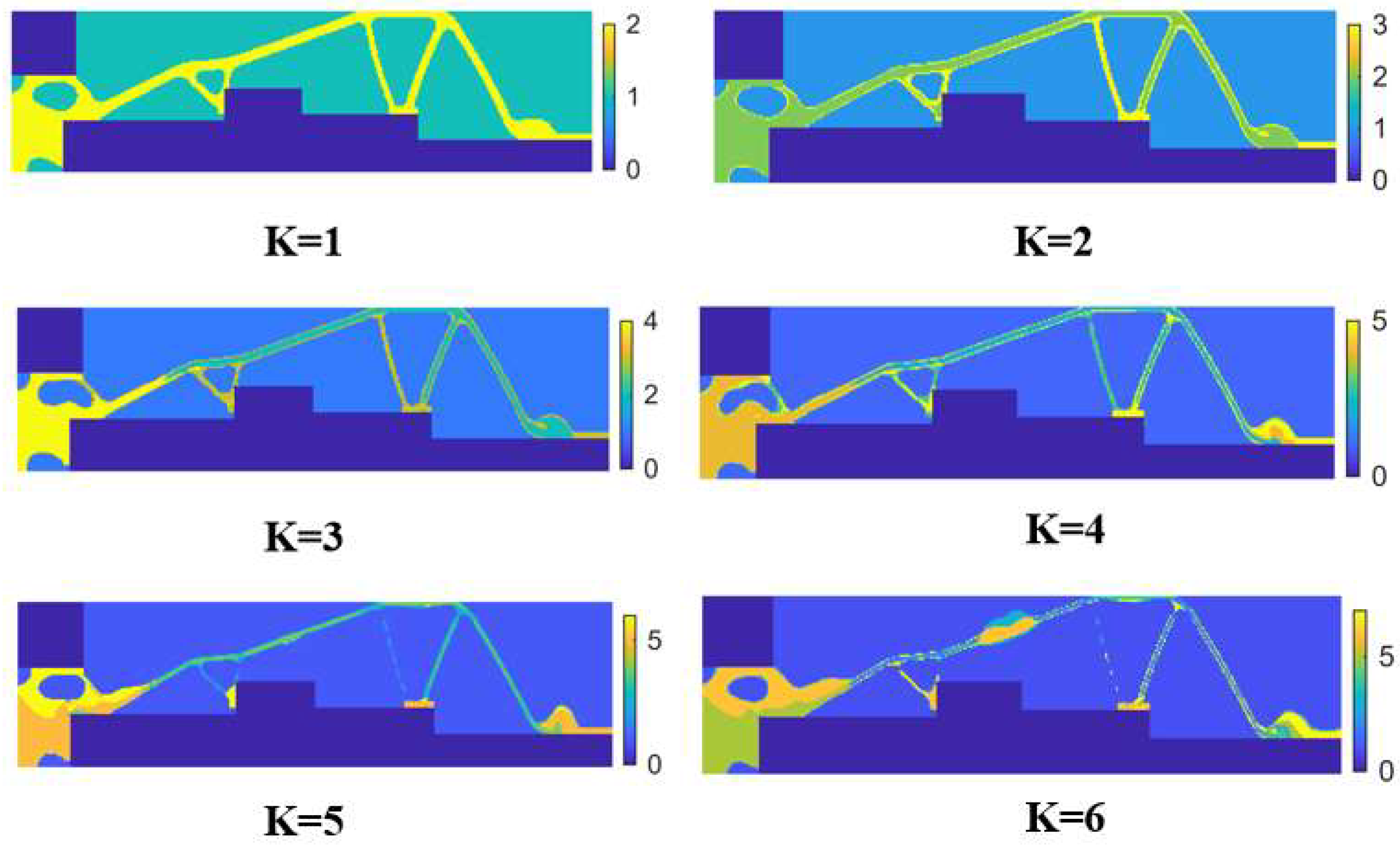
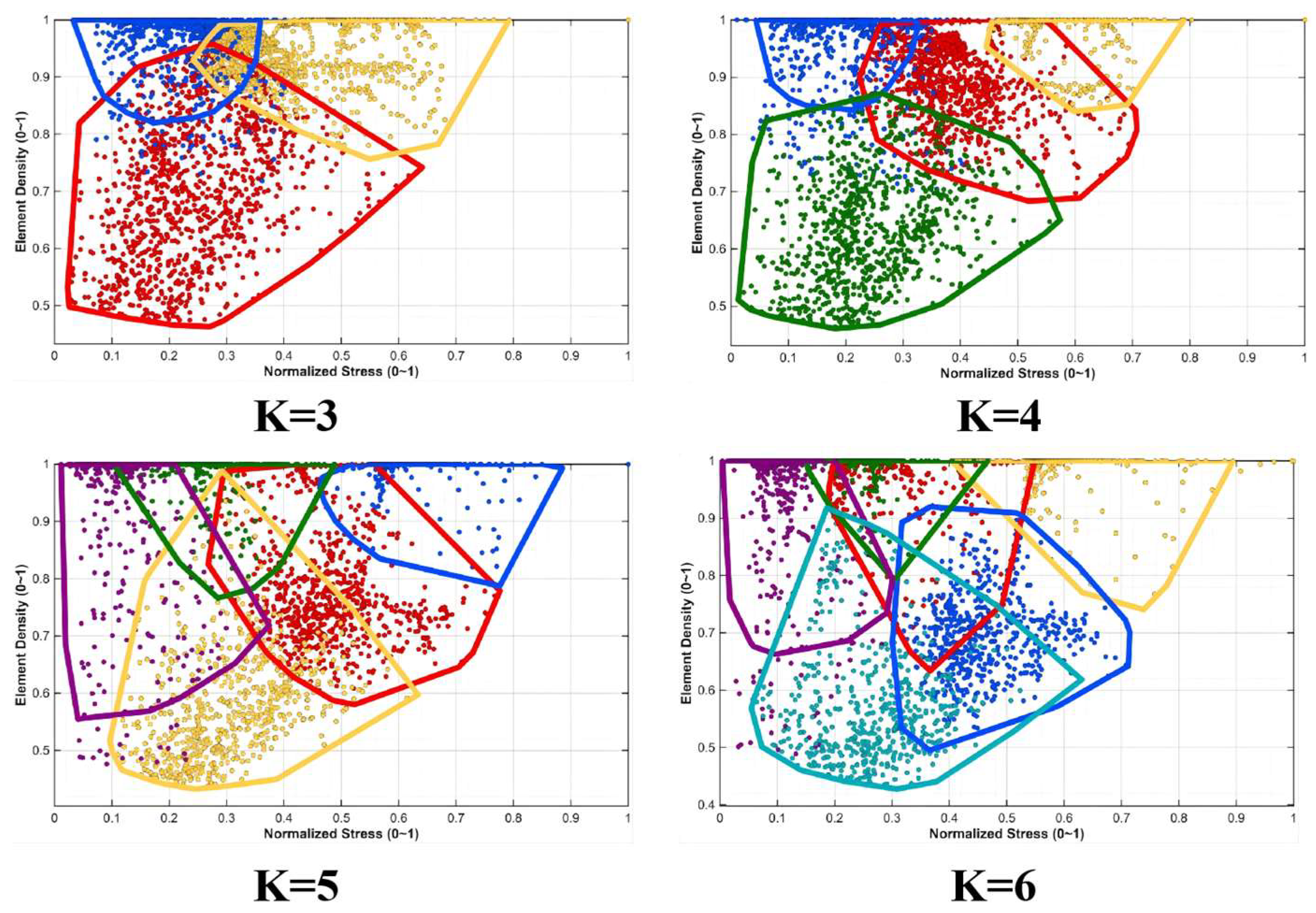
Figure 7 shows the distribution characteristics of sub-domains in the topological configuration under different numbers of partitions. The different numerical values represented by the color of the color bar in the figure correspond to the number of each sub-domain. It can be observed that as the number of partitions k increases, the element classification is gradually refined. When k = 2~4, the divided sub-domains exhibit significant differences, and the spatial distribution within each sub-domain is relatively continuous. However, when the k value is excessively large, the geometric distribution differences between sub-domains tend to blur, and the internal structure of each sub-domain also shows a spatial discretization trend. Figure 8 presents the normalized stress and density distribution characteristics of sub-domains in the topological configuration under different numbers of partitions. Each scatter point in the figure represents a design domain element, and the color of the scatter point indicates the sub-domain to which the element belongs. When k = 3 and k = 4, each sub-domain shows distinct regionalization in terms of stress and density distribution. As the k value increases, the distinguishability of the classification results gradually decreases.
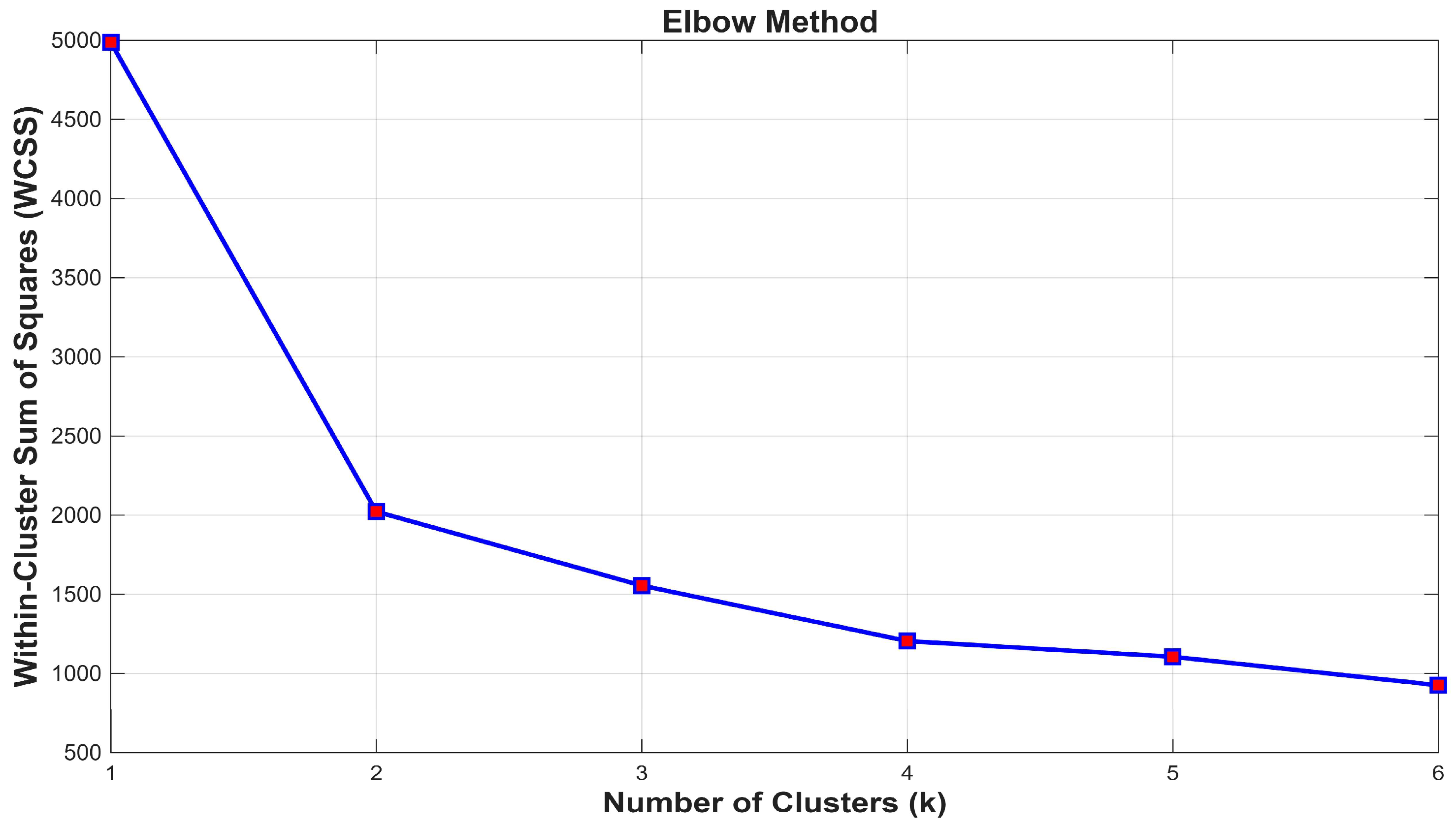
In addition, to reasonably select the optimal k value, various evaluation methods can be adopted to quantitatively assess the classification performance for the current k, such as the silhouette coefficient method, Akaike information criterion (AIC), etc. These methods measure the compactness of clustering results and the separation between different clusters through different statistical or geometric indicators, thereby assisting in determining the clustering number k that best matches the data structure. Compared with other methods, the elbow method has the advantages of simple principle and wide applicability. This method screens the optimal value by calculating the within-cluster sum of squares (WCSS) under different k values. Theoretically, as k increases, the WCSS value will gradually decrease. When the WCSS changes from a significant decline to a slow decline, it means that further increasing the number of clusters has little effect on reducing intra-cluster differences, and the corresponding k at this point is the optimal clustering number. The elbow method is employed to quantitatively evaluate the clustering number k in this paper, and the final elbow plot (Figure 9) is shown as follows: it can be observed that the trend of the elbow plot curve changes from a sharp decline to a gentle decline at k = 2~4, so k = 2~4 is determined as the optimal range of clusters.
In summary, the selection of the number of partitions k needs to balance the lightweight effect and solution stability, and must be controlled within a reasonable range to achieve a balance of optimization performance. Based on the results of this paper, the number of partitions k is finally selected as 3.

5.3. Performance of the Partitioned Topology Optimization Method Based on Multi-Feature K-Means Algorithm

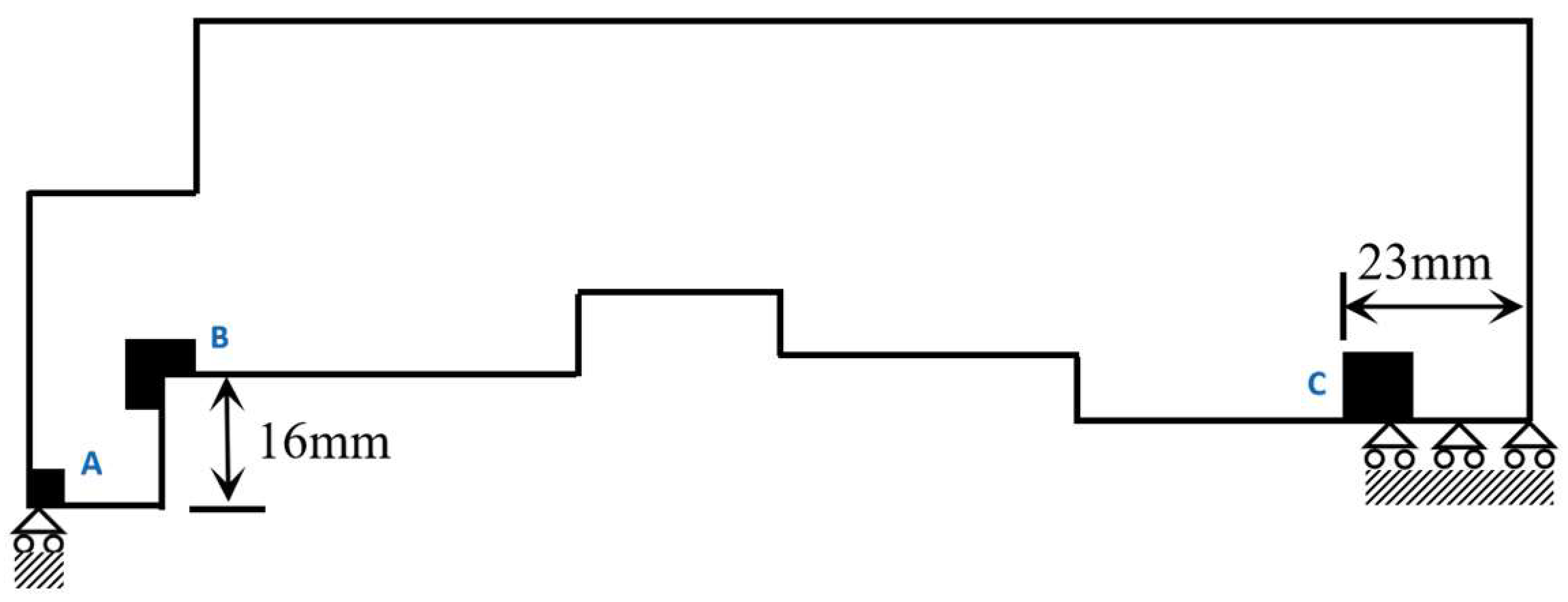
To verify the effectiveness of the partitioned topology optimization method based on the multi-feature K-means algorithm proposed in this paper for structural lightweight design, three stress-constrained topology optimization methods are selected for comparative analysis: the first one is the traditional global stress-constrained topology optimization method; the second one is the topology optimization method considering both the geometric partitioned stress constraints and global stress constraints; the third one is the partitioned stress-constrained topology optimization method based on the multi-feature K-means algorithm. The geometric partitioned stress constraints method predefines fixed regions based on the geometric features of the rear cooling plate (such as load application points and support structure boundaries) and stress distribution, and only imposes targeted stress constraints on the preset key load-bearing regions without considering the dynamic changes of stress distribution during the optimization process. In this paper, the key regions are set according to the initial stress distribution. As shown in Figure 10, region A has an area of 5 mm × 5 mm; region B is a square with a corner missing, with an area of 10 mm × 10 mm − 5 mm × 5 mm = 75 mm2; region C has an area of 10 mm × 10 mm; and the maximum allowable stress for all regions is 1000 MPa.
Table 3 presents the optimization results of the three topology optimization methods, including the structural mass fraction after optimization by each method, the improvement effect of the mass fraction relative to the original design, as well as the maximum stress of the optimized structure and the error of the maximum stress.
The final stress-constrained topology optimization results obtained by the three topology optimization methods are as follows: the maximum stress of the final structure achieved by the multi-feature partitioning topology optimization method based on K-means is 999.9 MPa, with the error controlled within 1%, and the final structural mass fraction is 0.157. The mass fraction of the original design of the rear cooling plate (Figure 3) is 0.485, and the mass fraction is relatively reduced by 67.6% compared with the original design. In addition, this mass fraction is relatively reduced by 13.7% compared with the global stress constraint method, and 11.3% compared with the topology optimization method considering both geometric partitioned stress constraints and global stress constraints. This result fully verifies the effectiveness of the proposed method in enhancing the lightweight performance of the structure.
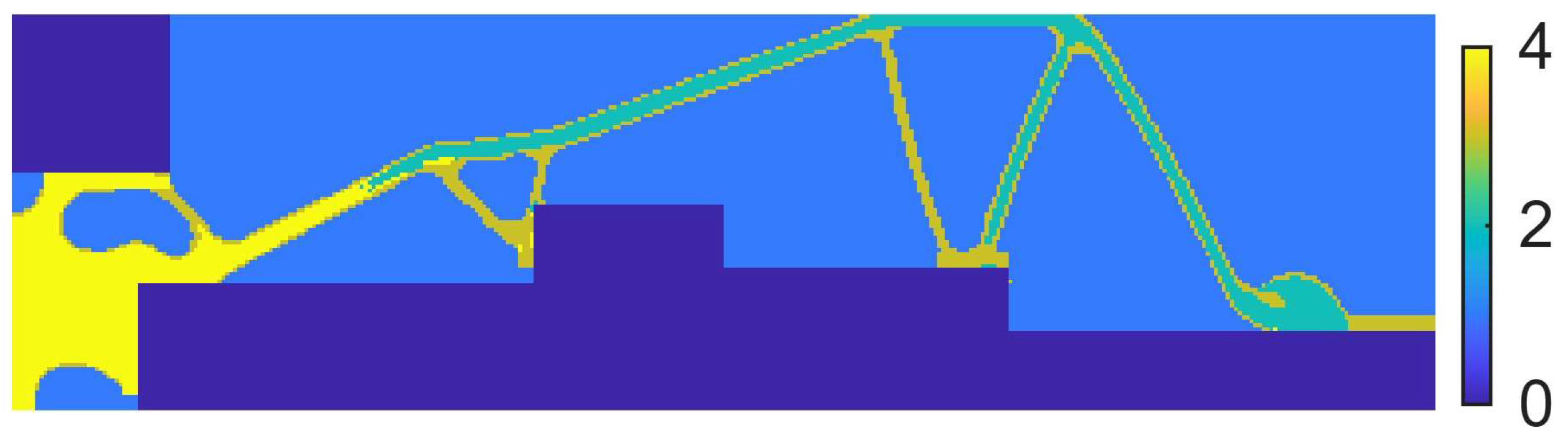
Figure 11 illustrates the spatial distribution of sub-domains in the multi-feature partitioning topology optimization. It can be observed that the K-means algorithm accurately identifies the areas around the left holes of the rear cooling plate and parts of the low-stress bracket regions as low-stress areas (indicated in ochre). Targeted optimization is implemented for these low-stress areas, resulting in a more reasonable material distribution compared with the global stress constraint method and the topology optimization method considering both the geometric partitioned stress constraints and global stress constraints. This indicates that the partitioned topology optimization method based on K-means fully leverages the differences between elements, releases the lightweight potential of the structure, and ultimately achieves a better weight reduction effect than the other two methods.
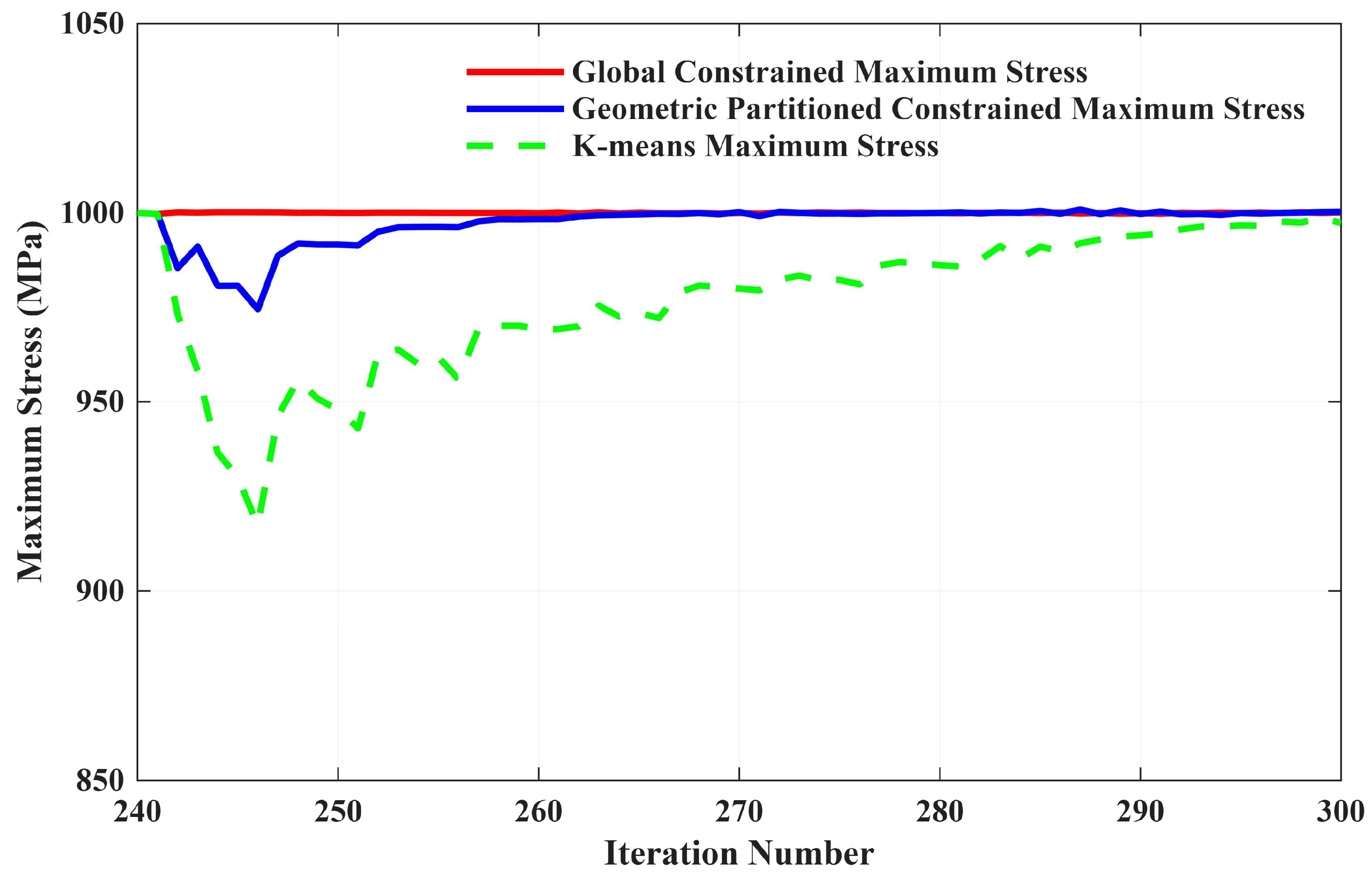
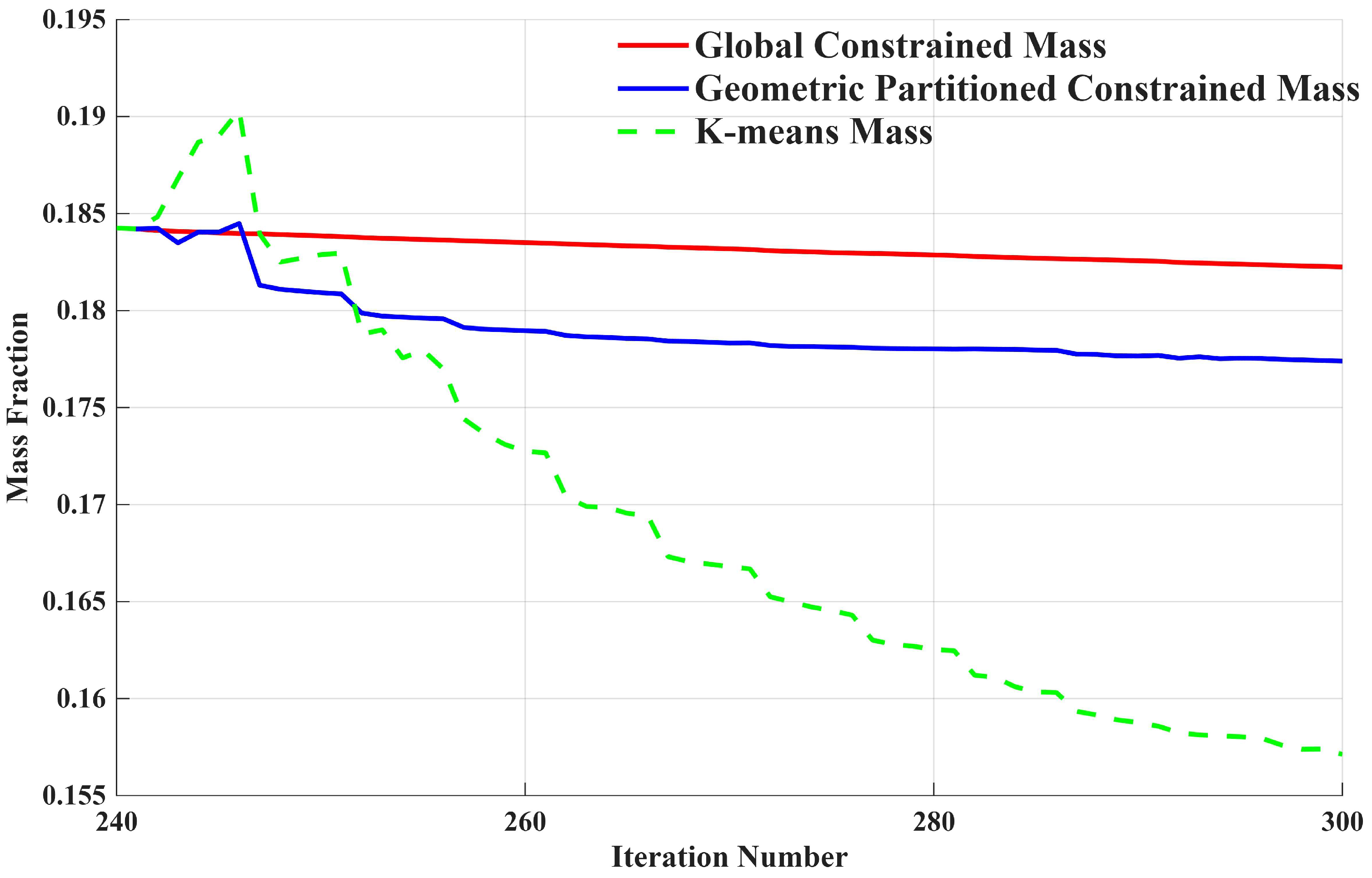
The iteration curves of the maximum stress and structural mass fraction during the topology optimization process of the three methods after entering the partitioned constraint topology optimization phase are shown in Figure 12 and Figure 13. It can be observed that the maximum stress under the global maximum stress constraint method remains constant at 1000 MPa, indicating that this method has entered a convergent saturation state and can no longer tap into further lightweight potential. In contrast, the mass fractions of both the topology optimization method considering both the geometric partitioned stress constraints and global stress constraints and the partitioned topology optimization method based on the multi-feature K-means algorithm continue to decrease during this phase, demonstrating that both methods possess the ability to further expand the solution space. Among them, the iteration curves of the mass fraction and maximum stress of the partitioned topology optimization method based on the multi-feature K-means algorithm exhibit a more significant variation range. Additionally, the convergence node of this method is later than that of the topology optimization method considering both the geometric partitioned stress constraints and global stress constraints. This characteristic fully confirms that the proposed method excels at tapping into lightweight potential compared to the topology optimization method considering both the geometric partitioned stress constraints and global stress constraints. It can more fully release the structural weight reduction potential and enhance the lightweight effect.
To verify the computational efficiency of the proposed multi-feature partitioning method, comparative numerical experiments are conducted on a standard topology optimization example. The global stress constraint method, the topology optimization method considering both geometric partitioned stress constraints and global stress constraints, and the multi-feature partitioning topology optimization method based on K-means are used to perform 300 iterations of optimization. All numerical simulations in this paper are performed on a desktop workstation using MATLAB (2025b) with the following hardware configuration: 13th Gen Intel Core i7-13700 processor (base frequency 2.10 GHz), 32 GB DDR4 RAM (3200 MT/s), 64-bit Windows operating system. All computations are completed only by CPU without GPU acceleration. The detailed computational cost is listed in Table 4 below.
The results show that the average time per iteration of the multi-feature partitioning topology optimization method based on K-means is 0.84 s, which is 0.17 s higher than that of the global stress constraint method and 0.11 s higher than that of the topology optimization method considering both geometric partitioned stress constraints and global stress constraints. The increment is generally controllable and within an acceptable range. The extra time consumption mainly comes from the precise prediction and control method of partitioned stress and the multi-feature K-means clustering process, which is a necessary cost to achieve finer regional division and higher-precision stress constraints. Overall, the proposed method significantly improves the stress constraint effect and optimization performance with only a limited increase in computational cost, demonstrating good engineering practicability.

5.4. Influence of Allowable Stress

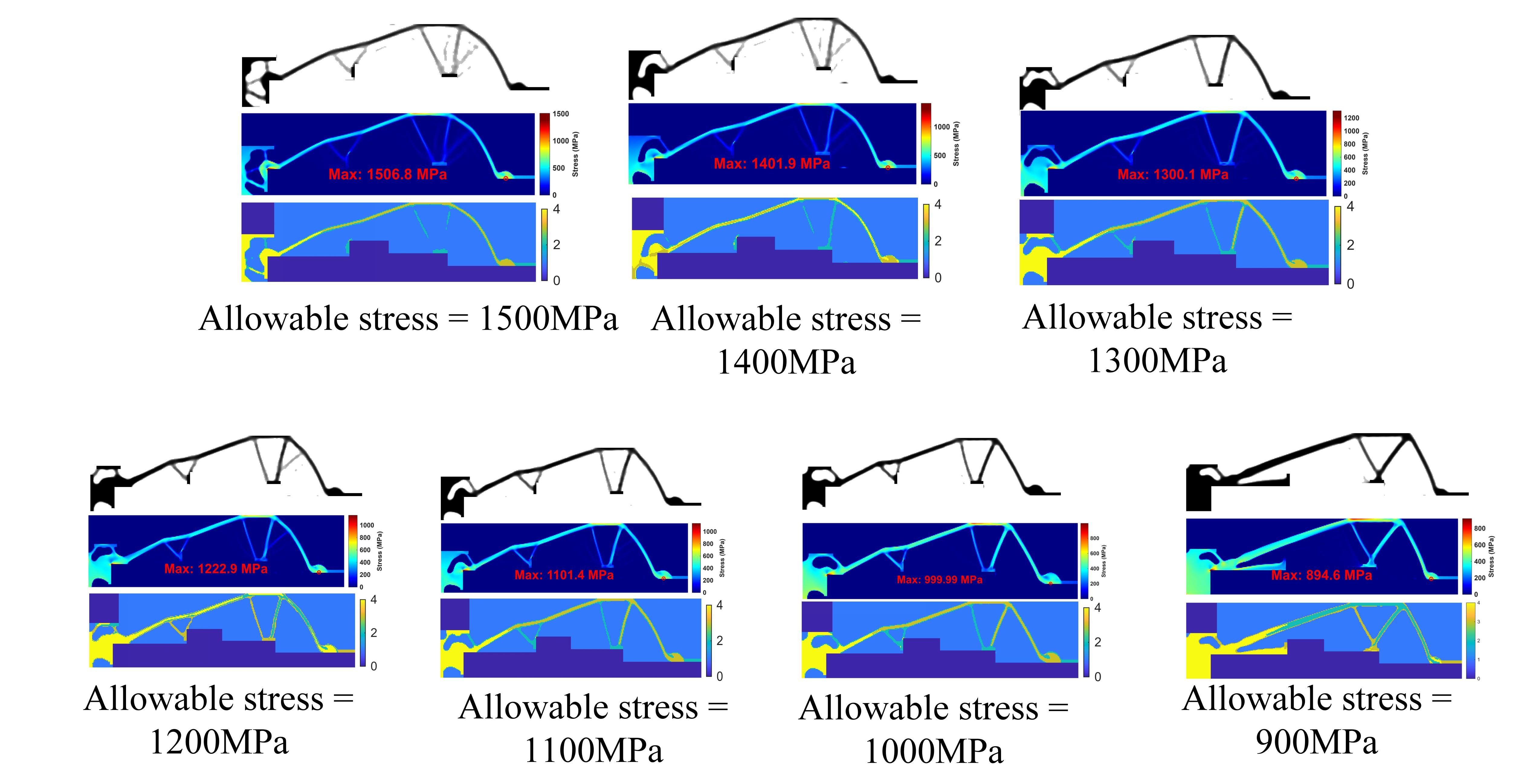
As a core constraint parameter in structural design, the value of allowable stress directly determines the mass distribution strategy of the rear cooling plate and has a crucial impact on its topology optimization results. Taking 100 MPa as the gradient interval, this paper studies the topology optimization results under the operating conditions where the allowable stress gradually decreases from 1500 MPa to 900 MPa, providing data support for balancing safety performance and lightweight goals in engineering design.
Figure 14 shows the topology optimization results under different allowable stresses, and Table 5 presents the mass fractions of the rear cooling plate’s topology optimization results at various allowable stresses. It can be observed from them that (1) as the allowable stress constraints gradually become stricter (gradually decreasing from 1500 MPa to 900 MPa), the mass fraction obtained by topology optimization shows a generally significant increasing trend, indicating that the material usage of the structure gradually increases, and the overall safety margin and bearing reliability are correspondingly improved. (2) Under stricter allowable stress constraints, the cross-sectional dimensions of the remaining load-bearing branches increase, and the structural force transmission path becomes clearer and more concentrated, which can better adapt to the mechanical transmission requirements and stability requirements under harsh stress constraints. (3) Strict allowable stress constraints promote the redistribution of materials and their further aggregation toward high-stress load-bearing regions, and the proportion of intermediate-density elements in the topological structure is significantly reduced at the same time.

6. Conclusions

To address the conflict between lightweight design and strength reliability in the topology optimization of aero-engine rear cooling plates, this paper presents a partitioned topology optimization method based on the multi-feature K-means algorithm. The proposed method achieves accurate maximum stress control while improving structural lightweight performance. First, the multi-feature K-means algorithm is adopted to dynamically repartition the design domain during iterations. Second, the p-norm function is used to aggregate the stress of each partition, and combined with a partitioned stress prediction and control method, the local stress control accuracy is improved with high optimization efficiency. On this basis, a topology optimization model considering multi-feature partitioned stress constraints is constructed. The adjoint method is then used to derive the stress sensitivity under centrifugal loads, enhancing the convergence and numerical stability of the optimization. Finally, the effectiveness of the method is verified through the topology optimization of the aero-engine rear cooling plate.
(1)
In the process of partitioned topology optimization, the selection of the number of partitions k has a significant impact on the optimization effect of the aero-engine rear cooling plate. An excessively small or excessively large number of partitions will affect the lightweight effect, stress control precision and iterative solution stability. To balance the structural lightweight potential and the convergence of the optimization process, achieve precise control of local stress and a clear configuration of topological boundaries, the reasonable range of the number of partitions in the rear cooling plate example of this paper is k = 2~4, and the final number of partitions selected in this paper is 3.
(2)
The proposed K-means based multi-feature partitioning method obtains a mass fraction of 0.157, with a maximum stress of 999.9 MPa and stress error within 1%. Compared with the original design, the mass fraction is reduced by 67.6%; it is reduced by 13.7% versus the global stress constraint method and 11.3% versus the geometric partitioned plus global stress method. These results validate the effectiveness of the proposed method in improving structural lightweight performance.
(3)
As a core design parameter, allowable stress directly affects the final mass and safety margin of the structure. As the allowable stress constraints gradually become stricter, to ensure the structural bearing reliability, the material usage increases correspondingly, and the mass fraction of the topology-optimized structure shows a significant overall increasing trend; meanwhile, the strict stress constraints promote the aggregation of materials toward high-stress load-bearing regions, leading to increased cross-sectional dimensions of the remaining load-bearing branches and clearer force transmission paths.
In the future, the proposed method can be further extended to 3D structures by replacing 2D finite elements with 3D solid elements. Since the multi-feature clustering algorithm and partitioned stress aggregation only involve the calculation and processing of element attributes such as element stress, density, and spatial position, but not the specific dimension of the finite element itself, the core ideas of multi-feature clustering and partitioned stress aggregation can still be directly adopted when the finite element model is replaced with 3D finite element. In addition, the framework can be extended to thermo-mechanical coupling conditions by introducing thermo-mechanical coupling finite element analysis, considering temperature-dependent material properties, and taking temperature as a new clustering feature to establish an adaptive element partitioning method suitable for temperature gradient environments, thus providing a feasible scheme for the lightweight design of aero-engine components under thermo-mechanical coupling loads.
In summary, the method proposed in this paper provides a new idea and technical path for the high-performance design of aero-engine rear cooling plates, and its core idea and technical framework can be further extended to the topology optimization design of other complex load-bearing structures in aerospace, such as turbine disks, blades, and brackets, which has important engineering application value and theoretical guiding significance for promoting the development of aerospace equipment towards lightweight, high reliability, and long service life.

Author Contributions

Conceptualization, H.C. and J.J.; methodology, H.C. and J.J.; software, H.C. and L.Z.; validation, D.M. and H.G.; investigation, S.A.; writing—original draft preparation, J.J.; writing—review and editing, H.C., H.G., S.A. and D.M.; visualization, L.Z., S.A. and D.M.; supervision, L.Z. and H.G.; funding acquisition, H.C. All authors have read and agreed to the published version of the manuscript.

Funding

This research was funded by the National Natural Science Foundation of China, grant number 52475285; the AECC Independent Innovation Special Fund, grant number ZZCX-2018-017; the Fujan Provincial Natural Science Foundation of China, grant number 2025J09012; and the Fundamental Research Funds for the Central Universities, grant number 20720240062.

Data Availability Statement

The data presented in this study are available on request from the corresponding author.

Conflicts of Interest

Authors Huanhuan Chen, Lizhang Zhang, Dong Mi and Shumin Ai were employed by the company AECC Hunan Aviation Powerplant Research Institute. The remaining authors declare that the research was conducted in the absence of any commercial or financial relationships that could be construed as a potential conflict of interest.

Appendix A

Appendix A.1. Density Filtering Method

As the most widely used approach in the field of topology optimization, the variable density method features advantages such as flexible modeling, convenient implementation, and high computational efficiency. It can effectively address the problem of material distribution within complex design domains. When the variable density method is adopted for structural topology optimization, the optimization results are often accompanied by numerical instabilities, including checkerboard patterns, mesh dependency and gray-scale regions, which cause the final topology to be inconsistent with actual physical laws and thus difficult to meet engineering manufacturing requirements. To effectively suppress such numerical instabilities, this paper introduces the density filtering method [51] to solve the aforementioned problems.
The core principle of the density filtering method is to perform a weighted average of the design variables of all elements within the filtering radius, thereby achieving the smoothing of design variables, eliminating local numerical oscillations, and improving the numerical stability of topology optimization results. The expression of the density filtering method is given as follows:
x ˜ e = i N e w x i v i x i i N e w x i v i
where v i denotes the volume of the i-th element, x i denotes the density of the i-th element, and x ˜ e denotes the filtered density of the e-th element. w is the weight function representing the influence of the i-th element on the e-th element, and its calculation method is given as follows:
w x i = max ( 0 , r min c i c e 2 )
where r min is the given filtering radius, c i is the central position of the i-th element, and c e is the central position of the e-th element.

Appendix A.2. Material Interpolation Model

A key step in the variable density method is to use material interpolation models to establish the relationship between element properties and material properties, such as the elastic modulus and thermal conductivity. Currently, the most commonly used material interpolation models mainly include the SIMP (Solid Isotropic Microstructure with Penalization) model and the RAMP [52,53,54] (Rational Approximation of Material Properties) model. When the SIMP model is applied to structural topology optimization problems involving design-related loads such as centrifugal loads, thermal loads, and surface pressure loads, elements in low-density regions still retain relatively high stiffness, which tends to induce the material attachment effect in these regions during the optimization process, meaning that elements there cannot be effectively removed. In contrast, the RAMP model can effectively circumvent this issue. Given that centrifugal loads are critical loads that must be considered in the structural design of aero-engine rear cooling plates, this paper adopts the RAMP model as the material interpolation model. The expression of the RAMP model is given as follows:
f x ¯ e = x ¯ e 1 + q 1 x ¯ e
where q is the penalty factor of the RAMP model; the larger the value of q, the stronger the penalty imposed on intermediate-density elements. Taking the calculation of the element elastic modulus as an example, the calculation expression is given as follows:
E x ¯ e = E min + x ¯ e 1 + q c 1 x ¯ e E max E min
where E max is the elastic modulus of the material, E min ( = 10 6 E max ) is a small value introduced to avoid matrix singularity, and q c is the stiffness penalty factor.

References

  1. Yan, C.; Guo, H.; Pei, B.; Liu, H.; Chen, Y.; Wang, C.; Yin, Z. Concurrent optimization of building direction and structural topology for multi-axis additive manufacturing of rotary parts considering anisotropic strength. Addit. Manuf. 2025, 109, 104851. [Google Scholar]
  2. Mao, J.; Wu, X.; Si, W.; Zhang, X.; Pan, J.; Wu, C.; Hu, D.; Wang, R. Recognition and quantification of polymorphic wrinkles based on FR-GAN in resin-based composite blade. Compos. Struct. 2026, 381, 120031. [Google Scholar]
  3. Fei, C.W.; Li, C.; Lin, J.Y.; Han, Y.J.; Choy, Y.S.; Chen, C.H. Structural design of aeroengine radiators: State of the art and perspectives. Propuls. Power Res. 2024, 13, 319–334. [Google Scholar] [CrossRef]
  4. Fei, C.W.; Han, Y.J.; Wen, J.R.; Li, C.; Han, L.; Choy, Y.S. Deep learning-based modeling method for probabilistic LCF life prediction of turbine blisk. Propuls. Power Res. 2024, 13, 12–25. [Google Scholar] [CrossRef]
  5. Kubíčková, L.; Gebouský, O.; Haidl, J.; Isoz, M. Accelerating shape optimization by deep neural networks with on-the-fly determined architecture. Appl. Soft Comput. 2026, 192, 114800. [Google Scholar] [CrossRef]
  6. Yang, S.; Zhu, X.; Yan, B.; Hou, F.; Li, J. The shape optimization of a mobile marine seismic acoustic buoy deflector. Ocean Eng. 2026, 356, 125291. [Google Scholar] [CrossRef]
  7. Song, Z.; Smriti; Natarajan, S.; Yu, T. Multi-patch isogeometric shape optimization of complex free-form surfaces with buckling constraints. Comput. Struct. 2026, 321, 108093. [Google Scholar] [CrossRef]
  8. Ma, Y.; Song, X.; Jia, Q.; Zhao, Y.; Lu, S. Isogeometric interval size optimization of beam structures. Comput. Methods Appl. Mech. Eng. 2022, 391, 115003. [Google Scholar] [CrossRef]
  9. Mešić, E.; Pervan, N.; Muminović, A.J.; Muminović, A.; Čolić, M. Development of knowledge-based engineering system for structural size optimization of external fixation device. Appl. Sci. 2021, 11, 10775. [Google Scholar] [CrossRef]
  10. Nam, V.T.; Ogawa, S.; Suzuki, K.; Kawamura, Y. Discrete material optimization approach for multi-material topology optimization of viscoelastic material for transient problem. Finite Elem. Anal. Des. 2026, 257, 104556. [Google Scholar] [CrossRef]
  11. Hirose, K.; Yamazaki, W.; Vengadesan, S. Investigation of thermal management in a differentially heated square cavity through topology optimization. Int. J. Heat Fluid Flow 2026, 120, 110365. [Google Scholar] [CrossRef]
  12. Shekhar, M.; Pillai, A.U.; De, S.; Rahaman, M.M. Level set-based topology optimization of micropolar solids under thermo-mechanical loading. Int. J. Mech. Sci. 2026, 318, 111547. [Google Scholar] [CrossRef]
  13. Bendsoe, M.P.; Kikuchi, N. Generating Optimal Topologies in Structural Design Using a Homogenization Method. Comput. Methods Appl. Mech. Eng. 1988, 71, 197–224. [Google Scholar] [CrossRef]
  14. Wan, C.D.; Jiao, H.Y.; Lv, L.; Lu, C.Y. Multi-material topology optimization based on multiple simp of variable density method. J. Mech. Sci. Technol. 2024, 38, 749–759. [Google Scholar] [CrossRef]
  15. Sigmund, O. A 99 line topology optimization code written in Matlab. Struct. Multidiscip. Optim. 2001, 21, 120–127. [Google Scholar] [CrossRef]
  16. Xu, T.; Wu, H.X.; Xue, F.; Guo, J.W.; Ran, J.Q.; Gong, F. Structural design of stamping die of advanced high-strength steel part for automobile based on topology optimization with variable density method. Int. J. Adv. Manuf. Technol. 2022, 121, 8115–8125. [Google Scholar] [CrossRef]
  17. Xie, Y.M.; Felicetti, P.; Tang, J.W.; Burry, M.C. Form finding for complex structures using evolutionary structural optimization method. Des. Stud. 2005, 26, 55–72. [Google Scholar] [CrossRef]
  18. Zhu, Q.Y.; Han, Q.K.; Liu, J.G. Topological optimization design on constrained layer damping treatment for vibration suppression of thin-walled structures via improved BESO method. Aerosp. Sci. Technol. 2023, 142, 108600. [Google Scholar] [CrossRef]
  19. Han, Y.S. Stress-based bi-directional evolutionary topology optimization for structures with multiple materials. Eng. Comput. 2024, 40, 2905–2923. [Google Scholar] [CrossRef]
  20. Zhu, Q.Y.; Han, Q.K.; Liu, J.G. A level set method for structural topology optimization. Comput. Meth. Appl. Mech. Eng. 2003, 192, 227–246. [Google Scholar]
  21. Neofytou, A.; Picelli, R.; Huang, T.-H.; Chen, J.-S.; Kim, H.A. Level set topology optimization for design-dependent pressure loads using the reproducing kernel particle method. Struct. Multidiscip. Optim. 2020, 61, 1805–1820. [Google Scholar] [CrossRef]
  22. Jansari, C.; Bordas, S.P.A.; Atroshchenko, E. Design of metamaterial-based heat manipulators using isogeometric level-set topology optimization. Struct. Multidiscip. Optim. 2024, 67, 61. [Google Scholar] [CrossRef]
  23. Yan, C.; Guo, H.; Liu, C.; Mi, D.; Liu, H.; You, Y. Multi-Material Topology Optimization for Dual-Alloy Turbine Disk Considering Accurate Stress Prediction and Control. Chin. J. Mech. Eng. 2026, 39, 100086. [Google Scholar] [CrossRef]
  24. William-Sobers, R.; Agwu, U.O.; Yamakawa, S.; Shimada, K. Redesigning Aerospace Components Using a Coupled Topology Optimization and Lattice Generation Approach. 3D Print. Addit. Manuf. 2025, 12, 223–238. [Google Scholar] [CrossRef]
  25. Okorie, O.; Perveen, A.; Talamona, D.; Kostas, K. Topology Optimization of an Aerospace Bracket: Numerical and Experimental Investigation. Appl. Sci. 2023, 13, 13218. [Google Scholar] [CrossRef]
  26. Wang, B.; Wang, G.M.; Tian, K.; Shi, Y.F.; Zhou, C.H.; Liu, H.; Xu, S.L. Apreliminary design method for axisymmetric turbomachinery disks based on topology optimization. Proc. Inst. Mech. Eng. Part C J. Eng. Mech. Eng. Sci. 2022, 236, 3313–3322. [Google Scholar] [CrossRef]
  27. Boccini, E.; Furferi, R.; Governi, L.; Meli, E.; Ridolfi, A.; Rindi, A.; Volpe, Y. Toward the integration of lattice structure-based topology optimization and additive manufacturing for the design of turbomachinery components. Adv. Mech. Eng. 2019, 11, 1687814019859789. [Google Scholar] [CrossRef]
  28. Meli, E.; Rindi, A.; Ridolfi, A.; Furferi, R.; Buonamici, F.; Iurisci, G.; Corbò, S.; Cangioli, F. Design and Production of Innovative Turbomachinery Components via Topology Optimization and Additive Manufacturing. Int. J. Rotating Mach. 2019, 2019, 9546831. [Google Scholar] [CrossRef]
  29. Duysinx, P.; Bendsoe, M.P. Topology optimization of continuum structures with local stress constraints. Int. J. Numer. Methods Eng. 1998, 43, 1453–1478. [Google Scholar] [CrossRef]
  30. Saeed, N.; Long, K.; Li, L.X.; Saeed, A.; Zhang, C.W.; Cheng, Z.K. An augmented Lagrangian method for multiple nodal displacement-constrained topology optimization. Eng. Optim. 2023, 55, 1832–1846. [Google Scholar] [CrossRef]
  31. Paris, J.; Navarrina, F.; Colominas, I.; Casteleiro, M. Global versus local statement of stress constraints in topology optimization of continuum structures. In Proceedings of the 10th International Conference on Computer Aided Design in Engineering, Myrtle Beach, SC, USA, 7–9 May 2007. [Google Scholar]
  32. Duysinx, P.; Sigmund, O. New Developments in Handling Optimal Stress Constraints in Optimal Material Distributions. In Proceedings of the 7th Symposium in Multidisciplinary Analysis and Optimization, AIAA/USAF/NASA/ISSMO, Saint Louis, MO, USA, 2–4 September 1998. [Google Scholar]
  33. Senhora, F.V.; Giraldo-Londoño, O.; Menezes, I.F.M.; Paulino, G.H. Topology optimization with local stress constraints: A stress aggregation-free approach. Struct. Multidiscip. Optim. 2020, 62, 1639–1668. [Google Scholar] [CrossRef]
  34. Martins, J.; Poon, N. On Structural Optimization Using Constraint Aggregation. In Proceedings of the 6th World Congress on Structural and Multidisciplinary Optimization, Rio de Janeiro, Brazil, 30 May–3 June 2005. [Google Scholar]
  35. París, J.; Navarrina, F.; Colominas, I.; Casteleiro, M. Topology optimization of structures with local and global stress constraints. Struct. Multidiscip. Optim. 2010, 39, 419–437. [Google Scholar] [CrossRef]
  36. Liu, J.K.; Yan, J.J.; Yu, H.C. Stress-constrained topology optimization for material extrusion polymer additive manufacturing. J. Comput. Des. Eng. 2021, 8, 979–993. [Google Scholar] [CrossRef]
  37. Han, Z.T.; Wei, K.; Gu, Z.Q.; Ma, X.K.; Yang, X.J. Stress-constrained multi-material topology optimization via an improved alternating active-phase algorithm. Eng. Optim. 2022, 54, 305–328. [Google Scholar] [CrossRef]
  38. Zhao, R.J.; Zhao, J.P.; Wang, C.J. Stress-constrained concurrent topology optimization of two-scale hierarchical structures. Int. J. Numer. Methods Eng. 2021, 122, 6126–6154. [Google Scholar] [CrossRef]
  39. Goo, S.; Wang, S.; Hyun, J.; Jung, J. Topology optimization of thin plate structures with bending stress constraints. Comput. Struct. 2016, 175, 134–143. [Google Scholar] [CrossRef]
  40. Ni, Y.; Zhan, J.Q.; Liu, M. Topological design of continuum structures with global stress constraints considering self-weight loads. Electron. Res. Arch. 2023, 31, 4708–4728. [Google Scholar] [CrossRef]
  41. Holmberg, E.; Torstenfelt, B.; Klarbring, A. Stress constrained topology optimization. Struct. Multidiscip. Optim. 2013, 48, 33–47. [Google Scholar] [CrossRef]
  42. Xia, H.; Wang, L.; Liu, H.; Wu, Z.; Li, J.; Xie, Y. Stress-constrained level set topology optimization method based on subregional p-norm measurement. Proc. Inst. Mech. Eng. Part C J. Eng. Mech. Eng. Sci. 2025, 240, 590–607. [Google Scholar] [CrossRef]
  43. Paris, J.; Navarrina, F.; Colominas, I.; Casteleiro, M. Block aggregation of stress constraints in topology optimization of structures. Adv. Eng. Softw. 2010, 41, 433–441. [Google Scholar] [CrossRef]
  44. Yang, X.J.; Zhao, W.H.; Xu, Y.X.; Wang, C.D.; Li, B.; Nie, F.P. Sparse K-means clustering algorithm with anchor graph regularization. Inf. Sci. 2024, 667, 120504. [Google Scholar] [CrossRef]
  45. Lai, H.; Huang, T.; Lu, B.; Zhang, S.; Xiaog, R. Silhouette coefficient-based weighting k-means algorithm. Neural Comput. Appl. 2025, 37, 3061–3075. [Google Scholar] [CrossRef]
  46. Al Shalabi, L.; Shaaban, Z. Normalization as a preprocessing engine for data mining and the approach of preference matrix. In Proceedings of the International Conference on Dependability of Computer Systems, Szklarska, Poland, 25–27 May 2006. [Google Scholar]
  47. Yan, C.; Liu, C.; Du, H.; Wang, C.F.; Yin, Z.Y. Topology optimization of turbine disk considering maximum stress prediction and constraints. Chin. J. Aeronaut. 2023, 36, 182–206. [Google Scholar] [CrossRef]
  48. Kiyono, C.Y.; Vatanabe, S.L.; Silva, E.C.N.; Reddy, J.N. A new multi-p-norm formulation approach for stress-based topology optimization design. Compos. Struct. 2016, 156, 10–19. [Google Scholar] [CrossRef]
  49. Zhang, X.; Duan, G.; Fang, Y.; Yin, X.C.; Li, W. Topology optimization based on the improved high-order RAMP interp olation model and bending properties research for curved square honeycomb sandwich structures. Compos. Struct. 2025, 351, 118643. [Google Scholar] [CrossRef]
  50. Svanberg, K. The Method of Moving Asymptotes—A New Method for Structural Optimization. Int. J. Numer. Methods Eng. 1987, 24, 359–373. [Google Scholar] [CrossRef]
  51. Bruns, T.E.; Tortorelli, D.A. Topology optimization of non-linear elastic structures and compliant mechanisms. Comput. Methods Appl. Mech. Eng. 2001, 190, 3443–3459. [Google Scholar] [CrossRef]
  52. Silva, R.F.; Coelho, P.G.; Conde, F.M.; Santos, B.R.; Oliveira, J.P. Minimizing the maximum von Mises stress of elastic continuum structures using topology optimization and additively manufactured functionally graded materials. Comput. Struct. 2024, 301, 107469. [Google Scholar] [CrossRef]
  53. Li, H.R.; Lu, Y.P.; Li, Y.Q.; Zhang, J.Y. A dynamic speed guidance method at on-ramp merging areas of urban expressway considering driving styles. Front. Eng. Manag. 2024, 11, 92–106. [Google Scholar] [CrossRef]
  54. Karri, O.V.B.R.R.; Rakshit, S. Topology optimization of heat sources in single phase natural circulation loops. Appl. Therm. Eng. 2026, 282, 128905. [Google Scholar] [CrossRef]
Figure 1. K-means algorithm flow.
Aerospace 13 00394 g001
Figure 2. Algorithm flow.
Aerospace 13 00394 g002
Figure 3. Axisymmetric model of the rear cooling plate.
Aerospace 13 00394 g003
Figure 4. Geometric dimension parameters and boundary conditions of rear cooling plate.
Aerospace 13 00394 g004
Figure 5. Topological configurations, mass fractions and maximum stress under different numbers of partitions.
Aerospace 13 00394 g005
Figure 6. Iterative curves of maximum stress under different numbers of partitions.
Aerospace 13 00394 g006
Figure 7. Spatial distribution of sub-domains under different numbers of partitions.
Aerospace 13 00394 g007
Figure 8. Clustering distributions of element physical density and normalized stress under different partition numbers.
Aerospace 13 00394 g008
Figure 9. Elbow plot.
Aerospace 13 00394 g009
Figure 10. Distribution of key regions.
Aerospace 13 00394 g010
Figure 11. Spatial distribution of sub-domains in the multi-feature partitioning topology optimization.
Aerospace 13 00394 g011
Figure 12. Iterative curve of maximum stress.
Aerospace 13 00394 g012
Figure 13. Iterative curve of mass fraction.
Aerospace 13 00394 g013
Figure 14. Topology optimization results under different allowable stresses.
Aerospace 13 00394 g014
Table 1. Non-design domain area.
Non-Design Domainabcdef
Area ( m m 2 )16 × 22 × 242 × 146 × 29 × 218 × 2
Table 2. Contact load of the rear cooling plate.
Contact LoadP1P2P3P4P5
Load magnitude (MPa)40309085145
Table 3. Three different methods’ topology optimization results.
MethodTopology Optimization ResultsMass FractionMaximum Stress (MPa)
Global
stress constraint method
Aerospace 13 00394 i0010.182
(62.5%)
1000
(±0%)
Aerospace 13 00394 i002
Geometric partitioned stress constraints and global stress constraintsAerospace 13 00394 i0030.177
(63.5%)
1000.4
(±0.04%)
Aerospace 13 00394 i004
Multi-feature partitioning methodAerospace 13 00394 i0050.157
(67.6%)
999.9
(±0.01%)
Aerospace 13 00394 i006
Table 4. The computational costs of the three methods.
MethodGlobal
Stress Constraint Method
Geometric Partitioned Stress Constraints and Global Stress ConstraintsMulti-Feature Partitioning Method
Finite Element Analysis8.98 s9.05 s9.04 s
Multi-feature K-means Algorithm0 s0 s8.67 s
Precise Prediction and Control Method of Partitioned Stress and Sensitivity Analysis153.57 s165.13 s191.26 s
Solution by MMA39 s45.68 s42.7 s
Total cost201.55 s219.81 s251.67 s
Average cost0.67 s0.73 s0.84 s
Table 5. Mass fractions of rear cooling plate topology optimization results under different allowable stresses.
Allowable Stress (MPa)150014001300120011001000900
Mass fraction0.1370.1520.1530.1620.1640.1570.212
Disclaimer/Publisher’s Note: The statements, opinions and data contained in all publications are solely those of the individual author(s) and contributor(s) and not of MDPI and/or the editor(s). MDPI and/or the editor(s) disclaim responsibility for any injury to people or property resulting from any ideas, methods, instructions or products referred to in the content.