Abstract
Understanding the community assembly mechanisms and stability of artificial sand-fixing forests is critical for the management of desert ecosystems. This study investigated the understory vegetation of four artificial sand-fixing shrub forests in the Mu Us Sandy Land to understand community assembly mechanisms and stability by analyzing niche characteristics, interspecific associations, and community stability. The results showed the following: (1) Lc (Leymus chinensis), Ee (Euphorbia esula), Gd (Grubovia dasyphylla), and Ch (Corispermum hyssopifolium) all have wide ecological niches and high importance values, serving as key species for maintaining community function. (2) The understory herbaceous plant communities of S. psammophila, A. ordosica and C. fruticosum exhibited low niche overlap, and the A. fruticosa understory herbaceous plant community showed high niche overlap. (3) The overall association of the understory herbaceous plant communities of S. psammophila, A. ordosica, and C. fruticosum is positive, while that of the understory herbaceous plant community of A. fruticosa is negative; the interspecific associations are weak, and the species show an independent distribution pattern. (4) Among the four understory herbaceous plant communities, the stability of the S. psammophila understory herbaceous plant community is relatively the highest, followed by A. ordosica and C. fruticosum understory herbaceous plant community, and the stability of A. fruticosa understory herbaceous plant community is the lowest. Furthermore, community stability was positively correlated with the variance ratio (VR) but negatively correlated with mean niche overlap. We recommend prioritizing S. psammophila and C. fruticosum for sand fixation and conserving key herbaceous species to optimize resource use and stabilize interspecific relationships. The novelty of this study lies in its integrated assessment of niche characteristics, interspecific associations, and community stability, and it primarily focused on the role of interspecific relationships. Future research should incorporate environmental drivers and shrub functional traits to disentangle the synergistic effects of biotic and abiotic factors, thereby providing a more robust scientific foundation for vegetation restoration in desert ecosystems.
1. Introduction
The stability of plant communities is the comprehensive attribute that enables the communities to maintain the stability of structure and function when they are subjected to external disturbances [1]. It is one of the core research directions in current plant ecology [2]. As a key indicator for measuring the anti-interference ability and self-repair potential of an ecosystem, its maintenance mechanism relies on the complex interspecific interactions within the communities. The interspecific relationships within a plant community are mainly manifested through two aspects: ecological niche characteristics and interspecific association [3]. These two factors jointly regulate the stability of the community. Among them, ecological niche breadth represents the breadth of resource utilization by species, while ecological niche overlap degree reveals the similarity in resource utilization among species and the intensity of competition [4]; interspecific association focus on the spatial distribution patterns of species [5], and by analyzing the spatial correlations of species coexistence or exclusion in different habitats, it can directly reflect the impact of habitat differences on species distribution.
The Mu Us Sandy Land, as one of the four major sandy land in China, is located in the transitional zone between arid and semi-arid climates, with scarce water resources, loose surface soil, and a fragile ecological environment [6]. Since the 1978, China has carried out a series of major ecological construction projects, forming large areas of artificial sand-fixing shrub forests, effectively curbing the process of desertification and significantly increasing the vegetation coverage in this region [7,8]. Salix psammophila [9,10], Artemisia ordosica [11,12], Corethrodendron fruticosum [13,14], and Amorpha fruticosa [15] are important sand-fixing shrub tree species in the Mu Us Sandy Land, playing an irreplaceable role in desertification prevention [16]. Currently, most studies on the ecological restoration effect of sand-fixing shrubs focus on soil improvement [17,18], water utilization methods [19,20], and soil microorganisms [21,22], while there is a lack of in-depth research on the construction mechanism of plant communities under the protective effect of different sand-fixing shrub forests, the interaction patterns among species, and the overall stability.
To address this research gap, this study takes the understory herbaceous plant communities of four shrub species (S. psammophila, A. ordosica, C. fruticosum, and A. fruticosa) in the Mu Us Sandy Land as the research objects. By analyzing the niche characteristics and interspecific association of understory vegetation, and using the M.Godron community stability measurement method, the resource allocation pattern, species coexistence mechanism and stable state of understory plant communities in different shrubs were revealed. This research not only interprets the recovery process and internal laws of the artificial sand-fixing forest ecosystem from the perspective of interspecific relationships, but also provides key scientific support for the scientific selection and reasonable configuration of sand-fixing shrub species in the desertification control of the Mu Us Sandy Land, thereby supporting the sustainable development of the desert ecosystem.
2. Results
2.1. Analysis of Ecological Niche Characteristics of Plants in Understory of Different Sand-Fixing Shrub Forests
2.1.1. Niche Width
The species ecological niche widths and importance values of the understory herbaceous plant communities in the four shrub forests are shown in Table 1 below. Species were classified as dominant species (DS) or accompanying species (AS) based on their importance value within each community. In the understory herbaceous plant community of S. psammophila, Ao is the species with the highest importance value (IV = 19.18%) and a relatively broad niche width (3.60). Lc has the largest niche width (4.07) and a high importance value (IV = 16.34%). Additionally, the dominant species Pt and Ta also exhibit considerable niche widths and importance values, with values of 3.27 (IV = 14.13%) and 2.27 (IV = 13.40%), respectively. Among the accompanying species, Ct has the highest importance value (5.72%) and a relatively broad niche width (2.29); Ip, Cs, Gd, and Sv show moderate importance values and niche widths. The remaining accompanying species, including Aa, Ch, Cc, Ck, Tl, Ac, and Sb, have low importance values and the minimum niche width of 1.00. In the understory herbaceous plant community of A. ordosica, Ee is the species with the highest importance value (IV = 32.59%) and the largest niche width (3.12). As dominant species, Pt and Ed have high importance values (25.98% and 20.25%, respectively) and niche widths (2.85 and 2.74, respectively). Among the accompanying species, Sv has a relatively prominent niche width (2.67) but a moderate importance value (7.82%); Gd and Ta have niche widths of 1.80 and 1.47, and importance values of 3.92% and 2.78%, respectively. The remaining accompanying species, including Ct, Cs, Pte, and Sb, have importance values below 5% and the minimum niche width of 1.00. In the understory herbaceous plant community of C. fruticosum, Ch is the species with the highest importance value (IV = 32.42%), but its niche width is relatively narrow (1.22). As a dominant species, Gd has the largest niche width (3.58) and a high importance value (21.17%). The accompanying species Sv exhibits a very broad niche width (3.52) with an importance value of 6.68%. Other dominant species include Ao (IV = 20.32%, NW = 2.88) and Aa (IV = 14.12%, NW = 2.00). The remaining accompanying species, including Cc, Ip, and Sc, have low importance values and a niche width of 1.00. In the understory herbaceous plant community of A. fruticosa, Ch is the overwhelmingly dominant species, with an importance value as high as 50.50% and a niche width of 2.27. The other two dominant species, Ct and Pa, have importance values of 15.89% and 28.12%, and niche widths of 2.00 and 1.60, respectively. The sole accompanying species, Cf, has an importance value of 5.49% and the minimum niche width of 1.00. At the community level, distinct patterns in niche structure were observed. The understory herbaceous plant community of S. psammophila exhibited the widest range of niche breadths alongside a relatively even distribution of importance values among species, indicating a strong overall capacity for resource utilization and pronounced niche differentiation. In contrast, the communities under A. ordosica and C. fruticosum showed moderate ranges in niche width. The A. fruticosa understory herbaceous plant community displayed the narrowest range of niche breadths and the largest disparities in species importance values, suggesting more limited resource utilization capacity and lower functional complementarity within the community.
Table 1.
Niche width and importance value of understory herbaceous plant community species under different sand-fixing shrubs, including dominant species (DS) and accompanying species (AS).
2.1.2. Niche Overlap
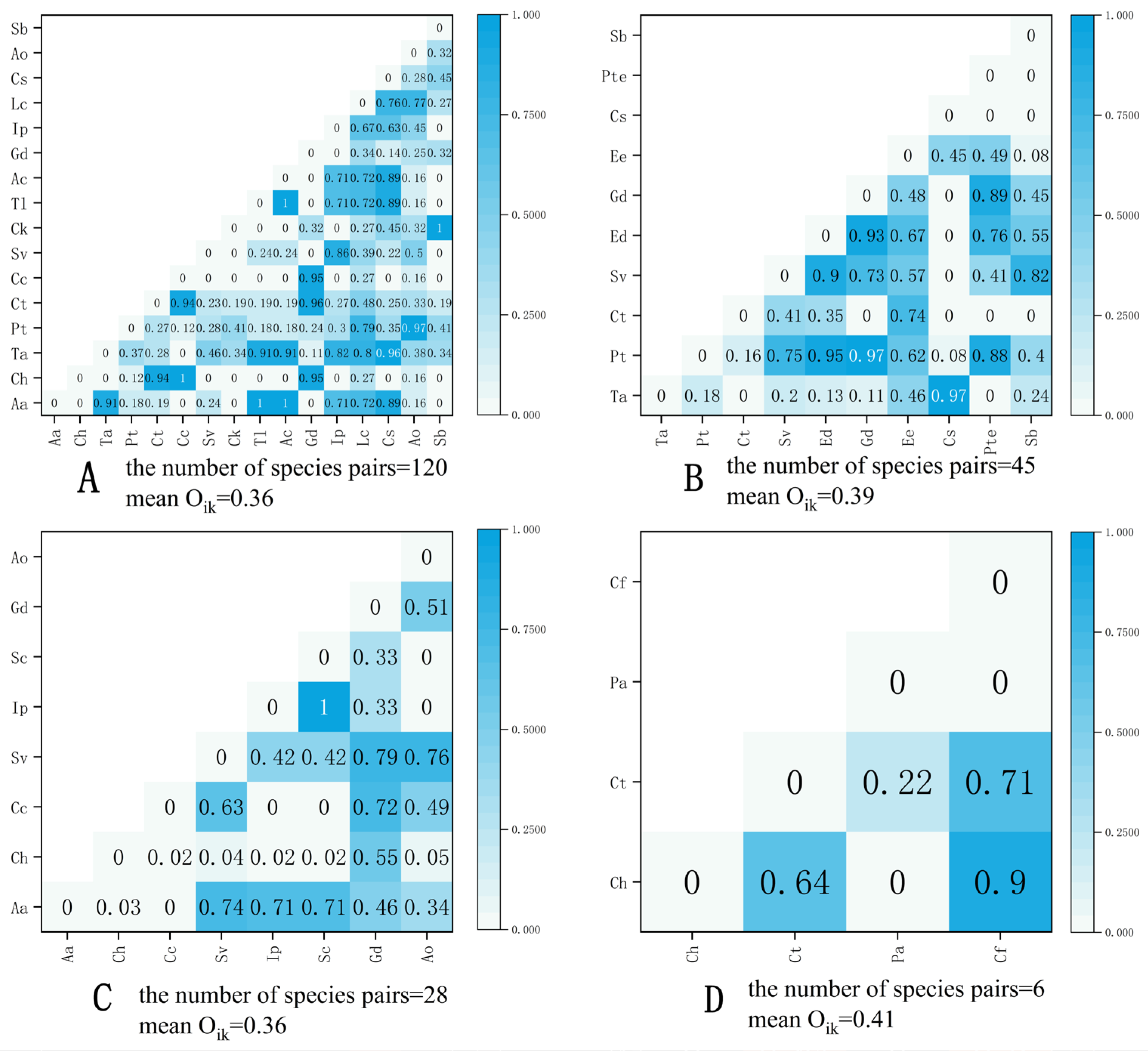
The results of niche overlap analysis among species in four different shrub understory herbaceous plant communities are shown in Figure 1. For the plant community under the S. psammophila forest (Figure 1A), 120 species pairs among 33 pairs (27.50%) without ecological niche overlap, and there are 55 pairs (45.83%) with Oik < 0.5; there are 32 pairs (26.67%) with Oik > 0.5, the average niche overlap among species in the community was 0.36. For the plant community under the A. ordosica forest (Figure 1B), 45 species pairs among 12 pairs (26.67%) without ecological niche overlap, and there are 17 pairs (37.78%) with Oik < 0.5; there are 16 pairs (35.56%) with Oik > 0.5, the average niche overlap among species in the community was 0.39. For the plant community under the C. fruticosum forest (Figure 1C), 28 species pairs among 5 pairs (17.86%) without ecological niche overlap, and there are 13 pairs (46.43%) with Oik < 0.5; there are 10 pairs (35.71%) with Oik > 0.5, the average niche overlap among species in the community was 0.36. For the plant community under the A. fruticosa forest (Figure 1D), 6 species pairs among 2 pairs (33.33%) without ecological niche overlap, and there is 1 pair (16.67%) with Oik < 0.5; there are 3 pairs (50.00%) with Oik > 0.5, the average niche overlap among species in the community was 0.41. Collectively, these findings suggest that divergent niche structures at the community level among the shrub types could significantly shape the stability and species coexistence dynamics within their respective understory vegetation.
Figure 1.
Semi-matrix diagram of species niche overlap of understory herbaceous plant communities under different sand-fixing shrubs. (A) stand for the plant community under the S. psammophila, (B) stand for the plant community under the A. ordosica, (C) stand for the plant community under the C. fruticosum, (D) stand for the plant community under the A. fruticosa.
2.2. Overall Association of Plants in Understory of Different Sand-Fixing Shrub Forests
The variance ratio method tested the overall interspecific associations in the four understory herbaceous plant communities, as summarized in Table 2. The variance ratios (VR) of the understory herbaceous plant communities of S. psammophila, A. ordosica, and C. fruticosum were 2.67, 2.41, and 1.69, respectively. Among them, the VR statistics of the understory herbaceous plant communities of S. psammophila and A. ordosica exceeded the χ2 critical value range, indicating a significant positive correlation in the interspecific associations; the VR statistics of the understory herbaceous plant community of C. fruticosum were all within the χ2 critical value range, indicating an insignificant positive correlation in the interspecific associations. The variance ratios of the understory herbaceous plant community of A. fruticosa were 0.73, and their VR statistics were all within their respective χ2 critical value ranges, indicating an insignificant negative correlation in the interspecific associations. These results suggest contrasting community assembly patterns among shrub forest types.
Table 2.
The overall correlation between species of understory herbaceous plant communities under different sand-fixing shrubs.
2.3. Interspecific Associations of Plants in Understory of Different Sand-Fixing Shrub Forests
2.3.1. Association Coefficient
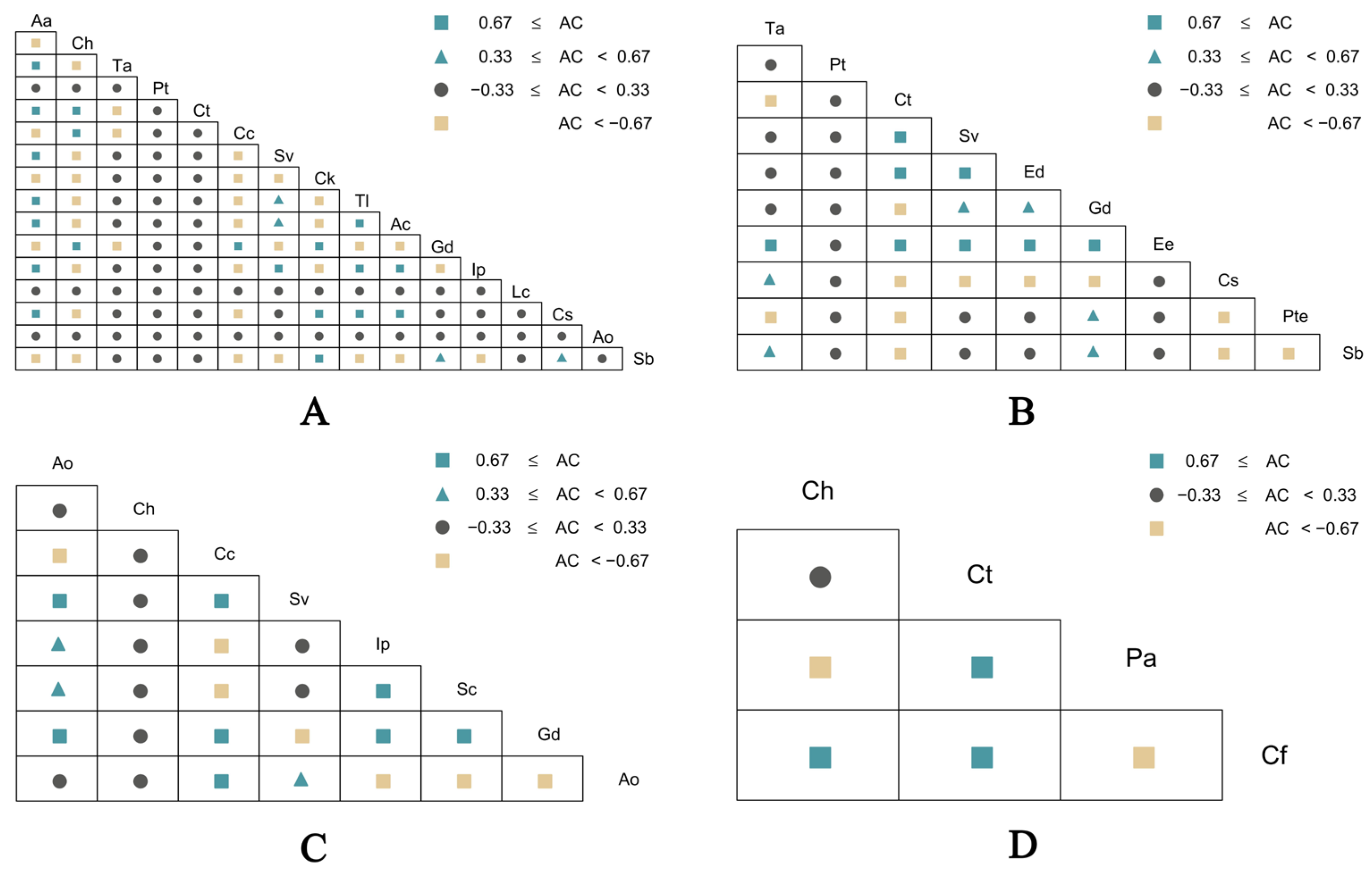
The interspecific associations within the herbaceous plant communities under the four shrub forests exhibited distinct patterns, as illustrated in Figure 2. For the plant community under the S. psammophila forest (Figure 2A), among the 120 species pairs, there are 24 pairs of positive connections, 35 pairs of negative connections, and 61 pairs of no connections, accounting for 20.00%, 29.17%, and 50.83% of the total number of species pairs, respectively. For the plant community under the A. ordosica forest (Figure 2B), among the 45 species pairs, there are 14 pairs of positive connections, 12 pairs of negative connections, and 19 pairs of no connections, accounting for 31.11%, 26.67%, and 42.22% of the total number of species pairs, respectively. For the plant community under the C. fruticosum forest (Figure 2C), among the 28 species pairs, there are 11 pairs of positive connections, 7 pairs of negative connections, and 10 pairs of no connections, accounting for 39.29%, 25.00%, and 35.71% of the total number of species pairs, respectively. For the plant community under the A. fruticosa forest (Figure 2D), among the 6 species pairs, there are 3 pairs of positive connections, 2 pairs of negative connections, and 1 pair of no connections, accounting for 50.00%, 33.33%, and 16.67% of the total number of species pairs, respectively.
Figure 2.
Semi-matrix diagram of species association coefficient (A,C) of plant communities under different sand-fixation shrubs. (A) stand for the plant community under the S. psammophila, (B) stand for the plant community under the A. ordosica, (C) stand for the plant community under the C. fruticosum, (D) stand for the plant community under the A. fruticosa.
2.3.2. Interspecific Correlation
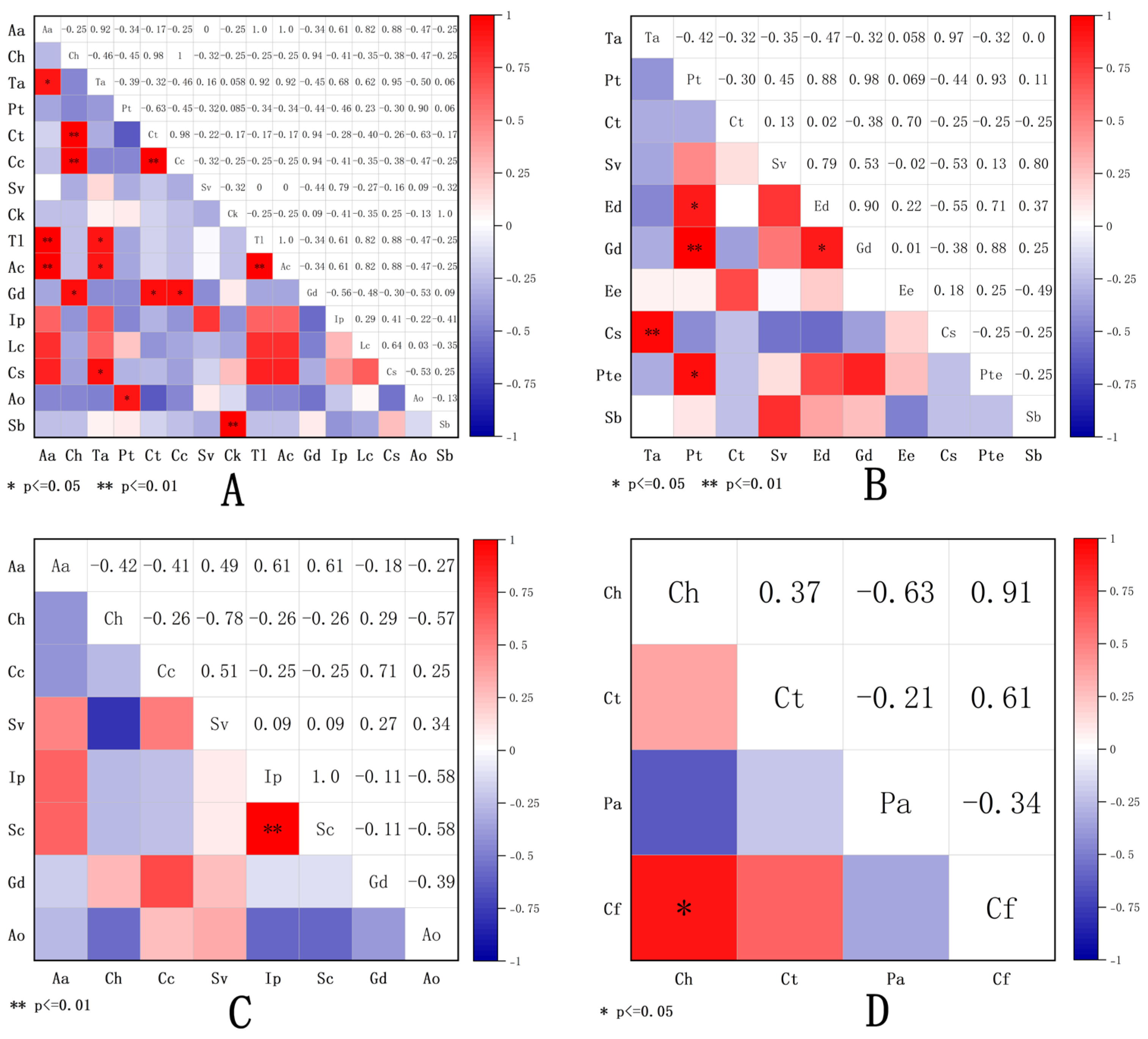
The test results of Pearson correlation coefficient between species in four shrub understory herbaceous plant communities are shown in Figure 3. In the herbaceous plant community under the S. psammophila forest (Figure 3A), among the 120 species pairs, 42 pairs were positively correlated (35.00%), 75 pairs were negatively correlated (62.50%), and 3 pairs were not correlated (2.50%). The significant rate of the test was 12.50%. In the herbaceous plant community under the A. ordosica forest (Figure 3B), among the 45 species pairs, 24 pairs were positively correlated (53.33%), 20 pairs were negatively correlated (44.44%), and 1 pair was not correlated (6.67%). The significant rate of the test was 11.11%. In the herbaceous plant community under the C. fruticosum forest (Figure 3C), among the 28 species pairs, 12 pairs were positively correlated (42.86%), 16 pairs were negatively correlated (57.14%), and there were no uncorrelated pairs.The significant rate of the test was 3.57%. In the herbaceous plant community under the A. fruticosa forest (Figure 3B), among the 6 species pairs, 3 pairs were positively correlated (50.00%), 3 pairs were negatively correlated (50.00%), and there were no uncorrelated pairs. The significant rate of the test was 16.67%.
Figure 3.
Species correlation coefficient (Pearson) semi-matrix diagram of understory herbaceous plant communities in different sand-fixing shrubs. (A) stand for the plant community under the S. psammophila, (B) stand for the plant community under the A. ordosica, (C) stand for the plant community under the C. fruticosum, (D) stand for the plant community under the A. fruticosa.
2.4. The Stability of Understory Communities in Different Sand-Fixing Shrub Forests and Its Correlation with the Ecological Niche Overlap and Variance Ratio
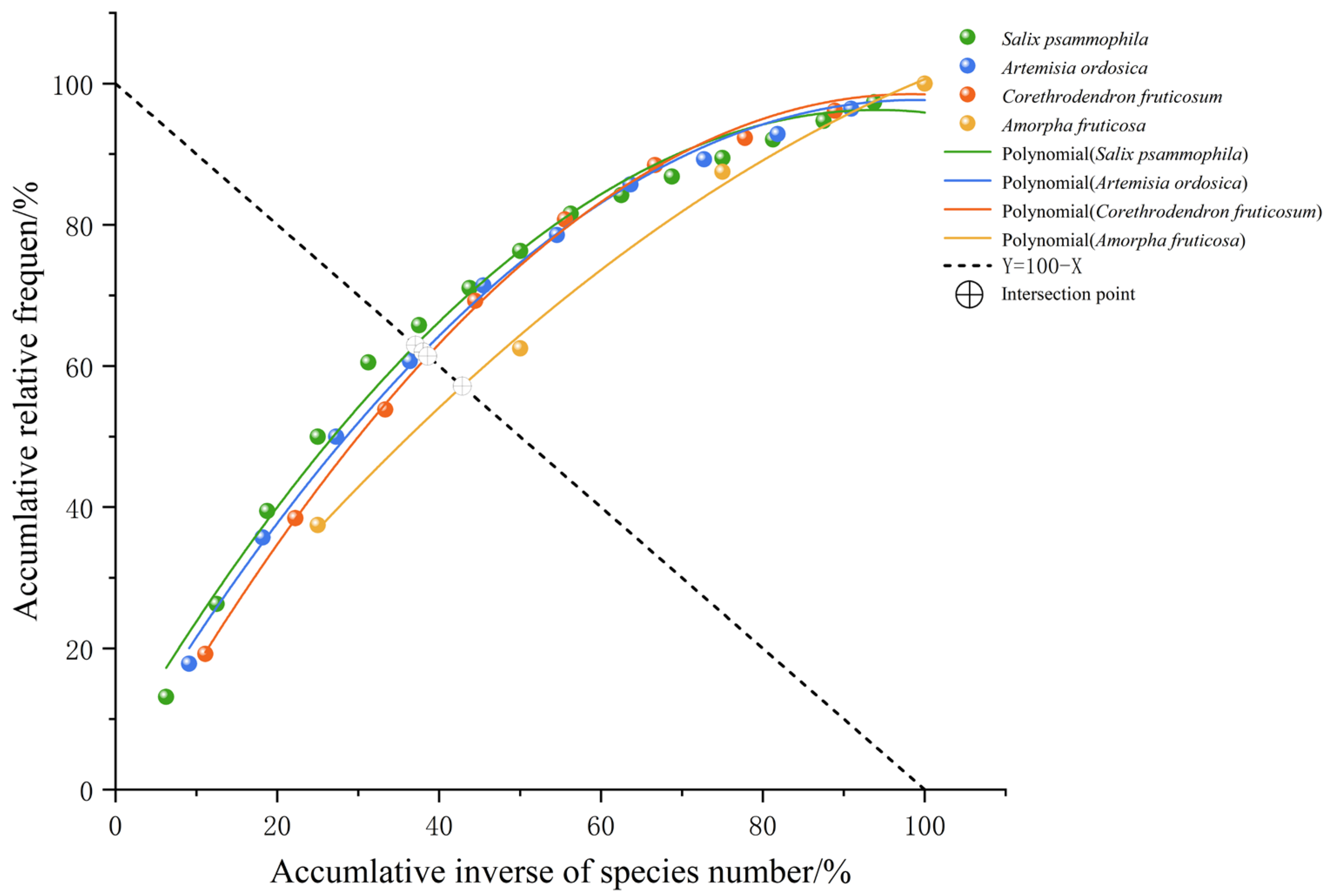
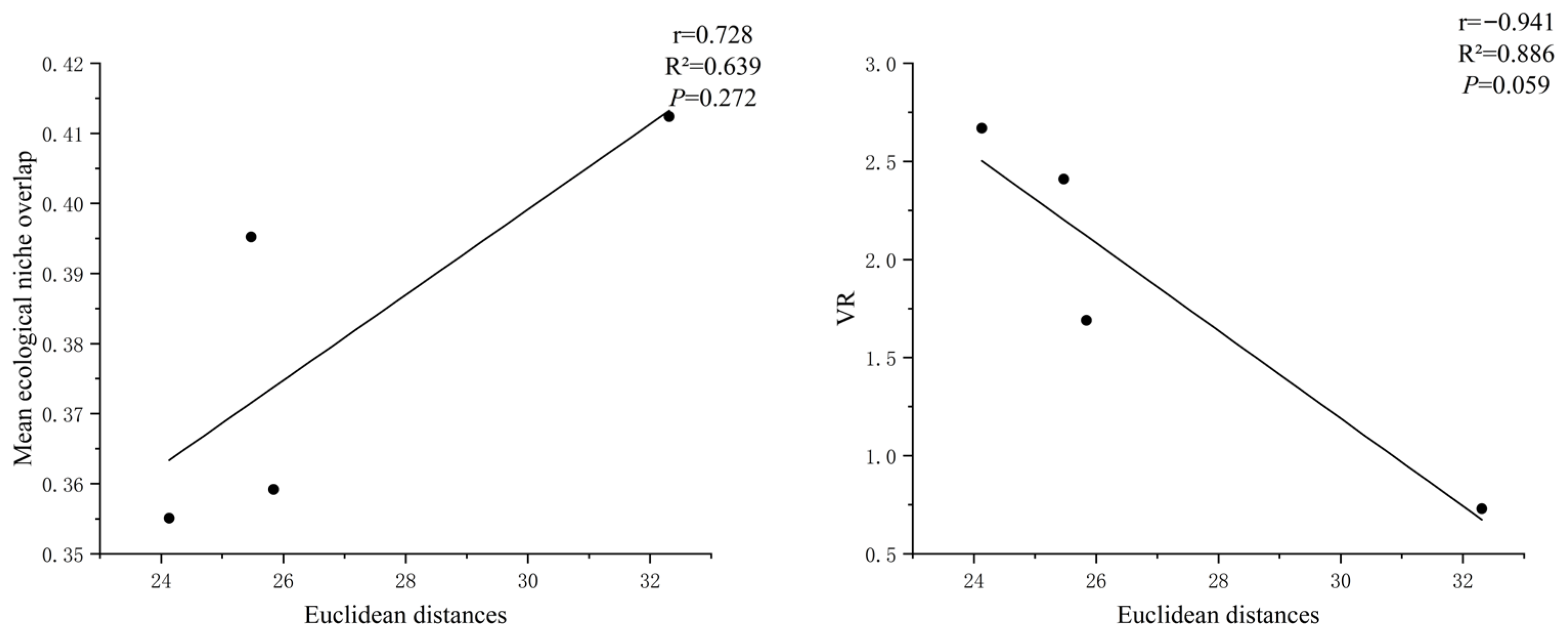
Using the M. Godron stability assessment method, the stability of four shrub understory herbaceous plant communities was evaluated. The fitted curve equation, determination coefficient (R2), intersection coordinates, Euclidean distance from the stable point (20, 80), and test results are shown in Table 3 and Figure 4. The intersection coordinates of the fitted curves of the herbaceous plant communities under the S. psammophila, A. ordosica, C. fruticosum, and A. fruticosa undergrowth with the linear equation y = 100 − x are (37.06, 62.94), (38.01, 61.99), (38.27, 61.73), and (42.85, 57.15), respectively. The Euclidean distances from the stable point (20, 80) are 24.13, 25.47, 25.84, and 32.31, respectively. Based on the Euclidean distance, the stability of the plant community under the S. psammophila is the highest, followed by the plant communities under the A. ordosica and C. fruticosum, and the stability of the plant community under the A. fruticosa is the lowest. This result is basically consistent with the analysis conclusions of ecological niche characteristics, overall connectivity, and interspecific associations in the previous text. The correlation analysis of the Euclidean distances of four shrub understory plant communities with their average ecological niche overlap and variance ratio is shown in Figure 5. The Euclidean distance is insignificantly positively correlated with the average ecological niche overlap (p = 0.272), with a correlation coefficient of 0.728. The Euclidean distance is insignificantly negative correlated with the variance ratio (p = 0.059), with a correlation coefficient of −0.941.
Table 3.
Stability of plant community under different sand-fixation shrubs.
Figure 4.
Stability analysis diagram of plant community under different sand-fixation shrubs.
Figure 5.
Correlation analysis diagram of the stability of plant communities with the mean ecological niche overlap and the VR.
3. Discussion
3.1. Ecological Niche Characteristics of Plant Communities Under Different Sand-Fixing Shrub Forests
This study analyzed the ecological niche characteristics of understory herbaceous plant communities within four artificial sand-fixing shrub forests in the Mu Us Sandy Land. The results are as follows. In the herbaceous plant communities under the four shrub forests, the dominant species occupy relatively high importance values and broad niche widths. The species importance value can indicate the dominance degree of a species in the community, while the ecological niche breadth reflects the species’ ability to utilize resources and its adaptability [23]. In this article, dominant species such as Lc, Ee, Gd, and Ch have a relatively wide ecological niche, indicating that they are widely distributed in sandy areas, have a stronger adaptability to sandy land, and make more efficient use of environmental resources. This might be because these plants can tolerate drought and poor soil conditions. They can absorb water through their well-developed root systems, thereby reducing the impact of water stress on the physiological activities of the plants [24]. Previous research has indicated a proportional relationship between importance value and niche width [25]; however, the findings of this study reveal certain discrepancies from earlier results. Research shows that in the C. fruticosum community, the niche width of Ch ranks fifth, while its importance value ranks first. The reason for this result might be that Ch shows an aggregated distribution pattern within the study area.
Ecological niche overlap is used to assess the potential competitive and mutually beneficial relationships between species [26]. Among the four understory herbaceous plant communities, the S. psammophila, A. ordosica, and C. fruticosum understory herbaceous plant communities were predominantly characterized by low niche overlap (Oik < 0.5), accounting for 45.83%, 37.78%, and 46.43% of the total species pairs, respectively. These communities also exhibited low mean niche overlap values of 0.36, 0.39, and 0.36. This indicates that most of the species in these communities currently have a high degree of ecological niche differentiation and are in an independent distribution state. The similarity in resource utilization among species is low, and interspecific competition is not intense. In contrast, the A. fruticosa understory herbaceous plant community showed a predominance of high niche overlap (Oik < 0.5), which represented 50% of its species pairs, along with the highest mean niche overlap of 0.41, this indicates that most of the species in this community currently have a relatively low ecological niche differentiation, and the similarity in resource utilization among species is high. Interspecific competition is intense, and the ecological niche overlap is influenced by both the biological characteristics of the species and the habitat. The research found that the ecological niches of understory herbaceous plant communities under S. psammophila, A. ordosica, and C. fruticosum are generally low in overall overlap. On one hand, due to the differences in biological characteristics among different dominant species, which are inevitable due to the varying requirements for light, water, and soil nutrients, there is ecological differentiation, thereby reducing direct competition among them [27]. On the other hand, this might be because the ecological environment of sandy land is fragile, with limited available resources, and the available resources for plants are also limited, resulting in a low degree of ecological niche overlap in the undergrowth plant communities [28].
3.2. The Interspecific Associations Characteristics of Plant Communities Under Different Sand-Fixing Shrub Forests
Overall association serves as an important criterion for evaluating both the vegetation recovery process and community stability [29], as it reflects the interactions and connections among species within a community over a specific period [30]. Previous studies have shown that as the process of vegetation restoration progresses, the community will become more stable, the overall association of the community will show a positive connection [31]. This is similar to the results of this study. The overall association of understory herbaceous plant communities under S. psammophila, A. ordosica and C. fruticosum shows a positive connection. Among them, the understory herbaceous plant communities under S. psammophila and A. ordosica forests have reached a significant level, while the overall connectivity of the understory herbaceous plant community under A. fruticosa forest shows a non-significant negative connection.
By analyzing the ratio of positive to negative interspecific associations among species pairs within the understory herbaceous plant communities of different shrubs, we can elucidate the patterns of species coexistence or exclusion [32]. Association coefficient, as a key indicator for measuring interspecific relationships and the stability of community structure, its dynamic changes can to some extent reflect the stable state of the community. Previous studies have shown that as the vegetation restoration process progresses, the interspecific correlations among the dominant species in the community will gradually transition from significant negative correlations to no correlations, and the number of species with no significant correlations will increase. Eventually, in the relatively stable community formed by vegetation restoration, species tend to be distributed independently rather than in a connected manner [33]. This pattern enables species to utilize different non-limiting resources in the habitat relatively independently, achieving rational allocation and efficient utilization of resources, thereby maintaining the stability of interspecific relationships within the community. In this study, among the four understory herbaceous plant communities, the interspecific associations of the species under the S. psammophila and A. ordosica forests were mainly non-associated, while those under the C. fruticosum and A. fruticosa forests were mainly positively associated. This indicates that the communities under the S. psammophila and A. ordosica forests are in a relatively stable state, while those under the C. fruticosum and A. fruticosa forests are in a relatively unstable state. Combined with the Pearson correlation test, it was found that the overall significant rate of the plant communities under the four shrub forests was extremely low, suggesting that the interspecific relationships were loose and the species within the communities were distributed independently.
3.3. The Stability of Plant Communities Under Different Sand-Fixing Shrub Forests the Stability of Plant Communities Under Different Sand-Fixing Shrub Forests and Its Correlation with the Mean Ecological Niche Overlap and Variance Ratio
The findings of HU Er-cha et al. on understory plant communities in different sand-fixing forests of the Mu Us Sandy Land indicate that plant communities formed under the protection of various sand-fixing tree species exhibit significant differences [34,35], which aligns with the results of the present study. However, while previous research on plant communities under the protection of different shrub forests in the Mu Us Sandy Land has mainly focused on post-restoration diversity and community characteristics, this study emphasizes the stability of plant communities under different sand-fixing shrub forests and explains the mechanisms underlying such stability from the perspective of interspecific relationships. The stability assessment revealed a clear gradient among the four understory herbaceous plant communities, with the S. psammophila understory community exhibiting the highest stability, followed by community under A. ordosica and C. fruticosum, while the A. fruticosa understory community was the least stable. The marked variation in community stability can be interpreted from both species-specific and community-structural perspectives. At the species level, the strong competitive traits of A. fruticosa including high sprouting capacity [36], extensive lateral root development, and superior adaptability, enable it to efficiently sequester water and nutrients. This dominance likely leads to asymmetrical resource allocation within the understory, constraining the growth of subordinate species and thereby undermining overall community stability. In contrast, S. psammophila fosters a more favorable microhabitat through its pronounced windbreak and sand-fixing functions [37], coupled with significant litter input [38]. These modifications contribute to a more balanced soil resource environment, which supports higher species coexistence and enhances community-level stability. At the community level, the observed correlation patterns provide further mechanistic insight. Community stability was positively correlated with the mean niche overlap but negatively correlated with the variance ratio (VR). This indicates that more stable communities are characterized by lower overall niche overlap among species and a higher degree of positive interspecific association [39,40]. These patterns align with classic models of ecological succession: during initial restoration phases, colonizing species often exhibit broad, overlapping niches and competitive (negative) interactions. As succession proceeds, niche differentiation increases, direct competition decreases (reducing niche overlap), and interspecific relationships tend to shift toward neutral or positive associations, thereby promoting community stability.
The overall association test results of the four shrub understory plant communities showed that the plant communities under S. psammophila, A. ordosica, and C. fruticosum all exhibited positive connectivity, indicating well-differentiated ecological niches and weak interspecific competition among the species in these understory herbaceous plant communities. However, the stability test results in this study were generally lower. This appears inconsistent with previous research concluding that overall interspecific association tends to show a significant positive correlation when a community becomes stable [39]. The reason may be that the maintenance of community stability depends not only on species composition and community structure but is also affected by external environmental factors [40]. During vegetation restoration in arid regions, the main source of water required for plant growth is atmospheric precipitation [41], making precipitation a key factor determining vegetation stability. The soil in the Mu Us Sandy Land is characterized by high sand content, poor water retention capacity, and intense evaporation of soil moisture [42]. Unstable precipitation further exacerbates the volatility of soil moisture, which may hinder the vegetation from achieving overall community stability.
4. Materials and Methods
4.1. Overview of the Study Area
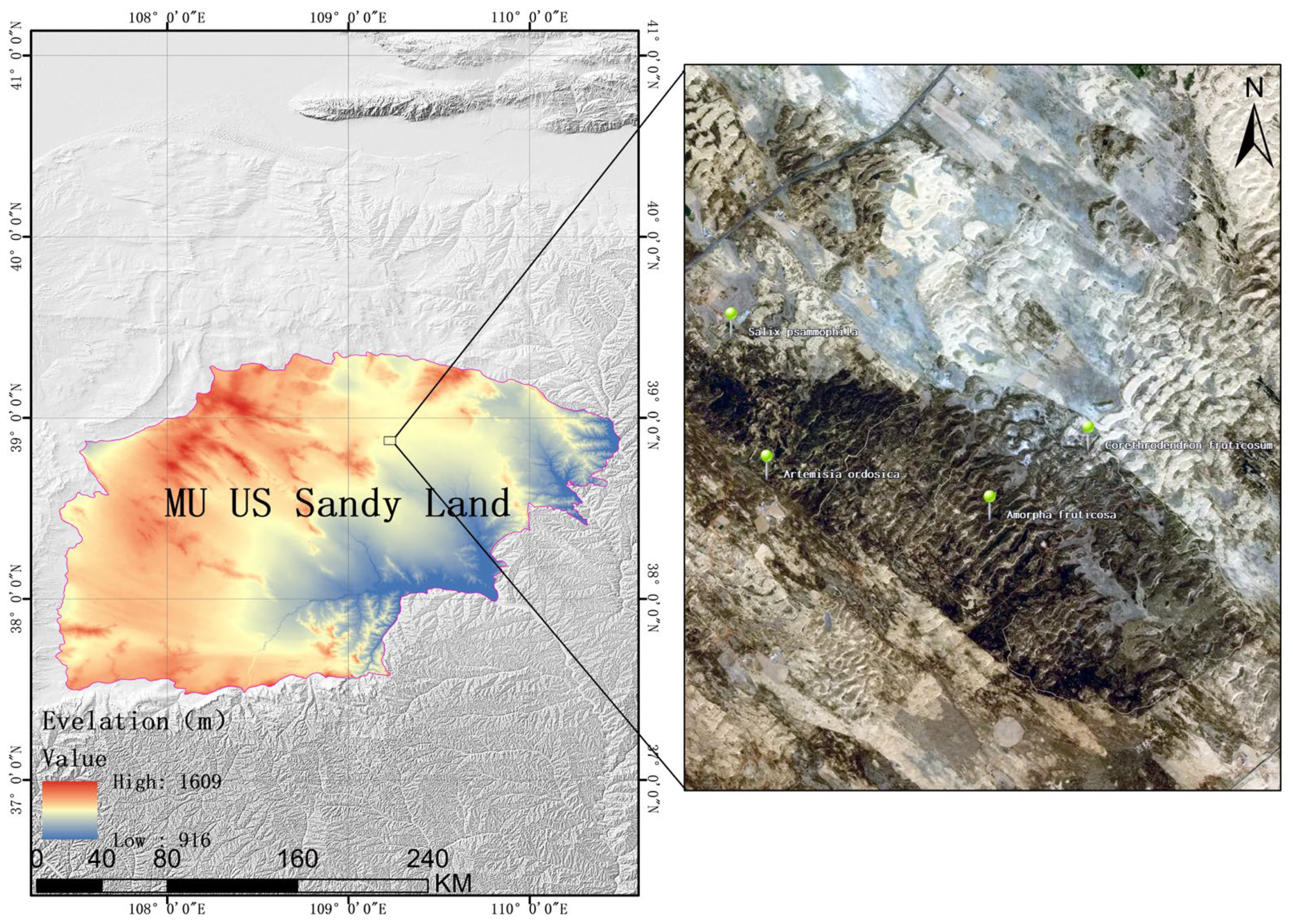
The study area is located in Wushen Banner, Ordos City, Inner Mongolia Autonomous Region, in the hinterland of the Mu Us Sandy Land (37°38′~39°23′ N, 108°17′~109°40′ E, altitude 1350~1437 m). The distribution map of the four shrub forest survey plots is shown in Figure 6. The study area has a temperate continental monsoon climate [43], the temperature varies greatly between day and night, with an average temperature of 8.6 °C, the annual sunshine duration is 2700 to 3000 h, the effective accumulated temperature is 2800 to 3000 degrees Celsius, and the annual average precipitation is between 350 and 400 mm [44], the annual average wind speed is 4 m/s, the annual evaporation volume ranges from 2200 to 2800 mm, the frost-free period lasts from 113 to 156 days, and the four major climatic characteristics of this region are obvious temperature changes, dry climate, frequent strong winds and intense sunlight [45]. The soil types are mainly sandy soil and calcareous loam. Their characteristics include poor cohesion, loose structure, high permeability, few soil microorganisms and low fertility [46]. The vegetation type in the study area is mainly xerophytic vegetation, in terms of distribution range, herbaceous plants, small shrubs and semi-shrubs are the most widespread, significantly outnumbering trees. The perennial herbaceous and shrub species such as C. fruticosum, A. ordosica, S. psammophila, Aster altaicus and Stipa caucasicaare considered as dominant and community-forming species in the ecosystem, Occasionally, one can also come across tree species such as the Salix matsudana and the Pinus sylvestris [47].
Figure 6.
The distribution map of the four shrub forest survey plots.
4.2. Plot Setup and Survey Methodology
In August 2024, the research team conducted a vegetation survey and sampling of the herbaceous plant communities under the artificial shrub forests in the area. First, four shrub plots were selected, namely S. psammophila, A. ordosica, C. fruticosum, and A. fruticosa, which were constructed during the period from 2013 to 2015 and had basically the same growth conditions. In each type of shrub forest, a large sample plot of 10 m × 10 m was delineated using a sampling line, and 5 representative 1 m × 1 m herbaceous investigation plots were set within it. There were 5 herbaceous sample plots for each shrub type, and a total of 20 sample plots in the study area. In each 1 m × 1 m herbaceous sample plot, the species of all plants were identified and the individual numbers were counted. At the same time, the natural height of the plants was measured using a tape measure. Then, the plants were cut to the ground level by species, and all plant samples were placed in paper bags. After being brought back to the laboratory, the plant materials were dried in a Laboratory Plant Drying Oven (Grieve Corporation, Round Lake, IL, USA) constant temperature at 65 °C until a constant weight was reached, and the dry weight was determined using analytical balances (±0.01 g precision) and the biomass data were recorded.
4.3. Computational Formula
4.3.1. Importance Value
The importance value (IV) is a comprehensive numerical indicator used to represent the relative importance of a certain species within a community. It is widely applied in vegetation ecology research [48], the calculation formula is as follows:
In this formula, RH represents relative height; RA represents relative density; RAG represents relative above-ground biomass. Hi, Ai, and AGBi represent the total height, total number, and total above-ground biomass of species i, respectively. ∑H, ∑A, and ∑AGB represent the total height, total number, and total above-ground biomass of all species within the herbaceous sample plot.
4.3.2. Overall Association
The overall association degree of the community was tested based on the variance ratio (VR) proposed by Schluter, and the statistical quantity W was used to evaluate the significance of the connections [49]:
In this formula, N represents the total number of sample plots, S represents the total number of species, Pi represents the frequency of species i, Tj represents the total number of species in sample plot j, and t represents the average number of species across all sample plots.
When VR > 1, it indicates that the community as a whole has a positive association; when VR = 1, it indicates that the community as a whole has no association; when VR < 1, it indicates that the community as a whole has a negative association. Additionally, to further verify the significance, W = VR × N is used for testing; if W ≤ χ20.95(N)or W ≥ χ20.05(N), then the overall association is significant (p < 0.05); if χ20.95(N) < W < χ20.05(N), then the overall association is not significant (p > 0.05).
4.3.3. Interspecific Association
Convert the data of the occurrence of species within the community into a binary data matrix of 0 and 1, establish a 2 × 2 contingency table (as shown in Table 4), and conduct an inter-species association degree test [50,51].
Table 4.
2 × 2 contingency table.
The strength of interspecific associations is analyzed using the connection coefficient AC. The calculation formula is as follows:
When ad ≥ bc, then
When bc > ad and d ≥ a, then
When bc > ad and d < a, then
In this formula, the range of AC is [−1, 1]. The closer AC is to −1, the stronger the negative association between species; the closer AC is to 1, the stronger the positive association between species; when AC is 0, it indicates no association [52]. If AC ≥ 0.6, it indicates a high degree of positive association among various pairs; if 0.3 ≤ AC < 0.6, it indicates a moderate degree of positive association among various pairs; if −0.3 ≤ AC < 0.3, it indicates loose association between species pairs and a tendency towards independence; if −0.6 ≤ AC < −0.3, it indicates a moderate degree of negative association between species pairs; if AC < −0.6, it indicates a high degree of negative association among various pairs.
4.3.4. Interspecific Correlation
The Pearson correlation test assesses the strength of interspecific associations within each shrub understory community, and the calculation formula is as follows:
In the formula, n represents the total number of sample plots; Xik and Xij are the abundance values of species i and j in sample plot k; and is the average abundance value of species i and j across all sample plots. The value range of is [−1, 1]. rp(i,j) < 0 indicates negative correlation, rp(i,j) = 0 indicates no correlation, and rp(i,j) > 0 indicates positive correlation.
4.3.5. Niche Characteristics
Niche width indicates the total range of resources utilized by species within a community, serving as an indicator of the community’s adaptability to environmental conditions. Niche width was calculated based on Levins’ niche widths (BL) [53]; The niche overlap index Oik refers to the degree of overlap in the utilization of a certain resource unit by species i and species k. Niche overlap was measured using Pianka’s niche overlap coefficient (Oik), the calculation formula is as follows:
In the formula, Pij and Pkj represent the proportions of the total importance values of species i and k in sample j. r is the total number of samples, BL is the ecological niche width of the species, and Oik is the ecological niche overlap value of the species.
4.3.6. Community Stability
Use the M. Godron stability determination method [54], arrange the plants in the community in descending order of relative frequency, calculate the cumulative percentage of species’ reciprocal values as the independent variable, and calculate the cumulative relative frequency as the dependent variable. Then, a scatter smoothing curve was used to fit the binomial equation, making it intersect with the straight line y = 100 − x. The coordinates of the intersection point represent the desired ratio of community stability. According to the stability judgment criteria proposed by M. Godron, the Euclidean distance between the coordinates of this intersection point and the theoretical stable point (20, 80) is calculated. The smaller the distance value, the higher the stability of the community.
4.4. Data Analysis
In this study, the distribution map of the four shrub forest survey plots in the study area was generated using ArcGIS 10.8, and Excel 2021 (Microsoft Corporation, Redmond, WA, USA) was used to initially organize the survey data of plant samples and calculate the species importance values within different communities. The ecological niche characteristic indices (ecological niche width, overlap degree), overall association (variance ratio VR, statistical quantity W), and interspecific association (AC connection coefficient, Pearson correlation coefficient) were calculated using the ‘spaa’ package of R language version 4.2.0 (R Core Team, Vienna, Austria). Other figures such as semi-matrix diagrams and plant community stability analysis were completed in Origin 2024 (OriginLab, Northampton, MA, USA) and R 4.2.0 software.
5. Conclusions
Based on a comprehensive analysis of the niche characteristics, interspecific associations, and community stability of understory vegetation in four artificial sand-fixing shrub forests in the Mu Us Sandy Land, this study reveals distinct community assembly mechanisms and restoration statuses among different shrub types. The results showed: (1) Species such as Lc (Leymus chinensis), Ee (Euphorbia esula), Gd (Grubovia dasyphylla), and Ch (Corispermum hyssopifolium) function as dominant species with broad niches and high importance values, playing a crucial role in maintaining community function. (2) The understory herbaceous plant communities of S. psammophila, A. ordosica and C. fruticosum exhibited low niche overlap and significant positive overall associations, reflecting clear niche differentiation and relatively stable species coexistence. In contrast, the A. fruticosa understory herbaceous plant community displayed high niche overlap, negative overall association, and intense interspecific competition, resulting in the lowest stability. (3) The four plant communities are mainly characterized by no connection and negative correlation, indicating that the spatial distribution of species is highly independent, and the community structure has not yet formed a stable interspecific relationship network. (4) The stability ranking, determined by M. Godron’s method, the stability of herbaceous plant community under S. psammophila is the highest, followed by A. ordosica and C. fruticosum, while the stability of herbaceous plant community under A. fruticosa is the lowest, with community stability positively correlated with mean niche overlap and negatively with the variance ratio (VR). S. psammophila and C. fruticosum have excellent water retention properties and can promote the succession process of plant communities under shrub forests. We recommend prioritizing S. psammophila and C. fruticosum for sand fixation and conserving key herbaceous species to optimize resource use and stabilize interspecific relationships.
The novelty of this work lies in the integrated assessment of niche characteristics, interspecific associations, and community stability, providing a holistic perspective on the assembly mechanisms of artificial sand-fixing forest ecosystems. However, limitations such as a small sample size and the lack of detailed environmental indicators (soil moisture, nutrients) highlight the need for future research to incorporate environmental factors and shrub functional traits (root architecture, litter properties) to elucidate the synergistic effects of interspecific relationships, shrub growth characteristics, and environmental drivers on community stability, thereby offering a more robust scientific basis for species selection and vegetation restoration management in desert ecosystems.
Author Contributions
Conceptualization, H.A., H.X., H.W. and L.Z.; methodology, H.X., H.A. and H.W.; software, H.X., H.A. and Y.M.; validation, H.W. and L.Z.; formal analysis, H.A., H.X. and L.Z.; investigation, S.Z. and H.G.; resources, H.A., S.L. and H.W.; data curation, H.X. and L.Z.; writing—original draft preparation, H.X. and H.A.; writing—review and editing, H.A., H.X., L.Z. and H.W.; funding acquisition, H.X., H.W. and L.Z. All authors have read and agreed to the published version of the manuscript.
Funding
This research was funded by the “Open bidding for selecting the best candidates” project of lnner Mongolia Autonomous Region (2024JBGS0020), The Inner Mongolia Forestry Science Research Institute’s Research apacity Enhancement “Unveiling and Leading” project (2024NLTS03) and National Center of Pratacultural Technology Innovation (under preparation) Special fund for innovation platform construction (CCPTZX2024GJ0402).
Data Availability Statement
Data are contained within the article.
Conflicts of Interest
The authors declare no conflicts of interest.
References
- Zeng, G.; Ye, M.; Li, M.; Chen, W.; He, Q.; Pan, X.; Zhang, X.; Che, J.; Qian, J.; Lv, Y. The Relationships between Plant Community Stability and Diversity across Different Grassland Types and Their Association with Environmental Factors in the Habahe Forest Area, Xinjiang. Diversity 2024, 16, 499. [Google Scholar] [CrossRef]
- Wang, Y.; Chen, J.; Zhang, L.; Feng, L.; Yan, L.; Li, F.; Zhao, X.; Yu, L.; Liu, N. Relationship between diversity and stability of a karst plant community. Ecol. Evol. 2022, 12, e9254. [Google Scholar] [CrossRef]
- Luo, Z.; Zhou, Y.; Liu, N.; Wang, L.; Liu, Y.; Shan, B.; Liu, M.; Chen, C.; Yang, C.; Sun, D. Ecological niche and interspecific association of the main fishes in the coastal waters of Hainan Island, China. Fishes 2023, 8, 511. [Google Scholar] [CrossRef]
- Wasof, S.; Lenoir, J.; Gallet-Moron, E.; Jamoneau, A.; Brunet, J.; Cousins, S.A.; De Frenne, P.; Diekmann, M.; Hermy, M.; Kolb, A. Ecological niche shifts of understorey plants along a latitudinal gradient of temperate forests in north-western Europe. Glob. Ecol. Biogeogr. 2013, 22, 1130–1140. [Google Scholar] [CrossRef]
- Martínez, I.; Wiegand, T.; González-Taboada, F.; Obeso, J.R. Spatial associations among tree species in a temperate forest community in North-western Spain. For. Ecol. Manag. 2010, 260, 456–465. [Google Scholar] [CrossRef]
- Gao, W.; Zheng, C.; Liu, X.; Lu, Y.; Chen, Y.; Wei, Y.; Ma, Y. NDVI-based vegetation dynamics and their responses to climate change and human activities from 1982 to 2020: A case study in the Mu Us Sandy Land, China. Ecol. Indic. 2022, 137, 108745. [Google Scholar] [CrossRef]
- Zhang, M.; Wu, X. The rebound effects of recent vegetation restoration projects in Mu Us Sandy land of China. Ecol. Indic. 2020, 113, 106228. [Google Scholar] [CrossRef]
- Zhang, P.; Shao, G.; Zhao, G.; Le Master, D.C.; Parker, G.R.; Dunning, J.B., Jr.; Li, Q. China’s forest policy for the 21st century. Science 2000, 288, 2135–2136. [Google Scholar] [CrossRef]
- Pei, Y.; Huang, L.; Shao, M.A.; Jia, X.; Tang, X.; Zhang, Y.; Pan, Y. Water sources used by artificial Salix psammophila in stands of different ages based on stable isotope analysis in northeastern Mu Us Sandy Land. Catena 2023, 226, 107087. [Google Scholar] [CrossRef]
- Ri, X.; Yang, J.; Zhao, L.-Q.; Qing, H.; Yao, Z.-Y.; Zhu, L.; Wu, Y.-H.; Tian, J.-B.; Cao, X.-P.; Yang, L. Establishment, development, and decline of Salix psammophila communities: Changes in soil conditions and floristic composition in dune slacks. Glob. Ecol. Conserv. 2020, 22, e00967. [Google Scholar] [CrossRef]
- Pang, Y.; Wu, B.; Jia, X.; Xie, S. Wind-proof and sand-fixing effects of Artemisia ordosica with different coverages in the Mu Us Sandy Land, northern China. J. Arid. Land 2022, 14, 877–893. [Google Scholar] [CrossRef]
- Zhang, J.; Zhang, Y.; Fan, D.; Qin, S.; Jia, X.; Wu, B.; Chen, D.; Gao, H.; Zhu, L. Effects of sand dune stabilization on the spatial pattern of Artemisia ordosica population in Mu Us Desert, Northwest China. PLoS ONE 2015, 10, e0129728. [Google Scholar] [CrossRef] [PubMed]
- Zhou, Z.; Yu, M.; Ding, G.; Gao, G.; He, Y.; Wang, G. Effects of Hedysarum leguminous plants on soil bacterial communities in the Mu Us Desert, northwest China. Ecol. Evol. 2020, 10, 11423–11439. [Google Scholar] [CrossRef]
- Xie, L.; He, X.; Wang, K.; Hou, L.; Sun, Q. Spatial dynamics of dark septate endophytes in the roots and rhizospheres of Hedysarum scoparium in northwest China and the influence of edaphic variables. Fungal Ecol. 2017, 26, 135–143. [Google Scholar] [CrossRef]
- Zhu, Z.; Shao, M.; Jia, X.; Zhao, C. Rainfall partitioning characteristics and simulation of typical shelter forest in Chinese Mu Us Sandy Land. Sci. Total Environ. 2024, 945, 174091. [Google Scholar] [CrossRef]
- Zhao, P.; Qiu, K.; Xie, Y.; Zhao, X.; Chen, L.; Liu, W.; Li, H.; Meng, W.; Hu, X.; He, Y.; et al. Spatial heterogeneity of soil nutrients under different sand-fixing shrubs in the southern margin of the Mu Us Sandy Land. Acta Agrestia Sin. 2021, 29, 2040–2048. (In Chinese) [Google Scholar]
- Hirobe, M.; Ohte, N.; Karasawa, N.; Zhang, G.-s.; Wang, L.-h.; Yoshikawa, K. Plant species effect on the spatial patterns of soil properties in the Mu-us desert ecosystem, Inner Mongolia, China. Plant Soil 2001, 234, 195–205. [Google Scholar] [CrossRef]
- Zhang, D.; Chen, X.; Fu, G.; Yang, Z.; Song, J.; Tong, X. Dissimilar evolution of soil dissolved organic matter chemical properties during revegetation with arbor and shrub in desertified land of the Mu Us Desert. Sci. Total Environ. 2022, 815, 152904. [Google Scholar] [CrossRef] [PubMed]
- Liu, L.; Bai, Y.; Qiao, Y.; Miao, C.; She, W.; Qin, S.; Zhang, Y. Water-use characteristics of two dominant plant species in different community types in the Mu Us Desert. Catena 2023, 221, 106803. [Google Scholar] [CrossRef]
- Gao, Q.; Dang, X.; Meng, Z.; Liu, Y.; Lou, J.; Yan, Y.; Zhang, X. Effects of Drought on the Water Use Strategies of Pure and Mixed Shrubs in the Mu Us Sandy Land. Plants 2024, 13, 3261. [Google Scholar] [CrossRef]
- Sun, Y.; Zhang, Y.; Feng, W.; Qin, S.; Liu, Z.; Bai, Y.; Yan, R.; Fa, K. Effects of xeric shrubs on soil microbial communities in a desert in northern China. Plant Soil 2017, 414, 281–294. [Google Scholar] [CrossRef]
- Shi, L.; Yang, L.; Peng, B.; Hua, D.; Sun, Z.; He, L. Characteristics of inter-root soil bacterial community structure and diversity of different sand-fixing shrubs at the southeastern edge of the Mu Us Desert, China. Ann. Microbiol. 2024, 74, 27. [Google Scholar] [CrossRef]
- Gu, L.; Gong, Z.-w.; Li, W.-z. Niches and interspecific associations of dominant populations in three changed stages of natural secondary forests on Loess Plateau, PR China. Sci. Rep. 2017, 7, 6604. [Google Scholar] [CrossRef] [PubMed]
- Lou, K.E.; Qu, W.J.; Wang, L.; Wang, X.; Gao, Y.G.; Zhang, B.; You, W.X.; Yang, X.G. Root architecture characteristics of four dominant annual herbs in Tengger Desert, China. Chin. J. Appl. Ecol. 2024, 35, 3015–3022. (In Chinese) [Google Scholar]
- Ma, Y.; Wang, Y.; Li, G.; Liang, T.; Zou, M.; Yan, J.; Ma, H. HunShanDaKe sand east edge of vegetation ecological niche and interspecific association studies. IOP Conf. Ser. Earth Environ. Sci. 2019, 351, 012045. [Google Scholar] [CrossRef]
- Xiang, X.; De, K.J.; Lin, W.; Feng, T.; Li, F.; Wei, X. The ecological niche characteristics and interspecific associations of plant species in the alpine meadow of the Tibetan Plateau affected plant species diversity under nitrogen addition. PeerJ 2024, 12, e18526. [Google Scholar] [CrossRef] [PubMed]
- Han, Y.; Wu, J.; Tian, Y.; Zha, T.; Jia, X.; Bourque, C.P.-A.; Wu, Y.; Bai, Y.; Ma, J.; Zhang, M. Light energy partitioning and photoprotection in an exotic species (Salix psammophila) grown in a semi-arid area of northwestern China. Forests 2018, 9, 341. [Google Scholar] [CrossRef]
- Su, J.J.; Liu, Y.P.; Liu, L.Y.; Wu, T.Z.; Rong, W.W.; Chu, G.M.; Wang, M. Niche and interspecific correlation of herbaceous plants in the Altay desert region. Pratacult. Sci. 2024, 41, 2217–2228. (In Chinese) [Google Scholar]
- Wang, X.; Liu, Y.; Li, Y.; Jin, J.; Guo, Q.; Pei, S. Interspecies association and community stability of plants in the core distribution area of Thuja sutchuenensis. Forests 2023, 14, 762. [Google Scholar] [CrossRef]
- He, S.; Li, D.; Yang, X.; Qi, D.; Shang, N.; Liang, C.; Liu, R.; Du, C.; Ding, H.; Ye, B. Interspecific Associations of Dominant Tree Species at Different Structural Levels and Community Stability in the Habitat of Endangered Plant Hopea hainanensis Merr. & Chun. Plants 2025, 14, 2546. [Google Scholar] [CrossRef]
- Jin, S.-S.; Zhang, Y.-Y.; Zhou, M.-L.; Dong, X.-M.; Chang, C.-H.; Wang, T.; Yan, D.-F. Interspecific association and community stability of tree species in natural secondary forests at different altitude gradients in the southern Taihang Mountains. Forests 2022, 13, 373. [Google Scholar] [CrossRef]
- Zhang, L.; Zhang, H.-L.; Chen, Y.; Nizamani, M.M.; Zhou, Q.; Su, X. Analyses of community stability and inter-specific associations between a plant species with extremely small populations (Hopea hainanensis) and its associated species. Front. Ecol. Evol. 2022, 10, 922829. [Google Scholar] [CrossRef]
- Wu, S.; Wen, L.; Dong, S.; Gao, X.; Xu, Y.; Li, S.; Dong, Q.; Wessell, K. The plant interspecific association in the revegetated alpine grasslands determines the productivity stability of plant community across restoration time on Qinghai–Tibetan Plateau. Front. Plant Sci. 2022, 13, 850854. [Google Scholar] [CrossRef] [PubMed]
- Hu, E.C.; Wang, Z.; Li, Z.H.; Bao, H.; Hu, Y.N.; Liu, C.M. Characteristics of understory plant communities and their relationships with stand factors in three artificial shrub forests in the Mu Us Sandy Land. J. West China For. Sci. 2024, 53, 1–7. (In Chinese) [Google Scholar]
- Hu, E.C.; Wang, Z.; Li, Z.H.; Li, Z.F.; Dong, D.W.; Bao, H.; Gao, R.H. Understory plant diversity and its relationship with soil physicochemical properties in different artificial forests in the Mu Us Sandy Land. For. Res. 2024, 37, 174–181. (In Chinese) [Google Scholar]
- Liu, T.; Yan, S.; Su, Y.; Gao, X.; Li, Z.; Wang, X. Study on root morphology and quantitative characteristics of four shrub seedlings. J. Inn. Mong. For. Sci. Technol. 2020, 46, 8–12. (In Chinese) [Google Scholar]
- Li, H.; Shao, L.; Meng, R.; Meng, Z.; Yang, Y.; Li, X. Decadal effects of checkerboard barriers of Salix psammophila on soil grain size distribution and erodibility. Catena 2025, 259, 109411. [Google Scholar] [CrossRef]
- Lai, Z.; Jin, A.; Feng, W.; She, W.; Lang, T.; Liu, Z. Comparative Carbon Allocation and Soil Carbon Storage in Three Revegetated Shrublands in the Mu Us Desert. Forests 2025, 16, 586. [Google Scholar] [CrossRef]
- Kang, S.; Niu, J.; Zhang, Q.; Zhang, X.; Han, G.; Zhao, M. Niche differentiation is the underlying mechanism maintaining the relationship between community diversity and stability under grazing pressure. Glob. Ecol. Conserv. 2020, 24, e01246. [Google Scholar] [CrossRef]
- Hu, Y.; Wang, H.; Jia, H.; Pen, M.; Liu, N.; Wei, J.; Zhou, B. Ecological niche and interspecific association of plant communities in alpine desertification grasslands: A case study of Qinghai Lake Basin. Plants 2022, 11, 2724. [Google Scholar] [CrossRef]
- Han, M.; Guo, Y.; Zhang, C.; Qi, W.; Cheng, L.; Feng, Y.; Song, Y.; Yang, W. Multivariate analysis of soil particle size distribution and Spatial correlation with soil moisture characteristics in different vegetation types of Mu Us Sandy Land. Sci. Rep. 2025, 15, 25659. [Google Scholar] [CrossRef] [PubMed]
- Zhang, Q.; Jia, B.; Li, T.; Li, W. Research on the sustainability of “greening” process in the Mu Us Sandy Land based on the spatiotemporal stability of ecological land. PLoS ONE 2024, 19, e0292469. [Google Scholar] [CrossRef] [PubMed]
- Jia, F.; Lu, R.; Gao, S.; Li, J.; Liu, X. Holocene aeolian activities in the southeastern Mu Us Desert, China. Aeolian Res. 2015, 19, 267–274. [Google Scholar] [CrossRef]
- Sun, Z.; Mao, Z.; Yang, L.; Liu, Z.; Han, J.; Wanag, H.; He, W. Impacts of climate change and afforestation on vegetation dynamic in the Mu Us Desert, China. Ecol. Indic. 2021, 129, 108020. [Google Scholar] [CrossRef]
- Yu, X.; Huang, Y.; Li, E.; Li, X.; Guo, W. Effects of rainfall and vegetation to soil water input and output processes in the Mu Us Sandy Land, northwest China. Catena 2018, 161, 96–103. [Google Scholar] [CrossRef]
- Xuan, R.Z.; She, W.W.; Guo, Y.P.; Qin, H.; Qiao, Y.G.; Yuan, X.Y.; Qin, S.G.; Zhang, Y.Q. Effects of water and nitrogen addition on the functional diversity and ecosystem multifunctionality of Artemisia ordosica community in the Mu Us Desert. Acta Ecol. Sin. 2025, 45, 11831–11844. (In Chinese) [Google Scholar] [CrossRef]
- Meng, S.W.; Liu, L.P.; Liu, W.J.; Sagesa; Niuwurina; Wang, H.J.; Siqingbilige. Radial growth dynamics of Mongolian pine and itsrelationship with climatic factors in Mu Us Sandy Land, Inner Mongolia of northern China. J. Beijing For. Univ. 2025, 47, 10−18. (In Chinese) [Google Scholar]
- Zhang, Z.; Liu, Y.F.; Cui, Z.; Huang, Z.; Liu, Y.; Leite, P.A.; Zhao, J.; Wu, G.L. Shrub encroachment impaired the structure and functioning of alpine meadow communities on the Qinghai–Tibetan Plateau. Land Degrad. Dev. 2022, 33, 2454–2463. [Google Scholar] [CrossRef]
- Schluter, D. A variance test for detecting species associations, with some example applications. Ecology 1984, 65, 998–1005. [Google Scholar] [CrossRef]
- Hurlbert, S.H. A coefficient of interspecific assciation. Ecology 1969, 50, 1–9. [Google Scholar] [CrossRef]
- Chai, Z.; Sun, C.; Wang, D.; Liu, W. Interspecific associations of dominant tree populations in a virgin old-growth oak forest in the Qinling Mountains, China. Bot. Stud. 2016, 57, 23. [Google Scholar] [CrossRef] [PubMed]
- Liu, Q.; Zhang, Q.; Yan, Y.; Zhang, X.; Niu, J.; Svenning, J.-C. Ecological restoration is the dominant driver of the recent reversal of desertification in the Mu Us Desert (China). J. Clean. Prod. 2020, 268, 122241. [Google Scholar] [CrossRef]
- Wang, J.; Liu, J.J.; Liu, C.; Ding, X.Y.; Wang, Y. Species niche and interspecific associations alter flora structure along a fertilization gradient in an alpine meadow of Tianshan Mountain, Xinjiang. Ecol. Indic. 2023, 147, 109953. [Google Scholar] [CrossRef]
- Godron, M.; Daget, P.; Poissonet, J. Some aspects of heterogeneity in grasslands of Cantal. Stat. Ecol. 1972, 3, 397–415. [Google Scholar]
Disclaimer/Publisher’s Note: The statements, opinions and data contained in all publications are solely those of the individual author(s) and contributor(s) and not of MDPI and/or the editor(s). MDPI and/or the editor(s) disclaim responsibility for any injury to people or property resulting from any ideas, methods, instructions or products referred to in the content. |
© 2026 by the authors. Licensee MDPI, Basel, Switzerland. This article is an open access article distributed under the terms and conditions of the Creative Commons Attribution (CC BY) license.