


Abstract
This investigation focuses on urban ornamental greenery, a field of research that is still relatively unexplored in Italy but is becoming increasingly important both from a botanical point of view and in relation to sustainable land management and planning. A checklist of the ornamental vascular flora of Basilicata (Southern Italy) is reported here. A total of 281 taxa were recorded, including trees, shrubs, herbaceous plants, and succulents cultivated in parks, gardens, and street trees. Such taxa (including 265 species s. str., 6 varieties, 5 subspecies, and 11 forms) belong to 201 genera, included in 94 families, among which the most represented are Rosaceae, Oleaceae, Asteraceae, Pinaceae, Cupressaceae, and Fabaceae. Phanerophytes represent the dominant growth form, and the chorological spectrum is composed mainly of Asian and American taxa. Taxa from subtropical and tropical biomes also showed a significant presence. This study highlighted the clear prevalence in the Basilicata ornamental flora of alien taxa (approximately 80%, of which 21% are naturalized aliens) compared to native ones, which is a phenomenon that is unfortunately widespread and observed worldwide.
1. Introduction
The term “ornamental plants” usually refers to plants cultivated for aesthetic and decorative purposes [1]. These plants are defined as ornamental for their characteristics, such as the beauty of their flowers and leaves, their pleasant fragrance, and the attractive texture of their foliage, which motivate their cultivation [2,3,4].
From an aesthetic perspective, ornamental plants contribute to the beauty of the landscape and are commonly used in the planning of lawns, gardens, shopping centers, and landscaped areas [5]. They are intentionally cultivated for decorative purposes rather than for food production or by-products, and can be employed as architectural elements, in flower beds, hedges, or on sunny windowsills.
Beyond their visual appeal, many ornamental species are also distinguished by their pleasant fragrance, which enhances their overall aesthetic value [2].
However, their role goes far beyond a mere decorative function: they are fundamental components of the urban environment, capable of providing numerous essential ecosystem services. These include climate regulation through shading and evapotranspiration, which help mitigate the effects of urban heat islands; air purification through the absorption of gaseous pollutants and particulate matter; and the ability to retain and filter storm water, reducing the risks of soil erosion and flooding, as well as improving the quality of wastewater [6,7]. They also contribute to nutrient cycling and the evolution of fertile soils, support crucial ecological processes such as pollination, and provide food and shelter for urban wildlife, particularly pollinating insects and birds [8]. Added to these are cultural, psychological, and social benefits: green spaces enriched with ornamental plants promote citizens’ psycho-physical well-being, stimulate social interaction, offer recreational opportunities, and serve as inspiration for artistic and creative activities [9].
At the same time, the critical aspects associated with the use of ornamental species cannot be overlooked. Many taxa are known for their toxic properties due to the presence of alkaloids, cyanogenic glycosides, saponins, or other bioactive molecules, which can cause serious adverse effects if accidentally ingested by children or pets [10]. Other species release allergenic substances in the form of pollen, latex, or volatile compounds, posing problems for sensitive individuals [11]. In this context, a study recently conducted in Sicily highlighted that most ornamental species cultivated in urban parks and gardens present potential toxic or allergenic risks, emphasizing the need for stricter criteria in their selection and management [12]. Another critical element is the role of ornamental species as vectors for the introduction of alien invasive plants. The extensive global trade of ornamental plants facilitates the spread of exotic taxa, many of which show strong invasive potential, with significant consequences for native ecosystems, local biodiversity, and the ecological functions of urban and periurban habitats [13,14].
Despite the ecological, social, and economic importance of the ornamental sector, scientific research dedicated to these species remains limited, particularly in Italy, where specific studies are sporadic and mostly included in broader investigations on alien vascular flora or invasive species [15,16]. In contrast, in other countries, ornamental plants have been the subject of in-depth research highlighting their multifunctionality and potential applications. Some studies have tested their effectiveness in phytoremediation processes, demonstrating the ability of different ornamental species to tolerate and accumulate heavy metals, thereby enabling soil and water decontamination interventions [17,18]. Other investigations have analyzed the use of ornamental plants in constructed wetlands for the treatment of urban and industrial wastewater, showing that the combined use of multiple species can improve purification performance while reducing environmental impact [19]. Many other studies have documented the ability of certain ornamental species to remove volatile organic compounds (VOCs) and other harmful substances from the air, benefiting indoor air quality and occupant health [20]. Finally, some ornamental species have been evaluated as sensitive bioindicators of air or soil pollution, representing useful tools for environmental monitoring, while other studies have explored the toxicity of shrubs and trees widely cultivated for aesthetic purposes but potentially hazardous to humans and urban fauna [21,22].
In recent years, however, systematic studies of ornamental flora have also progressed in Italy. In particular, two recent publications have provided specific and comprehensive contributions regarding the Apulia [23] and Sicily [24] regions. In Apulia, 287 ornamental taxa were recorded, whereas in Sicily, where the study of ornamental flora has historical roots going back more than forty years and can be considered the best-documented region in Italy on this topic, 928 taxa were recorded. In both studies, a significant percentage of taxa were included in the list of Italy’s alien vascular flora, with a strong predominance of occasional aliens and naturalized neophytes. These results highlight, on the one hand, the extraordinary floristic richness associated with ornamental use in the two regions, and on the other, the need to develop further research aimed at systematizing knowledge at the national level, while promoting sustainable management strategies and preventing the risks associated with the spread of potentially invasive species.
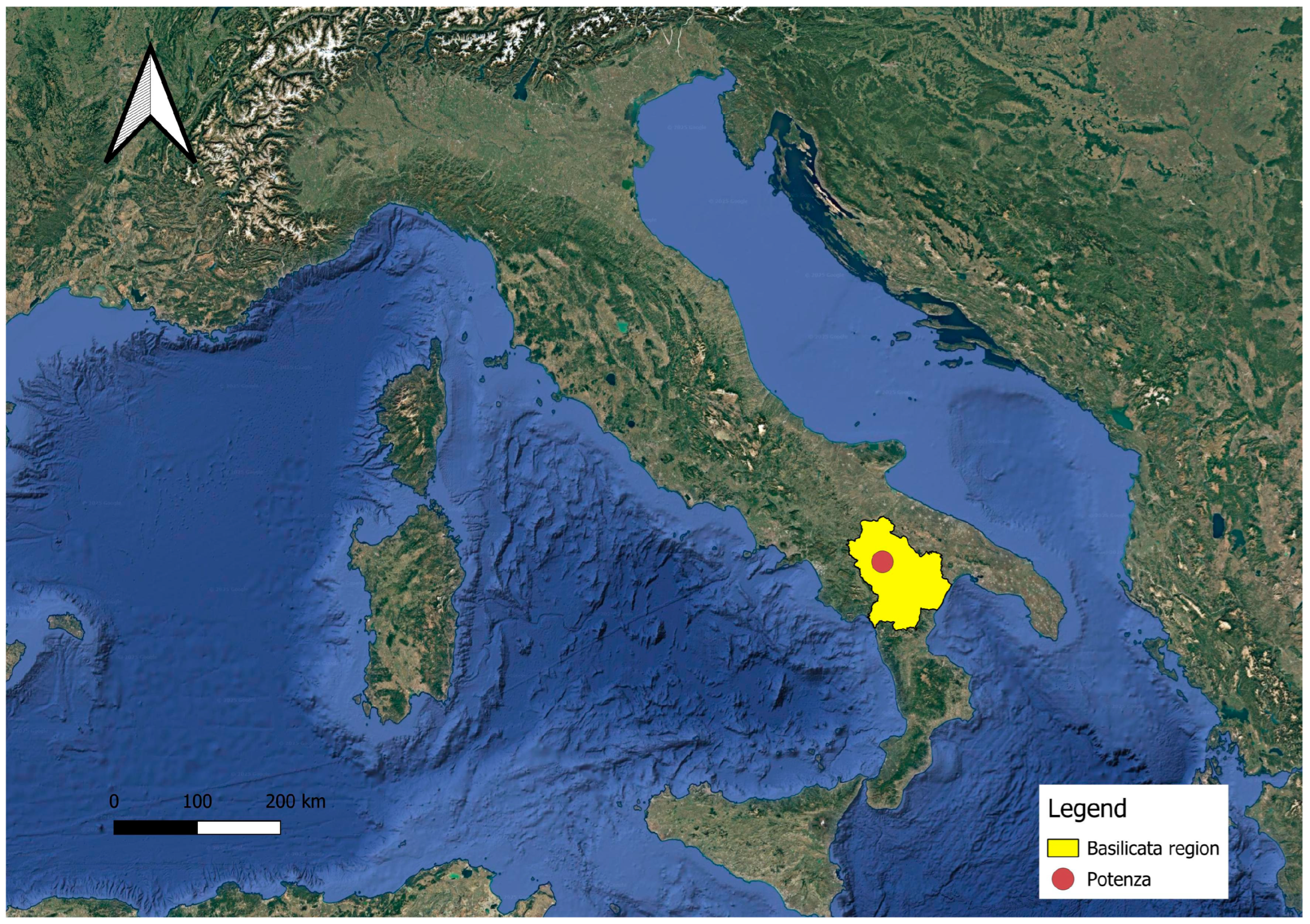
In this survey, we report the first contribution to the checklist of the ornamental vascular flora of the Basilicata region (Southern Italy) (Figure 1). Basilicata, with an area of approximately 9995 km2, is among the smallest regions in Italy and, with just over half a million inhabitants, has one of the lowest population densities in the country [25]. The administrative structure is divided into only two provinces: Potenza, which serves as the regional capital, and Matera. Its territory functions as a geo-crossroads between the Adriatic side (Apulia), the Tyrrhenian side (Calabria), and the inland area (Campania), with outlets to both the Tyrrhenian and Ionian Seas. The dominance of the Lucanian Apennines results in a predominantly mountainous and hilly topography, interrupted by a few plains [25]. This orographic structure, with altitudinal ranges from sea level up to 2267 m at Monte Pollino, creates, despite Basilicata’s limited territorial extent, a complex climatic mosaic: the inland areas exhibit a continental climate with cold, snowy winters; the hilly zones show a temperate sub-continental climate; along the Ionian coast there is a hot-arid Mediterranean alternation; the smaller Tyrrhenian strip enjoys milder and more humid conditions [25]. This climatic complexity allows the region to host a wide spectrum of plant taxa from different bioclimatic areas. Currently, knowledge of the ornamental flora of Basilicata is almost entirely lacking. Indeed, no specific contributions are available, and the only information comes from studies that briefly report the naturalization status of some cultivated exotic species in the region [26].
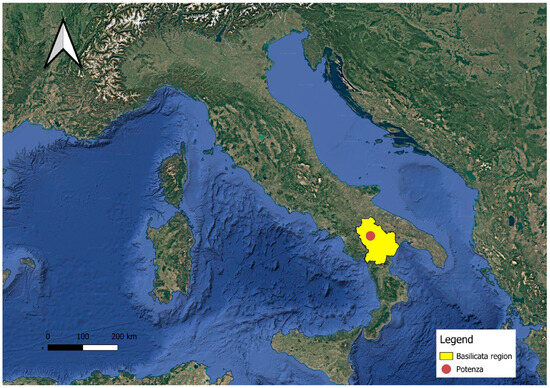
Figure 1.
Geographical location of the Basilicata region.
Our investigation, although preliminary, aims to fill this gap by compiling a checklist of the main ornamental taxa cultivated in the Basilicata region. For the purposes of this study, the term “ornamental plants” is used in its broadest sense, encompassing both native and non-native taxa, including trees, shrubs, annual and perennial herbaceous species, as well as bulbs and tubers, all cultivated for decorative purposes in street tree plantings, historic villas, and public and private gardens in the Basilicata region. In addition to its descriptive purpose, the study aims to provide a knowledge base useful for subsequent evaluations by local administrations, both in terms of the aesthetic and landscape enhancement of the species employed and for the analysis of potential risks associated with their spread. Particular attention is devoted, in this context, to issues related to the invasive capacity of certain species and their effects on public health, especially with regard to the possible increase in allergies.
2. Results
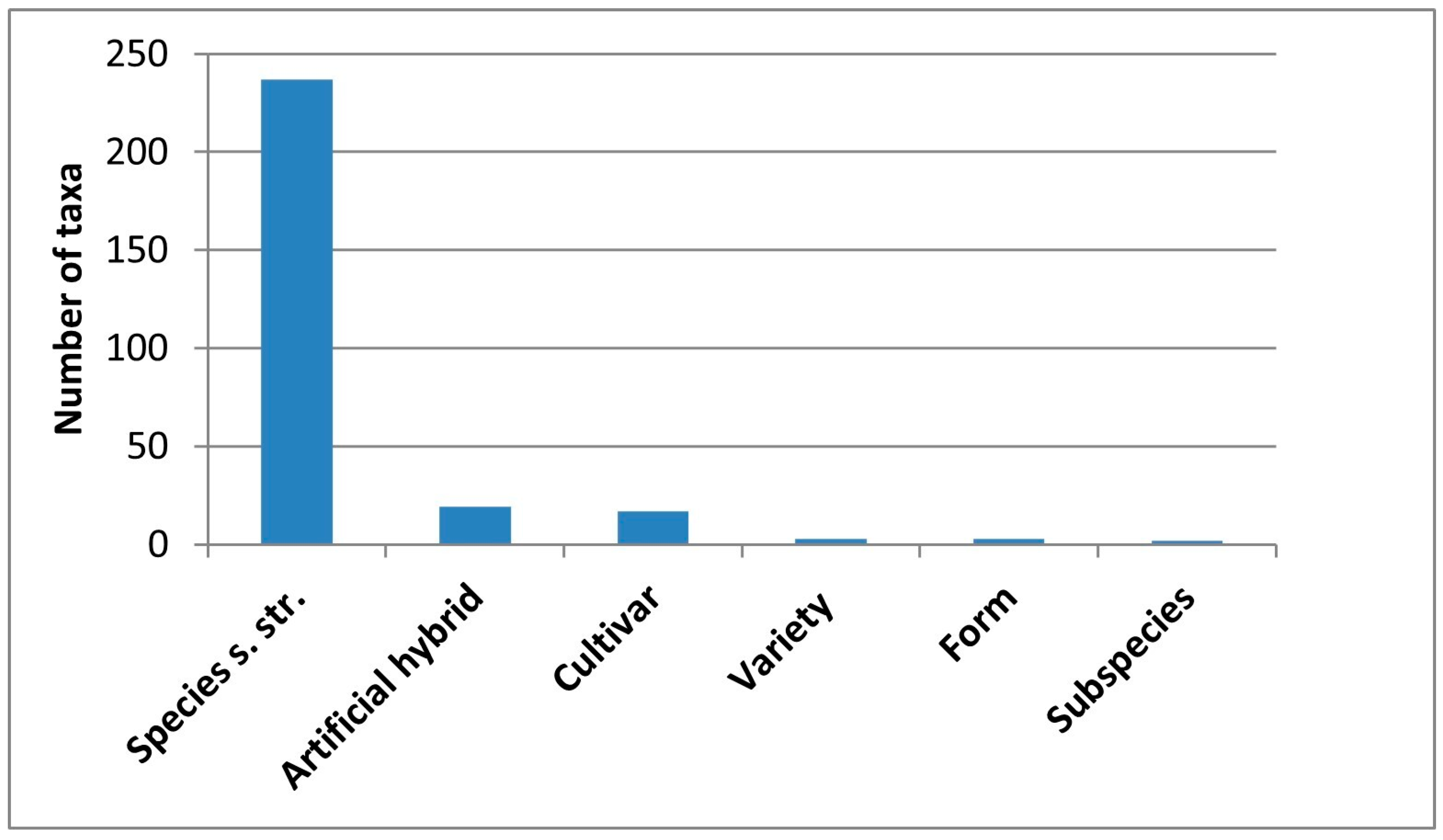
A total of 281 taxa were recorded (Appendix A Table A1), distributed as follows: 237 species sensu stricto, 2 subspecies, 3 varieties, 3 forms, 17 cultivars, and 19 hybrids (Figure 2). Specifically, 1 taxon belongs to Pteridophyta, 1 to Ginkgophyta, 1 to Cycadophyta, 29 to Pinophyta, and 249 to Magnoliophyta (of which 214 are Magnoliopsida and 35 Liliopsida). The recorded taxa belong to 201 genera, distributed in 94 families.
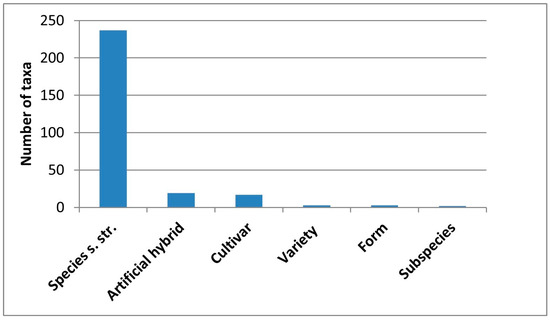
Figure 2.
Taxonomic ranks of the ornamental taxa of Basilicata.
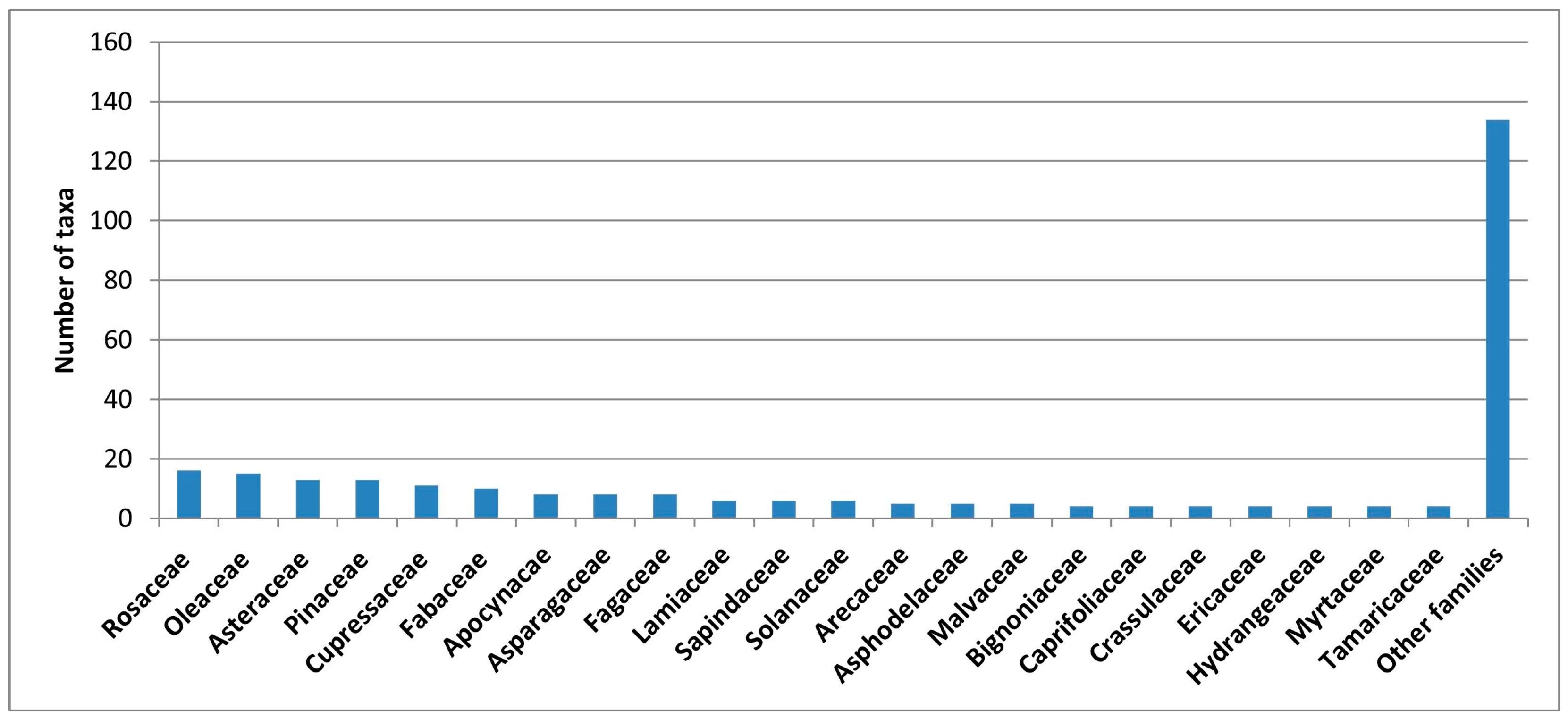
The families with the highest number of specific and infraspecific taxa are Rosaceae (16 taxa, 5.7%), Oleaceae (15 taxa, 5.3%), Asteraceae (13 taxa, 4.6%), Pinaceae (13 taxa, 4.6%), Cupressaceae (11 taxa, 3.9%), and Fabaceae (10 taxa, 3.6%) (Figure 3). The genera with the highest number of taxa are Ligustrum (7), Quercus (6), Acer (5), Abies (4), Tamarix (4), and Viburnum (4).
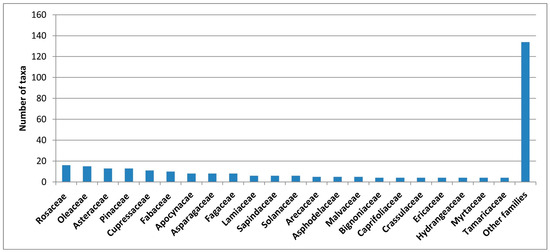
Figure 3.
Number of taxa per families in the ornamental flora of Basilicata.
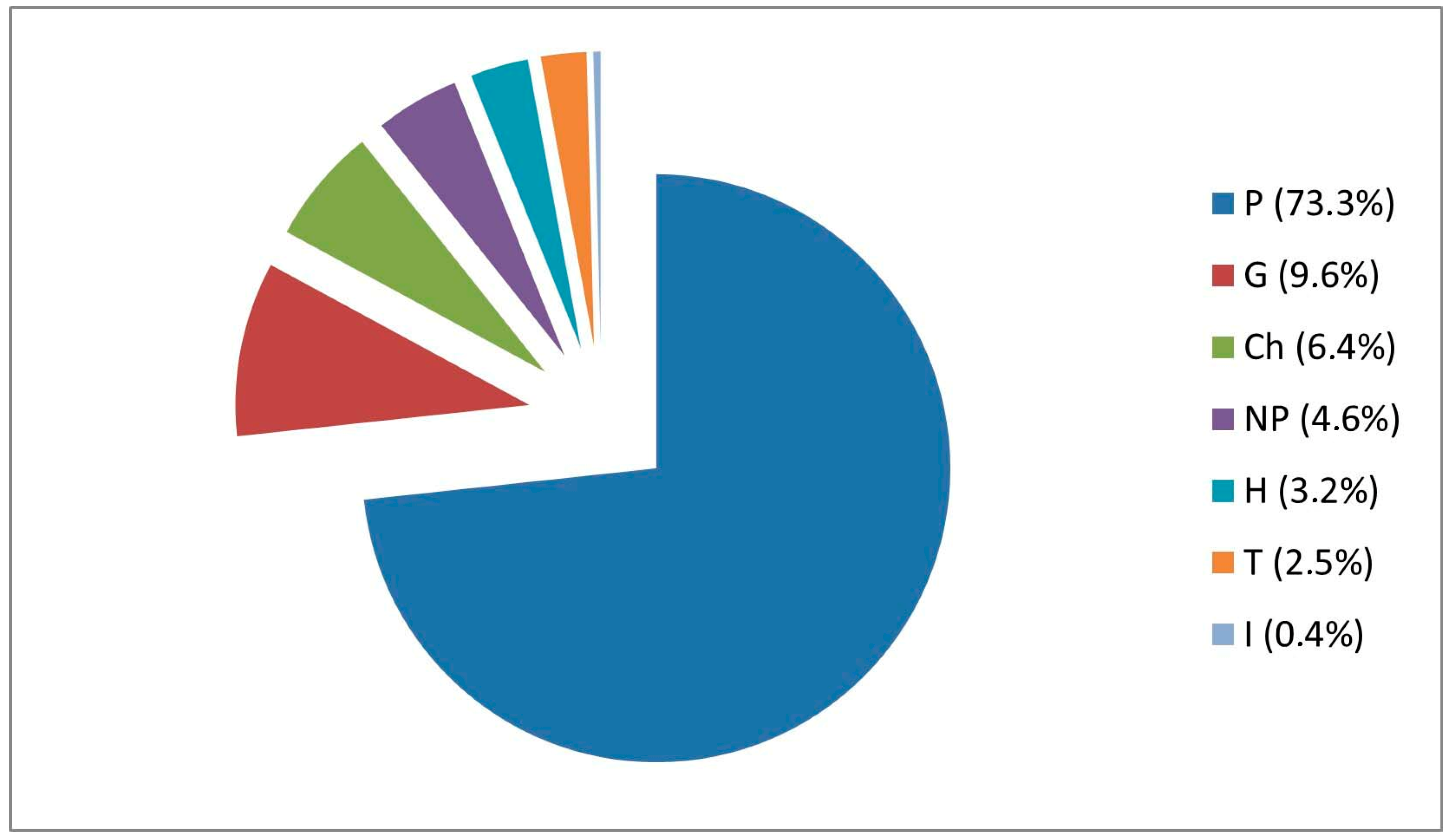
Regarding growth forms, there is a predominance of phanerophytes (P) (particularly scapose and cespitose), i.e., 206 taxa. They are followed by geophytes (G) (27 taxa), chamaephytes (Ch) (18 taxa), nanophanerophytes (NP) (13 taxa), and hemicryptophytes (H) (9 taxa). Lower percentages are observed in therophytes (T) (7 taxa) and hydrophytes (I) (1 taxon) (Figure 4).
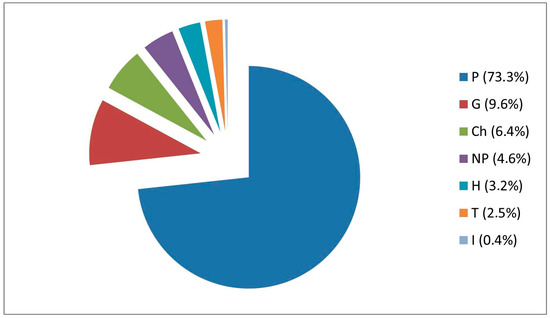
Figure 4.
Spectrum of growth forms of ornamental taxa in Basilicata classified according to [27,28] (P, Phanerophyte; NP, Nanophanerophyte; Ch, Chamaephyte; H, Hemicryptophyte; G, Geophyte; T, Therophyte; I, Hydrophyte).
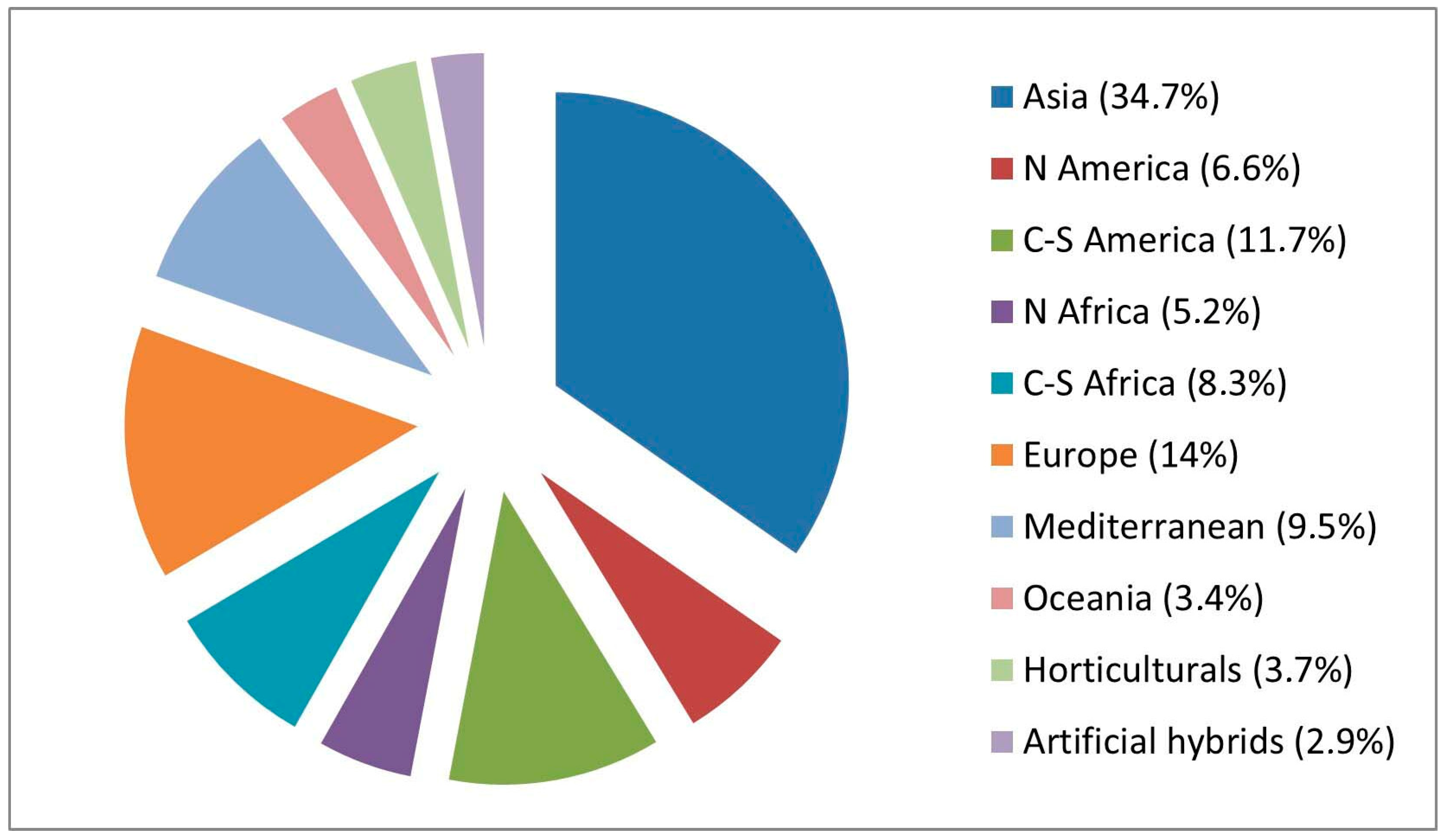
Regarding the geographic origin of the recorded taxa, the largest percentage is represented by the Asian contingent, followed by the American contingent and the European one. The African contingent represents the dominant component, with the Mediterranean and Oceanic groups following in relative abundance. Horticultural taxa and artificial hybrids are comparatively minor elements within the dataset (Figure 5).
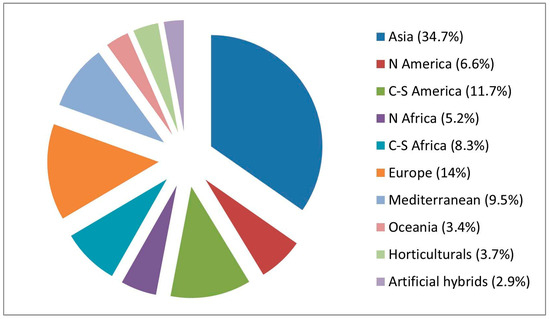
Figure 5.
Percentage of taxa by geographical origin (according to [27]).
The most represented biome of origin is the temperate biome (160 taxa, 57.0%), and the vast majority of taxa, with respect to their residence time in Italy, fall into the neophyte category (135 taxa, 48.0%).
Regarding their status in Italy, only 64 taxa are native, while 215 taxa are alien; the remaining taxa belong to the historical category (1 taxon) and the cryptogenic category (1 taxon).
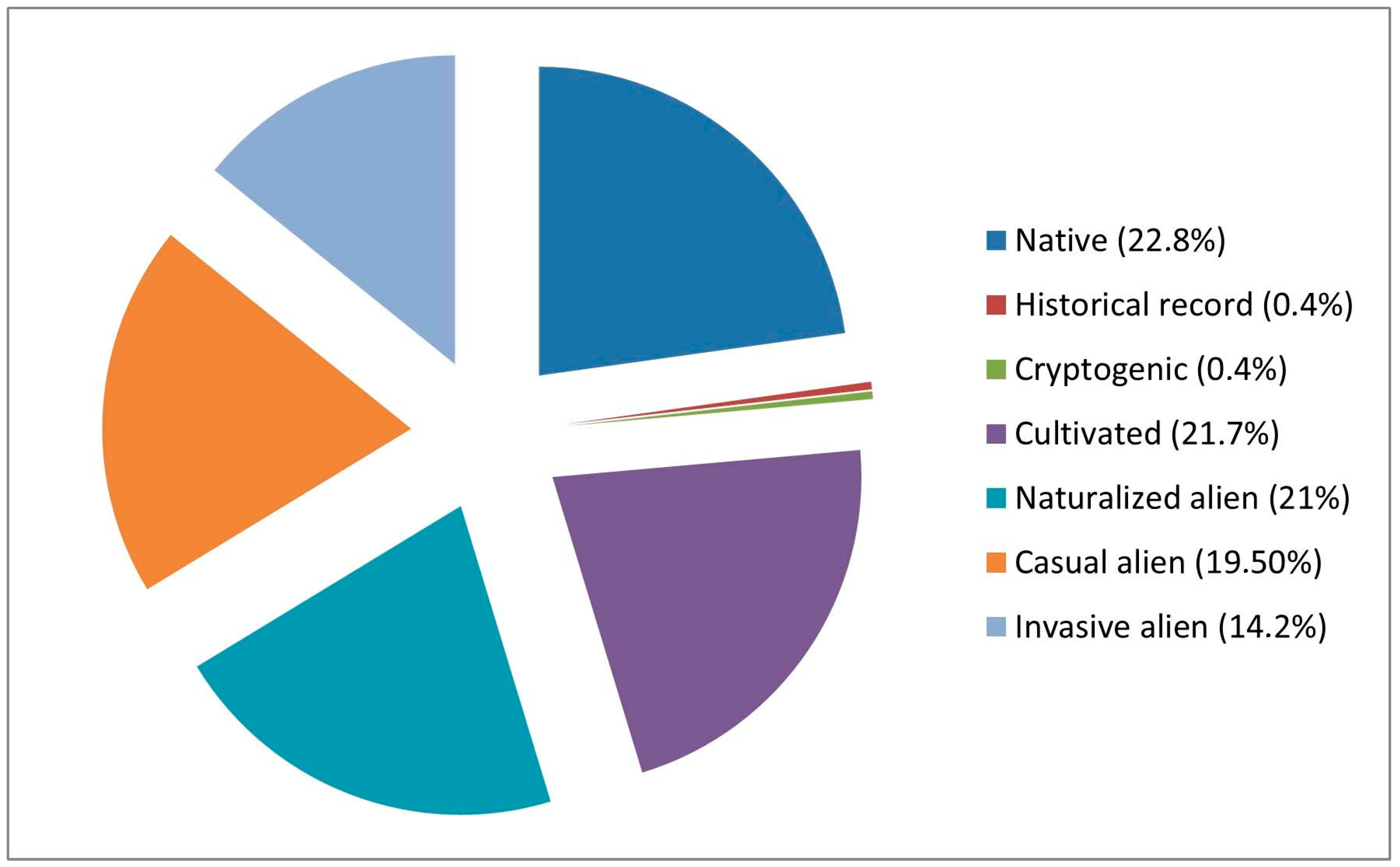
Considering the tendency of alien taxa to naturalize, 61 taxa are cultivated, 59 taxa are naturalized (i.e., tending to form stable populations), 55 taxa are casual aliens (i.e., showing a tendency to naturalize but not forming stable populations separate from cultivated plants), and 40 taxa are invasive aliens (i.e., potentially posing a threat to biodiversity by competing with native species) (Figure 6).
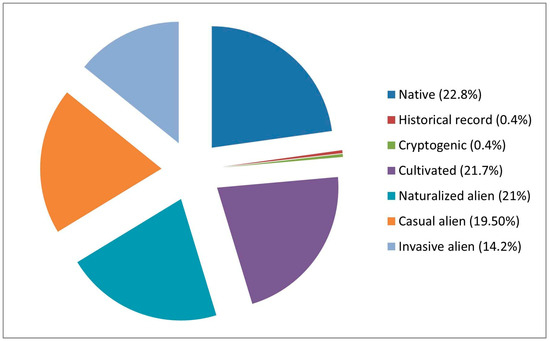
Figure 6.
Status in Italy (according to [26,29]) and percentage of ornamental taxa.
3. Discussion
The census carried out within the framework of our research has made permitted to draw up a preliminarylist of ornamental taxa from Basilicata (Appendix A Table A1), highlighting how the bioclimatic heterogeneity of the region, which extends from coastal areas to hills and up to the mountainous reliefs of the Lucanian Apennines, creates ecological conditions suitable for the cultivation of ornamental species originating from different geographical and climatic contexts. In fact, in mountainous or hilly areas, taxa typical of cold and temperate climates are found, such as Abies alba Mill., A. cephalonica Loudon, A. pinsapo Boiss., Cedrus atlantica (Endl.) Manetti ex Carrière, C. deodara (Roxb. ex D. Don) G. Don, C. libani A. Rich., Picea abies (L.) H. Karst., P. pungens Engelm., Sequoia sempervirens (D. Don) Endl., Taxus baccata L., etc. Along the coasts, the warm climate allows the establishment of species of subtropical and tropical origin, such as Aeonium arboreum (L.) Webb & Berthel., Agapanthus africanus (L.) Hoffmanns., Araucaria columnaris (G.Forst.) Hook., A. heterophylla (Salisb.) Franco, Cascabela thevetia (L.) Lippold, Hibiscus × rosa-sinensis L., Metrosideros excelsa Sol. ex Gaertn., Musa × paradisiaca L., Syagrus romanzoffiana (Cham.) Glassman, etc. Although the coasts cover a limited area compared to the rest of the region, when subtropical and tropical species are considered together, they account for almost 40% of the recorded taxa, a significant percentage that testifies to the importance of this contingent in characterizing the regional ornamental flora of Basilicata. The contingent of Mediterranean climate taxa also proved to be well represented overall, bearing witness to the growing interest in the use of native species for ornamental purposes and, more generally, to greater attention towards sustainable solutions compatible with local ecological conditions.
This heritage intertwines with another element of great importance in the Basilicata plant landscape, namely the presence of monumental species and so-called monumental trees which, while largely belonging to native taxa such as Castanea sativa Mill., Fagus sylvatica L., Quercus cerris L., Q. pubescens Willd., Pinus heldreichii subsp. leucodermis (Antoine) A.E.Murray, and Taxus baccata, also include species introduced for ornamental purposes and now fully integrated into the regional landscape. A striking example is represented by Sequoia sempervirens cultivated in Campomaggiore Vecchio (Potenza) [30,31]. The coexistence of exotic ornamental species and native monumental trees prompts reflections on the importance of reconciling aesthetic enhancement with the conservation of genetic resources and historical-cultural heritage. From this perspective, urban green planning and management strategies should be oriented towards resilient taxa adaptable to Basilicata bioclimatic conditions and ongoing climate change, while simultaneously promoting the protection of centuries-old specimens, recognized as elements of high ecological, identity, and landscape value.
The census of ornamental flora in Basilicata has also highlighted a dual aspect of relevance for urban and periurban green planning: on the one hand, the presence of many taxa that combine aesthetic value with productive function; on the other, the spread of ornamental species that can have negative effects on human health, both due to intrinsic toxicity and allergenic potential. The use of ornamental plants that also play a role in providing food represents a strategic resource from the perspective of landscape multifunctionality. Species such as Castanea sativa, Citrus × aurantium L., C. × limon (L.) Osbeck, Corylus avellana L., Diospyros kaki Thunb., Juglans regia L., Musa × paradisiaca L., and Punica granatum L. not only enrich green spaces with their aesthetic value and the seasonality of their blooms but also provide food products of high nutritional and cultural value. These plants, rooted in the Mediterranean agricultural and culinary tradition, also represent a bridge between the botanical and agro-food heritage of the region, contributing to strengthening the sense of local identity and promoting sustainable green management practices. Species such as Aloe arborescens Mill. and A. vera L. add further value as they offer phytotherapeutic and medicinal benefits, thus acting as ornamental plants with a functional role in promoting well-being [32,33].
At the same time, our study highlighted the need for greater awareness regarding the use of potentially harmful ornamental taxa. Some genera and species very common in urban contexts, such as Cupressus spp., Hesperocyparis spp., Pinus spp., Ailanthus altissima, Olea europaea L., Quercus ilex L., and Populus sp. pl., are responsible for allergic phenomena such as pollinosis [34,35,36], which represent an increasing problem for public health, especially in densely populated areas and near schools and hospitals. Another negative aspect is the presence of poisonous ornamental plants such as Cascabela thevetia (L.) Lippold, Laburnum anagyroides Medik., Melia azedarach L., Nerium oleander L., Nicotiana glauca Graham, Ricinus communis L., Tagetes erecta L., Taxus baccata L., and Thuja occidentalis L. These plants, although endowed with undeniable decorative value, contain toxic secondary metabolites that can pose a serious risk in the event of accidental ingestion or contact, particularly for children and domestic animals [37,38,39]. In light of these considerations, it is essential to adopt a critical and selective approach in the choice of ornamental species to be introduced into new public and private gardens. The integration of ornamental and food plants can foster the creation of more resilient, multifunctional green spaces rooted in local traditions, while the exclusion or controlled management of toxic and allergenic species can help reduce risks to population health. In the long term, such strategies would not only enhance the horticultural heritage of Basilicata but also promote a model of ornamental greenery that is sustainable, safe, and aligned with community needs.
Our investigation also revealed a considerable number of alien species in the flora of Basilicata, a phenomenon that is unfortunately widespread and observed worldwide. The predominant presence of alien ornamental taxa in the ornamental flora of Basilicata (almost 80%, of which 55% have begun the process of naturalization, with a large predominance of naturalized alien species) (Figure 6 and Figure 7) compared to native species represents an alert, as it shows how landscaping and ornamental choices of recent decades have favored the introduction of exotic species, often to the detriment of local plant components. This imbalance weakens the resilience of native flora, threatening local biodiversity and generating ecological imbalances that are difficult to contain. The massive use of alien ornamental plants becomes even more relevant when considering alien species that, in addition to competing with native flora, are dangerous to public health. This is the case, for example, of Melia azedarach, a plant of high ornamental value but characterized by high toxicity: its fruits are poisonous and potentially lethal, even if its young specimens are easily found in nurseries and the species is now naturalized in Basilicata. At the same time, the presence and spread of other invasive alien species pose a growing threat to local ecosystems. Some, such as Acacia saligna (Labill.) H. L. Wendl., Ailanthus altissima, Carpobrotus acinaciformis (L.) L. Bolus, C. edulis (L.) N.E.Br., Opuntia ficus-indica (L.) Mill., and Robinia pseudoacacia L., are known for their extraordinary ability to rapidly colonize new environments, altering natural habitats and denying native species of resources and space. All this makes these species particularly dangerous and difficult to manage, requiring interventions no longer limited to simple containment measures, but oriented towards true eradication programs. The eradication of invasive alien species is an action that, besides being complex and costly, is in some cases also difficult to implement. The eradication of Ailanthus altissima, for example, represents one of the most complex challenges in invasive species management. This plant, in fact, possesses an extraordinary vegetative regeneration capacity: even when cut or pollarded, it very rapidly produces a number of root suckers which not only ensure its survival but even favor its further spread. This characteristic makes simple mechanical interventions ineffective and often leads to an increase in population density, worsening the problem instead of containing it. For this reason, the management of tree-of-heaven requires integrated approaches that combine mechanical and chemical practices associated with repeated and long-term interventions, in order to truly reduce the vitality of the species and limit its spread [40,41].
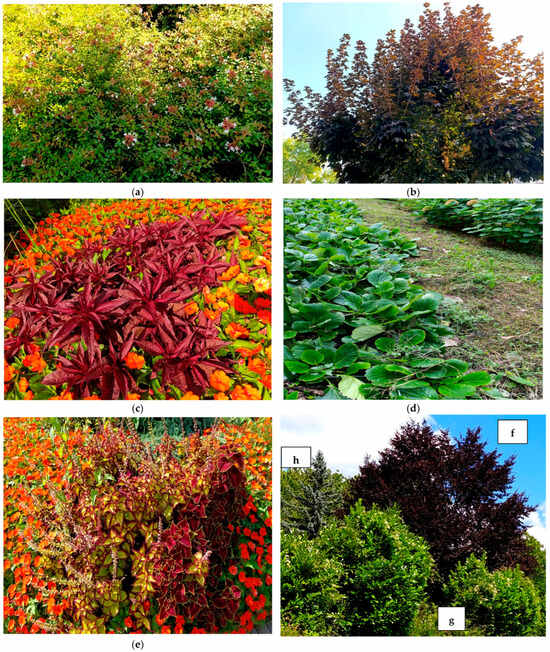
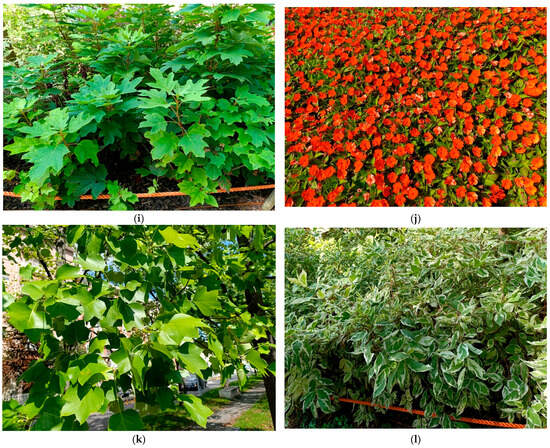
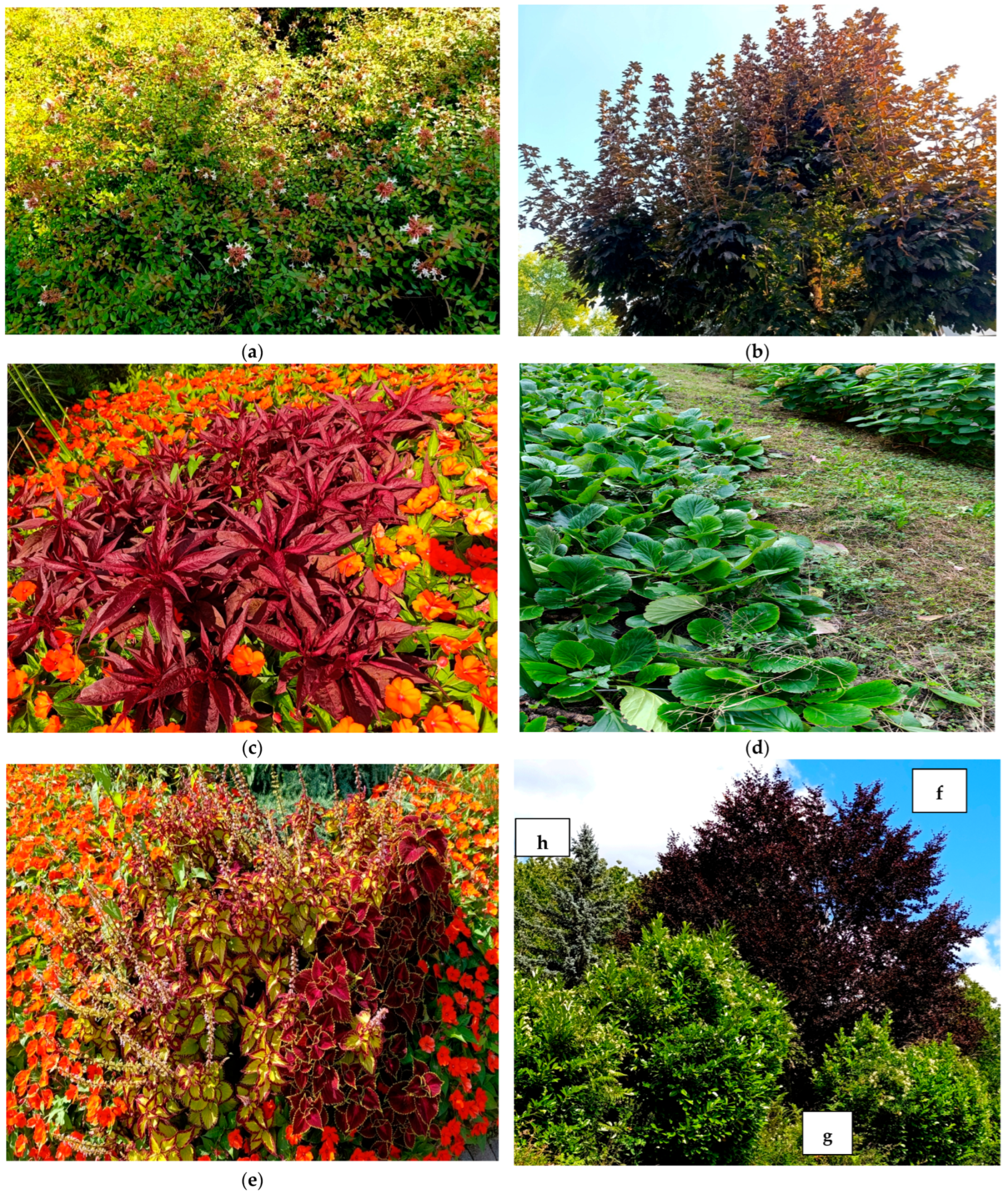
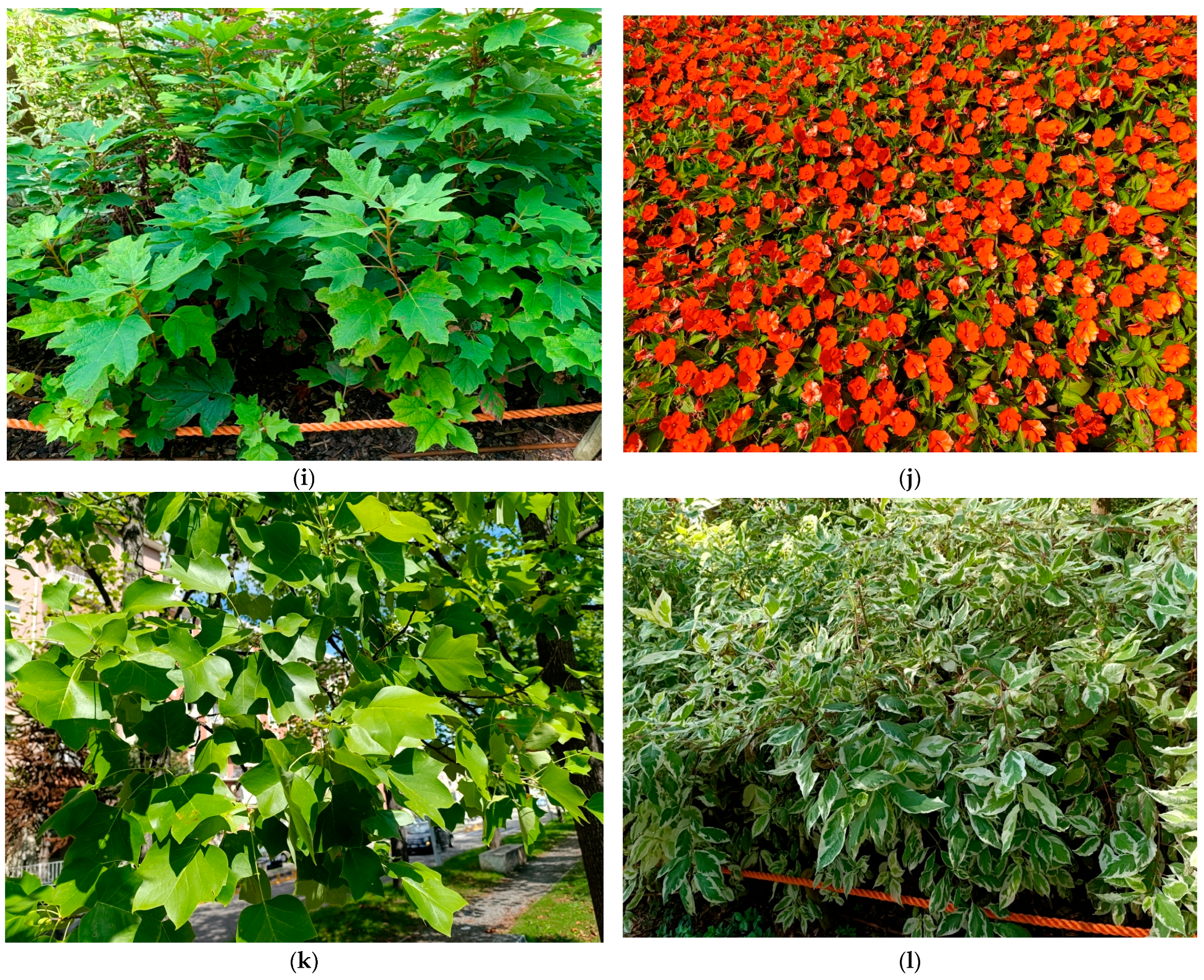
Figure 7.
Ornamental species found in parks, public and private gardens, and along urban avenues in Basilicata. (a) Abelia × grandiflora, (b) Acer pseudoplatanus ‘Atropurpureum’, (c) Amaranthus cruentus, (d) Bergenia crassifolia, (e) Coleus scutellarioides, (f) Fagus sylvatica ‘Purpurea’, (g) Viburnum odoratissimum, (h) Picea pungens ‘Kosteriana’, (i) Hydrangea quercifolia, (j) Impatiens hawkeri, (k) Liriodendron tulipifera, and (l) Weigela florida ‘Variegata’.
In view of this, the problem of biological invasions can no longer be addressed as a marginal issue. Their spread, fueled by nursery practices not always attentive and by a growing demand for exotic ornamental species, today requires radically more effective prevention, awareness and management strategies. Recently, the issue of invasive species has finally returned to the center of the debate in Italy, with initiatives aimed not only at raising public awareness of the risks associated with their introduction and spread, but also at promoting good practices both in nursery production and gardening [23]. However, in order for such measures to produce concrete results, it will be necessary to complement education and prevention programs with constant commitment in terms of monitoring, timely eradication interventions, and stricter protection policies.
4. Materials and Methods
To assess the composition of ornamental plants cultivated in Basilicata, a survey was conducted in two main phases. First, data already available in the literature regarding the regional ornamental flora were examined [16,26].
Subsequently, between 2024 and 2025, direct field observations were carried out throughout the provinces of Basilicata. Specifically, surveys were conducted during the spring, summer, and autumn of 2024, and during the spring and summer of 2025, in order to observe plants during their flowering period and thus ensure accurate identification of the various taxa. In particular, we organized daily field excursions, and we excluded the ornamental plants cultivated inside botanical gardens and the surroundings of the biggest cities.
To represent the main climatic gradients of the region, the surveys included sites distributed along the coastal, hilly, and mountainous areas. In particular, urban and peri-urban environments were examined, including street tree plantings, historic villas, and both public and private gardens. The investigated localities cover 13 urban areas, which are reported in Table 1.

Table 1.
List of the main investigated localities.
Taxonomic identification was performed with the support of authoritative floristic references [42,43,44,45,46,47,48,49,50]. Recorded taxa are listed in Appendix A Table A1. The nomenclature adopted follows the Plants of the World Online database (POWO, https://powo.science.kew.org, accessed on 5 September 2025) [27], and the taxon names are presented in alphabetical order. The checklist includes not only species sensu stricto but also infraspecific categories (subspecies, varieties, forms, cultivars) and hybrids. For each taxon, the following information was reported: family (according to [27]); growth form (according to [27,28]); geographic area of origin (derived from [27]); biome of origin (according to [27]); residence time (archaeophyte/neophyte) and status in Italy (native/alien), in accordance with [26,29].
5. Conclusions
Our investigation contributes to the knowledge of urban ornamental greenery, a field of research that has so far received limited attention at the national level but is gaining increasing interest, not only from a botanical perspective but also in practical and managerial terms. Urban ornamental greenery, in fact, represents a strategic element in territorial planning and in the sustainable management of public and private spaces, thereby requiring the development of targeted and informed strategies capable of integrating aesthetic, functional, and ecological requirements. In addition, our investigation contributes by initiating studies into the ornamental flora of Basilicata, which has remained largely unexplored until now. The number of taxa recorded, amounting to 281, is significant when compared to the limited size of the region, even though most of these are ornamental species commonly used in other Italian regions as well. The data collected in this first contribution provides a useful basis not only for further studies on the exotic component present in the Basilicata territory, but also to support municipal administrations in future actions of recovery, conservation, enhancement, and qualification of the plant heritage, with particular attention given to biodiversity protection and citizens’ well-being.
Author Contributions
Conceptualization, G.V., M.L.G. and E.D.G.; methodology, G.V. and E.D.G.; software, R.P., E.D.G. and F.C.; validation, G.V., E.D.G. and M.L.G.; investigation, E.D.G., R.P. and F.C.; resources, G.V.; data curation, E.D.G., R.P., F.C. and G.V.; writing—original draft preparation, E.D.G. and R.P.; writing—review and editing, G.V. and M.L.G.; visualization, G.V.; supervision, G.V. and M.L.G.; project administration, G.V.; funding acquisition, G.V. All authors have read and agreed to the published version of the manuscript.
Funding
Project funded under the National Recovery and Resilience Plan (NRRP), Mission 4, Component 2, Investment 1.4-Call for tender Number 3138 of 16 December 2021, rectified by Decree n. 3175 of 18 December 2021 of the Italian Ministry of University and Research funded by the European Union—NextGenerationEU Project Code CN_00000033, Concession Decree Number 1034 of 17 June 2022 adopted by the Italian Ministry of University and Research, CUP B73C22000790001, Project Title “National Biodiversity Future Center-NBFC”.
Data Availability Statement
Data are contained within the article.
Conflicts of Interest
The authors declare no conflicts of interest.
Abbreviations
The following abbreviations are used in this manuscript:
| POWO | Plants of the World Online database |
Appendix A
Table A1.
List of ornamental taxa surveyed in the Basilicata region, sorted by family, growth form (according to [27,28]), area of geographical origin (derived from [27]), biome origin (according to [27]), time of residence (archaeophyte/neophyte) and status (native/alien) in Italy (both derived from [26,29]).
Table A1.
List of ornamental taxa surveyed in the Basilicata region, sorted by family, growth form (according to [27,28]), area of geographical origin (derived from [27]), biome origin (according to [27]), time of residence (archaeophyte/neophyte) and status (native/alien) in Italy (both derived from [26,29]).
| Family | Taxa | Growth Form | Geographical Origin | Biome Origin | Time of Residence | Status in Italy |
|---|---|---|---|---|---|---|
| Acanthaceae | Acanthus mollis L. | H scap | Mediterranean | Temperate | Native | |
| Aizoaceae | Carpobrotus acinaciformis (L.) L.Bolus | Ch suffr | S Africa | Subtropical | Neophyte | Invasive alien |
| Aizoaceae | Carpobrotus edulis (L.) N.E.Br. | Ch suffr | S Africa | Subtropical | Neophyte | Invasive alien |
| Aizoaceae | Mesembryanthemum cordifolium L.f. | Ch suffr | Cape Province | Subtropical | Neophyte | Invasive alien |
| Altingiaceae | Liquidambar styraciflua L. | P scap | USA, C America | Temperate | Neophyte | Casual alien |
| Amaranthaceae | Amaranthus cruentus L. | T scap | S America | Tropical | Cultivated | |
| Amaryllidaceae | Agapanthus africanus (L.) Hoffmanns. | G rhiz | S Africa | Subtropical | Cultivated | |
| Amaryllidaceae | Clivia miniata Regel | G rhiz | S Africa | Subtropical | Cultivated | |
| Amaryllidaceae | Narcissus tazetta L. | G bulb | Mediterranean | Subtropical | Native | |
| Anacardiaceae | Cotinus coggygria Scop. | P caesp, P scap | C-S Europe, C Asia | Temperate | Native | |
| Anacardiaceae | Pistacia lentiscus L. | P caesp, P scap | Mediterranean | Subtropical | Native | |
| Anacardiaceae | Schinus molle L. | P scap | S America | Subtropical | Neophyte | Naturalized alien |
| Apocynaceae | Carissa macrocarpa (Eckl.) A.DC. | P caesp | S Africa | Shrubland | Neophyte | Naturalized alien |
| Apocynaceae | Cascabela thevetia (L.) Lippold | P caesp, P scap | C-S America | Tropical | Neophyte | Naturalized alien |
| Apocynaceae | Catharanthus roseus (L.) G.Don | Ch frut | Madagascar | Tropical | Neophyte | Naturalized alien |
| Apocynaceae | Mandevilla laxa (Ruiz & Pav.) Woodson | P lian | S America | Tropical | Cultivated | |
| Apocynaceae | Nerium oleander L. | P caesp | Mediterranean, S-W Asia | Subtropical | Native | |
| Apocynaceae | Trachelospermum jasminoides (Lindl.) Lem. | P lian | E Asia | Subtropical | Neophyte | Casual alien |
| Apocynaceae | Vinca major L. | Ch rept | S Europe, Caucasus | Temperate | Native | |
| Apocynaceae | Vinca major var. variegata Loudon | Ch rept | Horticultural | Temperate | Cultivated | |
| Aquifoliaceae | Ilex aquifolium L. | P caesp, P scap | Europe, N-W Africa | Temperate | Native | |
| Aquifoliaceae | Ilex aquifolium L. ‘Aurea Marginata’ | P scap | Horticultural | Temperate | Cultivated | |
| Araceae | Zantedeschia aethiopica (L.) Spreng. | G rhiz | S Africa | Tropical | Neophyte | Invasive alien |
| Araliaceae | Hedera canariensis Willd. | P lian | Canarie Island | Temperate | Neophyte | Naturalized alien |
| Araliaceae | Hedera helix L. | P lian | Europe, W Asia | Temperate | Native | |
| Araucariaceae | Araucaria araucana (Molina) K.Koch | P scap | S America | Temperate | Cultivated | |
| Araucariaceae | Araucaria columnaris (G.Forst.) Hook. | P scap | New Caledonia | Tropical | Cultivated | |
| Araucariaceae | Araucaria heterophylla (Salisb.) Franco | P scap | Norfolk Island | Tropical | Cultivated | |
| Arecaceae | Chamaerops humilis L. | NP | Mediterranean | Subtropical | Native | |
| Arecaceae | Phoenix canariensis H.Wildpret | P scap | Canarie Island | Subtropical | Neophyte | Naturalized alien |
| Arecaceae | Syagrus romanzoffiana (Cham.) Glassman | P scap | S America | Tropical | Casual alien | |
| Arecaceae | Trachycarpus fortunei (Hook.) H.Wendl. | P scap | E Asia | Temperate | Neophyte | Invasive alien |
| Arecaceae | Washingtonia filifera var. robusta (H.Wendl.) Parish | P scap | Mexico | Shrubland | Neophyte | Naturalized alien |
| Asparagaceae | Agave americana L. | P caesp | Mexico | Tropical | Neophyte | Invasive alien |
| Asparagaceae | Agave americana var. marginata Trel. | P caesp | Mexico | Tropical | Neophyte | Invasive alien |
| Asparagaceae | Asparagus falcatus L. | P lian | S-E Africa, India | Tropical | Neophyte | Casual alien |
| Asparagaceae | Asparagus setaceus (Kunth) Jessop | G rhiz | S-E Africa | Tropical | Neophyte | Naturalized alien |
| Asparagaceae | Aspidistra elatior Blume | G rhiz | Japan | Subtropical | Neophyte | Casual alien |
| Asparagaceae | Cordyline australis (G.Forst.) Endl. | P caesp | New Zealand | Subtropical | Neophyte | Casual alien |
| Asparagaceae | Ruscus aculeatus L. | G rhiz | C-S Europe, N Africa, Caucasus | Temperate | Native | |
| Asparagaceae | Yucca gigantea Lem. | P caesp | C America | Tropical | Neophyte | Casual alien |
| Asphodelaceae | Aloe arborescens Mill. | P succ | S Africa | Shrubland | Neophyte | Naturalized alien |
| Asphodelaceae | Aloe vera (L.) Burm.f. | P succ, NP | Oman | Shrubland | Archaeophyte | Naturalized alien |
| Asphodelaceae | Kniphofia uvaria (L.) Oken | Ch succ | Cape Province | Temperate | Neophyte | Casual alien |
| Asphodelaceae | Phormium tenax J.R.Forst. & G.Forst. | G rhiz | Norfolk Island, New Zealand | Temperate | Neophyte | Casual alien |
| Asphodelaceae | Phormium tenax J.R.Forst. & G.Forst. ‘Variegata’ | G rhiz | Horticultural | Temperate | Cultivated | |
| Asteraceae | Calendula suffruticosa Vahl | Ch suffr | S-W Mediterranean | Subtropical | Native | |
| Asteraceae | Chrysanthemum indicum L. | Ch frut | E Asia | Temperate | Cultivated | |
| Asteraceae | Dahlia × hortensis Guillaumin | G rhiz | Horticultural | Tropical | Cultivated | |
| Asteraceae | Dimorphotheca fruticosa (L.) DC. | H scap | Cape Province | Subtropical | Neophyte | Casual alien |
| Asteraceae | Dimorphotheca sinuata DC. | H caesp | S Africa | Subtropical | Cultivated | |
| Asteraceae | Euryops pectinatus (L.) Cass. | P caesp | S Africa | Subtropical | Cultivated | |
| Asteraceae | Farfugium japonicum (L.) Kitam. | H caesp | China, Japan | Subtropical | Cultivated | |
| Asteraceae | Gazania rigens (L.) Gaertn. | H caesp | S Africa | Subtropical | Neophyte | Naturalized alien |
| Asteraceae | Helianthus annuus L. | T scap | S America | Temperate | Neophyte | Casual alien |
| Asteraceae | Helianthus tuberosus L. | G bulb | N America | Temperate | Neophyte | Invasive alien |
| Asteraceae | Senecio angulatus L.f. | P lian | Cape Province | Subtropical | Neophyte | Invasive alien |
| Asteraceae | Tagetes erecta L. | T scap | C America | Subtropical | Neophyte | Casual alien |
| Asteraceae | Zinnia elegans Jacq. | T scap | C America | Tropical | Neophyte | Casual alien |
| Balsaminaceae | Impatiens hawkeri W.Bull | H scap | Papuasia | Tropical | Cultivated | |
| Begoniaceae | Begonia cucullata Willd. | H scap | S America | Tropical | Cultivated | |
| Berberidaceae | Berberis thunbergii DC. ‘Atropurpureum’ | Ch suffr | Japan | Temperate | Cultivated | |
| Berberidaceae | Nandina domestica Thunb. | P caesp | China | Temperate | Neophyte | Casual alien |
| Betulaceae | Alnus cordata Desf. | P scap | Corse | Temperate | Native | |
| Betulaceae | Corylus avellana L. | P caesp | Europe, Caucasus | Temperate | Native | |
| Betulaceae | Ostrya carpinifolia Scop. | P scap | S-C Europe, Caucasus | Temperate | Native | |
| Bignoniaceae | Campsis grandiflora (Thunb.) K.Schum. | P lian | China, Japan | Temperate | Cultivated | |
| Bignoniaceae | Campsis radicans (L.) Bureau | P lian | S-E USA | Subtropical | Neophyte | Naturalized alien |
| Bignoniaceae | Catalpa bignonioides Walter | P scap | N America | Temperate | Neophyte | Naturalized alien |
| Bignoniaceae | Tecomaria capensis (Thunb.) Spach | P caesp | S Africa | Subtropical | Neophyte | Casual alien |
| Buxaceae | Buxus sempervirens L. | NP | C-S Europe, N Africa, Caucasus | Temperate | Native | |
| Cactaceae | Opuntia ficus-indica (L.) Mill. | P succ | Mexico | Tropical | Neophyte | Invasive alien |
| Cactaceae | Opuntia humifusa (Raf.) Raf. | P succ | USA, Mexico | Shrubland | Neophyte | Invasive alien |
| Cactaceae | Opuntia tuna (L.) Mill. | P succ | C America | Tropical | Neophyte | Naturalized alien |
| Calycanthaceae | Calycanthus floridus L. | P caesp | N America | Temperate | Neophyte | Casual alien |
| Cannabaceae | Celtis australis L. | P scap | S Europe, N-W Africa, Caucasus | Subtropical | Native | |
| Cannaceae | Canna indica L. | G rhiz | C-S America | Tropical | Neophyte | Naturalized alien |
| Capparaceae | Capparis spinosa L. | NP | Mediterranean | Subtropical | Native | |
| Caprifoliaceae | Abelia × grandiflora (Rovelli ex André) Rehder | P caesp | Artificial hybrid | Temperate | Cultivated | |
| Caprifoliaceae | Lonicera japonica Thunb. | P caesp | E Asia | Temperate | Neophyte | Invasive alien |
| Caprifoliaceae | Symphoricarpos albus (L.) S.F.Blake | P caesp | N America, Mexico | Temperate | Neophyte | Naturalized alien |
| Caprifoliaceae | Weigela florida (Bunge) A.DC. ‘Variegata’ | P caesp | Horticultural | Temperate | Cultivated | |
| Celastraceae | Euonymus japonicus Thunb. | P caesp | Japan | Subtropical | Neophyte | Naturalized alien |
| Celastraceae | Euonymus japonicus Thunb. ‘Aureomarginatus’ | P caesp | Japan | Subtropical | Cultivated | |
| Commelinaceae | Tradescantia fluminensis Vell. | G rhiz | S America | Tropical | Neophyte | Invasive alien |
| Commelinaceae | Tradescantia pallida (Rose) D.R.Hunt | G rhiz | Mexico | Tropical | Neophyte | Casual alien |
| Convolvulaceae | Ipomoea purpurea (L.) Roth | P lian | C-S America | Tropical | Neophyte | Naturalized alien |
| Crassulaceae | Aeonium arboreum (L.) Webb & Berthel. | NP | Canarie Island | Subtropical | Archaeophyte | Invasive alien |
| Crassulaceae | Aeonium arboreum (L.) Webb & Berthel. ‘Atropurpureum’ | NP | Canarie Island | Subtropical | Cultivated | |
| Crassulaceae | Crassula ovata (Mill.) Druce | NP succ | S Africa | Subtropical | Neophyte | Casual alien |
| Crassulaceae | Petrosedum rupestre (L.) P.V.Heath | Ch succ | C-W Europe, Turkey | Temperate | Native | |
| Cupressaceae | Chamaecyparis lawsoniana (A.Murray bis) Parl. | P scap | N America | Temperate | Neophyte | Casual alien |
| Cupressaceae | Cupressus sempervirens f. horizontalis (Mill.) Voss | P scap | Mediterranean, Iran | Temperate | Archaeophyte | Naturalized alien |
| Cupressaceae | Cupressus sempervirens L. | P scap | Mediterranean, Iran | Temperate | Archaeophyte | Naturalized alien |
| Cupressaceae | Hesperocyparis arizonica (Greene) Bartel | P scap | N America | Temperate | Neophyte | Naturalized alien |
| Cupressaceae | Hesperocyparis macrocarpa (Hartw.) Bartel | P scap | California | Temperate | Neophyte | Naturalized alien |
| Cupressaceae | ×Hesperotropsis leylandii (A.B.Jacks. & Dallim.) Garland & Gerry Moore | P scap | Artificial hybrid | Temperate | Cultivated | |
| Cupressaceae | Juniperus chinensis f. pfltzeriana (Spaeth) Rehder | P caesp, P scap | E Asia | Temperate | Neophyte | Casual alien |
| Cupressaceae | Platycladus orientalis (L.) Franco | P scap | C-E Asia | Temperate | Neophyte | Naturalized alien |
| Cupressaceae | Sequoia sempervirens (D.Don) Endl. | P scap | Oregon, California, | Temperate | Neophyte | Naturalized alien |
| Cupressaceae | Thuja occidentalis L. | P scap | N-E America | Temperate | Neophyte | Casual alien |
| Cupressaceae | Thuja plicata Donn ex D.Don | P scap | N America | Temperate | Neophyte | Casual alien |
| Cycadaceae | Cycas revoluta Thunb. | P caesp | China, Japan, Taiwan | Subtropical | Neophyte | Casual alien |
| Cyperaceae | Cyperus alternifolius L. | G rhiz | Madagascar | Tropical | Neophyte | Invasive alien |
| Ebenaceae | Diospyros kaki Thunb. | P scap | E Asia | Temperate | Neophyte | Naturalized alien |
| Elaeagnaceae | Elaeagnus angustifolia L. | P scap | C Asia | Temperate | Neophyte | Naturalized alien |
| Elaeagnaceae | Elaeagnus pungens Thunb. | P scap | China | Temperate | Neophyte | Invasive alien |
| Elaeagnaceae | Elaeagnus × submacrophylla Servett. | P scap | Korea, Japan | Temperate | Neophyte | Casual alien |
| Ericaceae | Arbutus unedo L. | P scap | Mediterranean | Temperate | Native | |
| Ericaceae | Rhododendron arboreum Sm. | P caesp | India, Tibet | Temperate | Cultivated | |
| Ericaceae | Rhododendron simsii Planch. | P caesp | China, Taiwan | Subtropical | Cultivated | |
| Ericaceae | Rhododendron japonicum (A.Gray) Suringar | P caesp | Japan | Temperate | Cultivated | |
| Euphorbiaceae | Euphorbia pulcherrima Willd. | NP | C America | Tropical | Neophyte | Casual alien |
| Euphorbiaceae | Ricinus communis L. | P caesp, P scap | N-E Africa | Tropical | Archaeophyte | Invasive alien |
| Fabaceae | Acacia dealbata Link | P scap | Australia | Temperate | Neophyte | Invasive alien |
| Fabaceae | Acacia saligna (Labill.) H.L.Wendl. | P scap | Australia | Subtropical | Neophyte | Invasive alien |
| Fabaceae | Albizia julibrissin Durazz. | P scap | S Asia | Temperate | Neophyte | Casual alien |
| Fabaceae | Ceratonia siliqua L. | P scap | Mediterranean, Caucasus | Subtropical | Native | |
| Fabaceae | Cercis siliquastrum L. | P scap | S-E Europe | Temperate | Native | |
| Fabaceae | Erythrostemon gilliesii (Hook.) Klotzsch | P scap | S America | Temperate | Neophyte | Naturalized alien |
| Fabaceae | Laburnum anagyroides Medik. | P caesp | S Europe | Temperate | Native | |
| Fabaceae | Robinia pseudoacacia L. | P scap | N America | Temperate | Neophyte | Invasive alien |
| Fabaceae | Spartium junceum L. | P caesp | Mediterranean | Temperate | Native | |
| Fabaceae | Wisteria sinensis (Sims) DC. | P lian | China | Temperate | Neophyte | Naturalized alien |
| Fagaceae | Castanea sativa Mill. | P scap | Balkans, Caucasus | Temperate | Native | |
| Fagaceae | Fagus sylvatica L. ‘Purpurea’ | P scap | Horticultural | Temperate | Cultivated | |
| Fagaceae | Quercus cerris L. | P scap | C-S Europe, Caucasus | Temperate | Native | |
| Fagaceae | Quercus ilex L. | P scap | S Europe, Mediterranean | Temperate | Native | |
| Fagaceae | Quercus petraea (Matt.) Liebl. | P scap | Europe, Caucasus | Temperate | Native | |
| Fagaceae | Quercus pubescens Willd. s.l. | P scap | C-W Mediterranean | Temperate | Cultivated | |
| Fagaceae | Quercus robur L. | P scap | Europe, Caucasus | Temperate | Native | |
| Fagaceae | Quercus suber L. | P scap | C-W Mediterranean | Temperate | Native | |
| Garryaceae | Aucuba japonica Thunb. | P caesp | E Asia | Temperate | Neophyte | Casual alien |
| Geraniaceae | Pelargonium peltatum (L.) L’Hér. | Ch suffr | Cape Province | Subtropical | Neophyte | Casual alien |
| Geraniaceae | Pelargonium zonale (L.) L’Hér. | Ch suffr | Cape Province | Subtropical | Cultivated | |
| Ginkgoaceae | Ginkgo biloba L. | P scap | China | Temperate | Neophyte | Casual alien |
| Hamamelidaceae | Loropetalum chinense (R.Br.) Oliv. | P caesp | China, Japan | Temperate | Cultivated | |
| Hyacinthaceae | Hyacinthus orientalis L. | G bulb | W Asia | Temperate | Archaeophyte | Casual alien |
| Hydrangeaceae | Deutzia scabra Thunb. | P caesp | Japan | Temperate | Cultivated | |
| Hydrangeaceae | Hydrangea macrophylla (Thunb.) Ser. | P caesp | Japan | Temperate | Neophyte | Naturalized alien |
| Hydrangeaceae | Hydrangea quercifolia W. Bartram | P caesp | USA | Temperate | Cultivated | |
| Hydrangeaceae | Philadelphus coronarius L. | P caesp | Caucasus | Temperate | Native | |
| Iridaceae | Freesia refracta (Jacq.) Klatt | G bulb | S Africa | Subtropical | Cultivated | |
| Iridaceae | Freesia leichtlinii Klatt subsp. alba (G.L.Mey.) J.C.Manning & Goldblatt | G bulb | Cape Province | Subtropical | Neophyte | Naturalized alien |
| Iridaceae | Iris × germanica L. | G rhiz | E Mediterranean | Temperate | Archaeophyte | Naturalized alien |
| Juglandaceae | Juglans regia L. | P scap | Caucasus | Temperate | Cryptogenic | |
| Lamiaceae | Coleus scutellarioides (L.) Benth. | H scap | S-E Asia, Australia | Tropical | Neophyte | Casual alien |
| Lamiaceae | Lavandula angustifolia Mill. | NP | S-W Europe | Temperate | Native | |
| Lamiaceae | Salvia offiChinalis L. | Ch suffr | C-S Europe | Temperate | Native | |
| Lamiaceae | Salvia rosmarinus Spenn. | NP | Mediterranean | Temperate | Native | |
| Lamiaceae | Vitex agnus-castus L. | P caesp, P scap | Mediterranean, C-S Asia | Subtropical | Native | |
| Lauraceae | Laurus nobilis L. | P caesp, P scap | Mediterranean | Subtropical | Native | |
| Liliaceae | Lilium candidum L. | G bulb | E Mediterranean, W Asia | Temperate | Archaeophyte | Naturalized alien |
| Liliaceae | Tulipa agenensis Redouté | G bulb | E Mediterranean | Subtropical | Neophyte | Naturalized alien |
| Liliaceae | Tulipa raddii Reboul | G bulb | Turkey | Temperate | Neophyte | Naturalized alien |
| Lythraceae | Cuphea hyssopifolia Kunth | Ch suffr | C America | Tropical | Neophyte | Casual alien |
| Lythraceae | Lagerstroemia indica L. | P caesp, P scap | S Asia | Subtropical | Neophyte | Casual alien |
| Lythraceae | Punica granatum L. | P scap | Caucasus | Temperate | Archaeophyte | Naturalized alien |
| Magnoliaceae | Liriodendron tulipifera L. | P scap | N America | Temperate | Neophyte | Naturalized alien |
| Magnoliaceae | Magnolia grandiflora L. | P scap | N America | Subtropical | Neophyte | Casual alien |
| Magnoliaceae | Magnolia × soulangeana Soul.-Bod. | P scap | China | Temperate | Cultivated | |
| Malvaceae | Abutilon theophrasti Medik. | P caesp | C Asia | Subtropical | Archaeophyte | Invasive alien |
| Malvaceae | Hibiscus syriacus L. | P caesp | E Asia | Temperate | Casual alien | |
| Malvaceae | Hibiscus × rosa-sinensis L. | P caesp | W Pacific | Tropical | Neophyte | Casual alien |
| Malvaceae | Tilia cordata Mill. | P scap | Europe, N-C Asia | Temperate | Native | |
| Malvaceae | Tilia platyphyllos Scop. | P scap | Europe, Caucasus | Temperate | Native | |
| Meliaceae | Melia azedarach L. | P scap | E Asia, Australia | Tropical | Neophyte | Naturalized alien |
| Moraceae | Broussonetia papyrifera (L.) Vent. | P scap | E Asia | Temperate | Neophyte | Invasive alien |
| Moraceae | Morus alba L. | P scap | E Asia | Temperate | Archaeophyte | Naturalized alien |
| Moraceae | Morus nigra L. | P scap | W Asia | Temperate | Archaeophyte | Naturalized alien |
| Musaceae | Musa × paradisiaca L. | G rhiz | Malaysia | Tropical | Neophyte | Casual alien |
| Myrtaceae | Eucalyptus camaldulensis Dehnh. | P scap | Australia | Shrubland | Neophyte | Invasive alien |
| Myrtaceae | Metrosideros excelsa Sol. ex Gaertn. | P scap | New Zealand | Subtropical | Neophyte | Casual alien |
| Myrtaceae | Myrtus communis L. | P caesp, P scap | Mediterranean, W Asia | Temperate | Native | |
| Myrtaceae | Myrtus communis subsp. tarentina (L.) Nyman | P caesp, P scap | S Europe | Temperate | Native | |
| Nyctaginaceae | Bougainvillea glabra Choisy | P lian | C-S America | Tropical | Neophyte | Casual alien |
| Nyctaginaceae | Bougainvillea spectabilis Willd. | P lian | C-S America | Tropical | Neophyte | Casual alien |
| Nyctaginaceae | Mirabilis jalapa L. | G bulb | C America | Subtropical | Neophyte | Invasive alien |
| Nymphaeaceae | Nymphaea alba L. | I rad | Europe, N Africa, N-C Asia | Temperate | Native | |
| Oleaceae | Chrysojasminum fruticans (L.) Banfi | P caesp | Mediterranean, Caucasus | Temperate | Native | |
| Oleaceae | Forsythia × intermedia Zabel | P scap | Artificial hybrid | Subtropical | Neophyte | Casual alien |
| Oleaceae | Fraxinus angustifolia Vahl | P scap | Mediterranean | Temperate | Native | |
| Oleaceae | Fraxinus ornus L. | P scap | Mediterranean | Temperate | Native | |
| Oleaceae | Jasminum polyanthum Franch. | P caesp | China | Subtropical | Neophyte | Casual alien |
| Oleaceae | Ligustrum japonicum Thunb. | P caesp, P scap | E Asia | Temperate | Neophyte | Casual alien |
| Oleaceae | Ligustrum lucidum W.T.Aiton | P scap | E Asia | Temperate | Neophyte | Invasive alien |
| Oleaceae | Ligustrum lucidum W.T.Aiton ‘Excelsum Superbum’ | P scap | Horticultural | Temperate | Cultivated | |
| Oleaceae | Ligustrum ovalifolium Hassk. | P caesp, P scap | Japan | Temperate | Neophyte | Invasive alien |
| Oleaceae | Ligustrum ovalifolium Hassk. ‘Aureum’ | P caesp, P scap | Japan | Temperate | Cultivated | |
| Oleaceae | Ligustrum sinense Lour. | P caesp, P scap | S-E Asia | Subtropical | Neophyte | Invasive alien |
| Oleaceae | Ligustrum vulgare L. | P caesp | Europe, N Africa, Iran | Temperate | Native | |
| Oleaceae | Olea Europeea L. | P scap | Mediterranean, Africa, S-W Asia | Temperate | Native | |
| Oleaceae | Osmanthus fragrans Lour. | P caesp, P scap | C-E Asia | Subtropical | Cultivated | |
| Oleaceae | Syringa vulgaris L. | P caesp, P scap | S-E Europe | Temperate | Neophyte | Naturalized alien |
| Onagraceae | Fuchsia × standishii J.Harrison | P scap | Artificial hybrid | Tropical | Cultivated | |
| Paeoniaceae | Paeonia × suffruticosa Andrews | Ch suffr | China | Temperate | Neophyte | Historical record |
| Passifloraceae | Passiflora caerulea L. | P lian | S America | Subtropical | Neophyte | Naturalized alien |
| Paulowniaceae | Paulownia tomentosa (Thunb.) Steud. | P scap | China, Korea | Temperate | Neophyte | Invasive alien |
| Phytolaccaceae | Phytolacca americana L. | P scap | N-C America | Temperate | Neophyte | Invasive alien |
| Pinaceae | Abies alba Mill. | P scap | S Europe | Temperate | Native | |
| Pinaceae | Abies cephalonica Loudon | P scap | Greece | Temperate | Neophyte | Invasive alien |
| Pinaceae | Abies nordmanniana (Steven) Spach | P scap | Caucasus | Temperate | Cultivated | |
| Pinaceae | Abies pinsapo Boiss. | P scap | Spain | Temperate | Cultivated | |
| Pinaceae | Cedrus atlantica (Endl.) Manetti ex Carrière | P scap | N-W Africa | Temperate | Neophyte | Naturalized alien |
| Pinaceae | Cedrus deodara (Roxb. ex D.Don) G.Don | P scap | C Asia | Temperate | Neophyte | Naturalized alien |
| Pinaceae | Cedrus libani A.Rich. | P scap | Turkey, Lebanon | Temperate | Neophyte | Casual alien |
| Pinaceae | Picea abies (L.) H.Karst. | P scap | Europe, N-W Asia | Temperate | Native | |
| Pinaceae | Picea orientalis (L.) Peterm. | P scap | Turkey/Caucasus | Temperate | Cultivated | |
| Pinaceae | Picea pungens Engelm. ‘Kosteriana’ | P scap | N America | Temperate | Cultivated | |
| Pinaceae | Pinus halepensis Mill. | P scap | Mediterranean | Temperate | Native | |
| Pinaceae | Pinus nigra J.F.Arnold | P scap | S-E Europe, Caucasus | Temperate | Native | |
| Pinaceae | Pinus pinea L. | P scap | S Europe, Lebanon | Temperate | Archaeophyte | Naturalized alien |
| Pittosporaceae | Pittosporum tobira (Thunb.) W.T.Aiton | P caesp | Korea, Japan | Subtropical | Neophyte | Naturalized alien |
| Pittosporaceae | Pittosporum tobira (Thunb.) W.T.Aiton ‘Albomarginata’ | P caesp | Korea, Japan | Subtropical | Cultivated | |
| Pittosporaceae | Pittosporum tobira (Thunb.) W.T.Aiton ‘Nanum’ | P caesp | Horticultural | Subtropical | Cultivated | |
| Plantaginaceae | Antirrhinum majus L. | Ch frut | Spain, France | Temperate | Archaeophyte | Naturalized alien |
| Platanaceae | Platanus × hispanica Mill. ex Münchh. | P scap | Artificial hybrid | Temperate | Neophyte | Invasive alien |
| Plumbaginaceae | Plumbago auriculata Lam. | P lian | S Africa | Subtropical | Neophyte | Naturalized alien |
| Poaceae | Bambusa vulgaris Schrad. ex J.C.Wendl. | P scap | China | Tropical | Cultivated | |
| Poaceae | Cortaderia selloana (Schult. & Schult.f.) Asch. & Graebn. | H caesp | S America | Subtropical | Neophyte | Invasive alien |
| Poaceae | Phyllostachys nigra (Lodd. ex Lindl.) Munro | P caesp | China | Temperate | Neophyte | Naturalized alien |
| Polygonaceae | Polygala myrtifolia L. | NP | S Africa | Subtropical | Neophyte | Casual alien |
| Portulacaceae | Portulaca grandiflora Hook. | T scap | S America | Subtropical | Neophyte | Naturalized alien |
| Primulaceae | Cyclamen persicum Mill. | G bulb | Algeria, E Mediterranean | Subtropical | Neophyte | Naturalized alien |
| Pteridaceae | Adiantum capillus-veneris L. | G rhiz | Cosmopolitan | Temperate | Native | |
| Ranunculaceae | Clematis × jackmanii T.Moore | P lian | Artificial hybrid | Temperate | Cultivated | |
| Rhamnaceae | Rhamnus alaternus L. | P caesp | Mediterranean | Temperate | Native | |
| Rosaceae | Chaenomeles speciosa (Sweet) Nakai | P scap | China | Temperate | Neophyte | Casual alien |
| Rosaceae | Cotoneaster pannosus Franch. | P caesp | China | Temperate | Neophyte | Naturalized alien |
| Rosaceae | Crataegus monogyna Jacq. | P caesp | Europe, N-W Africa, Caucasus | Temperate | Native | |
| Rosaceae | Cydonia oblonga Mill. | P scap | S-W Asia | Temperate | Archaeophyte | Naturalized alien |
| Rosaceae | Eriobotrya japonica (Thunb.) Lindl. | P scap | China | Temperate | Neophyte | Naturalized alien |
| Rosaceae | Kerria japonica (L.) DC. | P caesp | China, Japan | Temperate | Neophyte | Naturalized alien |
| Rosaceae | Photinia serratifolia (Desf.) Kalkman | P caesp, P scap | E Asia | Temperate | Neophyte | Casual alien |
| Rosaceae | Photinia × fraseri Dress | P caesp, P scap | China | Temperate | Cultivated | |
| Rosaceae | Prunus cerasifera Ehrh. ‘Pissardi’ | P scap | Horticultural | Temperate | Naturalized alien | |
| Rosaceae | Prunus laurocerasus L. | P scap | S-E Europe, Caucasus | Temperate | Neophyte | Invasive alien |
| Rosaceae | Prunus serrulata Lindl. | P scap | E Asia | Temperate | Cultivated | |
| Rosaceae | Pyracantha coccinea M.Roem. | P caesp | C-S Europe, Caucasus | Temperate | Native | |
| Rosaceae | Rosa banksiae W.T.Aiton | NP | C hina | Temperate | Neophyte | Naturalized alien |
| Rosaceae | Rosa × centifolia L. | NP | Artificial hybrid | Temperate | Archaeophyte | Casual alien |
| Rosaceae | Rosa × hybrida Vill. | NP | Artificial hybrid | Temperate | Cultivated | |
| Rosaceae | Spiraea × vanhouttei (Briot) Carrière | P caesp | Artificial hybrid | Temperate | Neophyte | Casual alien |
| Rutaceae | Citrus × aurantium L. | P scap | S-E Asia | Subtropical | Archaeophyte | Casual alien |
| Rutaceae | Citrus × limon (L.) Osbeck | P scap | Artificial hybrid | Subtropical | Archaeophyte | Casual alien |
| Salicaceae | Populus alba L. | P scap | C-S Europe, C Asia | Temperate | Native | |
| Salicaceae | Populus nigra L. | P scap | Europe, N Africa, O Asia | Temperate | Native | |
| Salicaceae | Salix babylonica L. | P scap | China, Korea | Temperate | Neophyte | Casual alien |
| Sapindaceae | Acer campestre L. | P scap | Europe, N-W Africa, W Asia | Temperate | Native | |
| Sapindaceae | Acer negundo L. | P scap | N-C America | Temperate | Neophyte | Invasive alien |
| Sapindaceae | Acer palmatum Thunb. ‘Atropurpureum’ | P scap | Horticultural | Temperate | Cultivated | |
| Sapindaceae | Acer pseudoplatanus L. | P scap | Europe, Caucasus | Temperate | Native | |
| Sapindaceae | Acer pseudoplatanus L. ‘Atropurpureum’ | P scap | Horticultural | Temperate | Cultivated | |
| Sapindaceae | Aesculus hippocastanum L. | P scap | Balkans, Turkey | Temperate | Neophyte | Invasive alien |
| Saxifragaceae | Bergenia crassifolia (L.) Fritsch | Ch caesp | C-N Asia | Temperate | Neophyte | Casual alien |
| Scrophulariaceae | Buddleja davidii Franch. | P caesp | China | Temperate | Neophyte | Invasive alien |
| Simaroubaceae | Ailanthus altissima (Mill.) Swingle | P scap | China | Temperate | Neophyte | Invasive alien |
| Solanaceae | Brugmansia arborea (L.) Sweet | P scap | C-S America | Tropical | Cultivated | |
| Solanaceae | Capsicum annuum L. | T scap | S America | Tropical | Neophyte | Casual alien |
| Solanaceae | Cestrum nocturnum L. | P caesp | C-S America | Tropical | Cultivated | |
| Solanaceae | Cestrum parqui (Lam.) L’Hér. | P caesp | S America | Subtropical | Neophyte | Invasive alien |
| Solanaceae | Nicotiana glauca Graham | P caesp | Bolivia, Brazil | Subtropical | Neophyte | Invasive alien |
| Solanaceae | Petunia × atkinsiana (Sweet) D.Don ex W.H.Baxter | T scap | Artificial hybrid | Subtropical | Neophyte | Naturalized alien |
| Strelitzaceae | Strelitzia reginae Banks | G rhiz | Cape Province | Subtropical | Cultivated | |
| Tamaricaceae | Tamarix africana Poir. | P caesp, P scap | W Mediterranean | Subtropical | Neophyte | Native |
| Tamaricaceae | Tamarix arborea (Sieber ex Ehrenb.) Bunge | P scap | N Africa, S Europe | Shrubland | Native | |
| Tamaricaceae | Tamarix canariensis Willd. | P caesp | Canarie Island | Subtropical | Cultivated | |
| Tamaricaceae | Tamarix gallica L. | P caesp | S-W Europe, N-W Africa | Temperate | Native | |
| Taxaceae | Taxus baccata L. | P scap | Europe, N-W Africa, Caucasus | Temperate | Native | |
| Taxaceae | Taxus baccata L. ‘Fastigiata’ | P scap | Horticultural | Temperate | Cultivated | |
| Taxaceae | Taxus baccata L. ‘Fastigiata Aurea’ | P scap | Horticultural | Temperate | Cultivated | |
| Theaceae | Camellia japonica L. | P scap | S-E Asia | Subtropical | Cultivated | |
| Ulmaceae | Ulmus minor subsp. canescens Bartolucci & Galasso | P scap | C-W-E Mediterranean | Temperate | Native | |
| Verbenaceae | Duranta erecta L. | P caesp | C-S America | Tropical | Cultivated | |
| Verbenaceae | Lantana camara L. | P caesp | C-S America | Subtropical | Neophyte | Naturalized alien |
| Viburnaceae | Viburnum odoratissimum Ker Gawl. | P caesp | Asia | Subtropical | Cultivated | |
| Viburnaceae | Viburnum opulus L. | P caesp | Europe, N-C Asia, N-W Africa | Temperate | Native | |
| Viburnaceae | Viburnum rhytidophyllum Hemsl. | P caesp, P scap | China | Temperate | Neophyte | Casual alien |
| Viburnaceae | Viburnum tinus L. | P caesp | Mediterranean | Subtropical | Native | |
| Vitaceae | Parthenocissus quinquefolia (L.) Planch. | P lian | N America | Temperate | Neophyte | Invasive alien |
| Vitaceae | Parthenocissus tricuspidata (Siebold & Zucc.) Planch. | P lian | E Asia | Temperate | Neophyte | Naturalized alien |
References
- Monder, M.J.; Pacholczak, A.; Zajączkowska, M. Directions in Ornamental Herbaceous Plant Selection in the Central European Temperate Zone in the Time of Climate Change: Benefits and Threats. Agriculture 2024, 14, 2328. [Google Scholar] [CrossRef]
- Li, X.X.; Zhou, Z.K. Endemic Wild Ornamental Plants from Northwestern Yunnan, China. Hortscience 2005, 40, 1612–1619. [Google Scholar] [CrossRef]
- Dauda, W.P.; Dantata, I.J.; Adetunji, C.O.; Abraham, P.; Ifeanyi, U.J.; Glen, E.; Morumda, D.; Abraham, S.E.; Wabba, G.P.; Ogwuche, I.O.; et al. The Effect of Evaporative Coolant Structure on Ornamental Plants. In Evaporative Coolers for the Postharvest Management of Fruits and Vegetables; Academic Press: Cambridge, MA, USA, 2023; pp. 209–235. [Google Scholar] [CrossRef]
- Oloyede, F.A. Survey of Ornamental Ferns, their Morphology and Uses for Environmental Protection, Improvement and Management. Ife J. Sci. 2012, 14, 245–252. [Google Scholar]
- Zhao, D.; Tao, J. Recent Aadvances on the Development and Regulation of Flower Color in Ornamental Plants. Front. Plant Sci. 2015, 6, 261. [Google Scholar] [CrossRef]
- Larcher, F.; Battisti, L.; Pomatto, E.; Devecchi, M. Woody Species and Supporting Ecosystem Services: The Case Study of the City of Turin (Italy). Acta Hortic. 2021, 1331, 187–194. [Google Scholar] [CrossRef]
- Bolund, P.; Hunhammar, S. Ecosystem Services in Urban Areas. Ecol. Econ. 1999, 29, 293–301. [Google Scholar] [CrossRef]
- Tzoulas, K.; Korpela, K.; Venn, S.; Yli-Pelkonen, V.; Kaźmierczak, A.; Niemela, J.; James, P. Promoting Ecosystem and Human Health in Urban Areas Using Green Infrastructure: A Literature Review. Landsc. Urban Plan. 2007, 81, 167–178. [Google Scholar] [CrossRef]
- Chiesura, A. The Role of Urban Parks for the Sustainable City. Landsc. Urban Plan. 2004, 68, 129–138. [Google Scholar] [CrossRef]
- Bruneton, J. Toxic Plants Dangerous to Humans and Animals; Lavoisier Publishing: Paris, France, 1999. [Google Scholar]
- D’Amato, G.; Cecchi, L.; Bonini, S.; Nunes, C.; Annesi-Maesano, I.; Behrendt, H.; Liccardi, G.; Popov, T.; van Cauwenberge, P. Allergenic Pollen and Pollen Allergy in Europe. Allergy 2007, 62, 976–990. [Google Scholar] [CrossRef]
- Domina, G.; Di Gristina, E.; Barone, G. Main Poisonous and Allergenic Plant Species in Sicilian Gardens and Parks: Applications and Recommendations for Use. Plants 2024, 13, 1031. [Google Scholar] [CrossRef]
- Hulme, P.E.; Brundu, G.; Carboni, M.; Dehnen-Schmutz, K.; Dullinger, S.; Early, R.; Essl, F.; González-Moreno, P.; Groom, Q.J.; Kueffer, C.; et al. Integrating Invasive Species Policies Across Ornamental Horticulture Supply Chains to Prevent Plant Invasions. J. Appl. Ecol. 2018, 55, 92–98. [Google Scholar] [CrossRef]
- Lambdon, P.W.; Pyšek, P.; Basnou, C.; Hejda, M.; Arianoutsou, M.; Essl, F.; Jarošík, V.; Pergl, J.; Winter, M.; Anastasiu, P.; et al. Alien Flora of Europe: Species Diversity, Temporal Trends, Geographical Patterns and Research Needs. Preslia 2008, 80, 101–149. [Google Scholar]
- Celesti-Grapow, L.; Alessandrini, A.; Arrigoni, P.V.; Banfi, E.; Bernardo, L.; Bovio, M.; Brundu, G.; Cagiotti, M.R.; Camarda, I.; Carli, E.; et al. Non-native Flora of Italy: Species Distribution and Impacts on the Environment and Human Health. Plant Biosyst. 2009, 143, 386–430. [Google Scholar] [CrossRef]
- Galasso, G.; Bartolucci, F.; Peruzzi, L.; Ardenghi, N.M.G.; Banfi, E.; Celesti-Grapow, L.; Conti, F. Checklist Aggiornata della Flora Vascolare Alloctona d’Italia [Updated Checklist of the Italian Alien Vascular Flora]. Notiz. Soc. Bot. Ital. 2016, 49–50. [Google Scholar]
- Liu, J.N.; Zhou, Q.X.; Sun, T.; Ma, L.Q.; Wang, S. Identification and Chemical Enhancement of Two Ornamental Plants for Phytoremediation. Bull. Environ. Contam. Toxicol. 2008, 80, 260–265. [Google Scholar] [CrossRef]
- Liu, J.; Xin, X.; Zhou, Q. Phytoremediation of Contaminated Soils Using Ornamental Plants. Environ. Rev. 2018, 26, 43–54. [Google Scholar] [CrossRef]
- Rojas, J.; Ortega, F.; Andrade, C.; Vásquez, K.; Olivares, D.; Monasterio, M. Phytoremediation Performance with Ornamental Plants in Monocultures and Polycultures Conditions Using Constructed Wetlands Technology. Plants 2024, 13, 1051. [Google Scholar] [CrossRef]
- Wolverton, B.C.; Johnson, A.; Bounds, K. Interior Landscape Plants for Indoor Air Pollution Abatement; NASA: Stennis Space Center, MS, USA, 1989; pp. 1–22.
- Susarla, S.; Medina, V.F.; McCutcheon, S.C. Phytoremediation: An Ecological Solution to Organic Chemical Contamination. Ecol. Eng. 2002, 18, 647–658. [Google Scholar] [CrossRef]
- Burrows, G.E.; Tyrl, R.J. Toxic Plants of North America, 2nd ed.; Wiley-Blackwell: Ames, IA, USA, 2013; pp. 1–1383. [Google Scholar]
- Venturella, G.; Di Gristina, E.; Pardi, R.; Cirlincione, F.; Gargano, M.L. Checklist of Ornamental Trees, Shrubs, and Succulents of Apulia (Southern Italy). Plants 2024, 13, 2463. [Google Scholar] [CrossRef]
- Di Gristina, E.; Barone, G.; Domina, G.; Badalamenti, E.; Gargano, M.L.; Venturella, G.; Pardi, R. A Checklist of the Ornamental Vascular Flora of Sicily. Plants 2025, 14, 795. [Google Scholar] [CrossRef]
- Albano, R.; Lahsaini, M.; Mazzariello, A.; Pham-Duc, B.; Lacava, T. Study on 2007–2021 Drought Trends in Basilicata Region Based on the AMSU-Based Soil Wetness Index. Land 2025, 14, 1239. [Google Scholar] [CrossRef]
- Galasso, G.; Conti, F.; Peruzzi, L.; Alessandrini, A.; Ardenghi, N.M.G.; Bacchetta, G.; Banfi, E.; Barberis, L.; Bernardo, L.; Bouvet, D.; et al. A Second Update to the Checklist of the Vascular Flora Alien to Italy. Plant Biosyst. 2024, 158, 297–340. [Google Scholar] [CrossRef]
- POWO. Plants of the World Online. Facilitated by the Royal Botanic Gardens, Kew. Available online: http://www.plantsoftheworldonline.org (accessed on 5 September 2025).
- Raunkiaer, C. The Life Form of Plants and Statistical Geography; Claredon: Exford, UK, 1934; 632p. [Google Scholar]
- Bartolucci, F.; Peruzzi, L.; Galasso, G.; Alessandrini, A.; Ardenghi, N.M.G.; Bacchetta, G.; Banfi, E.; Barberis, G.; Bernardo, L.; Bouvet, D.; et al. A Second Update to the Checklist of the Vascular Flora Native to Italy. Plant Biosyst. 2024, 158, 219–296. [Google Scholar] [CrossRef]
- Regione Basilicata—ALSIA. Censimento Alberi Patriarchi e Monumentali. Aggiornamento Progetto “Custodi della Basilicata”, Regione Basilicata, Potenza, Italia. 2025. Available online: https://www.regione.basilicata.it/alsia-censimento-alberi-patriarchi-e-monumentali (accessed on 5 September 2025).
- MonumentalTrees.com. Monumental Trees in Basilicata. Database Online, MonumentalTrees, Italia. Available online: https://www.monumentaltrees.com/en/records/ita/basilicata/ (accessed on 5 September 2025).
- Maliehe, T.S.; Nqotheni, M.I.; Shandu, J.S.; Selepe, T.N.; Masoko, P.; Pooe, O.J. Chemical Profile, Antioxidant and Antibacterial Activities, Mechanisms of Action of the Leaf Extract of Aloe arborescens Mill. Plants 2023, 12, 869. [Google Scholar] [CrossRef] [PubMed]
- Sharma, D.; Purohit, N.; Chaubey, S.; Tiwari, M.; Bhadauriya, M.; Bhasker, N.; Kumar, D. A Review on Pharmacological and Therapeutic Potential of Aloe barbadensis Miller. Eur. J. Med. Plants 2022, 33, 23–43. [Google Scholar] [CrossRef]
- D’Amato, G.; Spieksma, F.T.M.; Bonini, S. Allergenic Pollen and Pollinosis in Europe; Blackwell Scientific Publications: Oxford, UK, 1991; 226p. [Google Scholar]
- Feliziani, V. Pollini di Interesse Allergologico: Guida al Loro Riconoscimento; Masson: Milano, Italy, 1986; 195p. [Google Scholar]
- Ciampolini, F.; Cresti, M. Atlante dei Principali Pollini Allergenici Presenti in Italia; Università di Siena: Siena, Italy, 1981; 190p. [Google Scholar]
- Poppenga, R.H. Poisonous Plants. In Molecular, Clinical and Environmental Toxicology: Volume 2: Clinical Toxicology; Luch, A., Ed.; Experientia Supplementum; Birkhauser: Basel, Switzerland, 2010; pp. 123–175. [Google Scholar]
- Colombo, M.L.; Assisi, F.; Puppa, T.D.; Moro, P.; Bissoli, M.; Borghini, R.; Perego, S.; Galasso, G.; Davanzo, F. Most Commonly Plant Exposures and Intoxications from Outdoor Toxic Plants. J. Pharm. Sci. 2010, 2, 417–425. [Google Scholar]
- Botha, C.J.; Penrith, M.L. Potential Plant Poisonings in Dogs and Cats in Southern Africa: Review Article. J. S. Afr. Vet. Assoc. 2009, 80, 63–74. [Google Scholar] [CrossRef] [PubMed]
- Arduini, I.; Pampana, S.; Alessandrini, V. Resprouting Control of Ailanthus altissima by Means of Cut and Stump Covering: Experimental Evidence for a Promising Technique. Diversity 2024, 16, 471. [Google Scholar] [CrossRef]
- Fogliatto, S.; Milan, M.; Vidotto, F. Control of Ailanthus altissima Using Cut Stump and Basal Bark Herbicide Applications in an Eighteenth-century Fortress. Weed Res. 2020, 60, 425–434. [Google Scholar] [CrossRef]
- Traverso, O. Botanica Horticultural; M. Ponzio: Pavia, Italy, 1926; 1367p. [Google Scholar]
- Bailey, L.H. The Standard Cyclopedia of Horticolture; Mcmillian & Co.: New York, NY, USA, 1963; Volumes 1–3. [Google Scholar]
- Graf, A.B. Tropica; Roehrs Company Publishers: Rutherford, NJ, USA, 1978. [Google Scholar]
- Graf, A.B. Exotica s. 4; Roehrs Company Publishers: Rutherford, NJ, USA, 1985. [Google Scholar]
- Huxley, A.M. Dictionary of Gardening, 1-4; TheMacmillian Press: London, UK; The Stockton Press: Stockton, NJ, USA, 1992. [Google Scholar]
- Cullen, J.; Knees, S.G.; Cubey, H.S. The European Garden Flora, 2nd ed.; 1–5; Cambridge University Press: Cambridge, UK, 2011. [Google Scholar]
- Pignatti, S. Flora d’Italia, 2nd ed.; 1; New Business Media: Milano, Italy, 2017. [Google Scholar]
- Pignatti, S. Flora d’Italia, 2nd ed.; 2; New Business Media: Milano, Italy, 2017. [Google Scholar]
- Pignatti, S. Flora d’Italia, 2nd ed.; 3; New Business Media: Milano, Italy, 2018. [Google Scholar]
Disclaimer/Publisher’s Note: The statements, opinions and data contained in all publications are solely those of the individual author(s) and contributor(s) and not of MDPI and/or the editor(s). MDPI and/or the editor(s) disclaim responsibility for any injury to people or property resulting from any ideas, methods, instructions or products referred to in the content. |
© 2025 by the authors. Licensee MDPI, Basel, Switzerland. This article is an open access article distributed under the terms and conditions of the Creative Commons Attribution (CC BY) license (https://creativecommons.org/licenses/by/4.0/).